
Germanys Great Depression Unemployment United States Great Depression
- Slides: 30
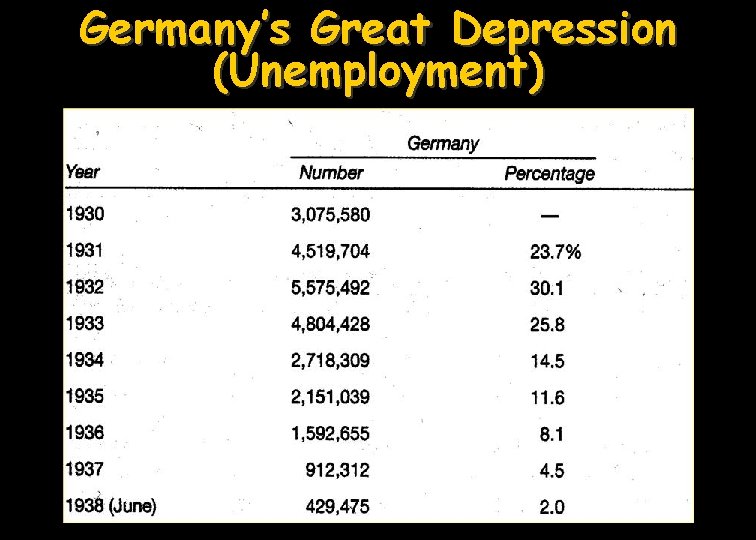
Germany’s Great Depression (Unemployment)
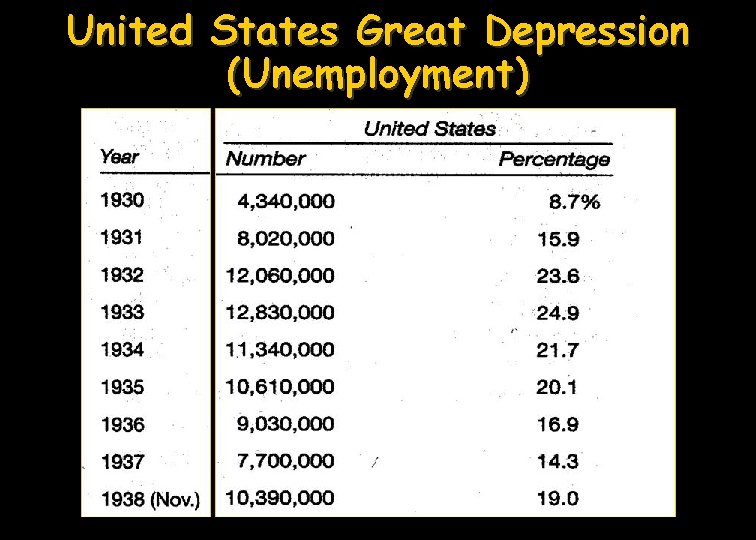
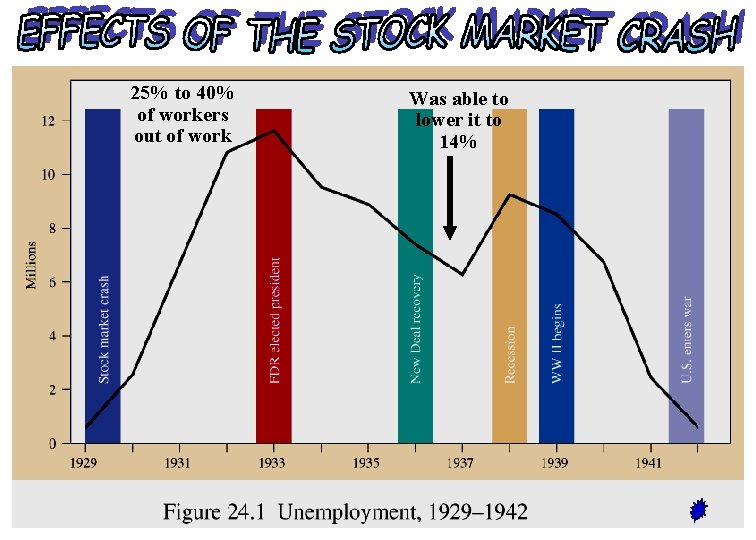
United States Great Depression (Unemployment)
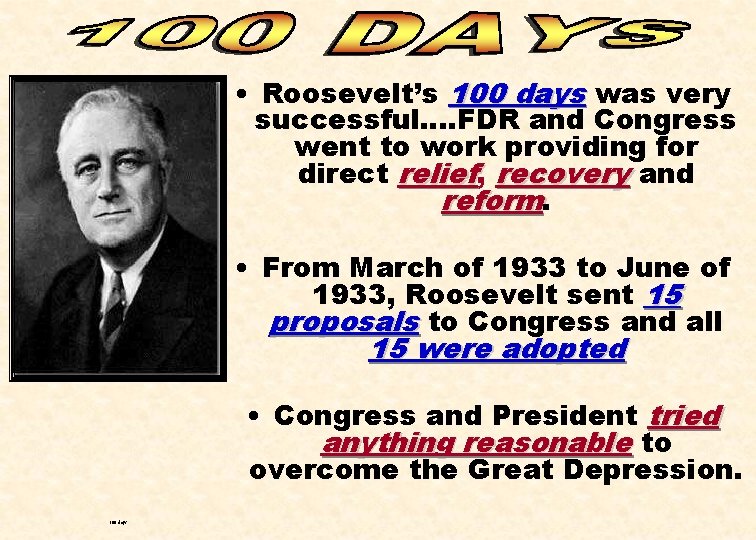
• Roosevelt’s 100 days was very successful…. FDR and Congress went to work providing for direct relief, recovery and reform. • From March of 1933 to June of 1933, Roosevelt sent 15 proposals to Congress and all 15 were adopted • Congress and President tried anything reasonable to overcome the Great Depression. 100 days
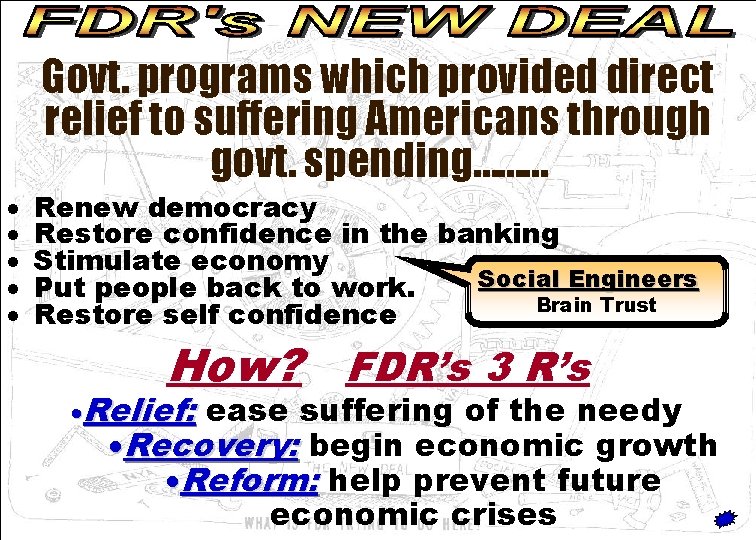
NEW DEAL CARTOON Govt. programs which provided direct relief to suffering Americans through govt. spending……… · · · Renew democracy Restore confidence in the banking Stimulate economy Social Engineers Put people back to work. Brain Trust Restore self confidence How? FDR’s 3 R’s ·Relief: ease suffering of the needy ·Recovery: begin economic growth ·Reform: help prevent future economic crises
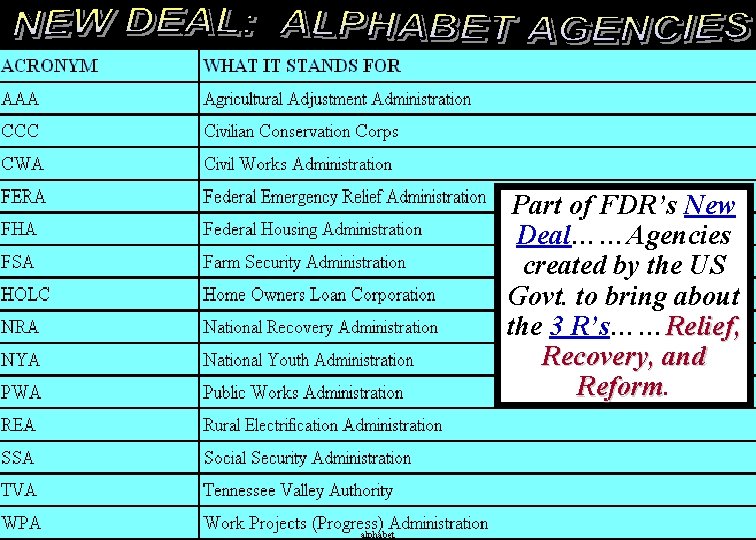
Part of FDR’s New Deal……Agencies created by the US Govt. to bring about the 3 R’s……Relief, Recovery, and Reform alphabet
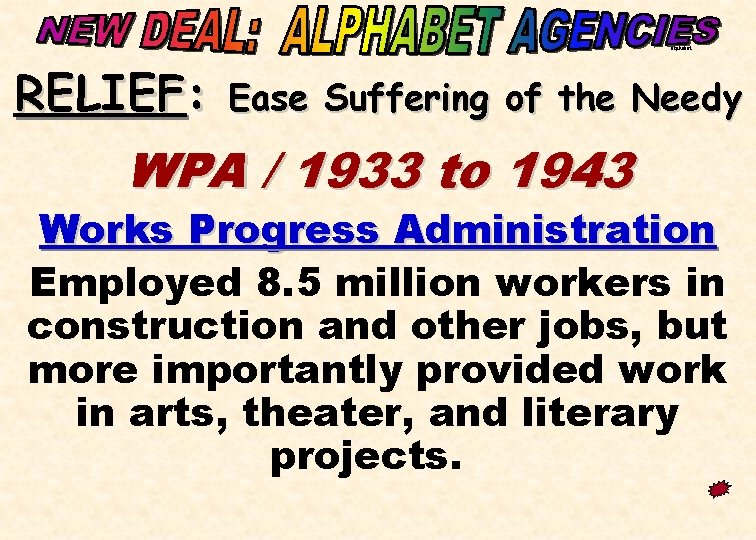
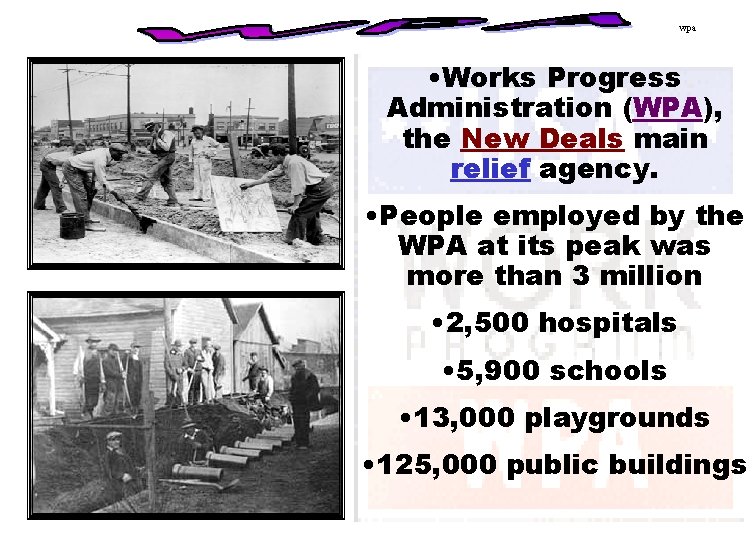
alphabet RELIEF: Ease Suffering of the Needy WPA / 1933 to 1943 Works Progress Administration Employed 8. 5 million workers in construction and other jobs, but more importantly provided work in arts, theater, and literary projects.
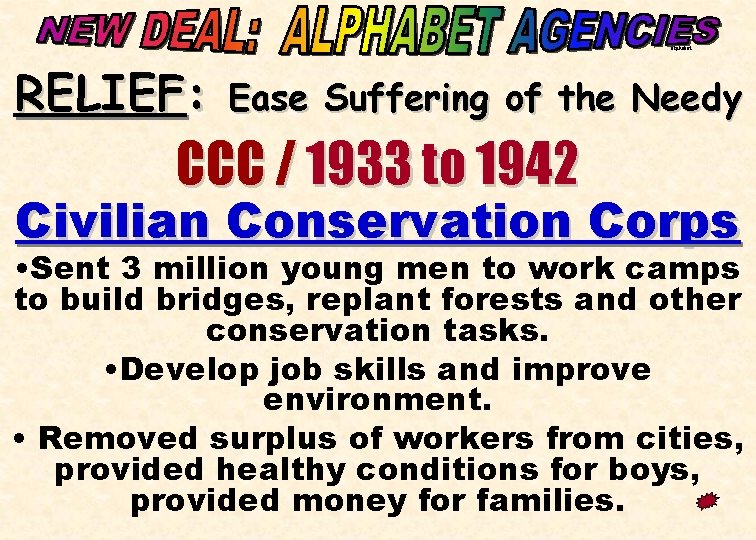
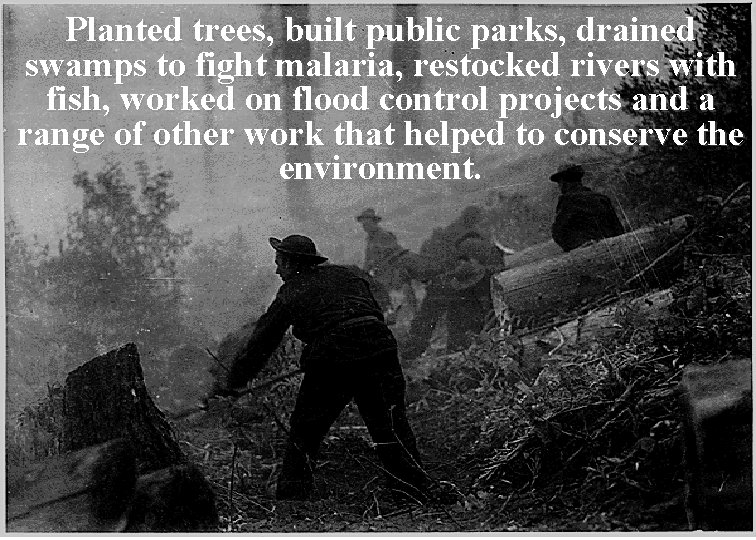
alphabet RELIEF: Ease Suffering of the Needy CCC / 1933 to 1942 Civilian Conservation Corps • Sent 3 million young men to work camps to build bridges, replant forests and other conservation tasks. • Develop job skills and improve environment. • Removed surplus of workers from cities, provided healthy conditions for boys, provided money for families.
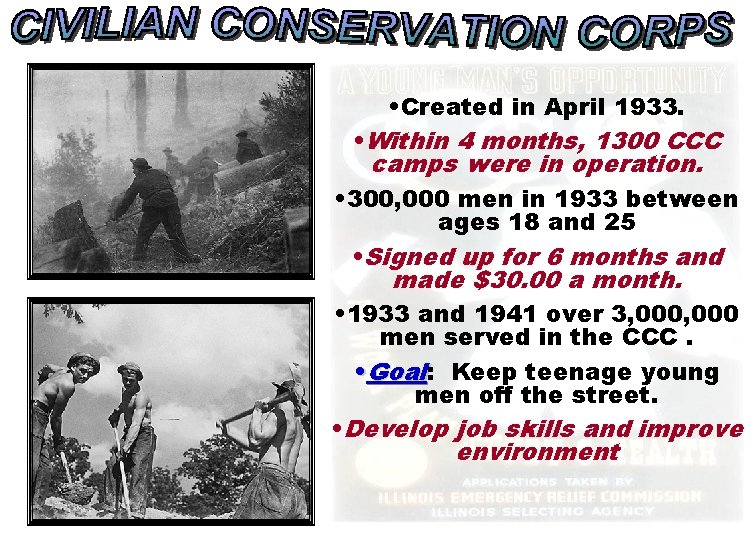
• Created in April 1933. • Within 4 months, 1300 CCC camps were in operation. • 300, 000 men in 1933 between ages 18 and 25 • Signed up for 6 months and made $30. 00 a month. • 1933 and 1941 over 3, 000 men served in the CCC. • Goal: Keep teenage young men off the street. • Develop job skills and improve environment
Planted trees, built public parks, drained swamps to fight malaria, restocked rivers with fish, worked on flood control projects and a range of other work that helped to conserve the environment.
wpa • Works Progress Administration (WPA), the New Deals main relief agency. • People employed by the WPA at its peak was more than 3 million • 2, 500 hospitals • 5, 900 schools • 13, 000 playgrounds • 125, 000 public buildings
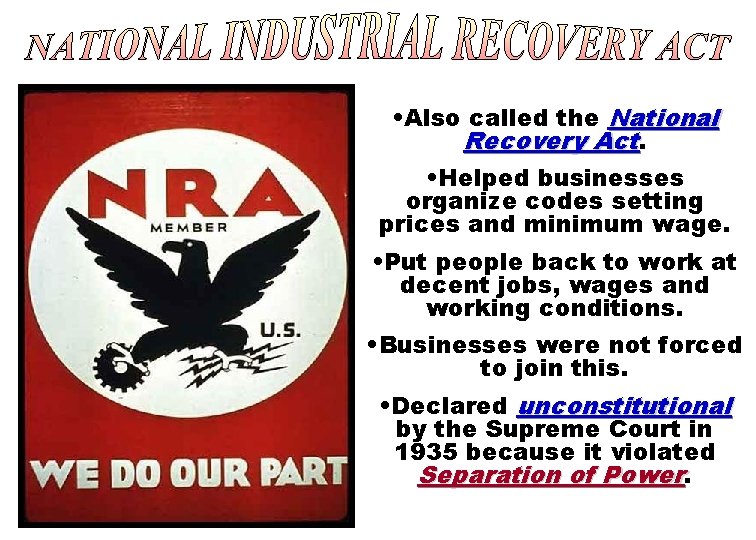
• Also called the National Recovery Act. • Helped businesses organize codes setting prices and minimum wage. • Put people back to work at decent jobs, wages and working conditions. • Businesses were not forced to join this. • Declared unconstitutional by the Supreme Court in 1935 because it violated Separation of Power.
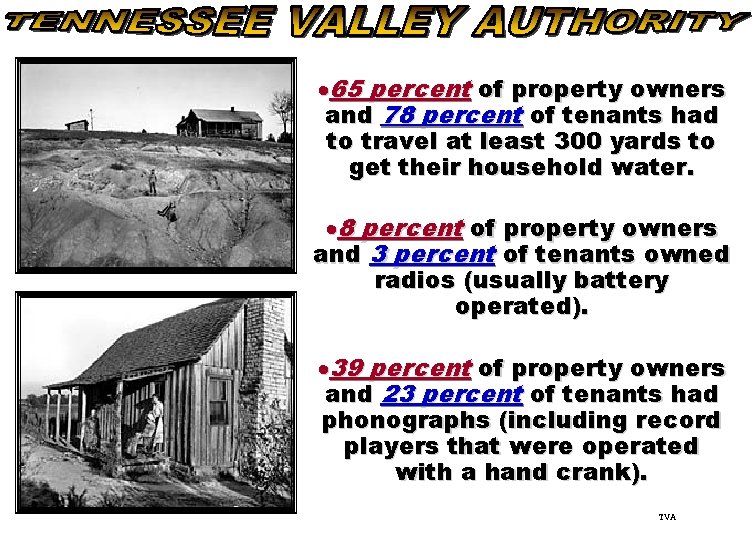
TVA • Develop a poor section of the Southeast U. S. • Stimulate the economy and produce cheap electricity. • Control floods, planting new forests. • Bring this section into the 20 th century. · 94 percent of property owners and 98 percent of tenants did not have electricity. · 30 percent of property owners and 41 percent of tenants had no toilet facilities whatsoever
· 65 percent of property owners and 78 percent of tenants had to travel at least 300 yards to get their household water. · 8 percent of property owners and 3 percent of tenants owned radios (usually battery operated). · 39 percent of property owners and 23 percent of tenants had phonographs (including record players that were operated with a hand crank). TVA
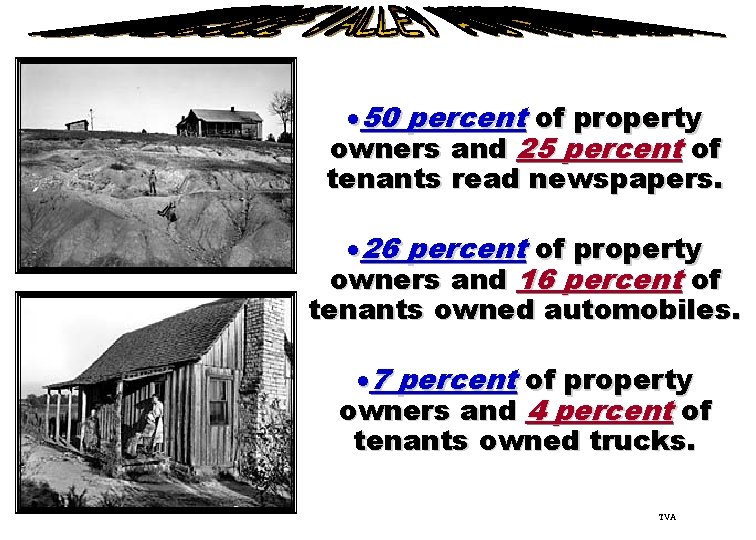
· 50 percent of property owners and 25 percent of tenants read newspapers. · 26 percent of property owners and 16 percent of tenants owned automobiles. · 7 percent of property owners and 4 percent of tenants owned trucks. TVA
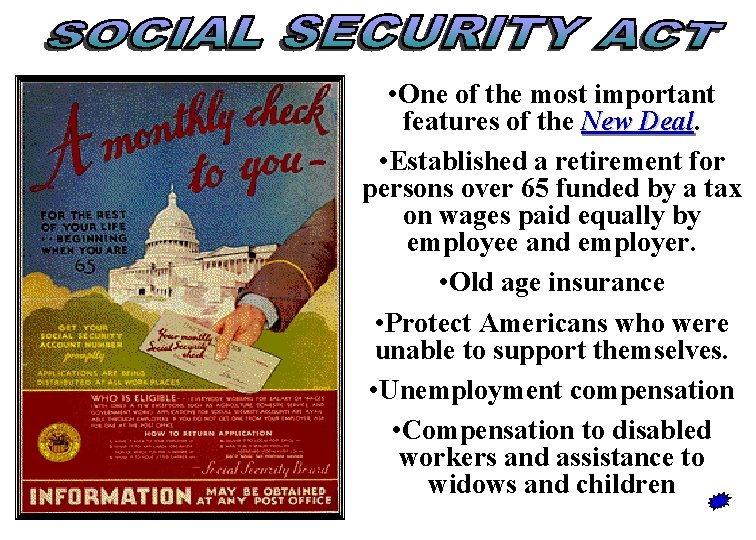
• One of the most important features of the New Deal • Established a retirement for persons over 65 funded by a tax on wages paid equally by employee and employer. • Old age insurance • Protect Americans who were unable to support themselves. • Unemployment compensation • Compensation to disabled workers and assistance to widows and children
RECOVERY: Begin Economic Growth NIRA / 1933 National Industrial Recovery Act • Called the National Recovery Act…. . • Created NRA to enforce codes of fair competition, minimum wages, and to permit collective bargaining of workers. alphabet
RECOVERY: Begin Economic Growth AAA / 1933 Agricultural Adjustment Act • Protected farmers from price drops and over production. . • US Govt. Paid farmers (subsidies) • not to grow crops, produce dairy products such as milk and butter or raise pigs and lambs. • Prevent another Dust Bowl, teach farmers methods of preventing soil erosion. alphabet
RECOVERY: Begin Economic Growth TVA / 1933 Tennessee Valley Authority • Federal government built a series of dams to prevent flooding and sold electricity. • First public competition with private power industries. alphabet
REFORM: Prevent Another Depression FDIC / 1933 Federal Deposit Insurance Corporation Created federally insured bank deposits ($2500 per investor at first) to prevent bank failures. alphabet
REFORM: Prevent Another Depression SEC / 1934 Securities and Exchange Commission Regulated stock market and restricted margin buying, and frauds. alphabet
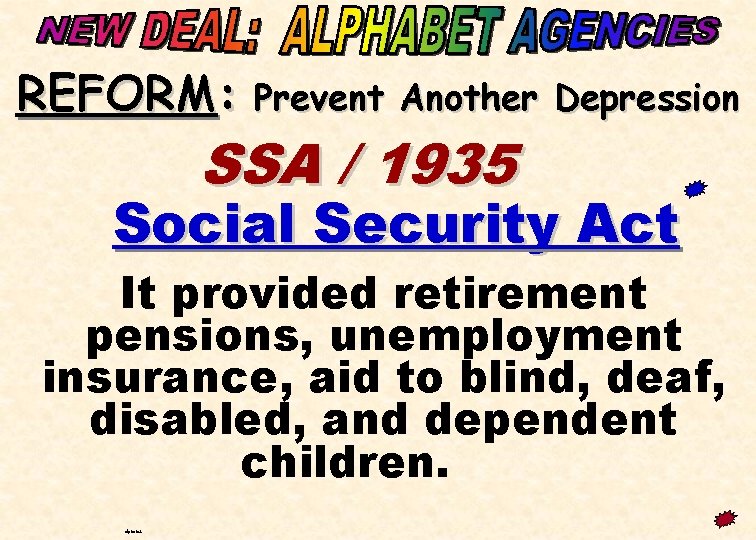
REFORM: Prevent Another Depression SSA / 1935 Social Security Act It provided retirement pensions, unemployment insurance, aid to blind, deaf, disabled, and dependent children. alphabet
25% to 40% of workers out of work Was able to lower it to 14%
Supreme Court Congressional opposition was beginning to grow; many of his laws, including the WPA, were taking a long time to get passed and met resistance. ►Schechter v. United States § The Schechter brothers had a poultry business in Brooklyn. § They had been convicted in 1933 of violating the NIRA’s Live Poultry Code; they had sold diseased chickens and violated the code’s wageand-hour provisions. § Known as the “sick chicken case. ” § The Supreme Court said that the Constitution did not allow the Congress to lend its powers to the executive; the NIRA was unconstitutional. § This suggested that the Supreme Court would make similar decisions in regards to the New Deal.
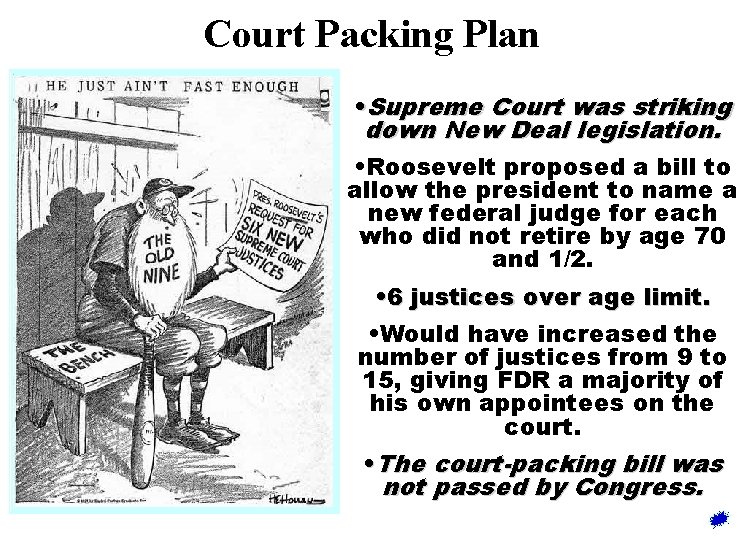
Court Packing Plan • Supreme Court was striking down New Deal legislation. • Roosevelt proposed a bill to allow the president to name a new federal judge for each who did not retire by age 70 and 1/2. • 6 justices over age limit. • Would have increased the number of justices from 9 to 15, giving FDR a majority of his own appointees on the court. • The court-packing bill was not passed by Congress.
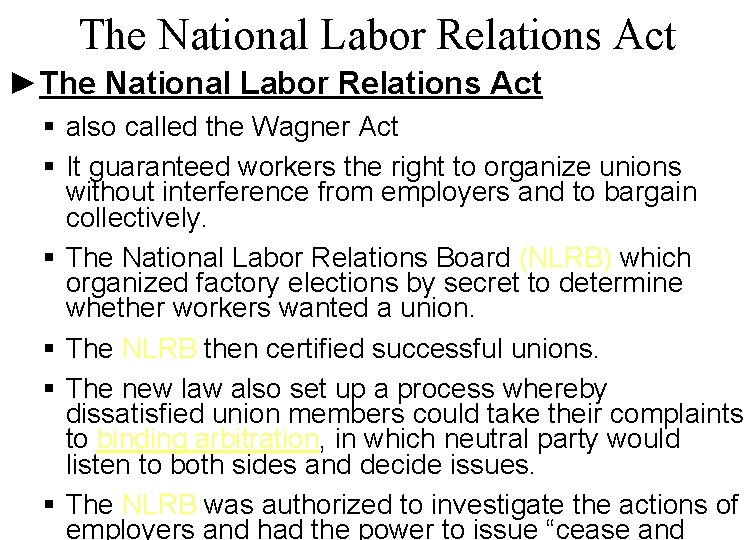
The National Labor Relations Act ►The National Labor Relations Act § also called the Wagner Act § It guaranteed workers the right to organize unions without interference from employers and to bargain collectively. § The National Labor Relations Board (NLRB) which organized factory elections by secret to determine whether workers wanted a union. § The NLRB then certified successful unions. § The new law also set up a process whereby dissatisfied union members could take their complaints to binding arbitration, in which neutral party would listen to both sides and decide issues. § The NLRB was authorized to investigate the actions of employers and had the power to issue “cease and
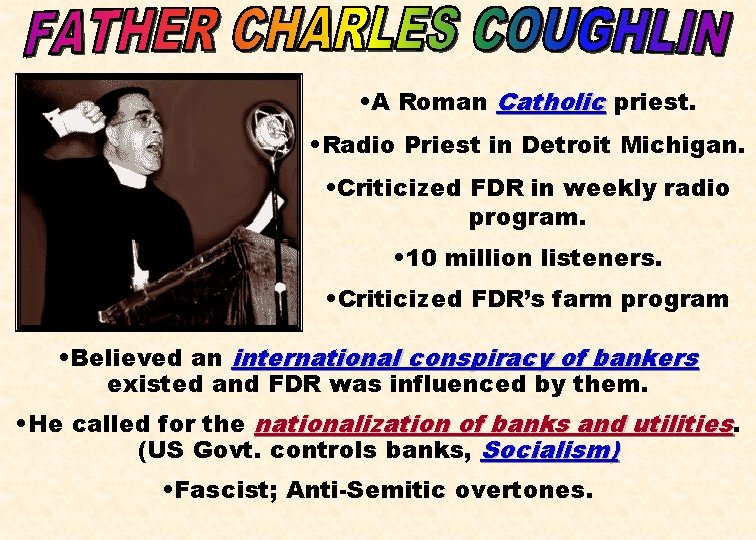
• A Roman Catholic priest. • Radio Priest in Detroit Michigan. • Criticized FDR in weekly radio program. • 10 million listeners. • Criticized FDR’s farm program • Believed an international conspiracy of bankers existed and FDR was influenced by them. • He called for the nationalization of banks and utilities. (US Govt. controls banks, Socialism) • Fascist; Anti-Semitic overtones.
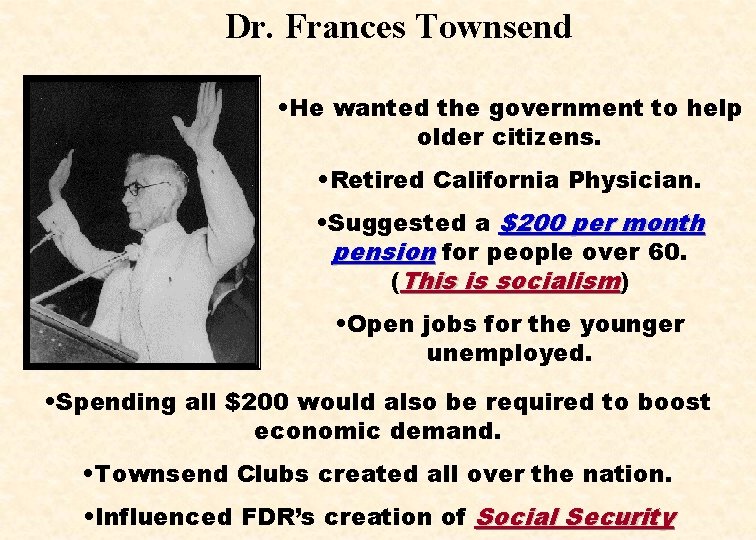
Dr. Frances Townsend • He wanted the government to help older citizens. • Retired California Physician. • Suggested a $200 per month pension for people over 60. (This is socialism) • Open jobs for the younger unemployed. • Spending all $200 would also be required to boost economic demand. • Townsend Clubs created all over the nation. • Influenced FDR’s creation of Social Security
• Economic system based on cooperation rather than competition • Believes in government ownership of business and capital • Government controls production and distribution of goods. • Opposite of laissez faire and capitalism
Criticisms of New Deal ·US government and President too powerful ·Violated laissez faire ·Supreme Court declared NIRA and AAA unconstitutional ·Critics: ·Father Charles Coughlin ·Dr. Francis Townsend ·Al Smith ·Huey Long ·Deficit spending: Govt. spends $$$ to stimulate the economy and help people even if it means US Govt. goes into debt. ·Welfare state----Created a population of Americans who relied on the US Govt. to live 100 days
Successes of New Deal AMERICANS IN 1939 WHO WANTED THE NEW DEAL TO CONTINUE WAS 55%…. . 37% REGARDED IT AS A BAD INFLUENCE AND WANTED A NEW PRESIDENT…………. . . ·Stimulated the economy ·Put people back to work…. ·Improved morale and self-confidence of the people ·US Govt’s. role changes and became directly involved in helping people ·WWII ended the Great Depression not FDR’s New Deal 100 days