
German War Guilt an overview of the historiographical

- Slides: 18
German War Guilt: an overview of the historiographical debate Aim: to examine the different interpretations of the causes of WWI
What is historiography? • What can influence historiographical opinion? • Why do schools of thought emerge? • In history, we usually talk about TRADITIONALIST REVISIONIST POST-REVISIONIST HISTORIANS • What does this mean?
The traditionalist position: What? - Germany to blame When? - In the aftermath of the war Why? - Article 231 of the Treaty of Versailles = war guilt clause. The victorious nations agreed that Germany caused the war
The first revisionist position: • When? - 1930 s – 1950 s • What? - Germany not solely responsible. All nations had ‘slithered over the brink’ (Lloyd George) Collective responsibility was now stressed. • Why? - All govs began to release more documents • Initially historians began to focus on the power of longer term factors such as nationalism, militarism, imperialism, alliances • Who? Fay, Lowes Dickinson
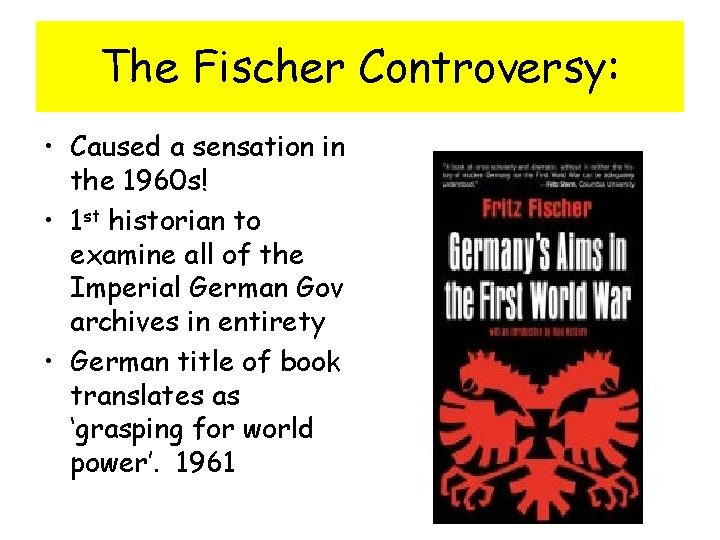
The Fischer Controversy: • Caused a sensation in the 1960 s! • 1 st historian to examine all of the Imperial German Gov archives in entirety • German title of book translates as ‘grasping for world power’. 1961
The Fischer Controversy: Three key conclusions: 1. Ger had gone to war to achieve European and worldwide domination 2. Ger hoped the blank cheque would result in war 3. The root causes of German expansionism were to be found in social, political and economic tensions in Germany
Fischer’s Evidence? • Based partly on a document found in German archives, written by Bethmann-Hollweg’s private secretary on 9 th Sept 1914 – See Sept programme worksheet map p 37 • Outlines the Chancellor’s plans for peace negotiations which he expected to take place soon. • Fischer concluded that these plans did not come from nowwhere they must have been already considered in July 1914.
Fischer’s Evidence? • Fischer argued that these plans were a continuation of policy made by politicians, industrialists and military leaders before the war • Fischer argued these plans had the support of the wider political nation not just the key figures. • These plans must have already been considered in July 1914.
Fischer Challenged? • Fischer’s analysis brought a storm of protest. • A number of historians attacked his thesis. • A group of historians argued that Germany’s reasons for going to war were defensive (a desire to break ‘encirclement’) rather than an aggressive desire for world power.
Fischer ‘War of Illusion’ 1969 • Argued there was a strong ‘will to war’ • The whole decision making German elite bore responsibility. • Fischer used diaries of Admiral Muller published in 1965 as evidence. • Fischer argued that the ‘War Council’ meeting of 1912 was evidence that the path to war had already been decided upon.
‘War Council’ Dec 1912 • Attended by top military staff including Molkte and Tirpitz. • Following points decided: • Kaiser promised to support Austria in her desire to stop Serbian expansionism. • Molkte believed war against Russia was inevitable. • See p 42.
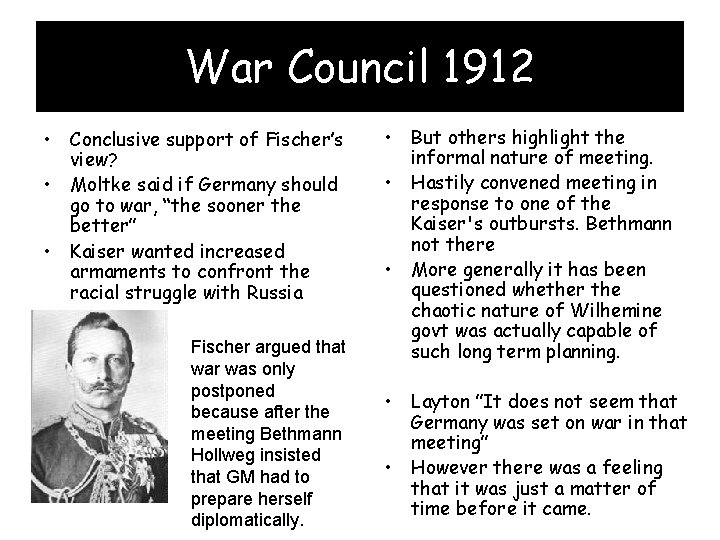
War Council 1912 • Conclusive support of Fischer’s view? • Moltke said if Germany should go to war, “the sooner the better” • Kaiser wanted increased armaments to confront the racial struggle with Russia Fischer argued that war was only postponed because after the meeting Bethmann Hollweg insisted that GM had to prepare herself diplomatically. • But others highlight the informal nature of meeting. • Hastily convened meeting in response to one of the Kaiser's outbursts. Bethmann not there • More generally it has been questioned whether the chaotic nature of Wilhemine govt was actually capable of such long term planning. • Layton ”It does not seem that Germany was set on war in that meeting” • However there was a feeling that it was just a matter of time before it came.
‘War Council’ Dec 1912 • Fischer’s interpretation of the War Council meeting has caused considerable debate amongst historians. • See sources p 42 -43
‘Primat der Innenpolitik – Dominance of internal policy. • Fischer argued that German foreign policy was affected by Germany’s internal pressures (e. g. industrialisation, middle class demands for more political power; growth of the SPD) • Fischer argued these tensions were diverted outwards, into foreign and diplomatic policy in order to preserve the status quo.
Other views: • What? Although many historians will now allocate some (if not most) of the blame to Germany, as archives have opened up there is evidence to suggest that there was ‘will to war’ in other countries • Who? Herwig, Roberts, Henig • Historians have considered the roles of other countries e. g. Aus Hun
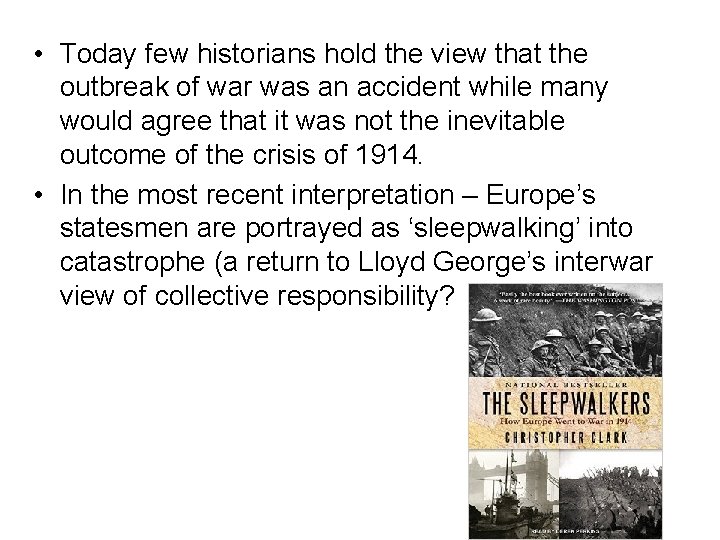
• Today few historians hold the view that the outbreak of war was an accident while many would agree that it was not the inevitable outcome of the crisis of 1914. • In the most recent interpretation – Europe’s statesmen are portrayed as ‘sleepwalking’ into catastrophe (a return to Lloyd George’s interwar view of collective responsibility?
Summary • Most Historians accept the main argument of Fischer, i. e. that Germany bears some responsibility. However, the reasons why German leaders pushed for war are still a source of controversy. • While Fischer argued that they launched a war of aggression and conquest, many have now suggested that it was more of a defensive war to break encirclement.