
German Romanticism LIT 181 Hour 12 Enlightenment Logic

- Slides: 56
German Romanticism LIT 181 Hour 12
Enlightenment • Logic, reason had dominated for the past eight decades. • Words like “enthusiasm, ” “imagination, ” “fantasy, ” and others had very different definitions, or were relegated to the realm of the wack-o, bizarre, strange, and not-to-be imitated.
German Classicism • Goethe and Schiller, Wieland Herder – in Weimar • Very few artists participated • A new artistic path for young blood was needed! • Europe – intellectually stifling for many.
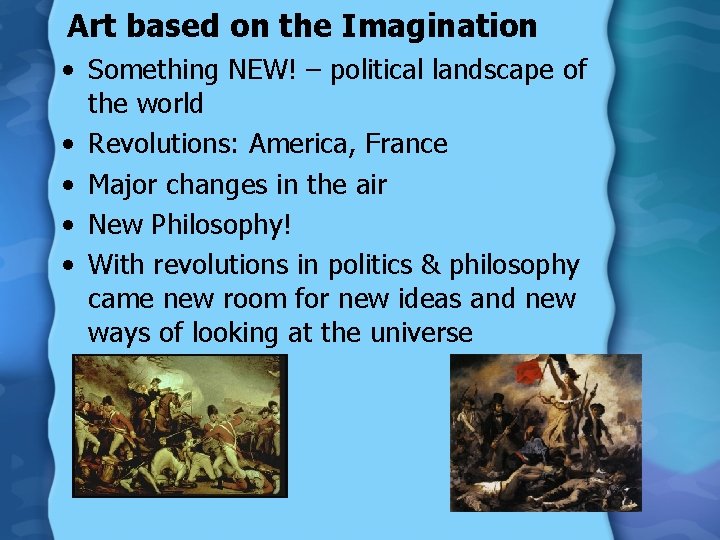
Art based on the Imagination • Something NEW! – political landscape of the world • Revolutions: America, France • Major changes in the air • New Philosophy! • With revolutions in politics & philosophy came new room for new ideas and new ways of looking at the universe
The Word “Romanticism” • Has nothing to do with being “romantic, ” except that a favorite Romantic theme is love • Refers back to medieval 'romance', a narrative or mythic tale about an individual. • Emphasizes the power of the imagination, nature, and the value of emotional and subjective ways of experiencing the world.
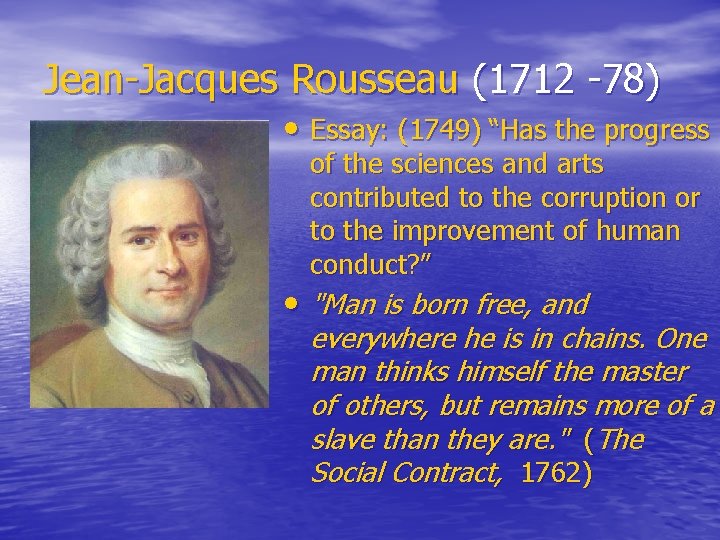
Jean-Jacques Rousseau (1712 -78) • Essay: (1749) “Has the progress of the sciences and arts contributed to the corruption or to the improvement of human conduct? ” • "Man is born free, and everywhere he is in chains. One man thinks himself the master of others, but remains more of a slave than they are. " (The Social Contract, 1762)
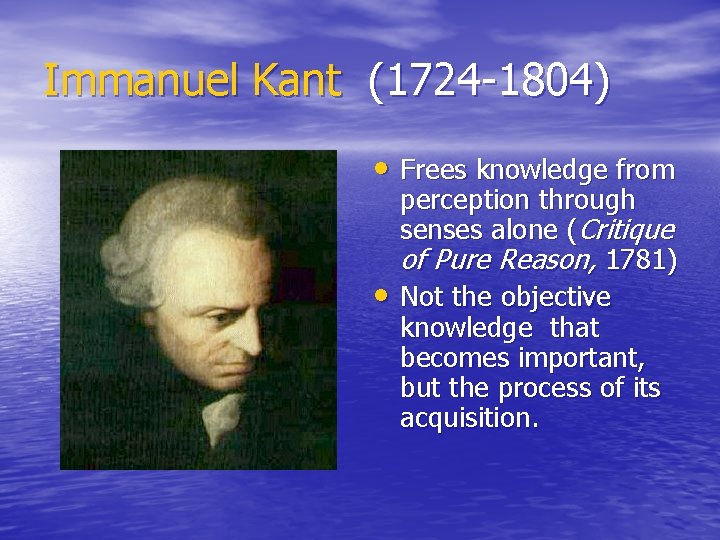
Immanuel Kant (1724 -1804) • Frees knowledge from • perception through senses alone (Critique of Pure Reason, 1781) Not the objective knowledge that becomes important, but the process of its acquisition.
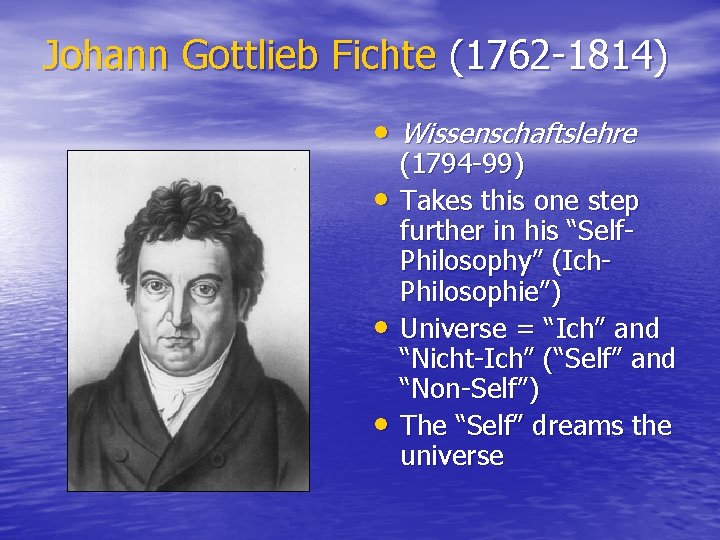
Johann Gottlieb Fichte (1762 -1814) • Wissenschaftslehre • • • (1794 -99) Takes this one step further in his “Self. Philosophy” (Ich. Philosophie”) Universe = “Ich” and “Nicht-Ich” (“Self” and “Non-Self”) The “Self” dreams the universe
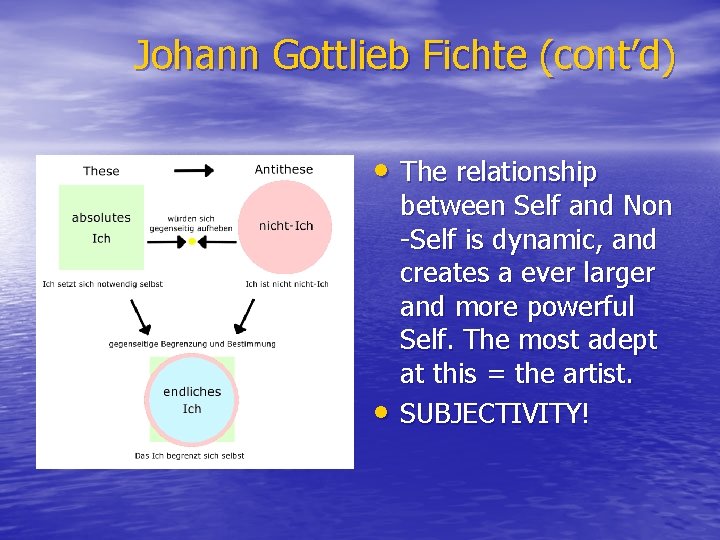
Johann Gottlieb Fichte (cont’d) • The relationship • between Self and Non -Self is dynamic, and creates a ever larger and more powerful Self. The most adept at this = the artist. SUBJECTIVITY!
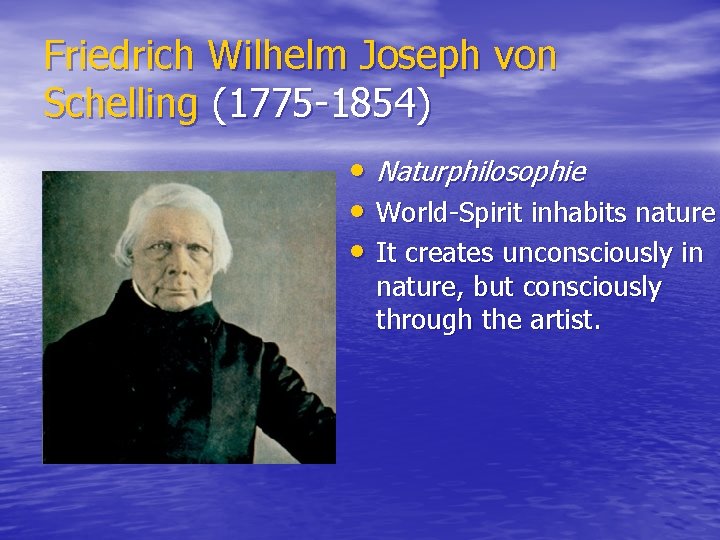
Friedrich Wilhelm Joseph von Schelling (1775 -1854) • Naturphilosophie • World-Spirit inhabits nature • It creates unconsciously in nature, but consciously through the artist.
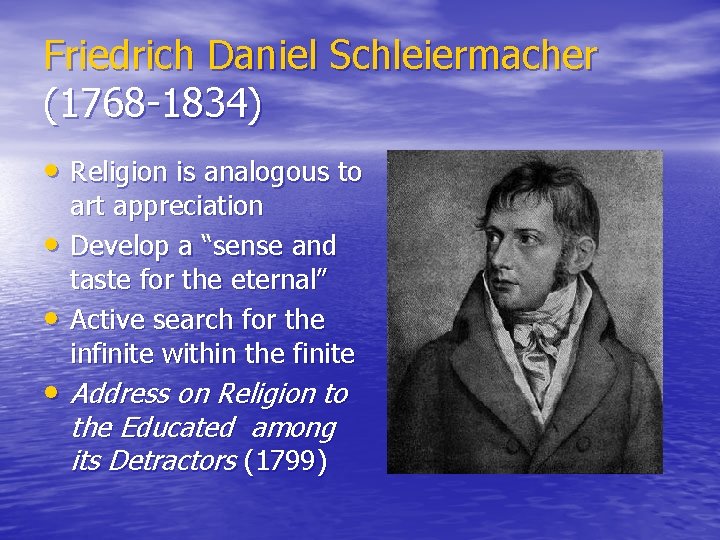
Friedrich Daniel Schleiermacher (1768 -1834) • Religion is analogous to • • art appreciation Develop a “sense and taste for the eternal” Active search for the infinite within the finite • Address on Religion to the Educated among its Detractors (1799)
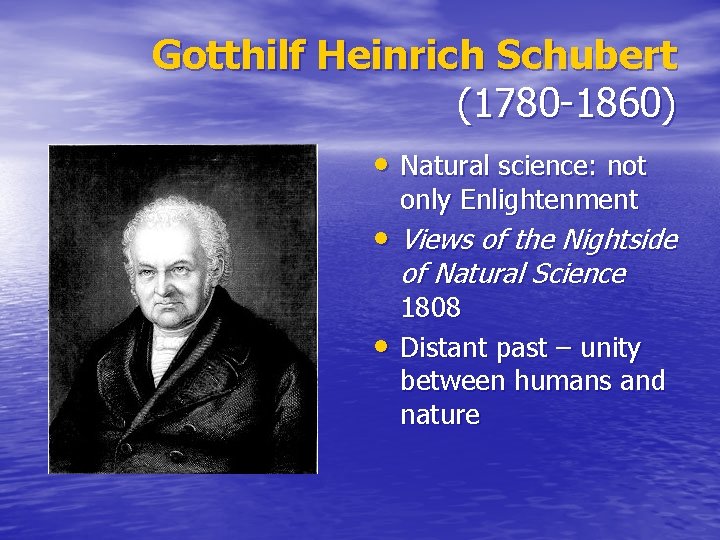
Gotthilf Heinrich Schubert (1780 -1860) • Natural science: not only Enlightenment • Views of the Nightside of Natural Science • 1808 Distant past – unity between humans and nature
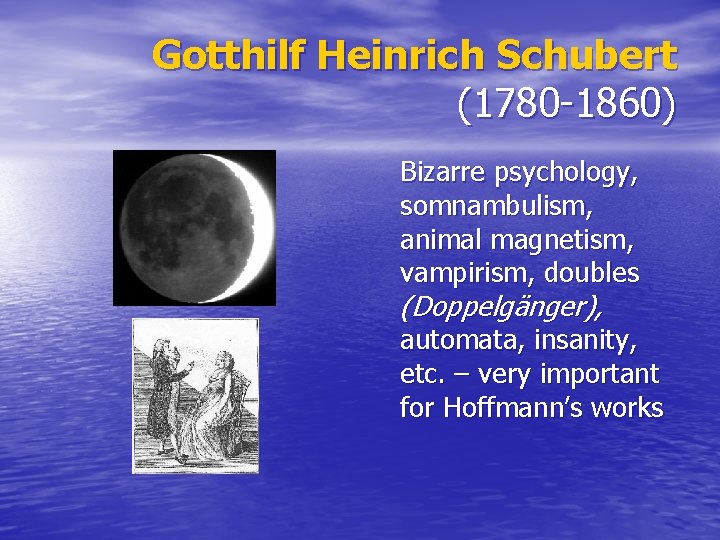
Gotthilf Heinrich Schubert (1780 -1860) Bizarre psychology, somnambulism, animal magnetism, vampirism, doubles (Doppelgänger), automata, insanity, etc. – very important for Hoffmann’s works
Romanticism: a universal movement • • Great Britain Germany Russia France Spain Latin America USA -not always at the same time, but from the early 19 th Century through the present era.
Romantics of Great Britain • Begin in 1797 • Wordsworth and Coleridge: Preface to Lyrical Ballads – Emphasis on “natural” rather than “cosmopolitan” experience – Rethinking the language of poetry: more accessible – What is a poet: a genius, someone extraordinary • Ballad: genre of lyric that combines all three generic forms: – Lyric (operates on mood, atmosphere) – Epic (narrator tells a story) – Dramatic (conversation)
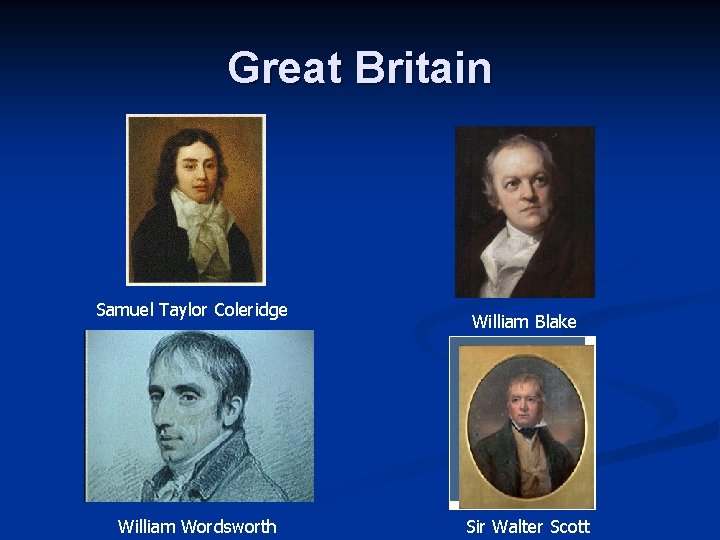
Great Britain Samuel Taylor Coleridge William Wordsworth William Blake Sir Walter Scott
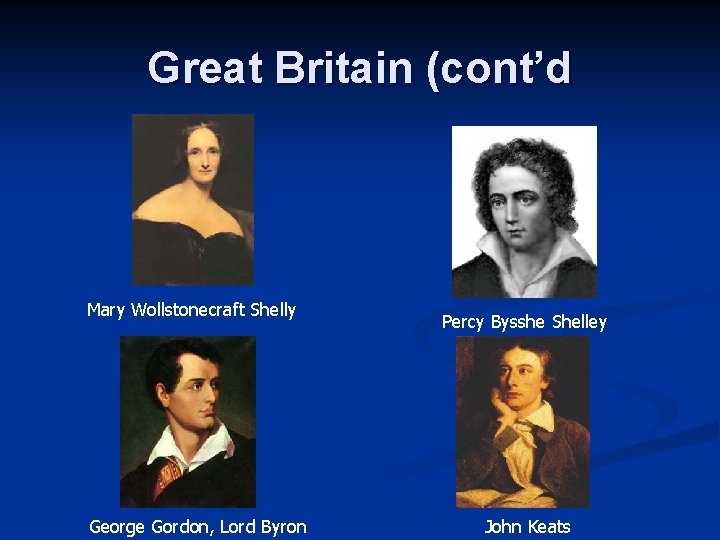
Great Britain (cont’d Mary Wollstonecraft Shelly George Gordon, Lord Byron Percy Bysshe Shelley John Keats
Romanticism in France • Land of revolution: Romanticism is political and social • Deep debt to Rousseau: nature • Hero = a “natural” person • Challenges social norms, gender roles (George Sand) • Fascination with the new democracy in the USA – heroes travel to US • Alexis de Tocqueville’s Democracy in America
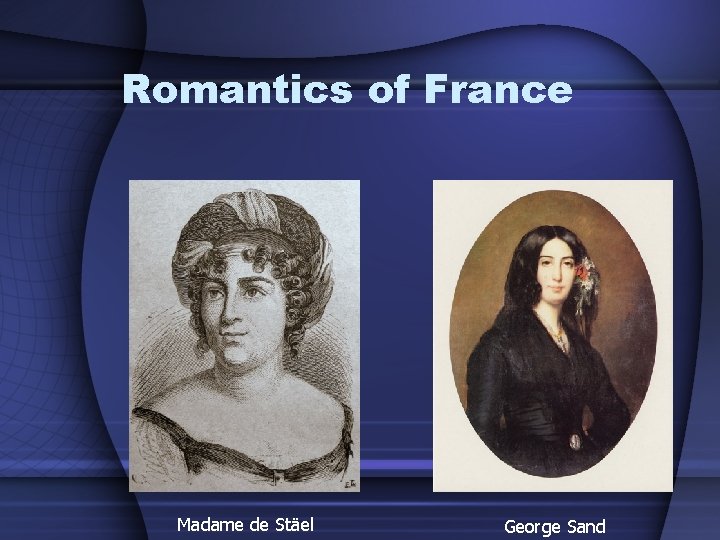
Romantics of France Madame de Stäel George Sand
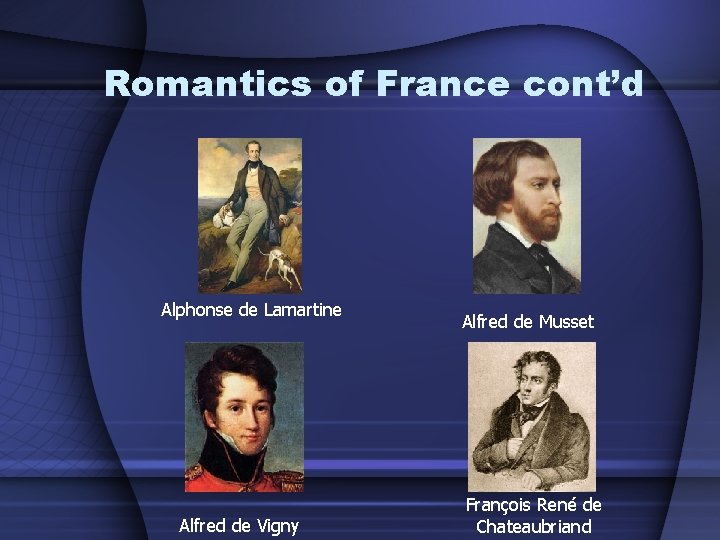
Romantics of France cont’d Alphonse de Lamartine Alfred de Vigny Alfred de Musset François René de Chateaubriand
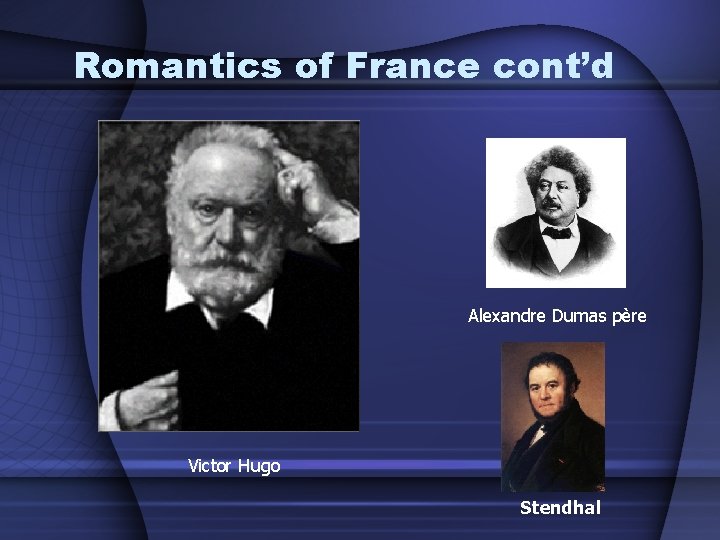
Romantics of France cont’d Alexandre Dumas père Victor Hugo Stendhal
Romanticism in the USA • Influence of Rousseau – nature! • Community: – transcendentalists of New England – Brook Farm • Fascination with the land, and those who live off the land • Nationalism • Emancipation of women, slaves
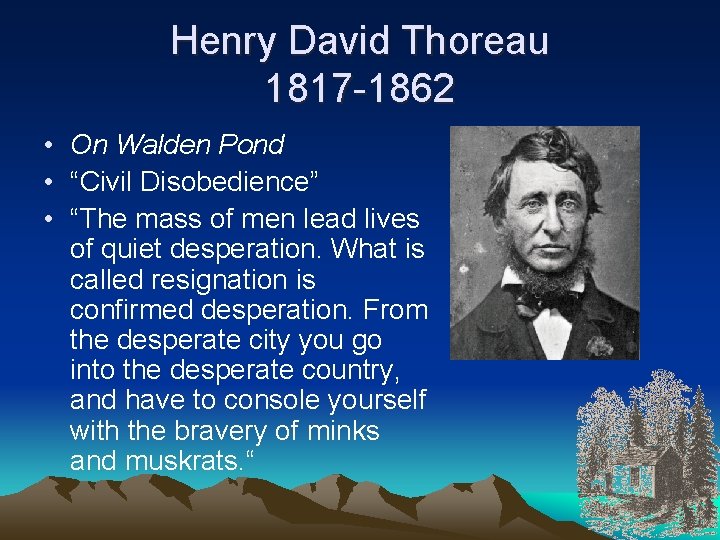
Henry David Thoreau 1817 -1862 • On Walden Pond • “Civil Disobedience” • “The mass of men lead lives of quiet desperation. What is called resignation is confirmed desperation. From the desperate city you go into the desperate country, and have to console yourself with the bravery of minks and muskrats. “
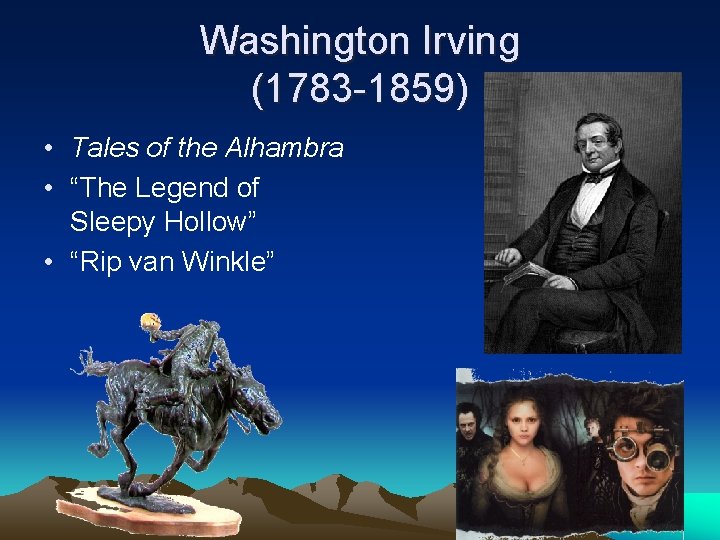
Washington Irving (1783 -1859) • Tales of the Alhambra • “The Legend of Sleepy Hollow” • “Rip van Winkle”
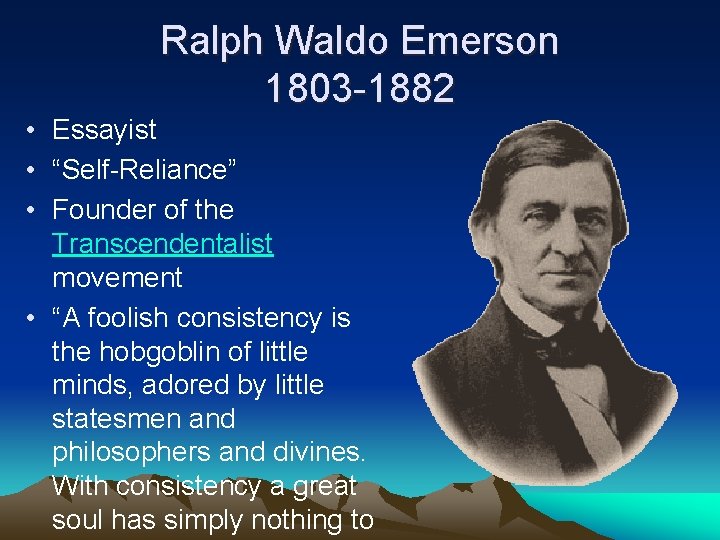
Ralph Waldo Emerson 1803 -1882 • Essayist • “Self-Reliance” • Founder of the Transcendentalist movement • “A foolish consistency is the hobgoblin of little minds, adored by little statesmen and philosophers and divines. With consistency a great soul has simply nothing to
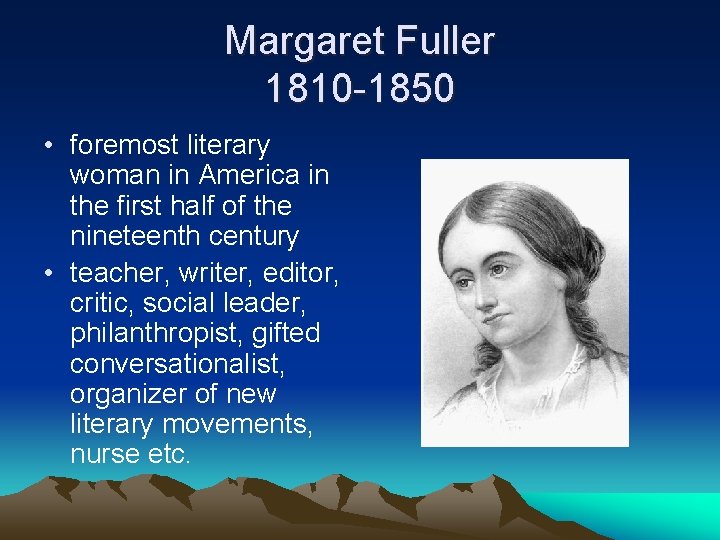
Margaret Fuller 1810 -1850 • foremost literary woman in America in the first half of the nineteenth century • teacher, writer, editor, critic, social leader, philanthropist, gifted conversationalist, organizer of new literary movements, nurse etc.
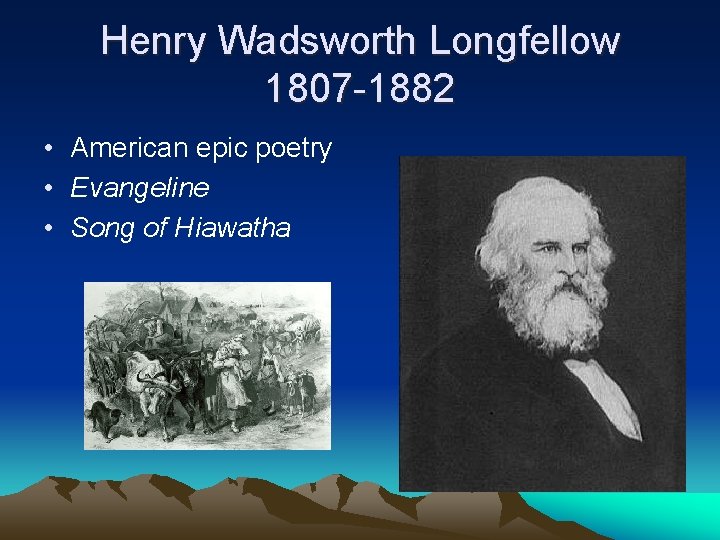
Henry Wadsworth Longfellow 1807 -1882 • American epic poetry • Evangeline • Song of Hiawatha
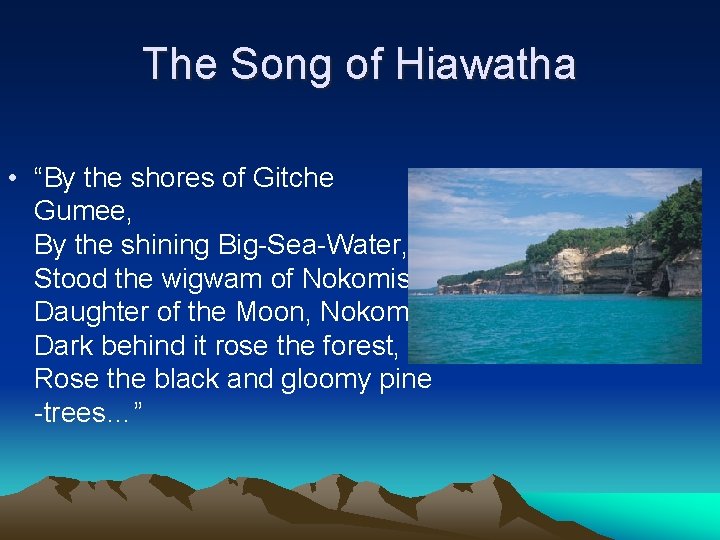
The Song of Hiawatha • “By the shores of Gitche Gumee, By the shining Big-Sea-Water, Stood the wigwam of Nokomis, Daughter of the Moon, Nokomis. Dark behind it rose the forest, Rose the black and gloomy pine -trees…”
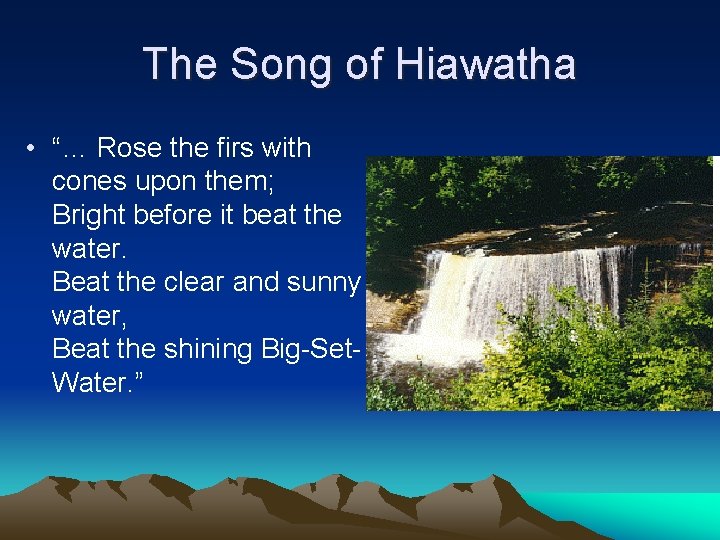
The Song of Hiawatha • “… Rose the firs with cones upon them; Bright before it beat the water. Beat the clear and sunny water, Beat the shining Big-Set. Water. ”
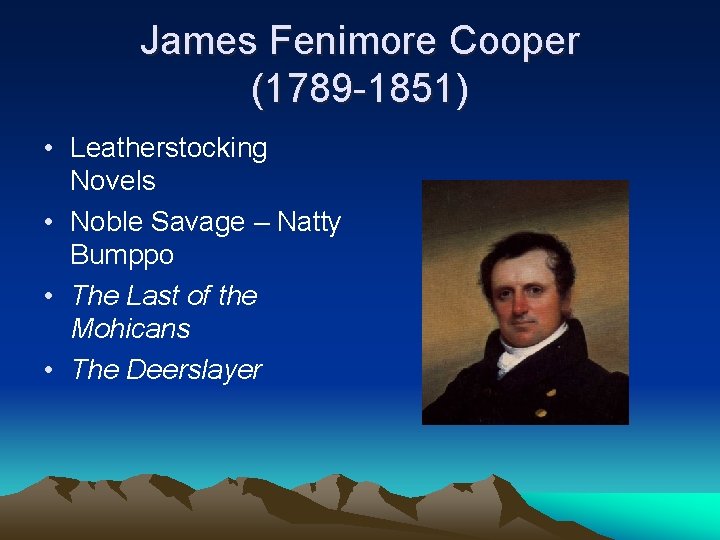
James Fenimore Cooper (1789 -1851) • Leatherstocking Novels • Noble Savage – Natty Bumppo • The Last of the Mohicans • The Deerslayer
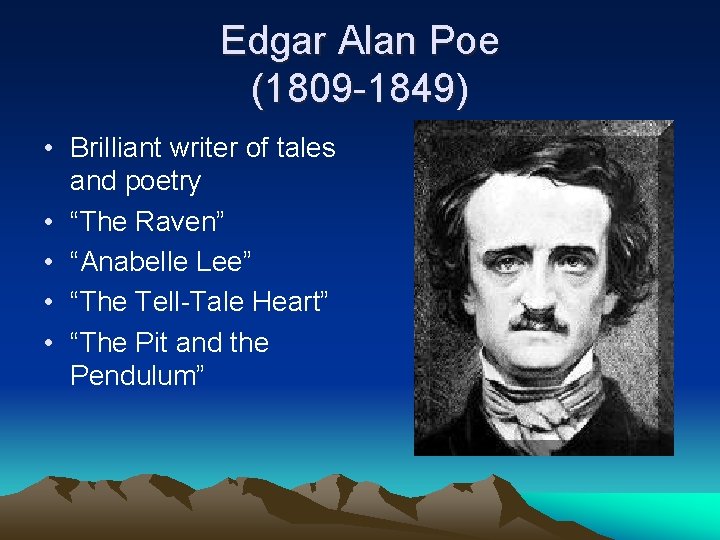
Edgar Alan Poe (1809 -1849) • Brilliant writer of tales and poetry • “The Raven” • “Anabelle Lee” • “The Tell-Tale Heart” • “The Pit and the Pendulum”
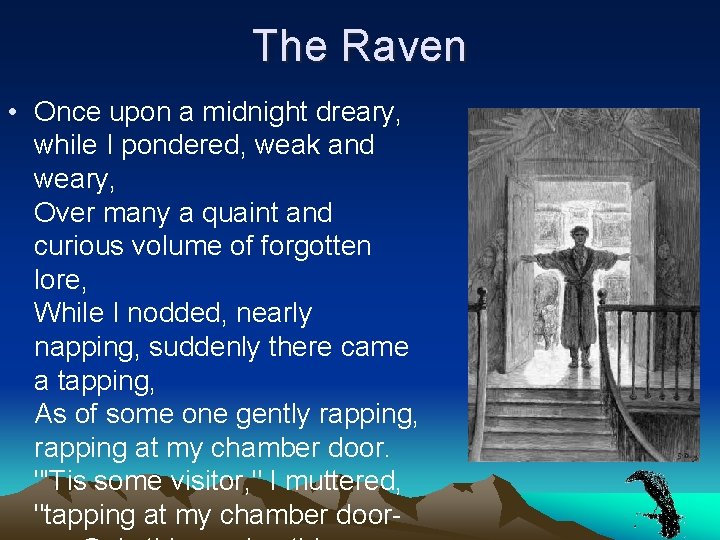
The Raven • Once upon a midnight dreary, while I pondered, weak and weary, Over many a quaint and curious volume of forgotten lore, While I nodded, nearly napping, suddenly there came a tapping, As of some one gently rapping, rapping at my chamber door. "'Tis some visitor, " I muttered, "tapping at my chamber door-
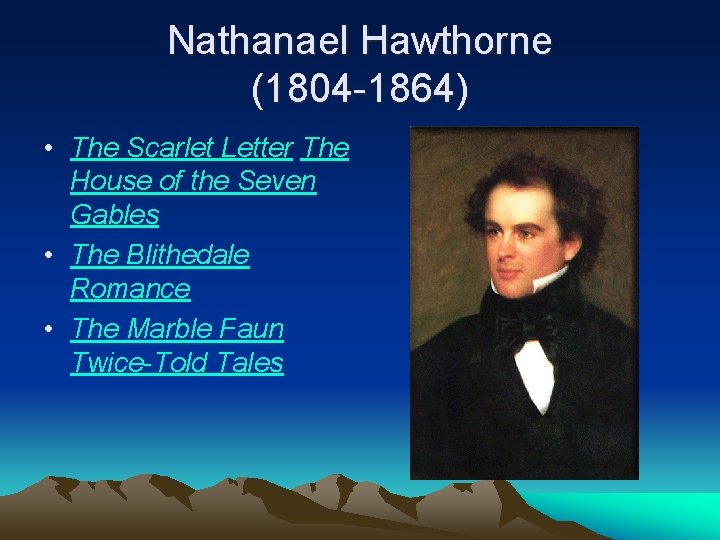
Nathanael Hawthorne (1804 -1864) • The Scarlet Letter The House of the Seven Gables • The Blithedale Romance • The Marble Faun Twice-Told Tales
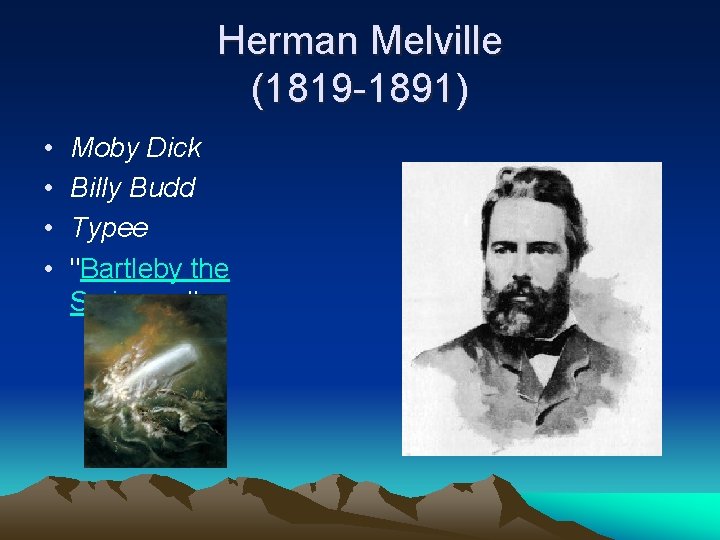
Herman Melville (1819 -1891) • • Moby Dick Billy Budd Typee "Bartleby the Scrivener"
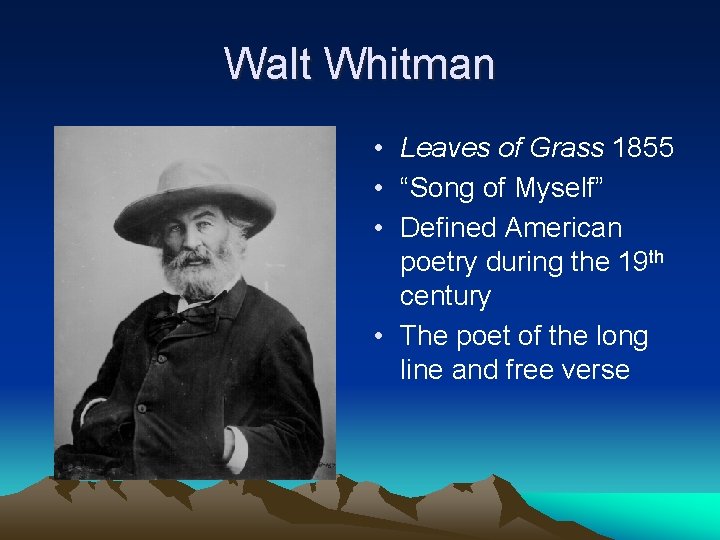
Walt Whitman • Leaves of Grass 1855 • “Song of Myself” • Defined American poetry during the 19 th century • The poet of the long line and free verse
Song of Myself 1859 • “The spotted hawk swoops by and accuses me, he complains of my gab and my loitering. I too am not a bit tamed, I too am untranslatable, I sound my barbaric yawp over the roofs of the world…
Song of Myself 1859 • “…I bequeath myself to the dirt to grow from the grass I love, If you want me again look for me under your boot-soles. You will hardly know who I am or what I mean, But I shall be good health to you nevertheless, And filter and fibre your blood. Failing to fetch me at first keep encouraged, Missing me one place search another, I stop somewhere waiting for you.
Romanticism in Germany • Began early, in the same year as British Romanticism = 1797 • Differs from others – less emphasis on nature, included the urban landscape – less Rousseau • Less politically progressive – most German Romantics were noblilty • Social – groups gathered and discussed • Came in two stages – Stage 1: very philosophical – Stage 2: more entertaining
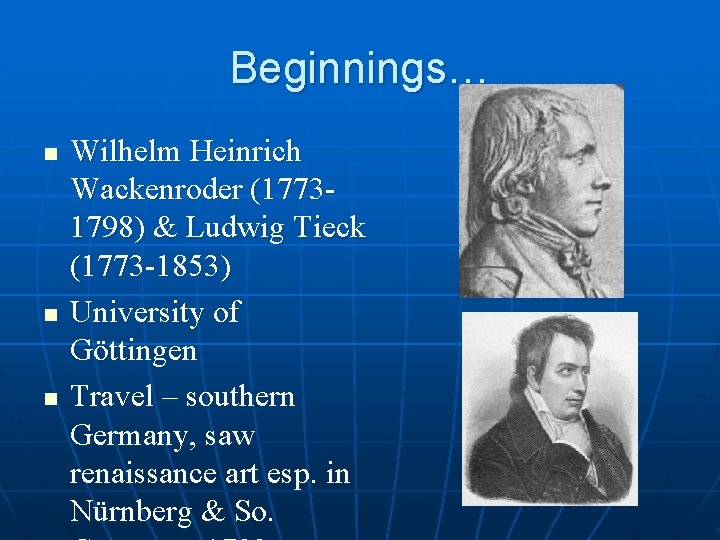
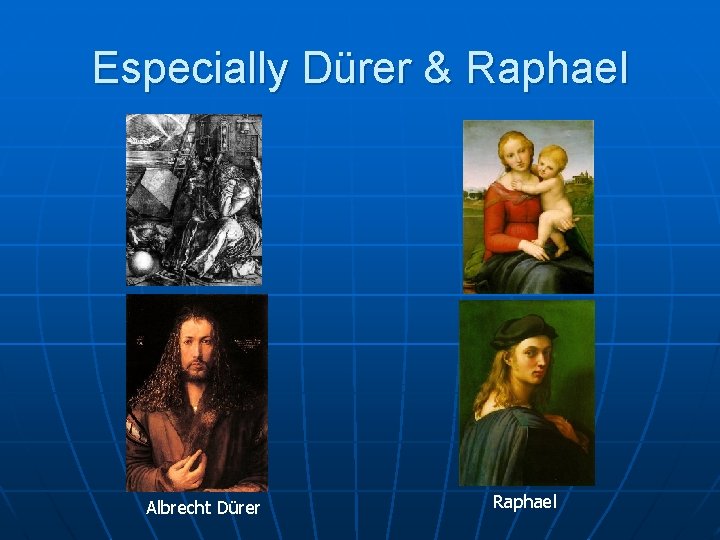
Beginnings… n n n Wilhelm Heinrich Wackenroder (17731798) & Ludwig Tieck (1773 -1853) University of Göttingen Travel – southern Germany, saw renaissance art esp. in Nürnberg & So.
Especially Dürer & Raphael Albrecht Dürer Raphael
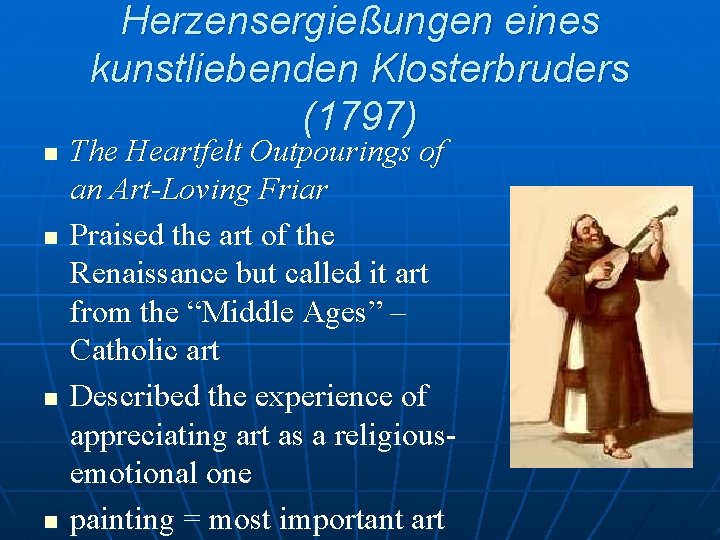
Herzensergießungen eines kunstliebenden Klosterbruders (1797) n n The Heartfelt Outpourings of an Art-Loving Friar Praised the art of the Renaissance but called it art from the “Middle Ages” – Catholic art Described the experience of appreciating art as a religiousemotional one painting = most important art
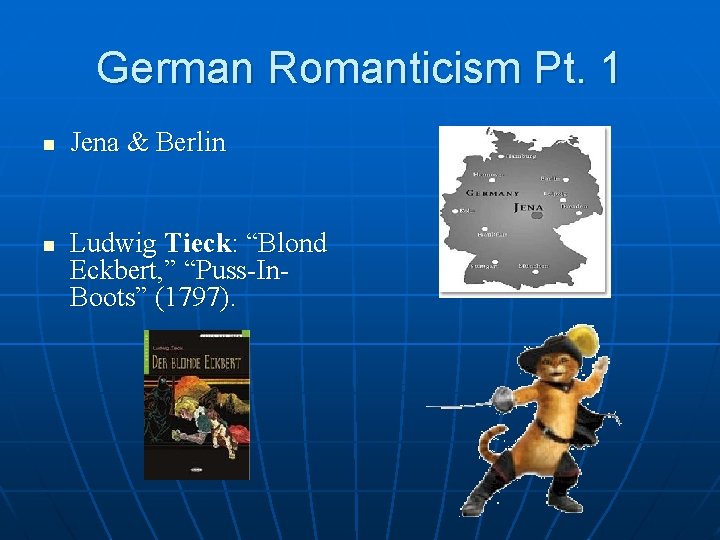
German Romanticism Pt. 1 n n Jena & Berlin Ludwig Tieck: “Blond Eckbert, ” “Puss-In. Boots” (1797).
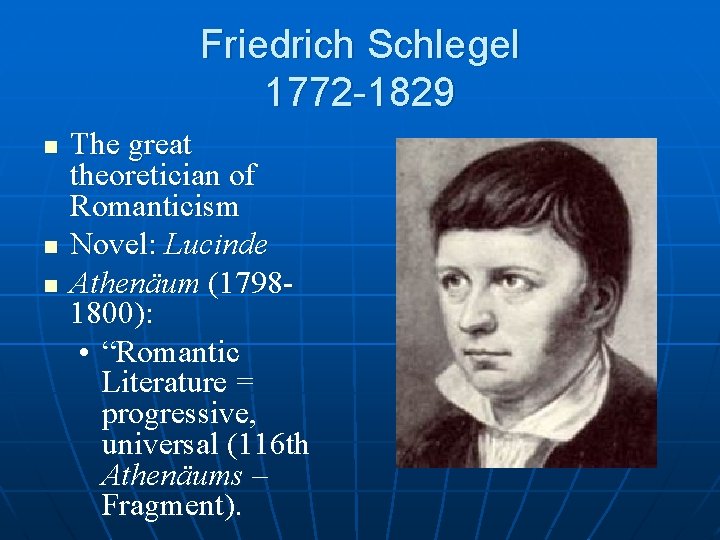
Friedrich Schlegel 1772 -1829 n n n The great theoretician of Romanticism Novel: Lucinde Athenäum (17981800): • “Romantic Literature = progressive, universal (116 th Athenäums – Fragment).
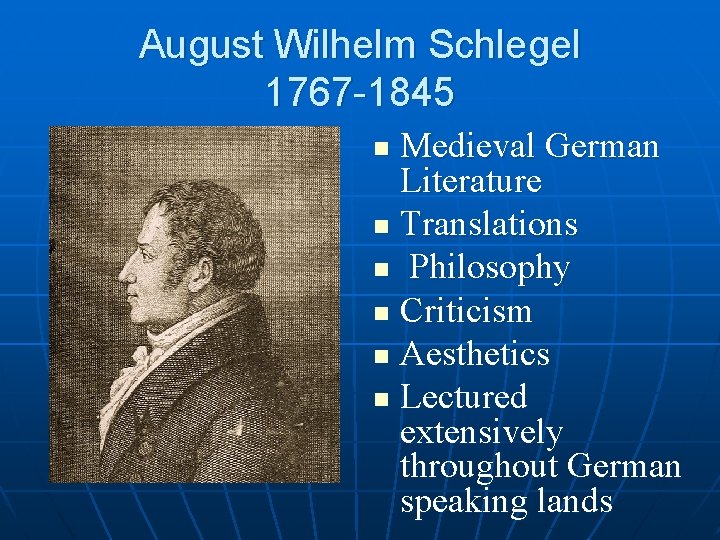
August Wilhelm Schlegel 1767 -1845 Medieval German Literature n Translations n Philosophy n Criticism n Aesthetics n Lectured extensively throughout German speaking lands n
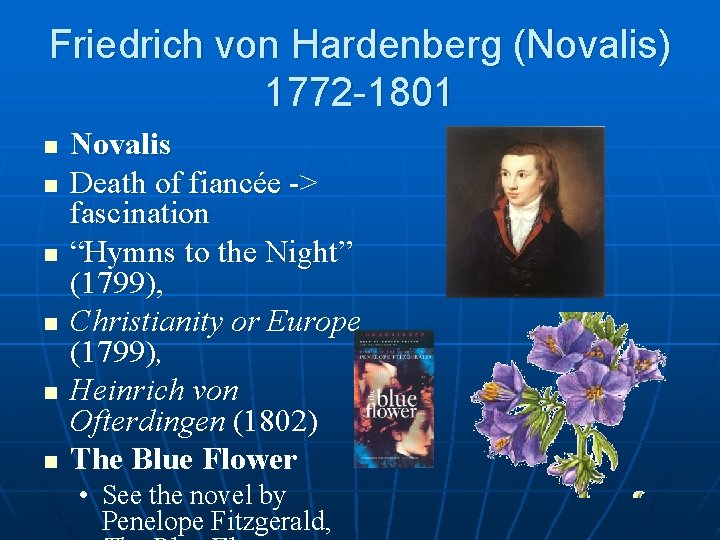
Friedrich von Hardenberg (Novalis) 1772 -1801 n n n Novalis Death of fiancée -> fascination “Hymns to the Night” (1799), Christianity or Europe (1799), Heinrich von Ofterdingen (1802) The Blue Flower • See the novel by Penelope Fitzgerald,
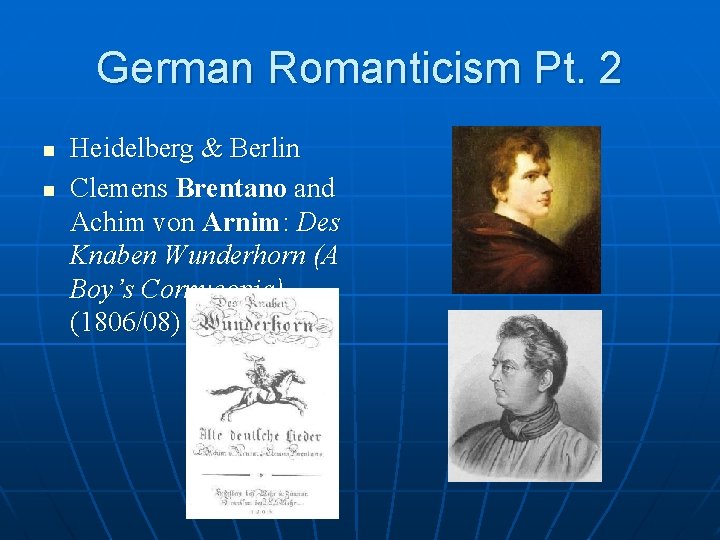
German Romanticism Pt. 2 n n Heidelberg & Berlin Clemens Brentano and Achim von Arnim: Des Knaben Wunderhorn (A Boy’s Cornucopia) (1806/08)
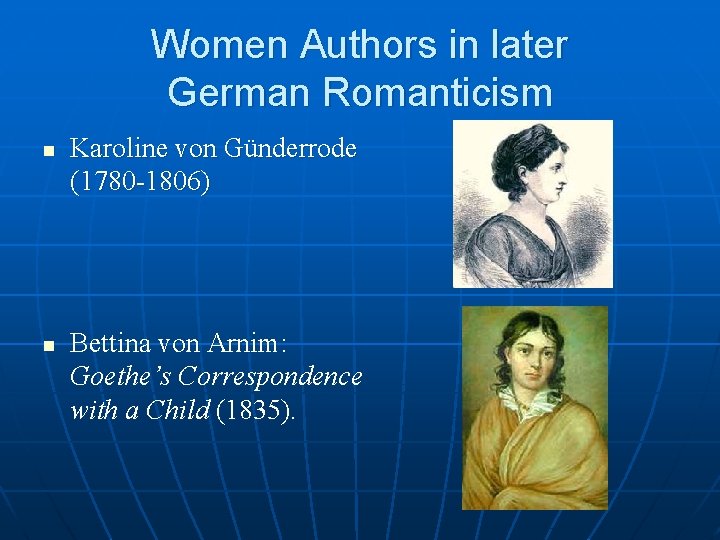
Women Authors in later German Romanticism n n Karoline von Günderrode (1780 -1806) Bettina von Arnim: Goethe’s Correspondence with a Child (1835).
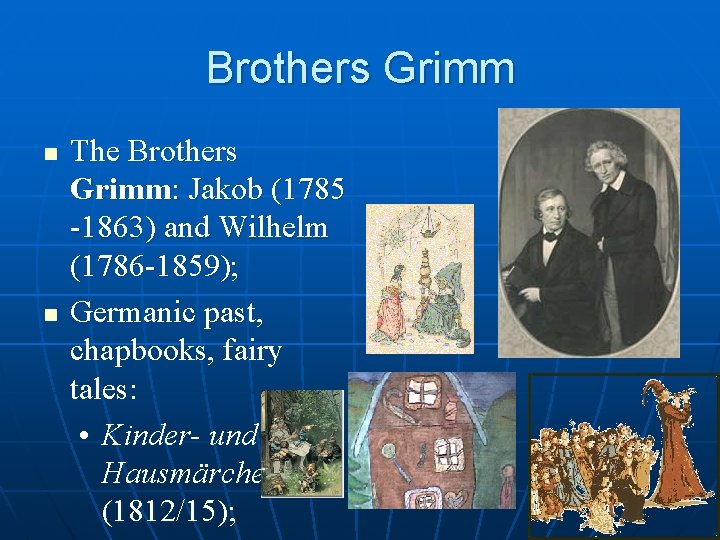
Brothers Grimm n n The Brothers Grimm: Jakob (1785 -1863) and Wilhelm (1786 -1859); Germanic past, chapbooks, fairy tales: • Kinder- und Hausmärchen (1812/15);
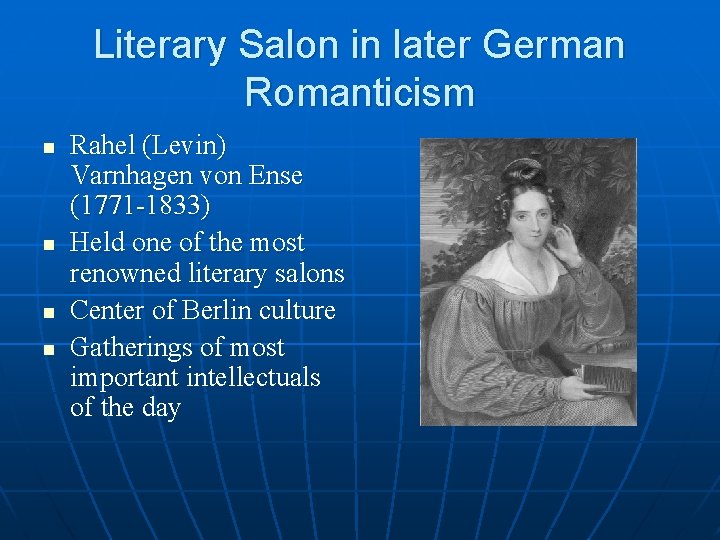
Literary Salon in later German Romanticism n n Rahel (Levin) Varnhagen von Ense (1771 -1833) Held one of the most renowned literary salons Center of Berlin culture Gatherings of most important intellectuals of the day
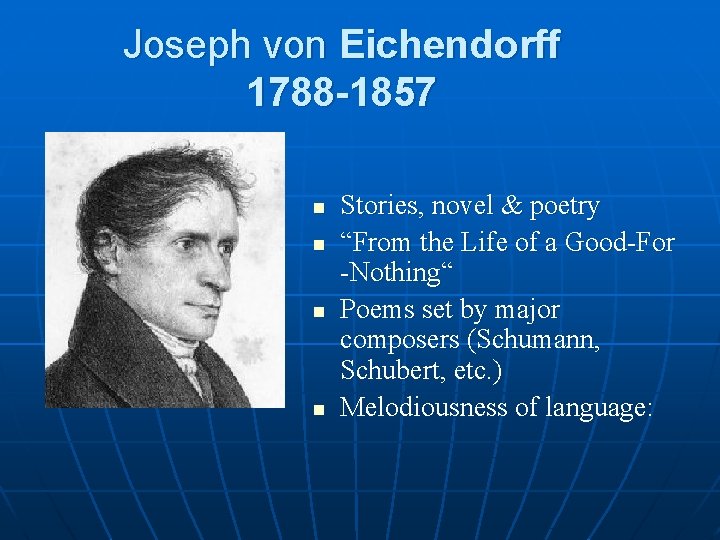
Joseph von Eichendorff 1788 -1857 n n Stories, novel & poetry “From the Life of a Good-For -Nothing“ Poems set by major composers (Schumann, Schubert, etc. ) Melodiousness of language:
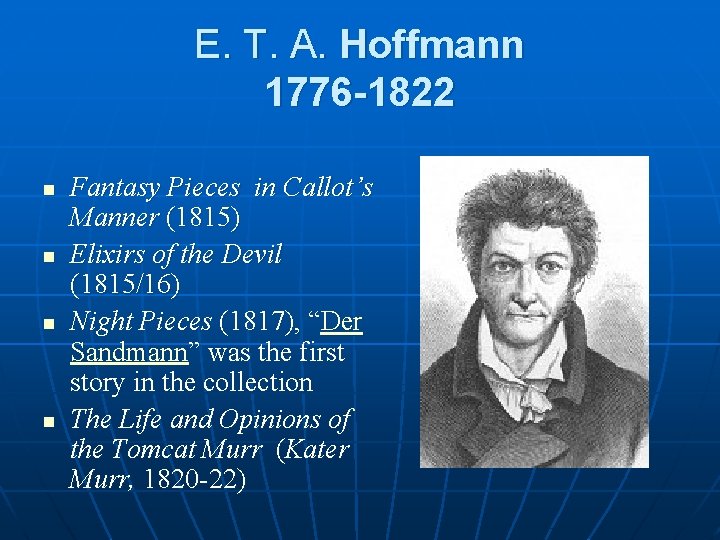
E. T. A. Hoffmann 1776 -1822 n n Fantasy Pieces in Callot’s Manner (1815) Elixirs of the Devil (1815/16) Night Pieces (1817), “Der Sandmann” was the first story in the collection The Life and Opinions of the Tomcat Murr (Kater Murr, 1820 -22)
Romanticism: Key Concepts • 1) loss of border and category: synthesis, expansion; association, connection, unity of opposites, the unreachable (limitless longing –> Nihilism) • 2) exponentialization / logarithmization of reality (Schlegel’s 116 th Athenäum-Frag. , Novalis) • 3) “Romanticism is a lens” (Brentano’s Godwi) • 4) Fragment (Novalis, Schlegel; Heinrich von Ofterdingen, Kater Murr)
More Key Concepts • 5) Bildungsroman (novel of education) (Heinrich von Ofterdingen, Franz Sternbald’s Wanderings, Godwi) • 6) Dream, Psychology especially Insanity, the Unconscious, Intuition, Longing (Hoffmann, Eichendorff) (Novalis: all philosophy longing – one is “always going home. ” • 7) the Middle Ages (Tieck, Novalis, Grimms) • 8) Folk - literature (the Grimms)
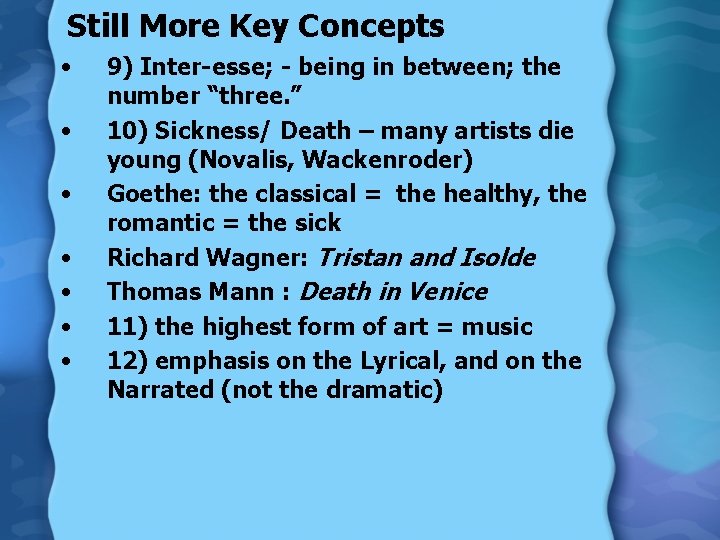
Still More Key Concepts • • 9) Inter-esse; - being in between; the number “three. ” 10) Sickness/ Death – many artists die young (Novalis, Wackenroder) Goethe: the classical = the healthy, the romantic = the sick Richard Wagner: Tristan and Isolde Thomas Mann : Death in Venice 11) the highest form of art = music 12) emphasis on the Lyrical, and on the Narrated (not the dramatic)
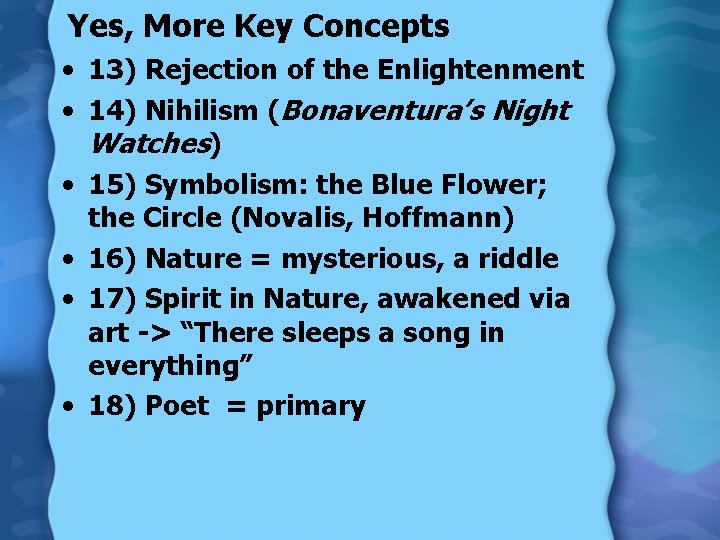
Yes, More Key Concepts • 13) Rejection of the Enlightenment • 14) Nihilism (Bonaventura’s Night Watches) • 15) Symbolism: the Blue Flower; the Circle (Novalis, Hoffmann) • 16) Nature = mysterious, a riddle • 17) Spirit in Nature, awakened via art -> “There sleeps a song in everything” • 18) Poet = primary
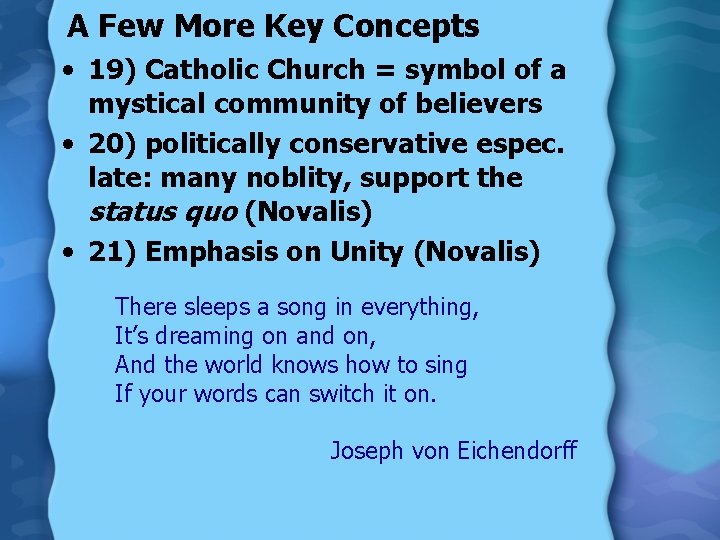
A Few More Key Concepts • 19) Catholic Church = symbol of a mystical community of believers • 20) politically conservative espec. late: many noblity, support the status quo (Novalis) • 21) Emphasis on Unity (Novalis) There sleeps a song in everything, It’s dreaming on and on, And the world knows how to sing If your words can switch it on. Joseph von Eichendorff