
German Grammar Lectures Lecture 8 Prepositions and Conjunctions
- Slides: 50
German Grammar Lectures Lecture 8: Prepositions and Conjunctions Designed by Paul Joyce University of Portsmouth E-Mail: Paul. Joyce@port. ac. uk
8. 1 What is a preposition? • A preposition is a word that links a noun or pronoun to other words. It can indicate: • • Direction: “He’s going to the shops. ” Location: “It’s in the box. ” Time: “I’ll see you after the lesson. ” Possession: “The government of Italy”
8. 2 German prepositions • German prepositions ‘take’ a specific case. 1) Accusative case 2) Dative case 3) Genitive case • German prepositions do not take the nominative case • The logic behind which preposition takes which case has little to do with the logic of the cases of objects discussed in Lecture 3. 3
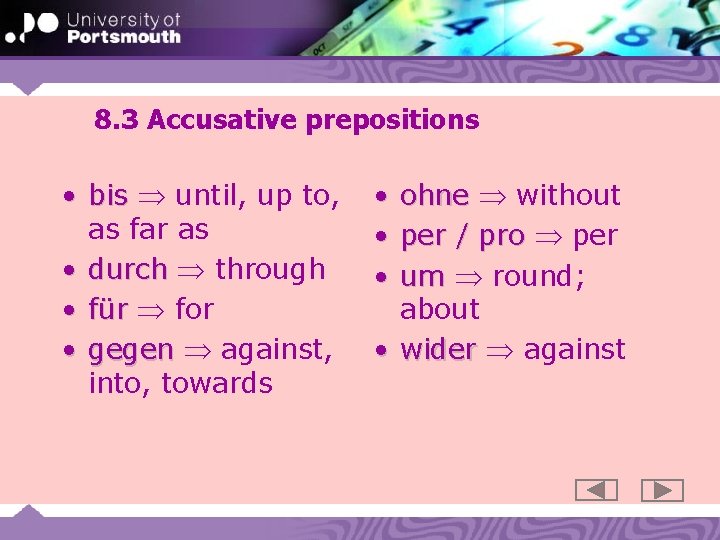
8. 3 Accusative prepositions • bis until, up to, as far as • durch through • für for • gegen against, into, towards • ohne without • per / pro per • um round; about • wider against
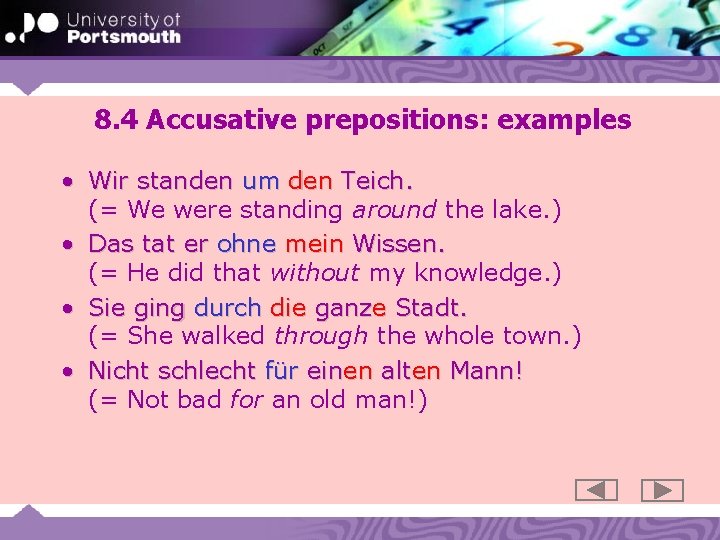
8. 4 Accusative prepositions: examples • Wir standen um den Teich. (= We were standing around the lake. ) • Das tat er ohne mein Wissen. (= He did that without my knowledge. ) • Sie ging durch die ganze Stadt. (= She walked through the whole town. ) • Nicht schlecht für einen alten Mann! (= Not bad for an old man!)
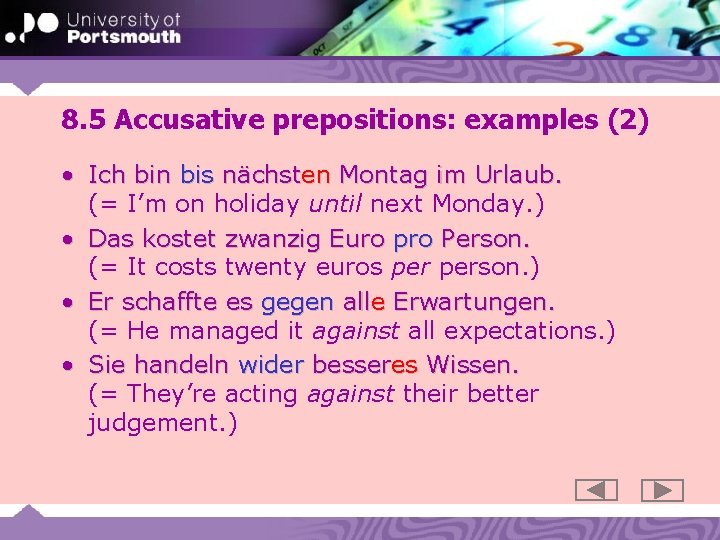
8. 5 Accusative prepositions: examples (2) • Ich bin bis nächsten Montag im Urlaub. (= I’m on holiday until next Monday. ) • Das kostet zwanzig Euro pro Person. (= It costs twenty euros person. ) • Er schaffte es gegen alle Erwartungen. (= He managed it against all expectations. ) • Sie handeln wider besseres Wissen. (= They’re acting against their better judgement. )
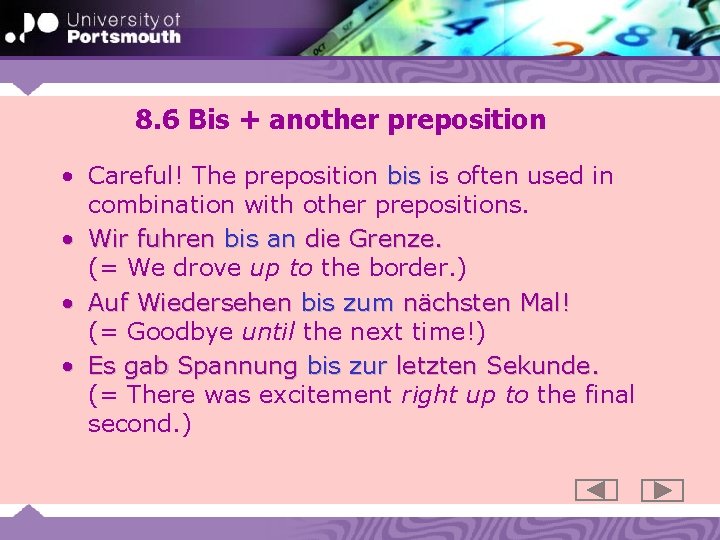
8. 6 Bis + another preposition • Careful! The preposition bis is often used in combination with other prepositions. • Wir fuhren bis an die Grenze. (= We drove up to the border. ) • Auf Wiedersehen bis zum nächsten Mal! (= Goodbye until the next time!) • Es gab Spannung bis zur letzten Sekunde. (= There was excitement right up to the final second. )
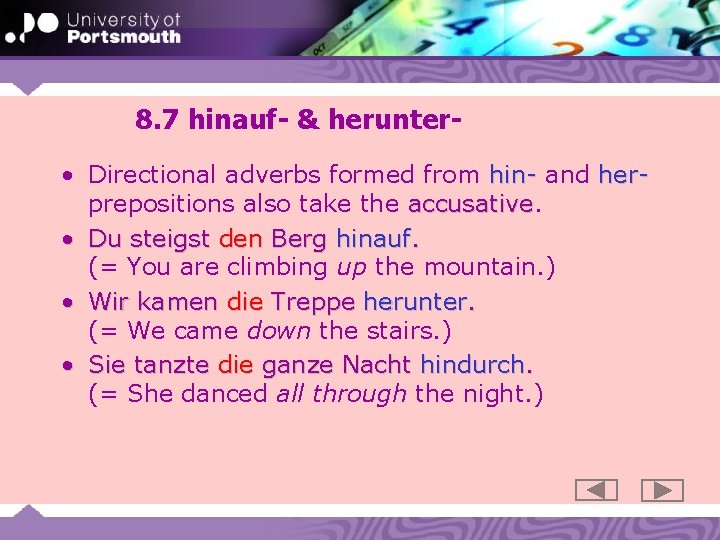
8. 7 hinauf- & herunter • Directional adverbs formed from hin- and herprepositions also take the accusative • Du steigst den Berg hinauf. (= You are climbing up the mountain. ) • Wir kamen die Treppe herunter. (= We came down the stairs. ) • Sie tanzte die ganze Nacht hindurch. (= She danced all through the night. )
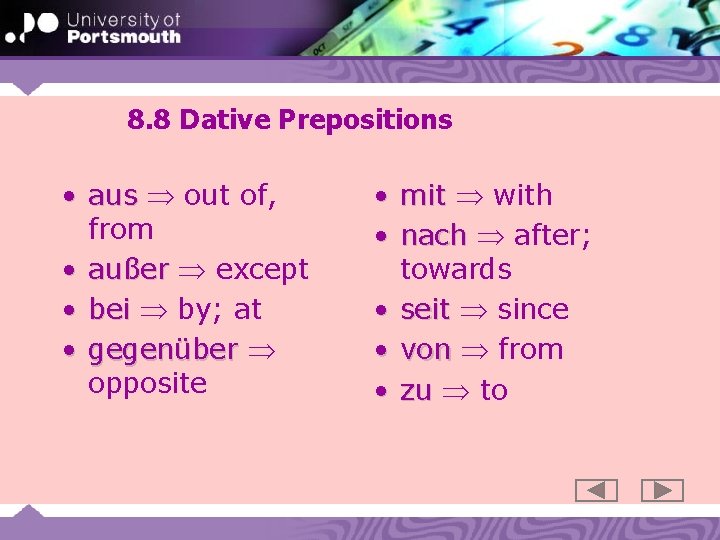
8. 8 Dative Prepositions • aus out of, from • außer except • bei by; at • gegenüber opposite • mit with • nach after; towards • seit since • von from • zu to
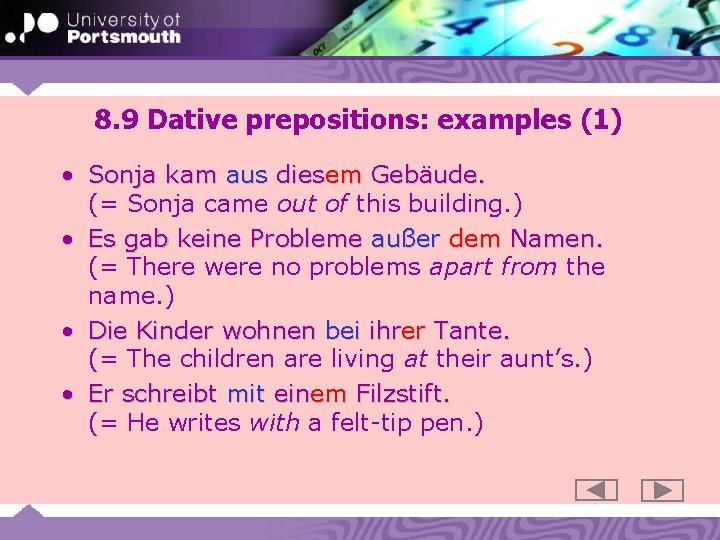
8. 9 Dative prepositions: examples (1) • Sonja kam aus diesem Gebäude. (= Sonja came out of this building. ) • Es gab keine Probleme außer dem Namen. (= There were no problems apart from the name. ) • Die Kinder wohnen bei ihrer Tante. (= The children are living at their aunt’s. ) • Er schreibt mit einem Filzstift. (= He writes with a felt-tip pen. )
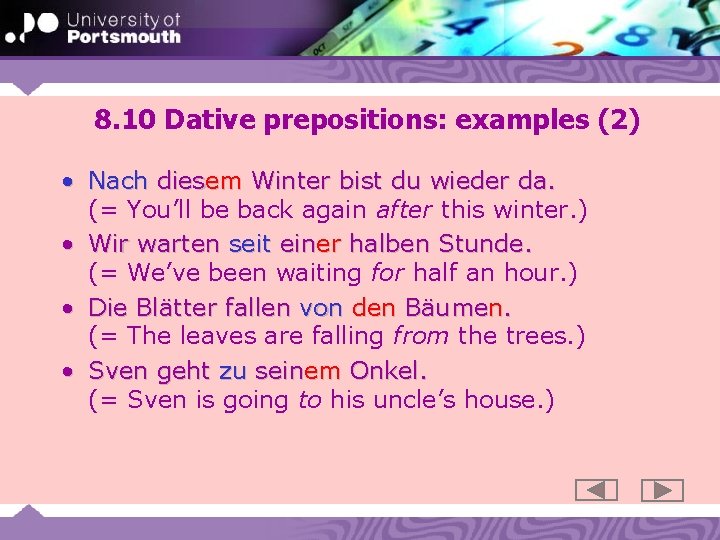
8. 10 Dative prepositions: examples (2) • Nach diesem Winter bist du wieder da. (= You’ll be back again after this winter. ) • Wir warten seit einer halben Stunde. (= We’ve been waiting for half an hour. ) • Die Blätter fallen von den Bäumen. (= The leaves are falling from the trees. ) • Sven geht zu seinem Onkel. (= Sven is going to his uncle’s house. )
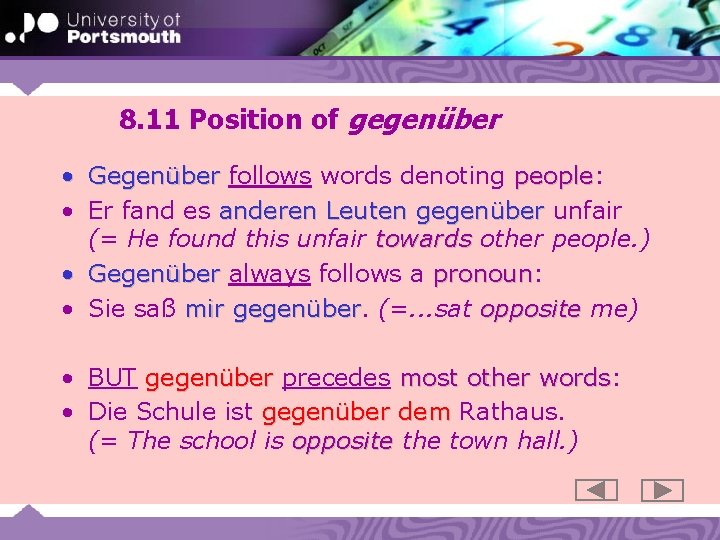
8. 11 Position of gegenüber • Gegenüber follows words denoting people: people • Er fand es anderen Leuten gegenüber unfair (= He found this unfair towards other people. ) • Gegenüber always follows a pronoun: pronoun • Sie saß mir gegenüber (=. . . sat opposite me) • BUT gegenüber precedes most other words: words • Die Schule ist gegenüber dem Rathaus. (= The school is opposite the town hall. )
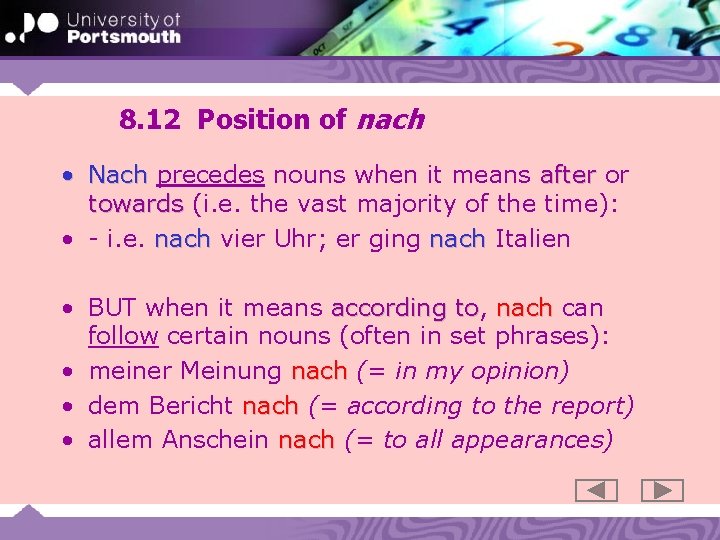
8. 12 Position of nach • Nach precedes nouns when it means after or towards (i. e. the vast majority of the time): • - i. e. nach vier Uhr; er ging nach Italien • BUT when it means according to, to nach can follow certain nouns (often in set phrases): • meiner Meinung nach (= in my opinion) • dem Bericht nach (= according to the report) • allem Anschein nach (= to all appearances)
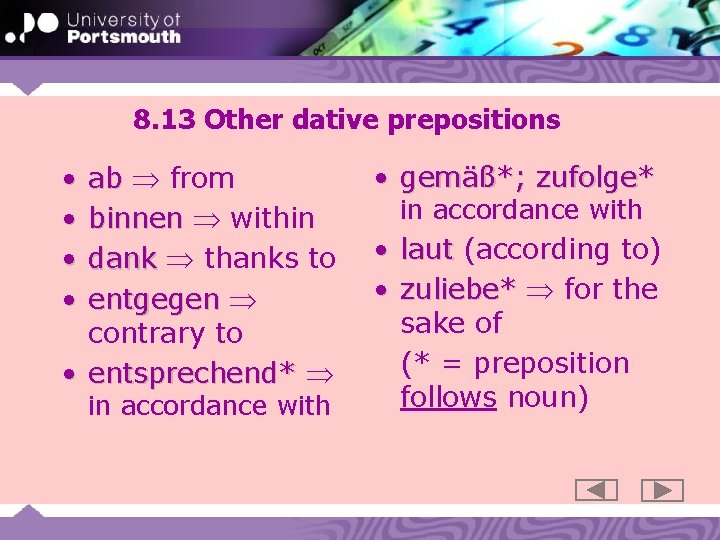
8. 13 Other dative prepositions • • ab from binnen within dank thanks to entgegen contrary to • entsprechend* in accordance with • gemäß*; zufolge* in accordance with • laut (according to) • zuliebe* for the sake of (* = preposition follows noun)
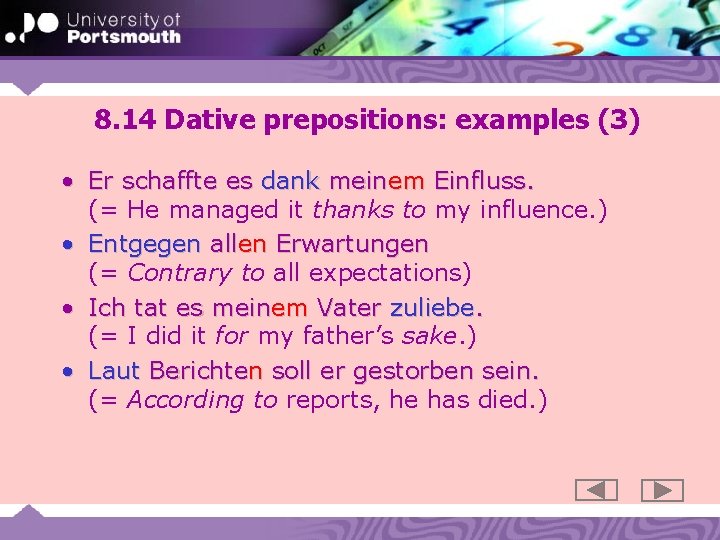
8. 14 Dative prepositions: examples (3) • Er schaffte es dank meinem Einfluss. (= He managed it thanks to my influence. ) • Entgegen allen Erwartungen (= Contrary to all expectations) • Ich tat es meinem Vater zuliebe. (= I did it for my father’s sake. ) • Laut Berichten soll er gestorben sein. (= According to reports, he has died. )
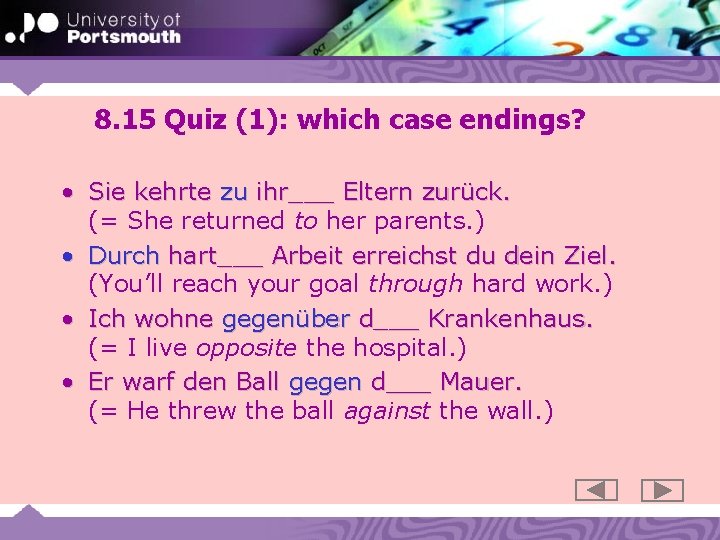
8. 15 Quiz (1): which case endings? • Sie kehrte zu ihr___ Eltern zurück. (= She returned to her parents. ) • Durch hart___ Arbeit erreichst du dein Ziel. (You’ll reach your goal through hard work. ) • Ich wohne gegenüber d___ Krankenhaus. (= I live opposite the hospital. ) • Er warf den Ball gegen d___ Mauer. (= He threw the ball against the wall. )
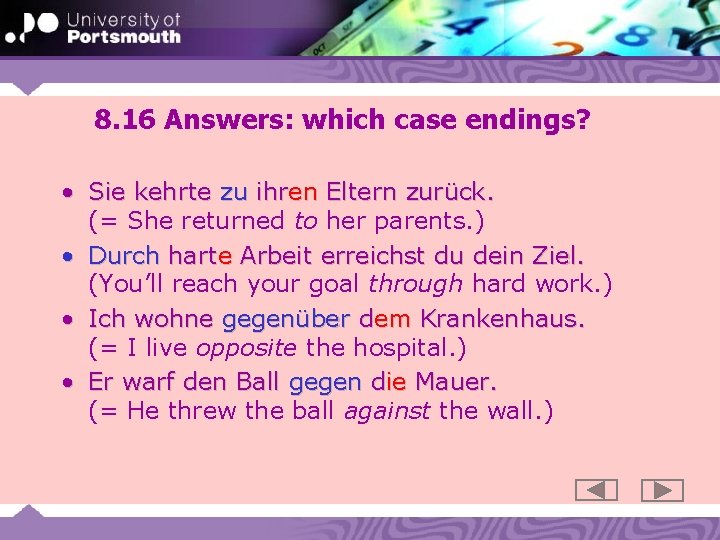
8. 16 Answers: which case endings? • Sie kehrte zu ihren Eltern zurück. (= She returned to her parents. ) • Durch harte Arbeit erreichst du dein Ziel. (You’ll reach your goal through hard work. ) • Ich wohne gegenüber dem Krankenhaus. (= I live opposite the hospital. ) • Er warf den Ball gegen die Mauer. (= He threw the ball against the wall. )
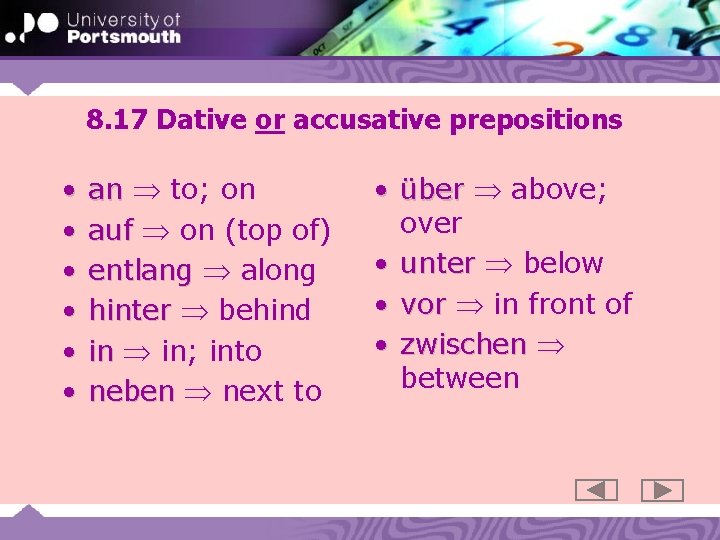
8. 17 Dative or accusative prepositions • • • an to; on auf on (top of) entlang along hinter behind in in; into neben next to • über above; over • unter below • vor in front of • zwischen between
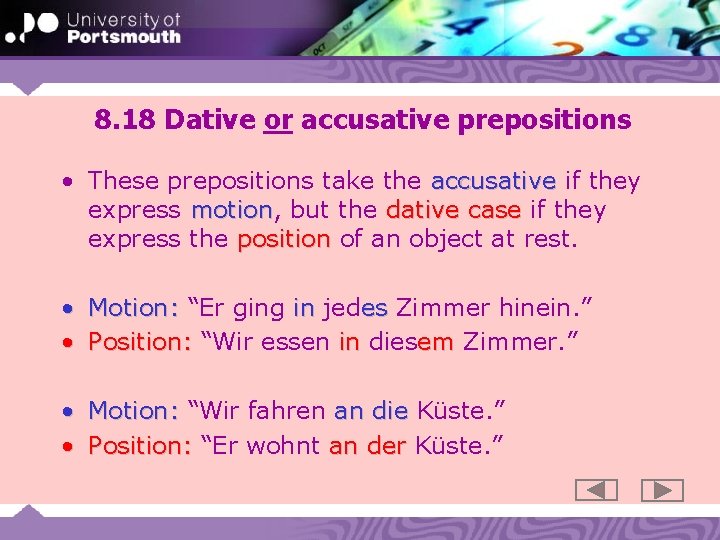
8. 18 Dative or accusative prepositions • These prepositions take the accusative if they express motion, motion but the dative case if they express the position of an object at rest. • Motion: “Er ging in jedes Zimmer hinein. ” • Position: “Wir essen in diesem Zimmer. ” • Motion: “Wir fahren an die Küste. ” • Position: “Er wohnt an der Küste. ”
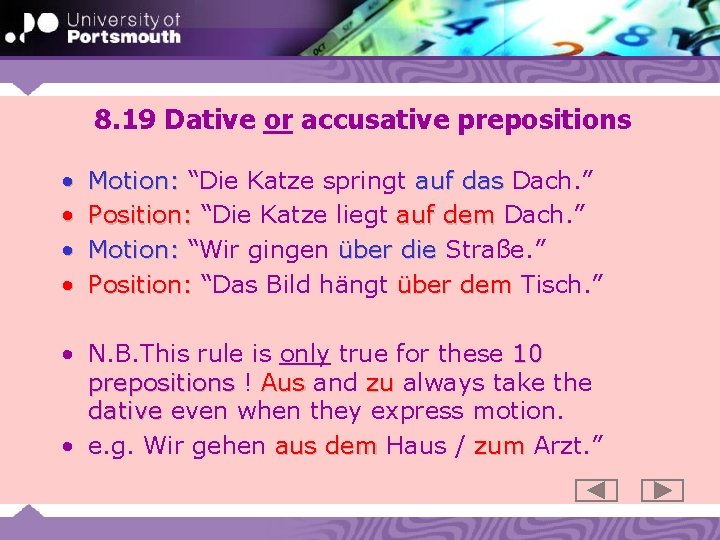
8. 19 Dative or accusative prepositions • • Motion: “Die Katze springt auf das Dach. ” Position: “Die Katze liegt auf dem Dach. ” Motion: “Wir gingen über die Straße. ” Position: “Das Bild hängt über dem Tisch. ” • N. B. This rule is only true for these 10 prepositions ! Aus and zu always take the dative even when they express motion. • e. g. Wir gehen aus dem Haus / zum Arzt. ”
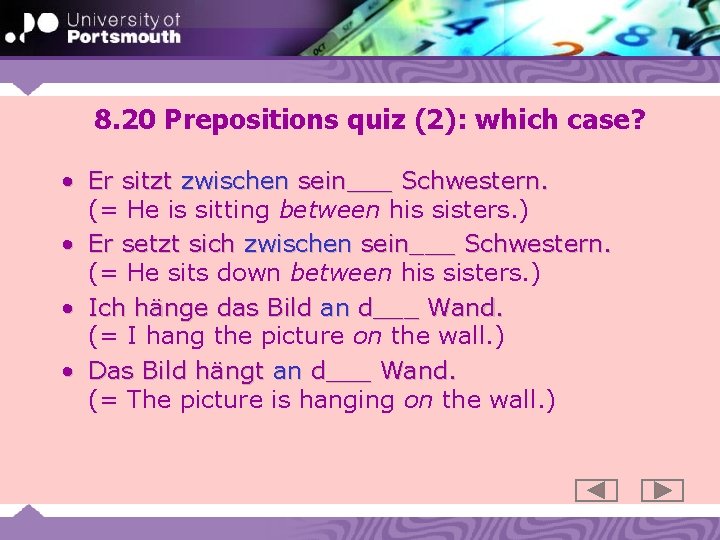
8. 20 Prepositions quiz (2): which case? • Er sitzt zwischen sein___ Schwestern. (= He is sitting between his sisters. ) • Er setzt sich zwischen sein___ Schwestern. (= He sits down between his sisters. ) • Ich hänge das Bild an d___ Wand. (= I hang the picture on the wall. ) • Das Bild hängt an d___ Wand. (= The picture is hanging on the wall. )
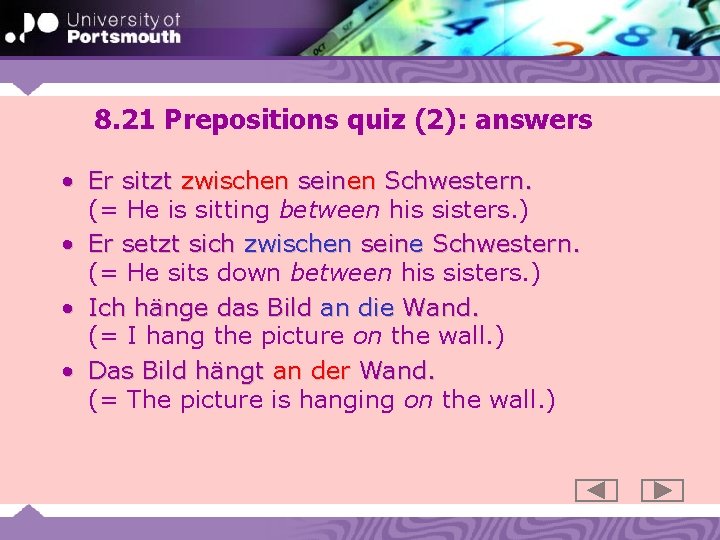
8. 21 Prepositions quiz (2): answers • Er sitzt zwischen seinen Schwestern. (= He is sitting between his sisters. ) • Er setzt sich zwischen seine Schwestern. (= He sits down between his sisters. ) • Ich hänge das Bild an die Wand. (= I hang the picture on the wall. ) • Das Bild hängt an der Wand. (= The picture is hanging on the wall. )
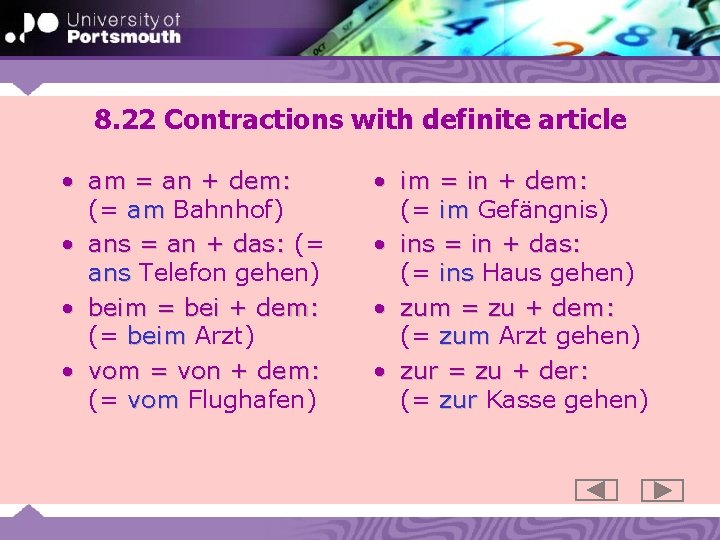
8. 22 Contractions with definite article • am = an + dem: (= am Bahnhof) • ans = an + das: (= ans Telefon gehen) • beim = bei + dem: (= beim Arzt) • vom = von + dem: (= vom Flughafen) • im = in + dem: (= im Gefängnis) • ins = in + das: (= ins Haus gehen) • zum = zu + dem: (= zum Arzt gehen) • zur = zu + der: (= zur Kasse gehen)
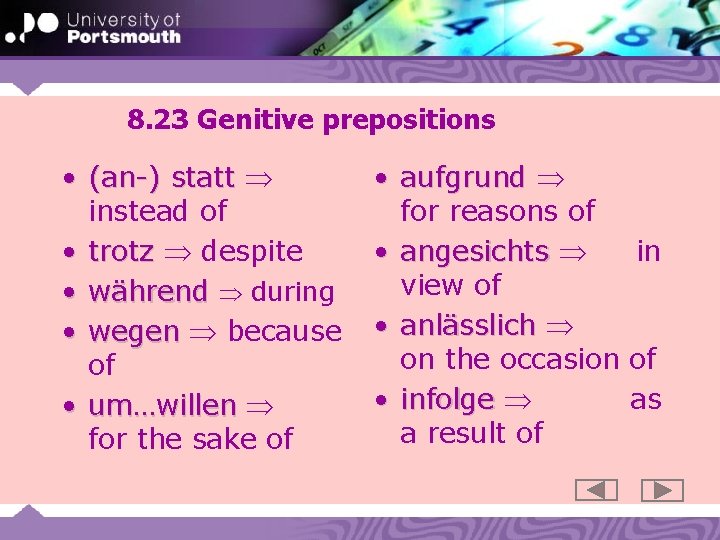
8. 23 Genitive prepositions • (an-) statt instead of • trotz despite • während during • wegen because of • um…willen for the sake of • aufgrund for reasons of • angesichts in view of • anlässlich on the occasion of • infolge as a result of
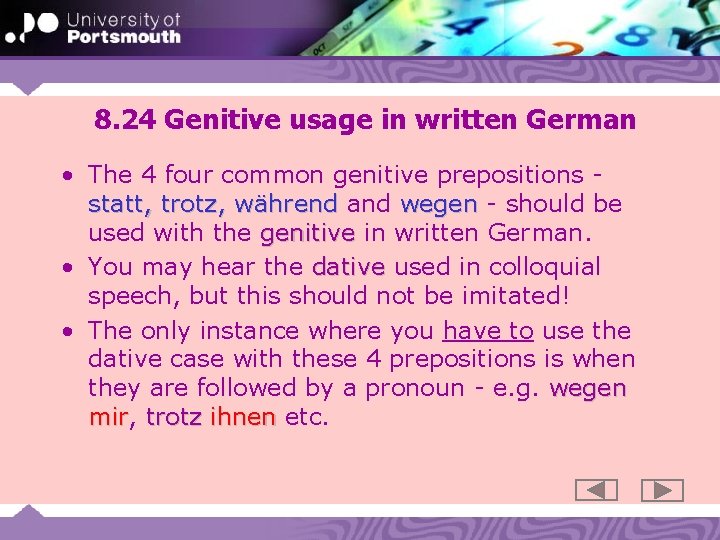
8. 24 Genitive usage in written German • The 4 four common genitive prepositions statt, trotz, während and wegen - should be used with the genitive in written German. • You may hear the dative used in colloquial speech, but this should not be imitated! • The only instance where you have to use the dative case with these 4 prepositions is when they are followed by a pronoun - e. g. wegen mir, mir trotz ihnen etc.
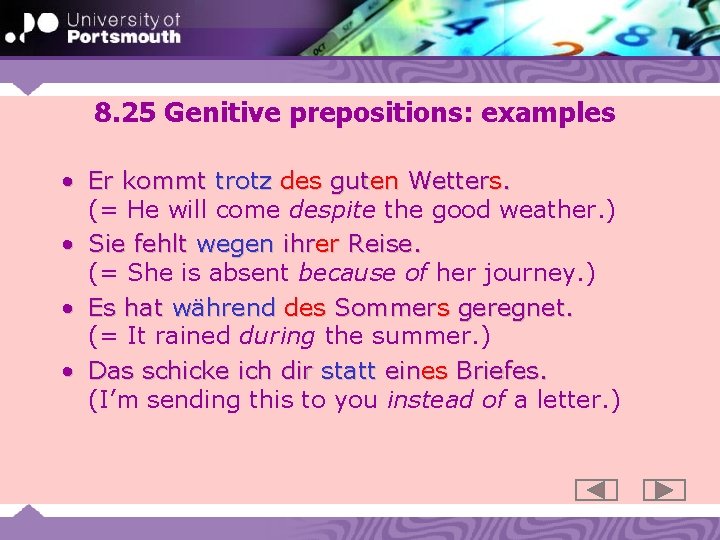
8. 25 Genitive prepositions: examples • Er kommt trotz des guten Wetters. (= He will come despite the good weather. ) • Sie fehlt wegen ihrer Reise. (= She is absent because of her journey. ) • Es hat während des Sommers geregnet. (= It rained during the summer. ) • Das schicke ich dir statt eines Briefes. (I’m sending this to you instead of a letter. )
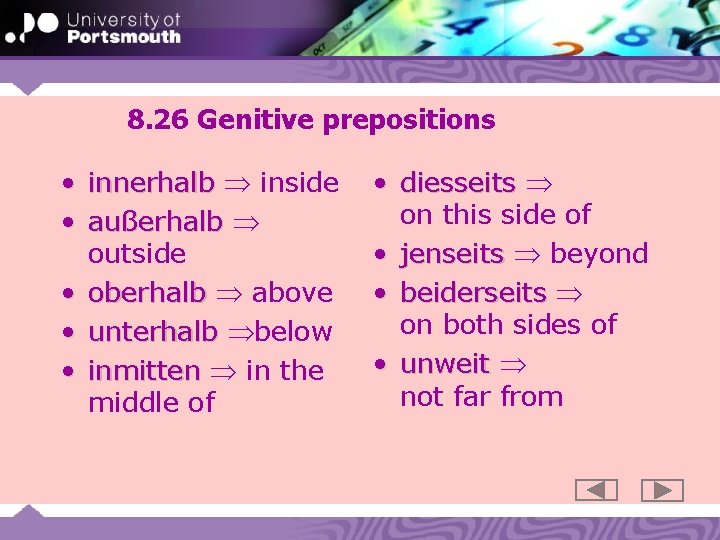
8. 26 Genitive prepositions • innerhalb inside • außerhalb outside • oberhalb above • unterhalb below • inmitten in the middle of • diesseits on this side of • jenseits beyond • beiderseits on both sides of • unweit not far from
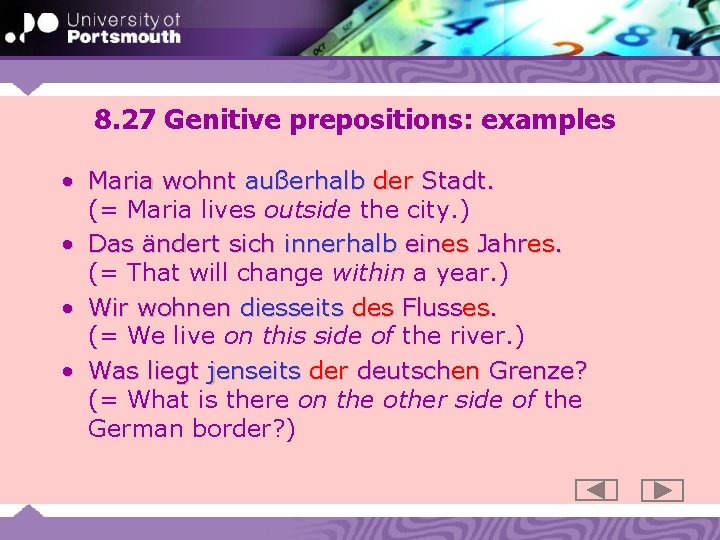
8. 27 Genitive prepositions: examples • Maria wohnt außerhalb der Stadt. (= Maria lives outside the city. ) • Das ändert sich innerhalb eines Jahres. (= That will change within a year. ) • Wir wohnen diesseits des Flusses. (= We live on this side of the river. ) • Was liegt jenseits der deutschen Grenze? (= What is there on the other side of the German border? )
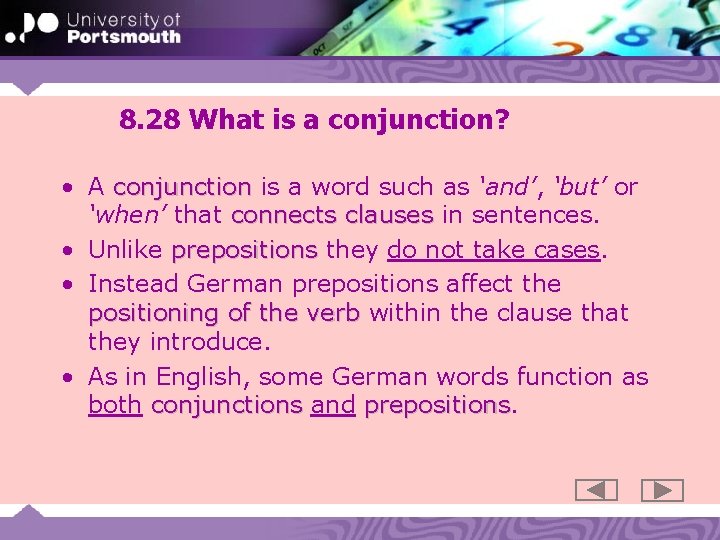
8. 28 What is a conjunction? • A conjunction is a word such as ‘and’, ‘but’ or ‘when’ that connects clauses in sentences. • Unlike prepositions they do not take cases. • Instead German prepositions affect the positioning of the verb within the clause that they introduce. • As in English, some German words function as both conjunctions and prepositions
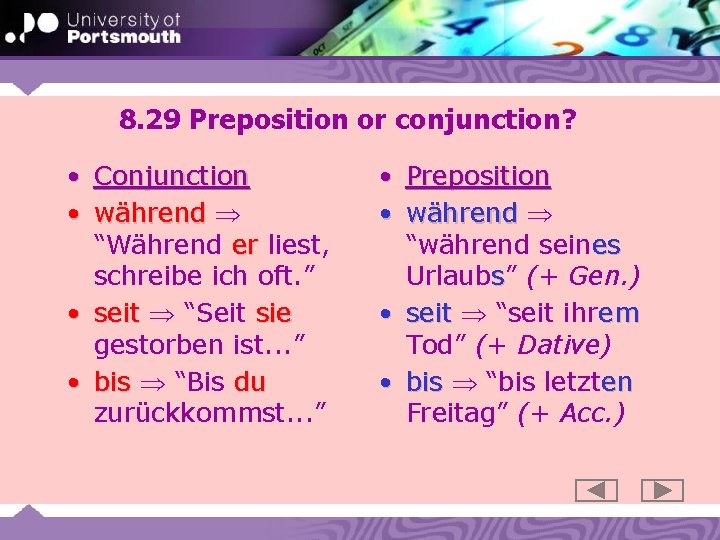
8. 29 Preposition or conjunction? • Conjunction • während “Während er liest, schreibe ich oft. ” • seit “Seit sie gestorben ist. . . ” • bis “Bis du zurückkommst. . . ” • Preposition • während “während seines Urlaubs” (+ Gen. ) • seit “seit ihrem Tod” (+ Dative) • bis “bis letzten Freitag” (+ Acc. )
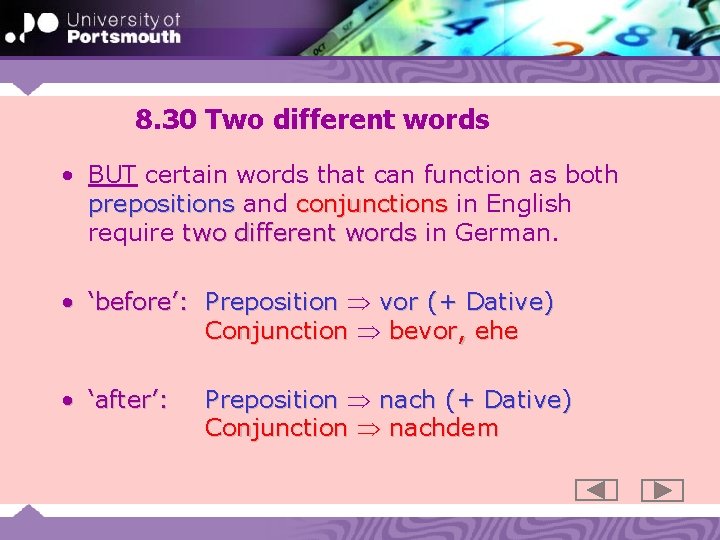
8. 30 Two different words • BUT certain words that can function as both prepositions and conjunctions in English require two different words in German. • ‘before’: Preposition vor (+ Dative) Conjunction bevor, ehe • ‘after’: Preposition nach (+ Dative) Conjunction nachdem
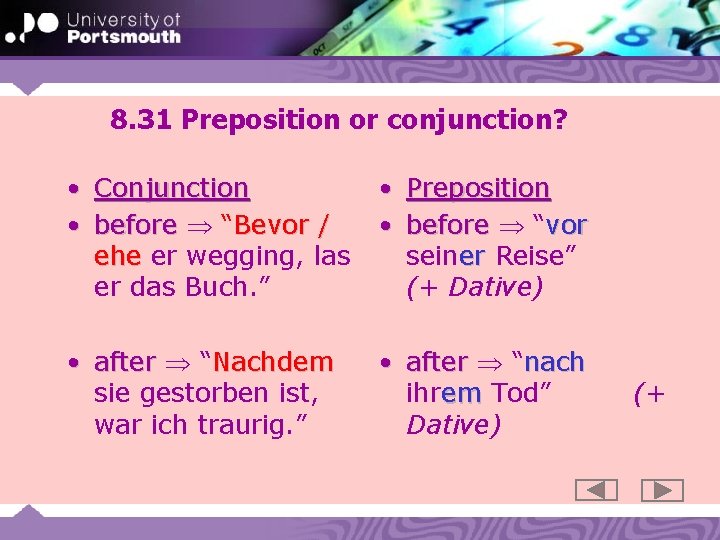
8. 31 Preposition or conjunction? • Conjunction • before “Bevor / ehe er wegging, las er das Buch. ” • Preposition • before “vor seiner Reise” (+ Dative) • after “Nachdem sie gestorben ist, war ich traurig. ” • after “nach ihrem Tod” Dative) (+
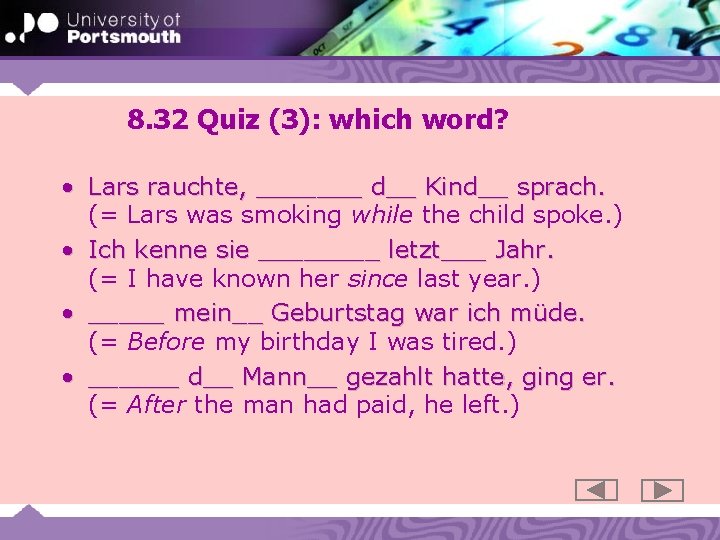
8. 32 Quiz (3): which word? • Lars rauchte, _______ d__ Kind__ sprach. (= Lars was smoking while the child spoke. ) • Ich kenne sie ____ letzt___ Jahr. (= I have known her since last year. ) • _____ mein__ Geburtstag war ich müde. (= Before my birthday I was tired. ) • ______ d__ Mann__ gezahlt hatte, ging er. (= After the man had paid, he left. )
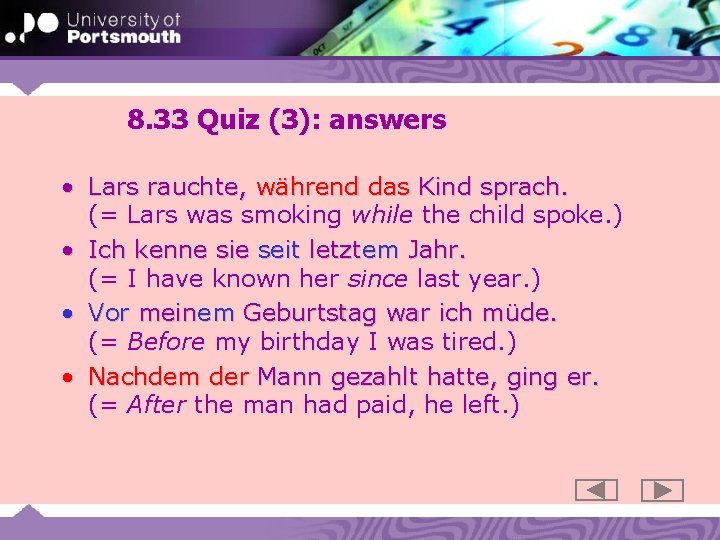
8. 33 Quiz (3): answers • Lars rauchte, während das Kind sprach. (= Lars was smoking while the child spoke. ) • Ich kenne sie seit letztem Jahr. (= I have known her since last year. ) • Vor meinem Geburtstag war ich müde. (= Before my birthday I was tired. ) • Nachdem der Mann gezahlt hatte, ging er. (= After the man had paid, he left. )
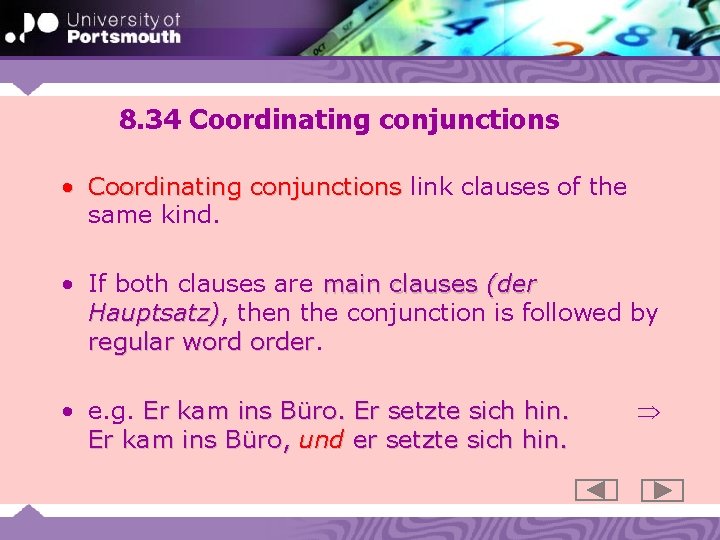
8. 34 Coordinating conjunctions • Coordinating conjunctions link clauses of the same kind. • If both clauses are main clauses (der Hauptsatz), then the conjunction is followed by regular word order • e. g. Er kam ins Büro. Er setzte sich hin. Er kam ins Büro, und er setzte sich hin.
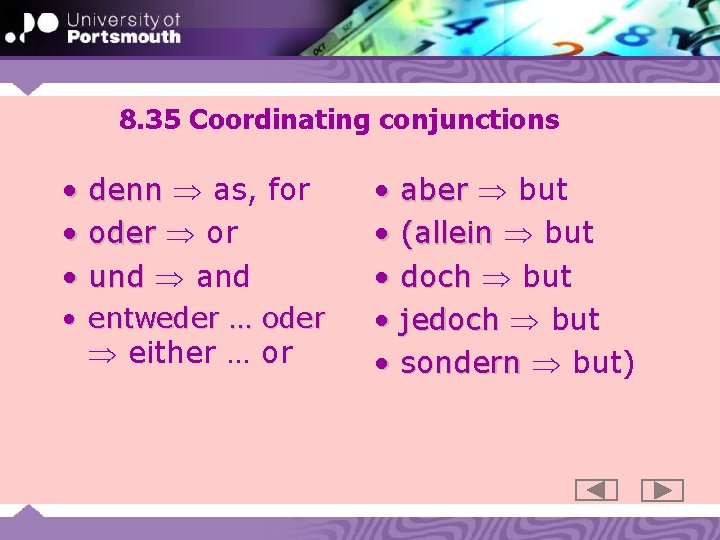
8. 35 Coordinating conjunctions • denn as, for • oder or • und and • entweder … oder either … or • aber but • (allein but • doch but • jedoch but • sondern but)
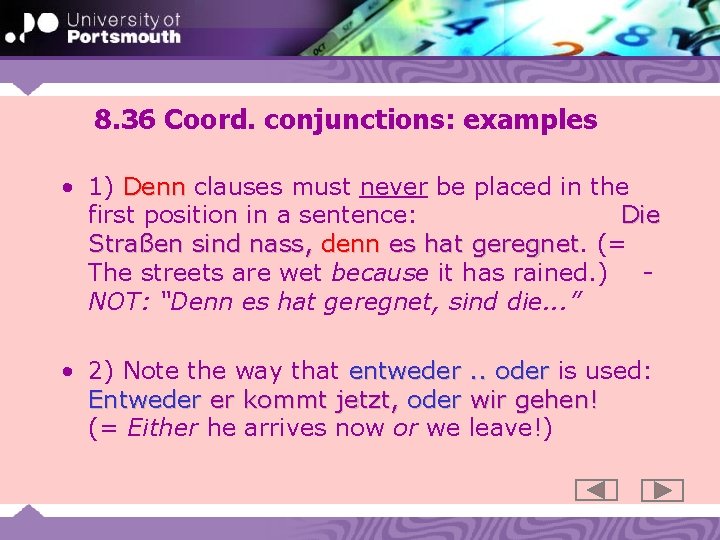
8. 36 Coord. conjunctions: examples • 1) Denn clauses must never be placed in the first position in a sentence: Die Straßen sind nass, denn es hat geregnet (= The streets are wet because it has rained. ) NOT: “Denn es hat geregnet, sind die. . . ” • 2) Note the way that entweder. . oder is used: Entweder er kommt jetzt, oder wir gehen! (= Either he arrives now or we leave!)
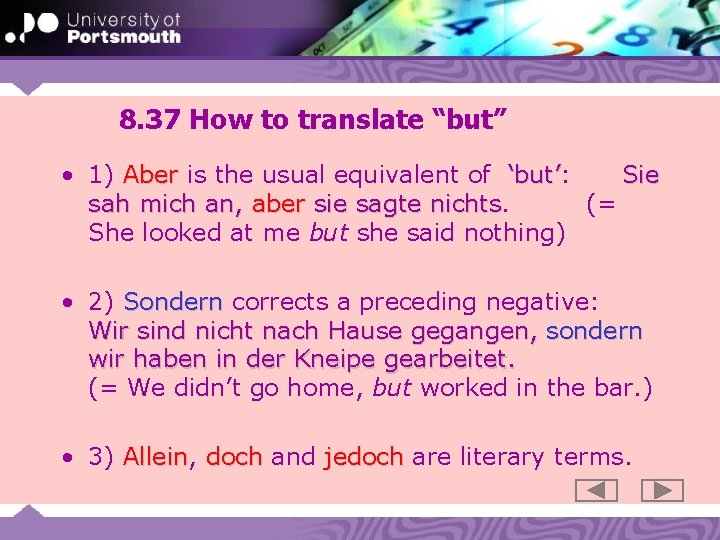
8. 37 How to translate “but” • 1) Aber is the usual equivalent of ‘but’: Sie ‘but’ sah mich an, aber sie sagte nichts. (= nichts She looked at me but she said nothing) • 2) Sondern corrects a preceding negative: Wir sind nicht nach Hause gegangen, sondern wir haben in der Kneipe gearbeitet. (= We didn’t go home, but worked in the bar. ) • 3) Allein, Allein doch and jedoch are literary terms.
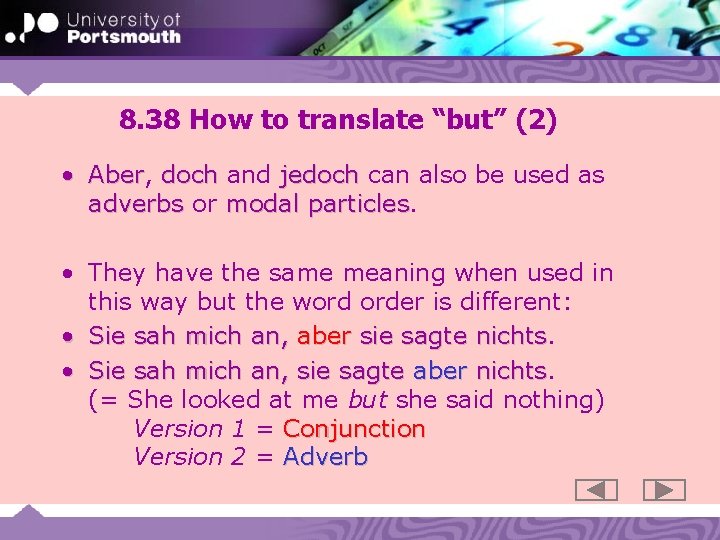
8. 38 How to translate “but” (2) • Aber, Aber doch and jedoch can also be used as adverbs or modal particles • They have the same meaning when used in this way but the word order is different: • Sie sah mich an, aber sie sagte nichts • Sie sah mich an, sie sagte aber nichts (= She looked at me but she said nothing) Version 1 = Conjunction Version 2 = Adverb
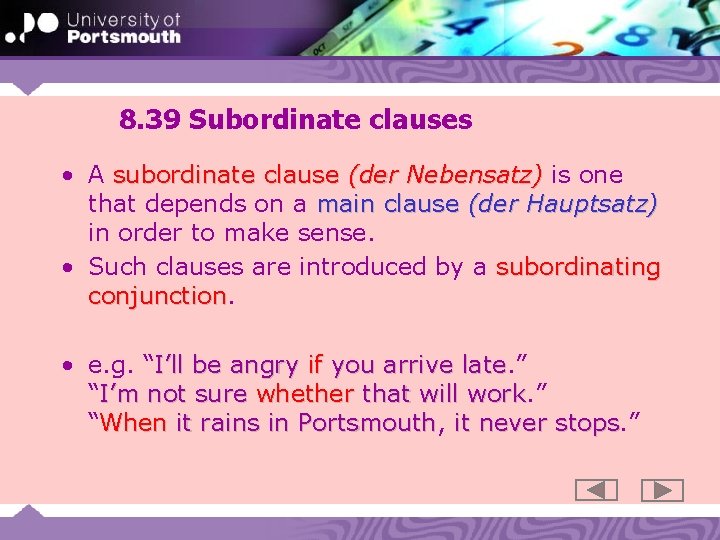
8. 39 Subordinate clauses • A subordinate clause (der Nebensatz) is one that depends on a main clause (der Hauptsatz) in order to make sense. • Such clauses are introduced by a subordinating conjunction • e. g. “I’ll be angry if you arrive late. ” late “I’m not sure whether that will work. ” work “When it rains in Portsmouth, Portsmouth it never stops. ” stops
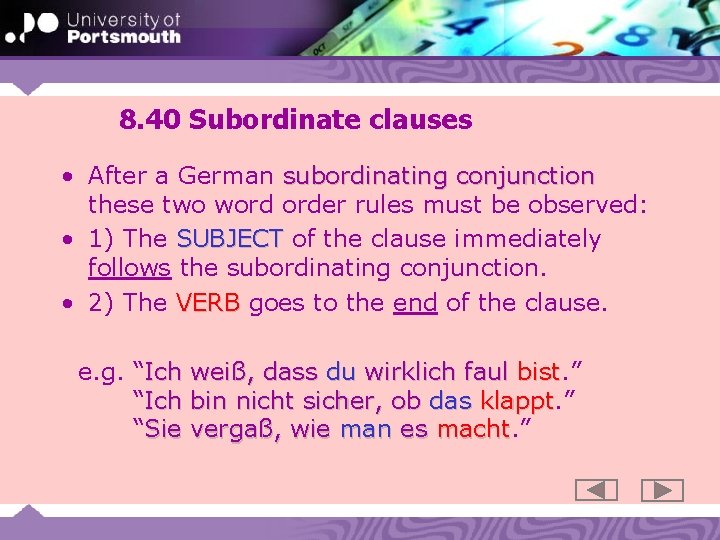
8. 40 Subordinate clauses • After a German subordinating conjunction these two word order rules must be observed: • 1) The SUBJECT of the clause immediately follows the subordinating conjunction. • 2) The VERB goes to the end of the clause. e. g. “Ich weiß, dass du wirklich faul bist. ” bist “Ich bin nicht sicher, ob das klappt. ” klappt “Sie vergaß, wie man es macht. ” macht
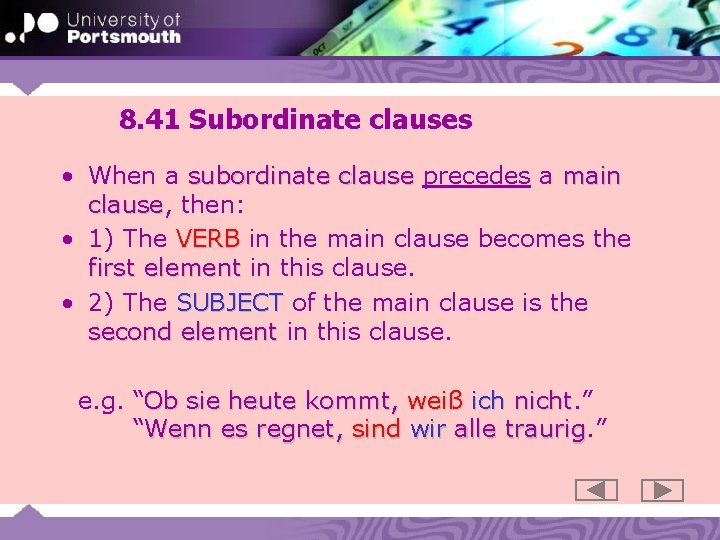
8. 41 Subordinate clauses • When a subordinate clause precedes a main clause, clause then: • 1) The VERB in the main clause becomes the first element in this clause. • 2) The SUBJECT of the main clause is the second element in this clause. e. g. “Ob sie heute kommt, weiß ich nicht. ” nicht “Wenn es regnet, sind wir alle traurig. ” traurig
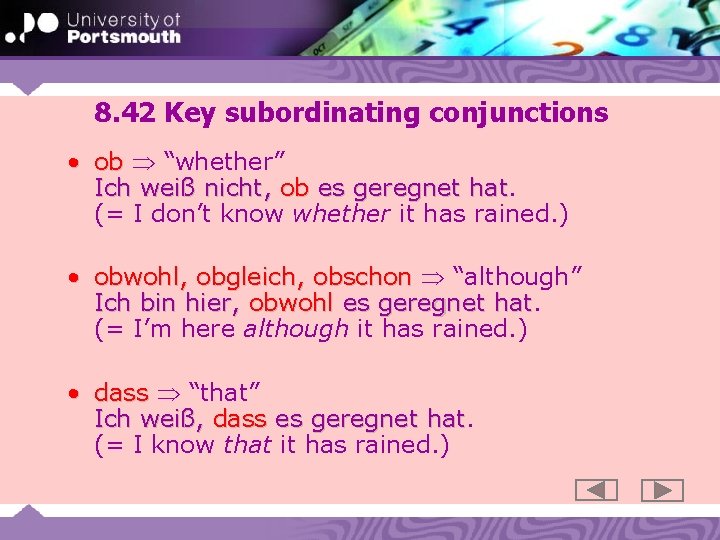
8. 42 Key subordinating conjunctions • ob “whether” Ich weiß nicht, ob es geregnet hat (= I don’t know whether it has rained. ) • obwohl, obgleich, obschon “although” Ich bin hier, obwohl es geregnet hat (= I’m here although it has rained. ) • dass “that” Ich weiß, dass es geregnet hat (= I know that it has rained. )
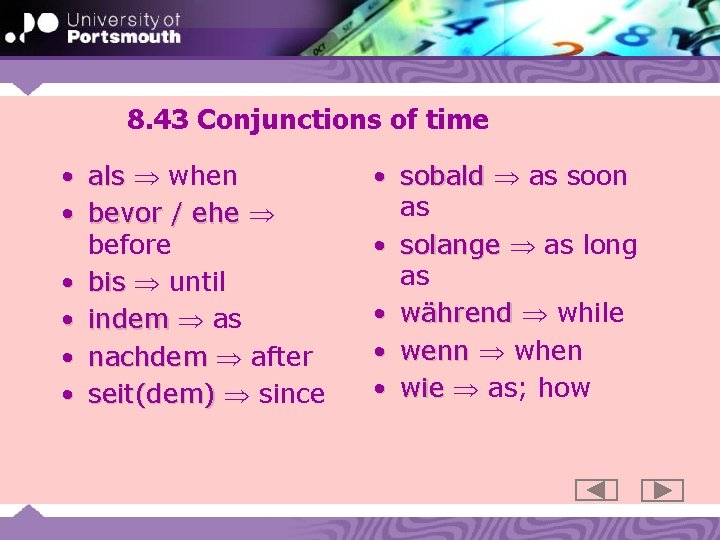
8. 43 Conjunctions of time • als when • bevor / ehe before • bis until • indem as • nachdem after • seit(dem) since • sobald as soon as • solange as long as • während while • wenn when • wie as; how
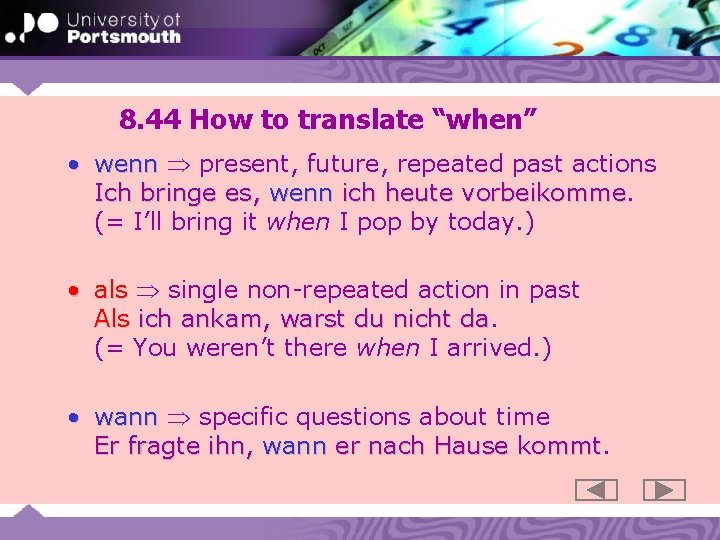
8. 44 How to translate “when” • wenn present, future, repeated past actions Ich bringe es, wenn ich heute vorbeikomme (= I’ll bring it when I pop by today. ) • als single non-repeated action in past Als ich ankam, warst du nicht da. da (= You weren’t there when I arrived. ) • wann specific questions about time Er fragte ihn, wann er nach Hause kommt
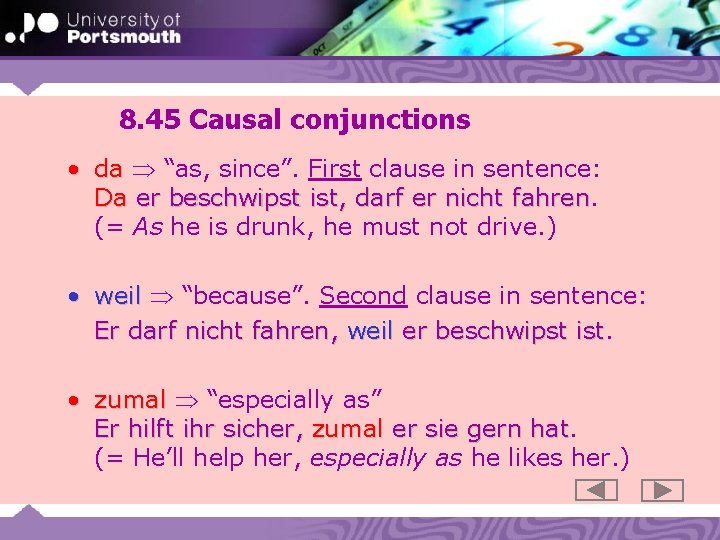
8. 45 Causal conjunctions • da “as, since”. First clause in sentence: Da er beschwipst ist, darf er nicht fahren (= As he is drunk, he must not drive. ) • weil “because”. Second clause in sentence: Er darf nicht fahren, weil er beschwipst ist • zumal “especially as” Er hilft ihr sicher, zumal er sie gern hat (= He’ll help her, especially as he likes her. )
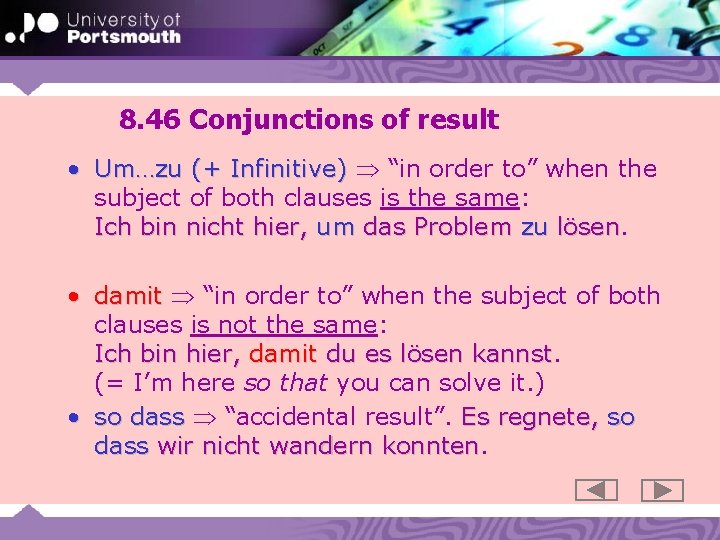
8. 46 Conjunctions of result • Um…zu (+ Infinitive) “in order to” when the subject of both clauses is the same: Ich bin nicht hier, um das Problem zu lösen • damit “in order to” when the subject of both clauses is not the same: Ich bin hier, damit du es lösen kannst (= I’m here so that you can solve it. ) • so dass “accidental result”. Es regnete, so dass wir nicht wandern konnten
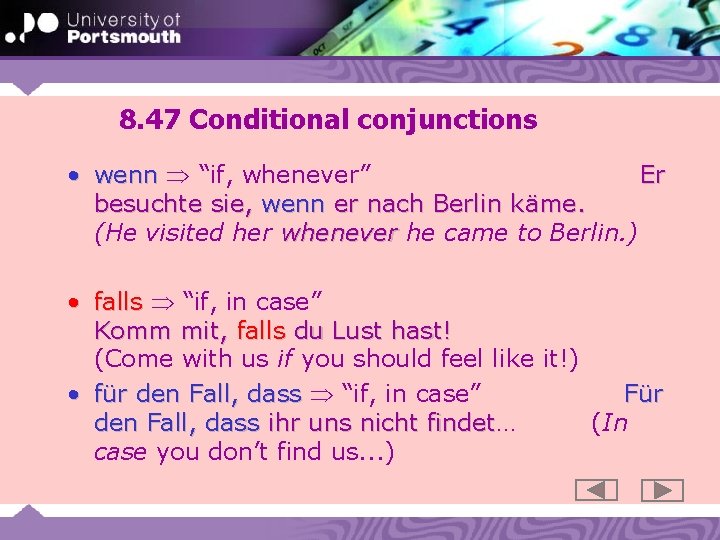
8. 47 Conditional conjunctions • wenn “if, whenever” Er besuchte sie, wenn er nach Berlin käme. (He visited her whenever he came to Berlin. ) • falls “if, in case” Komm mit, falls du Lust hast! (Come with us if you should feel like it!) • für den Fall, dass “if, in case” Für den Fall, dass ihr uns nicht findet… (In findet case you don’t find us. . . )
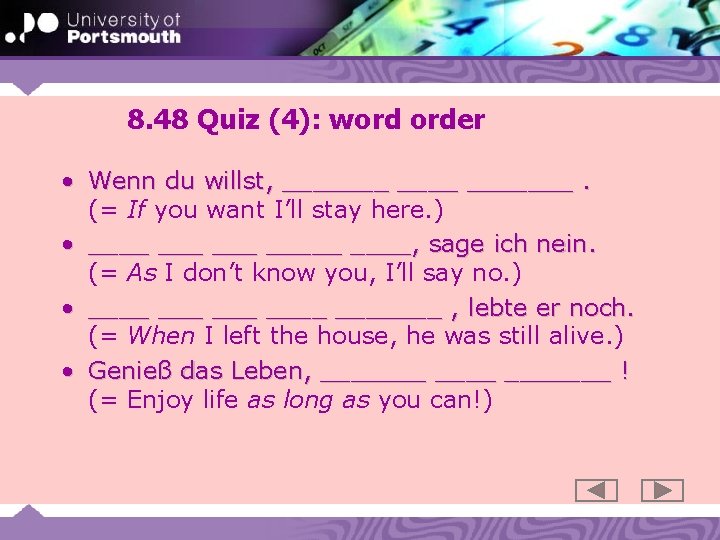
8. 48 Quiz (4): word order • Wenn du willst, _______. (= If you want I’ll stay here. ) • ____ ___ ____, sage ich nein. (= As I don’t know you, I’ll say no. ) • ____ ___ _______ , lebte er noch. (= When I left the house, he was still alive. ) • Genieß das Leben, _______ ! (= Enjoy life as long as you can!)
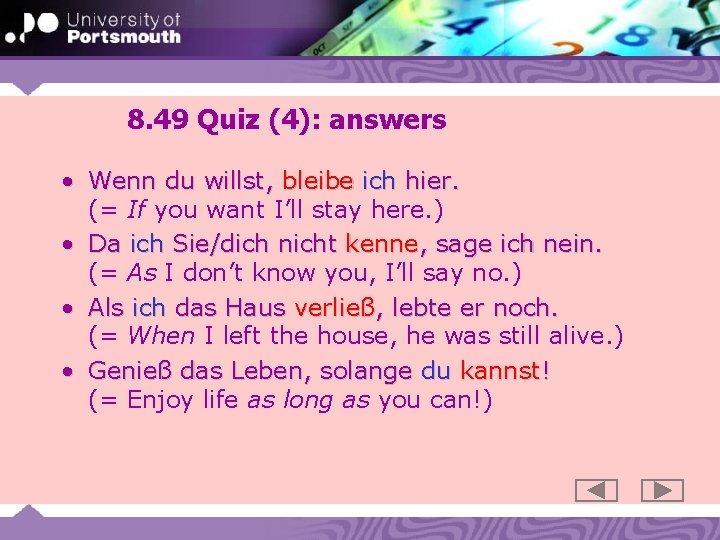
8. 49 Quiz (4): answers • Wenn du willst, bleibe ich hier. (= If you want I’ll stay here. ) • Da ich Sie/dich nicht kenne, sage ich nein. (= As I don’t know you, I’ll say no. ) • Als ich das Haus verließ, lebte er noch. (= When I left the house, he was still alive. ) • Genieß das Leben, solange du kannst! (= Enjoy life as long as you can!)