
GERMAN AIRPORT PERFORMANCE Efficiency Measurement of German Airports


- Slides: 19
GERMAN AIRPORT PERFORMANCE Efficiency Measurement of German Airports in an International Comparison A Joint Project of: University of Applied Sciences Bremen Berlin School of Economics (FHW) Int. University of Applied Sciences Bad Honnef Supported by
Outline 1. Introduction 2. Benchmarking of German Airports 3. GAP 4. Scientific Partners 5. Contact UAS Bremen ● Berlin School of Economics ● IUAS Bad Honnef 2
1. Introduction The Research Project Q Participants: Joint Research Project of the Universities of Applied Sciences in Bad Honnef, Berlin and Bremen Q Funding and Duration: Funded by the Federal Ministry of Education and Research from 2005 to 2008 Q Topic: Benchmarking Study to investigate the Economic Performance of German Airports Q Purpose: Results of the study are for Internal Use (and participating airports) rather than for Commercial Purposes UAS Bremen ● Berlin School of Economics ● IUAS Bad Honnef 3
2. Benchmarking of German Airports Why German Airports? Q Changing Institutional Structure QFrom Public Utilities to partially Privatized Airports QNew Strategies & Organizational Structures QIncentive versus Low Powered Cost-Plus Regulation QIncreasing Competition Q Bad Performance of German Airports in ATRS and TRL Studies UAS Bremen ● Berlin School of Economics ● IUAS Bad Honnef 4
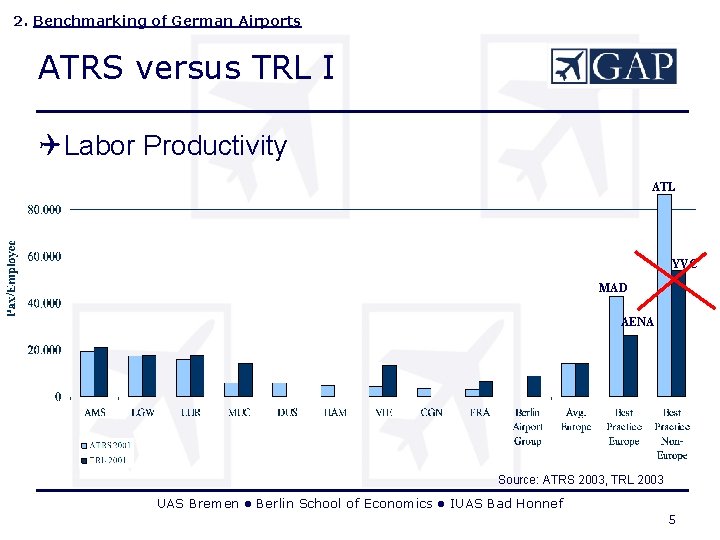
2. Benchmarking of German Airports ATRS versus TRL I QLabor Productivity ATL YVC MAD AENA Source: ATRS 2003, TRL 2003 UAS Bremen ● Berlin School of Economics ● IUAS Bad Honnef 5
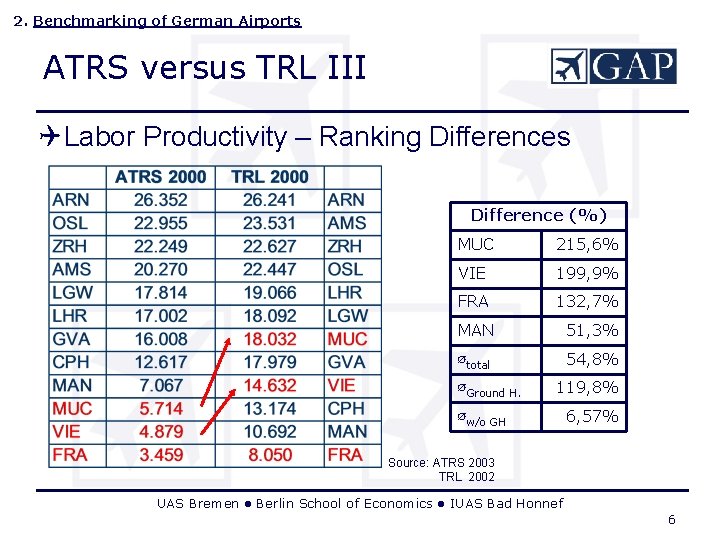
2. Benchmarking of German Airports ATRS versus TRL III QLabor Productivity – Ranking Differences Difference (%) MUC 215, 6% VIE 199, 9% FRA 132, 7% MAN 51, 3% ∅total 54, 8% ∅Ground H. 119, 8% ∅w/o GH 6, 57% Source: ATRS 2003 TRL 2002 UAS Bremen ● Berlin School of Economics ● IUAS Bad Honnef 6
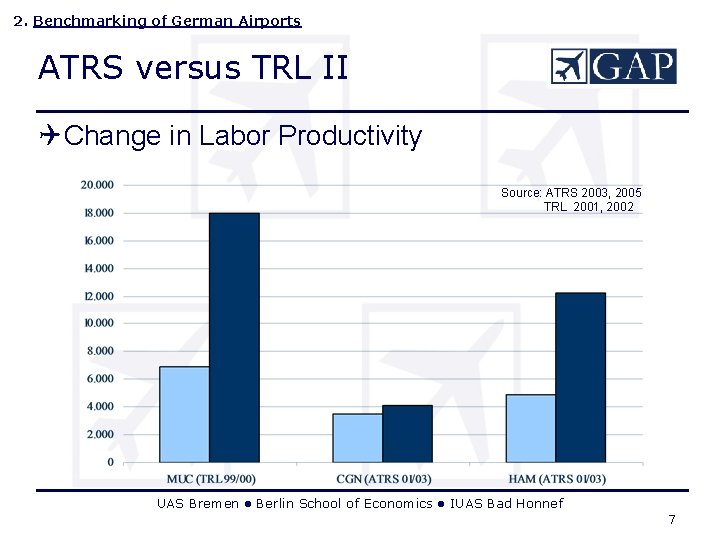
2. Benchmarking of German Airports ATRS versus TRL II QChange in Labor Productivity Source: ATRS 2003, 2005 TRL 2001, 2002 UAS Bremen ● Berlin School of Economics ● IUAS Bad Honnef 7
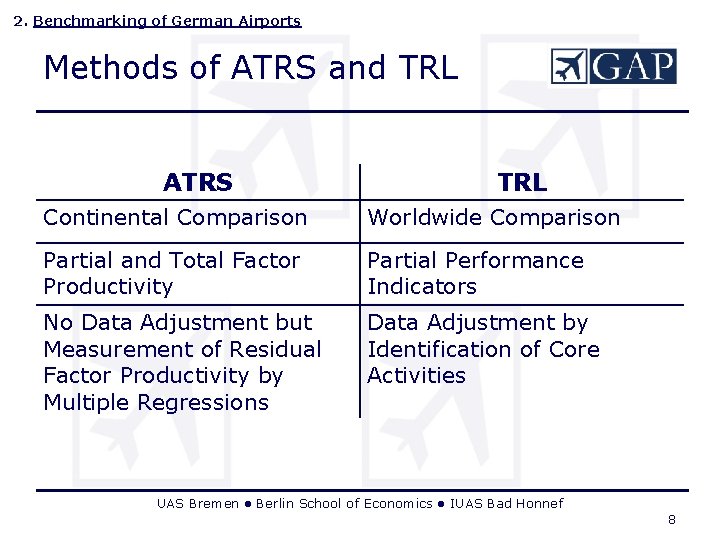
2. Benchmarking of German Airports Methods of ATRS and TRL ATRS TRL Continental Comparison Worldwide Comparison Partial and Total Factor Productivity Partial Performance Indicators No Data Adjustment but Measurement of Residual Factor Productivity by Multiple Regressions Data Adjustment by Identification of Core Activities UAS Bremen ● Berlin School of Economics ● IUAS Bad Honnef 8
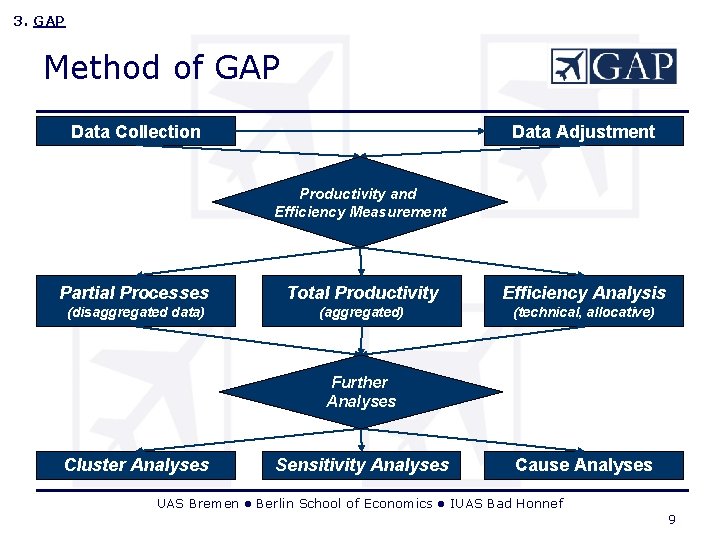
3. GAP Method of GAP Data Collection Data Adjustment Productivity and Efficiency Measurement Partial Processes Total Productivity Efficiency Analysis (disaggregated data) (aggregated) (technical, allocative) Further Analyses Cluster Analyses Sensitivity Analyses Cause Analyses UAS Bremen ● Berlin School of Economics ● IUAS Bad Honnef 9
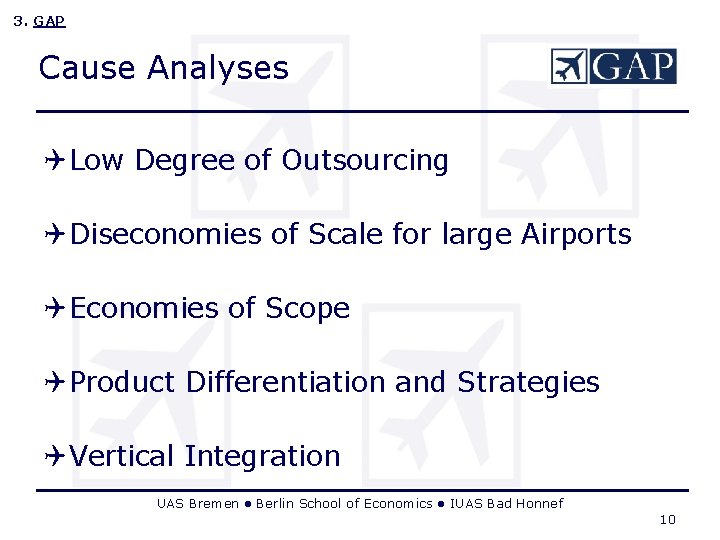
3. GAP Cause Analyses QLow Degree of Outsourcing QDiseconomies of Scale for large Airports QEconomies of Scope QProduct Differentiation and Strategies QVertical Integration UAS Bremen ● Berlin School of Economics ● IUAS Bad Honnef 10
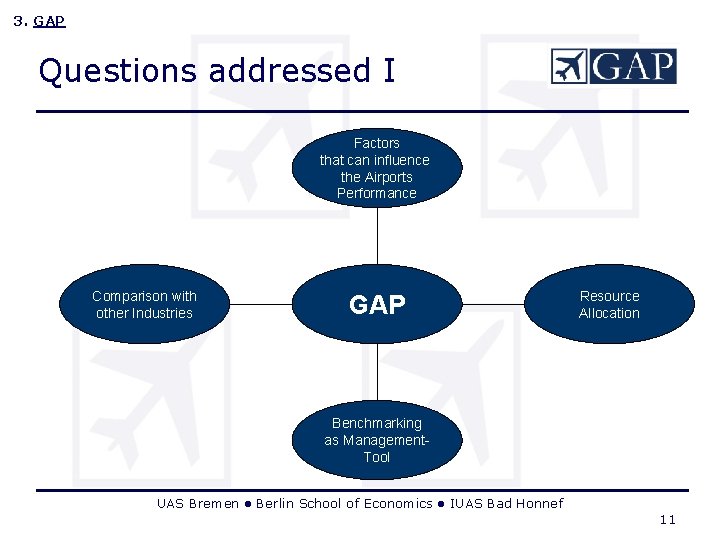
3. GAP Questions addressed I Factors that can influence the Airports Performance Comparison with other Industries GAP Resource Allocation Benchmarking as Management. Tool UAS Bremen ● Berlin School of Economics ● IUAS Bad Honnef 11
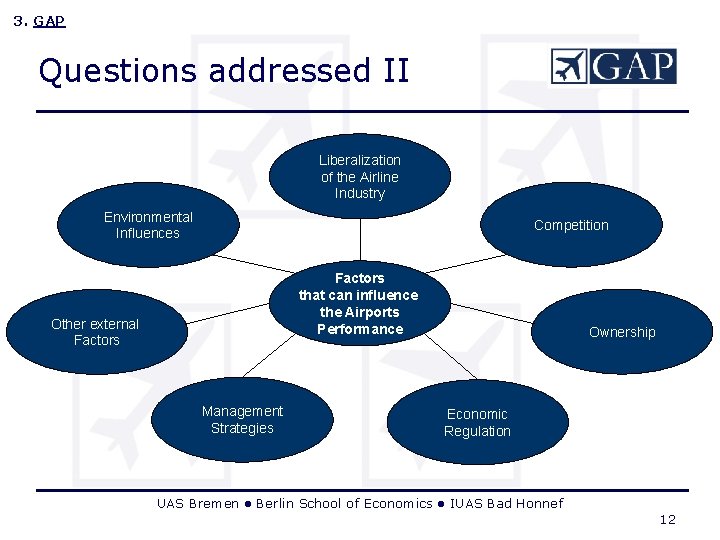
3. GAP Questions addressed II Liberalization of the Airline Industry Environmental Influences Competition Factors that can influence the Airports Performance Other external Factors Management Strategies Ownership Economic Regulation UAS Bremen ● Berlin School of Economics ● IUAS Bad Honnef 12
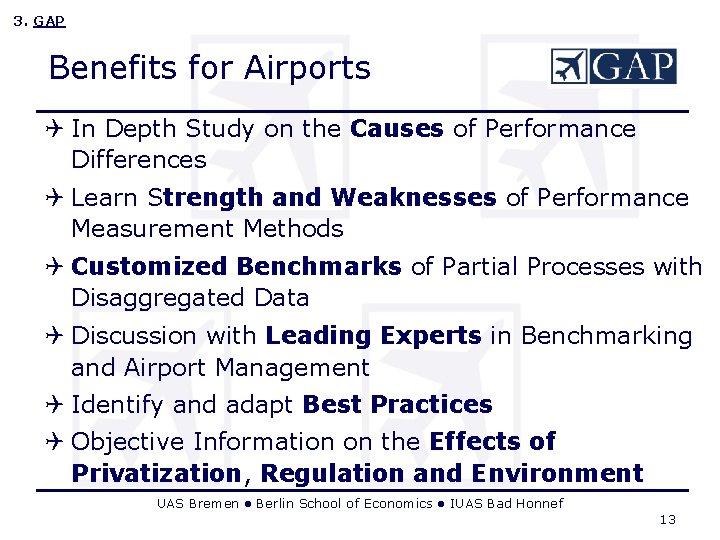
3. GAP Benefits for Airports Q In Depth Study on the Causes of Performance Differences Q Learn Strength and Weaknesses of Performance Measurement Methods Q Customized Benchmarks of Partial Processes with Disaggregated Data Q Discussion with Leading Experts in Benchmarking and Airport Management Q Identify and adapt Best Practices Q Objective Information on the Effects of Privatization, Regulation and Environment UAS Bremen ● Berlin School of Economics ● IUAS Bad Honnef 13
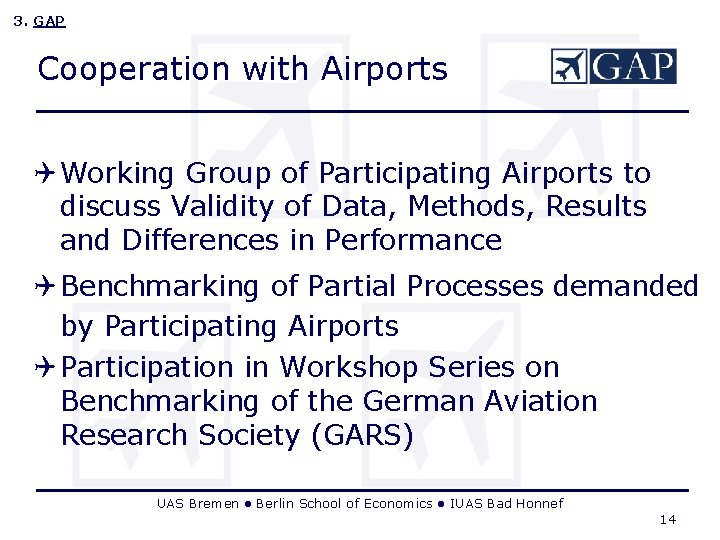
3. GAP Cooperation with Airports Q Working Group of Participating Airports to discuss Validity of Data, Methods, Results and Differences in Performance Q Benchmarking of Partial Processes demanded by Participating Airports Q Participation in Workshop Series on Benchmarking of the German Aviation Research Society (GARS) UAS Bremen ● Berlin School of Economics ● IUAS Bad Honnef 14
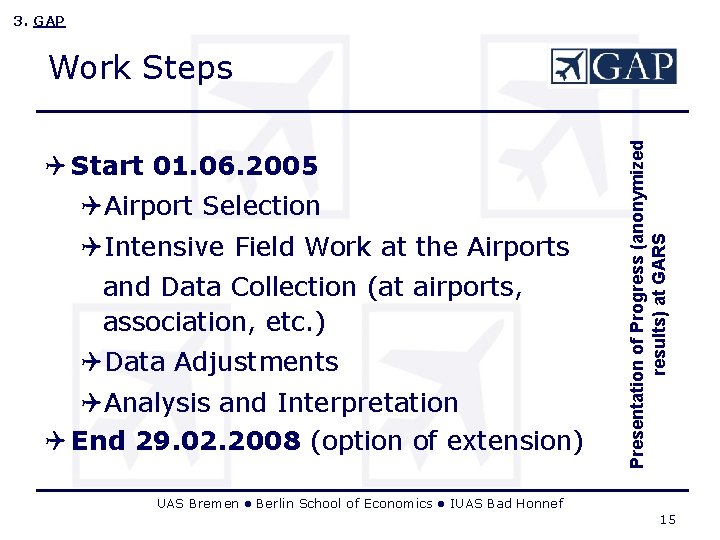
3. GAP Q Start 01. 06. 2005 QAirport Selection QIntensive Field Work at the Airports and Data Collection (at airports, association, etc. ) QData Adjustments QAnalysis and Interpretation Q End 29. 02. 2008 (option of extension) UAS Bremen ● Berlin School of Economics ● IUAS Bad Honnef Presentation of Progress (anonymized results) at GARS Work Steps 15
4. Scientific Partner International Partners QYVR, University of British Columbia: Prof. David Gillen und Prof. Tae Oum QLON, Transport Research Laboratory: Peter Mackenzie-Williams QLON, University of Westminster: Dr. Anne Graham QMEL, Monash University: Prof. Peter Forsyth QAMS, University of Amsterdam: Prof. Jaap de Wit QCGN, RWTH Aachen + DLR: Prof. Johannes Reichmuth QKEL, If. W an der Universität Kiel: Dr. Hartmut Wolf QBER/DRS, TU Dresden + DIW: Prof. Christian von Hirschhausen UAS Bremen ● Berlin School of Economics ● IUAS Bad Honnef 16
5. Contact For Further Questions… Hochschule Bremen Prof. Dr. Hans-Martin Niemeier (Coordinator) Werderstr. 73 D-28199 Bremen Tel. : +49 (0)40 811 93 77 HM. Niemeier@t-online. de Fax: +49 (0)421 5905 -4815 Fachhochschule für Wirtschaft Berlin Prof. Dr. Jürgen Müller Badensche Str. 50 -51 D-10825 Berlin jmueller@fhw-berlin. de Tel. : +49 (0)30 857 89 -145 Fax: +49 (0)30 857 89 -199 Internationale Fachhochschule Bad Honnef Prof. Dr. Hansjochen Ehmer Mülheimer Str. 38 D-53604 Bad Honnef Tel. : +49 (0)2203 601 -21 84 H. Ehmer@dlr. de Fax: +49 (0)2203 601 -23 77 UAS Bremen ● Berlin School of Economics ● IUAS Bad Honnef 17
5. Contact …or Hochschule Bremen Diplom-Volksw. (FH) Vanessa Kamp Werderstr. 73 D-28199 Bremen vkamp@fbn. hs-bremen. de Tel. : +49 (0)421 5905 -4283 Fax: +49 (0)421 5905 -4599 Website: www. gap-projekt. de UAS Bremen ● Berlin School of Economics ● IUAS Bad Honnef 18
Thank you very much for your attention! UAS Bremen ● Berlin School of Economics ● IUAS Bad Honnef 19