
GERIATRICS AN OVERVIEW AGS KEERTI SHARMA MD ASSISTANT

- Slides: 45
GERIATRICS: AN OVERVIEW AGS KEERTI SHARMA, MD ASSISTANT PROFESSOR OF MEDICINE THE AMERICAN GERIATRICS SOCIETY Geriatrics Health Professionals. Leading change. Improving care for older adults.
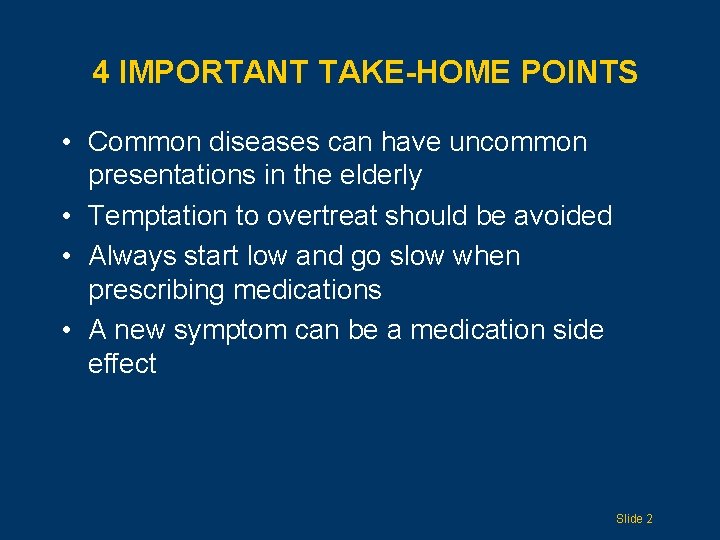
4 IMPORTANT TAKE-HOME POINTS • Common diseases can have uncommon presentations in the elderly • Temptation to overtreat should be avoided • Always start low and go slow when prescribing medications • A new symptom can be a medication side effect Slide 2
HISTORY • Develop a symptom • Perceive a symptom • Communicate Slide 3
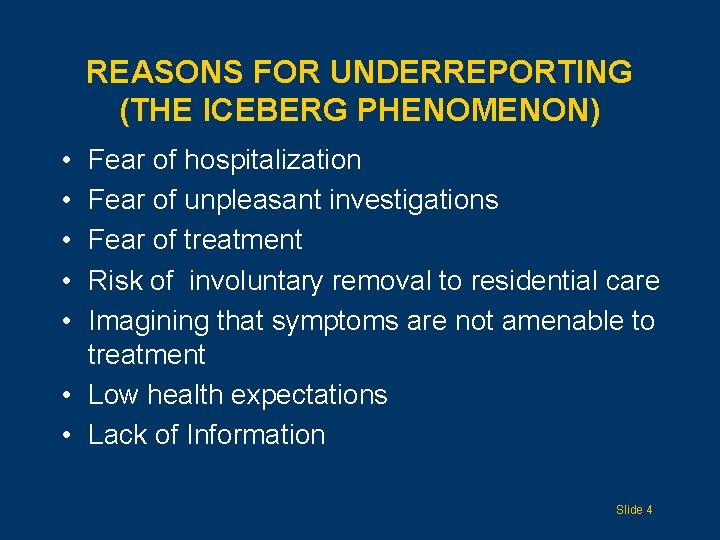
REASONS FOR UNDERREPORTING (THE ICEBERG PHENOMENON) • • • Fear of hospitalization Fear of unpleasant investigations Fear of treatment Risk of involuntary removal to residential care Imagining that symptoms are not amenable to treatment • Low health expectations • Lack of Information Slide 4
GOALS OF CARE • Focus must remain on keeping the older person functional • If that goal becomes medically infeasible, the patient’s dignity and comfort must then become the primary focus Slide 5
NORMAL AGING VERSUS PATHOLOGICAL AGING • Normal aging = aging-related changes • Pathological aging = aging-associated changes • Normal aging: Ø Involves a great number of biologic processes Ø Is characterized by progressive, predictable, and inevitable changes that are independent of disease Slide 6
PHYSIOLOGIC CHANGES WITH AGING
GENERAL PRINCIPLES OF NORMAL AGING • Organs in the same person age at different rates • Determinants of these rates include genetic makeup, personal choices, environmental exposures, and other factors • Aging changes are modifiable but inevitable Slide 8
BLOOD PRESSURE REGULATION • Higher risk for orthostatic or postural hypotension • Narrow range within which CNS perfusion maintained • Changes in antihypertensive drugs should be based on patient’s standing blood pressure Slide 9
CONTROL OF BODY TEMPERATURE Increased susceptibility to both hypothermia and hyperthermia Slide 10
VOLUME REGULATION • Predisposition to both volume depletion and volume overload • Decreased thirst • Decreased ADH response to hypovolemia and renal response to ADH • Greater difficulty in excreting fluid overload Ø Results in predisposition to hyponatremia and CHF Slide 11
BARRIER DEFENSES • Skin’s effectiveness as a barrier is decreased • Mucous membranes are less effective barriers • Ciliary clearance slows • Repair rate of injured skin declines • Disease affects wound healing Slide 12
PHYSICAL AND MECHANICAL DEFENSES • • Urine is less acidic Prostatic fluid has less antibacterial activity Bladder is less completely emptied Colonization of the vagina is more likely in estrogen-deficient women • Greater susceptibility to UTI and incontinence Slide 13
IMMUNE RESPONSE • Afebrile infection is common • Humoral antibody-mediated response is decreased • Antibody response to vaccine is decreased • Response to tuberculosis skin test decreases Slide 14
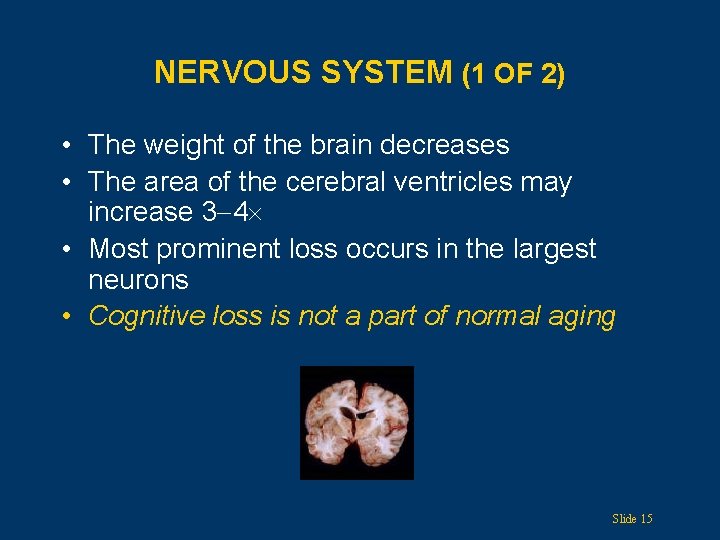
NERVOUS SYSTEM (1 OF 2) • The weight of the brain decreases • The area of the cerebral ventricles may increase 3 4 • Most prominent loss occurs in the largest neurons • Cognitive loss is not a part of normal aging Slide 15
NERVOUS SYSTEM (2 OF 2) • Changes affect the older person’s ability to distinguish between different stimuli • Reduced reaction time, resulting possibly in injuries and burns • Reduced balance • Greater risk of falls Slide 16
VISION • Iris becomes more rigid • Lens yellows (due to photooxidation and accumulation of insoluble protein) • Increased sensitivity to glare • Decreased static acuity and dynamic acuity • Decline in contrast sensitivity Slide 17
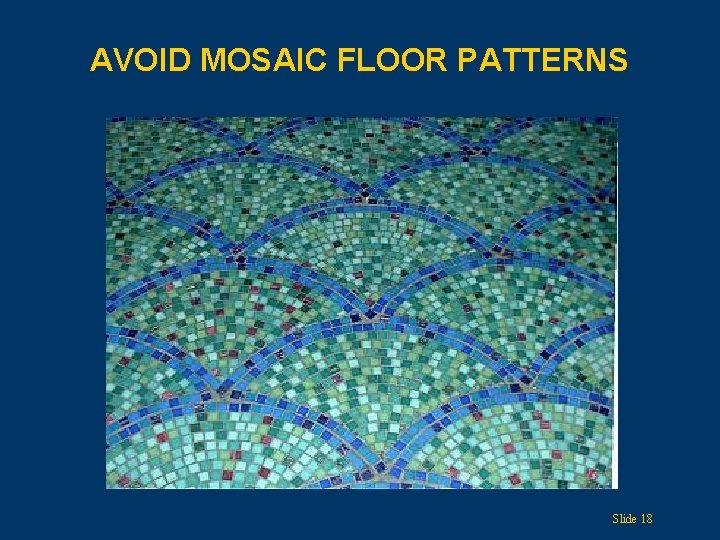
AVOID MOSAIC FLOOR PATTERNS Slide 18
HEARING • Drier cerumen, leading in greater risk of impaction • Tympanic membrane thickens • Ossicles undergo degenerative changes • Risk of high-frequency and low-frequency hearing loss Slide 19
TASTE AND SMELL • Olfaction declines Ø May lead to decreased enjoyment of food and difficulty in sorting the tastes of mixed and combined foods • Gustatory function unchanged Slide 20
CARDIOVASCULAR SYSTEM • Blood vessels: increased intimal thickness, increased wall thickness, increased smooth muscle Ø Leads to increased systolic and pulse pressure • Heart muscle: increased afterload Ø Leads to LVH, decreased cardiac output • Heart valves: left sides become sclerotic • Response to sympathetic stimulation: reduced Ø Leads to reduction in cardiac output during stress (eg, surgery) and increased risk of CHF Slide 21
RESPIRATORY SYSTEM • • Decreased effectiveness of cough Decline in PO 2 Decreased pulmonary reserve during stress Increased frequency of infection, increased likelihood of hypoxia Slide 22
GASTROINTESTINAL SYSTEM (1 OF 2) • Less effective chewing, even with intact teeth • Food is kept in the mouth longer and larger pieces of food are swallowed • Swallowing is less coordinated, which increases the risk of aspiration Slide 23
GASTROINTESTINAL SYSTEM (2 OF 2) • Lactase levels decline and intolerance of dairy products is common • Colon: slowed transit and increase in opioid receptor Ø May predispose the older person to drug-induced constipation • Liver: after age 30 there is 1% per year decline in liver mass and blood flow every year Slide 24
RENAL SYSTEM • After age 20 GFR decreases 0. 5% per year and renal blood flow decreases 1% per year • Serum creatinine is an imperfect marker of renal function in the elderly • Increased likelihood of adverse outcome from drugs with narrow therapeutic margins (eg, digoxin, aminoglycosides) Slide 25
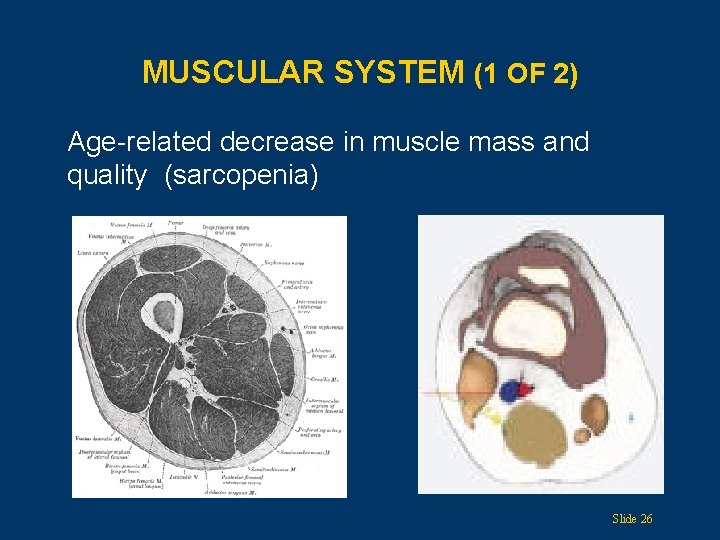
MUSCULAR SYSTEM (1 OF 2) Age-related decrease in muscle mass and quality (sarcopenia) Slide 26
MUSCULAR SYSTEM (2 OF 2) • Lower-extremity strength is lost at a faster rate than upper-extremity strength • Water content decreases in tendons and ligaments, and stiffness increases Slide 27
ENDOCRINE SYSTEM • Slight increase in fasting glucose, not clinically significant • Thyroid hormone levels unchanged • Vitamin D levels decline Slide 28
ANATOMY • Loss of height: 5 -cm decrease by age 75 due to increased hip and knee flexion, decreased vertebral body height, vertebral disc compaction, and flattening of foot arch • Fat compartment expands with age • Total body weight unchanged because of decrease in lean body mass Slide 29
COAGULATION • No change in the absolute number of RBC, WBC, platelets • Chronic low-grade activation of clotting pathways • Doubling of d-dimer • ESR rate increases with age Ø Women = (age + 10) / 2 Ø Men = age / 2 Slide 30
ARTERIAL BLOOD GASES • Arterial p. H and PCO 2 do not change with age • Arterial oxygen content and PO 2 decline (3 mm Hg per decade) 100 (age / 3) Slide 31
SERUM CHEMISTRY • • Electrolytes unchanged Creatinine unchanged Minor decline in total protein and albumin Uric acid and alkaline phosphatase increase slightly Slide 32
CHANGES IN THE PHYSICAL EXAMINATION
POSSIBLE EXPLANATIONS • Multiple comorbidities • Age-related physiological changes may alter perception to stimulus • Cognitive impairment may prevent patient from providing an accurate history Slide 34
GASTROINTESTINAL DISEASES • Achalasia: lower incidence of chest pain • Respond equally well to pneumatic dilation Slide 35
INTRA-ABDOMINAL INFECTIONS • Less likely to have nausea, vomiting or fever • More likely to be hypothermic and neutropenic • More likely to have biliary or pancreatic sources • Associated with significant mortality and morbidity Slide 36
APPENDICITIS • Although more common in the young, associated with higher mortality in the elderly • Abdominal rigidity, decreased bowel sounds, and the presence of a mass appear to be more common in older patients Slide 37
CHOLECYSTITIS May not present with the classic symptoms Slide 38
BACTEREMIA • Less likely to have fever, rigors, and chills • More likely to have delirium, weakness, or fall Slide 39
MYOCARDIAL INFARCTION • Dyspnea and CHF are common • Delirium was presenting symptom in 13% • Syncope and stroke were presenting symptoms in 7% Slide 40
PNEUMONIA • Atypical presentations occur more frequently • Nonspecific deterioration in a patient’s health status: decreased oral intake, fall, and confusion • Abrupt worsening of an underlying chronic medical condition Slide 41
URINARY TRACT INFECTION AND UROSEPSIS • Bacteriuria is increasingly common with advancing age • Lower tract infections (dysuria, urgency, suprapubic pain) usually missing • Upper urinary tract infection (flank pain, fever, and chills) usually missing • Confusion is a common presenting sign Slide 42
WORKUP • Avoid the temptation to overtreat • Treatment side effects must never be worse than the disease Slide 43
4 IMPORTANT TAKE-HOME POINTS • Common diseases can have uncommon presentations in the elderly • Temptation to overtreat should be avoided • Always start low and go slow when prescribing medications • A new symptom can be a medication side effect Slide 44
THANK YOU FOR YOUR TIME! Visit us at: www. americangeriatrics. org Facebook. com/American. Geriatrics. Society Twitter. com/Amer. Geriatrics linkedin. com/company/american-geriatricssociety Slide 45