
Gerald Mills UCDs School of Geography Planning Environmental

- Slides: 15
Gerald Mills UCD’s School of Geography, Planning & Environmental Policy Dublin, Ireland.
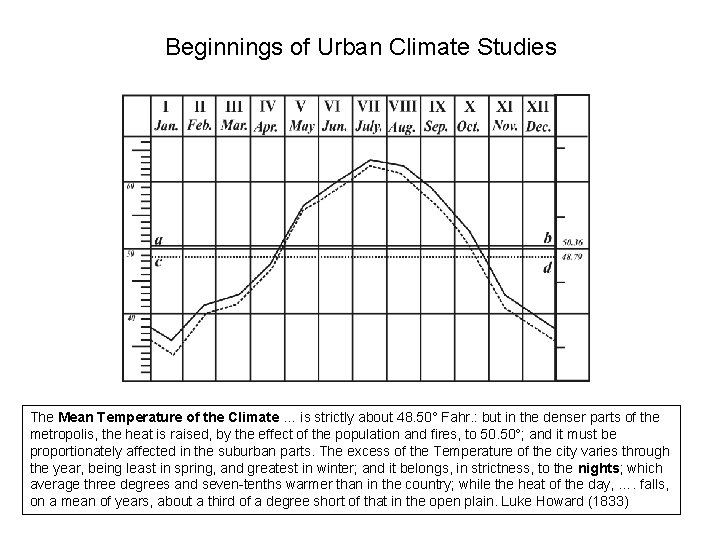
Beginnings of Urban Climate Studies The Mean Temperature of the Climate … is strictly about 48. 50° Fahr. : but in the denser parts of the metropolis, the heat is raised, by the effect of the population and fires, to 50. 50°; and it must be proportionately affected in the suburban parts. The excess of the Temperature of the city varies through the year, being least in spring, and greatest in winter; and it belongs, in strictness, to the nights; which average three degrees and seven-tenths warmer than in the country; while the heat of the day, …. falls, on a mean of years, about a third of a degree short of that in the open plain. Luke Howard (1833)
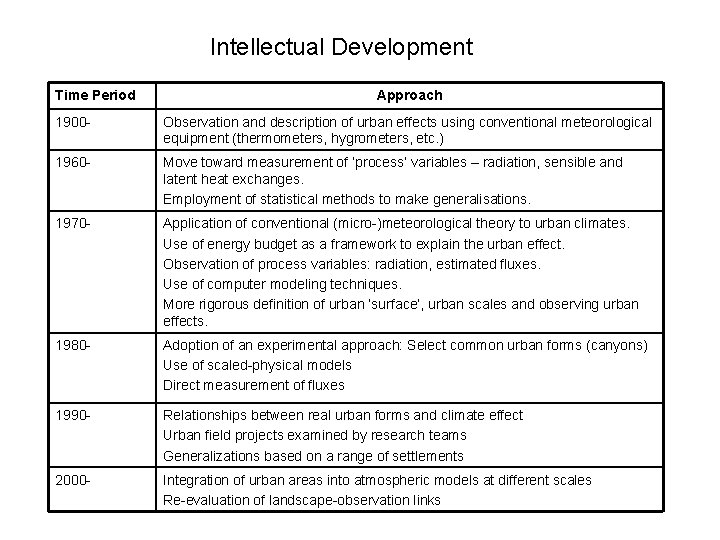
Intellectual Development Time Period Approach 1900 - Observation and description of urban effects using conventional meteorological equipment (thermometers, hygrometers, etc. ) 1960 - Move toward measurement of ‘process’ variables – radiation, sensible and latent heat exchanges. Employment of statistical methods to make generalisations. 1970 - Application of conventional (micro-)meteorological theory to urban climates. Use of energy budget as a framework to explain the urban effect. Observation of process variables: radiation, estimated fluxes. Use of computer modeling techniques. More rigorous definition of urban ‘surface’, urban scales and observing urban effects. 1980 - Adoption of an experimental approach: Select common urban forms (canyons) Use of scaled-physical models Direct measurement of fluxes 1990 - Relationships between real urban forms and climate effect Urban field projects examined by research teams Generalizations based on a range of settlements 2000 - Integration of urban areas into atmospheric models at different scales Re-evaluation of landscape-observation links
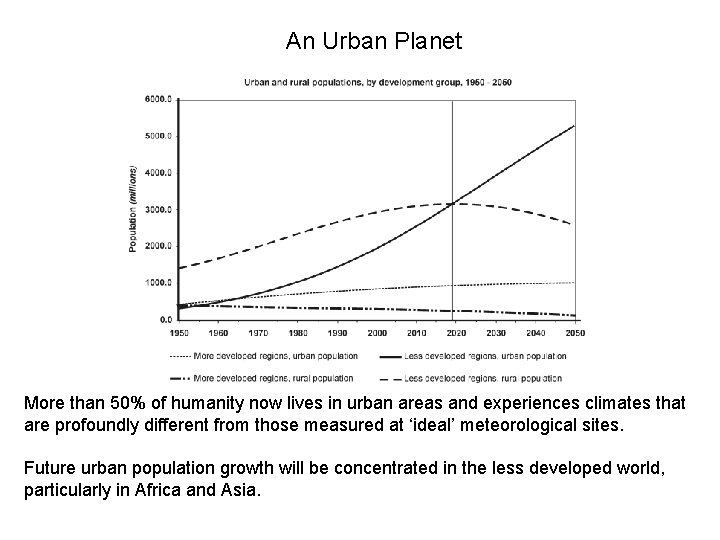
An Urban Planet More than 50% of humanity now lives in urban areas and experiences climates that are profoundly different from those measured at ‘ideal’ meteorological sites. Future urban population growth will be concentrated in the less developed world, particularly in Africa and Asia.
IAUC: A Brief History The formation of the IAUC is associated to a series of conferences on urban climates organised since the 1980’s, each organised by different bodies. These events brought together a diverse community of scholars. By 2000 many felt the time had come for the establishment of a body focussed on urban climate issues that would take a leadership role in organising International Conferences on Urban Climate (ICUC). The origin of the IAUC can be traced to ICUC-4 in Sydney, Australia. Year ICUC Location 2012 Dublin, Ireland 2009 Yokohama, Japan 2006 Göteborg, Sweden 2003 Lodz, Poland 1999 Sydney, Australia 1996 Essen, Germany 1993 Dakha, Bangladesh 1989 Kyoto, Japan An interim board was formed to create this organization. For simplicity, the unofficial board consisted of a member from each of the organizations involved in the Sydney meeting (Professor John Arnfield [IGU]; Professor Arieh Bitan [IFHP]; Professor Sue Grimmond [AMS]; Professor Tim Oke [ISB] and a representative from WMO).
The IAUC Organisation There was a shared ideal that the group wanted to keep meeting like this, perhaps without the budgetary vagaries that threaten societies and agencies and hence may cause the meetings to default. They also didn’t seem to want another scientific body with dues and political hassles. Clearly my vision is one of a low key, low maintenance, low administration and near zero cost organization, with a nearly virtual presence but significant influence. It also includes almost no rules, except those that govern the running of the Board in a democratic way. IAUC should be collegial and the organization should belong to the members. Oke (First President of the IAUC, 2002)
IAUC Development 2000 -2010 The organisational structure that was established was simple and consisted of a board of fourteen, ten of which were elected by the membership. Membership of the society is free. It seeks membership from those with scientific, scholarly and technical interests and responsibilities in: • the climatology and meteorology of built-up areas, • exchange processes between the urban "surface" and the overlying boundary layer, • urban air quality, • wind and turbulence in the city, • measurement, modeling and remote sensing of urban atmospheric and surface characteristics at all scales, • micro-scale processes and patterns associated with urban landscape elements (buildings, canyons, parks, roads etc), • building climatology, • biometeorology and bioclimatology within urban ecosystems, including human comfort and hazards, • the inclusion of urban atmospheric processes into design and planning and the modelling of weather, and • the representation of urban landscapes in models of climate at meso-scales. Most communication with the membership and within the board is electronic (Web www. urban-climate. org, personal email and a list email Urbclim).
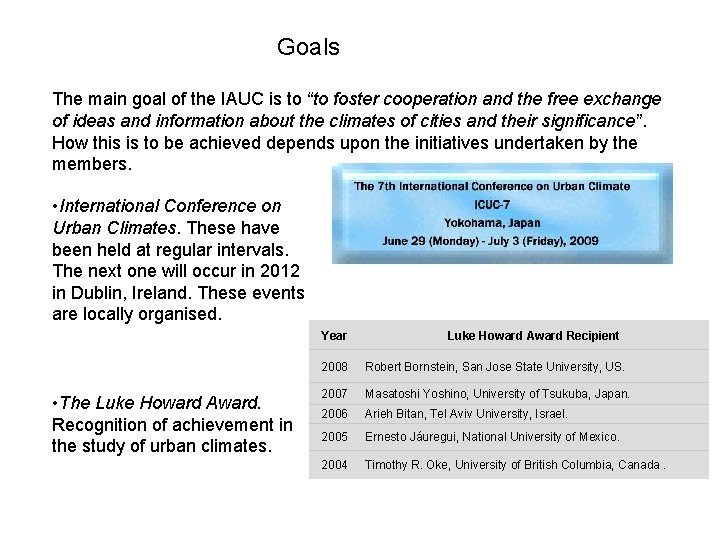
Goals The main goal of the IAUC is to “to foster cooperation and the free exchange of ideas and information about the climates of cities and their significance”. How this is to be achieved depends upon the initiatives undertaken by the members. • International Conference on Urban Climates. These have been held at regular intervals. The next one will occur in 2012 in Dublin, Ireland. These events are locally organised. Year • The Luke Howard Award. Recognition of achievement in the study of urban climates. Luke Howard Award Recipient 2008 Robert Bornstein, San Jose State University, US. 2007 Masatoshi Yoshino, University of Tsukuba, Japan. 2006 Arieh Bitan, Tel Aviv University, Israel. 2005 Ernesto Jáuregui, National University of Mexico. 2004 Timothy R. Oke, University of British Columbia, Canada.
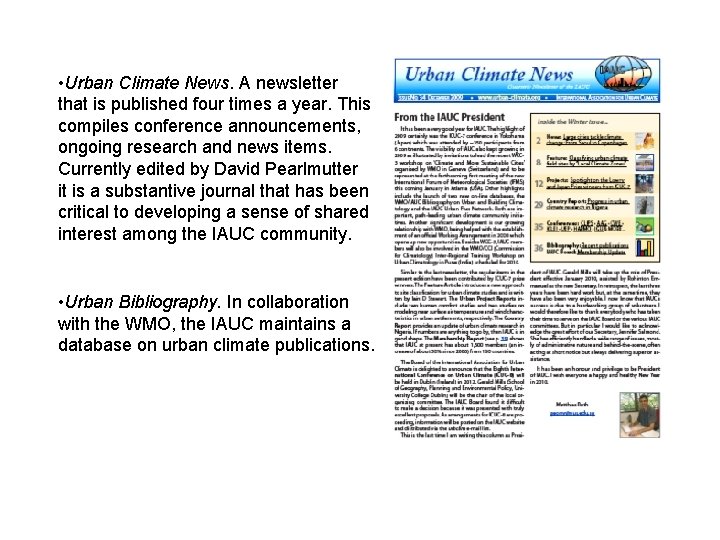
• Urban Climate News. A newsletter that is published four times a year. This compiles conference announcements, ongoing research and news items. Currently edited by David Pearlmutter it is a substantive journal that has been critical to developing a sense of shared interest among the IAUC community. • Urban Bibliography. In collaboration with the WMO, the IAUC maintains a database on urban climate publications.
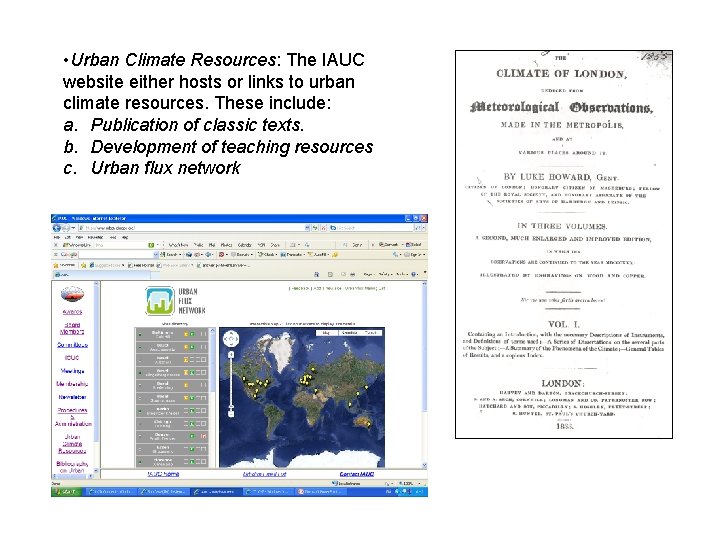
• Urban Climate Resources: The IAUC website either hosts or links to urban climate resources. These include: a. Publication of classic texts. b. Development of teaching resources c. Urban flux network
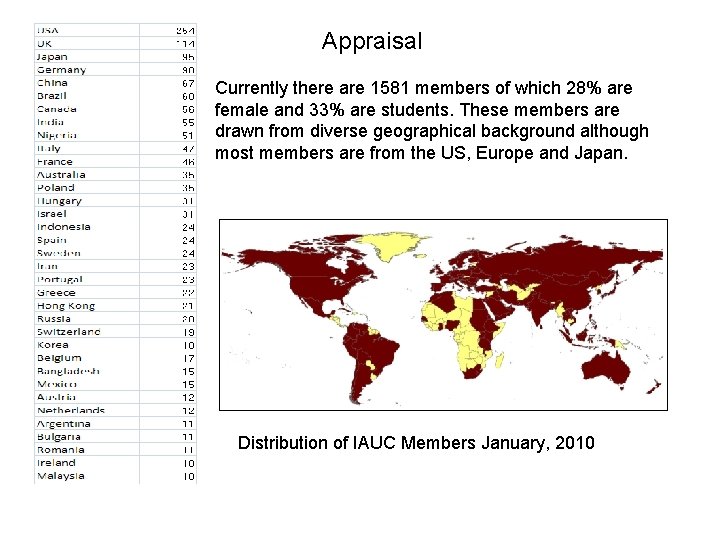
Appraisal Currently there are 1581 members of which 28% are female and 33% are students. These members are drawn from diverse geographical background although most members are from the US, Europe and Japan. Distribution of IAUC Members January, 2010
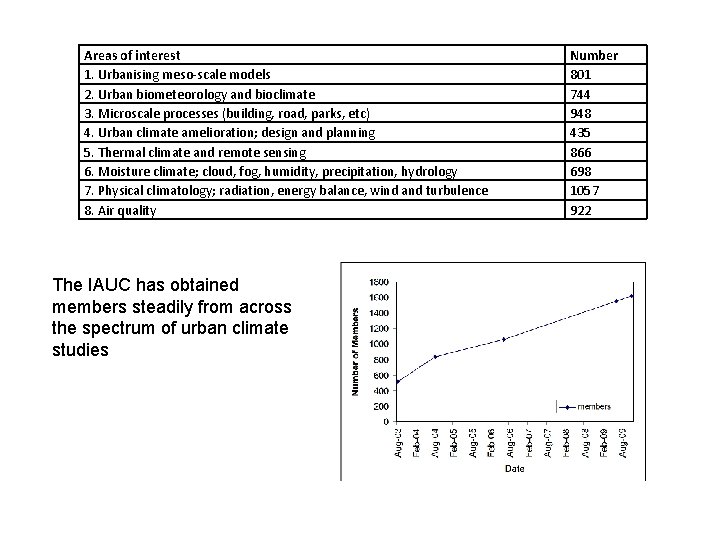
Areas of interest 1. Urbanising meso-scale models 2. Urban biometeorology and bioclimate 3. Microscale processes (building, road, parks, etc) 4. Urban climate amelioration; design and planning 5. Thermal climate and remote sensing 6. Moisture climate; cloud, fog, humidity, precipitation, hydrology 7. Physical climatology; radiation, energy balance, wind and turbulence 8. Air quality The IAUC has obtained members steadily from across the spectrum of urban climate studies Number 801 744 948 435 866 698 1057 922
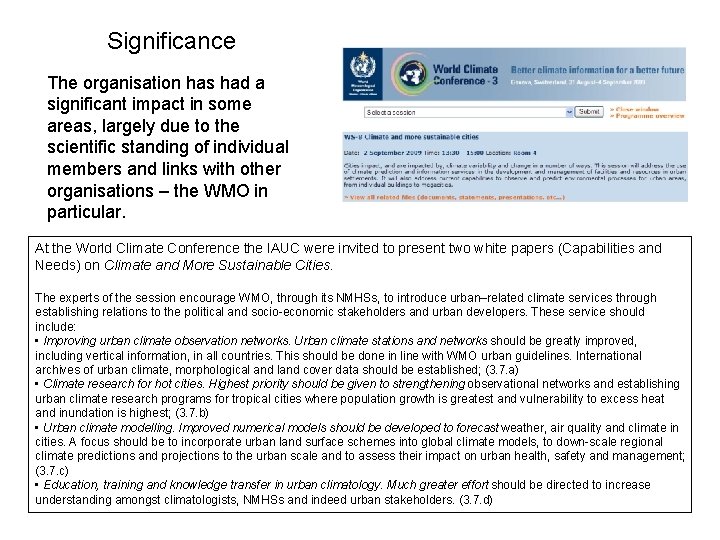
Significance The organisation has had a significant impact in some areas, largely due to the scientific standing of individual members and links with other organisations – the WMO in particular. At the World Climate Conference the IAUC were invited to present two white papers (Capabilities and Needs) on Climate and More Sustainable Cities. The experts of the session encourage WMO, through its NMHSs, to introduce urban–related climate services through establishing relations to the political and socio-economic stakeholders and urban developers. These service should include: • Improving urban climate observation networks. Urban climate stations and networks should be greatly improved, including vertical information, in all countries. This should be done in line with WMO urban guidelines. International archives of urban climate, morphological and land cover data should be established; (3. 7. a) • Climate research for hot cities. Highest priority should be given to strengthening observational networks and establishing urban climate research programs for tropical cities where population growth is greatest and vulnerability to excess heat and inundation is highest; (3. 7. b) • Urban climate modelling. Improved numerical models should be developed to forecast weather, air quality and climate in cities. A focus should be to incorporate urban land surface schemes into global climate models, to down-scale regional climate predictions and projections to the urban scale and to assess their impact on urban health, safety and management; (3. 7. c) • Education, training and knowledge transfer in urban climatology. Much greater effort should be directed to increase understanding amongst climatologists, NMHSs and indeed urban stakeholders. (3. 7. d)
Challenges To this point the structure of the IAUC has served it well. The drive of individual members has maintained a momentum. The administrative load is light and much of the management of the organisation is shared among committed members. Some of the concerns of the urban climate community that inspired the formation of the IAUC still remain. As the IAUC grows in size and scope some issues have arisen and others can be anticipated: • Adoption of a formal constitution, • Sustaining momentum through new initiatives and volunteers, • Needing funds to support initiatives, • Overcoming a reliance of relatively few high profile individuals, • Ensuring that it becomes a genuinely international organization, and • Providing leadership in developing areas of research
Conclusion The character of the IAUC is a modern organisation in that it has few of the advantages and disadvantages of older organisations. It operates without a budget and relies on the goodwill of its members. It can function effectively because of technology, which allows us to maintain a ‘virtual’ community. Its formation was well timed. The field has developed rapidly in the last twenty years and this has corresponded with a major shift in the population of the planet to urban areas. This means that there is a substantial community of urban climate ‘experts’ and a large interest in the field. Unfortunately, much of our expertise is based upon the largely completed cities of the developed world, whereas the needs are greatest in the emerging metropolises of the developing world. The ‘open knowledge’ perspective of the IAUC can help address this gap. Ideally the IAUC will maintain its trajectory and stay true to its goal: “to foster cooperation and the free exchange of ideas and information about the climates of cities and their significance”.