
Gerald Karp Cell and Molecular Biology Fourth Edition
Gerald Karp Cell and Molecular Biology Fourth Edition Chapter 6: Photosynthesis and the Chloroplast Copyright © 2005 by John Wiley & Sons, Inc.
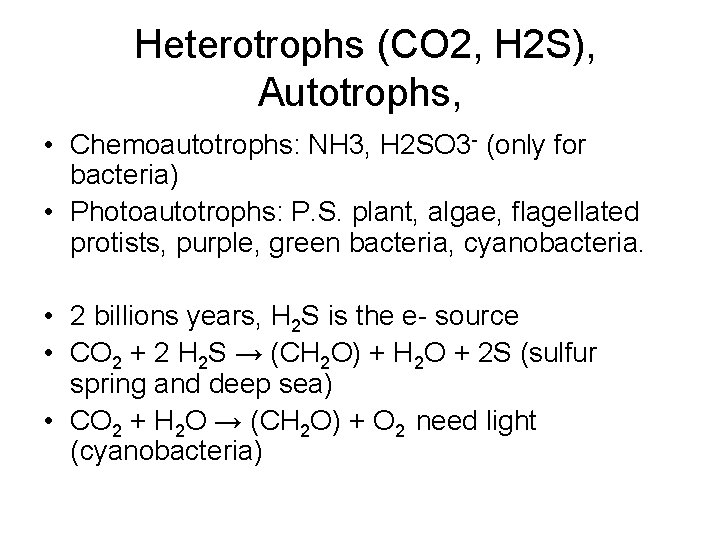
Heterotrophs (CO 2, H 2 S), Autotrophs, • Chemoautotrophs: NH 3, H 2 SO 3 - (only for bacteria) • Photoautotrophs: P. S. plant, algae, flagellated protists, purple, green bacteria, cyanobacteria. • 2 billions years, H 2 S is the e- source • CO 2 + 2 H 2 S → (CH 2 O) + H 2 O + 2 S (sulfur spring and deep sea) • CO 2 + H 2 O → (CH 2 O) + O 2 need light (cyanobacteria)

1881 German biologist T. Engelmann found the bacteria surround the algae in order to absorp the O 2 released by bacteria
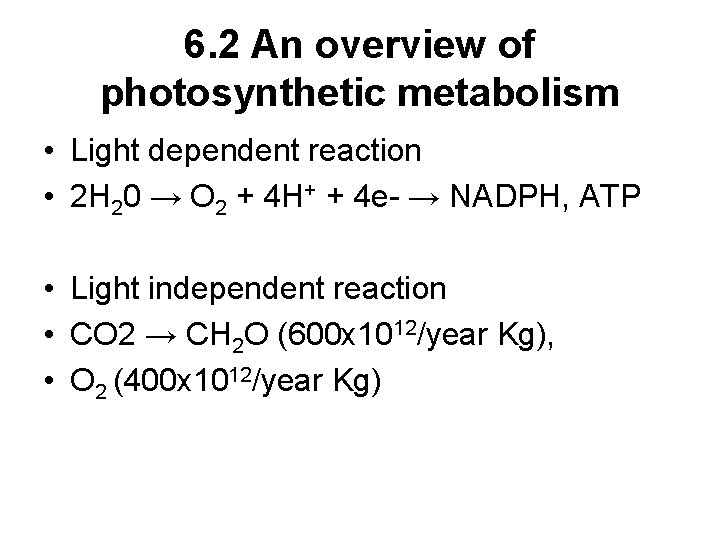
6. 2 An overview of photosynthetic metabolism • Light dependent reaction • 2 H 20 → O 2 + 4 H+ + 4 e- → NADPH, ATP • Light independent reaction • CO 2 → CH 2 O (600 x 1012/year Kg), • O 2 (400 x 1012/year Kg)
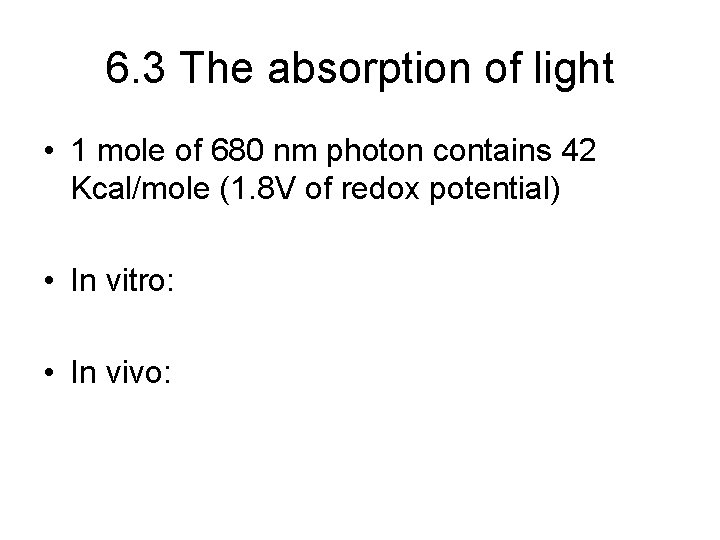
6. 3 The absorption of light • 1 mole of 680 nm photon contains 42 Kcal/mole (1. 8 V of redox potential) • In vitro: • In vivo:
1. Photosynthetic pigments • Chlorophyll: • porphyrin ring : absorption of light • hydrophobic phytol tail: in thylakoid membrane • Accessory pigments: carotenoids (capture energy and removal excited energy)

6. 4 Photosynthetic units and reaction centers • 1932: Emerson and Arnold of the CIT. About three hundred chlorophyll molecules absorbed to produce one molecule of oxygen ----- Photosynthetic unit • Only one member of the group ”the reaction-center chlorophyll” actually transfer electrons to an electron acceptor.
1. Oxygen formation: coordinating the action of two different photosynthetic systems • PSII operations: obtain electrons from water • • a. The flow of electrons from PSII to plastoquinone b. The flow of electrons from water to PSII • From PSII to PSI • PSI operations: The production of NADPH

From PSII to PSI
PS 1 operations: The production of NADPH 2001, 3 D structure of PS 1 from a cyanobacterium was discovered at 2. 5 A resolution. 12 polypeptides, 96 chlorophylls, 22 carotenoids and other elements
An overview of photosynthetic electron transport • Summary of the light-dependent reactions
Killing weeds by inhibiting electron transport • 1. Inhibitors of electron carries (herbicides) • 2. Binding to a core protein of PSII ( QB).
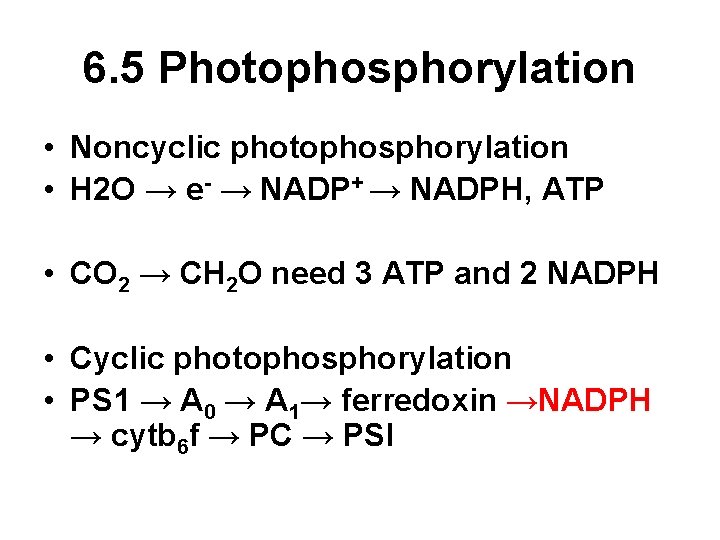
6. 5 Photophosphorylation • Noncyclic photophosphorylation • H 2 O → e- → NADP+ → NADPH, ATP • CO 2 → CH 2 O need 3 ATP and 2 NADPH • Cyclic photophosphorylation • PS 1 → A 0 → A 1→ ferredoxin →NADPH → cytb 6 f → PC → PSI
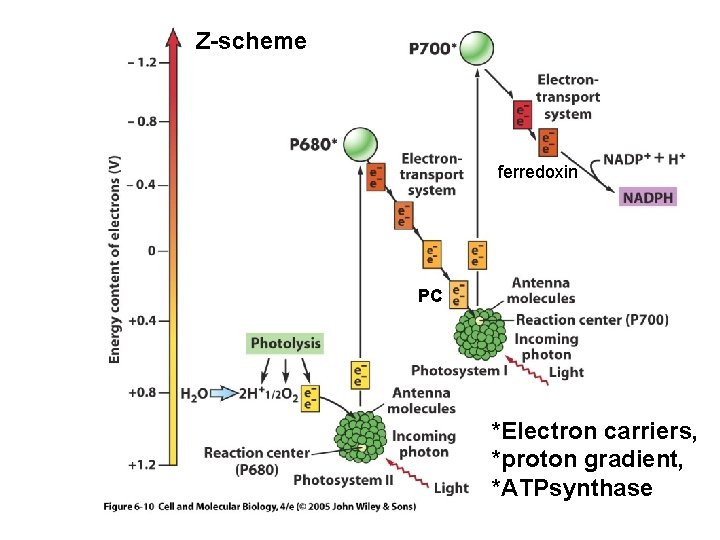
Z-scheme ferredoxin PC *Electron carriers, *proton gradient, *ATPsynthase
6. 6 carbon dioxide fixation and the synthesis of carbohydrate • 1. Carbohydrate synthesis in C 3 plants • Photorespiration and peroxisomes • 2. Carbohydrate synthesis in C 4 plants • 3. Carbohydrate synthesis in CAM plants
• Redox control of the Calvin cycle Several key enzymes of the Calvin cycle are only active in the light when ATP and NADPH are being produced by PS
6. 6 carbon dioxide fixation and the synthesis of carbohydrate • 1. Carbohydrate synthesis in C 3 plants • Photorespiration and peroxisomes • 2. Carbohydrate synthesis in C 4 plants • 3. Carbohydrate synthesis in CAM plants
6. 6 carbon dioxide fixation and the synthesis of carbohydrate • 1. Carbohydrate synthesis in C 3 plants • Photorespiration and peroxisomes • 2. Carbohydrate synthesis in C 4 plants • 3. Carbohydrate synthesis in CAM plants
6. 6 carbon dioxide fixation and the synthesis of carbohydrate • 1. Carbohydrate synthesis in C 3 plants • Photorespiration and peroxisomes • 2. Carbohydrate synthesis in C 4 plants • 3. Carbohydrate synthesis in CAM plants
• • Carbohydrate synthesis in CAM plants (cacti) carry out light-dependent reactions CO 2 fixation in different times (at night) of the day rather in different cells of the leaves At night, CO 2 enters into the leaves and fix to malic acid by PEP carboxylase in the vacuoles of the mesophyll, During the day, malic acid moves to cytoplasm to form malate and give CO 2 which can be fixed in Calvin cycle.
- Slides: 20