
Geostationary Operational NOAA Satellite and Information Service Environmental
- Slides: 17
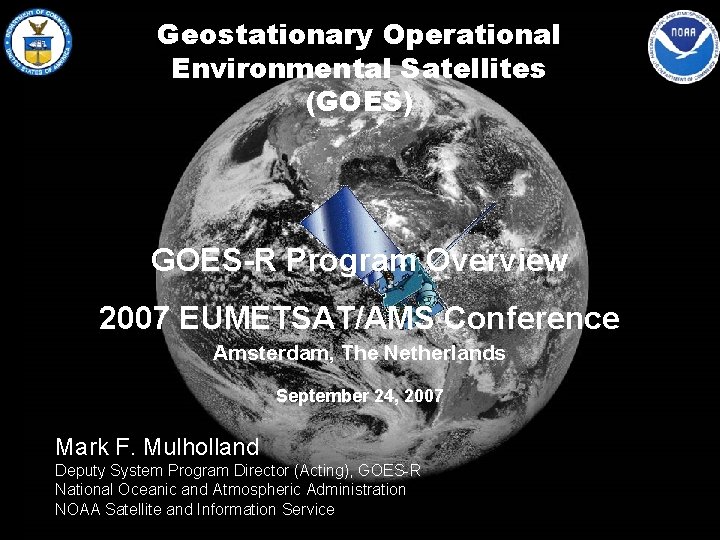
Geostationary Operational NOAA Satellite and Information Service Environmental Satellites (GOES) GOES-R Program Overview 2007 EUMETSAT/AMS Conference Amsterdam, The Netherlands September 24, 2007 Mark F. Mulholland Deputy System Program Director (Acting), GOES-R National Oceanic and Atmospheric Administration NOAA Satellite and Information Service
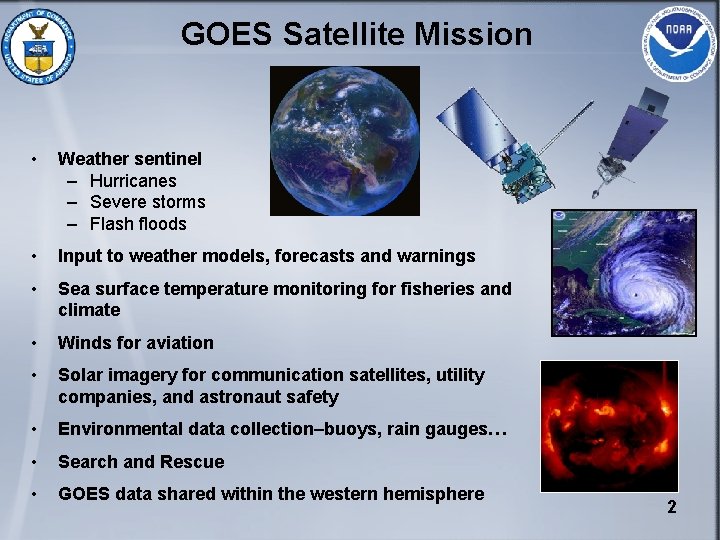
GOES Satellite Mission • Weather sentinel – Hurricanes – Severe storms – Flash floods • Input to weather models, forecasts and warnings • Sea surface temperature monitoring for fisheries and climate • Winds for aviation • Solar imagery for communication satellites, utility companies, and astronaut safety • Environmental data collection–buoys, rain gauges… • Search and Rescue • GOES data shared within the western hemisphere 2
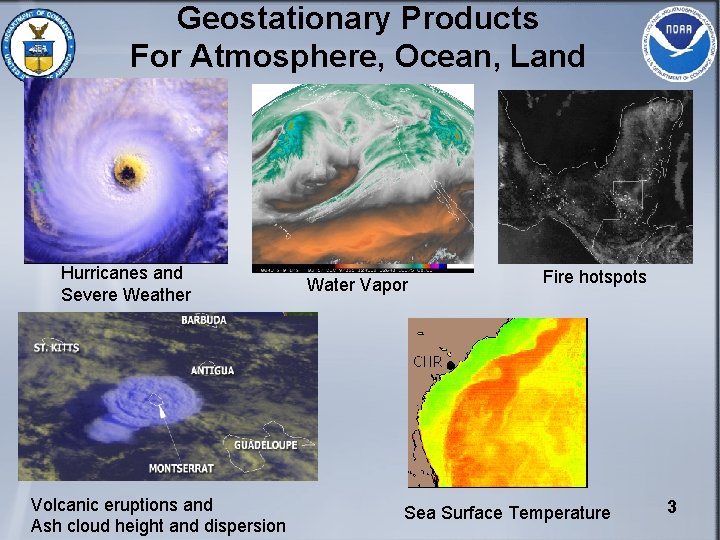
Geostationary Products For Atmosphere, Ocean, Land Hurricanes and Severe Weather Volcanic eruptions and Ash cloud height and dispersion Water Vapor Fire hotspots Sea Surface Temperature 3
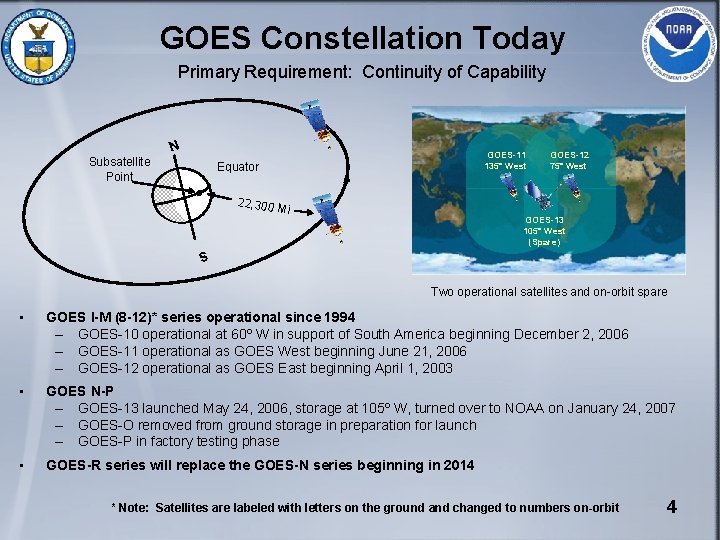
GOES Constellation Today Primary Requirement: Continuity of Capability N Subsatellite Point GOES-11 135° West Equator 22, 300 M i GOES-12 75° West GOES-13 105° West (Spare) S Two operational satellites and on-orbit spare • GOES I-M (8 -12)* series operational since 1994 – GOES-10 operational at 60º W in support of South America beginning December 2, 2006 – GOES-11 operational as GOES West beginning June 21, 2006 – GOES-12 operational as GOES East beginning April 1, 2003 • GOES N-P – GOES-13 launched May 24, 2006, storage at 105º W, turned over to NOAA on January 24, 2007 – GOES-O removed from ground storage in preparation for launch – GOES-P in factory testing phase • GOES-R series will replace the GOES-N series beginning in 2014 * Note: Satellites are labeled with letters on the ground and changed to numbers on-orbit 4
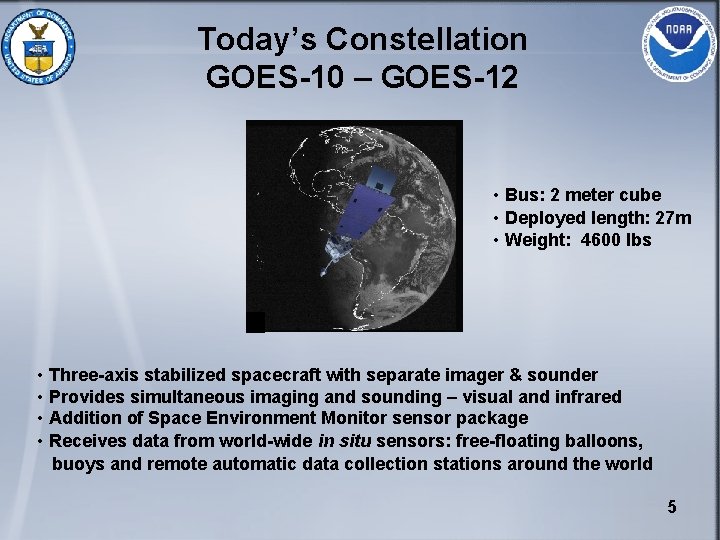
Today’s Constellation GOES-10 – GOES-12 • Bus: 2 meter cube • Deployed length: 27 m • Weight: 4600 lbs • Three-axis stabilized spacecraft with separate imager & sounder • Provides simultaneous imaging and sounding – visual and infrared • Addition of Space Environment Monitor sensor package • Receives data from world-wide in situ sensors: free-floating balloons, buoys and remote automatic data collection stations around the world 5
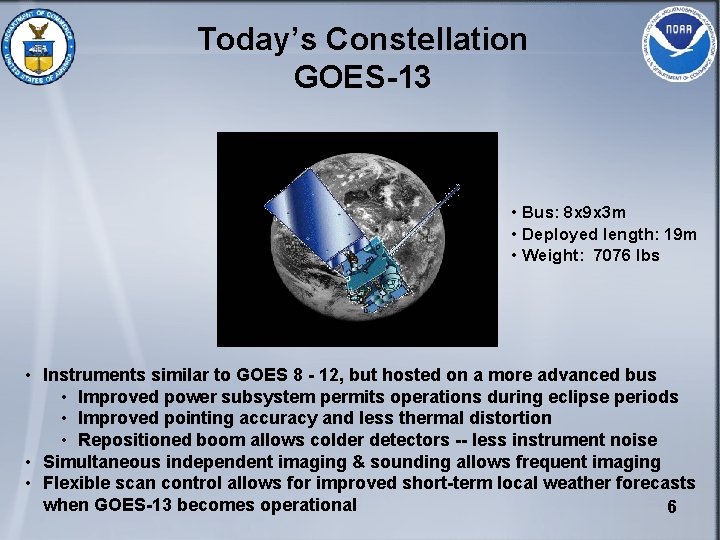
Today’s Constellation GOES-13 • Bus: 8 x 9 x 3 m • Deployed length: 19 m • Weight: 7076 lbs • Instruments similar to GOES 8 - 12, but hosted on a more advanced bus • Improved power subsystem permits operations during eclipse periods • Improved pointing accuracy and less thermal distortion • Repositioned boom allows colder detectors -- less instrument noise • Simultaneous independent imaging & sounding allows frequent imaging • Flexible scan control allows for improved short-term local weather forecasts when GOES-13 becomes operational 6
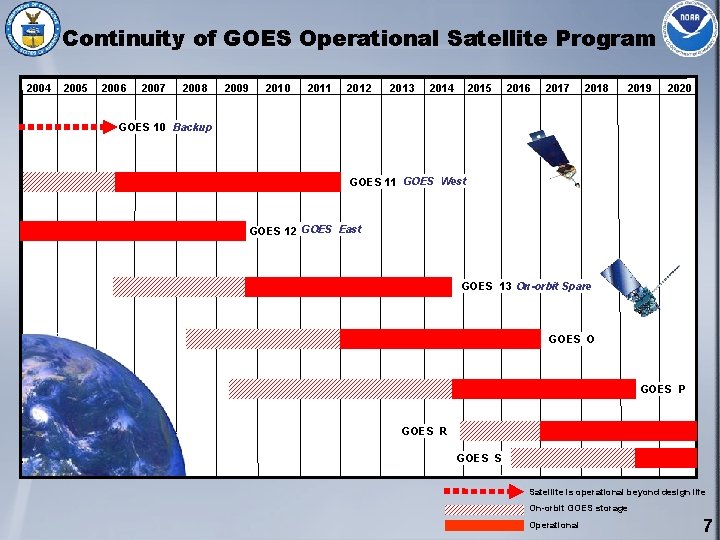
Continuity of GOES Operational Satellite Program 2004 2005 2006 2007 2008 2009 2010 2011 2012 2013 2014 2015 2016 2017 2018 2019 2020 GOES 10 Backup GOES 11 GOES West GOES 12 GOES East GOES 13 On-orbit Spare GOES O GOES P GOES R GOES S Satellite is operational beyond design life On-orbit GOES storage Operational 7
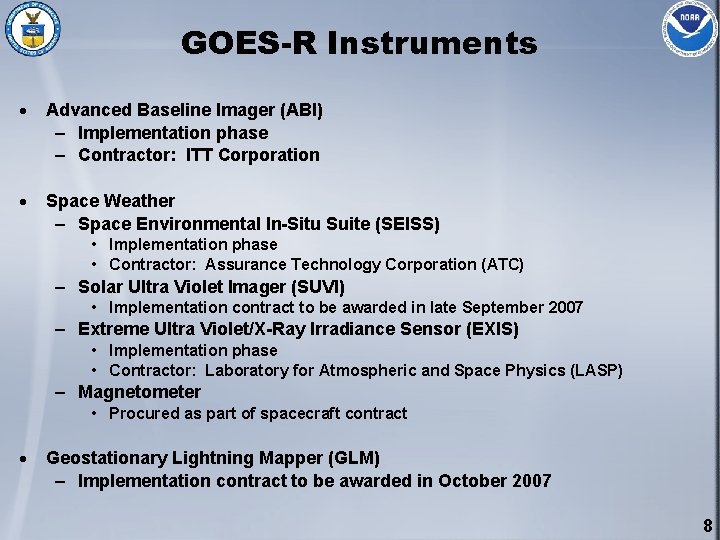
GOES-R Instruments · Advanced Baseline Imager (ABI) – Implementation phase – Contractor: ITT Corporation · Space Weather – Space Environmental In-Situ Suite (SEISS) • Implementation phase • Contractor: Assurance Technology Corporation (ATC) – Solar Ultra Violet Imager (SUVI) • Implementation contract to be awarded in late September 2007 – Extreme Ultra Violet/X-Ray Irradiance Sensor (EXIS) • Implementation phase • Contractor: Laboratory for Atmospheric and Space Physics (LASP) – Magnetometer • Procured as part of spacecraft contract · Geostationary Lightning Mapper (GLM) – Implementation contract to be awarded in October 2007 8
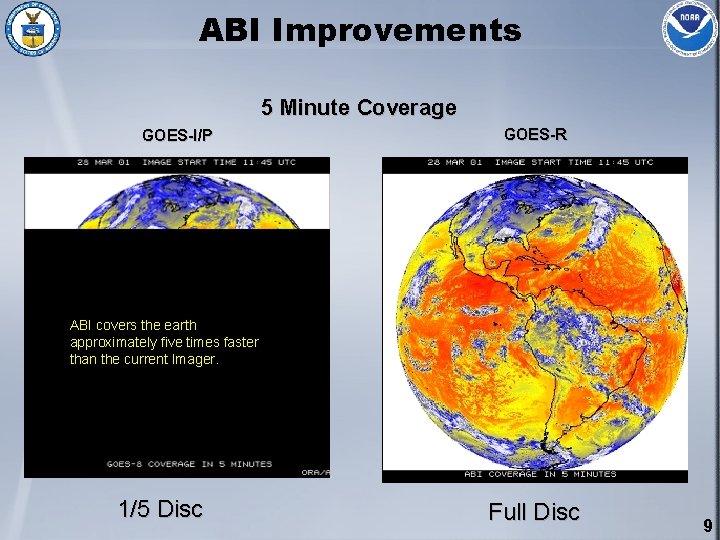
ABI Improvements 5 Minute Coverage GOES-I/P GOES-R ABI covers the earth approximately five times faster than the current Imager. 1/5 Disc Full Disc 9
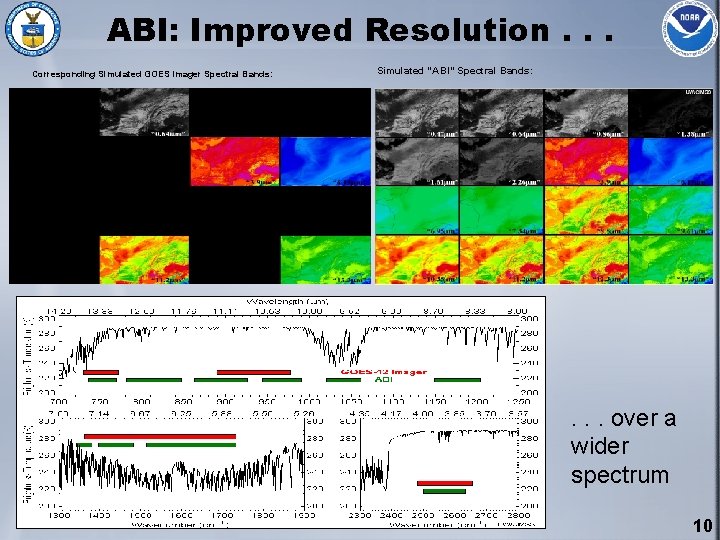
ABI: Improved Resolution. . . Corresponding Simulated GOES Imager Spectral Bands: Simulated “ABI” Spectral Bands: . . . over a wider spectrum 10
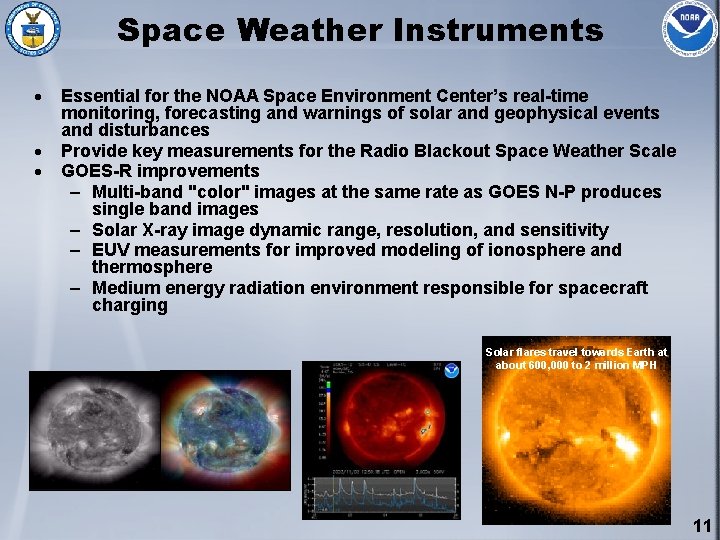
Space Weather Instruments · · · Essential for the NOAA Space Environment Center’s real-time monitoring, forecasting and warnings of solar and geophysical events and disturbances Provide key measurements for the Radio Blackout Space Weather Scale GOES-R improvements – Multi-band "color" images at the same rate as GOES N-P produces single band images – Solar X-ray image dynamic range, resolution, and sensitivity – EUV measurements for improved modeling of ionosphere and thermosphere – Medium energy radiation environment responsible for spacecraft charging Solar flares travel towards Earth at about 600, 000 to 2 million MPH 11
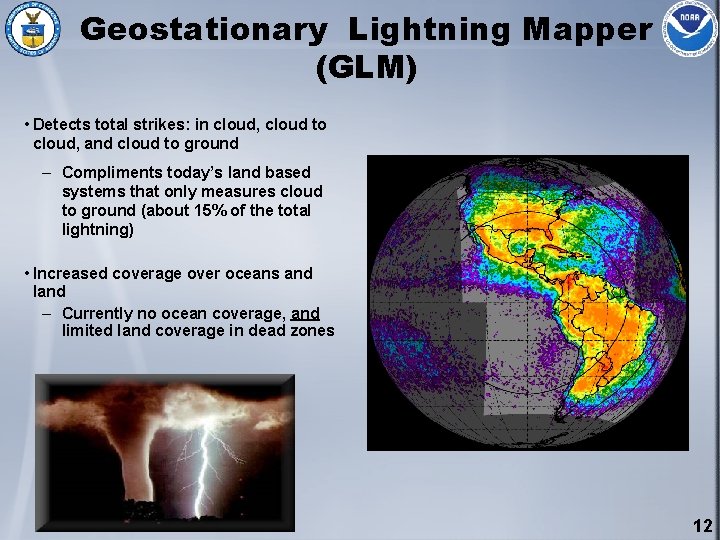
Geostationary Lightning Mapper (GLM) • Detects total strikes: in cloud, cloud to cloud, and cloud to ground – Compliments today’s land based systems that only measures cloud to ground (about 15% of the total lightning) • Increased coverage over oceans and land – Currently no ocean coverage, and limited land coverage in dead zones Figure from NASA. 12
Advanced Sounding · Hyperspectral Environmental Suite (HES) instrument removed from GOES-R program – August 2006 · Subsequent efforts included: – Assessment of ABI data for derived sounder products – NOAA Analysis of Alternatives (AOA) study • Advanced sounding • Coastal waters imaging – Contractor studies of advanced sounding concepts for later GOES spacecraft · Conclusions – ABI can approximate current GOES sounder capabilities – A geostationary advanced sounder demonstration mission should be funded as soon as possible 13
Program Status · NOAA/NASA Memorandum of Understanding signed on June 15, 2007 – Documents NOAA and NASA roles, responsibilities, authorities – Establishes basic management structure · Program Definition and Risk Reduction contracts ended on April 21, 2007 · Source selections for spacecraft and ground segment prime contractors underway – Spacecraft draft Request for Proposal (RFP) released on August 28, 2007 – Ground segment draft RFP under development · Instrument contracts proceeding as planned 14
EUMETSAT – GOES Partnership · Spinning Enhanced Visible and Infrared Imager (SEVIRI) vital to GOES-R ABI development – Many spectral band similarities – Offers 11 of 16 ABI channels – 15 -minute full-disc images more similar to ABI than current GOES imager – SEVIRI success led to addition of several ABI bands – Best proxy data available today for algorithm development · Clouds · Aviation · Hydrology · Trace gases · Cryosphere · Land & Winds – Comprehensive testing and validation source for GOESR algorithms 15
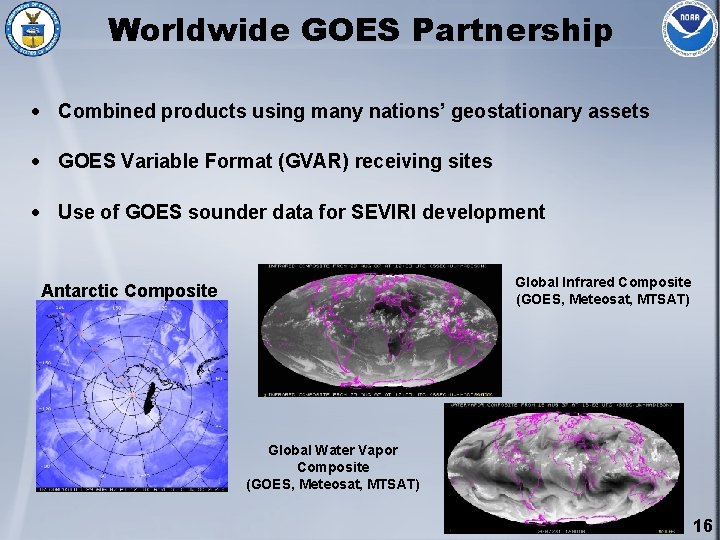
Worldwide GOES Partnership · Combined products using many nations’ geostationary assets · GOES Variable Format (GVAR) receiving sites · Use of GOES sounder data for SEVIRI development Global Infrared Composite (GOES, Meteosat, MTSAT) Antarctic Composite Global Water Vapor Composite (GOES, Meteosat, MTSAT) 16
NOAA Satellite and Information Service • In 2007… • GOES Continues Its 33 rd Consecutive Year Providing Real -Time Forecasting and Long. Term Science Data