
Geostationary Lightning Mapper Gridded Products FED Quick Guide
- Slides: 2
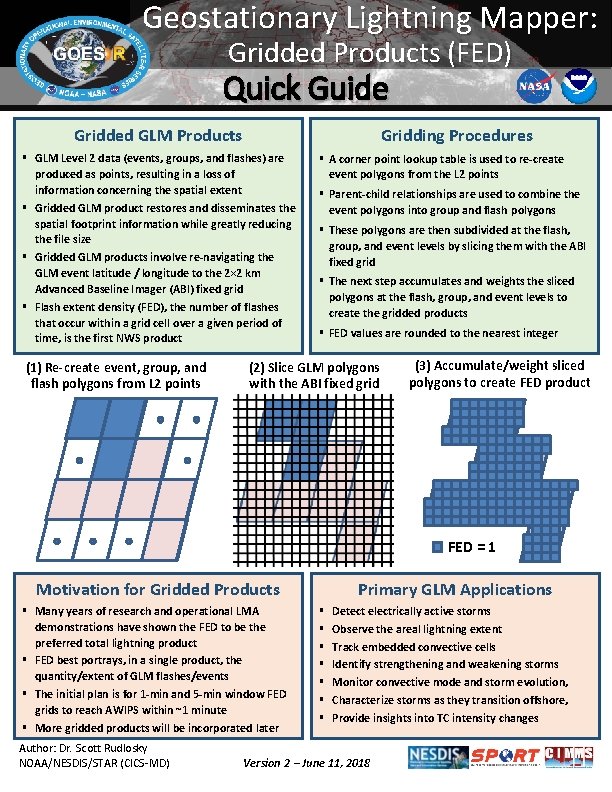
Geostationary Lightning Mapper: Gridded Products (FED) Quick Guide Gridded GLM Products Gridding Procedures § GLM Level 2 data (events, groups, and flashes) are produced as points, resulting in a loss of information concerning the spatial extent § Gridded GLM product restores and disseminates the spatial footprint information while greatly reducing the file size § Gridded GLM products involve re-navigating the GLM event latitude / longitude to the 2× 2 km Advanced Baseline Imager (ABI) fixed grid § Flash extent density (FED), the number of flashes that occur within a grid cell over a given period of time, is the first NWS product (1) Re-create event, group, and flash polygons from L 2 points § A corner point lookup table is used to re-create event polygons from the L 2 points § Parent-child relationships are used to combine the event polygons into group and flash polygons § These polygons are then subdivided at the flash, group, and event levels by slicing them with the ABI fixed grid § The next step accumulates and weights the sliced polygons at the flash, group, and event levels to create the gridded products § FED values are rounded to the nearest integer (2) Slice GLM polygons with the ABI fixed grid (3) Accumulate/weight sliced polygons to create FED product FED = 1 Motivation for Gridded Products § Many years of research and operational LMA demonstrations have shown the FED to be the preferred total lightning product § FED best portrays, in a single product, the quantity/extent of GLM flashes/events § The initial plan is for 1 -min and 5 -min window FED grids to reach AWIPS within ~1 minute § More gridded products will be incorporated later Author: Dr. Scott Rudlosky NOAA/NESDIS/STAR (CICS-MD) Primary GLM Applications § § § § Detect electrically active storms Observe the areal lightning extent Track embedded convective cells Identify strengthening and weakening storms Monitor convective mode and storm evolution, Characterize storms as they transition offshore, Provide insights into TC intensity changes Version 2 – June 11, 2018
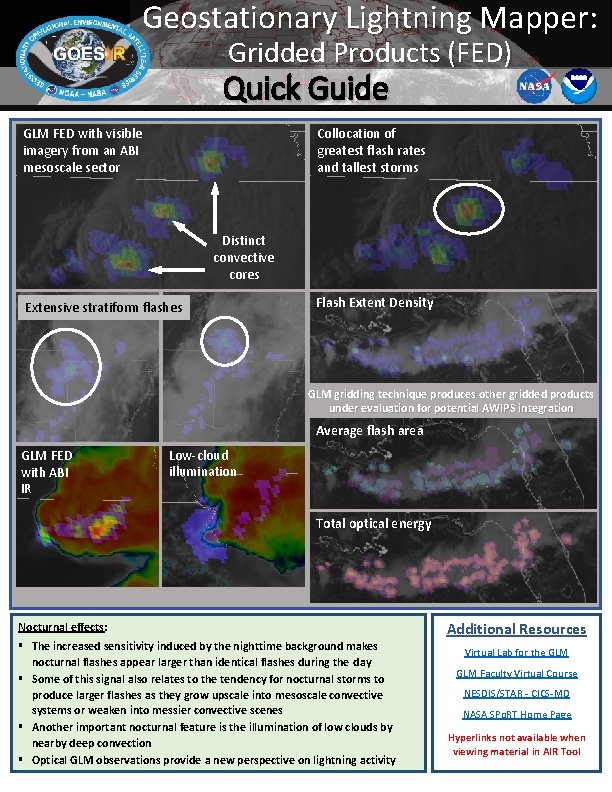
Geostationary Lightning Mapper: Gridded Products (FED) Quick Guide GLM FED with visible imagery from an ABI mesoscale sector Collocation of greatest flash rates and tallest storms Distinct convective cores Extensive stratiform flashes Flash Extent Density GLM gridding technique produces other gridded products under evaluation for potential AWIPS integration Average flash area GLM FED with ABI IR Low-cloud illumination Total optical energy Nocturnal effects: § The increased sensitivity induced by the nighttime background makes nocturnal flashes appear larger than identical flashes during the day § Some of this signal also relates to the tendency for nocturnal storms to produce larger flashes as they grow upscale into mesoscale convective systems or weaken into messier convective scenes § Another important nocturnal feature is the illumination of low clouds by nearby deep convection § Optical GLM observations provide a new perspective on lightning activity Additional Resources Virtual Lab for the GLM Faculty Virtual Course NESDIS/STAR - CICS-MD NASA SPo. RT Home Page Hyperlinks not available when viewing material in AIR Tool