
Geostationary Lightning Mapper Definitions and Detection Methods Quick
- Slides: 2
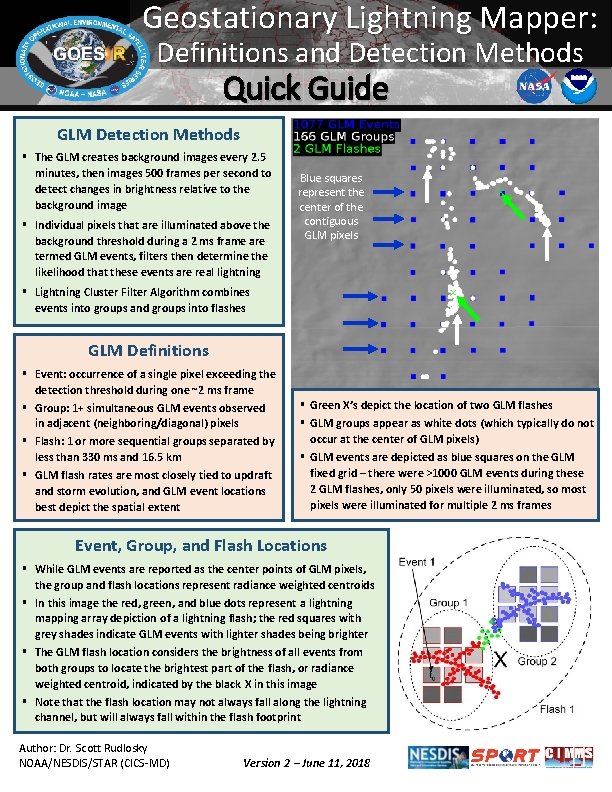
Geostationary Lightning Mapper: Definitions and Detection Methods Quick Guide GLM Detection Methods § The GLM creates background images every 2. 5 minutes, then images 500 frames per second to detect changes in brightness relative to the background image § Individual pixels that are illuminated above the background threshold during a 2 ms frame are termed GLM events, filters then determine the likelihood that these events are real lightning Blue squares represent the center of the contiguous GLM pixels § Lightning Cluster Filter Algorithm combines events into groups and groups into flashes GLM Definitions § Event: occurrence of a single pixel exceeding the detection threshold during one ~2 ms frame § Group: 1+ simultaneous GLM events observed in adjacent (neighboring/diagonal) pixels § Flash: 1 or more sequential groups separated by less than 330 ms and 16. 5 km § GLM flash rates are most closely tied to updraft and storm evolution, and GLM event locations best depict the spatial extent § Green X’s depict the location of two GLM flashes § GLM groups appear as white dots (which typically do not occur at the center of GLM pixels) § GLM events are depicted as blue squares on the GLM fixed grid – there were >1000 GLM events during these 2 GLM flashes, only 50 pixels were illuminated, so most pixels were illuminated for multiple 2 ms frames Event, Group, and Flash Locations § While GLM events are reported as the center points of GLM pixels, the group and flash locations represent radiance weighted centroids § In this image the red, green, and blue dots represent a lightning mapping array depiction of a lightning flash; the red squares with grey shades indicate GLM events with lighter shades being brighter § The GLM flash location considers the brightness of all events from both groups to locate the brightest part of the flash, or radiance weighted centroid, indicated by the black X in this image § Note that the flash location may not always fall along the lightning channel, but will always fall within the flash footprint Author: Dr. Scott Rudlosky NOAA/NESDIS/STAR (CICS-MD) Version 2 – June 11, 2018
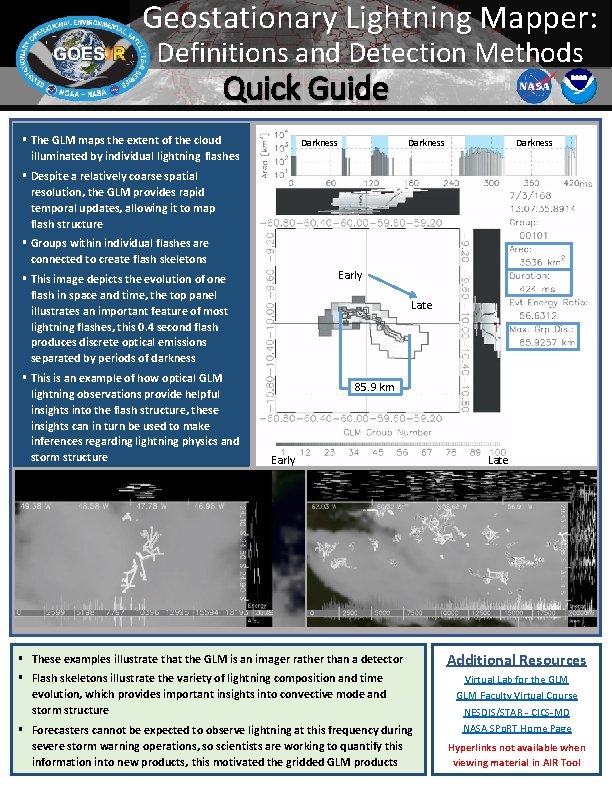
Geostationary Lightning Mapper: Definitions and Detection Methods Quick Guide § The GLM maps the extent of the cloud illuminated by individual lightning flashes Darkness § Despite a relatively coarse spatial resolution, the GLM provides rapid temporal updates, allowing it to map flash structure § Groups within individual flashes are connected to create flash skeletons Early § This image depicts the evolution of one flash in space and time, the top panel illustrates an important feature of most lightning flashes, this 0. 4 second flash produces discrete optical emissions separated by periods of darkness § This is an example of how optical GLM lightning observations provide helpful insights into the flash structure, these insights can in turn be used to make inferences regarding lightning physics and storm structure Late 85. 9 km Early § These examples illustrate that the GLM is an imager rather than a detector § Flash skeletons illustrate the variety of lightning composition and time evolution, which provides important insights into convective mode and storm structure § Forecasters cannot be expected to observe lightning at this frequency during severe storm warning operations, so scientists are working to quantify this information into new products, this motivated the gridded GLM products Late Additional Resources Virtual Lab for the GLM Faculty Virtual Course NESDIS/STAR - CICS-MD NASA SPo. RT Home Page Hyperlinks not available when viewing material in AIR Tool