
Geostationary Lightning Mapper Data Quality May 2019 Quick
- Slides: 2
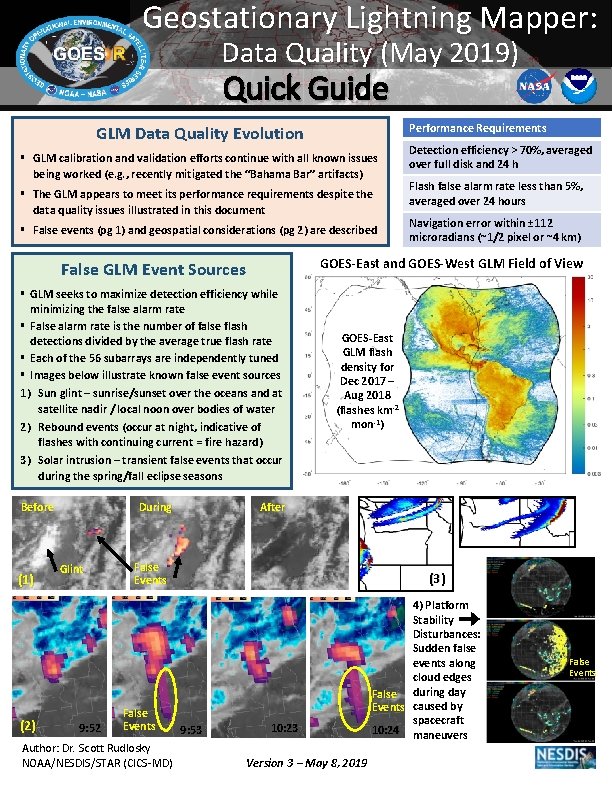
Geostationary Lightning Mapper: Data Quality (May 2019) Quick Guide Performance Requirements GLM Data Quality Evolution § GLM calibration and validation efforts continue with all known issues being worked (e. g. , recently mitigated the “Bahama Bar” artifacts) § The GLM appears to meet its performance requirements despite the data quality issues illustrated in this document § False events (pg 1) and geospatial considerations (pg 2) are described § GLM seeks to maximize detection efficiency while minimizing the false alarm rate § False alarm rate is the number of false flash detections divided by the average true flash rate § Each of the 56 subarrays are independently tuned § Images below illustrate known false event sources 1) Sun glint – sunrise/sunset over the oceans and at satellite nadir / local noon over bodies of water 2) Rebound events (occur at night, indicative of flashes with continuing current = fire hazard) 3) Solar intrusion – transient false events that occur during the spring/fall eclipse seasons During (1) (2) Glint 9: 52 Author: Dr. Scott Rudlosky NOAA/NESDIS/STAR (CICS-MD) Navigation error within ± 112 microradians (~1/2 pixel or ~4 km) GOES-East GLM flash density for Dec 2017 – Aug 2018 (flashes km-2 mon-1) After False Events Flash false alarm rate less than 5%, averaged over 24 hours GOES-East and GOES-West GLM Field of View False GLM Event Sources Before Detection efficiency > 70%, averaged over full disk and 24 h (3) 9: 53 10: 23 Version 3 – May 8, 2019 4) Platform Stability Disturbances: Sudden false events along cloud edges False during day Events caused by spacecraft 10: 24 maneuvers False Events
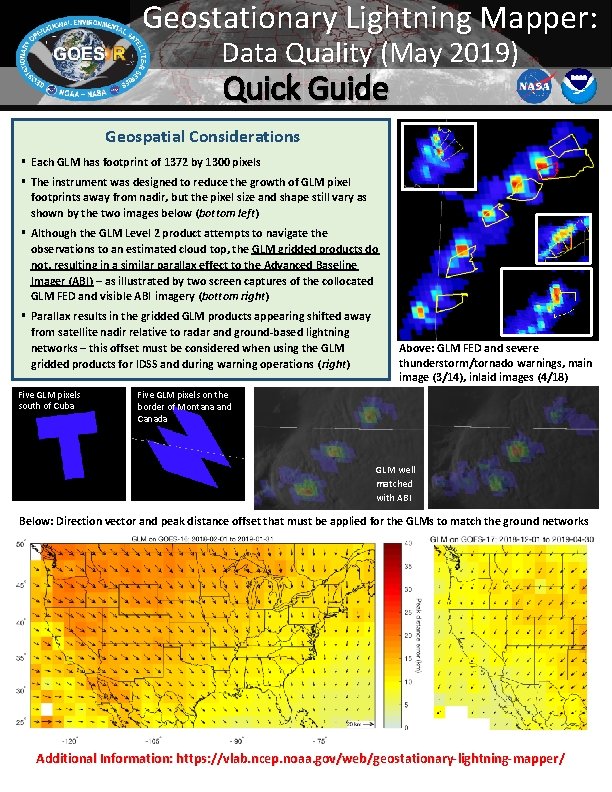
Geostationary Lightning Mapper: Data Quality (May 2019) Quick Guide Geospatial Considerations § Each GLM has footprint of 1372 by 1300 pixels § The instrument was designed to reduce the growth of GLM pixel footprints away from nadir, but the pixel size and shape still vary as shown by the two images below (bottom left) § Although the GLM Level 2 product attempts to navigate the observations to an estimated cloud top, the GLM gridded products do not, resulting in a similar parallax effect to the Advanced Baseline Imager (ABI) – as illustrated by two screen captures of the collocated GLM FED and visible ABI imagery (bottom right) § Parallax results in the gridded GLM products appearing shifted away from satellite nadir relative to radar and ground-based lightning networks – this offset must be considered when using the GLM gridded products for IDSS and during warning operations ( right) Five GLM pixels south of Cuba Above: GLM FED and severe thunderstorm/tornado warnings, main image (3/14), inlaid images (4/18) Five GLM pixels on the border of Montana and Canada GLM well matched with ABI Below: Direction vector and peak distance offset that must be applied for the GLMs to match the ground networks Additional Information: https: //vlab. ncep. noaa. gov/web/geostationary-lightning-mapper/