
GEOSS Model Based System Engineering Challenge team report
GEOSS Model Based System Engineering Challenge team report for GEOSS AIP-6 By Lawrence E. Mc. Govern, DSC INCOSE/WYLE Aerospace/Timothy Woodard, Tellus /Kenneth Druce , DCS Corp
Agenda for INCOSE GEOSS MBSE report • Societal Benefit Area(SBA) Alignment and Support effort – Development of RM-ODP Five Viewpoints for each AIP-6 Societal Based Areas (SBA) Agriculture, Disaster Management/Water • Small Unmanned Aerial Vehicle (s. UAV) effort to develop processes for collection of data and provide it to user via GEOSS
RMP-ODP Standards • ITU-T Rec. X. 901 -X. 904 • ISO/IEC 10746 • View Model Viewpoints addressed Volume 3 • Joint effort by the International Organization for Standardization (ISO), the International Electromechanical Commission (IEC) and the Telecommunication Standardization Sector (ITU-T)
RM-ODP Viewpoints and Modeling • Reference Model of Open Distributed Processing (RM-ODP) • reference model in computer science • coordinating framework for the standardization of open distributing processing (ODP) • It supports distribution, Internet working, platform and technology independence, and portability, together with an enterprise architecture framework for the specification of ODP systems

ODP Frameworks Descriptions The RM-ODP framework provides five generic and complementary viewpoints on the system and its environment: 1. Enterprise viewpoint - focuses on the purpose, scope and policies for the system 2. Information viewpoint - focuses on the semantics of the information and the information processing performed 3. Computational viewpoint - enables distribution through functional decomposition on the system into objects which interact at interfaces 4. Engineering viewpoint - focuses on the mechanisms and functions required to support distributed interactions between objects in the system 5. Technology viewpoint - focuses on the choice of technology of the system
Enterprise View • Use Case Realization process creates – Use case Diagram – Activity Diagram • steps of the Use Case Narrative become activities in the activity diagram – Sequence Diagram – These diagrams were completed in AIP-5
Transverse Use Case Realization • Steps in use cases are defined by the Transverse use groups • Use Cases will be subject to a Realization process that will yield an Activity Diagram and Sequence Diagram that will be part of the RM-ODP Enterprise Viewpoint • Transverse Use Cases provide for the Registering of data in Clearinghouse, Discover and Get Access and allowing User to Access Data from the provider • These will be captured in AIP-6
Information Viewpoint • Information Viewpoint – Focuses on the semantics of the information and the information processing performed – Describes the information managed by the system – Describes the structure and content type of the supporting data – These diagrams were completed in AIP-5
Computational View • Computational viewpoint • enables distribution through functional decomposition of the system into objects which interact at interfaces • describes the functionality provided by the system and its functional decomposition • Modeled as Sys. ML Block Definition Diagram (BDD) • employs the concept of blocks to specify hierarchies and interconnection within a system design • describes relationships between blocks such as composition, association, and specialization • used as the object template Block Diagram
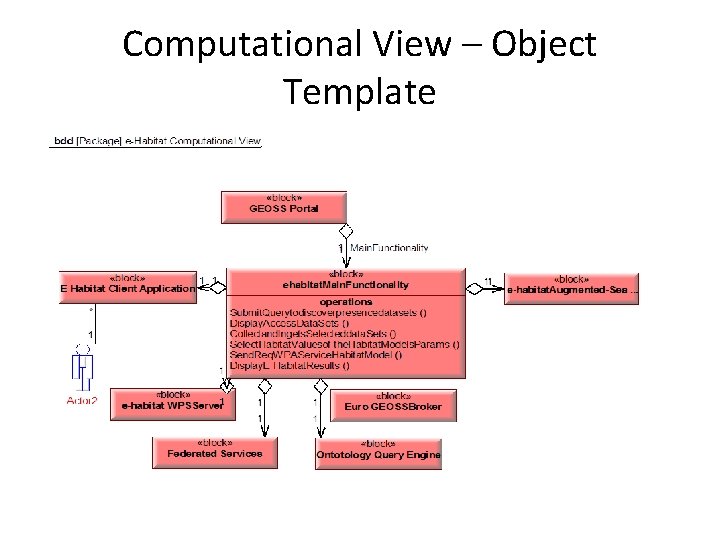
Computational View – Object Template
Engineering Viewpoint • Engineering viewpoint • focuses on the mechanisms and functions required to support distributed interactions between objects in the system • describes the distribution of processing performed by the system to manage the information and provide functionality • Modeled as an Internal Block Diagram (IBD) that has as it’s source a Sys. ML BDD as shown in Computational View.
Engineering Components • Engineering view identifies types of components to support deployment and management of distributed interaction between the components and are consistent with Enterprise viewpoints • GEOSS is part of a System of Systems • Components are part of a service layer in a three tier model. Top used by users directly, Middle has business processes that respond to requests by clients and lower provides read/write access to data
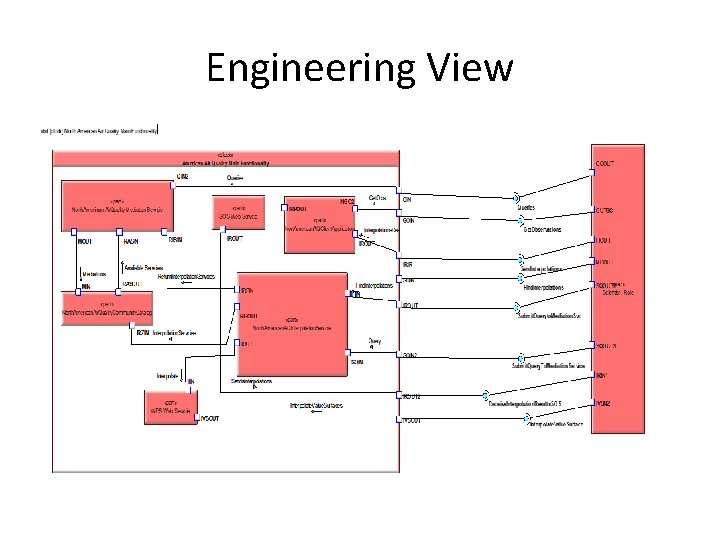
Engineering View
Technology Viewpoint • Technology viewpoint – focuses on the choice of technology of the system. – Describes the technologies chosen to provide the processing, functionality and presentation of information. – Modeled using the Deployment Diagram
Technology Viewpoint Example. Deployment Diagram
Small UAV Effort Progress • Considering Two Platform Options: – Rotary: • Advantages: Portable, Maneuverability, Customizable • Disadvantages: Less Endurance • Fixed Wing: • Advantages: Long flight times • Disadvantages: Must maintain horizontal motion therefore less maneuverable
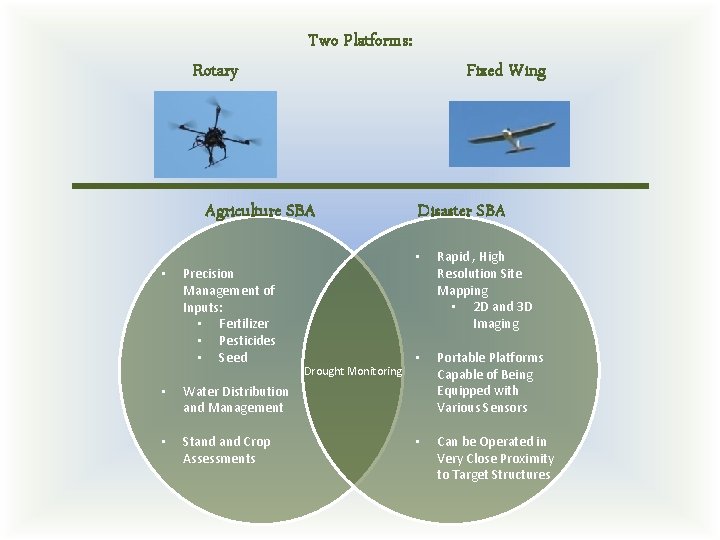
Two Platforms: Rotary Fixed Wing Agriculture SBA • Precision Management of Inputs: • Fertilizer • Pesticides • Seed • Water Distribution and Management • Stand Crop Assessments Drought Monitoring Disaster SBA • Rapid , High Resolution Site Mapping • 2 D and 3 D Imaging • Portable Platforms Capable of Being Equipped with Various Sensors • Can be Operated in Very Close Proximity to Target Structures
Small UAV Effort Progress • Preparation of 3 Minute video by September 2013 – Joint USIS/INCOSE effort – Will be presented to GEO Ministers (80 Countries) at GEO Plenary in Geneva, Switzerland January 2013 – First version of Video is provided next and is narrated and depicts an entire flight sequence showing how a flight to collect drought data would be conducted – The scenario of Drought covers the Disaster management/Agriculture/ and Water SBAs
Final Engineering Report • The s. UAV team will prepare and deliver the 3 minute Video for the Ministers meeting and work with INCOSE to model s. UAV Architecture model • The Architecture team will: – share the viewpoint results with each SBA team – resolve any changes required to viewpoint products – produce a final engineering report • include the results of all Viewpoints for – SBA Use Cases and Transverse Use Cases
- Slides: 19