
Geospatial Standards the OGC and Pervasive Computing Carl
- Slides: 13
Geospatial Standards, the OGC and Pervasive Computing Carl Reed, Ph. D CTO Open Geospatial Consortium November 11, 2009 Copyright © 2009, Open Geospatial Consortium, Inc.
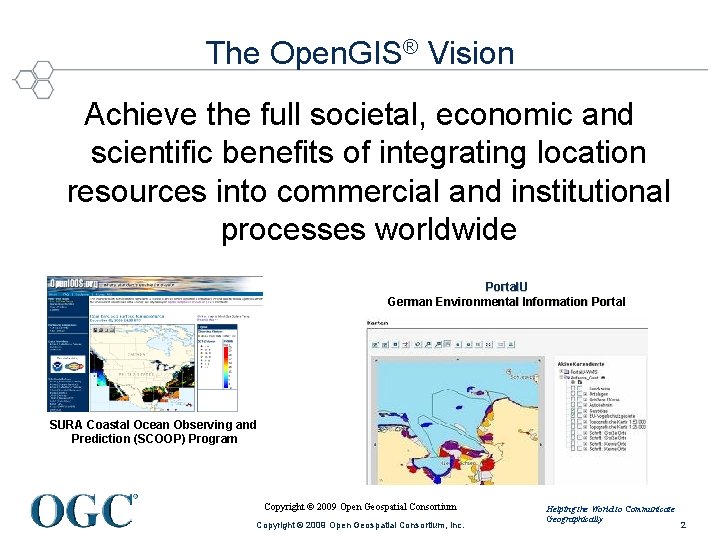
The Open. GIS® Vision Achieve the full societal, economic and scientific benefits of integrating location resources into commercial and institutional processes worldwide Portal. U German Environmental Information Portal SURA Coastal Ocean Observing and Prediction (SCOOP) Program Copyright © 2009 Open Geospatial Consortium, Inc. Helping the World to Communicate Geographically 2
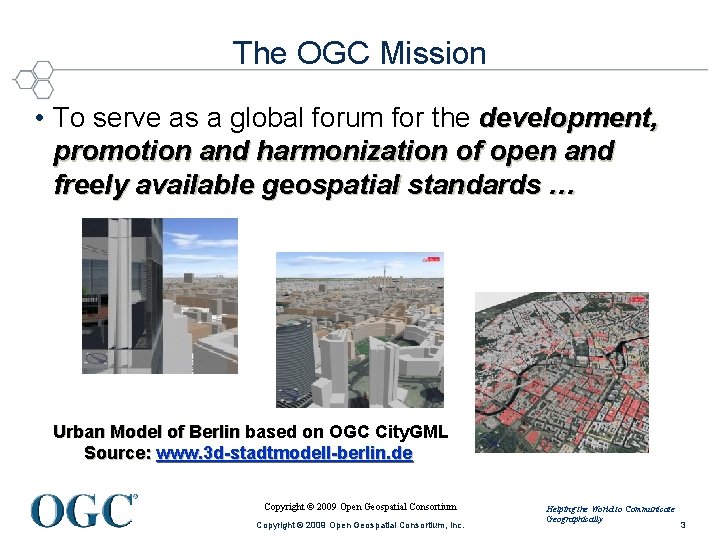
The OGC Mission • To serve as a global forum for the development, promotion and harmonization of open and freely available geospatial standards … Urban Model of Berlin based on OGC City. GML Source: www. 3 d-stadtmodell-berlin. de Copyright © 2009 Open Geospatial Consortium, Inc. Helping the World to Communicate Geographically 3
The Growth of the OGC • Over 385+ members worldwide – 38 countries & 6 continents • Broad participation in other standards organizations – ISO TC 211, IETF, OASIS, IEEE, CEN 287, building. SMART, OGF • Twenty eight approved, publicly and freely available standards • Numerous candidate standards in progress – Key areas of interoperability focus are web services, location services, Geo Digital Rights Management, mass market, and Sensor Webs/networks • The OGC Reference Model defines interoperability framework • Rapidly growing list of implementations Copyright © 2009 Open Geospatial Consortium, Inc. Helping the World to Communicate Geographically 4
OGC Standards and profiles • Range from light weight, simple encodings and protocols, such as Geo. RSS (www. georss. org) to support for complex modeling applications (Web Processing Service) • Are Vendor Neutral • Are application neutral • Are content neutral • Grounded in an abstract model Copyright © 2009 Open Geospatial Consortium Helping the World to Communicate Geographically
• It was interesting to note that electricity demand varies greatly in response to price depending on geography, customer density, and customer type. – David Carrier, Ph. D. – University of Notre Dame Copyright © 2009 Open Geospatial Consortium Helping the World to Communicate Geographically
OGC Standards and Energy modeling • Building energy modeling – http: //www. reuters. com/article/press. Release/id. US 197909+05 -May 2009+BW 20090505 • Electricity Production by Solar Plants – http: //www. ogcnetwork. net/node/350 • Solar plant placement – http: //www. ogcnetwork. net/AIP 2 ERs#energy • And others Copyright © 2009 Open Geospatial Consortium Helping the World to Communicate Geographically
OGC Simple Features - Ubiquitous services: Standard database access • Provides a well-defined and common way for applications to store and access geospatial feature data in relational or object-relational databases • Implemented in all major commercial database software • Implemented in all Open Source database software • Used by thousands of applications and millions of users. Copyright © 2009 Open Geospatial Consortium Helping the World to Communicate Geographically
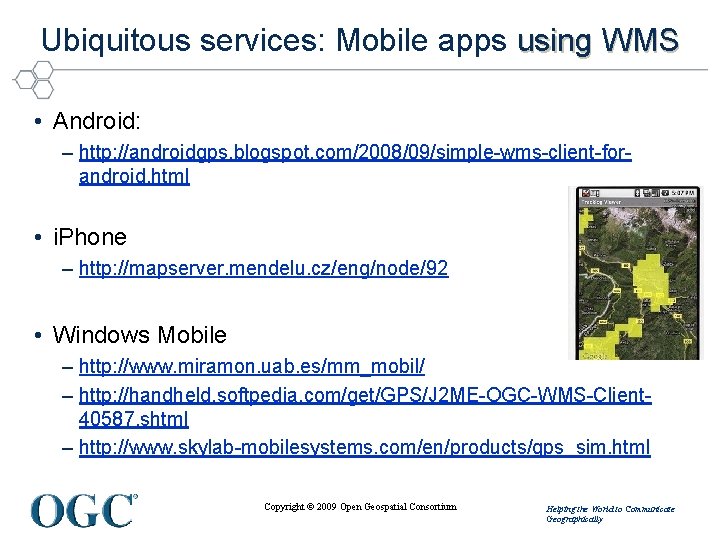
Ubiquitous services: Mobile apps using WMS • Android: – http: //androidgps. blogspot. com/2008/09/simple-wms-client-forandroid. html • i. Phone – http: //mapserver. mendelu. cz/eng/node/92 • Windows Mobile – http: //www. miramon. uab. es/mm_mobil/ – http: //handheld. softpedia. com/get/GPS/J 2 ME-OGC-WMS-Client 40587. shtml – http: //www. skylab-mobilesystems. com/en/products/gps_sim. html Copyright © 2009 Open Geospatial Consortium Helping the World to Communicate Geographically
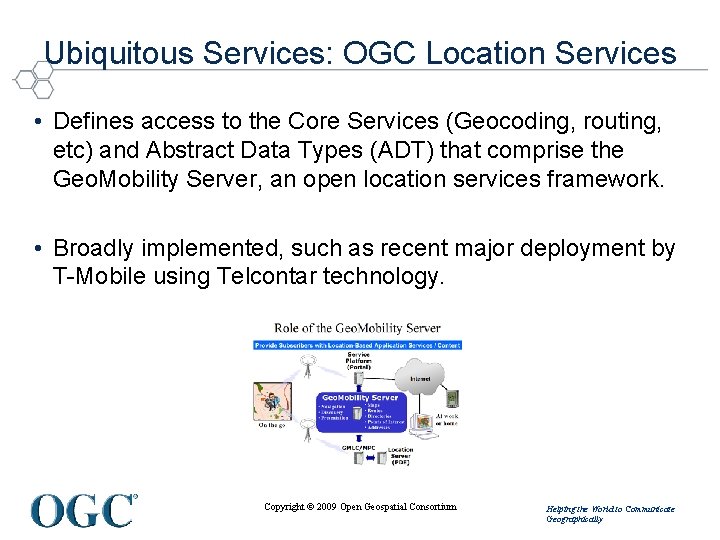
Ubiquitous Services: OGC Location Services • Defines access to the Core Services (Geocoding, routing, etc) and Abstract Data Types (ADT) that comprise the Geo. Mobility Server, an open location services framework. • Broadly implemented, such as recent major deployment by T-Mobile using Telcontar technology. Copyright © 2009 Open Geospatial Consortium Helping the World to Communicate Geographically
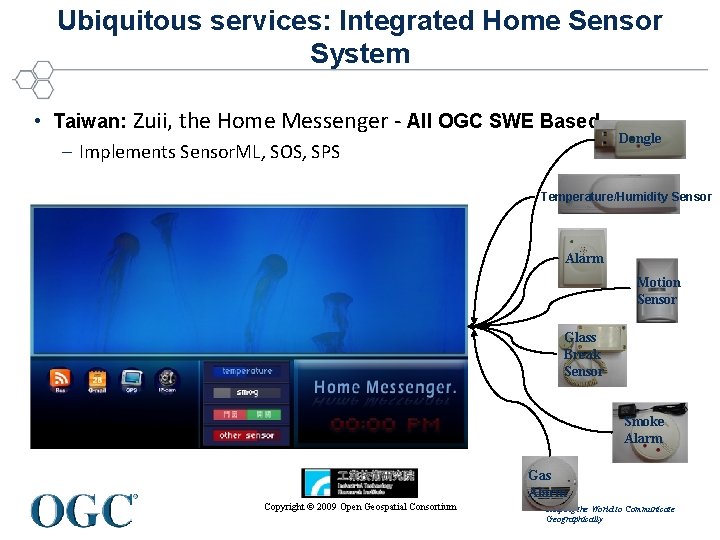
Ubiquitous services: Integrated Home Sensor System • Taiwan: Zuii, the Home Messenger ‐ All OGC SWE Based – Implements Sensor. ML, SOS, SPS Dongle Temperature/Humidity Sensor Alarm Motion Sensor Glass Break Sensor Smoke Alarm Gas Alarm Copyright © 2009 Open Geospatial Consortium Helping the World to Communicate Geographically
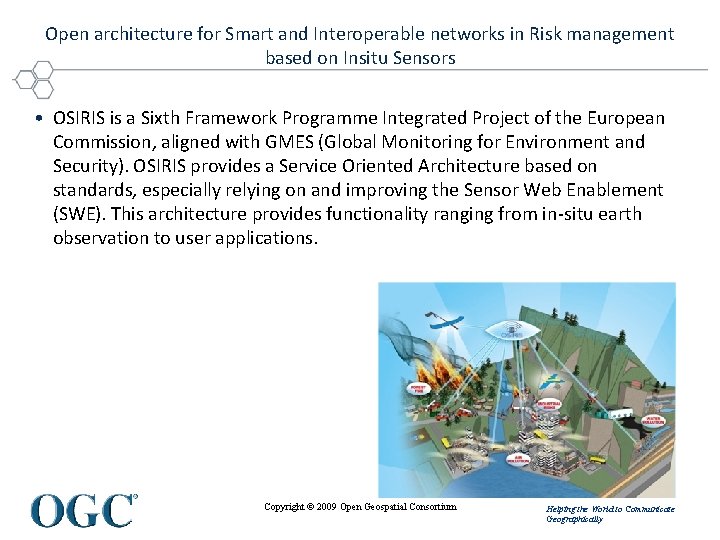
Open architecture for Smart and Interoperable networks in Risk management based on Insitu Sensors • OSIRIS is a Sixth Framework Programme Integrated Project of the European Commission, aligned with GMES (Global Monitoring for Environment and Security). OSIRIS provides a Service Oriented Architecture based on standards, especially relying on and improving the Sensor Web Enablement (SWE). This architecture provides functionality ranging from in‐situ earth observation to user applications. Copyright © 2009 Open Geospatial Consortium Helping the World to Communicate Geographically
OSIRIS Application Objectives • Within OSIRIS four key areas of major environmental risk are investigated: – forest fires: early detection of forest fires and efficient handling of the crisis situation if a fire occurs – industrial risks: more reliable fire detection by combining various sensor types and thus especially reducing the number of false alarms – unexpected fresh water pollution: sensor networks for detecting natural arsenic concentration as well as accidental hydrocarbon pollutions – air pollution in urban areas: using mobile as well as fixed sensors linked to simulation models for assessing the air quality • http: //tws 01. terranovaws. it/osiris/doc/Invitation_OSIRIS_Works hop. pdf Copyright © 2009 Open Geospatial Consortium Helping the World to Communicate Geographically