
Geospatial Preparedness Department of Homeland Security 10132006 Presentation
- Slides: 20
Geospatial Preparedness Department of Homeland Security 10/13/2006 Presentation for: Federal Geographic Data Committee Presented by: Dan Cotter Geospatial Management Officer Department of Homeland Security Date: October 23, 2006 Geospatail Preparedness Summary
Geospatial Preparedness Topics n Department of Homeland Security n Geospatial Preparedness ¨ Gap Summary ¨ Accomplishment Examples n In Transit Visibility n Baseline Imagery n IRSCC n Future Directions ¨ Less maps, more location-based transaction process? ¨ Migration to increasing reliance on State and local geospatial data 10/13/2006 Geospatail Preparedness Summary 2
Department of Homeland Security 10/13/2006 Geospatail Preparedness Summary
Geospatial Preparedness Planning / Implementation Considerations n Largest Civilian Agency n Integrating / Coordinating over 20+ major components n All Hazards, All Threats n ¨ Natural ¨ Technological ¨ Terrorist All Phases of the Emergency Lifecycle ¨ Prevention, Preparedness, Mitigation, Response, Recovery n Major Intelligence and Law Enforcement Missions n Multiple Levels of Confidentiality/Security n Multiple Networks n Multiple Stakeholders (i. e. Federal, State, Local, Tribal, Private, International) 10/13/2006 Geospatail Preparedness Summary 4
Geospatial Preparedness Mission Need n Apply geospatial technology to: ¨ Protect Lives ¨ Reduce the cost of disasters n Including private property ¨ Increase Response Effectiveness ¨ Reduce the Cost of Response and Recovery Operations ¨ Reduce the Recovery Timeline ¨ Support intelligence and law enforcement missions of the Department 10/13/2006 Geospatail Preparedness Summary 5
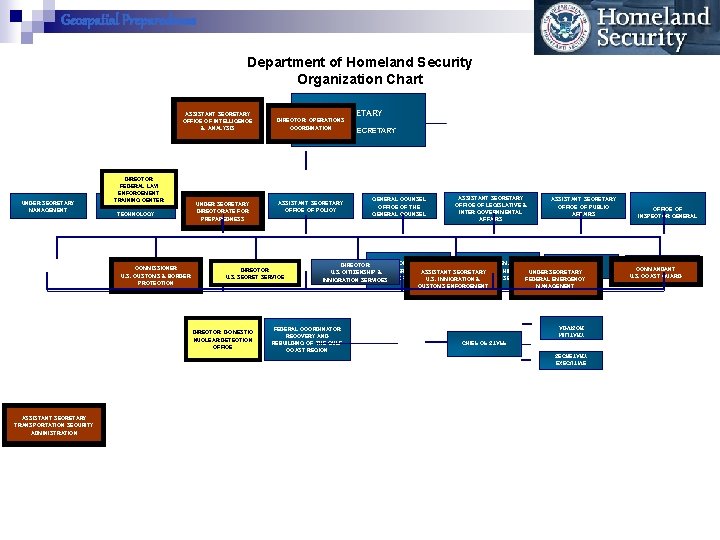
Geospatial Preparedness Department of Homeland Security Organization Chart ASSISTANT SECRETARY OFFICE OF INTELLIGENCE & ANALYSIS UNDER SECRETARY MANAGEMENT DIRECTOR FEDERAL LAW ENFORCEMENT UNDER SECRETARY TRAINING CENTER SCIENCE & TECHNOLOGY COMMISSIONER U. S. CUSTOMS & BORDER PROTECTION UNDER SECRETARY DIRECTORATE FOR PREPAREDNESS DEPUTY SECRETARY ASSISTANT SECRETARY OFFICE OF POLICY DIRECTOR U. S. SECRET SERVICE DIRECTOR DOMESTIC NUCLEAR DETECTION OFFICE ASSISTANT SECRETARY TRANSPORTATION SECURITY ADMINISTRATION SECRETARY DIRECTOR OPERATIONS COORDINATION GENERAL COUNSEL OFFICE OF THE GENERAL COUNSEL ASSISTANT SECRETARY OFFICE OF LEGISLATIVE & INTER GOVERNMENTAL AFFAIRS ASSISTANT SECRETARY OFFICE OF PUBLIC AFFAIRS OMBUDSMAN DIRECTOR OFFICE OF CHIEF PRIVACY DIRECTOR CITIZENSHIP & OFFICER UNDER SECRETARY ASSISTANT SECRETARY U. S. CITIZENSHIP &COUNTERNARCOTICS IMMIGRATION SERVICES ENFORCEMENT FEDERAL EMERGENCY U. S. IMMIGRATION & IMMIGRATION SERVICES MANAGEMENT CUSTOMS ENFORCEMENT FEDERAL COORDINATOR RECOVERY AND REBUILDING OF THE GULF COAST REGION ADVISOR MILITARY CHIEF OF STAFF SECRETARY EXECUTIVE OFFICE OF INSPECTOR GENERAL OFFICER CIVIL RIGHTS & CIVIL COMMANDANT LIBERTIES U. S. COAST GUARD
Geospatial Preparedness 10/13/2006 Geospatail Preparedness Summary
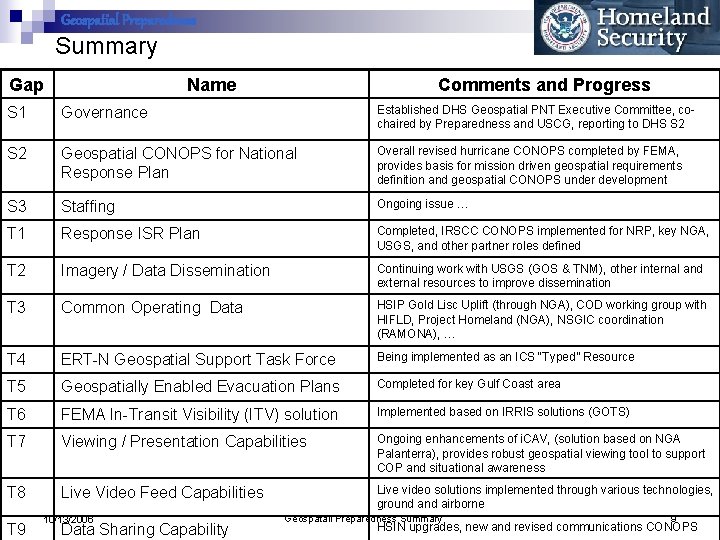
Geospatial Preparedness Gaps n DHS Sponsored a workshop should May 22 – 24, with Federal, State, local, NGO, and private sector representatives to identify major gaps in geospatial preparedness and develop and implement corrective actions. n Gaps broken out into 3 strategic and 9 tactical areas. 10/13/2006 Geospatail Preparedness Summary 8
Geospatial Preparedness Summary Gap Name Comments and Progress S 1 Governance Established DHS Geospatial PNT Executive Committee, cochaired by Preparedness and USCG, reporting to DHS S 2 Geospatial CONOPS for National Response Plan Overall revised hurricane CONOPS completed by FEMA, provides basis for mission driven geospatial requirements definition and geospatial CONOPS under development S 3 Staffing Ongoing issue … T 1 Response ISR Plan Completed, IRSCC CONOPS implemented for NRP, key NGA, USGS, and other partner roles defined T 2 Imagery / Data Dissemination Continuing work with USGS (GOS & TNM), other internal and external resources to improve dissemination T 3 Common Operating Data HSIP Gold Lisc Uplift (through NGA), COD working group with HIFLD, Project Homeland (NGA), NSGIC coordination (RAMONA), … T 4 ERT-N Geospatial Support Task Force Being implemented as an ICS “Typed” Resource T 5 Geospatially Enabled Evacuation Plans Completed for key Gulf Coast area T 6 FEMA In-Transit Visibility (ITV) solution Implemented based on IRRIS solutions (GOTS) T 7 Viewing / Presentation Capabilities Ongoing enhancements of i. CAV, (solution based on NGA Palanterra), provides robust geospatial viewing tool to support COP and situational awareness T 8 Live Video Feed Capabilities Live video solutions implemented through various technologies, ground airborne T 9 10/13/2006 Data Sharing Capability Geospatail Preparedness Summary 9 HSIN upgrades, new and revised communications CONOPS
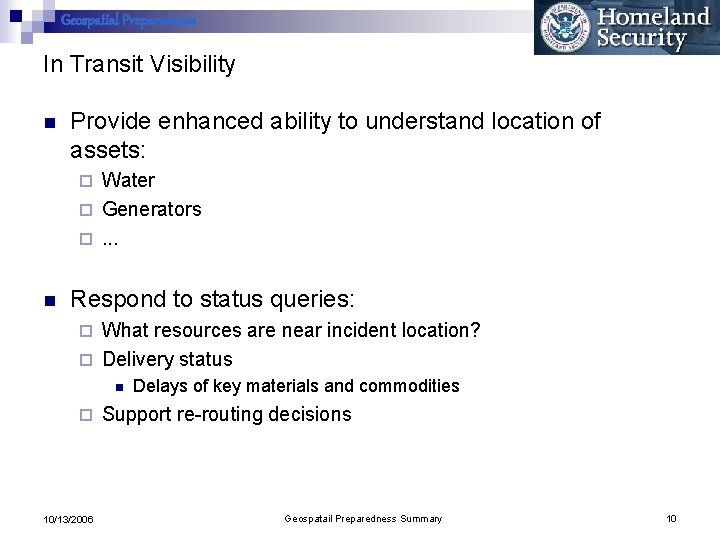
Geospatial Preparedness In Transit Visibility n Provide enhanced ability to understand location of assets: Water ¨ Generators ¨. . . ¨ n Respond to status queries: What resources are near incident location? ¨ Delivery status ¨ n ¨ 10/13/2006 Delays of key materials and commodities Support re-routing decisions Geospatail Preparedness Summary 10
Geospatial Preparedness Zoom In Around DC 10/13/2006 Geospatail Preparedness Summary 11
Geospatial Preparedness Attribute Information 10/13/2006 Geospatail Preparedness Summary 12
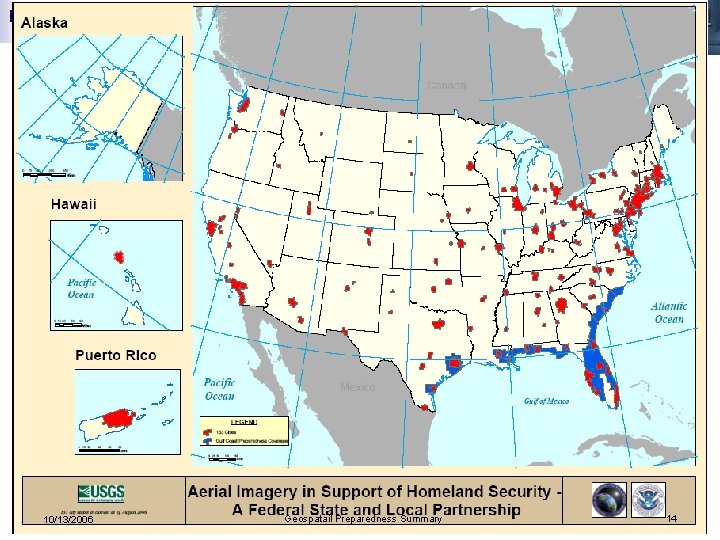
Geospatial Preparedness Baseline Imagery n Purpose: Provide knowledge of pre-event status ¨ n Preparedness (risk assessment, training, exercises), mitigation applications Priority coverage: 133 Cities Identified by HSIP Tiger Team ¨ Coastal Counties, NC – TX ¨ n Implementation: Leveraged procurement through USGS Liaisons, NGA funding support ¨ $75 M in product, $4. 5 M DHS investment ¨ n ¨ USGS Dissemination Support n 10/13/2006 Outstanding example of coordinated approach to data acquisition across multiple Federal Departments and multiple levels of government GOS Geospatail Preparedness Summary 13
Geospatial Preparedness 10/13/2006 Geospatail Preparedness Summary 14
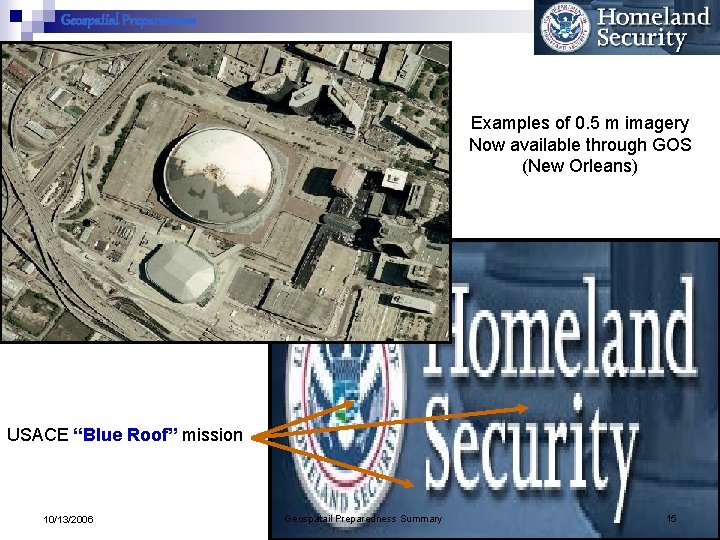
Geospatial Preparedness Examples of 0. 5 m imagery Now available through GOS (New Orleans) USACE “Blue Roof” mission 10/13/2006 Geospatail Preparedness Summary 15
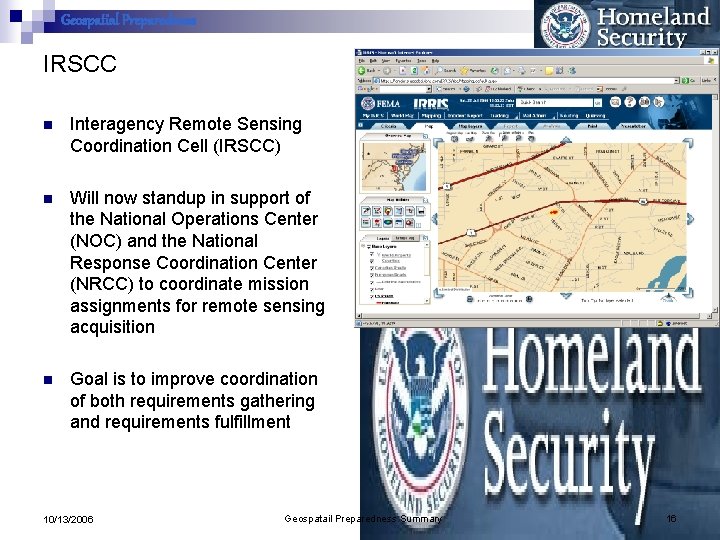
Geospatial Preparedness IRSCC n Interagency Remote Sensing Coordination Cell (IRSCC) n Will now standup in support of the National Operations Center (NOC) and the National Response Coordination Center (NRCC) to coordinate mission assignments for remote sensing acquisition n Goal is to improve coordination of both requirements gathering and requirements fulfillment 10/13/2006 Geospatail Preparedness Summary 16
Future Directions 10/13/2006 Geospatail Preparedness Summary
Geospatial Preparedness Less Maps, More Location Based Transaction Processing? n n Massive transaction processing critical part of emergency response ¨ Individual Assistance Applications ¨ SBA Disaster Loans ¨ Commodity Management ¨ Support long term recovery, including HUD Community Development Block Grant (CDBG) programs ¨ Many Others … All require various location inputs and attributes ¨ In or out of damage area n Severity ¨ Link of address to parcel for ownership verification ¨ NFIP flood insurance mandatory purchase n Can we automate these tasks to take out the need for map publishing and manual interpretation to reduce cost, improve time service to victims and increase quality? n Individual Assistance Example 10/13/2006 Geospatail Preparedness Summary 18
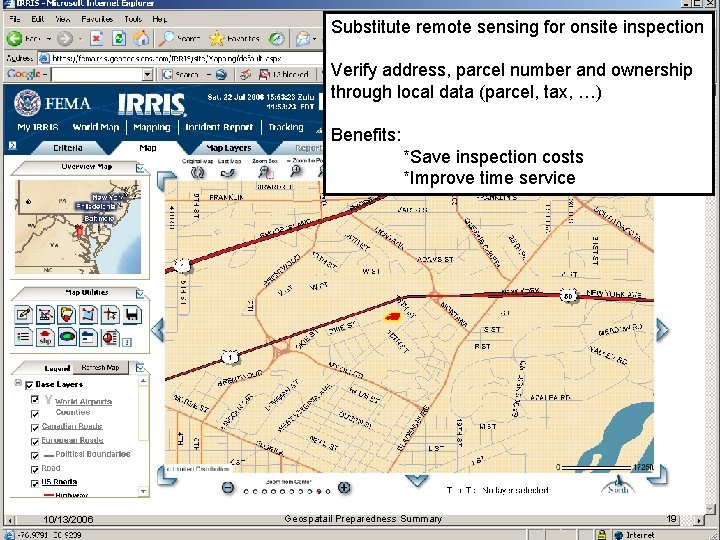
Geospatial Preparedness Substitute remote sensing for onsite inspection Verify address, parcel number and ownership through local data (parcel, tax, …) Benefits: *Save inspection costs *Improve time service 10/13/2006 Geospatail Preparedness Summary 19
Geospatial Preparedness Migrate to Increased Reliance on State and Local Data n Why – ¨ ¨ Often have best data for certain themes (parcel, infrastructure, . . . ) Access to same data used locally n n Issues ¨ Many n n n Feds involved in only very small fraction of emergency response events – we need to work with the same data locals use day to day Information Sharing Agreements … Getting there … ¨ DHS Grant Programs n ¨ ¨ ¨ State and Local Fusion Centers Project Homeland (NGA) FY 2007 USGS Liaison Programs n ¨ 10/13/2006 Geospatial grant guidance has been published Build on FY 2006 imagery program success NSGIC, other initiatives Geospatail Preparedness Summary 20