
Geospatial Information Human Resource Development KOREAs Experience Action

- Slides: 20
Geospatial Information Human Resource Development - KOREA's Experience & Action Plan- 2013. 9. 26. Eun-Sun Im, Jae. Yong Lee
Contents u Background u Concept & Purpose of the Geospatial Information HRD u Model of the Geospatial Information HRD u HR Development Policies u. KOREA's Experience & Action Plan
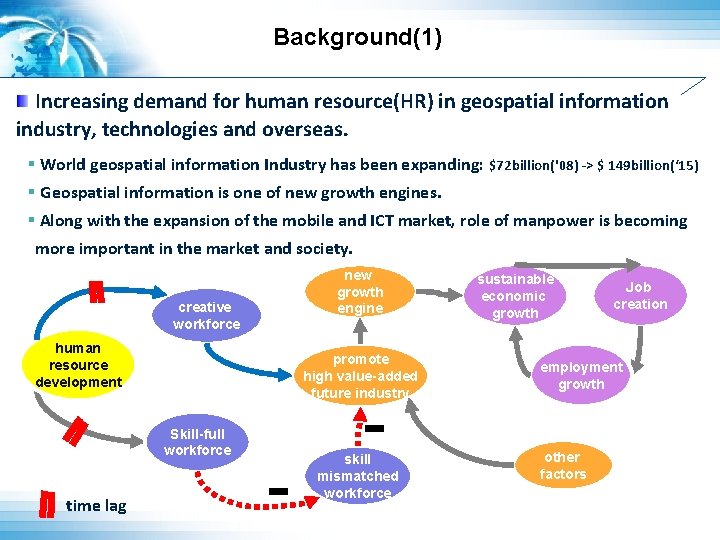
Background(1) Increasing demand for human resource(HR) in geospatial information industry, technologies and overseas. § World geospatial information Industry has been expanding: $72 billion('08) -> $ 149 billion(‘ 15) § Geospatial information is one of new growth engines. § Along with the expansion of the mobile and ICT market, role of manpower is becoming more important in the market and society. creative workforce human resource development promote high value-added future industry Skill-full workforce time lag new growth engine skill mismatched workforce sustainable economic growth Job creation employment growth other factors
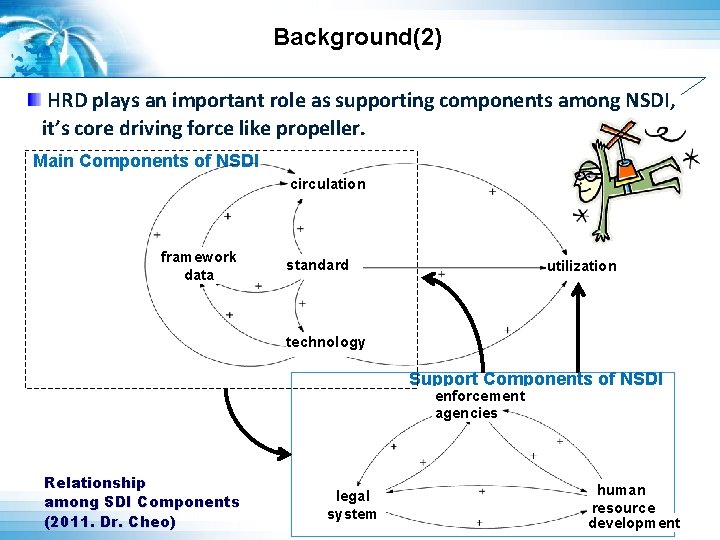
Background(2) HRD plays an important role as supporting components among NSDI, it’s core driving force like propeller. Main Components of NSDI circulation framework data standard utilization technology Support Components of NSDI enforcement agencies Relationship among SDI Components (2011. Dr. Cheo) legal system human resource development
Concept & Purpose of GIHRD(1) Human Resource Development , HRD does not simply mean to run the job training. Previously, the notion of ‘training’ was used. Its meaning was extended to the ‘education’. ‘Human resources development’ has become the important keywords because knowledge information industry has become more and more advanced and workforce has been recognized as one of the resources for economic development. Concept of Geospatial Information HRD GIHRD is the framework for workforces(student, job finders, official, teacher) develop their personal and organizational skills, knowledge, and abilities on geospatial information, including environmental and institutional elements
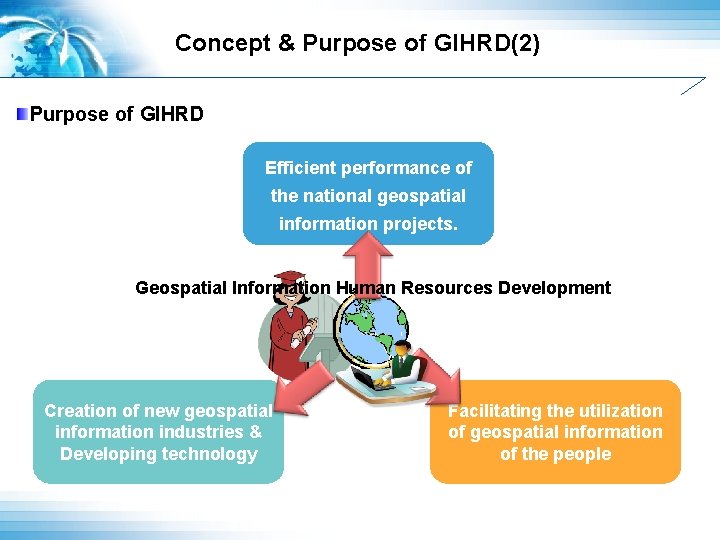
Concept & Purpose of GIHRD(2) Purpose of GIHRD Efficient performance of the national geospatial information projects. Geospatial Information Human Resources Development Creation of new geospatial information industries & Developing technology Facilitating the utilization of geospatial information of the people
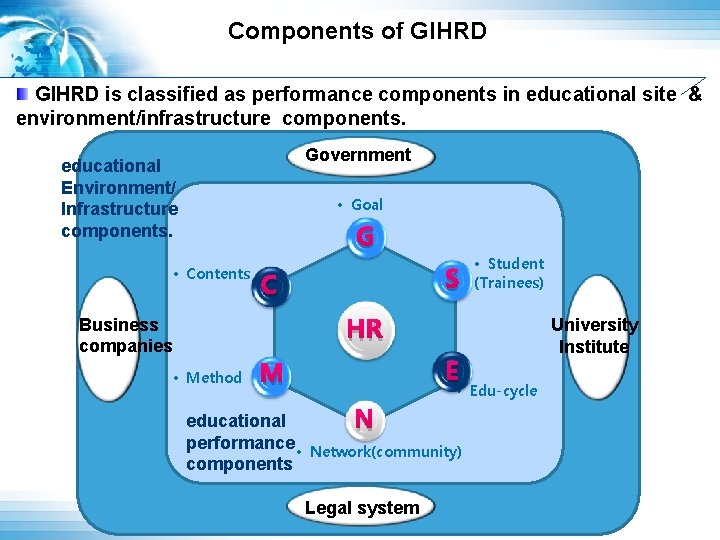
Components of GIHRD is classified as performance components in educational site & environment/infrastructure components. educational Environment/ Infrastructure components. Government • Goal G NSDI • Contents Business 산업 companies 체 C 공간정보 인적자원 개발 S • Student (Trainees) HR • Method E M • Edu-cycle educational N performance • Network(community) components Legal system University 산업 Institute 체
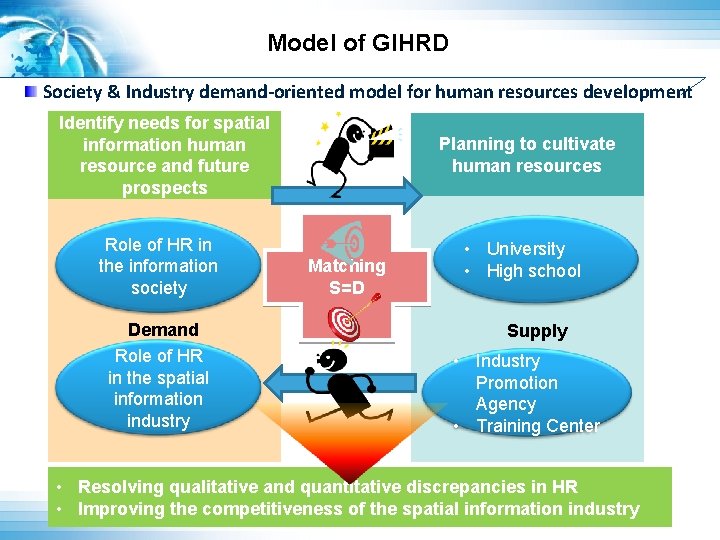
Model of GIHRD Society & Industry demand-oriented model for human resources development Identify needs for spatial information human resource and future prospects Role of HR in the information society Demand Role of HR in the spatial information industry Planning to cultivate human resources Matching S=D • University • High school Supply • Industry Promotion Agency • Training Center • Resolving qualitative and quantitative discrepancies in HR • Improving the competitiveness of the spatial information industry
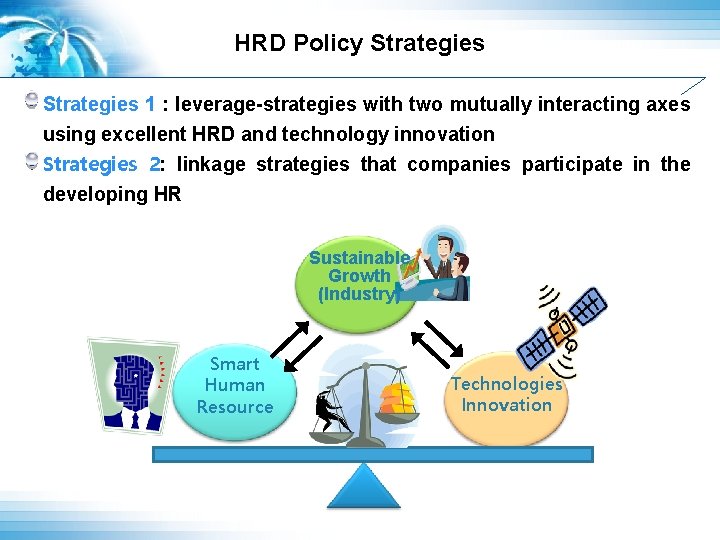
HRD Policy Strategies 1 : leverage-strategies with two mutually interacting axes using excellent HRD and technology innovation Strategies 2: linkage strategies that companies participate in the developing HR Sustainable Growth (Industry) Smart Human Resource Technologies Innovation
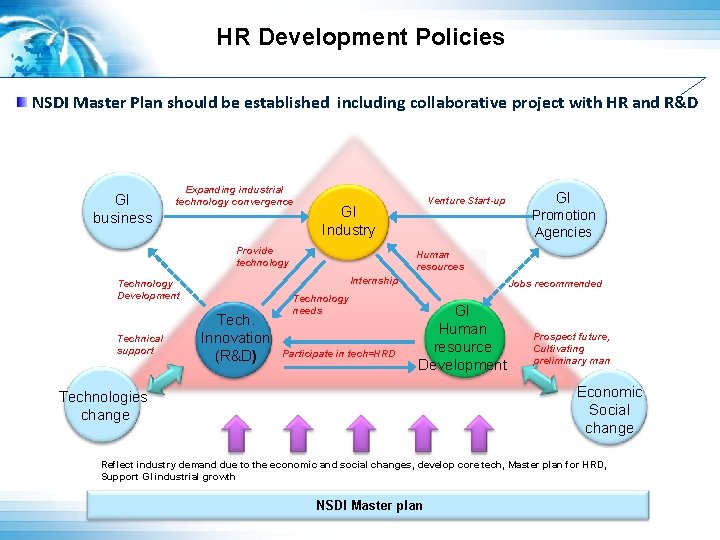
HR Development Policies NSDI Master Plan should be established including collaborative project with HR and R&D GI business Expanding industrial technology convergence GI Industry NSDI Provide technology Technology Development Technical support Venture Start-up Promotion Agencies Human resources Internship Tech. Innovation (R&D) GI Technology needs Participate in tech=HRD GI Human resource Development Jobs recommended Prospect future, Cultivating preliminary man Economic Social change Technologies change Reflect industry demand due to the economic and social changes, develop core tech, Master plan for HRD, Support GI industrial growth NSDI Master plan
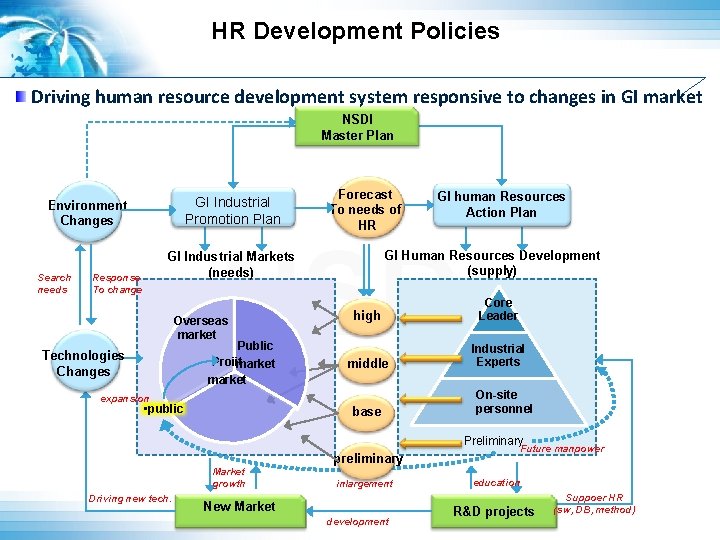
HR Development Policies Driving human resource development system responsive to changes in GI market NSDI Master Plan GI Industrial Promotion Plan Environment Changes Search needs Forecast To needs of HR GI human Resources Action Plan NSDI GI Human Resources Development (supply) GI Industrial Markets (needs) Response To change Overseas market Public Proiit market Technologies Changes expansion • public high Core Leader middle Industrial Experts base On-site personnel Preliminary Future manpower preliminary Market growth Driving new tech. inlargement New Market development education R&D projects Suppoer HR (sw, DB, method)
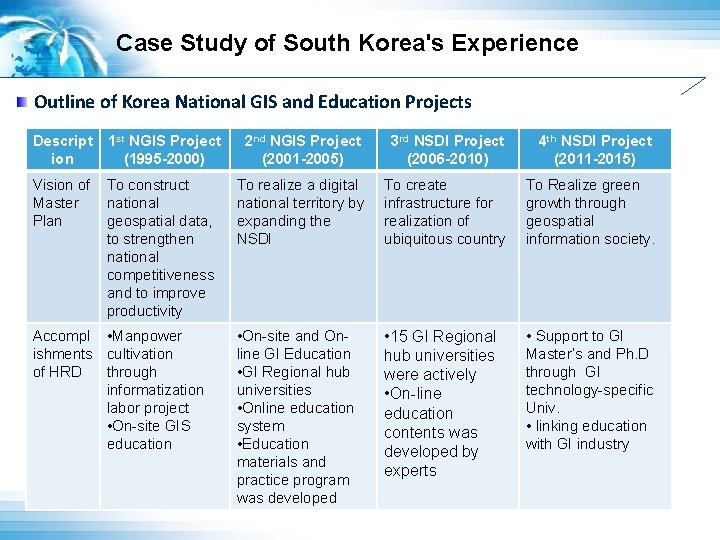
Case Study of South Korea's Experience Outline of Korea National GIS and Education Projects Descript ion 1 st NGIS Project (1995 -2000) 2 nd NGIS Project (2001 -2005) 3 rd NSDI Project (2006 -2010) 4 th NSDI Project (2011 -2015) Vision of Master Plan To construct national geospatial data, to strengthen national competitiveness and to improve productivity To realize a digital national territory by expanding the NSDI To create infrastructure for realization of ubiquitous country To Realize green growth through geospatial information society. • On-site and Online GI Education • GI Regional hub universities • Online education system • Education materials and practice program was developed • 15 GI Regional hub universities were actively • On-line education contents was developed by experts • Support to GI Master’s and Ph. D through GI technology-specific Univ. • linking education with GI industry Accompl • Manpower ishments cultivation of HRD through informatization labor project • On-site GIS education NSDI
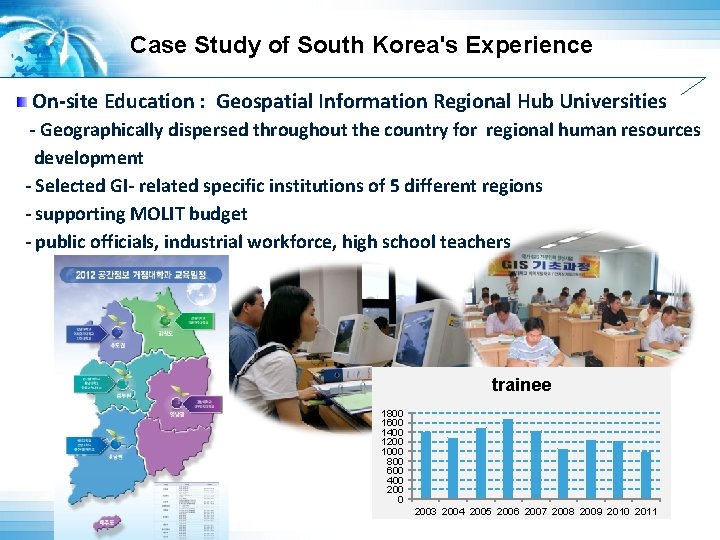
Case Study of South Korea's Experience On-site Education : Geospatial Information Regional Hub Universities - Geographically dispersed throughout the country for regional human resources development - Selected GI- related specific institutions of 5 different regions - supporting MOLIT budget - public officials, industrial workforce, high school teachers trainee 1800 1600 1400 1200 1000 800 600 400 2003 2004 2005 2006 2007 2008 2009 2010 2011
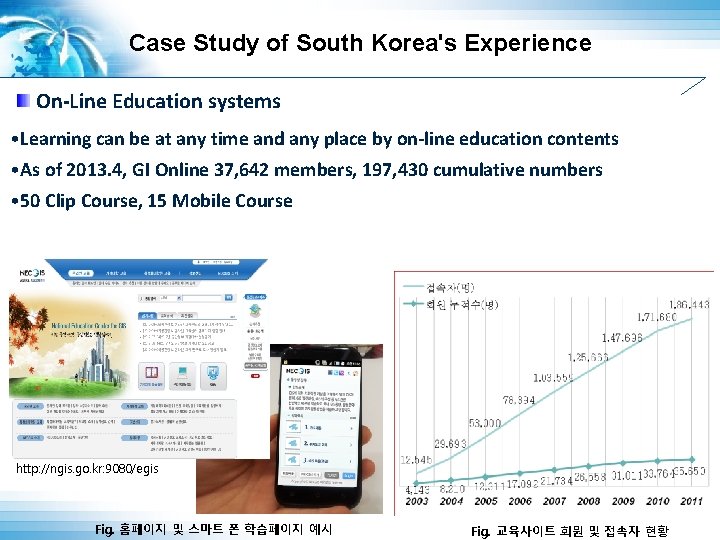
Case Study of South Korea's Experience On-Line Education systems • Learning can be at any time and any place by on-line education contents • As of 2013. 4, GI Online 37, 642 members, 197, 430 cumulative numbers • 50 Clip Course, 15 Mobile Course http: //ngis. go. kr: 9080/egis Fig. 홈페이지 및 스마트 폰 학습페이지 예시 Fig. 교육사이트 회원 및 접속자 현황
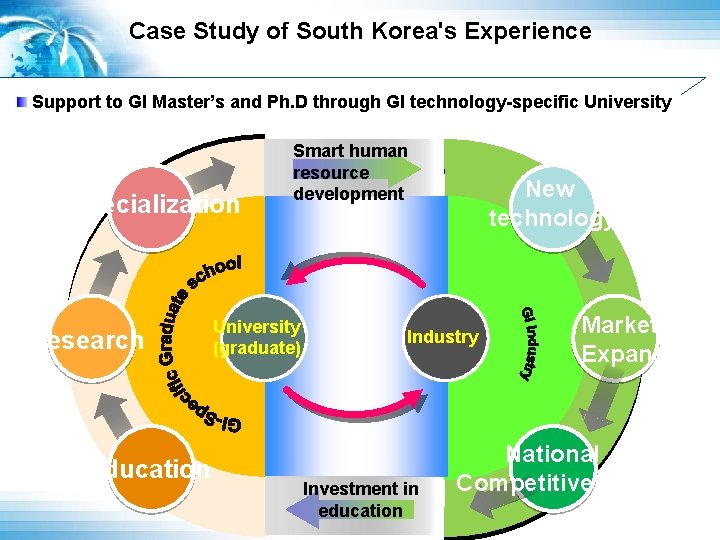
Case Study of South Korea's Experience Support to GI Master’s and Ph. D through GI technology-specific University specialization research education Smart human resource development University (graduate) New technology Industry Investment in education Market Expansion National Competitiveness
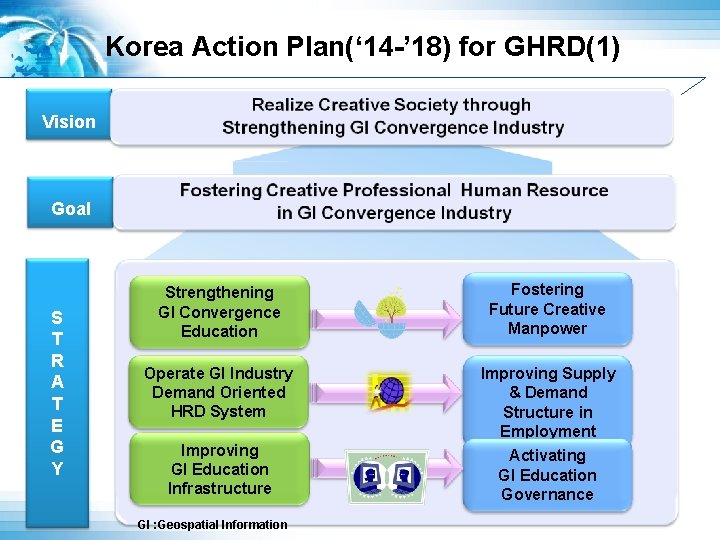
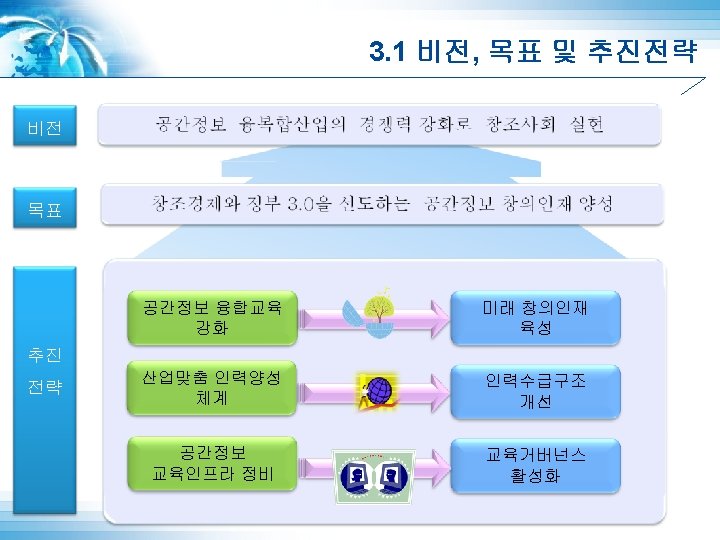
Korea Action Plan(‘ 14 -’ 18) for GHRD(1) Vision Goal S T R A T E G Y Strengthening GI Convergence Education Fostering Future Creative Manpower NSDI Operate GI Industry Demand Oriented HRD System Improving Supply & Demand Structure in Employment Improving GI Education Infrastructure Activating GI Education Governance GI : Geospatial Information
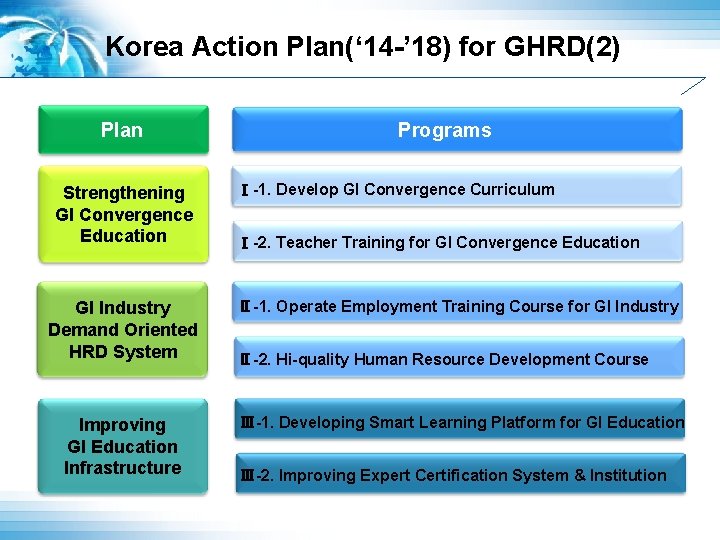
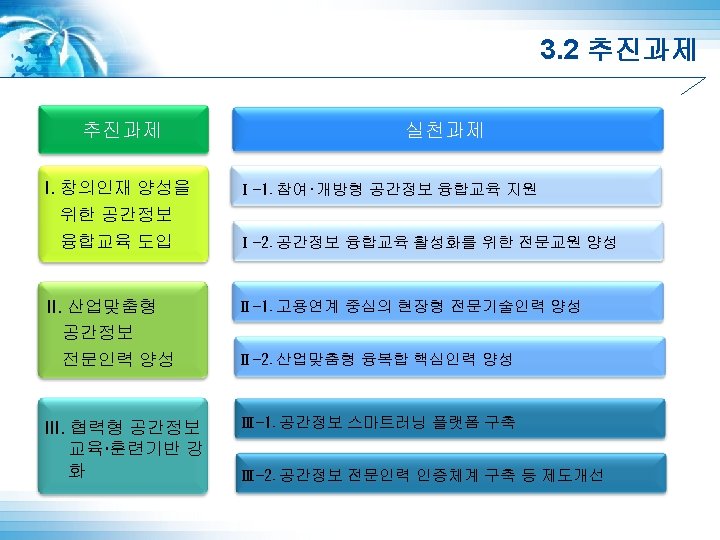
Korea Action Plan(‘ 14 -’ 18) for GHRD(2) Plan Strengthening GI Convergence Education Programs Ⅰ-1. Develop GI Convergence Curriculum Ⅰ-2. Teacher Training for GI Convergence Education GI Industry Demand Oriented HRD System Ⅱ-1. Operate Employment Training Course for GI Industry Improving GI Education Infrastructure Ⅲ-1. Developing Smart Learning Platform for GI Education Ⅱ-2. Hi-quality Human Resource Development Course Ⅲ-2. Improving Expert Certification System & Institution
Thank you for your attention! Q&A