
GEOSChem model overview Daniel J Jacob Harvard University

GEOS-Chem model overview Daniel J. Jacob, Harvard University GEOS-Chem Community Mission: to advance understanding of human and natural influences on the environment through a comprehensive, state-of-the-science, readily accessible global model of atmospheric composition GEOS-Chem user groups IGC 8 meeting (Harvard, May 2017)
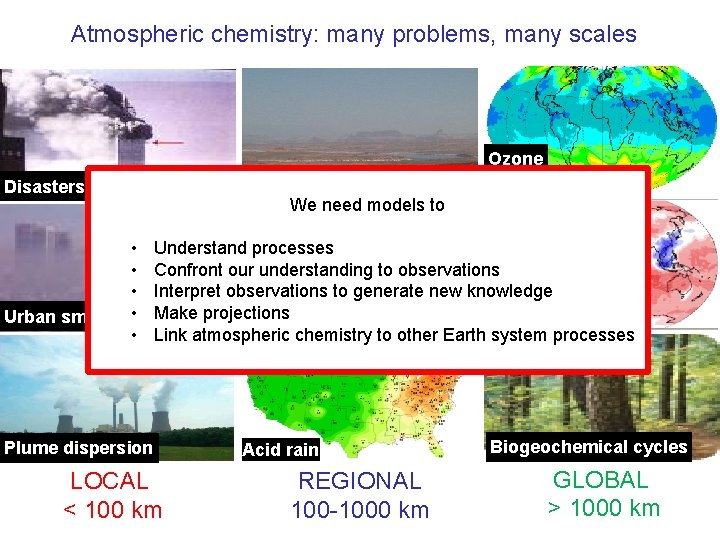
Atmospheric chemistry: many problems, many scales Visibility We need models to Disasters Urban smog • • • Ozone layer Understand processes Confront our understanding to observations Interpret observations to generate new knowledge Make projections Climate forcing Regional smog Link atmospheric chemistry to other Earth system processes Plume dispersion LOCAL < 100 km Acid rain REGIONAL 100 -1000 km Biogeochemical cycles GLOBAL > 1000 km
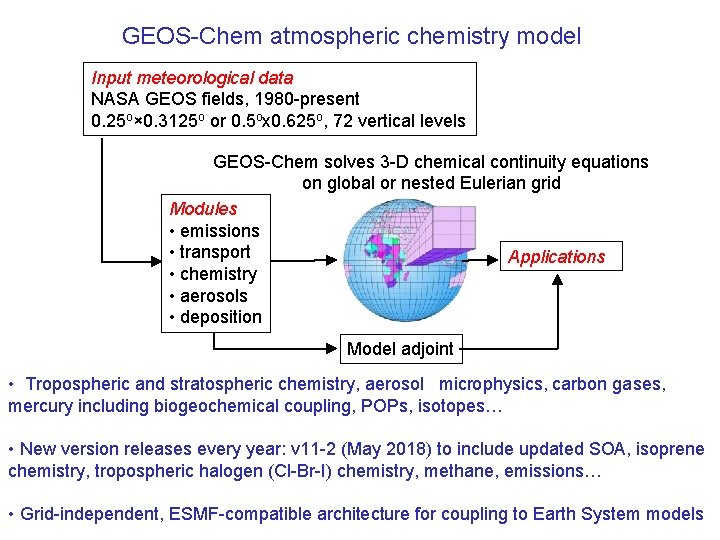
GEOS-Chem atmospheric chemistry model Input meteorological data NASA GEOS fields, 1980 -present 0. 25 o× 0. 3125 o or 0. 5 ox 0. 625 o, 72 vertical levels GEOS-Chem solves 3 -D chemical continuity equations on global or nested Eulerian grid Modules • emissions • transport Applications • chemistry • aerosols • deposition Model adjoint • Tropospheric and stratospheric chemistry, aerosol microphysics, carbon gases, mercury including biogeochemical coupling, POPs, isotopes… • New version releases every year: v 11 -2 (May 2018) to include updated SOA, isoprene chemistry, tropospheric halogen (Cl-Br-I) chemistry, methane, emissions… • Grid-independent, ESMF-compatible architecture for coupling to Earth System models

GEOS-Chem as on-line chemical module for Earth system models (ESMs) any 3 -D grid specified at run time ESMF Advection Mixing Convection Off-line GEOS-Chem CTM ESMF O Emissions Chemistry (HEMCO): (Flex. Chem): d. C/dt = P –L - D d. C/dt = E GEOS-Chem chemical module

GEOS-Chem as on-line chemical module for Earth system models (ESMs) any 3 -D grid specified at run time ESMF O Emissions Chemistry (HEMCO): (Flex. Chem): d. C/dt = P –L - D d. C/dt = E ESMF Dynamics, chemical transport Earth System Model with GEOS-Chem chemical module GEOS-Chem chemistry
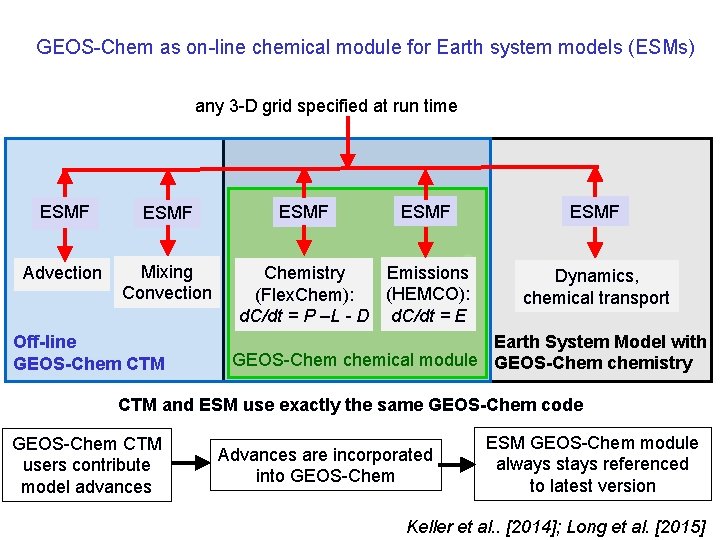
GEOS-Chem as on-line chemical module for Earth system models (ESMs) any 3 -D grid specified at run time ESMF Advection Mixing Convection Off-line GEOS-Chem CTM ESMF O Emissions Chemistry (HEMCO): (Flex. Chem): d. C/dt = P –L - D d. C/dt = E ESMF Dynamics, chemical transport Earth System Model with GEOS-Chem chemical module GEOS-Chem chemistry CTM and ESM use exactly the same GEOS-Chem code GEOS-Chem CTM users contribute model advances Advances are incorporated into GEOS-Chem ESM GEOS-Chem module always stays referenced to latest version Keller et al. . [2014]; Long et al. [2015]

Full-year tropospheric chemistry simulation at c 720 (~12 km) resolution using on-line GEOS-Chem in GEOS ESM August 1, 2013 0 Z Hu et al. [2018]
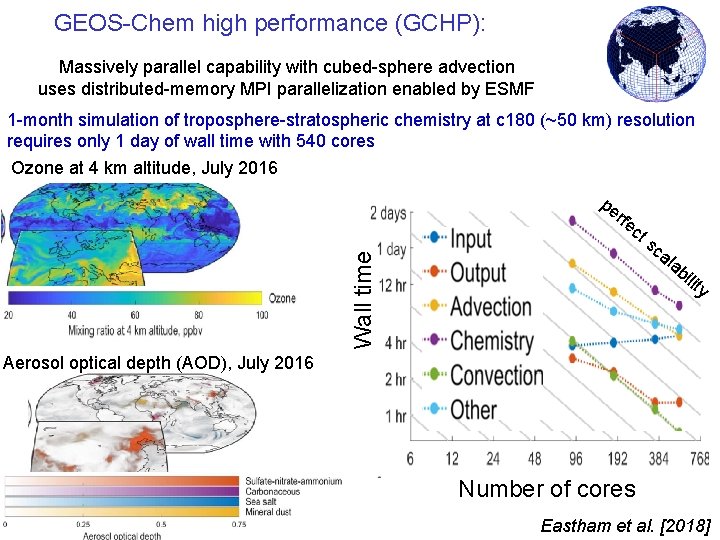
GEOS-Chem high performance (GCHP): Massively parallel capability with cubed-sphere advection uses distributed-memory MPI parallelization enabled by ESMF 1 -month simulation of troposphere-stratospheric chemistry at c 180 (~50 km) resolution requires only 1 day of wall time with 540 cores Ozone at 4 km altitude, July 2016 pe ct Wall time rfe sc al ab ilit y Aerosol optical depth (AOD), July 2016 Number of cores Eastham et al. [2018]
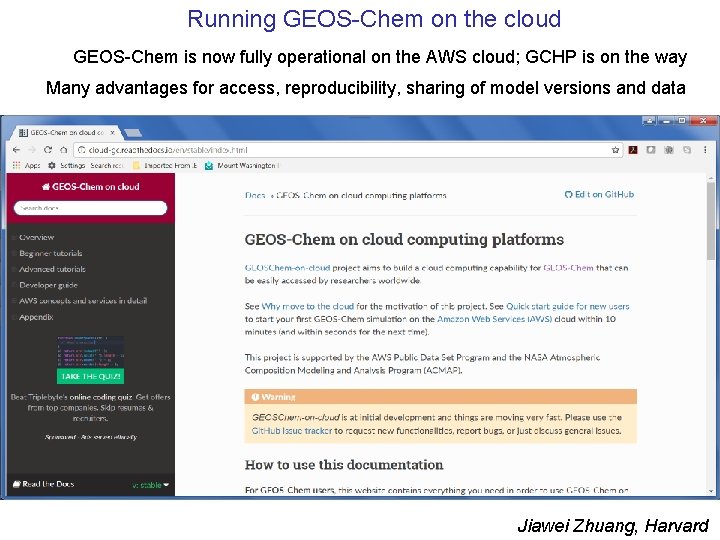
Running GEOS-Chem on the cloud GEOS-Chem is now fully operational on the AWS cloud; GCHP is on the way Many advantages for access, reproducibility, sharing of model versions and data Jiawei Zhuang, Harvard
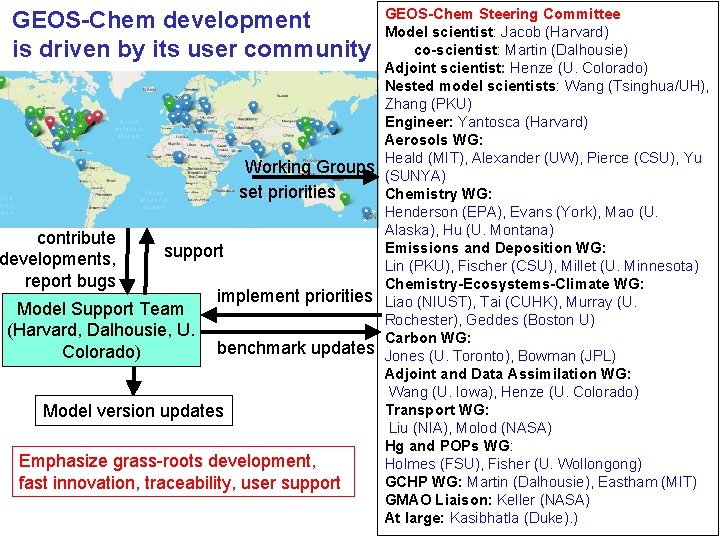
GEOS-Chem development is driven by its user community Working Groups set priorities contribute developments, report bugs support Model Support Team (Harvard, Dalhousie, U. Colorado) implement priorities benchmark updates Model version updates Emphasize grass-roots development, fast innovation, traceability, user support GEOS-Chem Steering Committee Model scientist: Jacob (Harvard) co-scientist: Martin (Dalhousie) Adjoint scientist: Henze (U. Colorado) Nested model scientists: Wang (Tsinghua/UH), Zhang (PKU) Engineer: Yantosca (Harvard) Aerosols WG: Heald (MIT), Alexander (UW), Pierce (CSU), Yu (SUNYA) Chemistry WG: Henderson (EPA), Evans (York), Mao (U. Alaska), Hu (U. Montana) Emissions and Deposition WG: Lin (PKU), Fischer (CSU), Millet (U. Minnesota) Chemistry-Ecosystems-Climate WG: Liao (NIUST), Tai (CUHK), Murray (U. Rochester), Geddes (Boston U) Carbon WG: Jones (U. Toronto), Bowman (JPL) Adjoint and Data Assimilation WG: Wang (U. Iowa), Henze (U. Colorado) Transport WG: Liu (NIA), Molod (NASA) Hg and POPs WG: Holmes (FSU), Fisher (U. Wollongong) GCHP WG: Martin (Dalhousie), Eastham (MIT) GMAO Liaison: Keller (NASA) At large: Kasibhatla (Duke). )
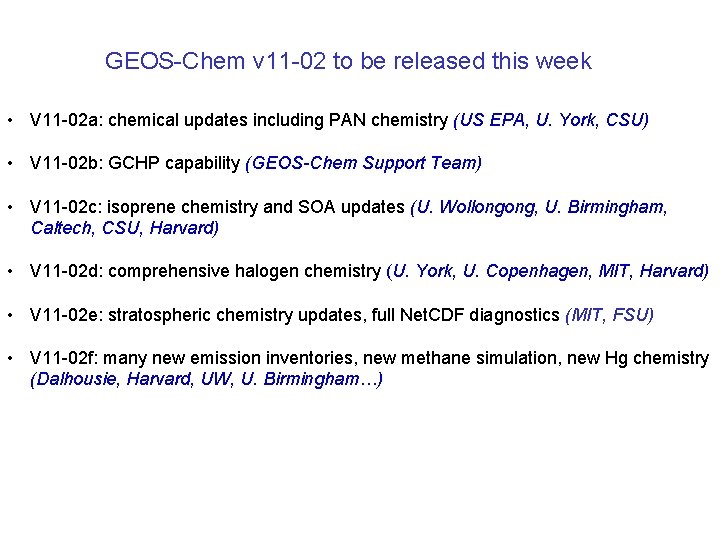
GEOS-Chem v 11 -02 to be released this week • V 11 -02 a: chemical updates including PAN chemistry (US EPA, U. York, CSU) • V 11 -02 b: GCHP capability (GEOS-Chem Support Team) • V 11 -02 c: isoprene chemistry and SOA updates (U. Wollongong, U. Birmingham, Caltech, CSU, Harvard) • V 11 -02 d: comprehensive halogen chemistry (U. York, U. Copenhagen, MIT, Harvard) • V 11 -02 e: stratospheric chemistry updates, full Net. CDF diagnostics (MIT, FSU) • V 11 -02 f: many new emission inventories, new methane simulation, new Hg chemistry (Dalhousie, Harvard, UW, U. Birmingham…)
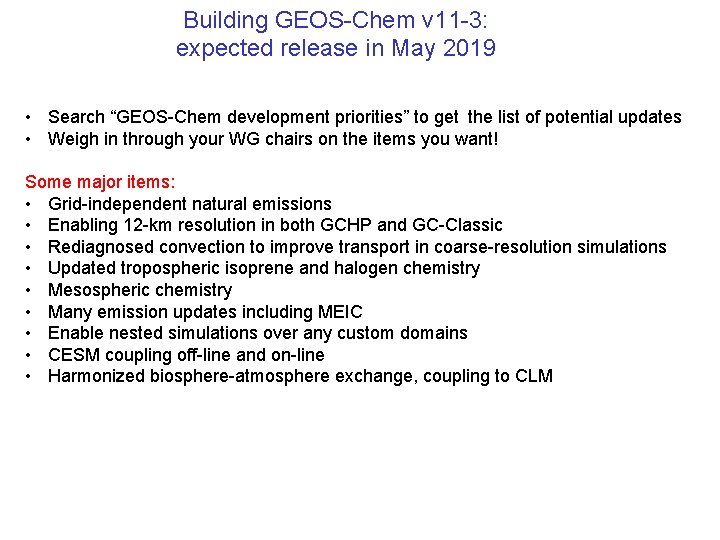
Building GEOS-Chem v 11 -3: expected release in May 2019 • Search “GEOS-Chem development priorities” to get the list of potential updates • Weigh in through your WG chairs on the items you want! Some major items: • Grid-independent natural emissions • Enabling 12 -km resolution in both GCHP and GC-Classic • Rediagnosed convection to improve transport in coarse-resolution simulations • Updated tropospheric isoprene and halogen chemistry • Mesospheric chemistry • Many emission updates including MEIC • Enable nested simulations over any custom domains • CESM coupling off-line and on-line • Harmonized biosphere-atmosphere exchange, coupling to CLM
Chemistry challenges • How do we get to a unified mechanistic mechanism for SOA? o Simple seems to do best, but are we satisfied with that? • Full tropospheric-stratospheric Cl-Br-I chemistry o Major tropospheric ozone sink at mid-latitudes from seasalt aerosol – how do we fix? • Updating isoprene chemistry o New “reduced” Caltech mechanism has 150 species… • Aromatic chemistry and terpene chemistry are still sketchy • Speeding up the model o Mechanism reduction? o Machine learning? o Crowd sourcing through the cloud?
Progress in emissions • HEMCO has made updating emission inventories much easier but beware of black box – need to check what comes out • Grid-independent natural emissions will be major advance • Harmonized biosphere-atmosphere exchange, coupling to CLM • Continual challenge to update emissions to latest years o Community participation is key Need to facilitate update of “specialty” simulations • Hg chemistry moving to KPP • Need to maintain aerosol microphysics simulations
Push to higher resolution AQ applications look for higher resolution, also evidence that coarse model resolutions produce transport errors Two approaches: • Off-line simulations matched to highest GEOS resolution (now 12 km) o Advantages: - Ease of use - Cost - Reproducibility - Inverse applications o Disadvantages: - Loss of information in temporal archiving of met data - Management of large archive - Cannot go finer than GEOS resolution • On-line simulations with hi-res met model using GEOS-Chem chemical module o Advantages: - Specific on-line applications: chem-climate, data assimilation - Explore different meteorological simulations, high resolution o Disadvantages: see off-line advantages Some other considerations: • As resolution increases, on-line becomes more desirable • Many of our applications don’t need very high resolution …. so a model with both on-line and off-line capabilities makes sense • Have the exact same GEOS-Chem chemical module in all applications
Off-line approaches: GC-Classic and GCHP GC-Classic is to be maintained indefinitely (or until it has outlived its usefulness) • Ease of access and use • Nested model capability can be extended to higher resolutions GCHP: a powerful tool for the future • High-performance applications through MPI • Better transport through FV 3 on cubed sphere • Challenge #1: difficulty of use o Solve with access through cloud? o Simplify the MAPL coupler? • Challenge #2: Availability of cubed-sphere native archive o Prototype archive being tested: air mass fluxes and pressure • Challenge #3: dealing with model nesting o Use stretched-grid approach?
On-line approach: GEOS-Chem chemical module • Coupling to GEOS-5 and to BCC is already in place o But these models are not open access… • Coupling to WRF – very exciting for AQ applications! o a much better, more transparent chemical module than current WRF-Chem • Coupling to NCAR CESM – development being led by Seb Eastham o Prototype version to be presented to NCAR next week o Strong buy-in from NCAR – they want GEOS-Chem
Looking to the future: balancing community needs for innovation and stability GEOS-Chem Community Mission: to advance understanding of human and natural influences on the environment through a comprehensive, state-of-the-science, readily accessible global model of atmospheric composition • GEOS-Chem is unique among atmchem models in its ease of use; allows atm chemists with low computing resources to contribute scientific innovation • But they wouldn’t use it if it didn’t stay at the cutting edge of science – meaning that we have to continuously innovate in both the science and the underlying software engineering • But somebody’s “cutting edge of science” is someone else’s “unnecessary update” and users are stressed when the model keeps changing • This is particularly the case for specialty simulations that get broken in model updates • On the other hand, continued support for older versions would unduly stress the Support Team Best solution is for GEOS-Chem Steering Committee to provide guidance in striking a balance between innovation and stability
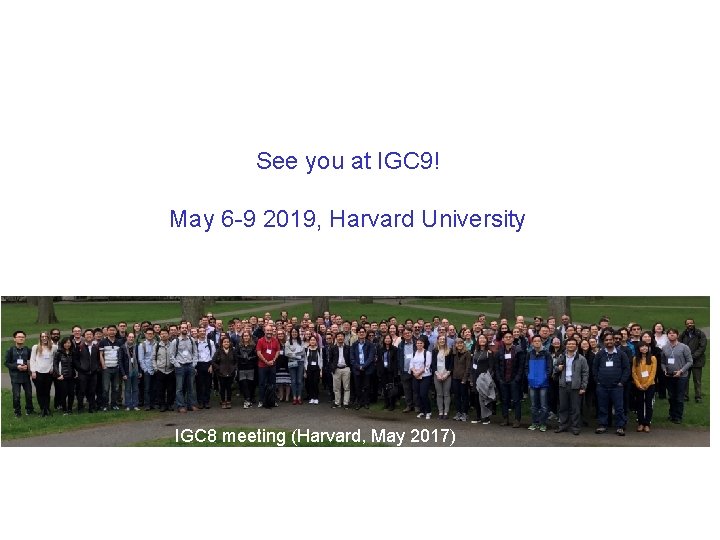
See you at IGC 9! May 6 -9 2019, Harvard University IGC 8 meeting (Harvard, May 2017)
- Slides: 19