
GEOSChem atmospheric chemistry model current capabilities future developments
GEOS-Chem atmospheric chemistry model: current capabilities, future developments, partnership with GMAO Daniel Jacob, Harvard University Bob Yantosca Melissa Sulprizio Haipeng Lin Lu Shen Karen Yu Lizzie Lundgren Jiawei Zhuang Seb Eastham Lu Hu Surface NOx in c 720 GEOS-5 simulation with GEOS-Chem tropospheric chemistry: Nature Run for geostationary OSSEs [Hu et al. , GMD 2018]
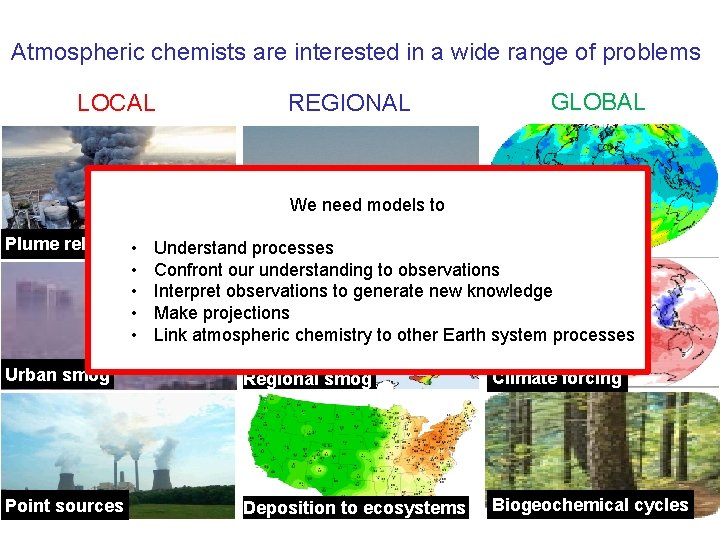
Atmospheric chemists are interested in a wide range of problems LOCAL We need models to Plume releases • • • GLOBAL REGIONAL Ozone layer Visibility Understand processes Confront our understanding to observations Interpret observations to generate new knowledge Make projections Link atmospheric chemistry to other Earth system processes Urban smog Regional smog Climate forcing Point sources Deposition to ecosystems Biogeochemical cycles
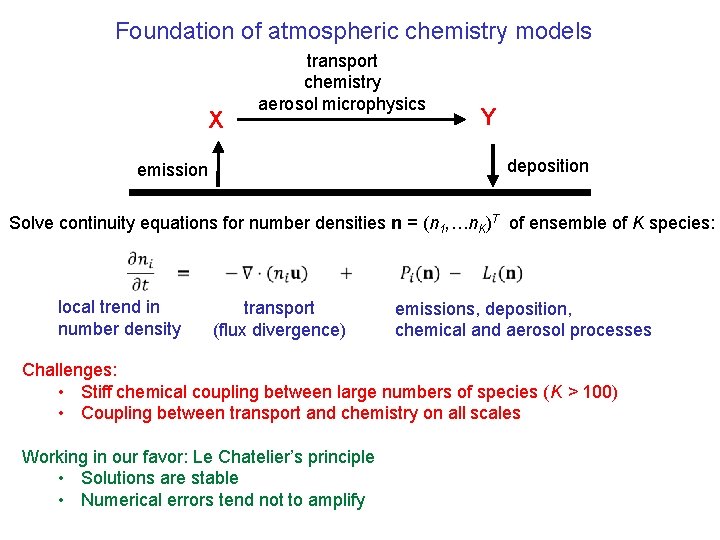
Foundation of atmospheric chemistry models X transport chemistry aerosol microphysics Y deposition emission Solve continuity equations for number densities n = (n 1, …n. K)T of ensemble of K species: local trend in number density transport (flux divergence) emissions, deposition, chemical and aerosol processes Challenges: • Stiff chemical coupling between large numbers of species (K > 100) • Coupling between transport and chemistry on all scales Working in our favor: Le Chatelier’s principle • Solutions are stable • Numerical errors tend not to amplify
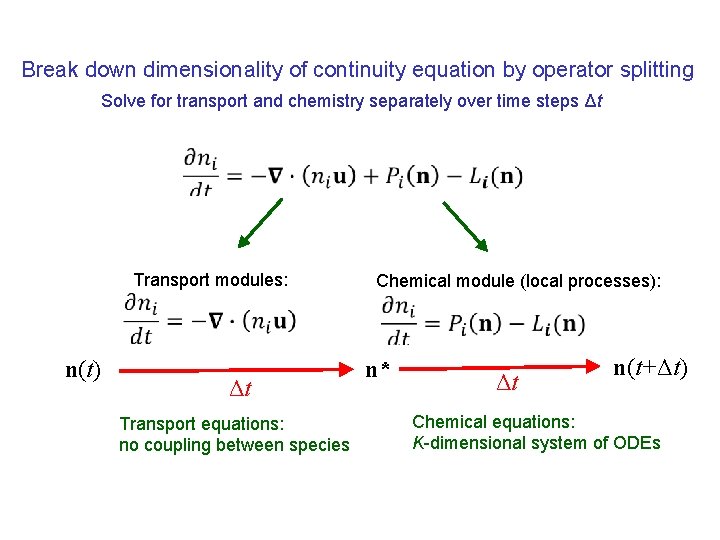
Break down dimensionality of continuity equation by operator splitting Solve for transport and chemistry separately over time steps Δt Transport modules: n(t) Δt Transport equations: no coupling between species Chemical module (local processes): n* Δt n(t+Δt) Chemical equations: K-dimensional system of ODEs
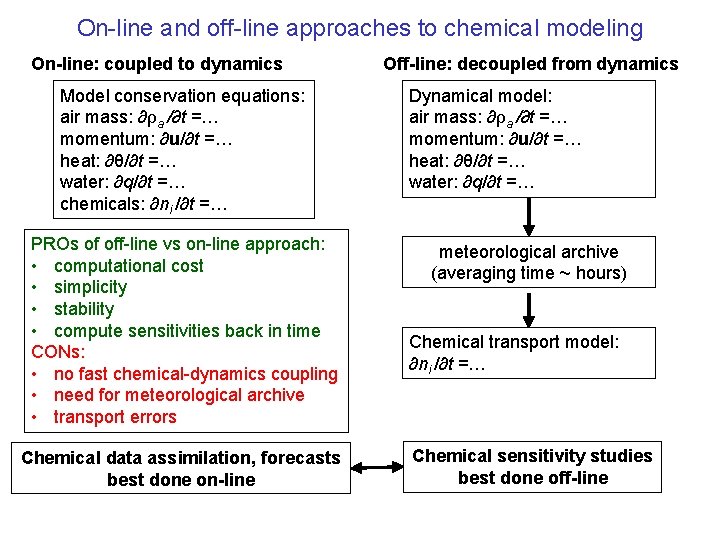
On-line and off-line approaches to chemical modeling On-line: coupled to dynamics Model conservation equations: air mass: ∂⍴a /∂t =… momentum: ∂u/∂t =… heat: ∂θ/∂t =… water: ∂q/∂t =… chemicals: ∂ni /∂t =… PROs of off-line vs on-line approach: • computational cost • simplicity • stability • compute sensitivities back in time CONs: • no fast chemical-dynamics coupling • need for meteorological archive • transport errors Chemical data assimilation, forecasts best done on-line Off-line: decoupled from dynamics Dynamical model: air mass: ∂⍴a /∂t =… momentum: ∂u/∂t =… heat: ∂θ/∂t =… water: ∂q/∂t =… meteorological archive (averaging time ~ hours) Chemical transport model: ∂ni /∂t =… Chemical sensitivity studies best done off-line
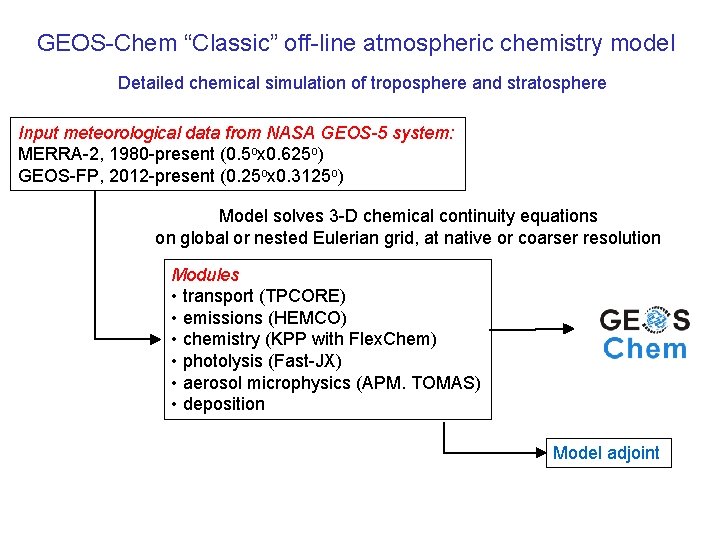
GEOS-Chem “Classic” off-line atmospheric chemistry model Detailed chemical simulation of troposphere and stratosphere Input meteorological data from NASA GEOS-5 system: MERRA-2, 1980 -present (0. 5 ox 0. 625 o) GEOS-FP, 2012 -present (0. 25 ox 0. 3125 o) Model solves 3 -D chemical continuity equations on global or nested Eulerian grid, at native or coarser resolution Modules • transport (TPCORE) • emissions (HEMCO) • chemistry (KPP with Flex. Chem) • photolysis (Fast-JX) • aerosol microphysics (APM. TOMAS) • deposition Model adjoint
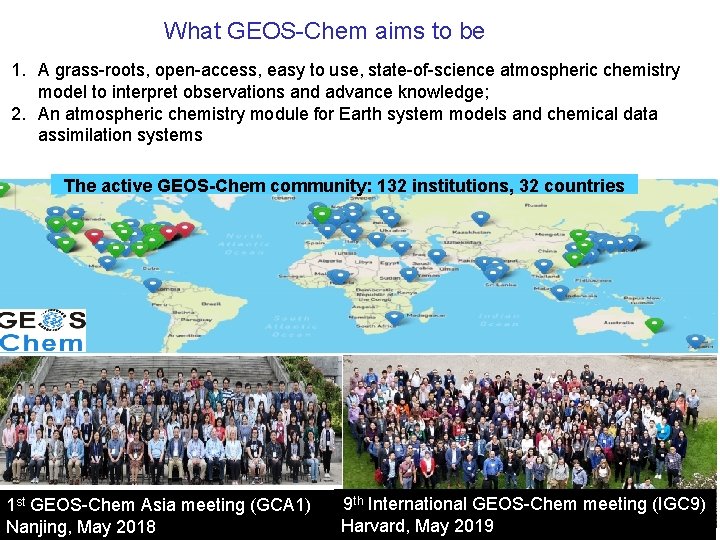
What GEOS-Chem aims to be 1. A grass-roots, open-access, easy to use, state-of-science atmospheric chemistry model to interpret observations and advance knowledge; 2. An atmospheric chemistry module for Earth system models and chemical data assimilation systems The active GEOS-Chem community: 132 institutions, 32 countries 1 st GEOS-Chem Asia meeting (GCA 1) Nanjing, May 2018 9 th International GEOS-Chem meeting (IGC 9) Harvard, May 2019

Functioning of GEOS-Chem community model users contribute developments, report bugs set development priorities through Working Groups: support Model Support Team Harvard, Wash. U, CU implement priorities review benchmarks Model version updates Emphasize user support, community spirit, nimble innovation, strong version control, documentation, traceability GEOS-Chem Steering Committee Model scientist: Jacob (Harvard) Model co-scientist: Martin (Washington U. ) Adjoint model scientist: Henze (U. Colorado) Nested model scientists: Y. Wang (U. Houston), L. Zhang (PKU) WRF-GC scientist: Fu (SUSTech) Engineer: Yantosca (Harvard) Aerosols WG: Heald (MIT), Alexander (UW), Pierce (CSU), Yu (SUNYA) Chemistry WG: Henderson (EPA), Evans (York), Mao (U. Alaska), Hu (U. Montana) Emissions and Deposition WG: Lin (PKU), Fischer (CSU), Millet (U. Minnesota), Marais (U. Leicester) Chemistry-Ecosystem-Climate WG: Liao (NUIST), Tai (CUHK), Murray (U. Rochester), Geddes (Boston U) Carbon WG: Jones (U. Toronto), Bowman (JPL) Adjoint and Data Assimilation WG: J. Wang (U. Iowa), Henze (U. Colorado) Transport WG: Liu (NIA), Molod (NASA) Hg and POPs WG: Holmes (FSU), Fisher (U. Wollongong), Y. Zhang (Nanjing U. ) GCHP WG: Martin (Dalhousie), Eastham (MIT) Stratospheric WG: Jones (U. Toronto), Strahan (NASA) GMAO rep: Keller (NASA) At large: Kasibhatla (Duke).
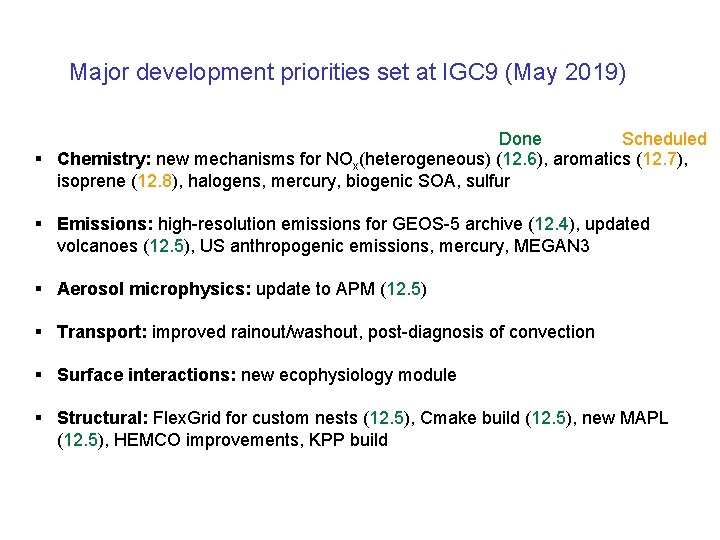
Major development priorities set at IGC 9 (May 2019) Done Scheduled § Chemistry: new mechanisms for NOx(heterogeneous) (12. 6), aromatics (12. 7), isoprene (12. 8), halogens, mercury, biogenic SOA, sulfur § Emissions: high-resolution emissions for GEOS-5 archive (12. 4), updated volcanoes (12. 5), US anthropogenic emissions, mercury, MEGAN 3 § Aerosol microphysics: update to APM (12. 5) § Transport: improved rainout/washout, post-diagnosis of convection § Surface interactions: new ecophysiology module § Structural: Flex. Grid for custom nests (12. 5), Cmake build (12. 5), new MAPL (12. 5), HEMCO improvements, KPP build
Recent software engineering advances q HEMCO as generalized emission/regridding/scaling data tool (Keller et al. , GMD 2014) q Processes emissions and other data bases on any grid and on the fly q GEOS-Chem operating on 1 -D columns rather than fixed grids (Long et al, GMD 2015) q enables use of any meteorological fields; grid is selected at run time q High-Performance GEOS-Chem (GCHP) (Eastham et al. , GMD 2018) q enables massively parallel simulations on native cubed-sphere GEOS grid q GEOS-Chem as chemical module for weather/climate models (Hu et al. , GMD 2018) q Interface with GEOS-5 (mature), Beijing Climate Center GCM (mature), WRF (beta), CESM (in development) q GEOS-Chem fully compatible with open-source software (GFortran, Python) q No need to purchase expensive software licenses; plotting tools moved to Python q GEOS-Chem operational and supported on AWS cloud (Zhuang et al. , BAMS 2019) q Enables immediate access to GEOS-Chem for new users q Software containers, GEOS-5 meteorological data available for download
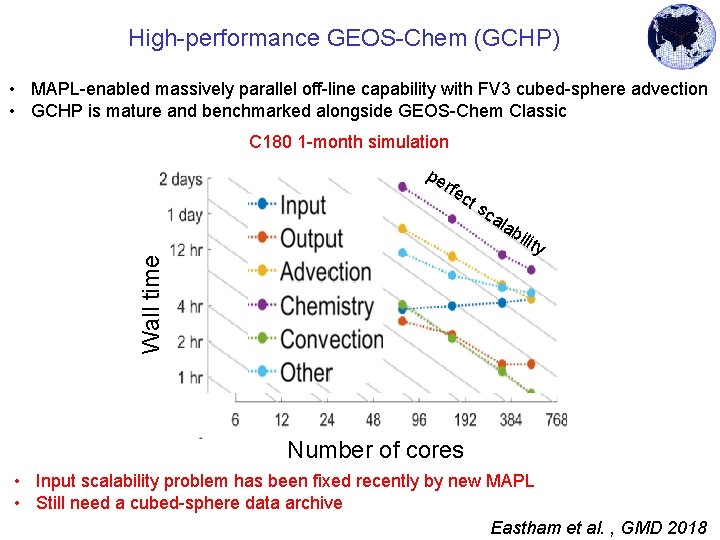
High-performance GEOS-Chem (GCHP) • MAPL-enabled massively parallel off-line capability with FV 3 cubed-sphere advection • GCHP is mature and benchmarked alongside GEOS-Chem Classic C 180 1 -month simulation pe rfe Wall time ct sc ala bil ity Number of cores • Input scalability problem has been fixed recently by new MAPL • Still need a cubed-sphere data archive Eastham et al. , GMD 2018
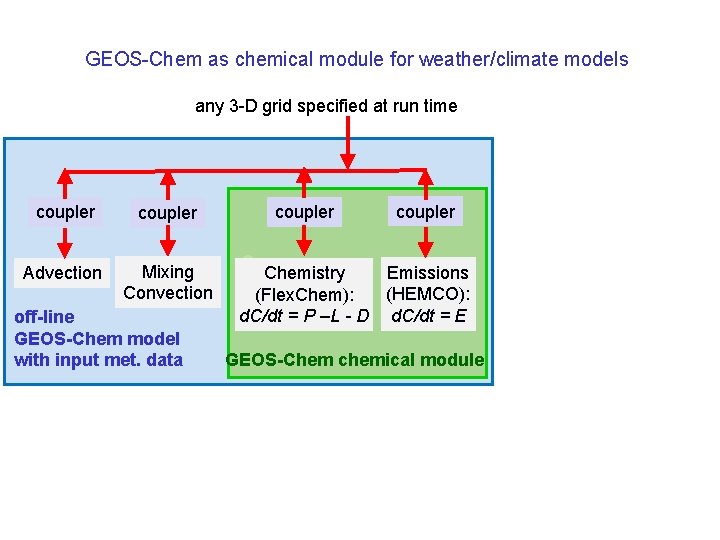
GEOS-Chem as chemical module for weather/climate models any 3 -D grid specified at run time coupler Advection Mixing Convection off-line GEOS-Chem model with input met. data coupler O Emissions Chemistry (HEMCO): (Flex. Chem): d. C/dt = P –L - D d. C/dt = E GEOS-Chem chemical module
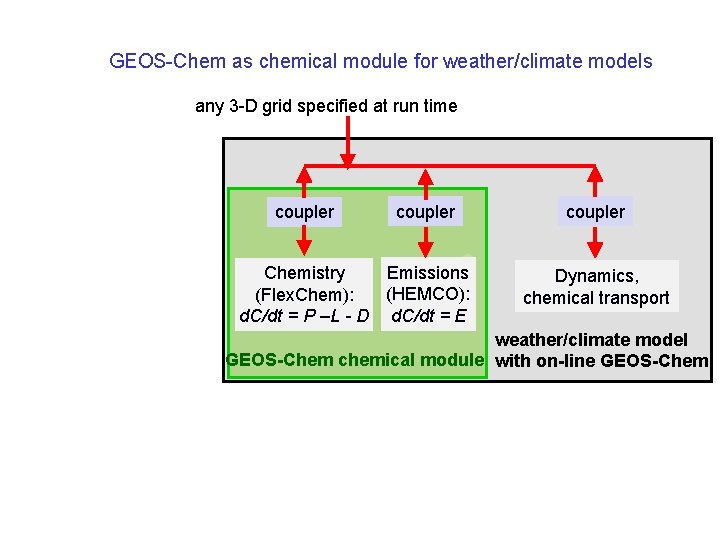
GEOS-Chem as chemical module for weather/climate models any 3 -D grid specified at run time coupler O Emissions Chemistry (HEMCO): (Flex. Chem): d. C/dt = P –L - D d. C/dt = E coupler Dynamics, chemical transport weather/climate model GEOS-Chem chemical module with on-line GEOS-Chem
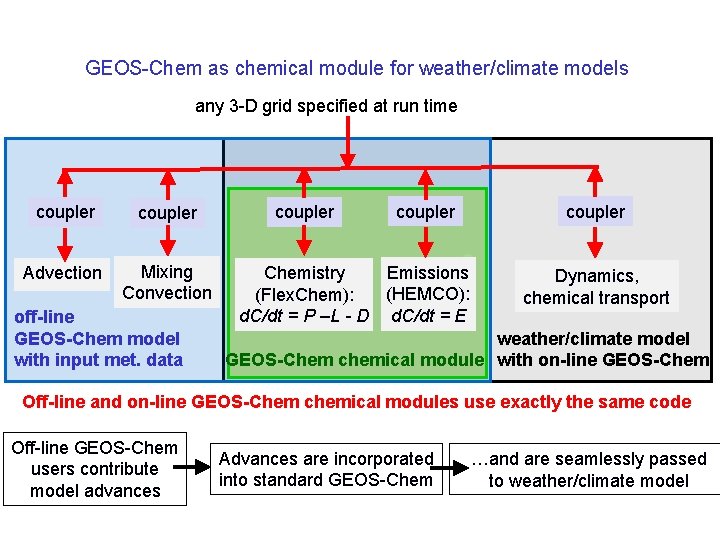
GEOS-Chem as chemical module for weather/climate models any 3 -D grid specified at run time coupler Advection Mixing Convection off-line GEOS-Chem model with input met. data coupler O Emissions Chemistry (HEMCO): (Flex. Chem): d. C/dt = P –L - D d. C/dt = E Dynamics, chemical transport weather/climate model GEOS-Chem chemical module with on-line GEOS-Chem Off-line and on-line GEOS-Chem chemical modules use exactly the same code Off-line GEOS-Chem users contribute model advances Advances are incorporated into standard GEOS-Chem …and are seamlessly passed to weather/climate model
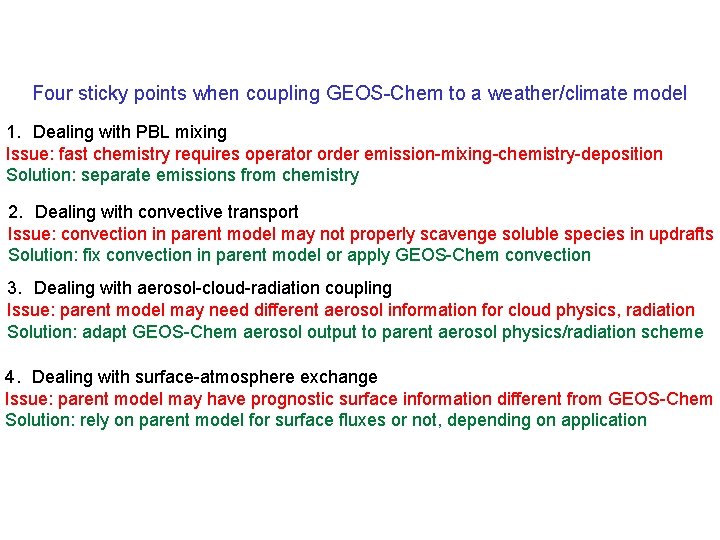
Four sticky points when coupling GEOS-Chem to a weather/climate model 1. Dealing with PBL mixing Issue: fast chemistry requires operator order emission-mixing-chemistry-deposition Solution: separate emissions from chemistry 2. Dealing with convective transport Issue: convection in parent model may not properly scavenge soluble species in updrafts Solution: fix convection in parent model or apply GEOS-Chem convection 3. Dealing with aerosol-cloud-radiation coupling Issue: parent model may need different aerosol information for cloud physics, radiation Solution: adapt GEOS-Chem aerosol output to parent aerosol physics/radiation scheme 4. Dealing with surface-atmosphere exchange Issue: parent model may have prognostic surface information different from GEOS-Chem Solution: rely on parent model for surface fluxes or not, depending on application
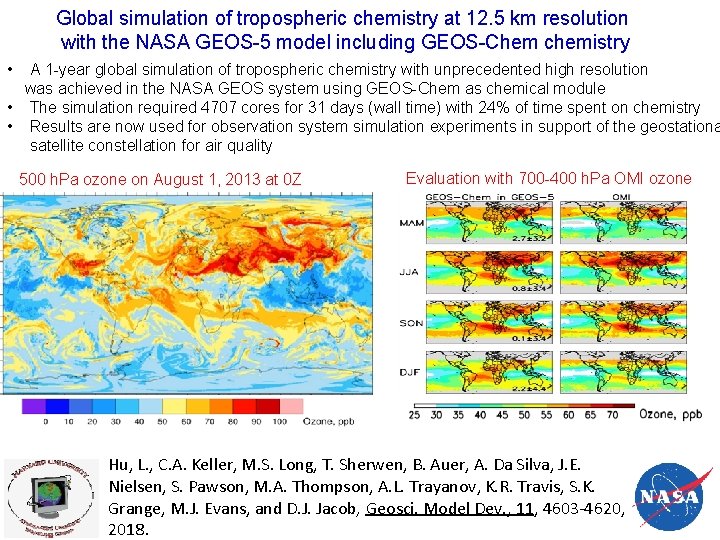
Global simulation of tropospheric chemistry at 12. 5 km resolution with the NASA GEOS-5 model including GEOS-Chem chemistry • A 1 -year global simulation of tropospheric chemistry with unprecedented high resolution was achieved in the NASA GEOS system using GEOS-Chem as chemical module • The simulation required 4707 cores for 31 days (wall time) with 24% of time spent on chemistry • Results are now used for observation system simulation experiments in support of the geostationa satellite constellation for air quality 500 h. Pa ozone on August 1, 2013 at 0 Z Evaluation with 700 -400 h. Pa OMI ozone Hu, L. , C. A. Keller, M. S. Long, T. Sherwen, B. Auer, A. Da Silva, J. E. Nielsen, S. Pawson, M. A. Thompson, A. L. Trayanov, K. R. Travis, S. K. Grange, M. J. Evans, and D. J. Jacob, Geosci. Model Dev. , 11, 4603 -4620, 2018.
Global chemical analyses and forecasts at GMAO Christoph Keller, GMAO
Global chemical analyses and forecasts at GMAO Christoph Keller, GMAO
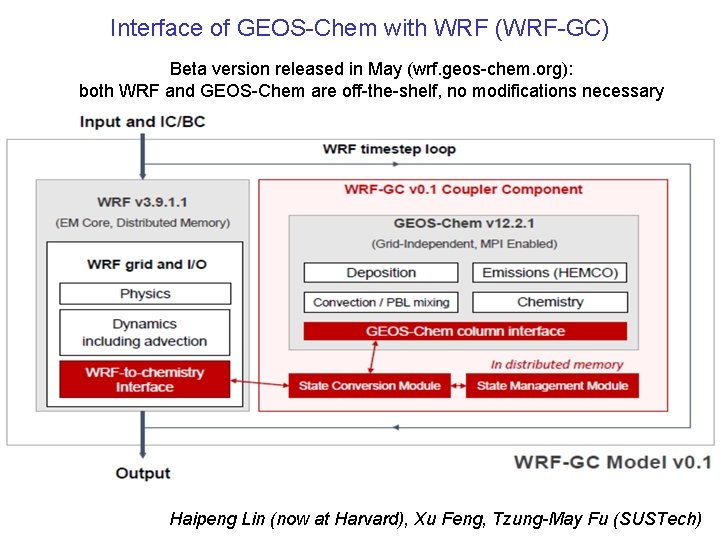
Interface of GEOS-Chem with WRF (WRF-GC) Beta version released in May (wrf. geos-chem. org): both WRF and GEOS-Chem are off-the-shelf, no modifications necessary Haipeng Lin (now at Harvard), Xu Feng, Tzung-May Fu (SUSTech)
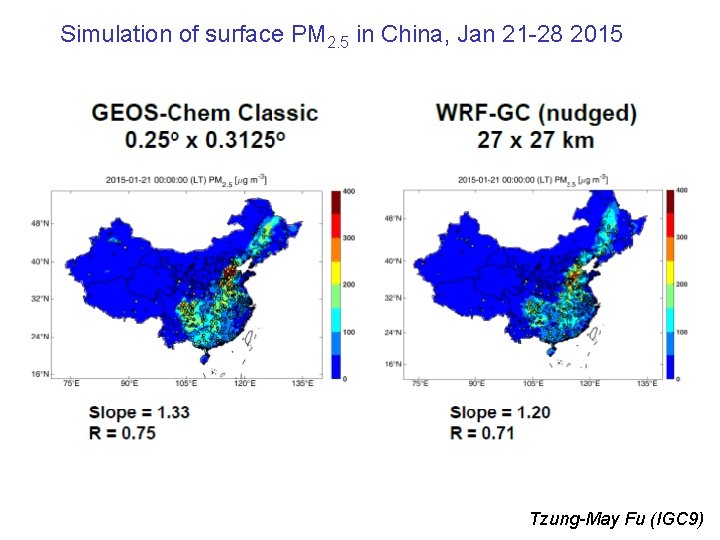
Simulation of surface PM 2. 5 in China, Jan 21 -28 2015 Tzung-May Fu (IGC 9)
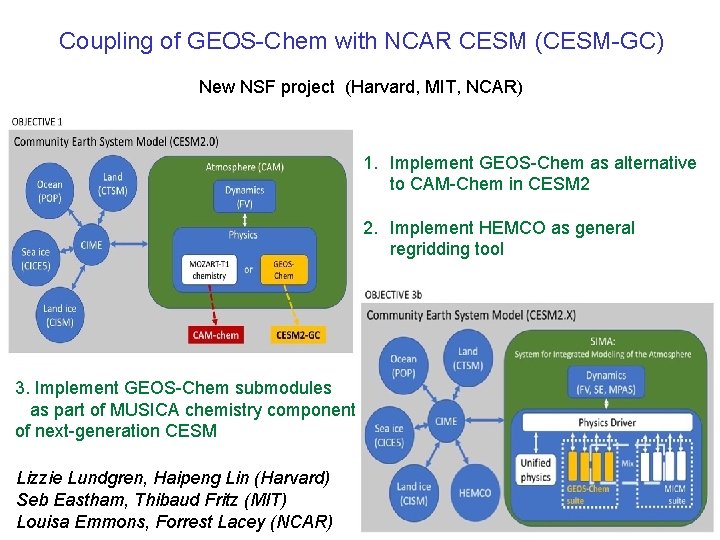
Coupling of GEOS-Chem with NCAR CESM (CESM-GC) New NSF project (Harvard, MIT, NCAR) 1. Implement GEOS-Chem as alternative to CAM-Chem in CESM 2 2. Implement HEMCO as general regridding tool 3. Implement GEOS-Chem submodules as part of MUSICA chemistry component of next-generation CESM Lizzie Lundgren, Haipeng Lin (Harvard) Seb Eastham, Thibaud Fritz (MIT) Louisa Emmons, Forrest Lacey (NCAR)
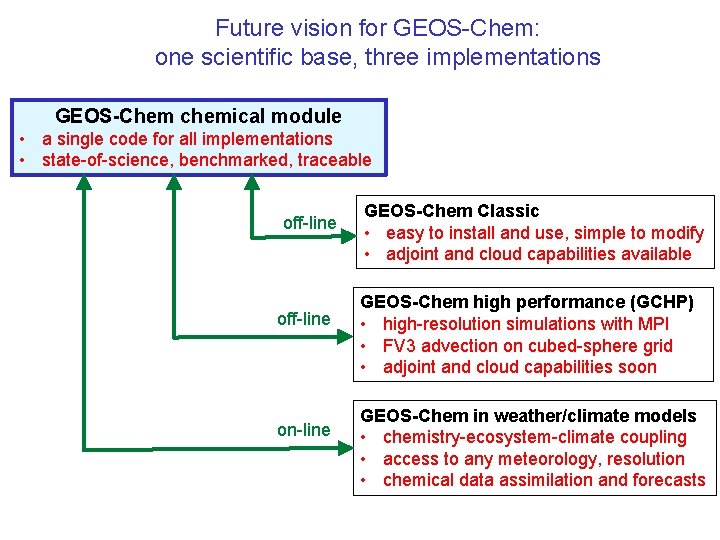
Future vision for GEOS-Chem: one scientific base, three implementations GEOS-Chem chemical module • a single code for all implementations • state-of-science, benchmarked, traceable off-line on-line GEOS-Chem Classic • easy to install and use, simple to modify • adjoint and cloud capabilities available GEOS-Chem high performance (GCHP) • high-resolution simulations with MPI • FV 3 advection on cubed-sphere grid • adjoint and cloud capabilities soon GEOS-Chem in weather/climate models • chemistry-ecosystem-climate coupling • access to any meteorology, resolution • chemical data assimilation and forecasts
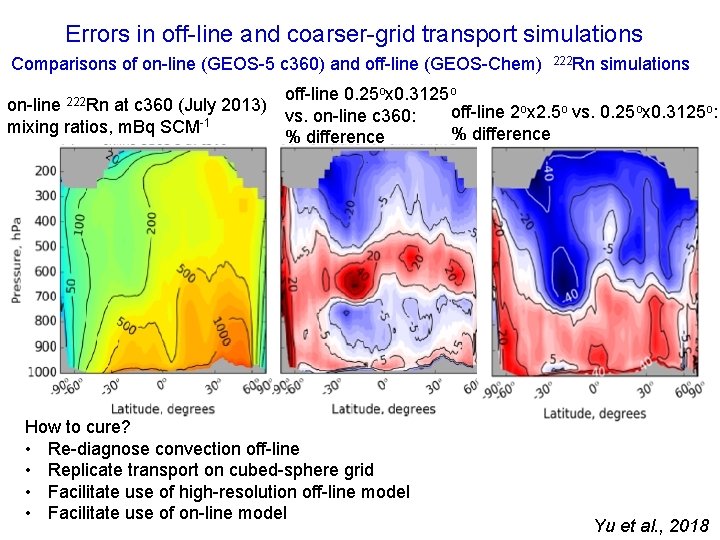
Errors in off-line and coarser-grid transport simulations Comparisons of on-line (GEOS-5 c 360) and off-line (GEOS-Chem) 222 Rn simulations off-line 0. 25 ox 0. 3125 o on-line at c 360 (July 2013) off-line 2 ox 2. 5 o vs. 0. 25 ox 0. 3125 o: vs. on-line c 360: -1 mixing ratios, m. Bq SCM % difference 222 Rn How to cure? • Re-diagnose convection off-line • Replicate transport on cubed-sphere grid • Facilitate use of high-resolution off-line model • Facilitate use of on-line model Yu et al. , 2018
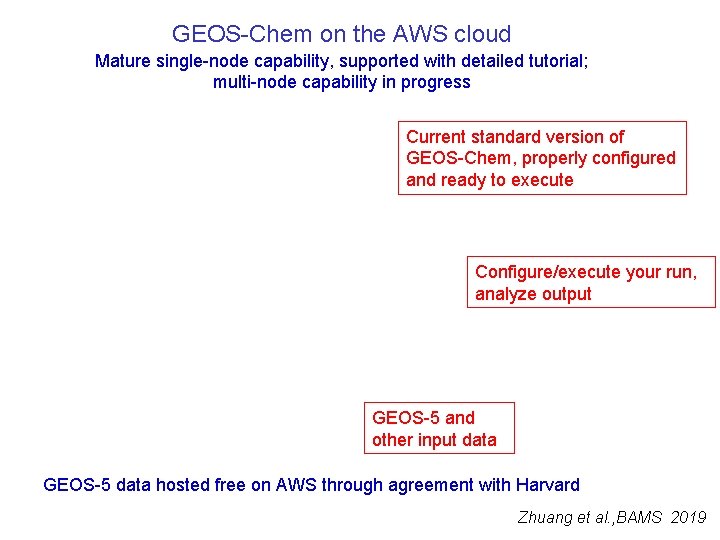
GEOS-Chem on the AWS cloud Mature single-node capability, supported with detailed tutorial; multi-node capability in progress Current standard version of GEOS-Chem, properly configured and ready to execute Configure/execute your run, analyze output GEOS-5 and other input data GEOS-5 data hosted free on AWS through agreement with Harvard Zhuang et al. , BAMS 2019
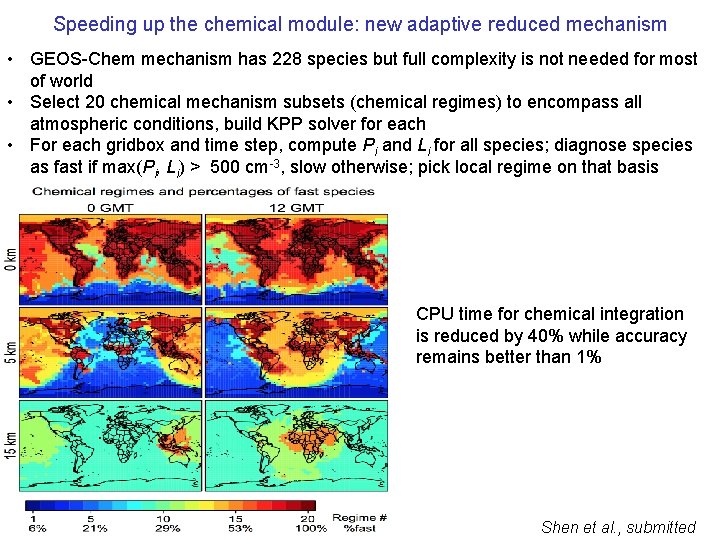
Speeding up the chemical module: new adaptive reduced mechanism • GEOS-Chem mechanism has 228 species but full complexity is not needed for most of world • Select 20 chemical mechanism subsets (chemical regimes) to encompass all atmospheric conditions, build KPP solver for each • For each gridbox and time step, compute Pi and Li for all species; diagnose species as fast if max(Pi, Li) > 500 cm-3, slow otherwise; pick local regime on that basis CPU time for chemical integration is reduced by 40% while accuracy remains better than 1% Shen et al. , submitted
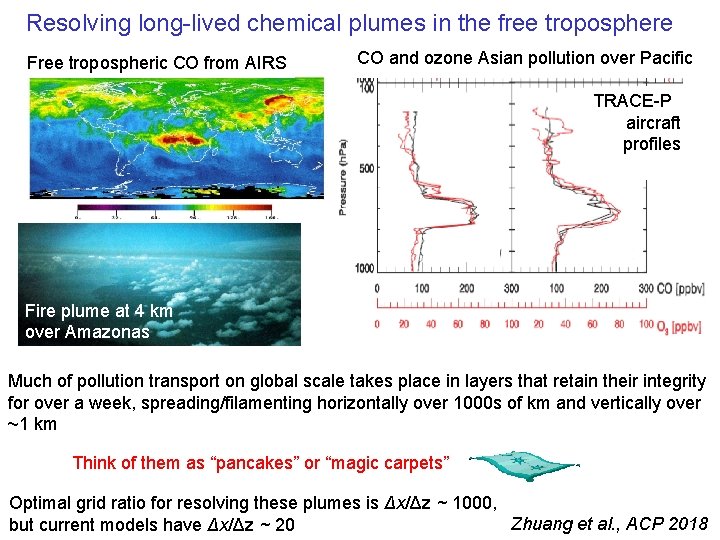
Resolving long-lived chemical plumes in the free troposphere Free tropospheric CO from AIRS CO and ozone Asian pollution over Pacific TRACE-P aircraft profiles Fire plume at 4 km over Amazonas Much of pollution transport on global scale takes place in layers that retain their integrity for over a week, spreading/filamenting horizontally over 1000 s of km and vertically over ~1 km Think of them as “pancakes” or “magic carpets” Optimal grid ratio for resolving these plumes is Δx/Δz ~ 1000, Zhuang et al. , ACP 2018 but current models have Δx/Δz ~ 20
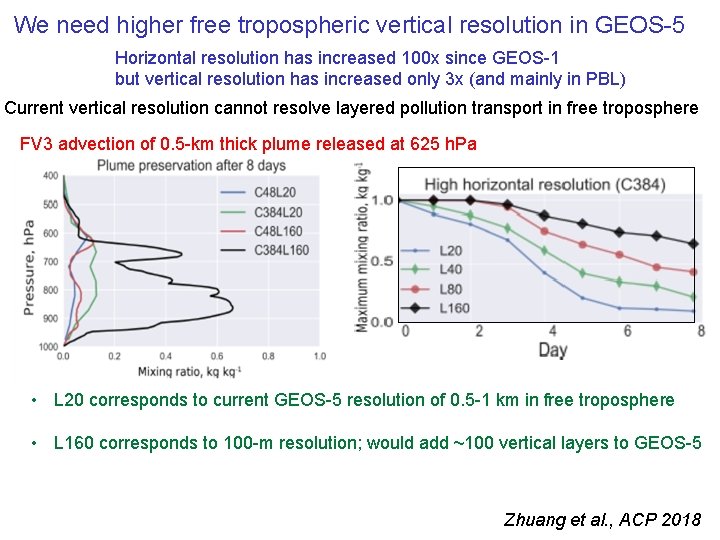
We need higher free tropospheric vertical resolution in GEOS-5 Horizontal resolution has increased 100 x since GEOS-1 but vertical resolution has increased only 3 x (and mainly in PBL) Current vertical resolution cannot resolve layered pollution transport in free troposphere FV 3 advection of 0. 5 -km thick plume released at 625 h. Pa • L 20 corresponds to current GEOS-5 resolution of 0. 5 -1 km in free troposphere • L 160 corresponds to 100 -m resolution; would add ~100 vertical layers to GEOS-5 Zhuang et al. , ACP 2018
Looking forward to continued partnership with GMAO • Maintaining up-to-date GEOS-Chem chemical capability in GEOS system • Using this capability for chemical data assimilation, forecasting, satellite simulators. . • Comparing with GMI, GOCART, Strat. Chem to improve model, estimate uncertainty • Contributing to GEOS aerosol simulation with GOCART, MAM, CARMA • Speeding up the chemical computation • Using MAPL to develop stretched-grid capability for GCHP • Better understanding transport errors in off-line simulations with GEOS-CTM
- Slides: 28