
Georgias Pyramid of Intervention Promising Practices in RTI




- Slides: 61
Georgia’s Pyramid of Intervention: Promising Practices in RTI Summer GAEL July 2009 Scarlet Correll, Debbie Rondem, Dr. Paula Freer for John Wight 1
Handouts Power. Pt will be available on the SSTAGE website in 2 weeks www. sstage. org
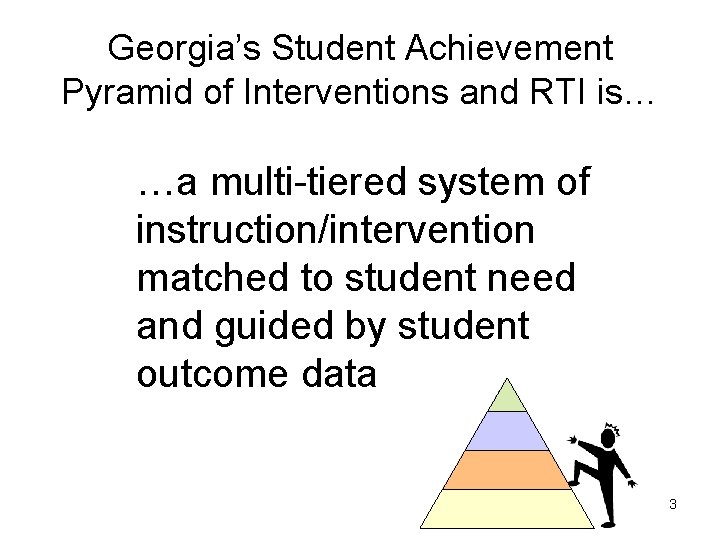
Georgia’s Student Achievement Pyramid of Interventions and RTI is… …a multi-tiered system of instruction/intervention matched to student need and guided by student outcome data 3
SSTAGE STATS First Year (2007 -08) ü 3 Conferences = 1000+ participants (SOLD OUT!) ü 9 Symposia = 580+ participants ü 5 Regional meetings Second Year (2008 -09) • Sept. 9 th & 10 th Conference (Interventions) Dublin • Jan. 14 th & 15 th Conference (Best Practices) Athens 4
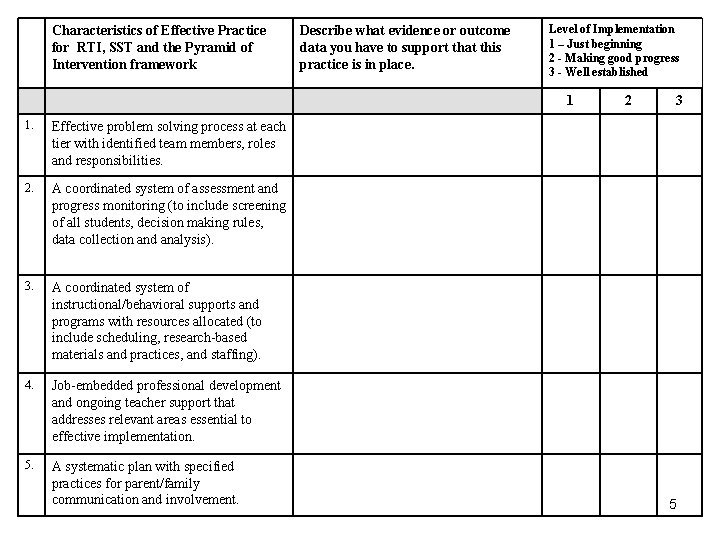
Characteristics of Effective Practice for RTI, SST and the Pyramid of Intervention framework Describe what evidence or outcome data you have to support that this practice is in place. Level of Implementation 1 – Just beginning 2 - Making good progress 3 - Well established 1 1. Effective problem solving process at each tier with identified team members, roles and responsibilities. 2. A coordinated system of assessment and progress monitoring (to include screening of all students, decision making rules, data collection and analysis). 3. A coordinated system of instructional/behavioral supports and programs with resources allocated (to include scheduling, research-based materials and practices, and staffing). 4. Job-embedded professional development and ongoing teacher support that addresses relevant areas essential to effective implementation. 5. A systematic plan with specified practices for parent/family communication and involvement. 2 3 5
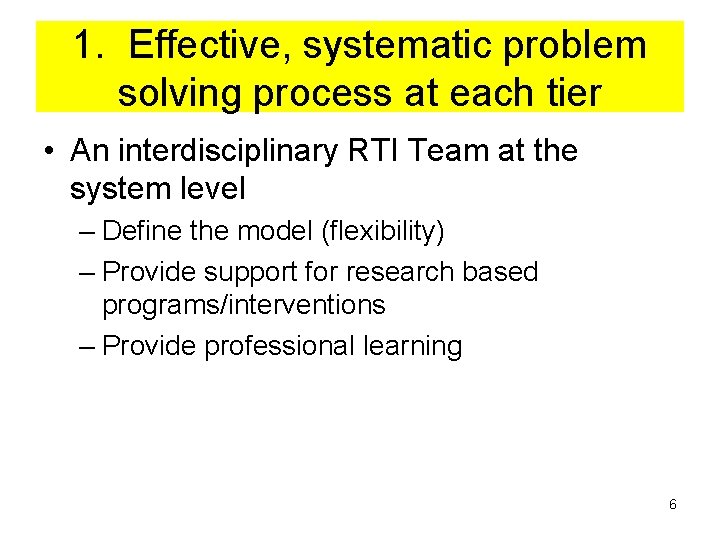
1. Effective, systematic problem solving process at each tier • An interdisciplinary RTI Team at the system level – Define the model (flexibility) – Provide support for research based programs/interventions – Provide professional learning 6
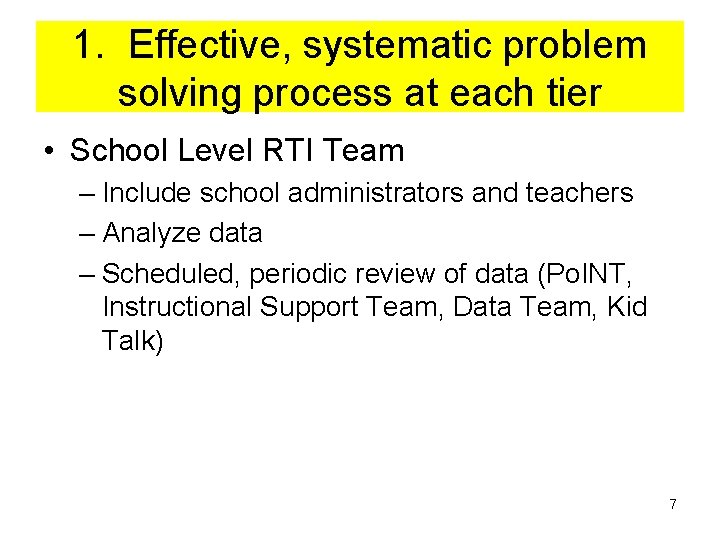
1. Effective, systematic problem solving process at each tier • School Level RTI Team – Include school administrators and teachers – Analyze data – Scheduled, periodic review of data (Po. INT, Instructional Support Team, Data Team, Kid Talk) 7
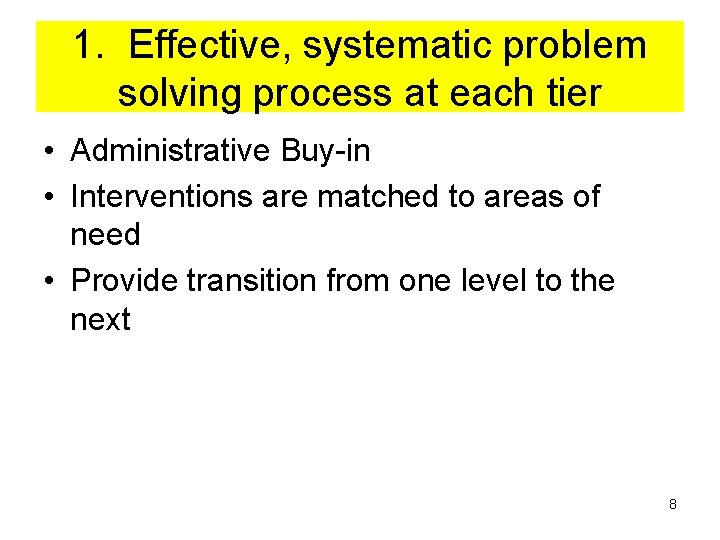
1. Effective, systematic problem solving process at each tier • Administrative Buy-in • Interventions are matched to areas of need • Provide transition from one level to the next 8
2 minute discussion – Share with a partner what your school or school system could be doing better or share what your school/system is doing to address. 1. Effective, systematic problem solving process at each tier 9
2. A coordinated system of instructional/behavioral supports and programs with resources allocated • Dedicated RTI (“in addition to”) – Consistent scheduled time – During the school day – Before school – After school 10
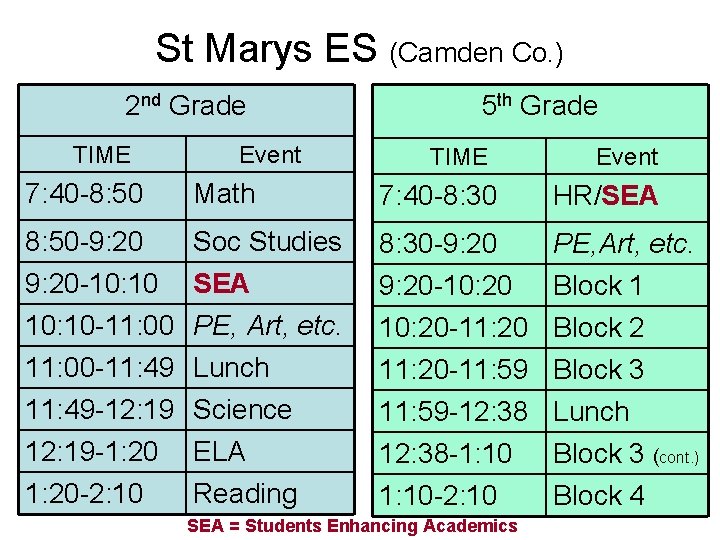
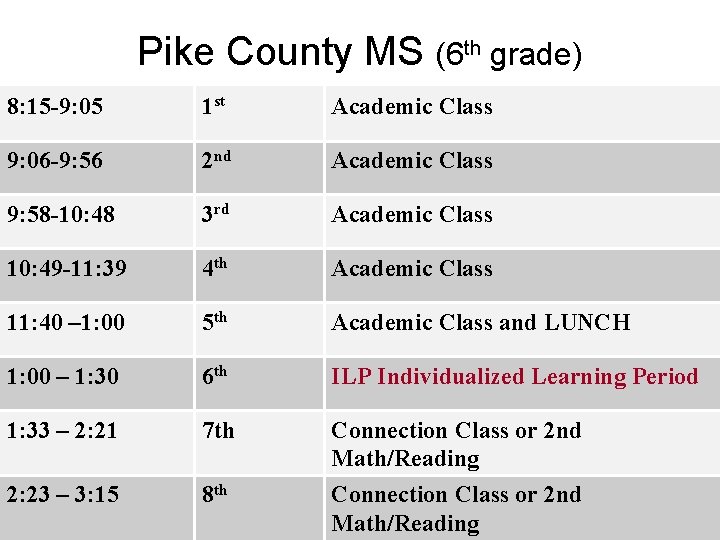
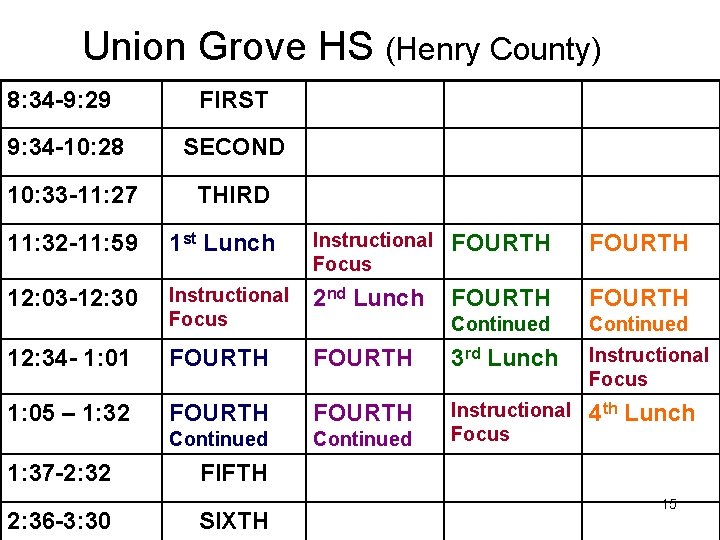
Scheduling Considerations • • When will the most adults be available? Can students be easily regrouped? Can students be grouped across grades? What meaningful activities can be provided for students who do not need interventions? • Who will track data to determine when students need to be regrouped? 11
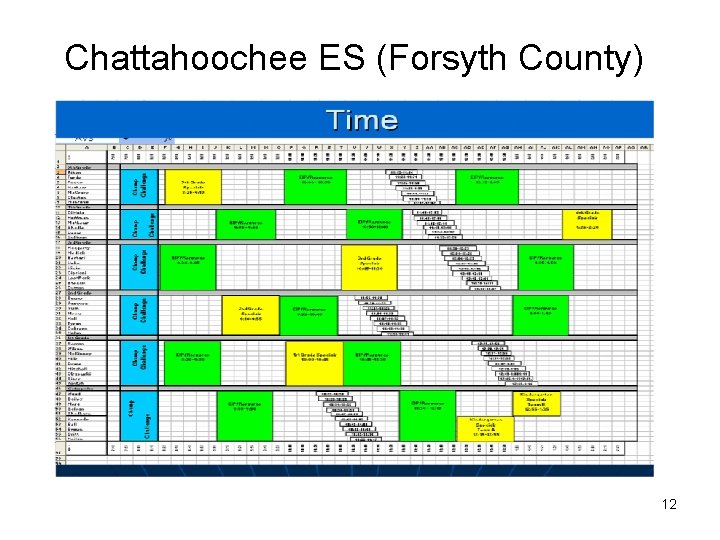
Chattahoochee ES (Forsyth County) 12
St Marys ES (Camden Co. ) 2 nd Grade TIME Event 5 th Grade TIME Event 7: 40 -8: 50 Math 7: 40 -8: 30 HR/SEA 8: 50 -9: 20 Soc Studies 8: 30 -9: 20 PE, Art, etc. 9: 20 -10: 10 -11: 00 -11: 49 -12: 19 -1: 20 -2: 10 SEA PE, Art, etc. Lunch Science ELA Reading 9: 20 -10: 20 -11: 20 -11: 59 -12: 38 -1: 10 -2: 10 Block 1 Block 2 Block 3 Lunch Block 3 (cont. ) Block 4 13 SEA = Students Enhancing Academics
Pike County MS (6 th grade) 8: 15 -9: 05 1 st Academic Class 9: 06 -9: 56 2 nd Academic Class 9: 58 -10: 48 3 rd Academic Class 10: 49 -11: 39 4 th Academic Class 11: 40 – 1: 00 5 th Academic Class and LUNCH 1: 00 – 1: 30 6 th ILP Individualized Learning Period 1: 33 – 2: 21 7 th 2: 23 – 3: 15 8 th Connection Class or 2 nd Math/Reading 14
Union Grove HS (Henry County) 8: 34 -9: 29 FIRST 9: 34 -10: 28 SECOND 10: 33 -11: 27 THIRD 11: 32 -11: 59 1 st Lunch Instructional Focus FOURTH 12: 03 -12: 30 Instructional Focus 2 nd Lunch FOURTH Continued 12: 34 - 1: 01 FOURTH 3 rd Lunch Instructional Focus 1: 05 – 1: 32 FOURTH 4 th Lunch Continued Instructional Focus 1: 37 -2: 32 2: 36 -3: 30 FIFTH SIXTH 15
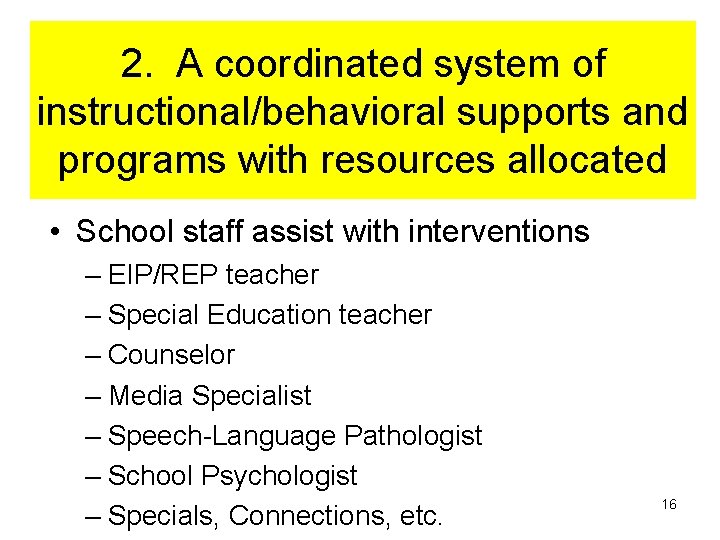
2. A coordinated system of instructional/behavioral supports and programs with resources allocated • School staff assist with interventions – EIP/REP teacher – Special Education teacher – Counselor – Media Specialist – Speech-Language Pathologist – School Psychologist – Specials, Connections, etc. 16
2. A coordinated system of instructional/behavioral supports and programs with resources allocated • Tier 2 – Standard Protocol – Fidelity • Research based interventions • Behavior Support Plan 17
2 minute discussion – Share with a partner what your school or school system could be doing better or share what your school/system is doing to address. 2. A coordinated system of instructional/behavioral supports and programs with resources allocated 18
3. A coordinated system of assessment and progress monitoring • Tier 1 – Universal screening – Common assessments – Benchmark assessments • Tier 2 -4 – Diagnostic assessments – Progress monitoring 19
Why Universal Screening? • Quickly identifies students that may need extra assistance • Time efficient • Serves as gauge of proficiency 21
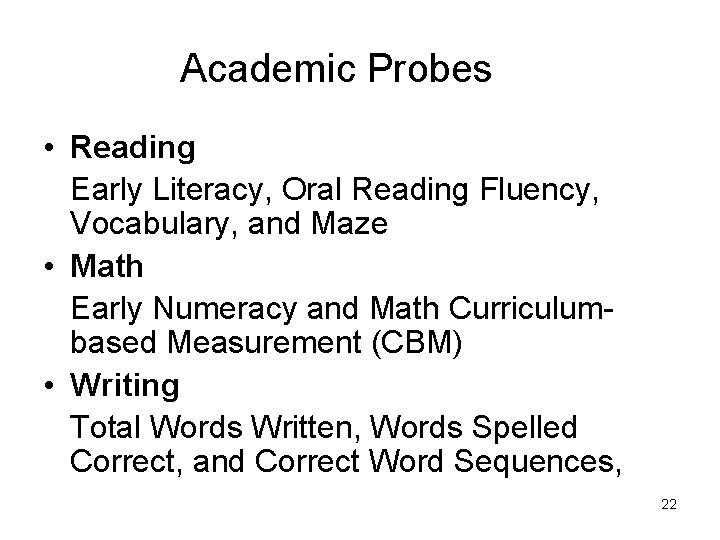
Academic Probes • Reading Early Literacy, Oral Reading Fluency, Vocabulary, and Maze • Math Early Numeracy and Math Curriculumbased Measurement (CBM) • Writing Total Words Written, Words Spelled Correct, and Correct Word Sequences, 22
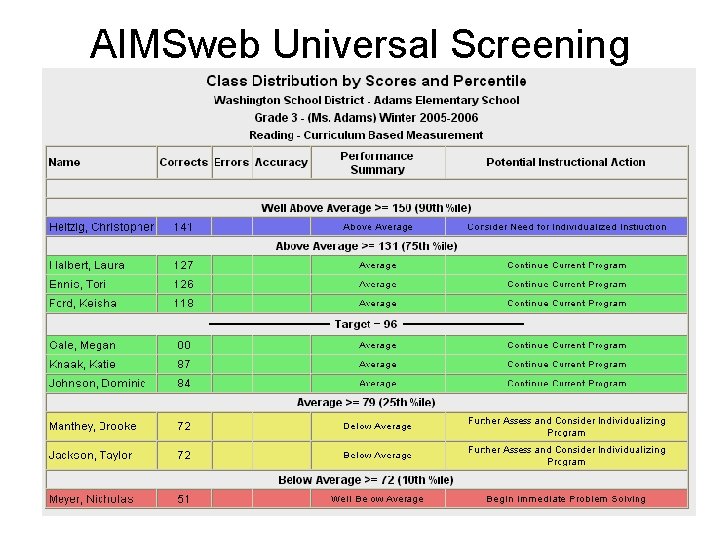
AIMSweb Universal Screening Grades K-2 23
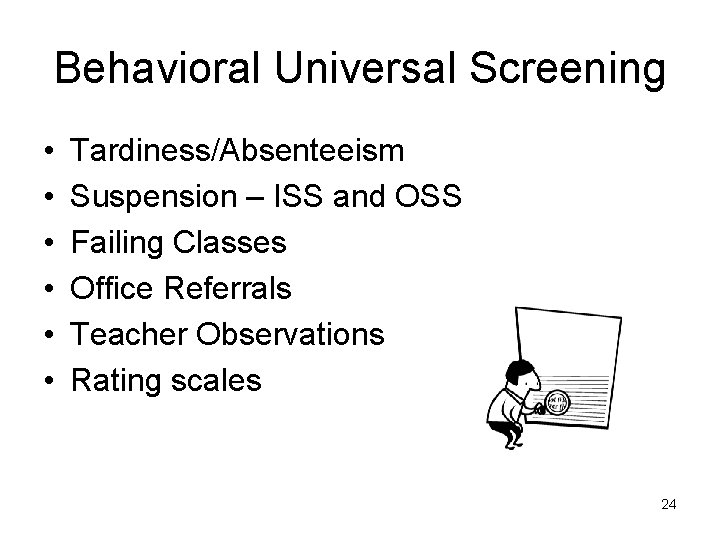
Behavioral Universal Screening • • • Tardiness/Absenteeism Suspension – ISS and OSS Failing Classes Office Referrals Teacher Observations Rating scales 24
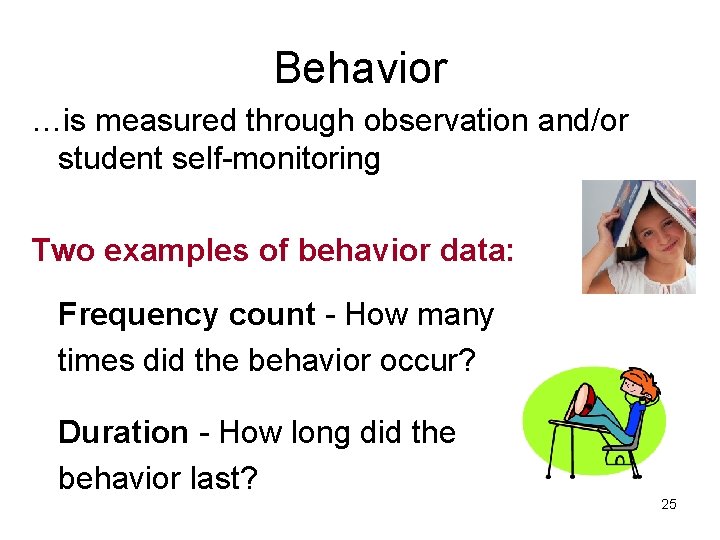
Behavior …is measured through observation and/or student self-monitoring Two examples of behavior data: Frequency count - How many times did the behavior occur? Duration - How long did the behavior last? 25
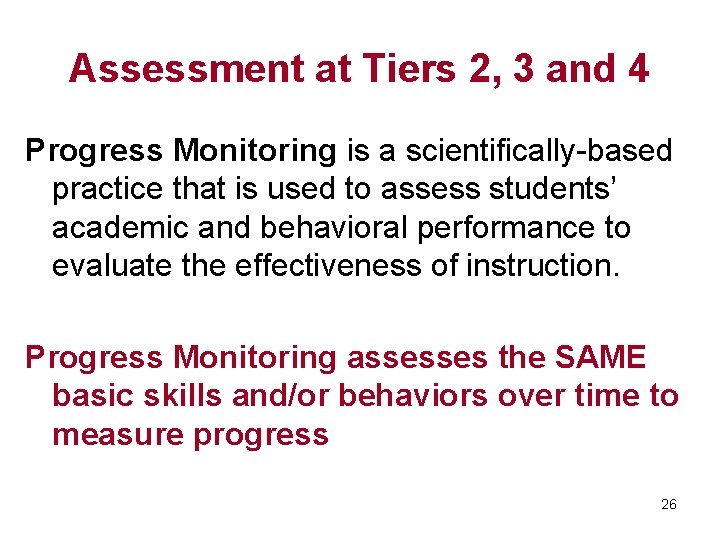
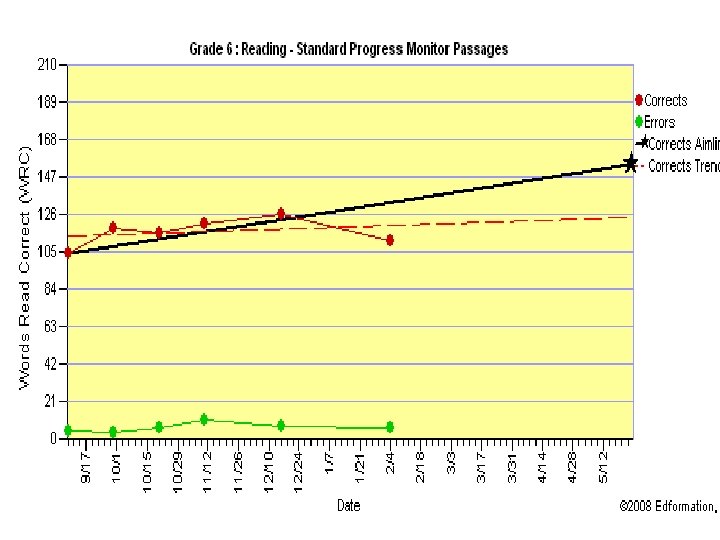
Assessment at Tiers 2, 3 and 4 Progress Monitoring is a scientifically-based practice that is used to assess students’ academic and behavioral performance to evaluate the effectiveness of instruction. Progress Monitoring assesses the SAME basic skills and/or behaviors over time to measure progress 26
27
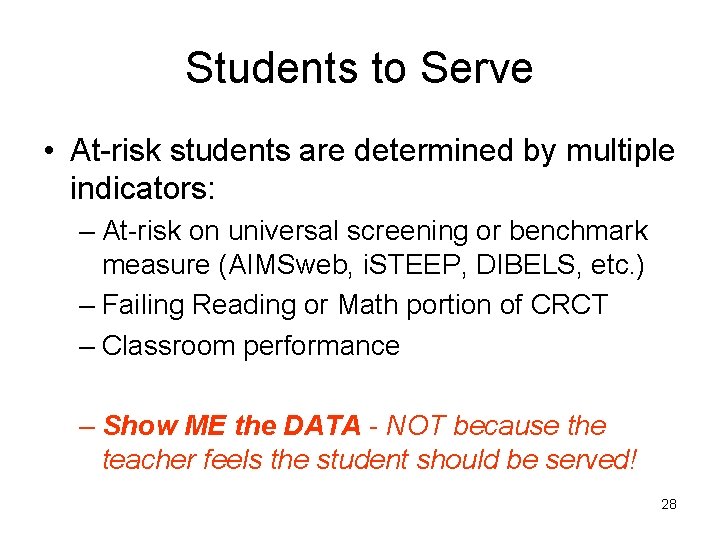
Students to Serve • At-risk students are determined by multiple indicators: – At-risk on universal screening or benchmark measure (AIMSweb, i. STEEP, DIBELS, etc. ) – Failing Reading or Math portion of CRCT – Classroom performance – Show ME the DATA - NOT because the teacher feels the student should be served! 28
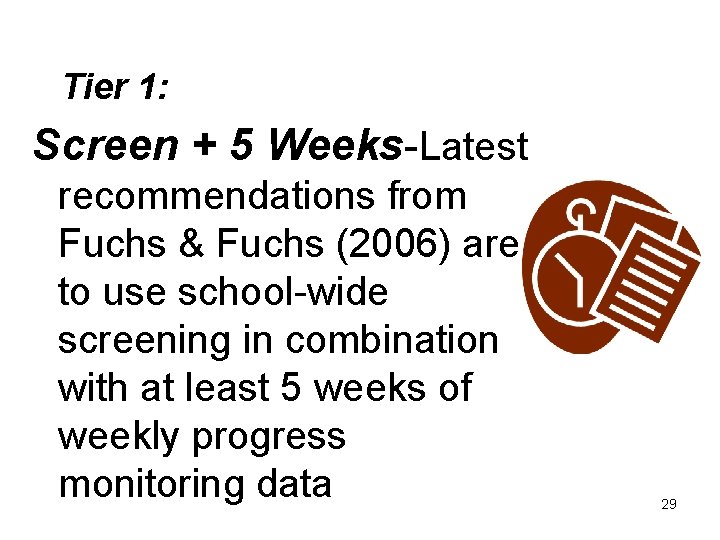
Tier 1: Screen + 5 Weeks-Latest recommendations from Fuchs & Fuchs (2006) are to use school-wide screening in combination with at least 5 weeks of weekly progress monitoring data 29
2 minute discussion – Share with a partner what your school or school system could be doing better or share what your school/system is doing to address. 3. A coordinated system of assessment and progress monitoring 30
4. Job-embedded professional learning and ongoing teacher support that addresses relevant areas essential to effective implementation • Professional learning communities • Coaching support – conduct model lessons that support interventions • Tier 2 weekly meetings • Carousel of interventions 31
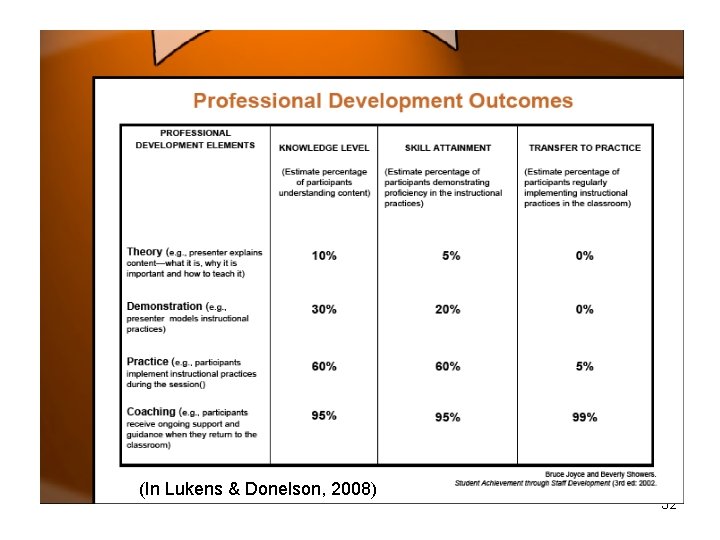
(In Lukens & Donelson, 2008) 32
4. Job-embedded professional learning and ongoing teacher support that addresses relevant areas essential to effective implementation • Competencies – Tier 1 – Effective instructional practices – Understanding data – Universal screening – Progress monitoring – Research based interventions 33
Professional Leaning for RTI • • Training at district level School-based training Grade level training Department meetings throughout district 34
2 minute discussion – Share with a partner what your school or school system could be doing better or share what your school/system is doing to address. 4. Job-embedded professional learning and ongoing teacher support that addresses relevant areas essential to effective implementation 35
5. A systematic plan with specified practices for parent/family communications and involvement 36
TIER 1 STANDARDS BASED CLASSROOM INSTRUCTION/LEARNING Tier 1 applies to all students and their parents: • Parent conferences • Family/parent nights – supper, donuts for dad; parent workshops • School website with parent support, resources and videos • Brochures, newsletters, and student/parent handbook • School councils, PTA/PTO • New student orientation • Community partnerships (churches, daycare, apartments. . ) Tier 1 includes all parents 37
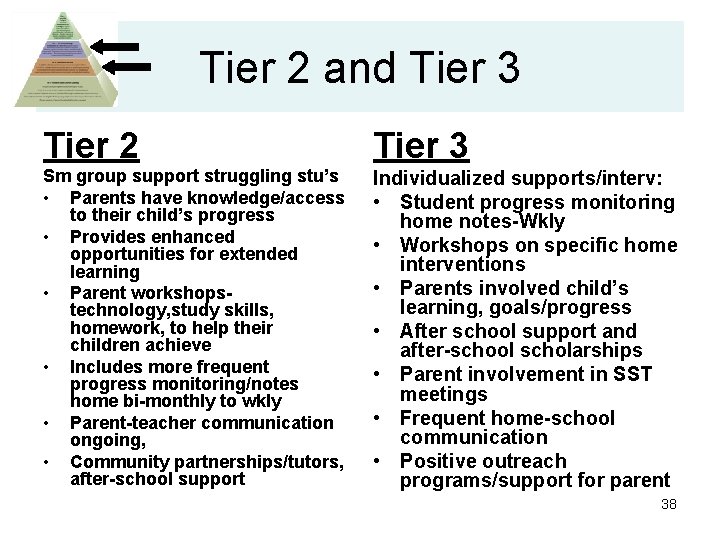
Tier 2 and Tier 3 Tier 2 Tier 3 Sm group support struggling stu’s • Parents have knowledge/access to their child’s progress • Provides enhanced opportunities for extended learning • Parent workshopstechnology, study skills, homework, to help their children achieve • Includes more frequent progress monitoring/notes home bi-monthly to wkly • Parent-teacher communication ongoing, • Community partnerships/tutors, after-school support Individualized supports/interv: • Student progress monitoring home notes-Wkly • Workshops on specific home interventions • Parents involved child’s learning, goals/progress • After school support and after-school scholarships • Parent involvement in SST meetings • Frequent home-school communication • Positive outreach programs/support for parent 38
2 minute discussion – Share with a partner what your school or school system could be doing better or share what your school/system is doing to address. 5. A systematic plan with specified practices for parent/family communications and involvement 39
Where do you begin? • Develop a district-wide, interdisciplinary RTI task force • Meet regularly • Define and establish common vocabulary, goals, and vision for RTI within district 40
Where do you begin? • Establish RTI framework for district • Develop 3 -5 Year Plan for RTI Implementation • Determine what interventions are available and/or needed within district and schools • Expectations for Progress Monitoring – RTI implementation at school level – Available interventions by district/school – How will data be collected, disseminated, etc. 41
Words of Wisdom • Do It! – A little less talk and a little more action. • Do It Right! – Make sure students think, respond, and get feedback. – Get students on the right kind of intervention. • Measure It! – Make sure it works. (Joe Witt, 2007) 42
43
44
45
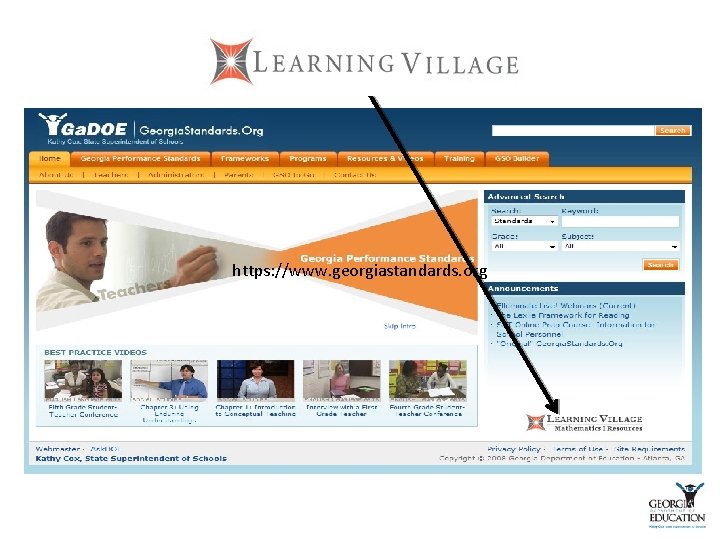
https: //www. georgiastandards. org 46
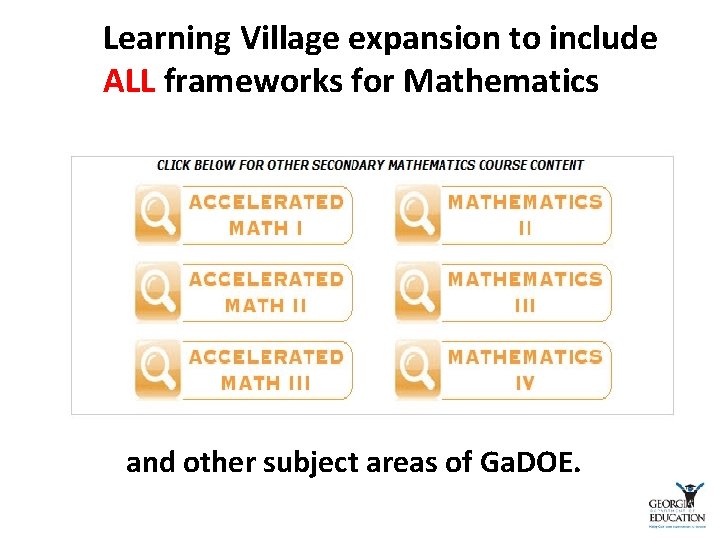
Learning Village expansion to include ALL frameworks for Mathematics and other subject areas of Ga. DOE. 47
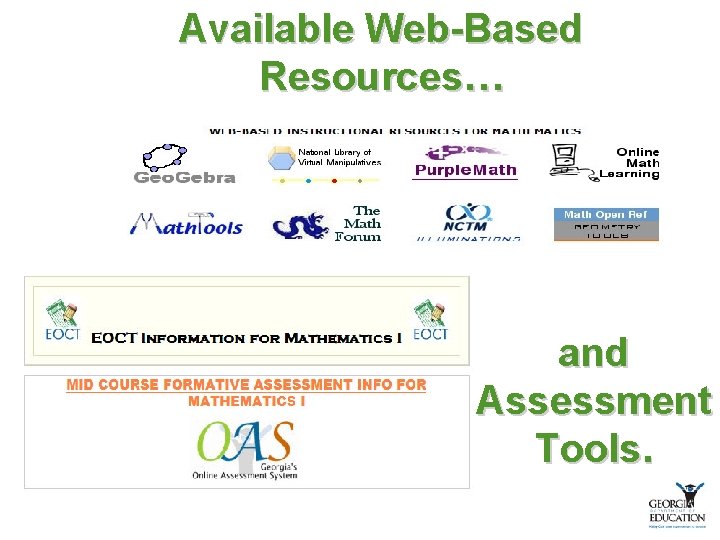
Available Web-Based Resources… and Assessment Tools. 48
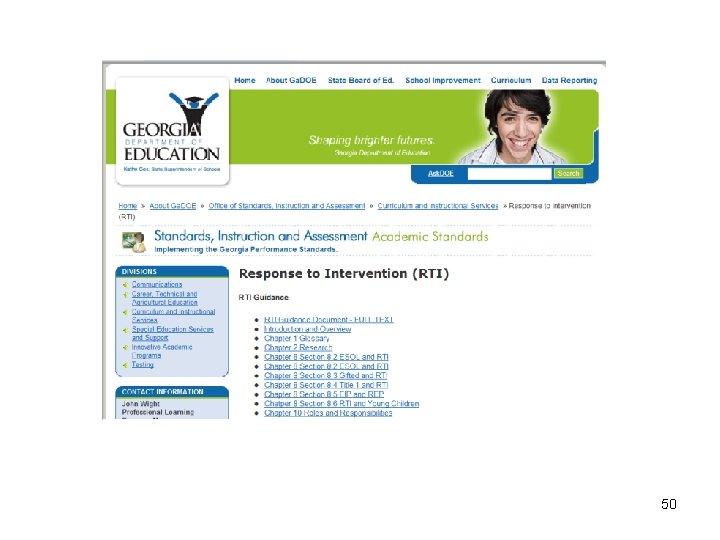
49
50
51
Choosing Interventions Review Protocols provided by SERVE to support schools and districts in choosing interventions based on student achievement data. 52
Choosing Interventions Webinar Series • Collaborative effort: Ga. DOE, SSTAGE, REL-SE, and SERVE at UNC-Greensboro • National presenters from the Institutes of Educational Sciences • Review of latest research on interventions (IES Practice Guides) • Audience: school and district teams responsible for choosing interventions based on student need 53
Contact Information John Wight Professional Learning Program Manager Standards, Instruction, and Assessment Georgia Department of Education 404 -657 -9064 jwight@doe. k 12. ga. us 54
SSTAGE Conference Setting the SSTAGE for Great Performances: ACT III Spotlight on Instructional and Behavioral Solutions September 15 -16, 2009 The Du. Bose Porter Conference Center Dublin, Georgia 55
Featuring Effective Interventions and Strategies by Two National Presenters and Authors Jim Wright (Intervention Central) on Motivating Reluctant Learners and Math Strategies Gail Adams on Effective Vocabulary Instruction and Strategic Reading (comprehensive strategies) Plus more… 56
Powerful Presentations on Proven Practices: • Presentations by the four winning teams of the SSTAGE Star Award for Promising Practices (two elementary, one middle school and one school system) • Behavior Intervention Toolkit (Elementary and Secondary levels) • Positive Behavioral Supports • Georgia’s RTI/POI Framework and Professional Learning Supports • Using Research to Strengthen RTI Decision Making and Implementation • DATA: Effective Assessment and Analysis • Fidelity: Intervention and Implementation • SLANT Class Participation Strategy (Kansas Strategy) • Engaging Parents 57 • Vendor Exhibits and Presentations
SSTAGE Conference Coming in January. . . Best Practices Conference in Athens, Georgia 58
RTI Assessment Resources Investigate and compare commercial products: • www. studentprogress. org Websites with free materials and links: • www. interventioncentral. org • https: //dibels. uoregon. edu • http: //ggg. umn. edu/siteindex. html • http: //iris. peabody. vanderbilt. edu/browsebytopic 04. html Graph data using: • Excel • Chartdog on www. interventioncentral. org 59 • www. easycbm. com
Presenters Scarlet Correll (scorrell@gocats. org) Director of Professional Learning, Research and Intervention, Coordinator for RTI and 504 Valdosta City Schools Debbie Rondem (drondem@forsyth. k 12. ga. us) Director of Student Support Services Forsyth County Schools Dr. Paula Freer for John Wight (jwight@doe. k 12. ga. us) Program Specialist Metro West GLRS 60
References • Harn, B. , NASP Presentation 2007 • NASDE Presentation/Online 2008 • Powers, K. , Hagans, K. , & Olaya, C. , NASP Presentation 2007 • Shinn, M. , March, R. , & Phillips, M. , NASP Presentation 2008 • SSTAGE Conference Presentations, Sept. 2007, January 2008, and March 2008 • Torgesen et al. 2001 cited in Skinner et al. 2005 61
Reference • Freer, P. (2008) Building Successful Pyramids through Effective Parent Involvement, Metro RESA/ Metro West GLRS Parent Involvement Conference Ctr. Evergreen Conference Center, Stone Min Georgia. January 2008. • Lukens, J. & Donelson, B. (2008). Gap Guzzling via RTI: The Ultimate SUV (Stop Underachievement Vehicle), NASP Conference Feb. 2008, New Orleans, Louisiana 62