
Georgias Government Georgias Government Basic definition a constitution

Georgia’s Government

Georgia’s Government • Basic definition: a constitution is law that forms the foundation and principles of government.

preamble • Introduction; states main purpose and goals • Example: • “to insure justice, we the people of
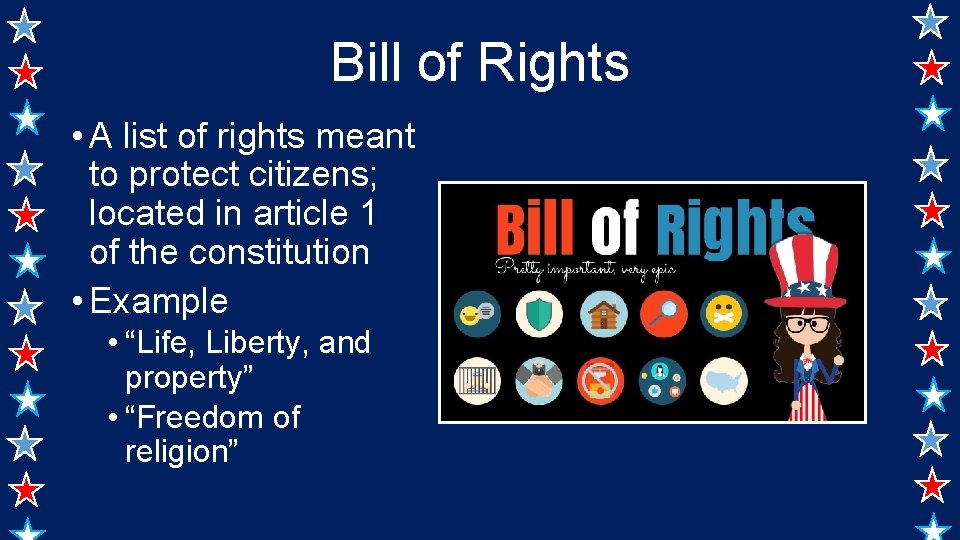
Bill of Rights • A list of rights meant to protect citizens; located in article 1 of the constitution • Example • “Life, Liberty, and property” • “Freedom of religion”
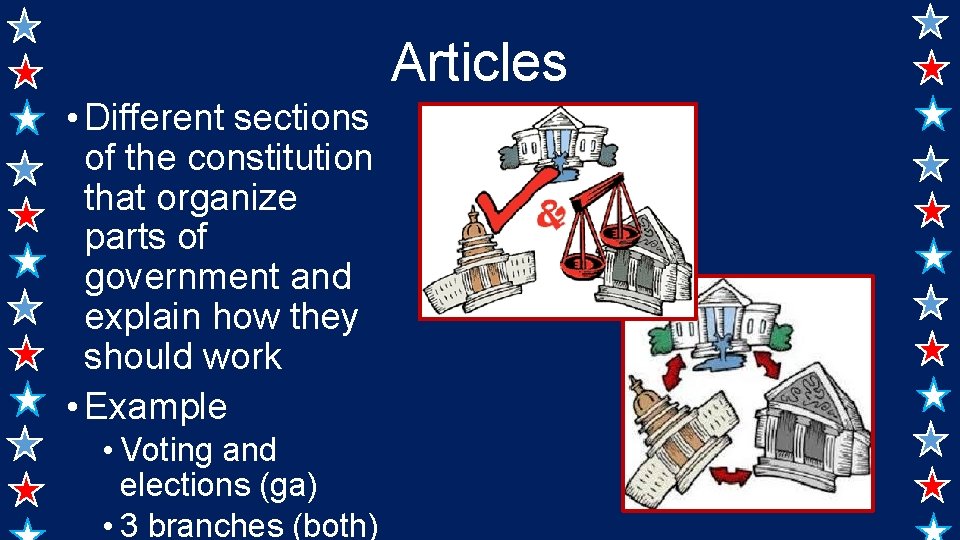
Articles • Different sections of the constitution that organize parts of government and explain how they should work • Example • Voting and elections (ga) • 3 branches (both)
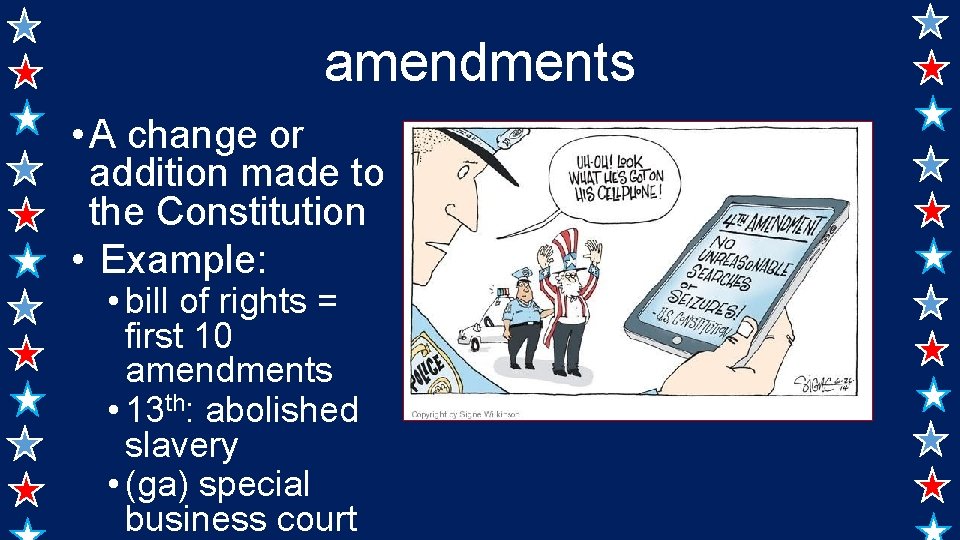
amendments • A change or addition made to the Constitution • Example: • bill of rights = first 10 amendments • 13 th: abolished slavery • (ga) special business court
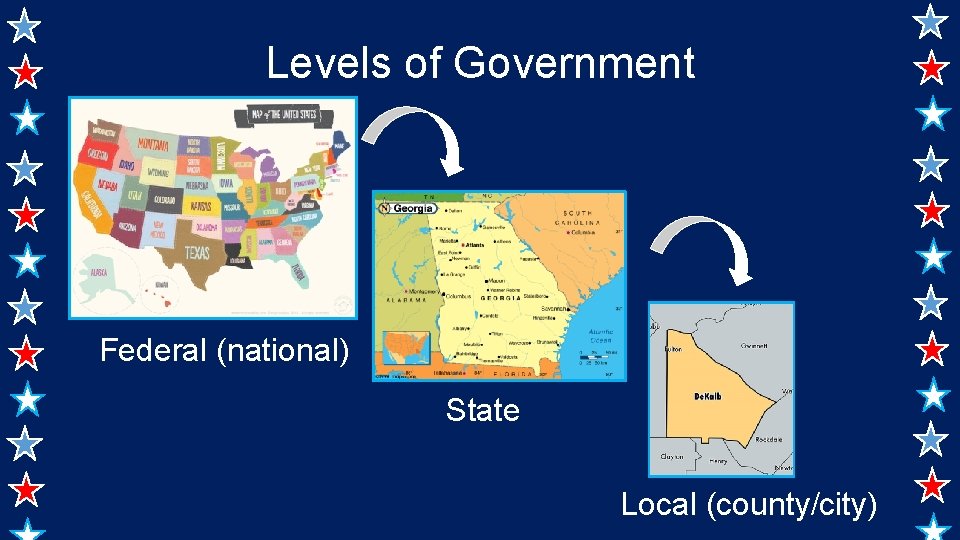
Levels of Government Federal (national) State Local (county/city)
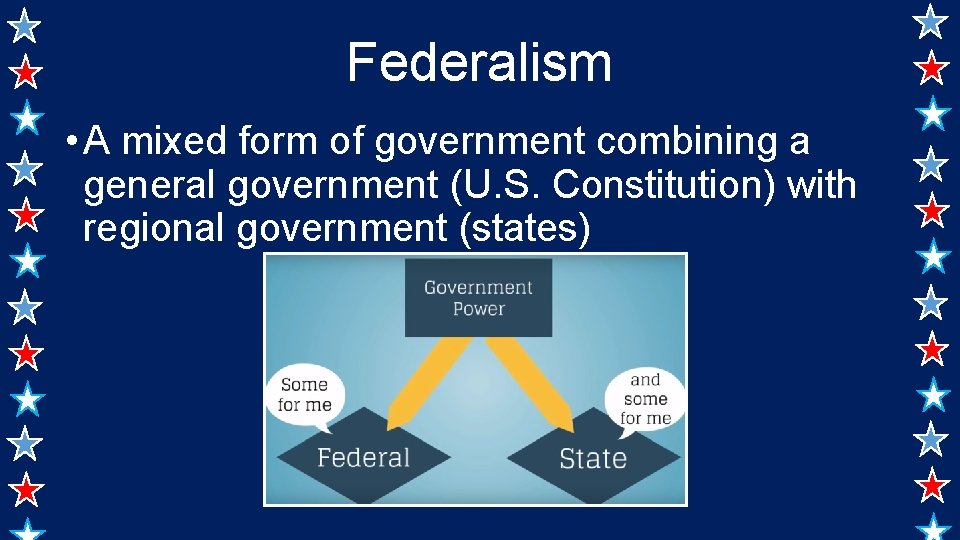
Federalism • A mixed form of government combining a general government (U. S. Constitution) with regional government (states)
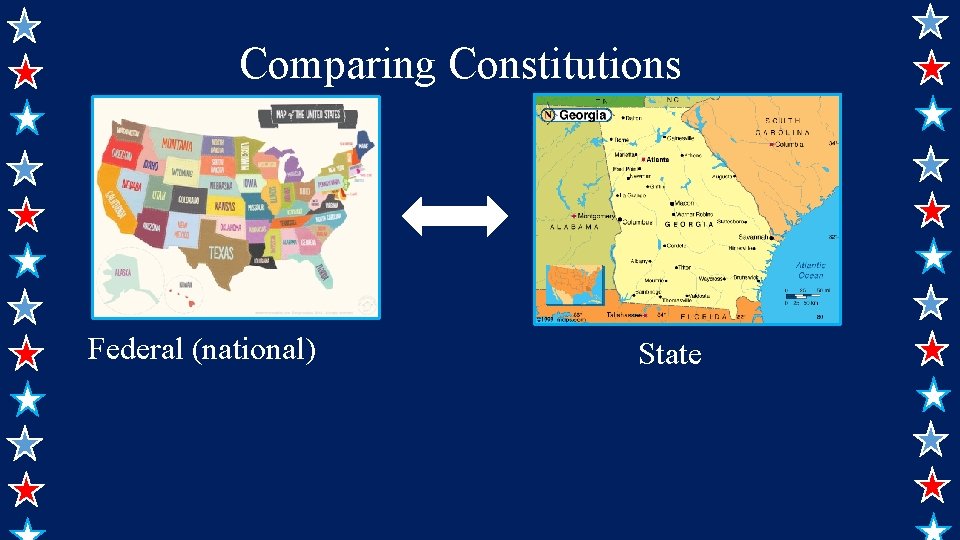
Comparing Constitutions Federal (national) State
Comparing Constitutions 1. You and a partner will read the outlines of the U. S. Constitution and the Georgia Constitution. 2. Create a list of similarities and differences that you notice. 3. When everyone is done, the class will come together to make one official venn diagram.

Comparing Constitutions Georgia Constitution U. S. Constitution • 7 Articles • Legislature is called Congress • Article on States • Order • 11 Articles • Preamble • 3 Branches • Bill of Rights • Legislature is called General Assembly • Amendments • Additional sections • Education • Bicameral • Voting legislature • Taxation • Boards & commissions • Checks & • Miscellaneous balances • Article on counties and municipalities • Order
Quick Review 1. Name three levels of government 2. The idea that national (federal) and state governments can both rule together is called _______. 3. Name 4 parts of Georgia’s Constitution. 4. Give two similarities between Georgia’s constitution and the U. S. Constitution. 5. Give to differences between the U. S. Constitution and Georgia’s Constitution.
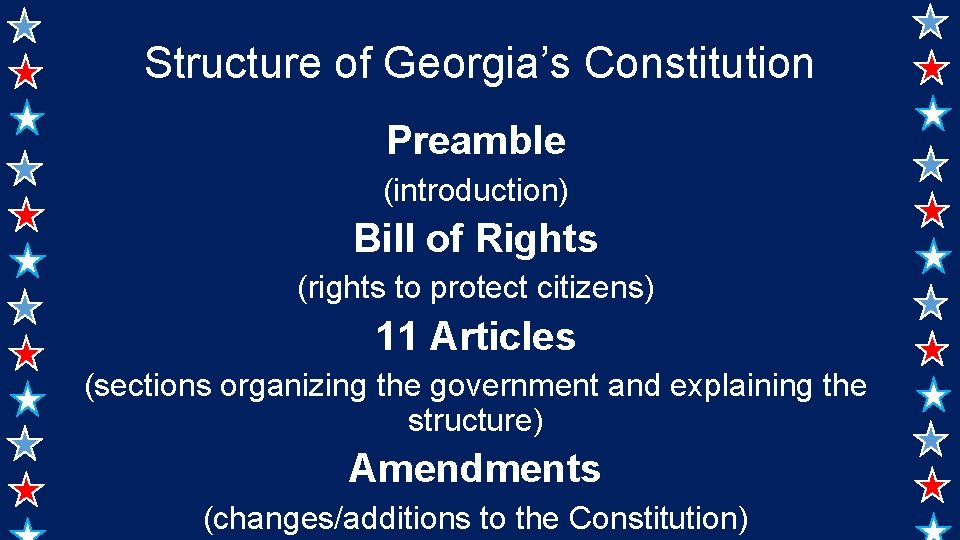
Structure of Georgia’s Constitution Preamble (introduction) Bill of Rights (rights to protect citizens) 11 Articles (sections organizing the government and explaining the structure) Amendments (changes/additions to the Constitution)
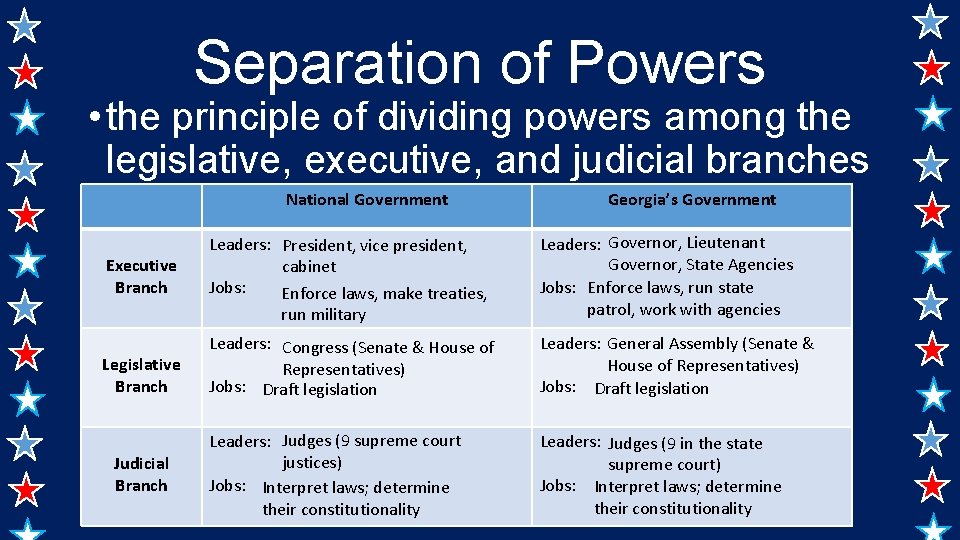
Separation of Powers • the principle of dividing powers among the legislative, executive, and judicial branches National Government Georgia’s Government of government. Executive Branch Legislative Branch Judicial Branch Leaders: President, vice president, cabinet Jobs: Enforce laws, make treaties, run military Leaders: Governor, Lieutenant Governor, State Agencies Jobs: Enforce laws, run state patrol, work with agencies Leaders: Congress (Senate & House of Representatives) Jobs: Draft legislation Leaders: General Assembly (Senate & House of Representatives) Jobs: Draft legislation Leaders: Judges (9 supreme court justices) Jobs: Interpret laws; determine their constitutionality Leaders: Judges (9 in the state supreme court) Jobs: Interpret laws; determine their constitutionality
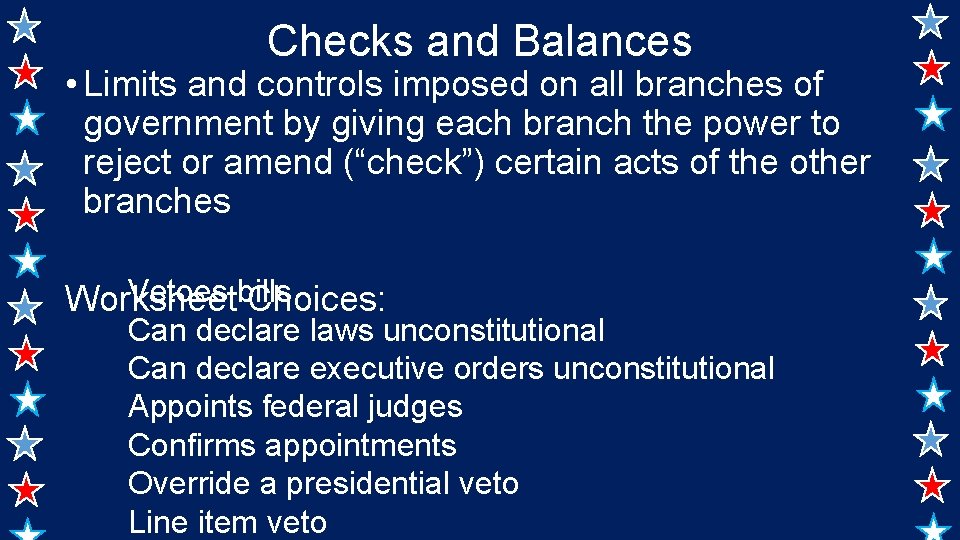
Checks and Balances • Limits and controls imposed on all branches of government by giving each branch the power to reject or amend (“check”) certain acts of the other branches Vetoes bills Worksheet Choices: Can declare laws unconstitutional Can declare executive orders unconstitutional Appoints federal judges Confirms appointments Override a presidential veto Line item veto
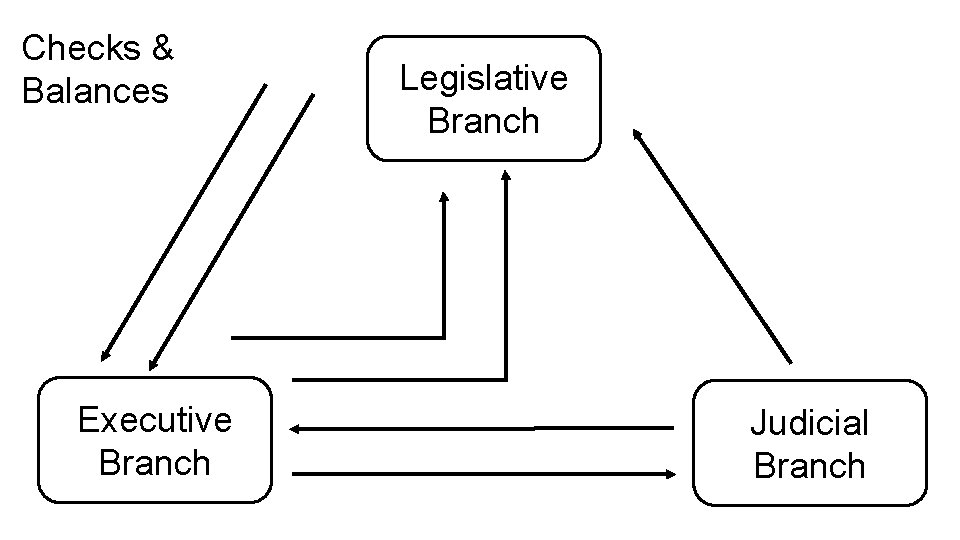
Checks & Balances Executive Branch Legislative Branch Judicial Branch
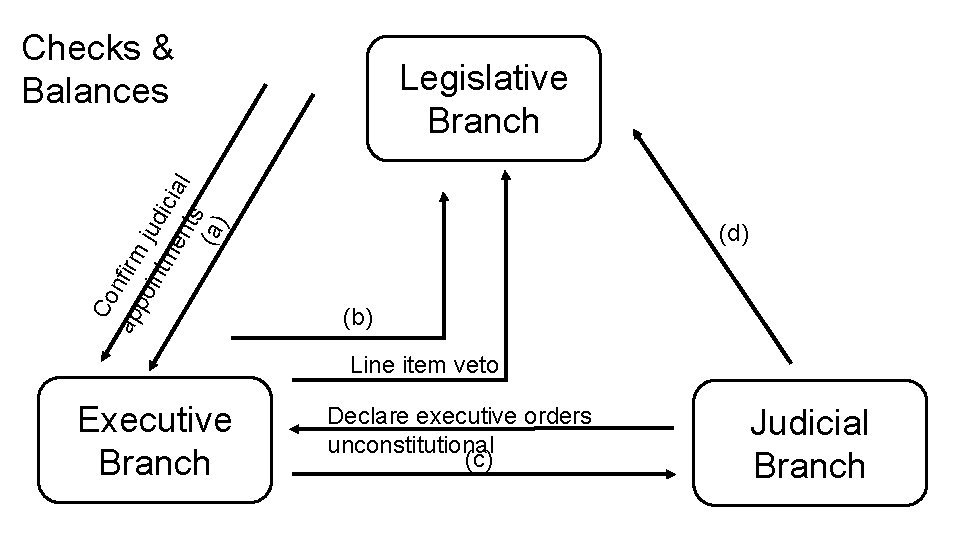
Co ap nfirm po int judi me cia nts l (a) Checks & Balances Legislative Branch (d) (b) Line item veto Executive Branch Declare executive orders unconstitutional (c) Judicial Branch
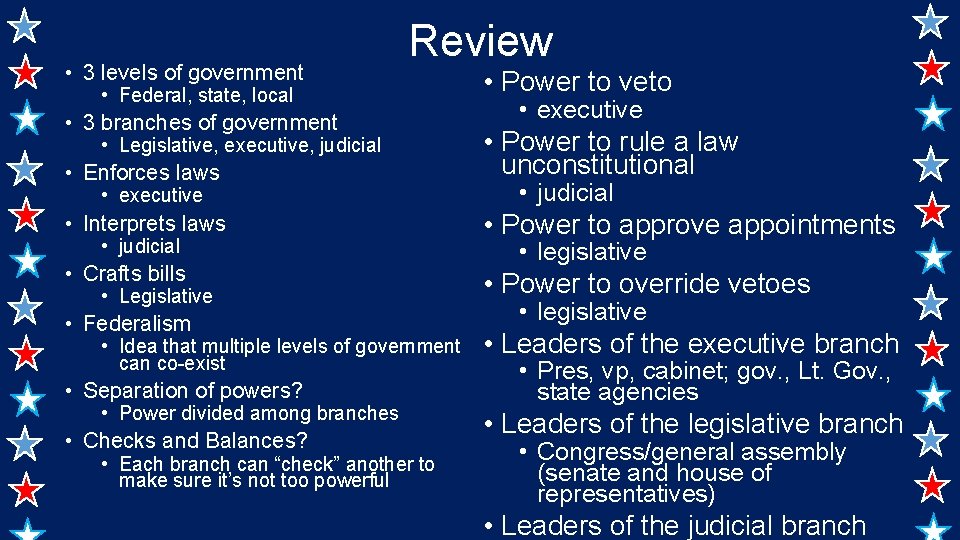
• 3 levels of government Review • Federal, state, local • 3 branches of government • Power to veto • executive • Enforces laws • Power to rule a law unconstitutional • Interprets laws • Power to approve appointments • Legislative, executive, judicial • executive • judicial • Crafts bills • Legislative • Federalism • Idea that multiple levels of government can co-exist • Separation of powers? • Power divided among branches • Checks and Balances? • Each branch can “check” another to make sure it’s not too powerful • judicial • legislative • Power to override vetoes • legislative • Leaders of the executive branch • Pres, vp, cabinet; gov. , Lt. Gov. , state agencies • Leaders of the legislative branch • Congress/general assembly (senate and house of representatives) • Leaders of the judicial branch
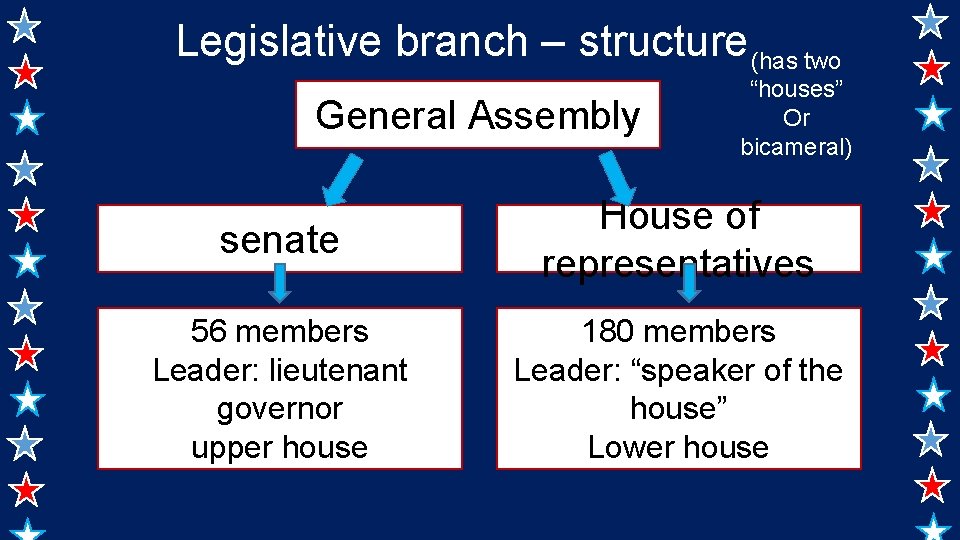
Legislative branch – structure (has two General Assembly “houses” Or bicameral) senate House of representatives 56 members Leader: lieutenant governor upper house 180 members Leader: “speaker of the house” Lower house
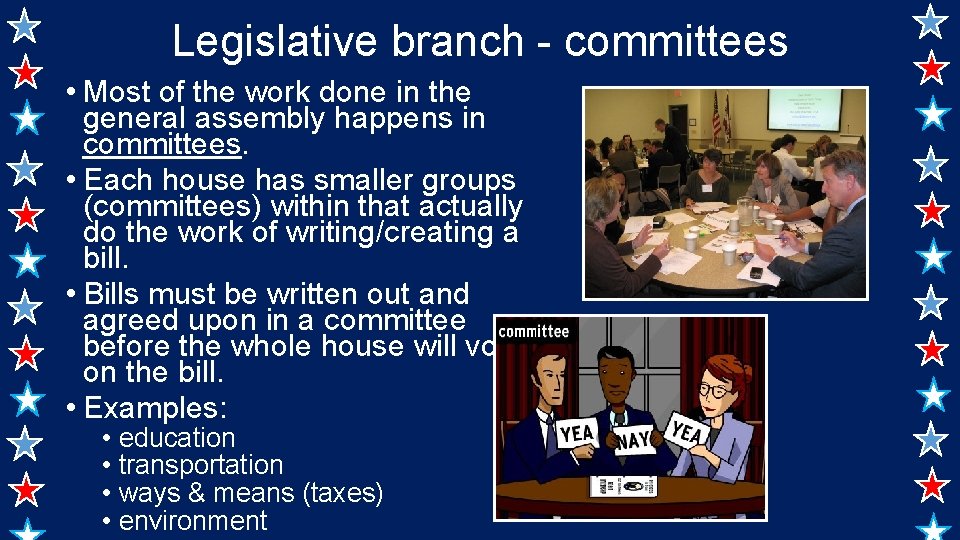
Legislative branch - committees • Most of the work done in the general assembly happens in committees. • Each house has smaller groups (committees) within that actually do the work of writing/creating a bill. • Bills must be written out and agreed upon in a committee before the whole house will vote on the bill. • Examples: • • education transportation ways & means (taxes) environment
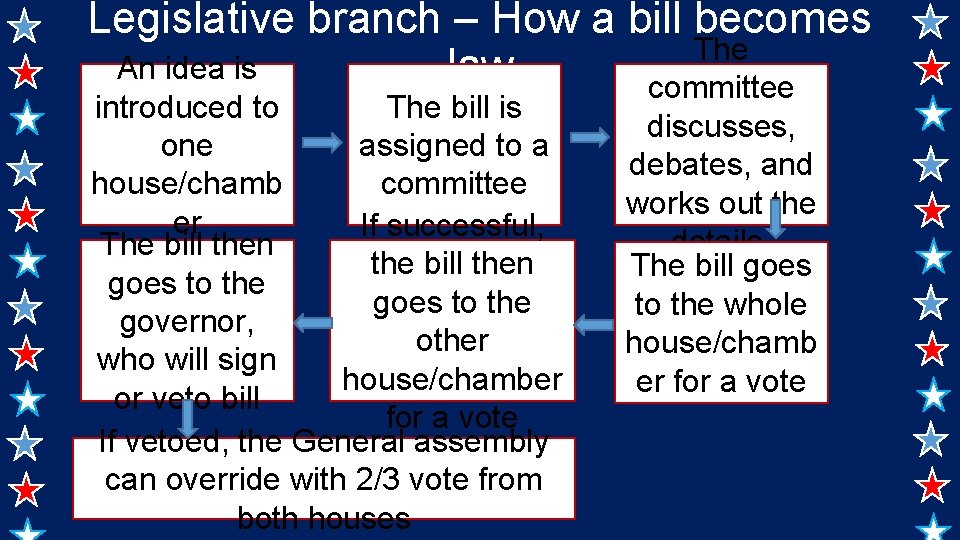
Legislative branch – How a bill becomes The An idea is law committee introduced to The bill is one assigned to a house/chamb committee er If successful, The bill then the bill then goes to the governor, other who will sign house/chamber or veto bill for a vote If vetoed, the General assembly can override with 2/3 vote from both houses discusses, debates, and works out the details. The bill goes to the whole house/chamb er for a vote
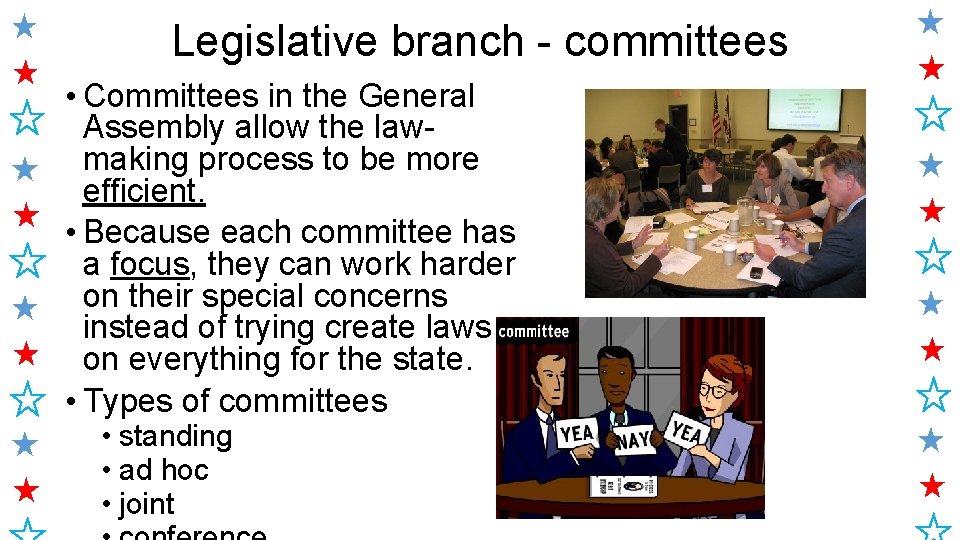
Legislative branch - committees • Committees in the General Assembly allow the lawmaking process to be more efficient. • Because each committee has a focus, they can work harder on their special concerns instead of trying create laws on everything for the state. • Types of committees • standing • ad hoc • joint
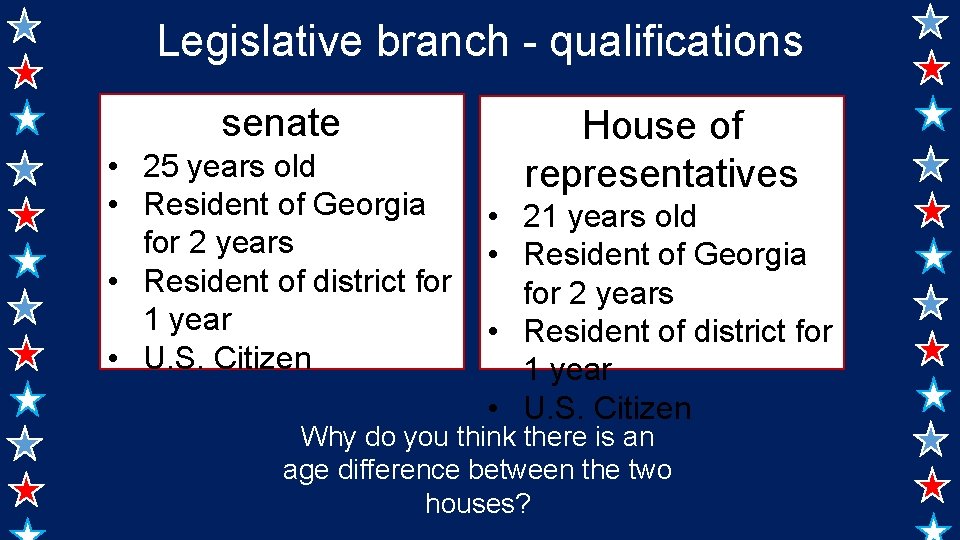
Legislative branch - qualifications senate • 25 years old • Resident of Georgia for 2 years • Resident of district for 1 year • U. S. Citizen House of representatives • 21 years old • Resident of Georgia for 2 years • Resident of district for 1 year • U. S. Citizen Why do you think there is an age difference between the two houses?
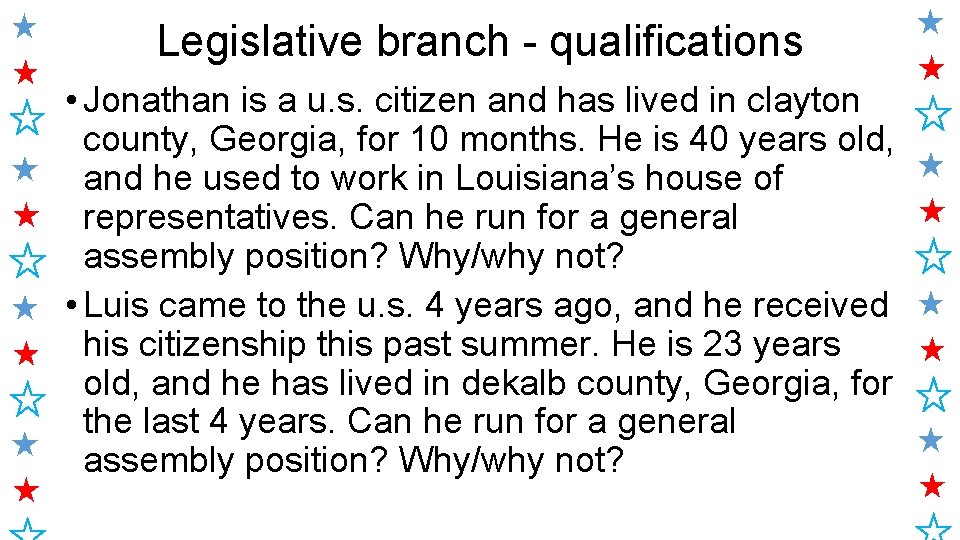
Legislative branch - qualifications • Jonathan is a u. s. citizen and has lived in clayton county, Georgia, for 10 months. He is 40 years old, and he used to work in Louisiana’s house of representatives. Can he run for a general assembly position? Why/why not? • Luis came to the u. s. 4 years ago, and he received his citizenship this past summer. He is 23 years old, and he has lived in dekalb county, Georgia, for the last 4 years. Can he run for a general assembly position? Why/why not?
Legislative branch – state funding • In order for the state government to function effectively, the government must generate revenue (money) to operate. • This is necessary for many governmentsponsored programs to meet the needs of the citizens of the state. • The General Assembly determines the types of revenue sources. • The department of revenue, an agency of the state government, is charged with the responsibility of administering and collecting revenue, while governor, the state’s budget
Legislative branch – state funding • Below is a list of taxes. Let’s try to match them up with the descriptions in your notes! Individual income Property taxes Corporate income General sales taxes Estate Excise taxes (inheritance) taxes Insurance premium taxes State lottery fees Settlement programs
Executive branch - qualifications governor • 30 years old • Resident of Georgia for 6 years • U. S. Citizen for 15 years lieutenant governor • 30 years old • Resident of Georgia for 6 years • U. S. Citizen for 15 years Why do you think there are different qualifications for the executive branch and the
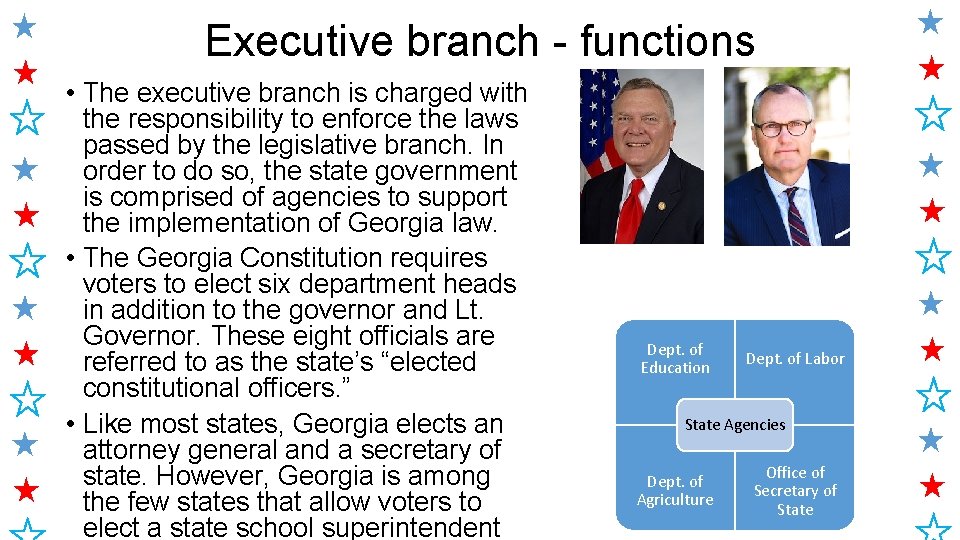
Executive branch - functions • The executive branch is charged with the responsibility to enforce the laws passed by the legislative branch. In order to do so, the state government is comprised of agencies to support the implementation of Georgia law. • The Georgia Constitution requires voters to elect six department heads in addition to the governor and Lt. Governor. These eight officials are referred to as the state’s “elected constitutional officers. ” • Like most states, Georgia elects an attorney general and a secretary of state. However, Georgia is among the few states that allow voters to elect a state school superintendent Left: Governor Nathan Deal Right: Lt. Governor Casey Cagle Dept. of Education Dept. of Labor State Agencies Dept. of Agriculture Office of Secretary of State
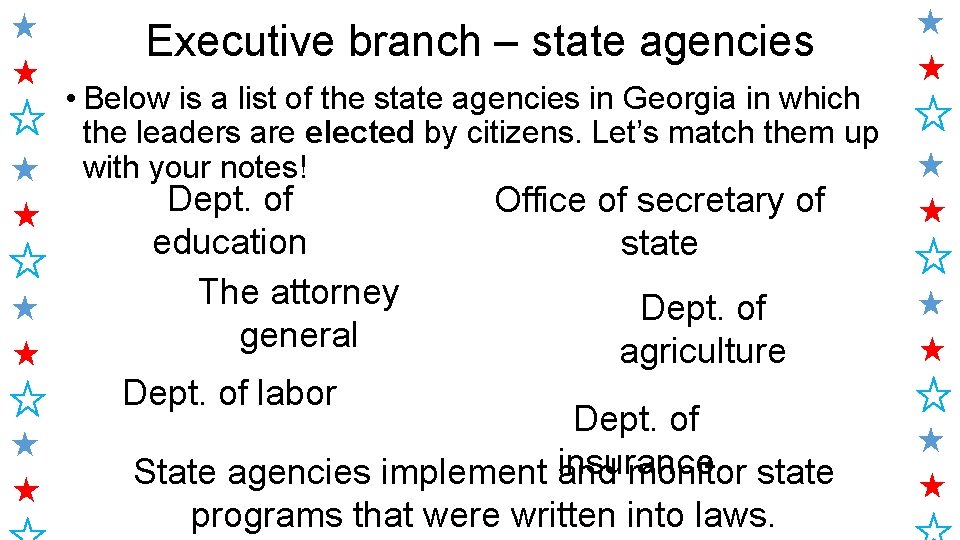
Executive branch – state agencies • Below is a list of the state agencies in Georgia in which the leaders are elected by citizens. Let’s match them up with your notes! Dept. of education The attorney general Dept. of labor Office of secretary of state Dept. of agriculture Dept. of insurance State agencies implement and monitor state programs that were written into laws.
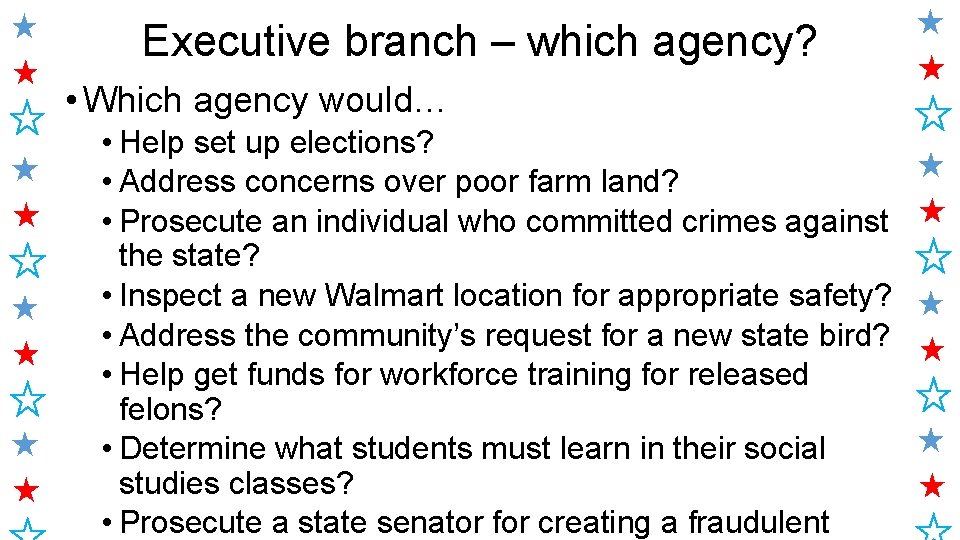
Executive branch – which agency? • Which agency would… • Help set up elections? • Address concerns over poor farm land? • Prosecute an individual who committed crimes against the state? • Inspect a new Walmart location for appropriate safety? • Address the community’s request for a new state bird? • Help get funds for workforce training for released felons? • Determine what students must learn in their social studies classes? • Prosecute a state senator for creating a fraudulent
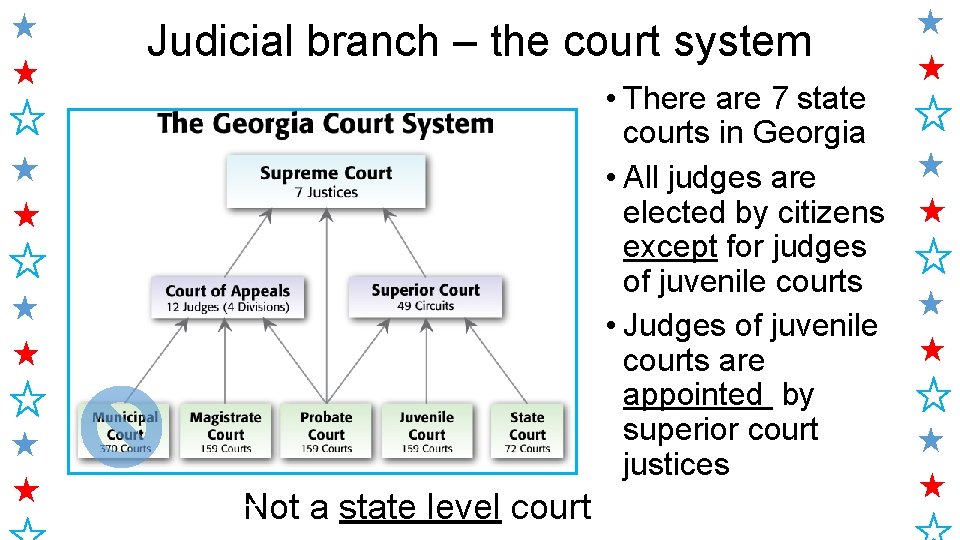
Judicial branch – the court system • There are 7 state courts in Georgia • All judges are elected by citizens except for judges of juvenile courts • Judges of juvenile courts are appointed by superior court justices Not a state level court
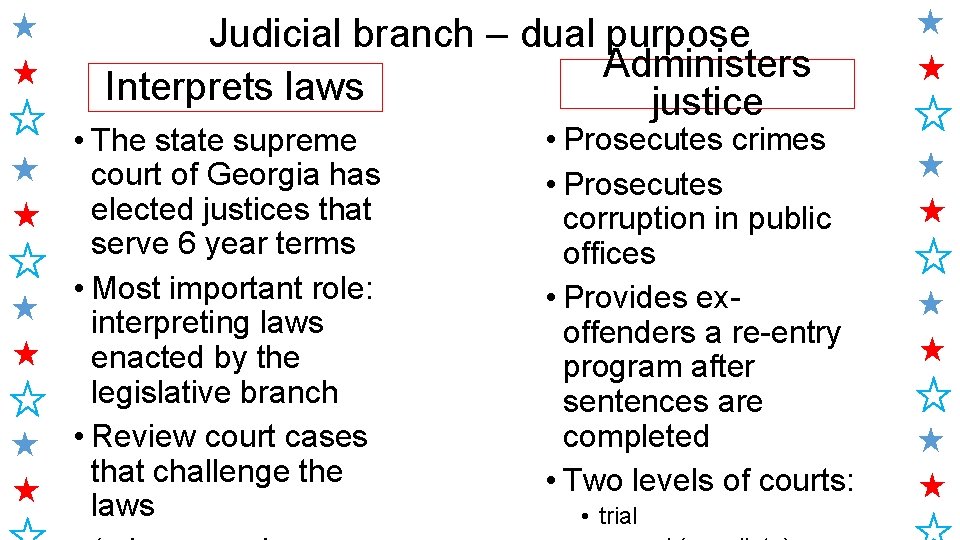
Judicial branch – dual purpose Administers Interprets laws justice • The state supreme court of Georgia has elected justices that serve 6 year terms • Most important role: interpreting laws enacted by the legislative branch • Review court cases that challenge the laws • Prosecutes crimes • Prosecutes corruption in public offices • Provides exoffenders a re-entry program after sentences are completed • Two levels of courts: • trial
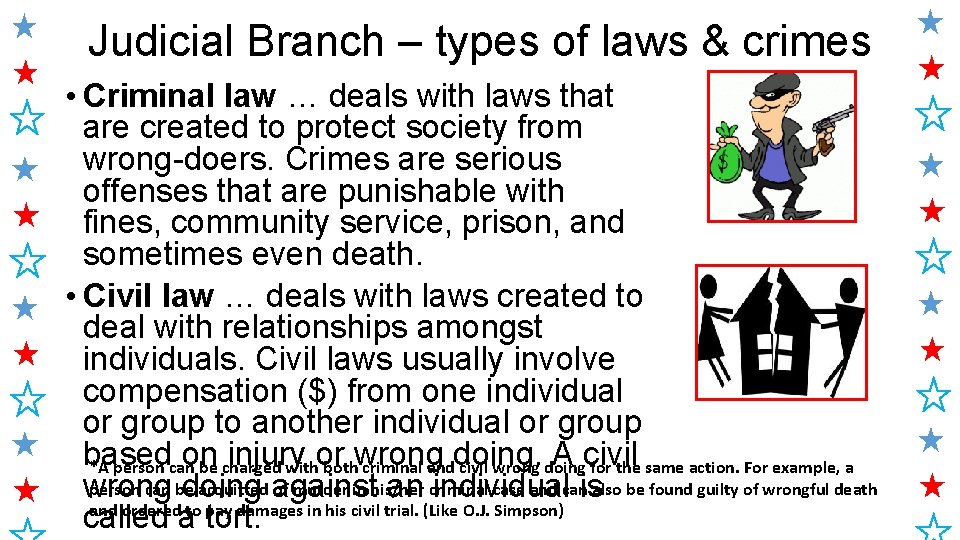
Judicial Branch – types of laws & crimes • Criminal law … deals with laws that are created to protect society from wrong-doers. Crimes are serious offenses that are punishable with fines, community service, prison, and sometimes even death. • Civil law … deals with laws created to deal with relationships amongst individuals. Civil laws usually involve compensation ($) from one individual or group to another individual or group based on injury A civil *A person can be charged withor bothwrong criminal anddoing. civil wrong doing for the same action. For example, a person can be acquitted against of murder in his/her case and canis also be found guilty of wrongful death wrong doing an criminal individual and ordered to pay damages in his civil trial. (Like O. J. Simpson) called a tort.
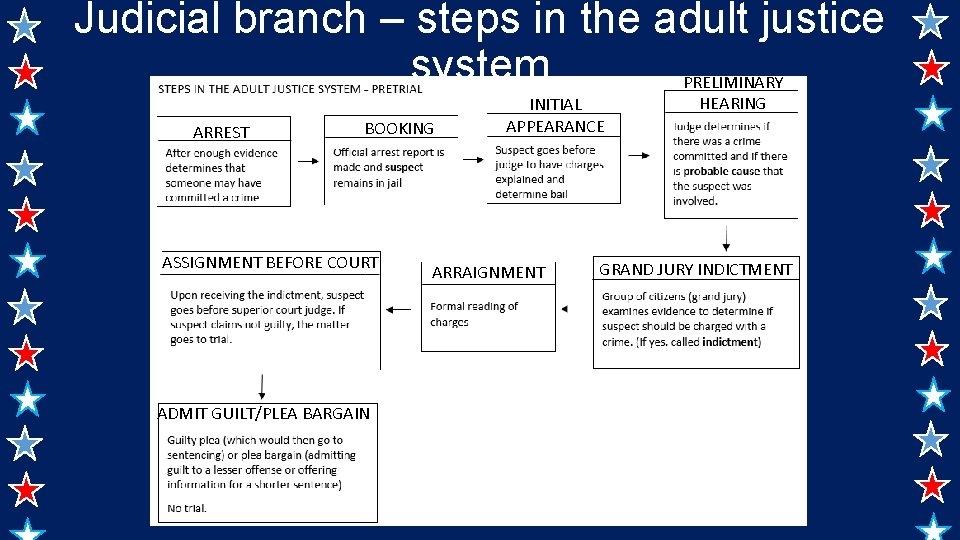
Judicial branch – steps in the adult justice system PRELIMINARY ARREST BOOKING ASSIGNMENT BEFORE COURT ADMIT GUILT/PLEA BARGAIN INITIAL APPEARANCE ARRAIGNMENT HEARING GRAND JURY INDICTMENT
Judicial branch – steps in the adult justice system 1. 2. 3. 4. 5. 6. 7. Jury selection Opening statements Presentation of evidence Closing statements Jury deliberation and verdict Sentencing Appeal
- Slides: 35