
Georgia Studies Unit 4 Georgia and the Westward












- Slides: 30
Georgia Studies Unit 4 – Georgia and the Westward Expansion Lesson 1: Westward Expansion Study Presentation
Georgia Studies “Unpacking the Standards”: Georgia in the American Revolutionary Era
Unit 4: Georgia and the Westward Expansion Lesson 1: Westward Expansion Verbs Nouns
Lesson 1: Westward Expansion SS 8 H 4 The student will explain significant factors that affected westward expansion of Georgia between 1789 and 1840.
Find the major verbs and nouns and label Lesson 1: them on your “T” Westward Expansion Chart. Element a. Explain reasons for establishment of the University of Georgia, and for the westward movement of Georgia’s capitals.
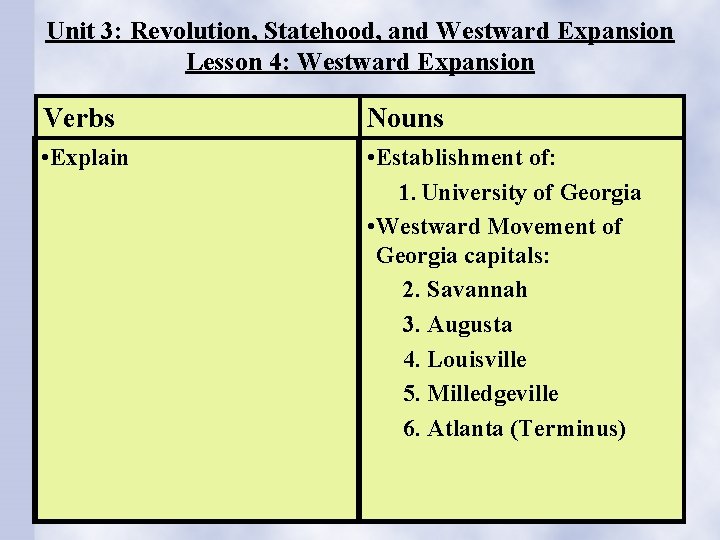
Unit 3: Revolution, Statehood, and Westward Expansion Lesson 4: Westward Expansion Verbs Nouns • Explain • Establishment of: 1. University of Georgia • Westward Movement of Georgia capitals: 2. Savannah 3. Augusta 4. Louisville 5. Milledgeville 6. Atlanta (Terminus)
Lesson 4: Westward Expansion • Essential Question – What was the reasons for the establishment of the University of Georgia and westward movement of Georgia's capitals?
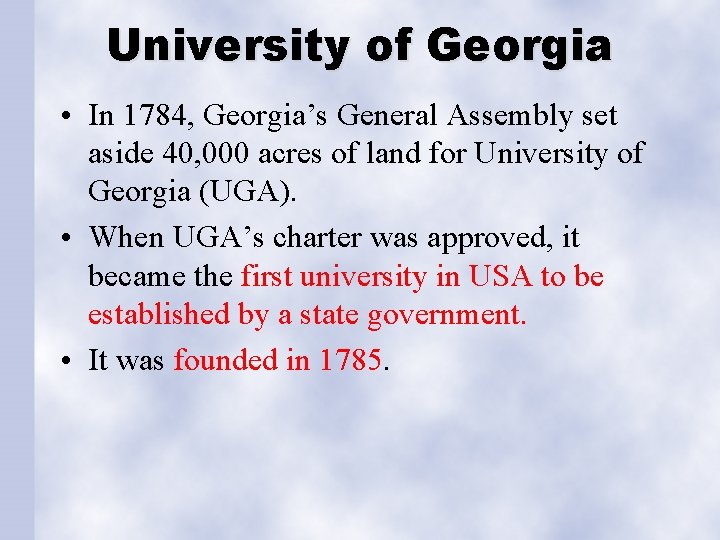
University of Georgia • In 1784, Georgia’s General Assembly set aside 40, 000 acres of land for University of Georgia (UGA). • When UGA’s charter was approved, it became the first university in USA to be established by a state government. • It was founded in 1785.
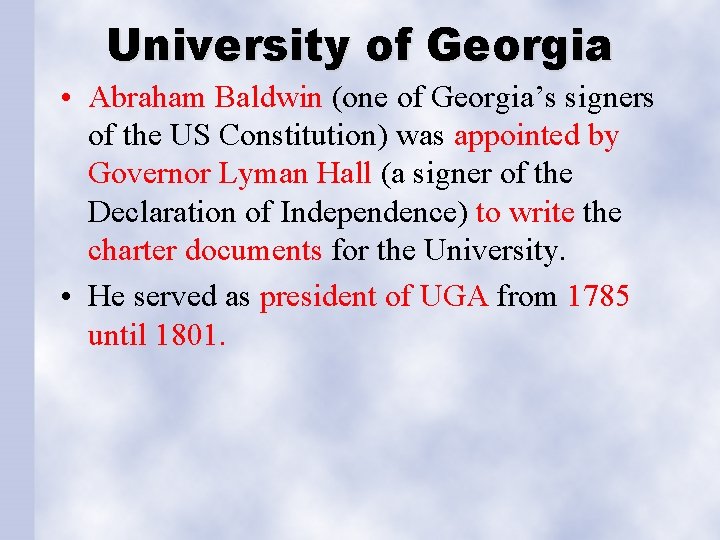
University of Georgia • Abraham Baldwin (one of Georgia’s signers of the US Constitution) was appointed by Governor Lyman Hall (a signer of the Declaration of Independence) to write the charter documents for the University. • He served as president of UGA from 1785 until 1801.
University of Georgia What was the purpose for the establishment of the University of Georgia? • In the charter, Abraham Baldwin wrote – all people, not just the rich, have a right to education. • He also stated that educated people was essential for a free government. • Set the example for today’s American system of public colleges and universities.
Georgia’s Capital City • Westward movement of the state capitals as American Indian territory was given to the state of Georgia. • Continued westward movement of the state capital as the state’s population moved west.
Georgia’s Capital City • There have been five cities that have served as the state capital of Georgia.
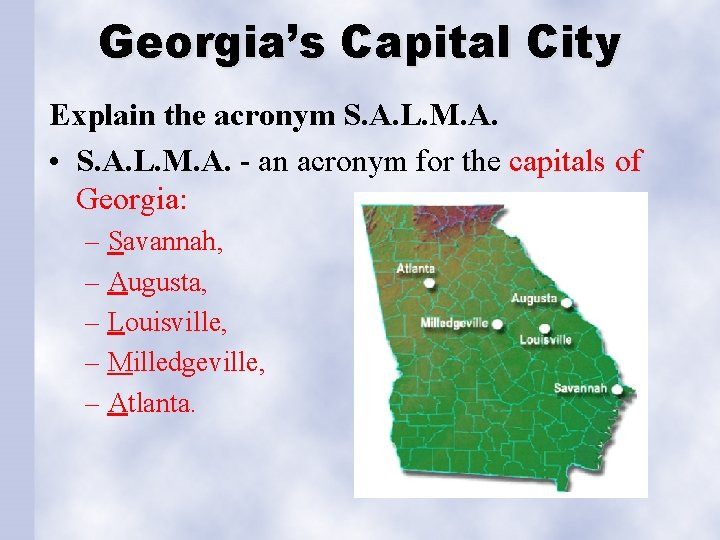
Georgia’s Capital City Explain the acronym S. A. L. M. A. • S. A. L. M. A. - an acronym for the capitals of Georgia: – Savannah, – Augusta, – Louisville, – Milledgeville, – Atlanta.
Savannah • Georgia’s first capital. • Served as the colonial “capital” of Georgia. • Official power, however, was maintained by the Trustees who remained in England. • When the Trustee period ended, Savannah was deemed the “seat of government” and the royal governor, legislative assembly and courts were headquartered there.
Savannah • In those days, the state legislature approved divorces, bridge fees, and many other legal matters affecting people’s daily lives. • There was no fast way to travel, so it was important for people to live near their capital.
Savannah Why was Georgia’s capital shifted from Savannah? • As more Georgians moved west, Savannah’s location as capital became less and less useful for people and legislators.
Moving to Augusta • Georgia’s second capital. • After the American Revolution Georgia’s capital city moved from the original capital (Savannah) to Augusta in 1786.
Moving to Augusta • Settlers complained even Augusta was too far east. • Georgia’s population was spreading towards the center of the state.
Moving to Augusta Why was Georgia’s capital shifted from Augusta? • People wanted a new capital city with a central location – one that would be easy to get to by all Georgians.
Moving to Louisville • As Georgia’s population began to move farther west Georgia decided to move its capital city; Louisville served as GA’s third capital city from 1796 -1807.
Moving to Louisville • Named Louisville in honor of the King Louis XVI of France for his help during the Revolutionary War.
Moving to Louisville Why was Georgia’s capital changed to Louisville? • Location - center of population. • Location - on the Ogeechee River; easy water transportation • Location – near Indian trading post
Moving to Milledgeville • The city of Milledgeville served as Georgia’s fourth capital city from 1807 until after the Civil War (1868) • Capital for 60 years.
Moving to Milledgeville • Capital during the Civil War.
Moving to Milledgeville Why was Georgia’s capital changed to Milledgeville? • Creek lands west of Louisville were taken by the state in 1802 and there was a push to move the state capital westward.
Atlanta • Atlanta became Georgia’s fifth capital city in 1868.
Atlanta • The city of Terminus was created in 1837. • This was the site where the end of the Western and Atlantic Railroad “terminated, ” hence the name Terminus; this name was never an official name. • Terminus was renamed Marthasville in 1843, after the daughter of former Governor Wilson Lumpkin • The name was changed to Atlanta in 1845.
Atlanta Why was Georgia’s capital changed to Atlanta? • The removal of the Cherokees in 1838 led state lawmakers to anticipate another westward move for the state capital.
The Western Territory • In 1802, Georgia ceded (gave up) its land claims west of the Chattahoochee River to the federal government for $1. 25 million • President Thomas Jefferson doubled the nation’s size in 1803 with the Louisiana territory purchase; the U. S. paid France $15 million for land that stretched to the Rocky Mountains • Many people began to move west across the Oregon and Santa Fe trails, many of these hoping to find gold. Between 1848 and 1850, the population of California increased tenfold due to a major gold rush. • Georgia’s farmers now had access to a large amount of land.