
Georgia in the 1920 s 1930 s Georgia
- Slides: 21
Georgia in the 1920 s & 1930 s Georgia Studies
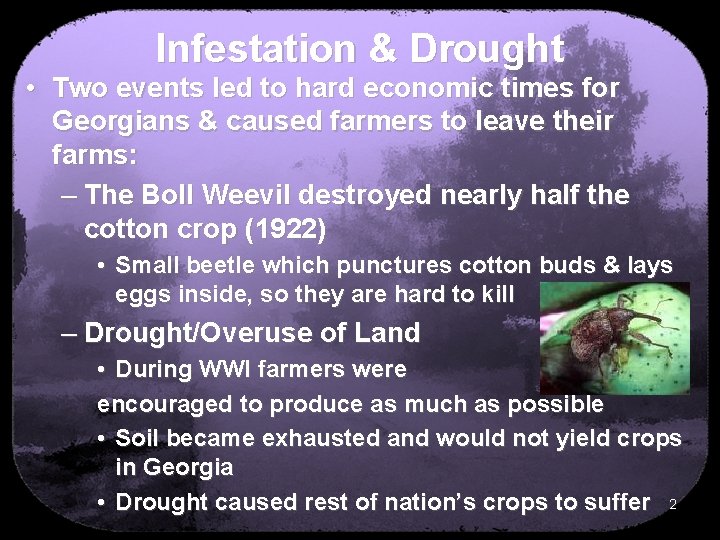
Infestation & Drought • Two events led to hard economic times for Georgians & caused farmers to leave their farms: – The Boll Weevil destroyed nearly half the cotton crop (1922) • Small beetle which punctures cotton buds & lays eggs inside, so they are hard to kill – Drought/Overuse of Land • During WWI farmers were encouraged to produce as much as possible • Soil became exhausted and would not yield crops in Georgia • Drought caused rest of nation’s crops to suffer 2
The Great Depression • The economy normally goes through highs and lows • An extreme economic drop is known as a “depression” – Unemployment is high – People cannot afford many goods and services – Businesses suffer greatly or fail altogether 3
The Great Depression • The worst depression in the U. S. occurred in the 1930 s • This was caused by a chain of events beginning after WWI • Although the U. S. originally prospered after the war, other countries involved in the war suffered greatly 4
The Great Depression • Era before the depression known as the “Roaring Twenties” – Many people made many purchases of the new products available to them – When they couldn’t afford items, they put them on credit – Businesses made large profits – Consumers invested in business stocks – Economy grew very quickly (too quickly) 5
The Stock Market Crash • Consumer confidence led to investment • Many people borrowed money to buy stocks • On October 24, 1929, the value of stocks dropped dramatically – Black Tuesday • Many people tried to sell their stock at the same time • Soon banks could not collect on the loans people had taken • The banks ran out of money and many lost their savings from their accounts 6
Stock Market Crash, cont. • People who lost their savings could no longer make payments on their possessions bought on credit • Many were forced to sell everything they had just to buy necessities • People lost their homes and farms or had to sell them for the best price they could get • People could no longer buy luxury items & unemployment increased • Businesses who survived cut production as fewer people bought goods • This period was called the great depression and lasted over ten years 7
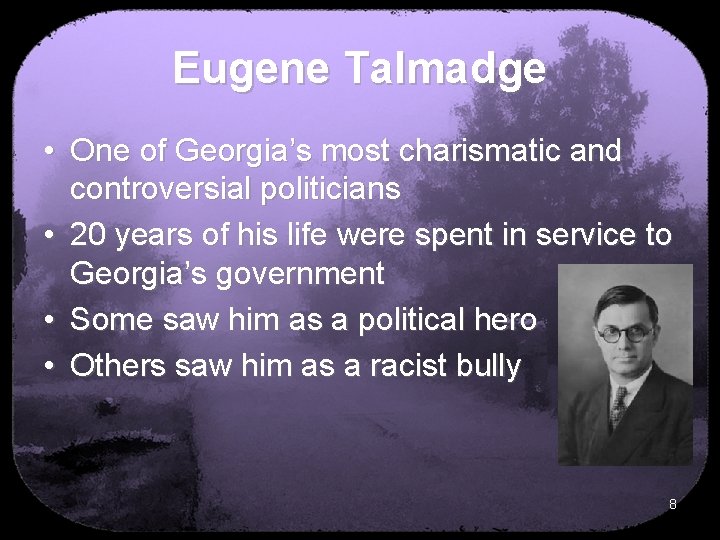
Eugene Talmadge • One of Georgia’s most charismatic and controversial politicians • 20 years of his life were spent in service to Georgia’s government • Some saw him as a political hero • Others saw him as a racist bully 8
Eugene Talmadge: Early career • Began as Commissioner of Agriculture • Farmers & people who lived in rural communities loved him because his policies supported farmers • Although he was accused of several illegal acts during his time as commissioner, he served three terms before he was elected governor 9
Eugene Talmadge: Governor • He proved to be a strong governor • He used “executive order” to fulfill a campaign promise to lower the cost of car tags – Executive order is an act by governor that does not have legislative approval • When the Public Service Commission (elected officials) refused to lower utility prices, he fired them – He appointed replacements who would lower the prices 10
Eugene Talmadge: Governor • He had the state treasurer and comptroller general physically removed from their offices in the state capitol • He was an outspoken critic of Franklin D. Roosevelt – Did not like Roosevelt’s New Deal Programs – Did what he could to keep the programs out of Georgia 11
The Third Term • After his second term as governor, Talmadge ran for the U. S. Senate in 1936 and 1938, but lost both elections • He was elected governor again in 1940 • His third term was filled with controversy – He was against integration at the University of Georgia and threatened to have the Dean of the College of Education fired – The chain of events that followed seriously damaged the University system and accreditation for all public universities for white people was removed 12
Eugene Talmadge, cont. • After the University system debacle, Talmadge lost the next gubernatorial election • In 1946, he was elected governor a fourth time – His election was due largely to his opposition of a supreme court decision to allow black people to vote in primary elections – He died before taking office 13
FDR & The New Deal • At the beginning of the Great Depression, Herbert Hoover was president • His policies depended on the individual states to help themselves • Most states were too poor to create programs to help their citizens who were struggling • People began to believe the only way the economy would prosper again was for the federal government to help the states out 14
FDR & The New Deal • In 1933 Franklin Delano Roosevelt took office and set up a plan called the New Deal • When Roosevelt took office, American agriculture was suffering and unemployment was high • The New Deal involved creating new jobs and national relief programs to help the economy grow 15
New Deal Programs • The Agricultural Adjustment Administration (AAA) – Purpose of the Agricultural Adjustment Act was to raise the price of staple crops by limiting supply – Farmers in GA were paid to plant less cotton to drive the prices up – This administration also hoped to raise the price of farms and vary crops grown – They also hoped to protect the soil from being overworked 16
New Deal Programs • The Rural Electrification Administration (REA) – Before 1935, very few rural areas in GA and around the country had electricity – Private electric companies did not offer service to many people who lived near power lines – This agency provided loans to states to improve electric service to rural areas – The money was used to build power plants & power lines – Within four years, GA was leading the country in the number of REA groups 17
New Deal Programs • The Civilian Conservation Corps (CCC) – This program created jobs for thousands of young war veterans who were suffering from job loss & poverty – In exchange for work, the men received housing, food and money – Work included soil conservation, reforestation, fire prevention and park building – Educational classes and job training were also provided – Many Georgia parks were built by the CCC 18
New Deal Programs • Works Progress Administration (WPA) – As the largest work relief program in U. S. history, it provided jobs for both men and women in construction and education – Roosevelt hoped this program would repair the spirit of people – The Georgia library system is an example of a WPA program • Over 100 libraries received assistance • Program provided pay for workers and technical services for libraries 19
New Deal Programs • The Social Security Act – Passed by Congress in 1935 – Permanent plan to protect workers from losing their wages – Two social insurance programs were formed to remedy severe poverty & prevent it in the future: • Old-age benefits for retiring workers would support them when they could no longer work (managed by federal government) • Insurance was provided for unemployed and disabled to provide people with a sense of security in their jobs (managed by state & federal government) 20
The New Deal • These programs changed the way people looked at labor • Unions had greater power and began to ask for better wages and working conditions as well as better welfare packages • The New Deal gave those who suffered during the Depression security & power 21