
Georgia High School Graduation Writing Test Standard Addressed
- Slides: 25
Georgia High School Graduation Writing Test
Standard Addressed • ELA 11 W 1 How do I produce writing that sets a context, engages the reader, maintains a focus, and signals closure?
Prompt Specifications • The GHSWT topics are often referred to as “prompts, ” for their purpose is to prompt or elicit a writing sample in an on-demand setting. • Each prompt is divided into two clearly marked parts: the Writing Situation and the Directions for Writing. • Writing prompts contain six elements.
Six Elements of the Writing Prompt Issue • The issue is to be of enough complexity to allow for the expression of diverse viewpoints. • The issue will be relevant to the experiences and interests of Georgia’s high school students. • Topics are drawn from teen and school-based issues, societal concerns, and diverse content areas (such as the social sciences and sciences). The variety of topics is intended to foster writing across the curriculum and to allow for differences in students’ prior knowledge.
The Prompt Descriptive Setup • The issue is presented within a framework that engages the writer’s interest, provides a realistic context for examining the issue, and presents enough information to familiarize any potentially uninformed writer with the nature of the issue. • The context may be historical, literary, current, or hypothetical. • Key terms that might be unfamiliar are defined, paraphrased, or illustrated with examples.
Knowledge Base Writers should be able to produce a complete and competent response using knowledge gained through either personal or academic experiences or a combination of these sources.
Writer’s Intent and Writing Task Cues in the wording of the prompt should make it clear whether the writer is to • examine different sides of a controversy or • choose a position and provide support for that position or • analyze a problem and its solution(s) The organization or structure of the writing sample is to be appropriate to the task.
Audience The audience is specified. The audience may range from the familiar (fellow students or family members) to the distant (legislators, school board members, newspaper subscribers).
Form • Form is specified. • However, the conventions of form, such as the inside address or salutation of a business letter, are not evaluated. • Possible forms include letters, speeches, compositions, position papers, and papers to be read aloud.
New Georgia High School Writing Test Domain • • Ideas Organization Style Conventions 1. A domain is an aspect of writing. 2. Each domain itself is scored holistically. The score assigned indicates the writer’s command of the components. Weight 2 1 1 1
Weighting of Domains Weighting means that the scores in some writing domains will be given more weight than others in determining the total score that a student receives. Scoring Domain Weight % of total score Ideas 2 x raters’ scores 40% Organization 1 x raters’ scores 20% Style 1 x raters’ scores 20% Conventions 1 x raters’ scores 20%
Successful Essays • are consistently focused on the assigned topic, persuasive purpose, and audience • have an effective introduction, body, and conclusion • demonstrate a well developed and valid writer’s position • present supporting ideas that are fully elaborated with specific examples and details
Successful Essays • fully address readers’ concerns and/or counter arguments. * • have main points of their argument that are logically grouped and sequenced within paragraphs and across parts of the paper. • contain varied transitional elements that connect ideas (ex. first, next, finally) • exhibit word choice that is varied and precise throughout the response
Successful Essays • presentences that are varied in length and structure. • show a writer’s voice that is distinctive. • maintain sustained attention to the audience in the introduction, body, and conclusion.
Successful Essays • strive for sentence formation, usage, and mechanics that are consistently correct in a variety of contexts. • contain only minor and infrequent errors. • have a text of sufficient length to demonstrate effective writing skills in a variety of contexts.
Persuasive Writing • has as its purpose convincing others to accept the writer’s position as valid, adopt a certain point of view, or take some action. • provides logical appeals, emotional appeals, facts, statistics, narrative anecdotes, humor and/or the writer’s personal experiences and knowledge.
Persuasive Writing • clearly establishes a position on the issue and fully develops an argument with specific details and examples. • defends the writer’s position with relevant evidence that is appropriate for the audience identified in the writing topic.
Persuasive Writing • demonstrates that the writer can anticipate and counter the audience’s position on the issue. * • uses specific facts, personal experience and knowledge, and/or statistics to support the writer’s position.
Persuasive Writing • includes appeals to logic and/or emotion. • contains an organizational structure appropriate for persuasion.
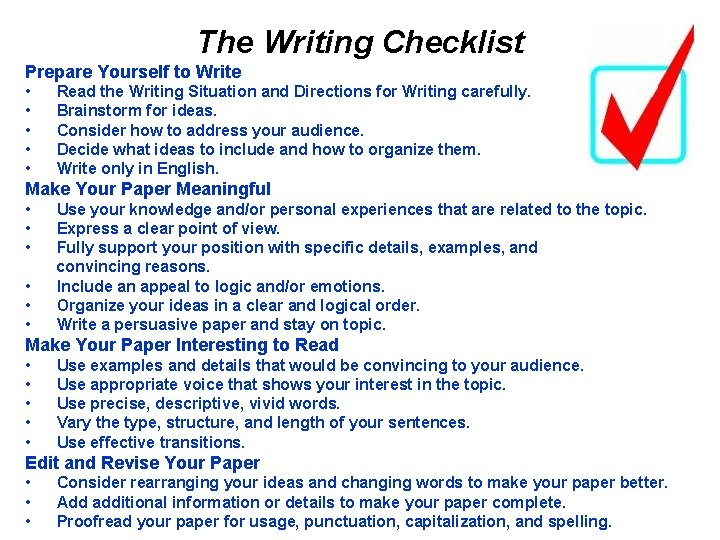
The Writing Checklist Prepare Yourself to Write • • • Read the Writing Situation and Directions for Writing carefully. Brainstorm for ideas. Consider how to address your audience. Decide what ideas to include and how to organize them. Write only in English. Make Your Paper Meaningful • • • Use your knowledge and/or personal experiences that are related to the topic. Express a clear point of view. Fully support your position with specific details, examples, and convincing reasons. Include an appeal to logic and/or emotions. Organize your ideas in a clear and logical order. Write a persuasive paper and stay on topic. Make Your Paper Interesting to Read • • • Use examples and details that would be convincing to your audience. Use appropriate voice that shows your interest in the topic. Use precise, descriptive, vivid words. Vary the type, structure, and length of your sentences. Use effective transitions. Edit and Revise Your Paper • • • Consider rearranging your ideas and changing words to make your paper better. Add additional information or details to make your paper complete. Proofread your paper for usage, punctuation, capitalization, and spelling.
Scoring the Georgia High School Writing Test • Five score points in each scoring domain (Ideas X 2, Organization, Style, and Conventions) • A score of “ 5” represents the highest level of competence in each domain.
Timeline for the Testing Part 1: Planning/Prewriting (15 minutes) • • • Read your assigned topic on the Writing Topic Page and review the Writing Checklist. Use the space provided for your notes, jot list, or outline. Organize your major supporting details before writing the first draft. Part 2: Drafting (35 minutes) • • Using your prewriting notes, write a first draft of your paper on the Drafting Sheet. Concentrate on getting your ideas down on paper in a logical order. Part 3: Revising and Editing (25 minutes) • • Carefully reread what you have written to see if your ideas are clear and fully developed. Consider any changes that would make your paper better.
Test Timeline (cont. ) Part 4: Final Draft (20 minutes) • • • Rewrite your paper on pages 3 and 4 of the Answer Document. When you rewrite, make sure that you use a blue or black pen and write neatly. You may either print or write in cursive. Do not use pages 1 and 2 of the Answer Document for you writing. Only what is written on pages 3 and 4 of the Answer Document will be scored. Part 5: Proofreading (5 minutes) • • • When you finish writing your final draft, make any needed corrections on your paper. You may strike through words, but do so neatly. Do not use correction fluid. The suggested times given in the directions are approximate. You will be reminded of the times for each part. What you write on the Planning/Prewriting Page and the Drafting Page will not be graded. Only your final draft will be graded. You MUST write your final draft (using a blue or black ink PEN) on the Answer Document using only pages 3 and 4.
Sample Essay Prompt • Writing Situation Many public school systems across the country require students to wear uniforms. Some educators believe that wearing uniforms will help students concentrate more on their school work. On the other hand, some students argue that having to wear uniforms prevents them from expressing their individuality. Your principal is considering whether students at your school should wear uniforms. • Directions for Writing Write a letter to your principal expressing your view on school uniforms. Provide convincing reasons and specific examples to support your position.
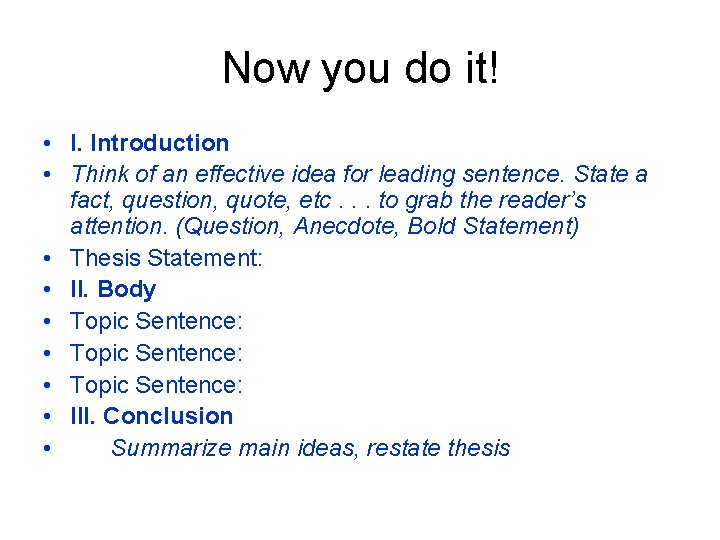
Now you do it! • I. Introduction • Think of an effective idea for leading sentence. State a fact, question, quote, etc. . . to grab the reader’s attention. (Question, Anecdote, Bold Statement) • Thesis Statement: • II. Body • Topic Sentence: • III. Conclusion • Summarize main ideas, restate thesis