
Georgia Grade 8 Writing Assessment How the Grade
- Slides: 32
Georgia Grade 8 Writing Assessment
How the Grade 8 Writing Assessment is Scored: Domains New Grade 8 Writing Assessment Four Scoring Domains • Ideas • Organization • Style • Conventions Introduction: Scoring Information 2
How the Grade 8 Assessment is Scored: The Score Scale New Grade 8 Writing Assessment • Five score points in each scoring domain • A score of “ 5” represents the highest level of competence in each domain. Introduction: Scoring Information 3
How the Domains are Weighted Weighting means that the scores in some writing domains will be given more weight than others in determining the total score that a student receives. Grade 8 Writing Assessment Weight Ideas 2 Organization 1 Style 1 Conventions 1 Introduction: Scoring Information 4
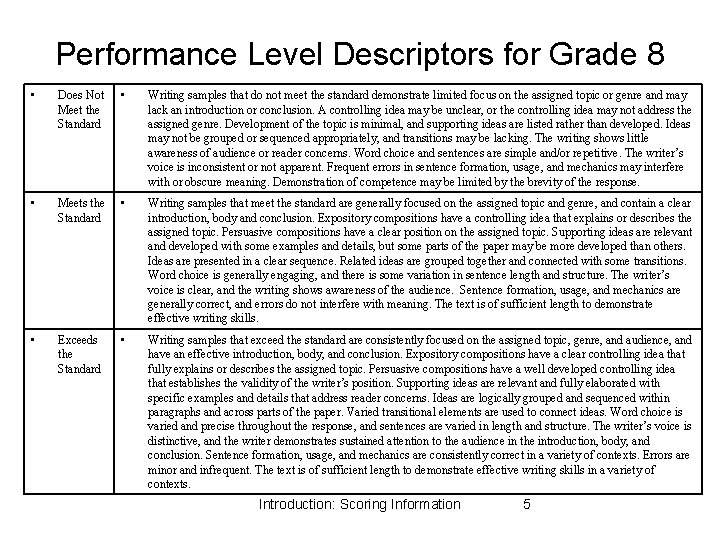
Performance Level Descriptors for Grade 8 • Does Not Meet the Standard • Writing samples that do not meet the standard demonstrate limited focus on the assigned topic or genre and may lack an introduction or conclusion. A controlling idea may be unclear, or the controlling idea may not address the assigned genre. Development of the topic is minimal, and supporting ideas are listed rather than developed. Ideas may not be grouped or sequenced appropriately, and transitions may be lacking. The writing shows little awareness of audience or reader concerns. Word choice and sentences are simple and/or repetitive. The writer’s voice is inconsistent or not apparent. Frequent errors in sentence formation, usage, and mechanics may interfere with or obscure meaning. Demonstration of competence may be limited by the brevity of the response. • Meets the Standard • Writing samples that meet the standard are generally focused on the assigned topic and genre, and contain a clear introduction, body and conclusion. Expository compositions have a controlling idea that explains or describes the assigned topic. Persuasive compositions have a clear position on the assigned topic. Supporting ideas are relevant and developed with some examples and details, but some parts of the paper may be more developed than others. Ideas are presented in a clear sequence. Related ideas are grouped together and connected with some transitions. Word choice is generally engaging, and there is some variation in sentence length and structure. The writer’s voice is clear, and the writing shows awareness of the audience. Sentence formation, usage, and mechanics are generally correct, and errors do not interfere with meaning. The text is of sufficient length to demonstrate effective writing skills. • Exceeds the Standard • Writing samples that exceed the standard are consistently focused on the assigned topic, genre, and audience, and have an effective introduction, body, and conclusion. Expository compositions have a clear controlling idea that fully explains or describes the assigned topic. Persuasive compositions have a well developed controlling idea that establishes the validity of the writer’s position. Supporting ideas are relevant and fully elaborated with specific examples and details that address reader concerns. Ideas are logically grouped and sequenced within paragraphs and across parts of the paper. Varied transitional elements are used to connect ideas. Word choice is varied and precise throughout the response, and sentences are varied in length and structure. The writer’s voice is distinctive, and the writer demonstrates sustained attention to the audience in the introduction, body, and conclusion. Sentence formation, usage, and mechanics are consistently correct in a variety of contexts. Errors are minor and infrequent. The text is of sufficient length to demonstrate effective writing skills in a variety of contexts. Introduction: Scoring Information 5
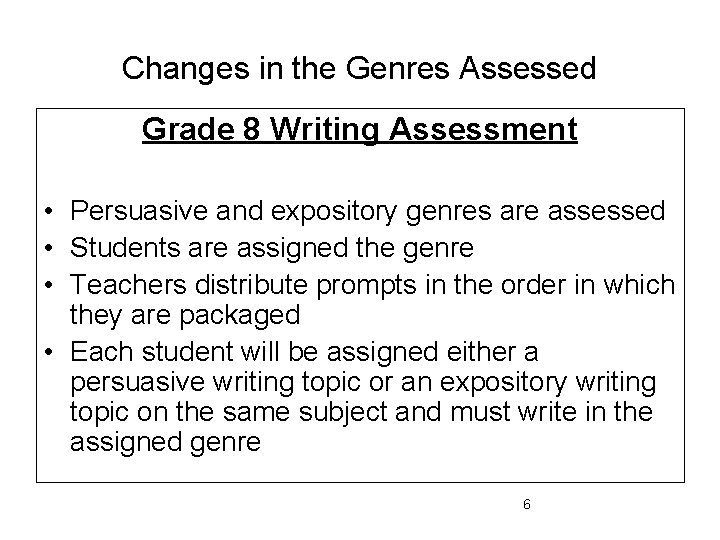
Changes in the Genres Assessed Grade 8 Writing Assessment • Persuasive and expository genres are assessed • Students are assigned the genre • Teachers distribute prompts in the order in which they are packaged • Each student will be assigned either a persuasive writing topic or an expository writing topic on the same subject and must write in the assigned genre 6
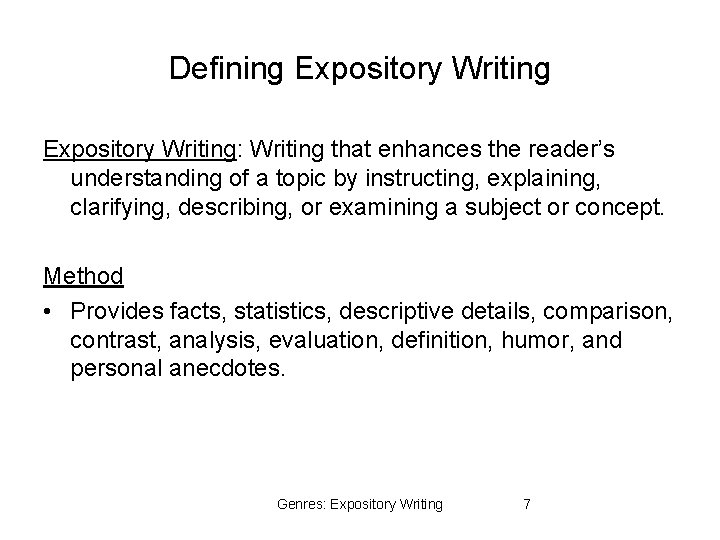
Defining Expository Writing: Writing that enhances the reader’s understanding of a topic by instructing, explaining, clarifying, describing, or examining a subject or concept. Method • Provides facts, statistics, descriptive details, comparison, contrast, analysis, evaluation, definition, humor, and personal anecdotes. Genres: Expository Writing 7
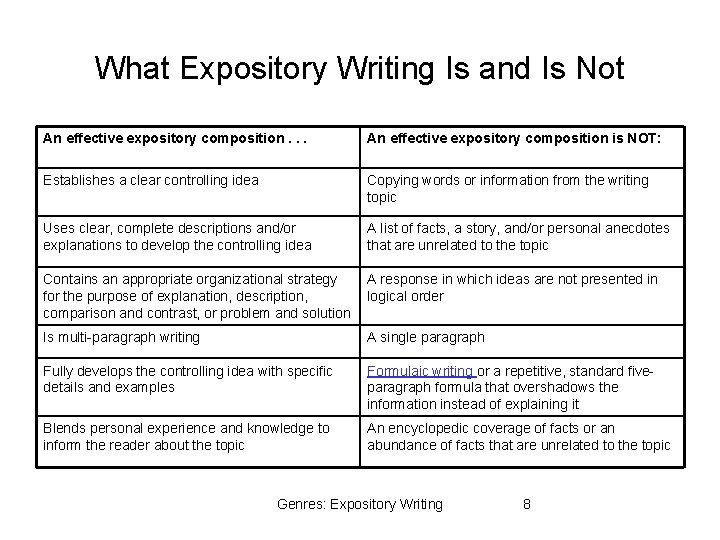
What Expository Writing Is and Is Not An effective expository composition. . . An effective expository composition is NOT: Establishes a clear controlling idea Copying words or information from the writing topic Uses clear, complete descriptions and/or explanations to develop the controlling idea A list of facts, a story, and/or personal anecdotes that are unrelated to the topic Contains an appropriate organizational strategy for the purpose of explanation, description, comparison and contrast, or problem and solution A response in which ideas are not presented in logical order Is multi-paragraph writing A single paragraph Fully develops the controlling idea with specific details and examples Formulaic writing or a repetitive, standard fiveparagraph formula that overshadows the information instead of explaining it Blends personal experience and knowledge to inform the reader about the topic An encyclopedic coverage of facts or an abundance of facts that are unrelated to the topic Genres: Expository Writing 8
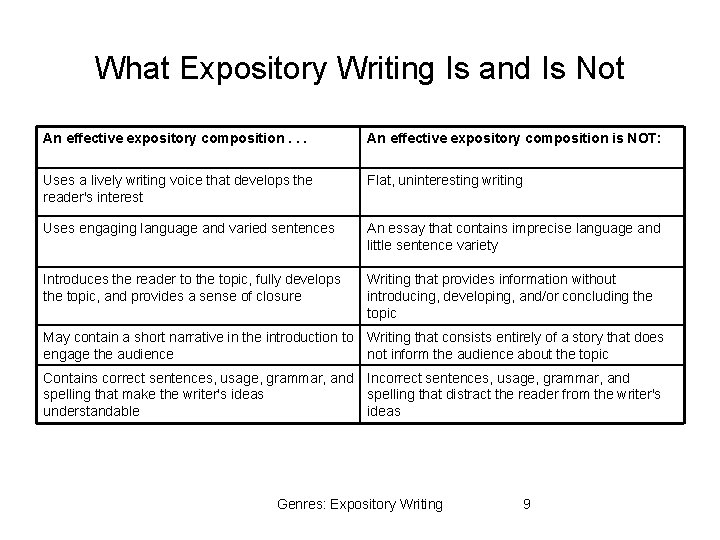
What Expository Writing Is and Is Not An effective expository composition. . . An effective expository composition is NOT: Uses a lively writing voice that develops the reader's interest Flat, uninteresting writing Uses engaging language and varied sentences An essay that contains imprecise language and little sentence variety Introduces the reader to the topic, fully develops the topic, and provides a sense of closure Writing that provides information without introducing, developing, and/or concluding the topic May contain a short narrative in the introduction to Writing that consists entirely of a story that does engage the audience not inform the audience about the topic Contains correct sentences, usage, grammar, and Incorrect sentences, usage, grammar, and spelling that make the writer's ideas spelling that distract the reader from the writer's understandable ideas Genres: Expository Writing 9
Defining Persuasive Writing: Writing that has as its purpose convincing others to accept the writer’s position as valid, adopt a certain point of view, or take some action. Method: • Provides logical appeals, emotional appeals, facts, statistics, narrative anecdotes, humor, and/or the writer’s personal experiences and knowledge. Genres: Persuasive Writing 10
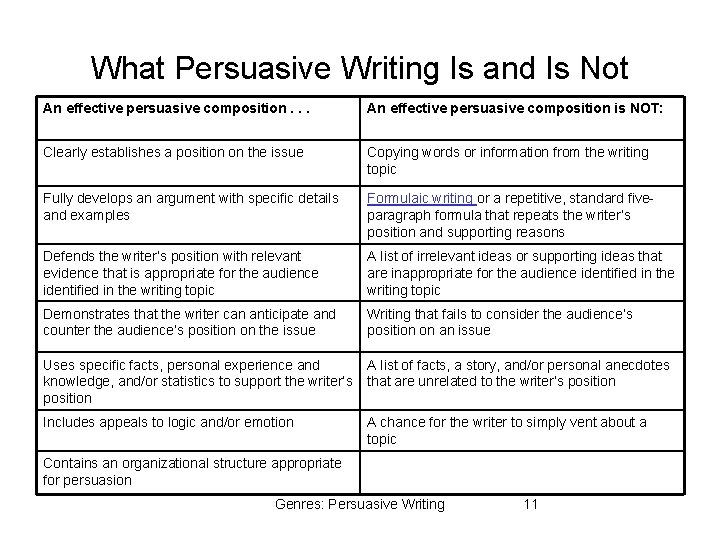
What Persuasive Writing Is and Is Not An effective persuasive composition. . . An effective persuasive composition is NOT: Clearly establishes a position on the issue Copying words or information from the writing topic Fully develops an argument with specific details and examples Formulaic writing or a repetitive, standard fiveparagraph formula that repeats the writer’s position and supporting reasons Defends the writer’s position with relevant evidence that is appropriate for the audience identified in the writing topic A list of irrelevant ideas or supporting ideas that are inappropriate for the audience identified in the writing topic Demonstrates that the writer can anticipate and counter the audience’s position on the issue Writing that fails to consider the audience’s position on an issue Uses specific facts, personal experience and knowledge, and/or statistics to support the writer’s position A list of facts, a story, and/or personal anecdotes that are unrelated to the writer’s position Includes appeals to logic and/or emotion A chance for the writer to simply vent about a topic Contains an organizational structure appropriate for persuasion Genres: Persuasive Writing 11
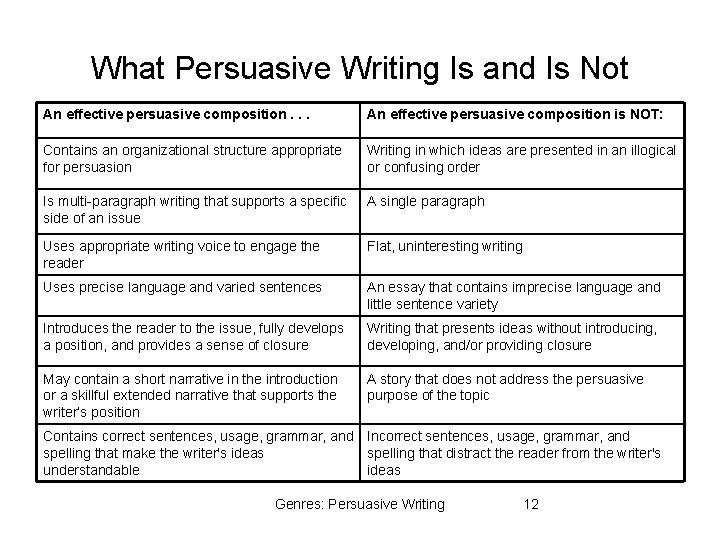
What Persuasive Writing Is and Is Not An effective persuasive composition. . . An effective persuasive composition is NOT: Contains an organizational structure appropriate for persuasion Writing in which ideas are presented in an illogical or confusing order Is multi-paragraph writing that supports a specific side of an issue A single paragraph Uses appropriate writing voice to engage the reader Flat, uninteresting writing Uses precise language and varied sentences An essay that contains imprecise language and little sentence variety Introduces the reader to the issue, fully develops a position, and provides a sense of closure Writing that presents ideas without introducing, developing, and/or providing closure May contain a short narrative in the introduction or a skillful extended narrative that supports the writer’s position A story that does not address the persuasive purpose of the topic Contains correct sentences, usage, grammar, and Incorrect sentences, usage, grammar, and spelling that make the writer's ideas spelling that distract the reader from the writer's understandable ideas Genres: Persuasive Writing 12
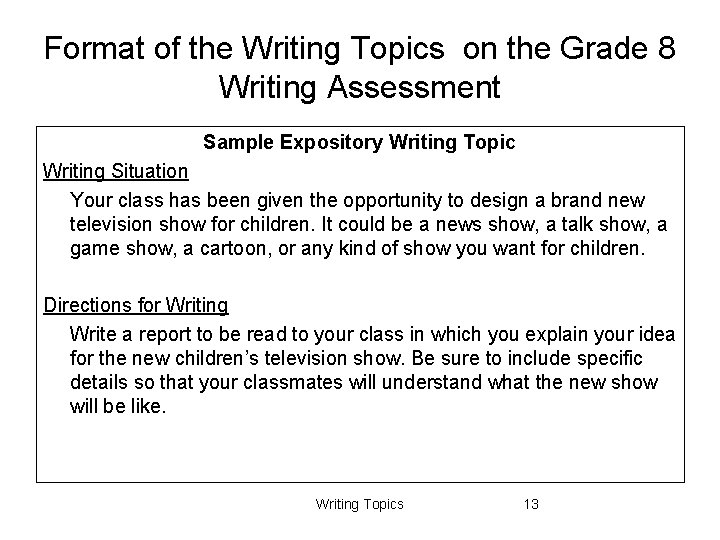
Format of the Writing Topics on the Grade 8 Writing Assessment Sample Expository Writing Topic Writing Situation Your class has been given the opportunity to design a brand new television show for children. It could be a news show, a talk show, a game show, a cartoon, or any kind of show you want for children. Directions for Writing Write a report to be read to your class in which you explain your idea for the new children’s television show. Be sure to include specific details so that your classmates will understand what the new show will be like. Writing Topics 13
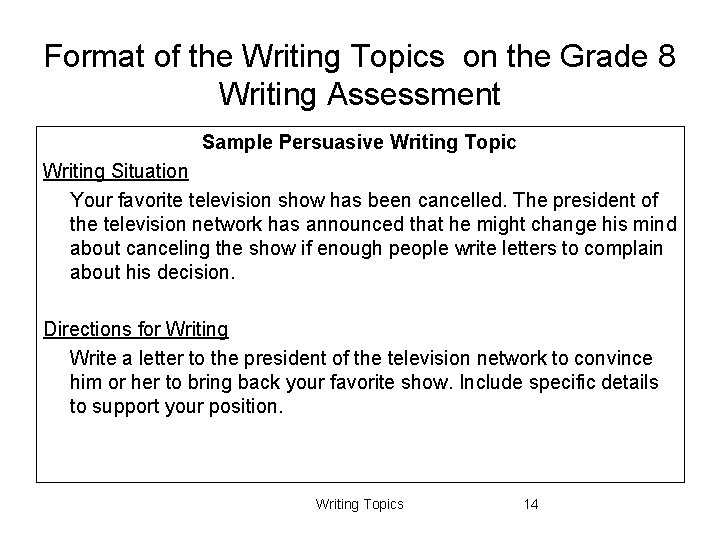
Format of the Writing Topics on the Grade 8 Writing Assessment Sample Persuasive Writing Topic Writing Situation Your favorite television show has been cancelled. The president of the television network has announced that he might change his mind about canceling the show if enough people write letters to complain about his decision. Directions for Writing Write a letter to the president of the television network to convince him or her to bring back your favorite show. Include specific details to support your position. Writing Topics 14
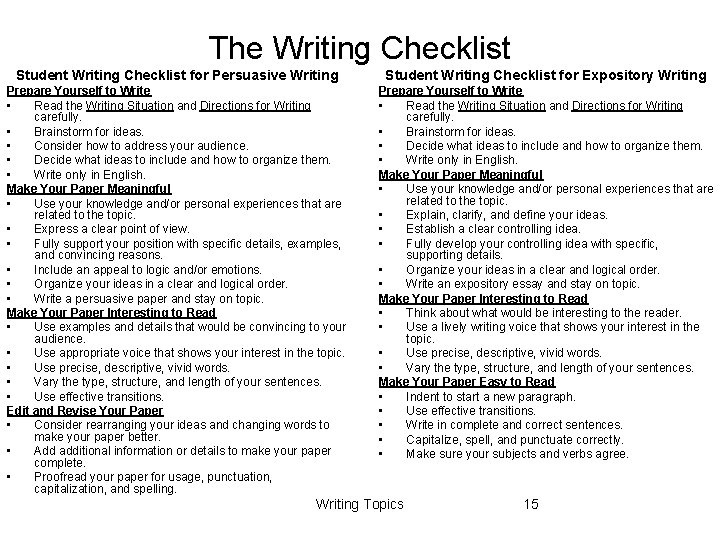
The Writing Checklist Student Writing Checklist for Persuasive Writing Student Writing Checklist for Expository Writing Prepare Yourself to Write • Read the Writing Situation and Directions for Writing carefully. • Brainstorm for ideas. • Consider how to address your audience. • Decide what ideas to include and how to organize them. • Write only in English. Make Your Paper Meaningful • Use your knowledge and/or personal experiences that are related to the topic. • Express a clear point of view. • Fully support your position with specific details, examples, and convincing reasons. • Include an appeal to logic and/or emotions. • Organize your ideas in a clear and logical order. • Write a persuasive paper and stay on topic. Make Your Paper Interesting to Read • Use examples and details that would be convincing to your audience. • Use appropriate voice that shows your interest in the topic. • Use precise, descriptive, vivid words. • Vary the type, structure, and length of your sentences. • Use effective transitions. Edit and Revise Your Paper • Consider rearranging your ideas and changing words to make your paper better. • Add additional information or details to make your paper complete. • Proofread your paper for usage, punctuation, capitalization, and spelling. Prepare Yourself to Write • Read the Writing Situation and Directions for Writing carefully. • Brainstorm for ideas. • Decide what ideas to include and how to organize them. • Write only in English. Make Your Paper Meaningful • Use your knowledge and/or personal experiences that are related to the topic. • Explain, clarify, and define your ideas. • Establish a clear controlling idea. • Fully develop your controlling idea with specific, supporting details. • Organize your ideas in a clear and logical order. • Write an expository essay and stay on topic. Make Your Paper Interesting to Read • Think about what would be interesting to the reader. • Use a lively writing voice that shows your interest in the topic. • Use precise, descriptive, vivid words. • Vary the type, structure, and length of your sentences. Make Your Paper Easy to Read • Indent to start a new paragraph. • Use effective transitions. • Write in complete and correct sentences. • Capitalize, spell, and punctuate correctly. • Make sure your subjects and verbs agree. Writing Topics 15
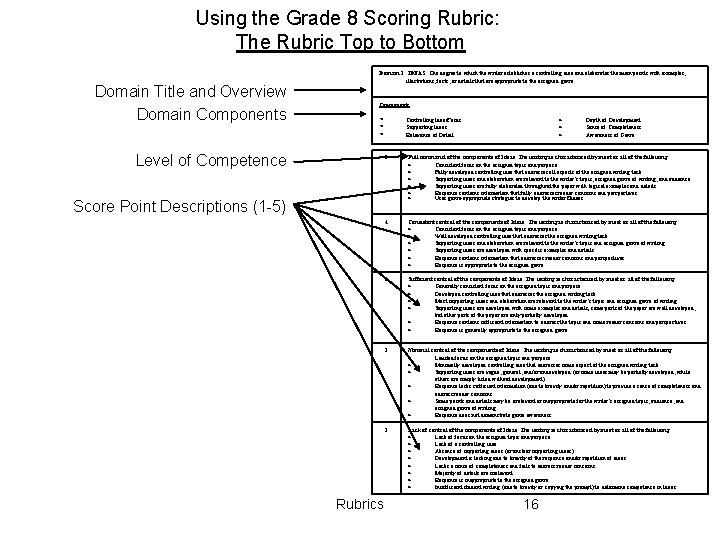
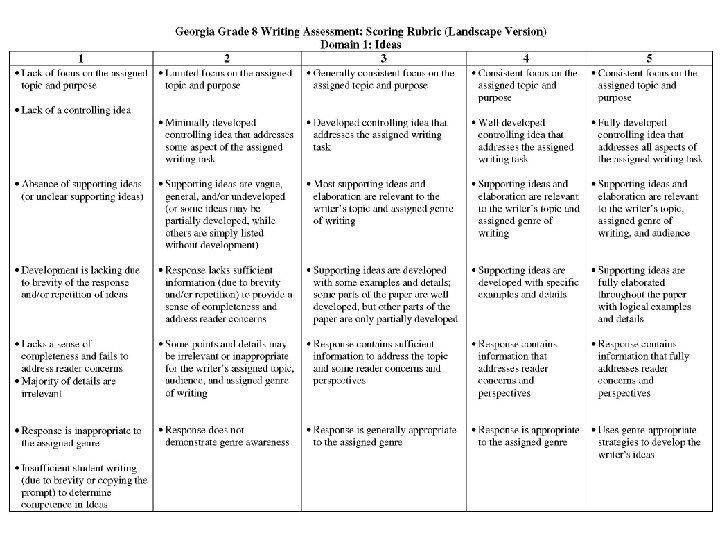
Using the Grade 8 Scoring Rubric: The Rubric Top to Bottom Domain Title and Overview Domain Components Domain 1: IDEAS. The degree to which the writer establishes a controlling idea and elaborates the main points with examples, illustrations, facts, or details that are appropriate to the assigned genre. Components * * * Level of Competence Depth of Development Sense of Completeness Awareness of Genre 5 Full command of the components of Ideas. The writing is characterized by most or all of the following: Consistent focus on the assigned topic and purpose Fully developed controlling idea that addresses all aspects of the assigned writing task Supporting ideas and elaboration are relevant to the writer’s topic, assigned genre of writing, and audience Supporting ideas are fully elaborated throughout the paper with logical examples and details Response contains information that fully addresses reader concerns and perspectives Uses genre-appropriate strategies to develop the writer� s ideas 4 Consistent control of the components of Ideas. The writing is characterized by most or all of the following: Consistent focus on the assigned topic and purpose Well developed controlling idea that addresses the assigned writing task Supporting ideas and elaboration are relevant to the writer’s topic and assigned genre of writing Supporting ideas are developed with specific examples and details Response contains information that addresses reader concerns and perspectives Response is appropriate to the assigned genre 3 Sufficient control of the components of Ideas. The writing is characterized by most or all of the following: Generally consistent focus on the assigned topic and purpose Developed controlling idea that addresses the assigned writing task Most supporting ideas and elaboration are relevant to the writer’s topic and assigned genre of writing Supporting ideas are developed with some examples and details; some parts of the paper are well developed, but other parts of the paper are only partially developed Response contains sufficient information to address the topic and some reader concerns and perspectives Response is generally appropriate to the assigned genre 2 Minimal control of the components of Ideas. The writing is characterized by most or all of the following: Limited focus on the assigned topic and purpose Minimally developed controlling idea that addresses some aspect of the assigned writing task Supporting ideas are vague, general, and/or undeveloped (or some ideas may be partially developed, while others are simply listed without development) Response lacks sufficient information (due to brevity and/or repetition) to provide a sense of completeness and address reader concerns Some points and details may be irrelevant or inappropriate for the writer’s assigned topic, audience, and assigned genre of writing Response does not demonstrate genre awareness 1 Lack of control of the components of Ideas. The writing is characterized by most or all of the following: Lack of focus on the assigned topic and purpose Lack of a controlling idea Absence of supporting ideas (or unclear supporting ideas) Development is lacking due to brevity of the response and/or repetition of ideas Lacks a sense of completeness and fails to address reader concerns Majority of details are irrelevant Response is inappropriate to the assigned genre Insufficient student writing (due to brevity or copying the prompt) to determine competence in Ideas Score Point Descriptions (1 -5) Rubrics Controlling Idea/Focus Supporting Ideas Relevance of Detail 16
Ideas Landscape Rubrics 17
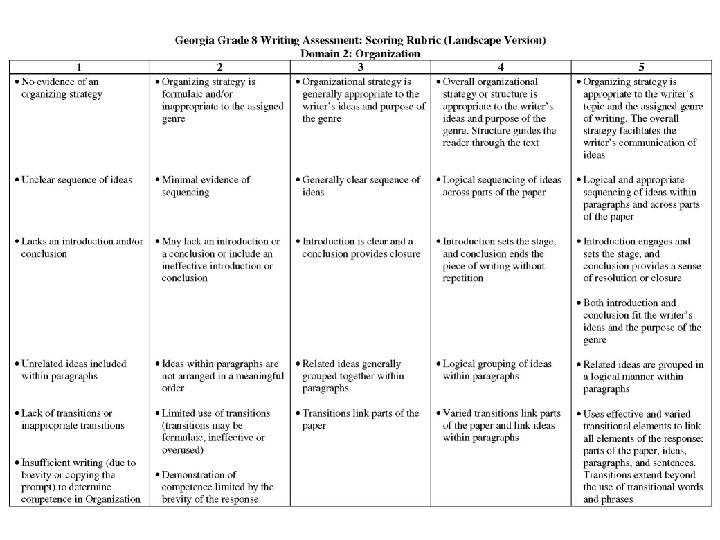
Organization Landscape Rubrics 18
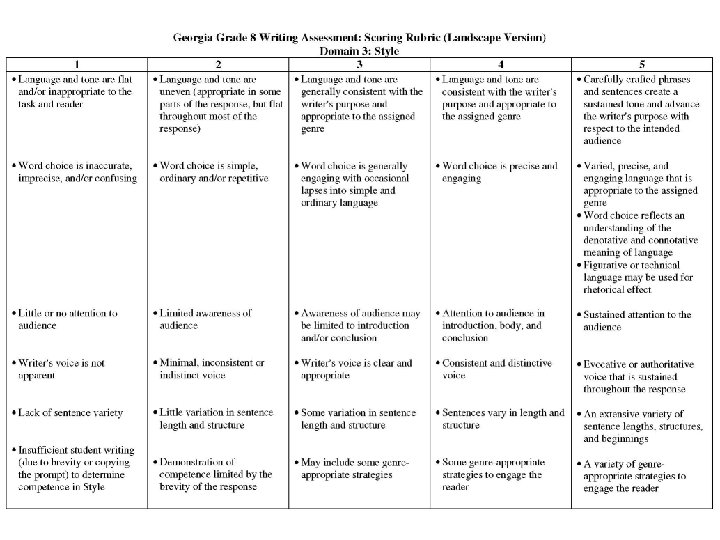
Style Landscape Rubrics 19
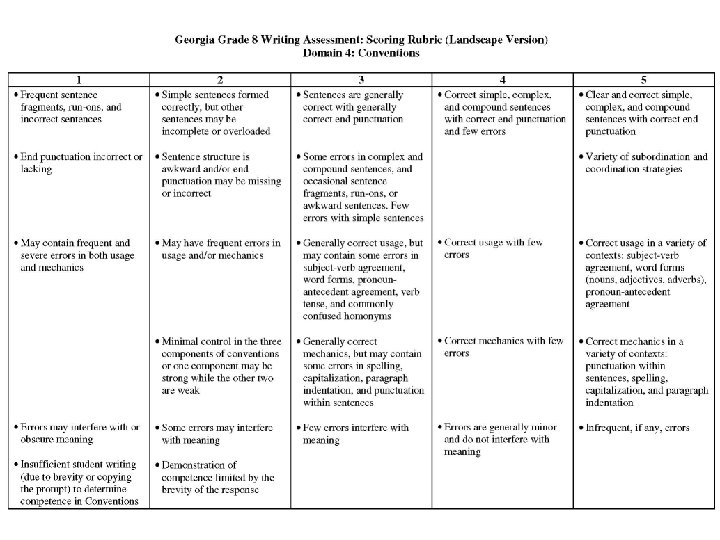
Conventions Landscape Rubrics 20
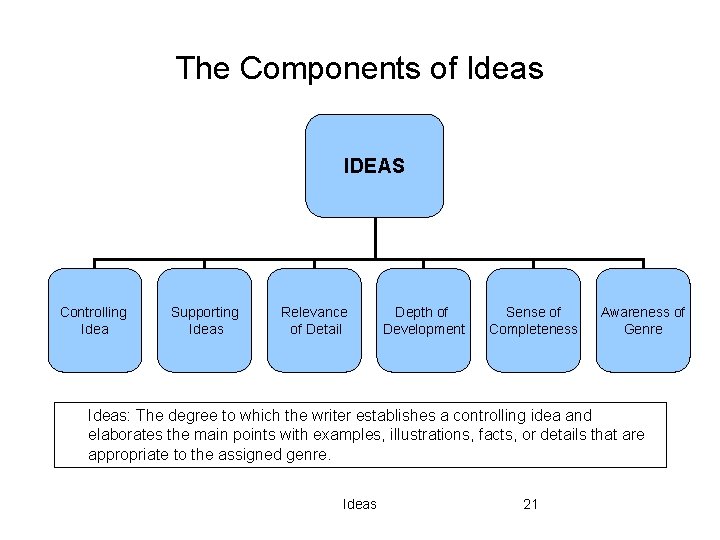
The Components of Ideas IDEAS Controlling Idea Supporting Ideas Relevance of Detail Depth of Development Sense of Completeness Awareness of Genre Ideas: The degree to which the writer establishes a controlling idea and elaborates the main points with examples, illustrations, facts, or details that are appropriate to the assigned genre. Ideas 21
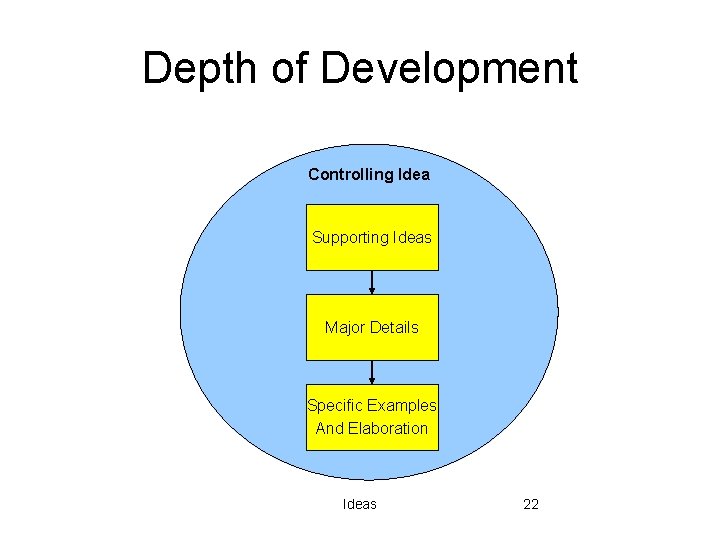
Depth of Development Controlling Idea Supporting Ideas Major Details Specific Examples And Elaboration Ideas 22
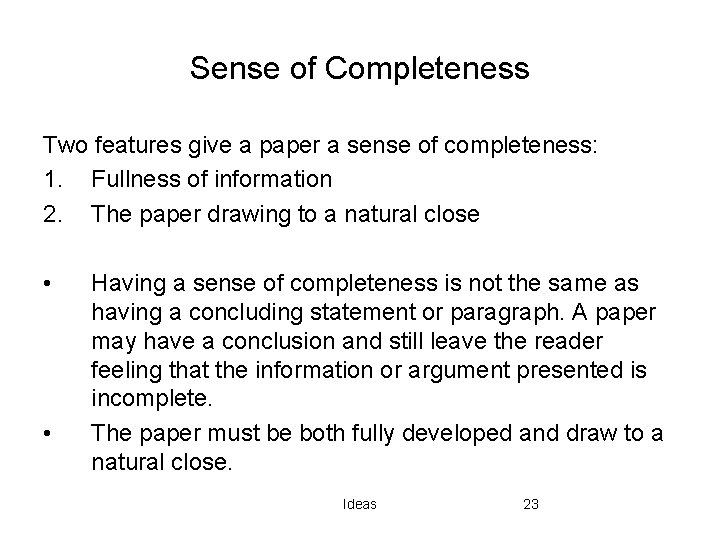
Sense of Completeness Two features give a paper a sense of completeness: 1. Fullness of information 2. The paper drawing to a natural close • • Having a sense of completeness is not the same as having a concluding statement or paragraph. A paper may have a conclusion and still leave the reader feeling that the information or argument presented is incomplete. The paper must be both fully developed and draw to a natural close. Ideas 23
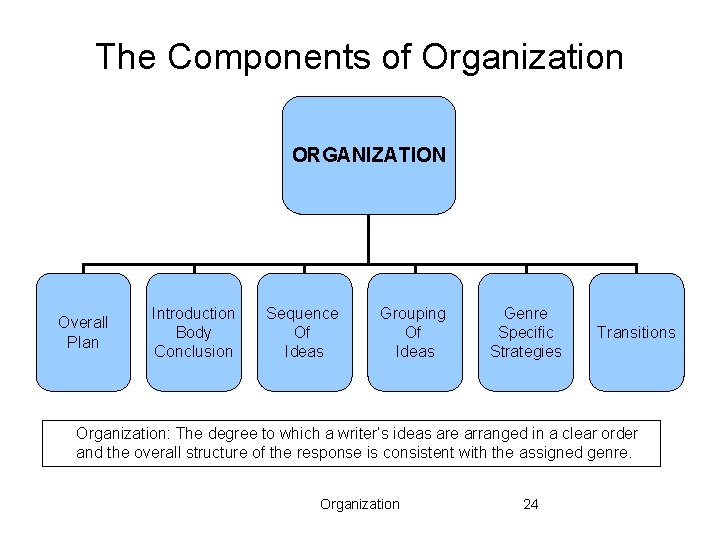
The Components of Organization ORGANIZATION Overall Plan Introduction Body Conclusion Sequence Of Ideas Grouping Of Ideas Genre Specific Strategies Transitions Organization: The degree to which a writer’s ideas are arranged in a clear order and the overall structure of the response is consistent with the assigned genre. Organization 24
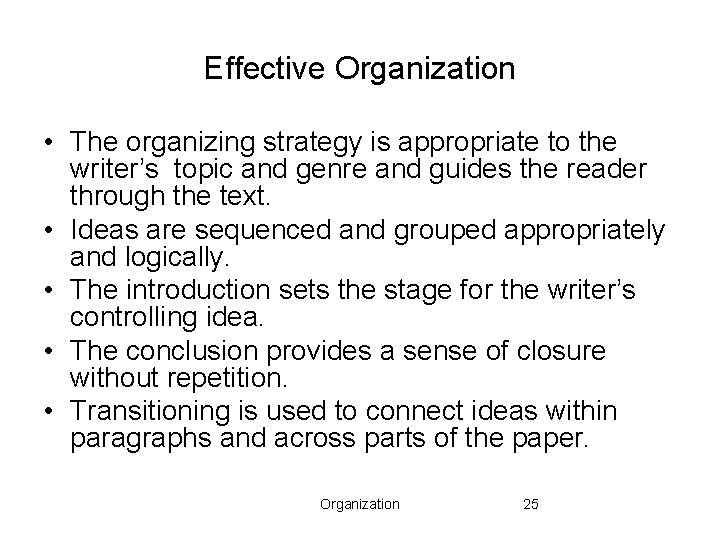
Effective Organization • The organizing strategy is appropriate to the writer’s topic and genre and guides the reader through the text. • Ideas are sequenced and grouped appropriately and logically. • The introduction sets the stage for the writer’s controlling idea. • The conclusion provides a sense of closure without repetition. • Transitioning is used to connect ideas within paragraphs and across parts of the paper. Organization 25
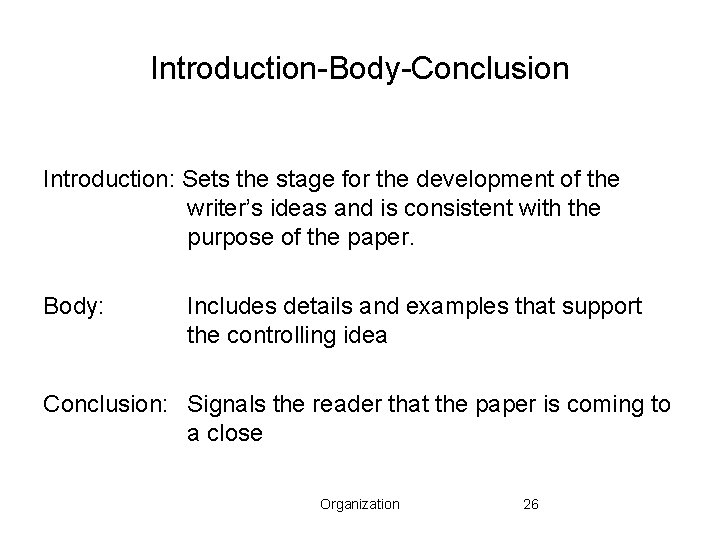
Introduction-Body-Conclusion Introduction: Sets the stage for the development of the writer’s ideas and is consistent with the purpose of the paper. Body: Includes details and examples that support the controlling idea Conclusion: Signals the reader that the paper is coming to a close Organization 26
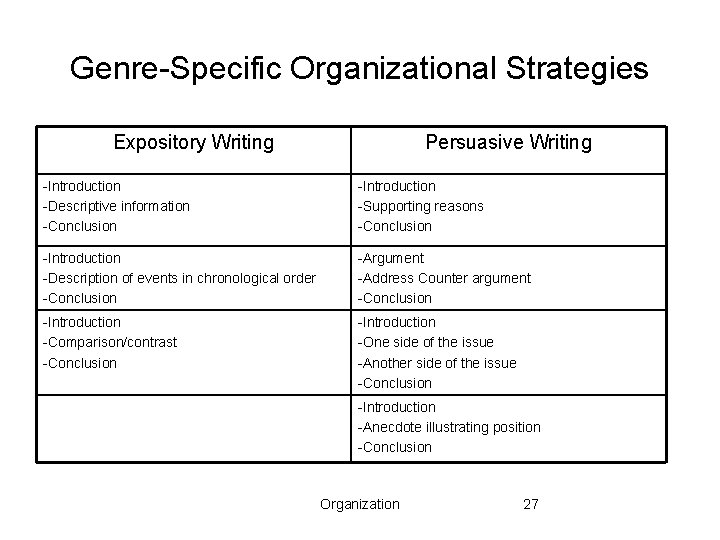
Genre-Specific Organizational Strategies Expository Writing Persuasive Writing -Introduction -Descriptive information -Conclusion -Introduction -Supporting reasons -Conclusion -Introduction -Description of events in chronological order -Conclusion -Argument -Address Counter argument -Conclusion -Introduction -Comparison/contrast -Conclusion -Introduction -One side of the issue -Another side of the issue -Conclusion -Introduction -Anecdote illustrating position -Conclusion Organization 27
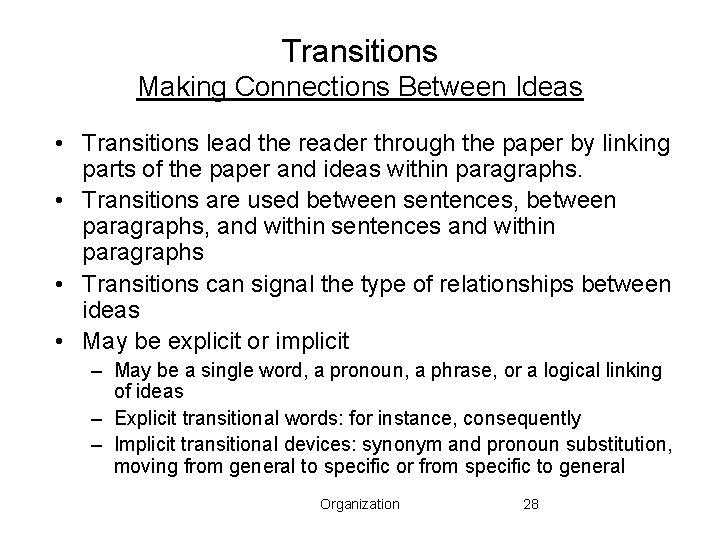
Transitions Making Connections Between Ideas • Transitions lead the reader through the paper by linking parts of the paper and ideas within paragraphs. • Transitions are used between sentences, between paragraphs, and within sentences and within paragraphs • Transitions can signal the type of relationships between ideas • May be explicit or implicit – May be a single word, a pronoun, a phrase, or a logical linking of ideas – Explicit transitional words: for instance, consequently – Implicit transitional devices: synonym and pronoun substitution, moving from general to specific or from specific to general Organization 28
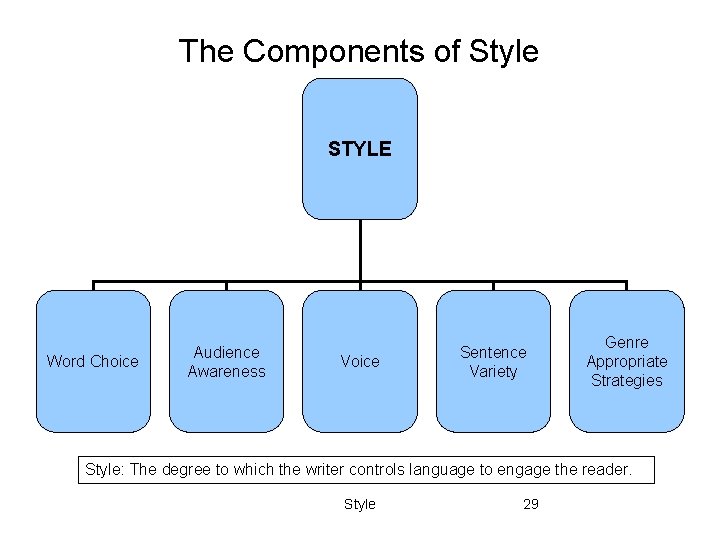
The Components of Style STYLE Word Choice Audience Awareness Voice Sentence Variety Genre Appropriate Strategies Style: The degree to which the writer controls language to engage the reader. Style 29
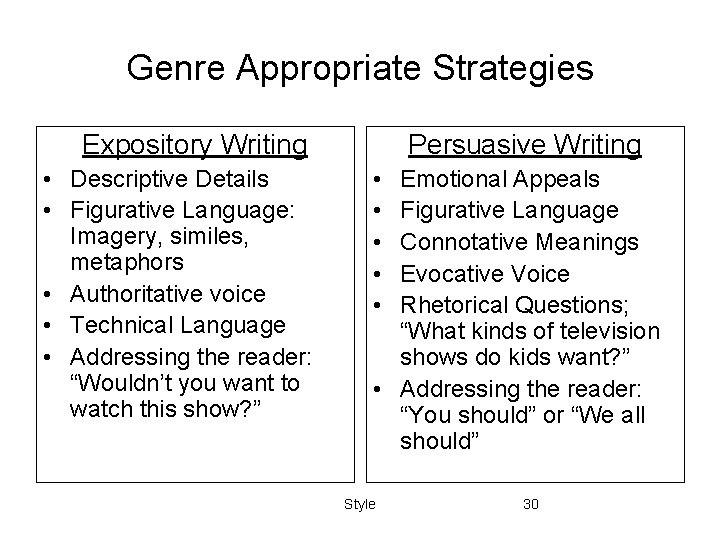
Genre Appropriate Strategies Expository Writing • Descriptive Details • Figurative Language: Imagery, similes, metaphors • Authoritative voice • Technical Language • Addressing the reader: “Wouldn’t you want to watch this show? ” Persuasive Writing • • • Emotional Appeals Figurative Language Connotative Meanings Evocative Voice Rhetorical Questions; “What kinds of television shows do kids want? ” • Addressing the reader: “You should” or “We all should” Style 30
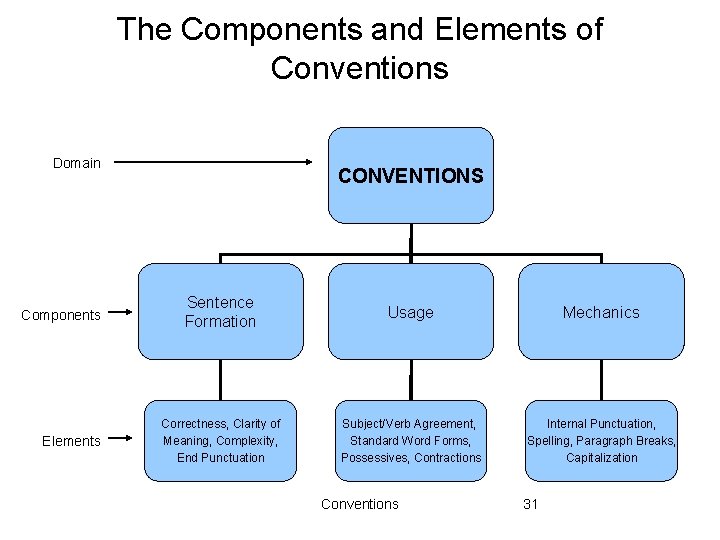
The Components and Elements of Conventions Domain Components Elements CONVENTIONS Sentence Formation Usage Mechanics Correctness, Clarity of Meaning, Complexity, End Punctuation Subject/Verb Agreement, Standard Word Forms, Possessives, Contractions Internal Punctuation, Spelling, Paragraph Breaks, Capitalization Conventions 31
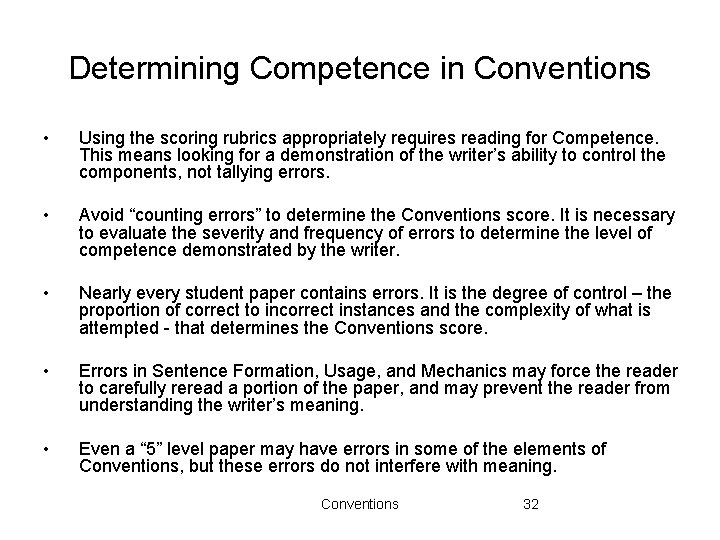
Determining Competence in Conventions • Using the scoring rubrics appropriately requires reading for Competence. This means looking for a demonstration of the writer’s ability to control the components, not tallying errors. • Avoid “counting errors” to determine the Conventions score. It is necessary to evaluate the severity and frequency of errors to determine the level of competence demonstrated by the writer. • Nearly every student paper contains errors. It is the degree of control – the proportion of correct to incorrect instances and the complexity of what is attempted - that determines the Conventions score. • Errors in Sentence Formation, Usage, and Mechanics may force the reader to carefully reread a portion of the paper, and may prevent the reader from understanding the writer’s meaning. • Even a “ 5” level paper may have errors in some of the elements of Conventions, but these errors do not interfere with meaning. Conventions 32