
Georgia Drug Overdose Prescribing Surveillance Laura Edison DVM
Georgia Drug Overdose & Prescribing Surveillance Laura Edison DVM, MPH, CDC Career Epidemiology Field Officer GEORGIA DEPARTME NT OF PUBLIC HE ALTH
DPH Comprehensive Opioid and Substance Use Program • Started in 2016 with 3 CDC grants • Now supported by the Overdose Data to Action (OD 2 A) CDC grant, which will combine surveillance and prevention • 3 Program areas • Epidemiology and surveillance (Drug Surveillance Unit) • Prescription Drug Monitoring Program (PDMP) • Statewide strategic Planning https: //dph. georgia. gov/stopopioidaddiction GEORGIA DEPARTME NT OF PUBLIC HE ALTH
Drug Surveillance Unit • Team of epidemiologists, biostatisticians, and information technologists • Goals • • • Identify and respond to overdose clusters Produce data reports Fulfill data requests Facilitate data access Create visual displays Website: https: //dph. georgia. gov/drug-surveillance-unit GEORGIA DEPARTME NT OF PUBLIC HE ALTH
Opioid Overdose Surveillance • How do we determine the scope of the problem in Georgia? • Surveillance is essential to any public health prevention or containment strategy • Surveillance is hard to do! • How do you know how many people are at risk of addiction, overdose, death? Many limitations to every data source! • Use available data to describe the epidemic and detect clusters and hotspots • Inform partners to direct prevention, treatment, enforcement, and policy decisions • Work to improve our data GEORGIA DEPARTME NT OF PUBLIC HE ALTH
Current Surveillance Data Sources • Hospital and Emergency Department (ED) discharge data • Syndromic surveillance • Prescription Drug Monitoring Program (PDMP) • Death certificates, Coroner/Medical Examiner & toxicology reports • GBI Drug seizure data • Emergency Medical Services (EMS) reports • Neonatal Abstinence Syndrome reports (dph. ga. gov/nas) • Overdose Detection Mapping Application Program (ODMAP) • Behavioral surveys GEORGIA DEPARTME NT OF PUBLIC HE ALTH
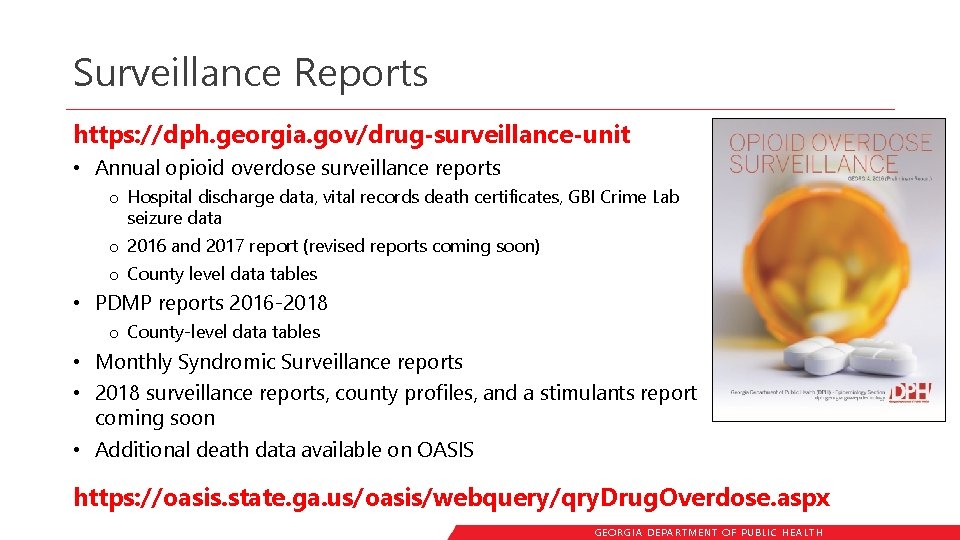
Surveillance Reports https: //dph. georgia. gov/drug-surveillance-unit • Annual opioid overdose surveillance reports o Hospital discharge data, vital records death certificates, GBI Crime Lab seizure data o 2016 and 2017 report (revised reports coming soon) o County level data tables • PDMP reports 2016 -2018 o County-level data tables • Monthly Syndromic Surveillance reports • 2018 surveillance reports, county profiles, and a stimulants report coming soon • Additional death data available on OASIS https: //oasis. state. ga. us/oasis/webquery/qry. Drug. Overdose. aspx GEORGIA DEPARTME NT OF PUBLIC HE ALTH
Opioid-Involved Overdoses in Georgia GEORGIA DEPARTME NT OF PUBLIC HE ALTH
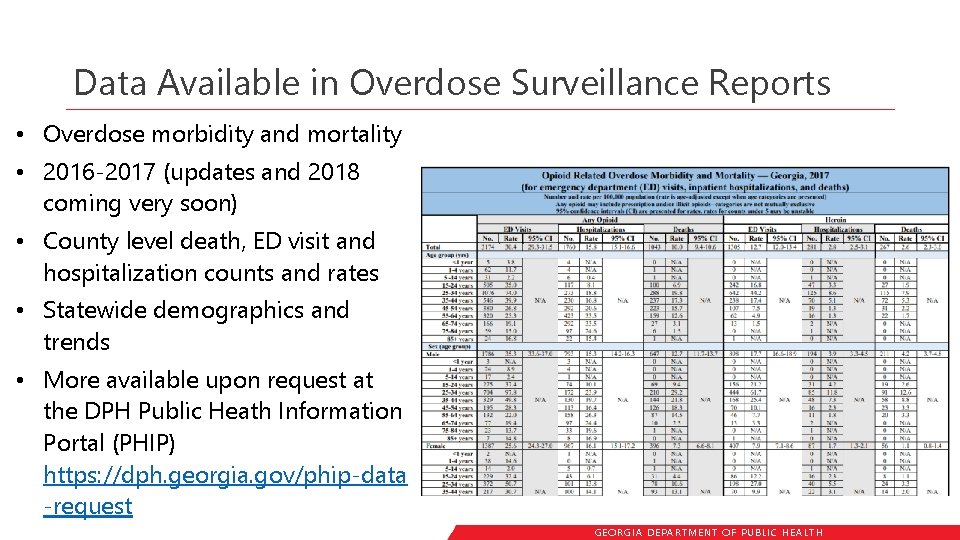
Data Available in Overdose Surveillance Reports • Overdose morbidity and mortality • 2016 -2017 (updates and 2018 coming very soon) • County level death, ED visit and hospitalization counts and rates • Statewide demographics and trends • More available upon request at the DPH Public Heath Information Portal (PHIP) https: //dph. georgia. gov/phip-data -request GEORGIA DEPARTME NT OF PUBLIC HE ALTH
Understanding Case Definitions • Use ICD codes and sometimes text to identify drug overdoses by drug type • Some case definitions overlap, drug categories are NOT mutually exclusive • Geographic data may mean different things • Place of residence vs. place of injury (overdose) • ED visits or hospitalizations occurring in GA vs. among GA residents • ED visits may also be represented in the hospitalization data (in updated reports) • Etc. KNOW YOUR DATA AND WHAT IT REALLY REPRESENTS! GEORGIA DEPARTME NT OF PUBLIC HE ALTH
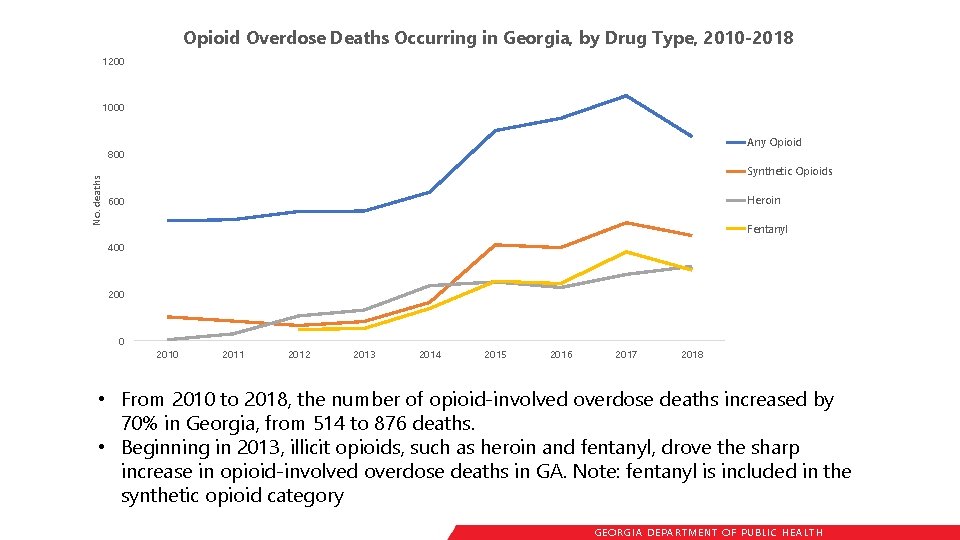
Opioid Overdose Deaths Occurring in Georgia, by Drug Type, 2010 -2018 1200 1000 Any Opioid No. deaths 800 Synthetic Opioids Heroin 600 Fentanyl 400 200 0 2011 2012 2013 2014 2015 2016 2017 2018 • From 2010 to 2018, the number of opioid-involved overdose deaths increased by 70% in Georgia, from 514 to 876 deaths. • Beginning in 2013, illicit opioids, such as heroin and fentanyl, drove the sharp increase in opioid-involved overdose deaths in GA. Note: fentanyl is included in the synthetic opioid category GEORGIA DEPARTME NT OF PUBLIC HE ALTH
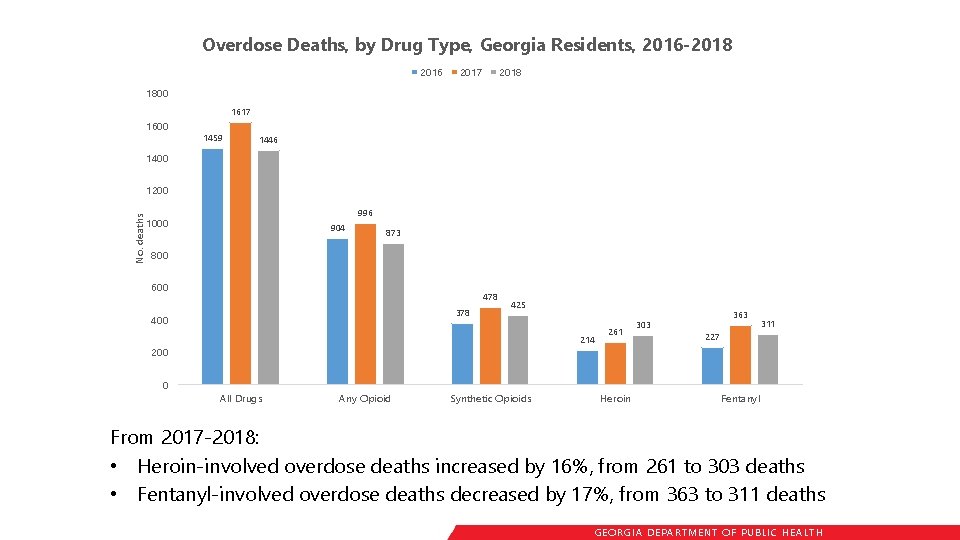
Overdose Deaths, by Drug Type, Georgia Residents, 2016 -2018 2016 2017 2018 1800 1617 1600 1459 1446 1400 No. deaths 1200 996 1000 904 873 800 600 478 378 400 425 214 261 363 303 311 227 200 0 All Drugs Any Opioid Synthetic Opioids Heroin Fentanyl From 2017 -2018: • Heroin-involved overdose deaths increased by 16%, from 261 to 303 deaths • Fentanyl-involved overdose deaths decreased by 17%, from 363 to 311 deaths GEORGIA DEPARTME NT OF PUBLIC HE ALTH
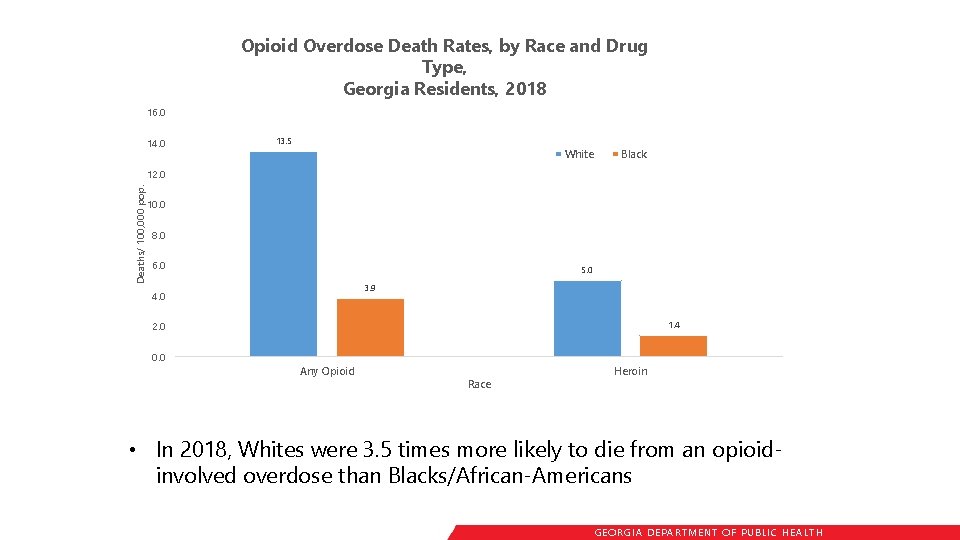
Opioid Overdose Death Rates, by Race and Drug Type, Georgia Residents, 2018 16. 0 14. 0 13. 5 White Black Deaths/ 100, 000 pop. 12. 0 10. 0 8. 0 6. 0 5. 0 3. 9 4. 0 1. 4 2. 0 0. 0 Any Opioid Race Heroin • In 2018, Whites were 3. 5 times more likely to die from an opioidinvolved overdose than Blacks/African-Americans GEORGIA DEPARTME NT OF PUBLIC HE ALTH
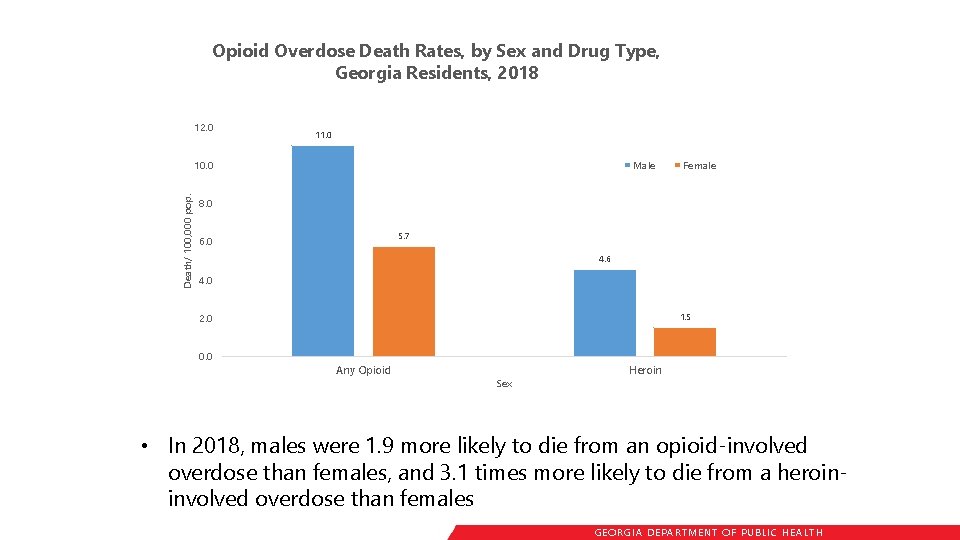
Opioid Overdose Death Rates, by Sex and Drug Type, Georgia Residents, 2018 12. 0 11. 0 Death/ 100, 000 pop. 10. 0 Male Female 8. 0 5. 7 6. 0 4. 6 4. 0 2. 0 0. 0 1. 5 Any Opioid Sex Heroin • In 2018, males were 1. 9 more likely to die from an opioid-involved overdose than females, and 3. 1 times more likely to die from a heroininvolved overdose than females GEORGIA DEPARTME NT OF PUBLIC HE ALTH
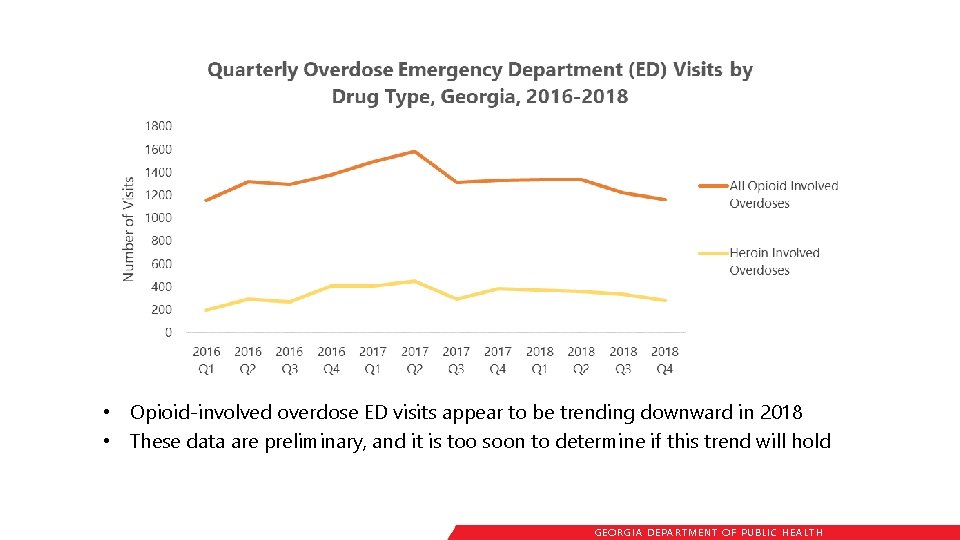
• Opioid-involved overdose ED visits appear to be trending downward in 2018 • These data are preliminary, and it is too soon to determine if this trend will hold GEORGIA DEPARTME NT OF PUBLIC HE ALTH
State Unintentional Drug Overdose Reporting System (SUDORS) • Uses information from Death Certificates, Coroner/Medical Examiner reports, EMS and Law Enforcement reports to provide a complete picture of opioid-involved overdose deaths in Georgia • Information can be used to characterize opioid overdose deaths in Georgia, and Inform, develop, and guide overdose prevention programs • Mixed Coroner/Medical Examiner (C/ME) system in GA • Death certificate data obtained from vital records for import into NVDRS • Investigation summary, autopsy, and toxicology reports requested from 5 different ME entities (Cobb, Dekalb, Fulton, Gwinnett, GBI) • EMS and PDMP records pulled manually • Data abstracted into a CDC database The first SUDORS report is coming soon! GEORGIA DEPARTME NT OF PUBLIC HE ALTH
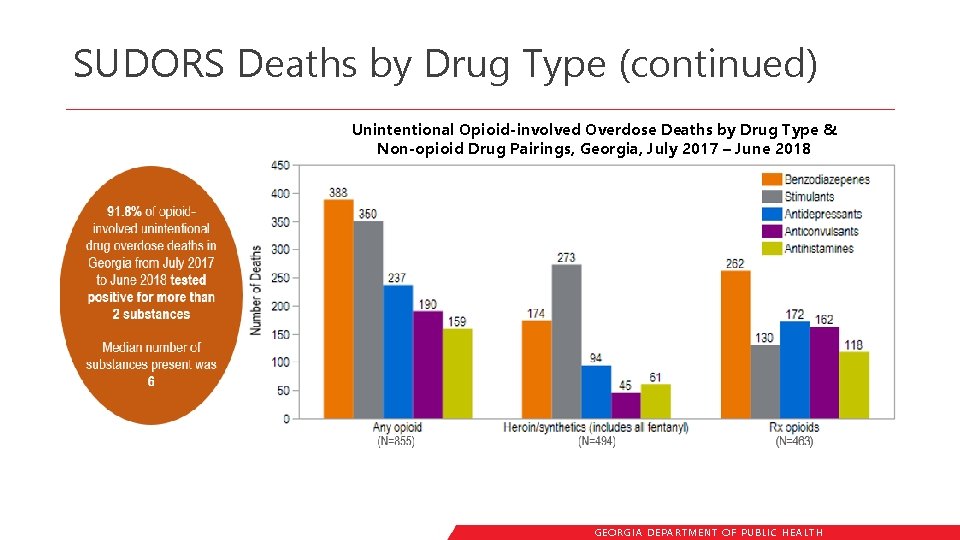
SUDORS Deaths by Drug Type (continued) Unintentional Opioid-involved Overdose Deaths by Drug Type & Non-opioid Drug Pairings, Georgia, July 2017 – June 2018 GEORGIA DEPARTME NT OF PUBLIC HE ALTH
Prescription Drug Monitoring Program Database of all dispensed schedule II-V controlled substances PDMPs are in all states with some data sharing between states Purpose of PDMP • Reduce abuse of controlled substances • Ensure legitimate use of controlled substances • Reduce duplicative prescribing and overprescribing Georgia dispensers are required to submit information for dispensed substance within 24 hours All Prescribers (except veterinarians) are required to register in PDMP Prescribers are required to check PDMP prior to prescribing schedule II opioids or cocaine derivatives, or benzodiazepines as of July 2018 GEORGIA DEPARTME NT OF PUBLIC HE ALTH
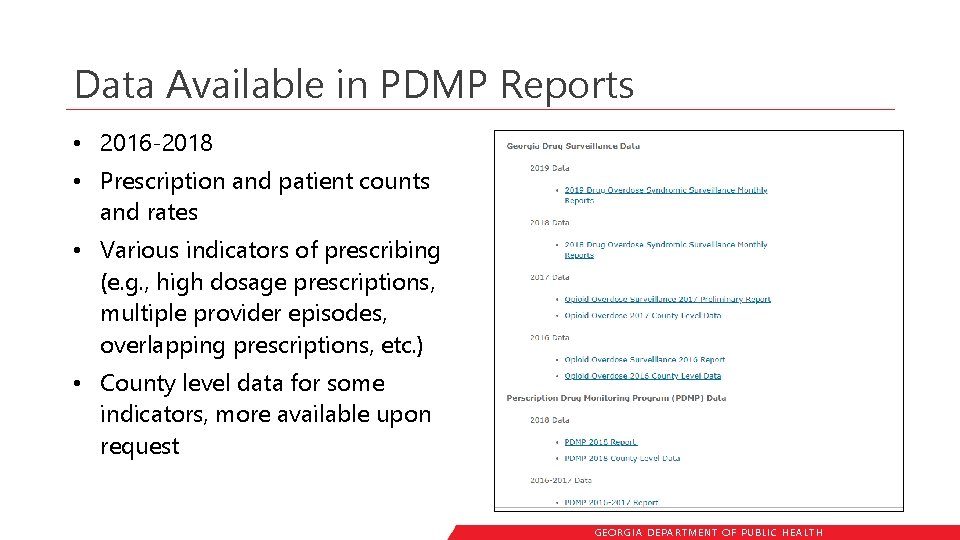
Data Available in PDMP Reports • 2016 -2018 • Prescription and patient counts and rates • Various indicators of prescribing (e. g. , high dosage prescriptions, multiple provider episodes, overlapping prescriptions, etc. ) • County level data for some indicators, more available upon request GEORGIA DEPARTME NT OF PUBLIC HE ALTH
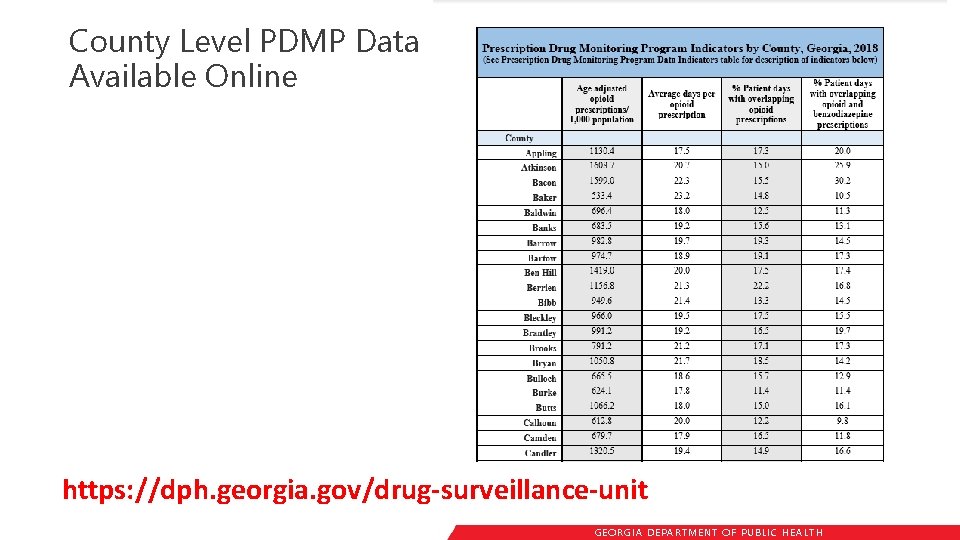
County Level PDMP Data Available Online https: //dph. georgia. gov/drug-surveillance-unit GEORGIA DEPARTME NT OF PUBLIC HE ALTH
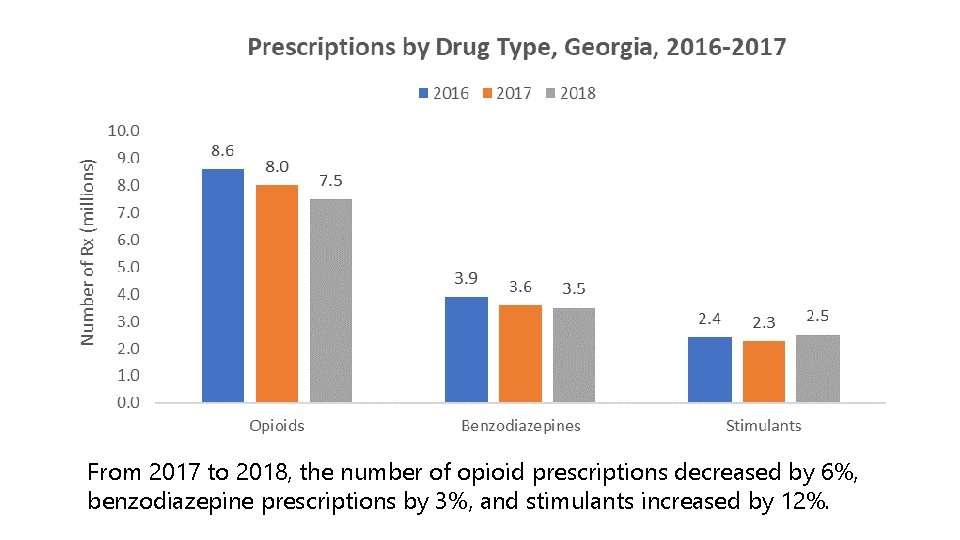
From 2017 to 2018, the number of opioid prescriptions decreased by 6%, benzodiazepine prescriptions by 3%, and stimulants increased by 12%.
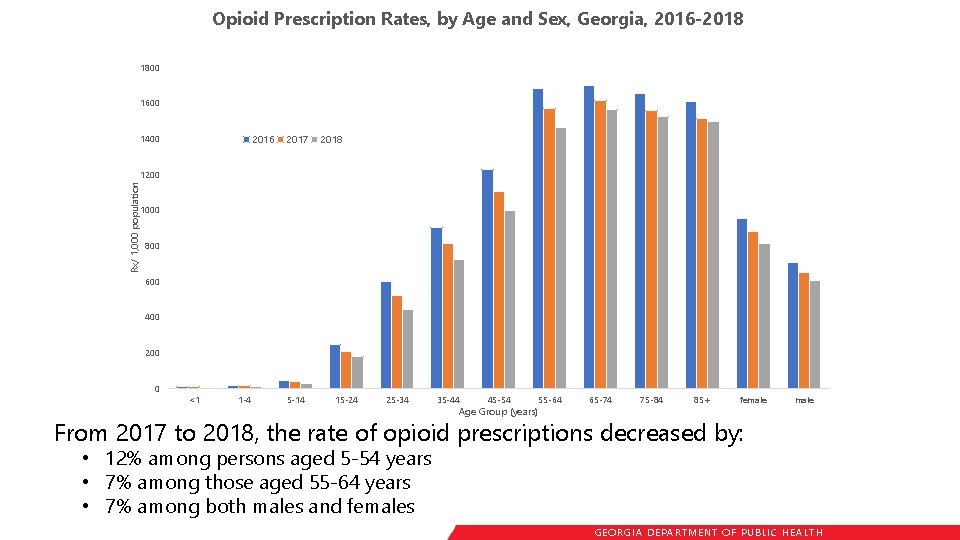
Opioid Prescription Rates, by Age and Sex, Georgia, 2016 -2018 1800 1600 2016 1400 2017 2018 Rx/ 1, 000 population 1200 1000 800 600 400 200 0 <1 1 -4 5 -14 15 -24 25 -34 35 -44 45 -54 Age Group (years) 55 -64 65 -74 75 -84 85+ female From 2017 to 2018, the rate of opioid prescriptions decreased by: • 12% among persons aged 5 -54 years • 7% among those aged 55 -64 years • 7% among both males and females GEORGIA DEPARTME NT OF PUBLIC HE ALTH
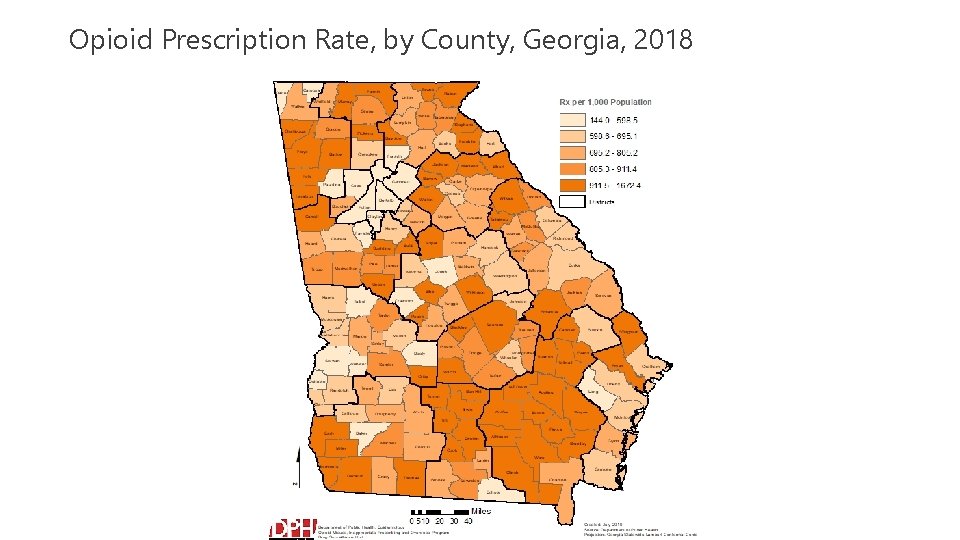
Opioid Prescription Rate, by County, Georgia, 2018

DATA IMPROVEMENT & NEXT STEPS GEORGIA DEPARTME NT OF PUBLIC HE ALTH
Data Improvement Project: Coroner Database • Developing a database in Send. SS for coroners to document death investigations • Web-based • Free to use for all coroners, but getting them to use it may be difficult • Decrease duplicative reporting for coroners and improve data access • Will interface into GAVERS to electronically start death certificate • SUDORS and NVDRS teams will have access to all data as soon as it is entered • Will enable easy report generation for other stakeholders • Will be ready to pilot at the end of 2019 • Training of all coroners will begin in 2020 GEORGIA DEPARTME NT OF PUBLIC HE ALTH
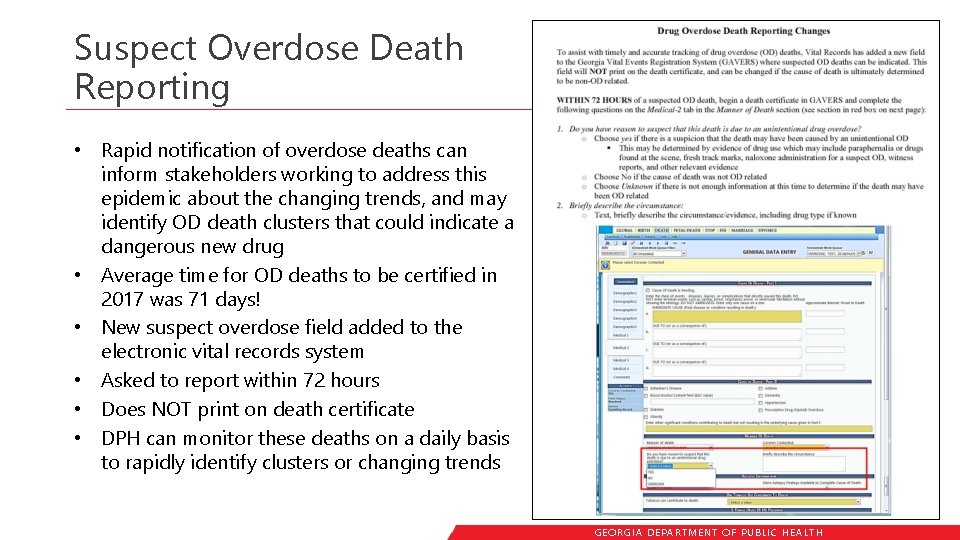
Suspect Overdose Death Reporting • Rapid notification of overdose deaths can inform stakeholders working to address this epidemic about the changing trends, and may identify OD death clusters that could indicate a dangerous new drug • Average time for OD deaths to be certified in 2017 was 71 days! • New suspect overdose field added to the electronic vital records system • Asked to report within 72 hours • Does NOT print on death certificate • DPH can monitor these deaths on a daily basis to rapidly identify clusters or changing trends GEORGIA DEPARTME NT OF PUBLIC HE ALTH
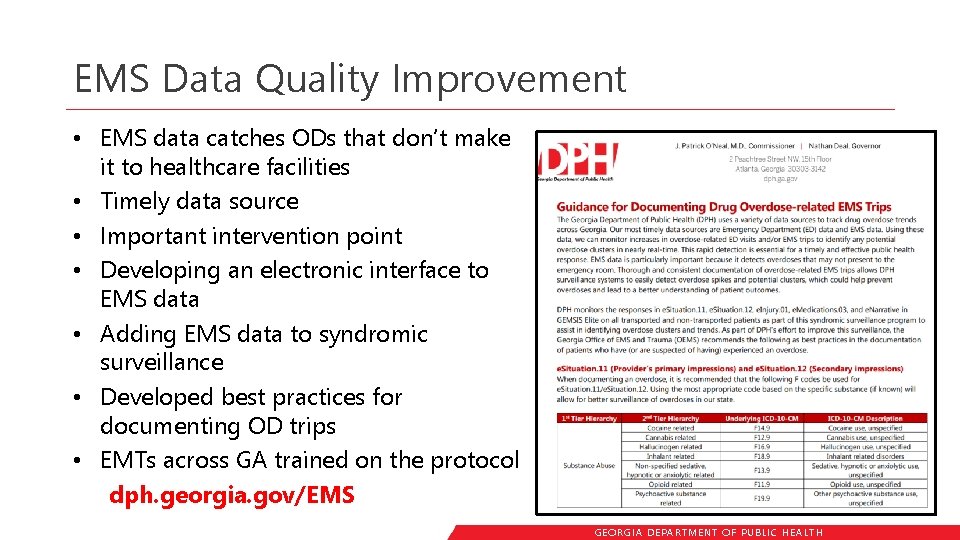
EMS Data Quality Improvement • EMS data catches ODs that don’t make it to healthcare facilities • Timely data source • Important intervention point • Developing an electronic interface to EMS data • Adding EMS data to syndromic surveillance • Developed best practices for documenting OD trips • EMTs across GA trained on the protocol dph. georgia. gov/EMS GEORGIA DEPARTME NT OF PUBLIC HE ALTH
Other Projects • Matching data sources for predictive analyses (e. g. , death and PDMP data) • Data needs assessment and data inventory • Data repository and data visualization tools in Send. SS for improved data access and analyses • Public facing data dashboard • Rural/urban analyses, spatial analyses to look beyond county boundaries • Stimulants report coming soon • Funding Medical Examiners to do enhanced opioid toxicology testing GEORGIA DEPARTME NT OF PUBLIC HE ALTH
How You Can Use the Data Determine the burden and population affected in your district/ counties Evaluate programs Share data with stakeholders to raise awareness, etc. County level profiles, additional reports, and a data dashboard coming soon! • If the data you need is not available on our website: https: //dph. georgia. gov/drug-surveillance-unit, you can submit a data request through PHIP: https: //dph. georgia. gov/phipdata-request • • Know the data! Understand the limitations, case definitions, and what it really represents! GEORGIA DEPARTME NT OF PUBLIC HE ALTH
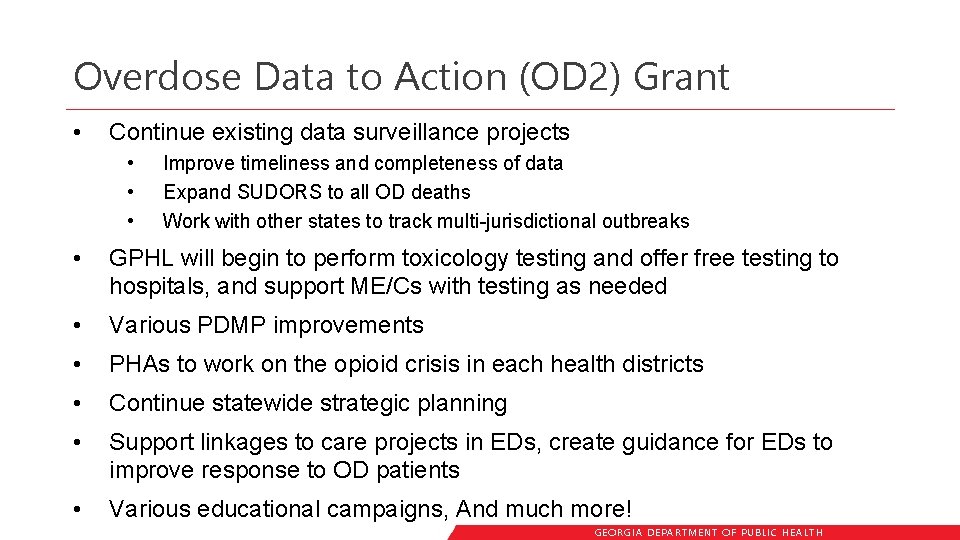
Overdose Data to Action (OD 2) Grant • Continue existing data surveillance projects • • • Improve timeliness and completeness of data Expand SUDORS to all OD deaths Work with other states to track multi-jurisdictional outbreaks • GPHL will begin to perform toxicology testing and offer free testing to hospitals, and support ME/Cs with testing as needed • Various PDMP improvements • PHAs to work on the opioid crisis in each health districts • Continue statewide strategic planning • Support linkages to care projects in EDs, create guidance for EDs to improve response to OD patients • Various educational campaigns, And much more! GEORGIA DEPARTME NT OF PUBLIC HE ALTH
THANK YOU! Laura Edison, DVM, MPH CDC Career Epidemiology Field Officer Georgia Department of Public Health Phone: 404 -657 -6542 Email: laura. edison@dph. ga. gov GEORGIA DEPARTME NT OF PUBLIC HE ALTH
- Slides: 31