
GEORGIA DEPARTMENT OF BEHAVIORAL HEALTH AND DISABILITIES COMMUNITY
GEORGIA DEPARTMENT OF BEHAVIORAL HEALTH AND DISABILITIES COMMUNITY PREVENTION ALLIANCE WORKGROUPS COMMUNITY MOBILIZATION TRAINING August 2012 Peachtree City, GA Maxine Fuller Facilitator
MODULE 1: INTRODUCTION TO THE WORKSHOP § Workshop Purpose and Learning Objectives § Participant Experience Exercise § Workshop Agenda 2
Workshop Purpose To enhance the capacity of the Community Prevention Alliance Workgroups to mobilize diverse communities to prevent the onset and impact of alcohol abuse and misuse. 3
Learning Objectives § Identify the importance, benefits, and challenges of community mobilization. § Describe a six-step model of community mobilization. § Conduct a community assessment and determine organizational readiness § Define effective strategies for planning, implementing, sustaining, and evaluating community prevention initiatives. § Understand how to use effective presentations to mobilize diverse community resources and volunteers. § Network and share knowledge, skills, and experiences 4
Participant Experiences § What experiences have you had mobilizing communities to address alcohol use and abuse or other social issues? § What made those experiences successful? § What was challenging about those experiences? 5
Workshop Agenda § Introduction to the Workshop § Overview of Community Mobilization § Assessing Readiness and Resources § Outreach and Commitment § Implementation, Sustainability, and Evaluation § Closing Activities 6
MODULE 2: OVERVIEW OF COMMUNITY MOBILIZATION § Community Mobilization § Elements of Community Mobilization § Benefits and Challenges of Community Mobilization § A 6 -Step Community Mobilization Model 7
Community People living together with common interests that bind them together, including: Ø Beliefs Ø Religion Ø Values Ø Culture Ø Traditions Ø Occupation Ø Language Ø Geography Ø Race 8
Community Mobilization A capacity building process through which community members, groups, and organizations plan, implement, and evaluate sustainable programs and activities in a participatory manner to achieve an agreed upon goal. 9
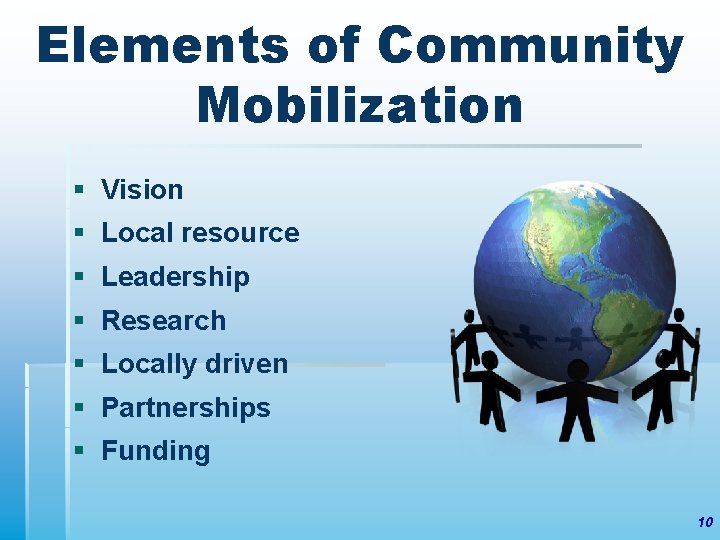
Elements of Community Mobilization § Vision § Local resource § Leadership § Research § Locally driven § Partnerships § Funding 10
Benefits of Community Mobilization v Awareness and support. v New volunteers v Change and transformation v Public pressure to change v New energy v Opportunities to partner v Effective change strategies v New leaders v Sustainability and long-term commitment v Positive change v Community ownership 11
Challenges of Community Mobilization Tension about power and authority Backlash Non existent leadership skills Personal commitment Hidden issues and institutional biases Less important Status-quo mindset Skills training Target population Requires resources 12

6 -Step Community Mobilization Model Step 1: Assessing Organizational Readiness Step 2: Identifying Community Resources Step 3: Researching Potential Partners Step 4: Promoting and Agreeing Step 5: Planning, Implementation, and Sustainability Step 6: Monitoring and Evaluating 13
MODULE 3: ASSESSING READINESS AND RESOURCS Step 1: Organizational Readiness § Prevention Infrastructure Assessment Step 2: Identifying Community Resources § Identifying Community Policies and Practices § Assessing Community Programs 14
Step 1: Organizational Readiness § Organizations need to assess their policies, processes and structure as indicated by a clearly defined mission, goals and values, stability of leadership, and strengths/ weaknesses. § Most effective and far-reaching partnerships engage various levels of the organization in substantive activities. § Staff must possess skills to support the organization’s mission and goals 15
Step 1: Organizational Readiness Activities and Skill Requirements Activities: § Conduct an organizational assessment (i. e. , participant's organization) § Conduct a context assessment (opportunities/threats in the environment; history of partnering, etc. ) § Define partnering expectations (what do you want or expect to gain from partnering) § Assess partnering skills § Establish a clear direction Skills: § Planning and aspects of strategic planning § Research and Analysis § Self-assessment 16
Prevention Infrastructure Assessment Exercise Work in CPAW teams Answer questions about your organization’s: Human Resources Structure & Processes Technical Resources Cultural Competency Fiscal Resources Material Resources Gaps Record responses 15 Minutes to complete the exercise 17
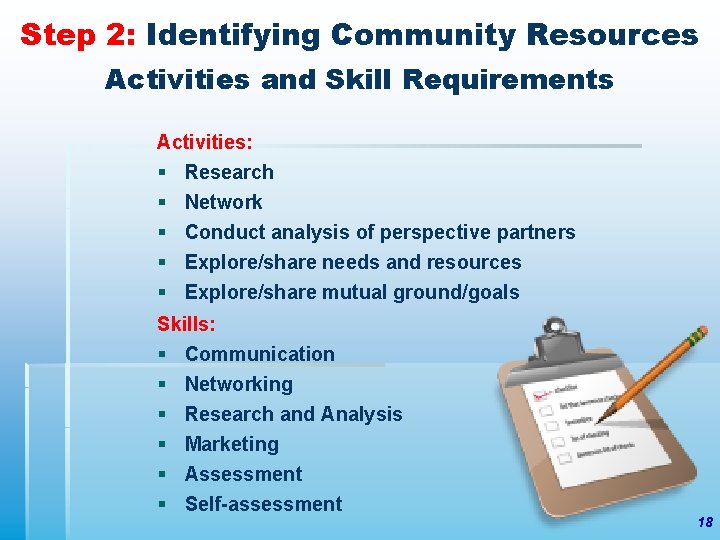
Step 2: Identifying Community Resources Activities and Skill Requirements Activities: § Research § § Network Conduct analysis of perspective partners Explore/share needs and resources Explore/share mutual ground/goals Skills: § Communication § § § Networking Research and Analysis Marketing Assessment Self-assessment 18
Community Policies and Practices Exercise § Work in CPAW Teams § Identify policies and procedures that address one or all of the State’s priorities § Explain local cultural adaptations § Identify gaps § Identify other issues and barriers § 10 -15 minutes to complete exercise 19
Community Programs Exercise § Work in CPAW Teams § Identify programs that address the State’s priorities § Identify local cultural adaptations § Identify gaps § Identify other issues and barriers § 10 -15 minutes to complete the exercise 20
MODULE 4: OUTREACH & COMMITMENT Step 3: Research Potential Partners §Current Partner Review Exercise §Prospective Partner Identification Exercise Step 4: Promotion and Agreement §Presentations §Presenter’s Skills §Role-Play Presentation Exercise 21
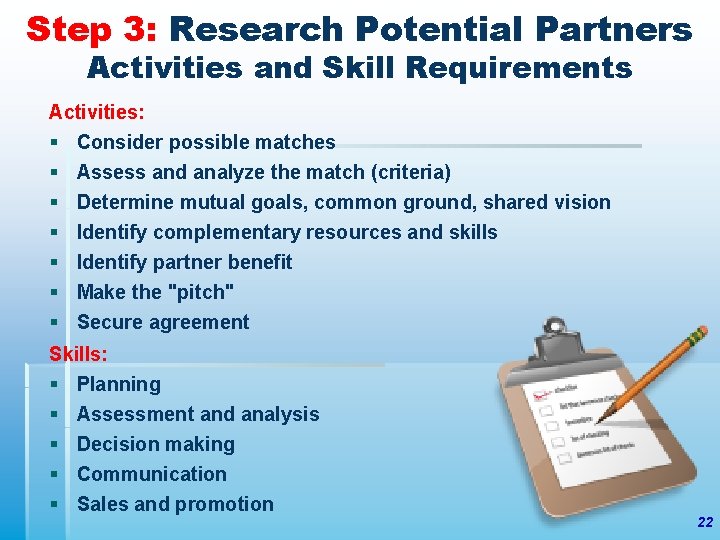
Step 3: Research Potential Partners Activities and Skill Requirements Activities: § Consider possible matches § § § Assess and analyze the match (criteria) Determine mutual goals, common ground, shared vision Identify complementary resources and skills Identify partner benefit Make the "pitch" Secure agreement Skills: § Planning § Assessment and analysis § Decision making § Communication § Sales and promotion 22
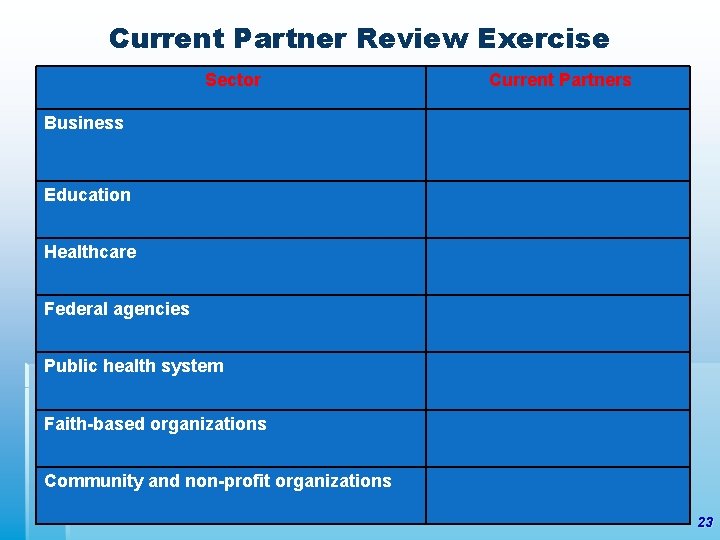
Current Partner Review Exercise Sector Current Partners Business Education Healthcare Federal agencies Public health system Faith-based organizations Community and non-profit organizations 23
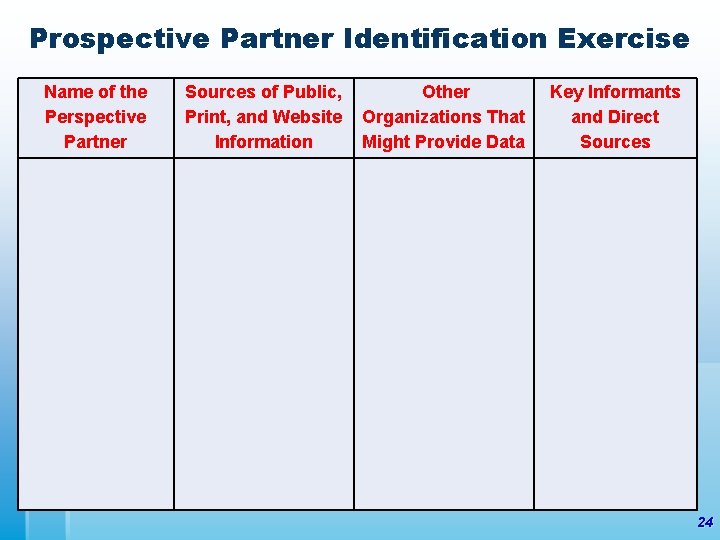
Prospective Partner Identification Exercise Name of the Perspective Partner Sources of Public, Print, and Website Information Other Organizations That Might Provide Data Key Informants and Direct Sources 24
Step 4: Promotion & Agreement Purpose of Presentation Audience Analysis o. Stimulate o. Size of group o. Inform o. Age/Sex o. Persuade o. Education/Occupation o. Activate o. Cultural and ethnic occupation o. Attitudes/Values o. Past reactions to topic o. Audience challenges o. Reason for attending 25
Presentation Openers Ø Unusual fact Ø Visual aids Ø Personal experience Ø Reference to a current events Ø Quotation Ø Citing of an authority Ø Anecdote Ø Rhetorical question Ø Story Ø Unusual definition Ø Relevant joke 26
The Presentation The Body of the Presentation Identify main points Organize main points Make point, support it, restate it The Presentation Closing Presentation Closers 27
Presentation Logistics Checklist § Seating § Room size § Room temperature § Equipment § Presenter/audience materials § Protocol § Other 28
Platform Skills The Verbal Element § Eliminate weak words/phrases § Replace non-words with pauses § Use vivid language § Use simple and direct language § Be natural § Emphasize beginning and ending 29
Platform Skills The Vocal Element § Volume § Pitch and inflection § Pace and rhythm § Emphasis § Pauses § Loosening up § Clarity of speech § Breath control 30
Platform Skills The Visual Element § Posture § Movement § Eye contact § Hand gestures § Facial expression § Power. Point slides § Easel pad § Videos/DVDs § Handout materials § Props 31
Presentation Exercise Read assigned case study Prepare presentation 20 -30 minutes to prepare 5 -minute presentation Criteria: o At least one visual aid o Only workshop facilitator provides feedback o Participants will be the audience 32
MODULE 5: PLANNING, IMPLEMENTATION, SUSTAINABILITY, AND EVALUATION Step 5: Planning, Implementation, and Sustainability • Planning Activities • Planning Skills • Implementation Activities • Implementation Skills Step 6: Monitoring & Evaluation • Activities • Skills Action Planning 33
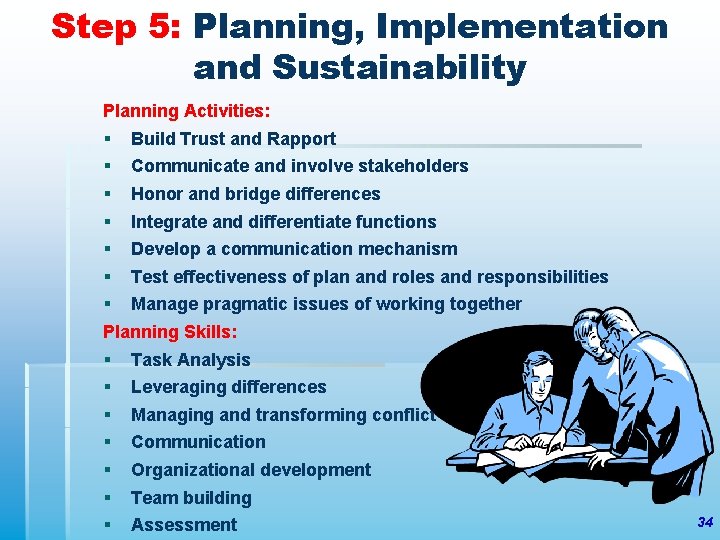
Step 5: Planning, Implementation and Sustainability Planning Activities: § Build Trust and Rapport § Communicate and involve stakeholders § Honor and bridge differences § Integrate and differentiate functions § Develop a communication mechanism § Test effectiveness of plan and roles and responsibilities § Manage pragmatic issues of working together Planning Skills: § Task Analysis § Leveraging differences § Managing and transforming conflict § Communication § Organizational development § Team building § Assessment 34
Step 5: Planning, Implementation and Sustainability Implementation Activities: Implementation Skills: üMaintain regular communication üNegotiation üAppreciate and recognize the partner(s) üDecision Making üComplete tasks and honor commitments üConflict Transformation üMonitor the climate and agreement üCommunication üStay engaged and involved üEvaluation and planning üEvaluate progress üSelf- assessment 35
Step 5: Planning, Implementation and Sustainability Activities Sustainability Skills Strategic long-term planning Ongoing Outreach Fundraising Community Mobilization Communications Planning Social Marketing Proposal Writing Organizing Public Relations 36
Step 6: Monitoring & Evaluation Activities and Skill Requirements Activities: § Assessment: self, partner, and partnership § Evaluate outcomes § Assess needs that might dictate additional partnership efforts Skills: § Evaluation § Communication § Negotiation and decision making § Planning § Self-assessment 37
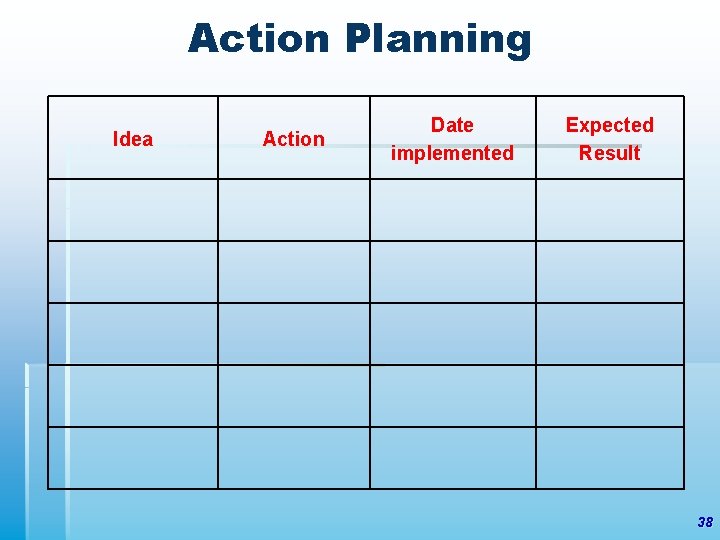
Action Planning Idea Action Date implemented Expected Result 38
Workshop Closing § Summary and Wrap-Up § Participants’ Expectations Review § Closing Comments § Workshop Evaluations 39

THANK YOU! 40
- Slides: 40