
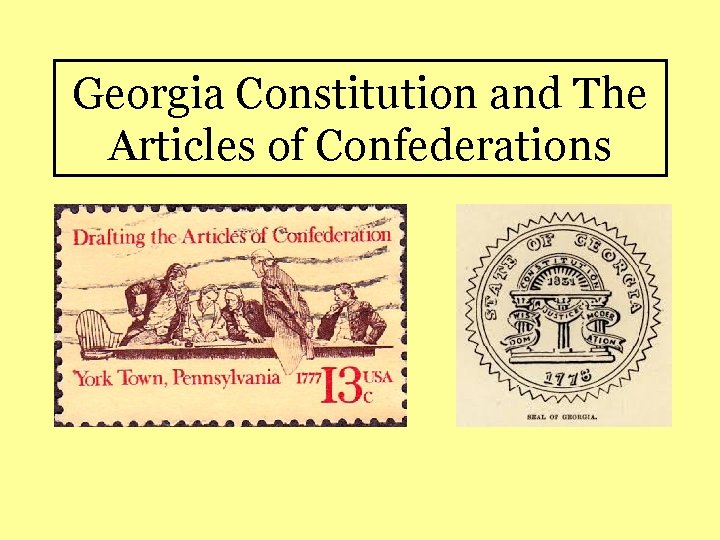
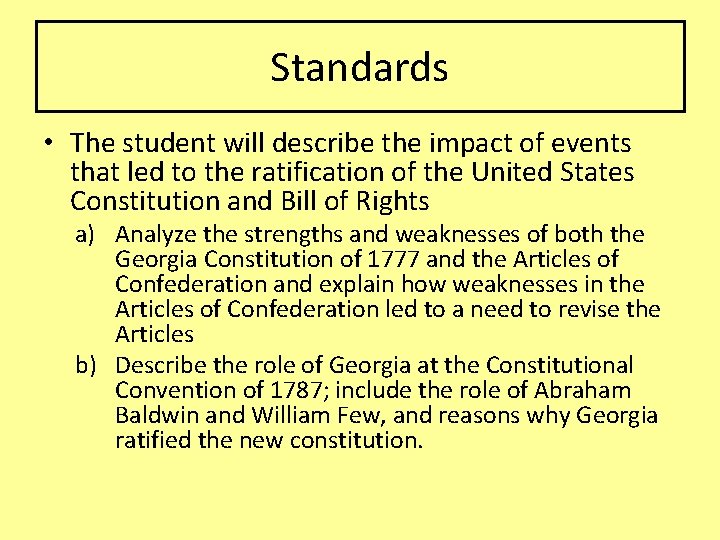
Georgia Constitution and The Articles of Confederations Standards



- Slides: 68
Georgia Constitution and The Articles of Confederations
Standards • The student will describe the impact of events that led to the ratification of the United States Constitution and Bill of Rights a) Analyze the strengths and weaknesses of both the Georgia Constitution of 1777 and the Articles of Confederation and explain how weaknesses in the Articles of Confederation led to a need to revise the Articles b) Describe the role of Georgia at the Constitutional Convention of 1787; include the role of Abraham Baldwin and William Few, and reasons why Georgia ratified the new constitution.
Word Review • Ratify- To approve or make valid • Unicameral - Consisting of a single branch, chamber or house, as a legislative assembly. • Bicameral - having two branches, chambers, or houses, as a legislative body. • Confederation - local/state governments make their own laws. A weak overlying central government.
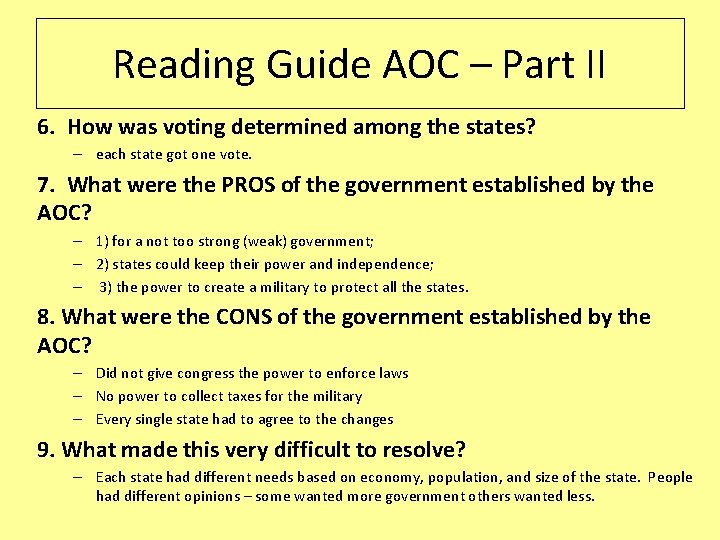
Reading Guide AOC 1. What problem did the colonists face after gaining independence from Great Britain? – They did not know what kind of government that should have? 2. How did their experience with heavy-handed British rule effect the establishment of the new form of government? – They wanted a government that couldn’t do much 3. How many governments did they have under the Articles of Confederation? – 13 Each state had their own government. 4. What was the Congress of the Confederation? – A group of representatives that make laws. 5. How many branches of government did they have? – 1 Congress was the only branch of government.
Reading Guide AOC – Part II 6. How was voting determined among the states? – each state got one vote. 7. What were the PROS of the government established by the AOC? – 1) for a not too strong (weak) government; – 2) states could keep their power and independence; – 3) the power to create a military to protect all the states. 8. What were the CONS of the government established by the AOC? – Did not give congress the power to enforce laws – No power to collect taxes for the military – Every single state had to agree to the changes 9. What made this very difficult to resolve? – Each state had different needs based on economy, population, and size of the state. People had different opinions – some wanted more government others wanted less.
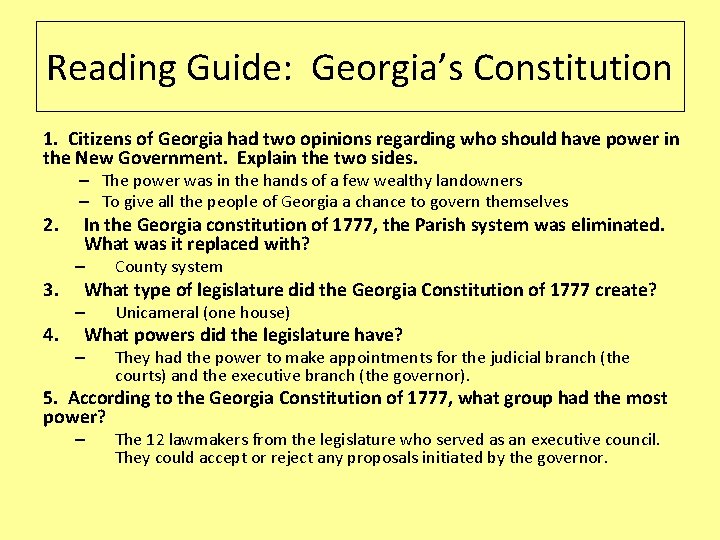
Reading Guide: Georgia’s Constitution 1. Citizens of Georgia had two opinions regarding who should have power in the New Government. Explain the two sides. 2. – The power was in the hands of a few wealthy landowners – To give all the people of Georgia a chance to govern themselves In the Georgia constitution of 1777, the Parish system was eliminated. What was it replaced with? – 3. 4. County system What type of legislature did the Georgia Constitution of 1777 create? – Unicameral (one house) What powers did the legislature have? – They had the power to make appointments for the judicial branch (the courts) and the executive branch (the governor). 5. According to the Georgia Constitution of 1777, what group had the most power? – The 12 lawmakers from the legislature who served as an executive council. They could accept or reject any proposals initiated by the governor.
The Georgia Constitution of 1777 • 1777 – 1789 (12 years) • Based on the principles of the Declaration of Independence • Not capable of meeting the needs of governing the state. • Three Branches of Government
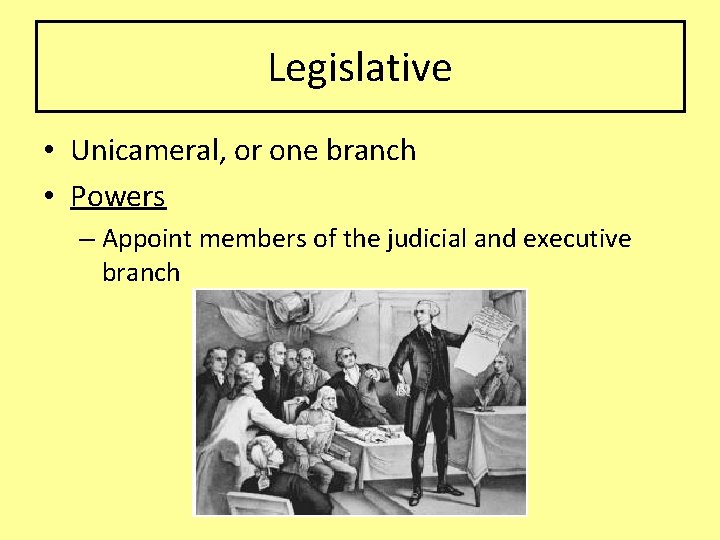
Legislative • Unicameral, or one branch • Powers – Appoint members of the judicial and executive branch
Executive Branch • Governor – Appointed by legislative branch – Limited to a ONE year term – Very little power
Judicial Branch • All Courts • Legislature appointed the positions for this branch
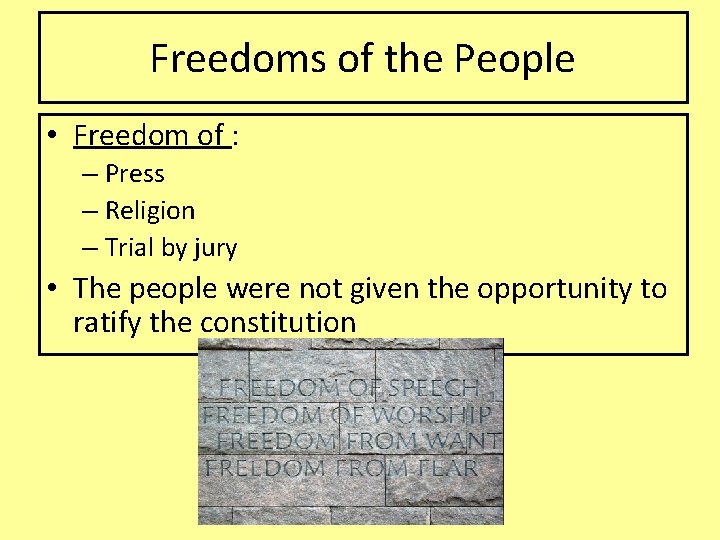
Freedoms of the People • Freedom of : – Press – Religion – Trial by jury • The people were not given the opportunity to ratify the constitution
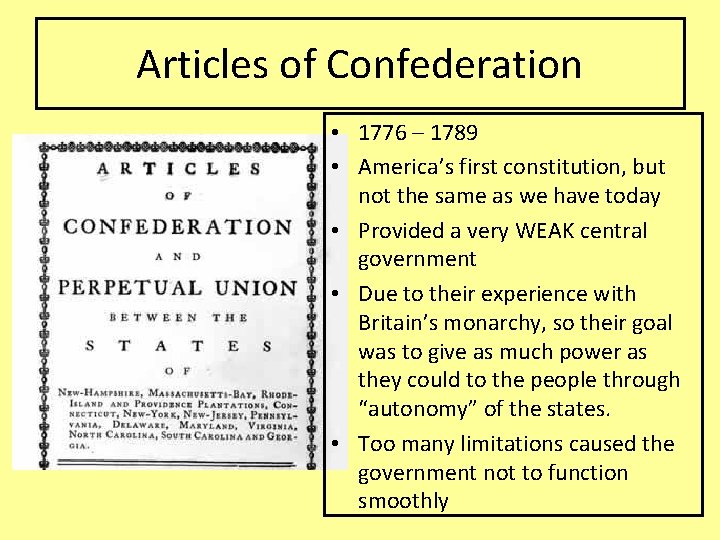
Articles of Confederation • 1776 – 1789 • America’s first constitution, but not the same as we have today • Provided a very WEAK central government • Due to their experience with Britain’s monarchy, so their goal was to give as much power as they could to the people through “autonomy” of the states. • Too many limitations caused the government not to function smoothly
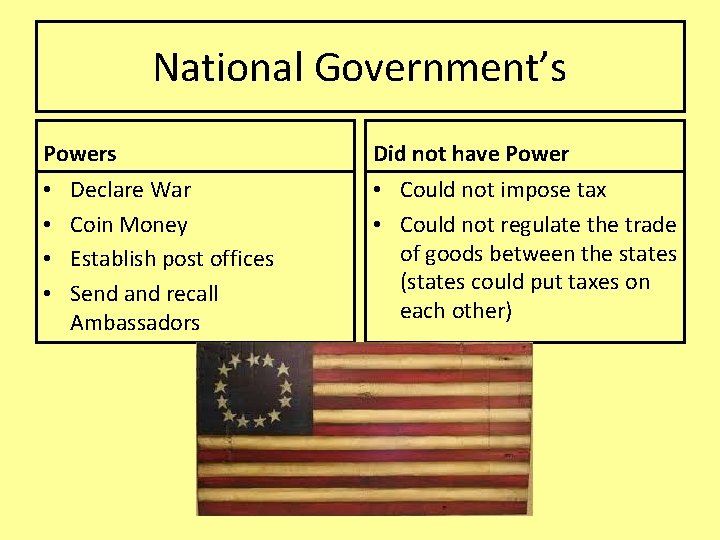
National Government’s Powers • • Declare War Coin Money Establish post offices Send and recall Ambassadors Did not have Power • Could not impose tax • Could not regulate the trade of goods between the states (states could put taxes on each other)
Overall Weakness of the AOC • • • Strong legislative branch No Executive branch No Judicial branch Each state had its own currency All 13 states had to approve a law for it to pass ONE vote per state no matter the size of the population
AOC Video • Link
QUICK QUIZ! THE ARTICLES OF CONFEDERATION
Think About It Under the Articles of Confederation, a President would lead the country. True False
Under the Articles of Confederation, states Think would be About independent. It True False
Think About It The Articles of Confederation were easy to change. True False
Think About It Under the Articles, states with more people got more votes in Congress. True False
Think About It Under the Articles, Congress did not have the power to collect taxes. True False
Under the Articles, Congress could pass Think laws and force states About to follow them. It True False
The Articles of Confederation created Think the first American About government. It True False
Creating a New U. S. Constitution New Government
Problems with the Articles of Confederation • The Articles of Confederation were purposefully designed to provide the people with as much power as possible. • After their recent history, they wanted to limit taxes. • (1)This created a very weak central government and lead to many problems including: – Fighting over land sea rights – (2)Lack of funds meant they could not maintain an Army or Navy and they could not build roads or canals – (3) Difficulty passing laws because all 13 states had to agree
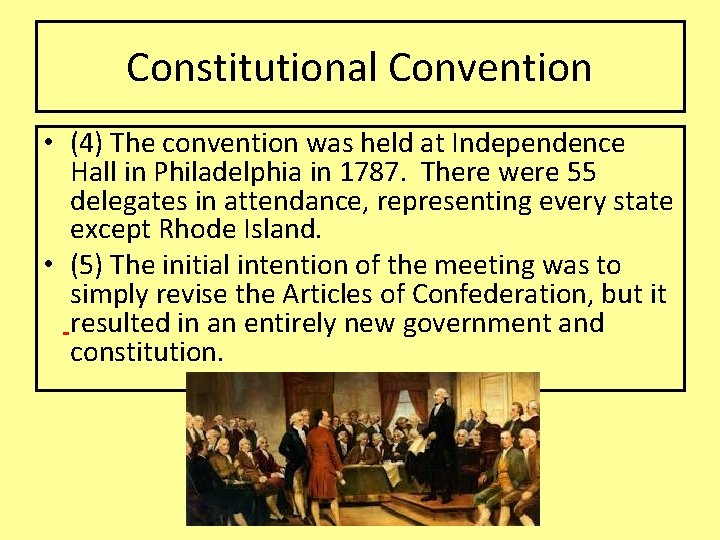
Constitutional Convention • (4) The convention was held at Independence Hall in Philadelphia in 1787. There were 55 delegates in attendance, representing every state except Rhode Island. • (5) The initial intention of the meeting was to simply revise the Articles of Confederation, but it resulted in an entirely new government and constitution.
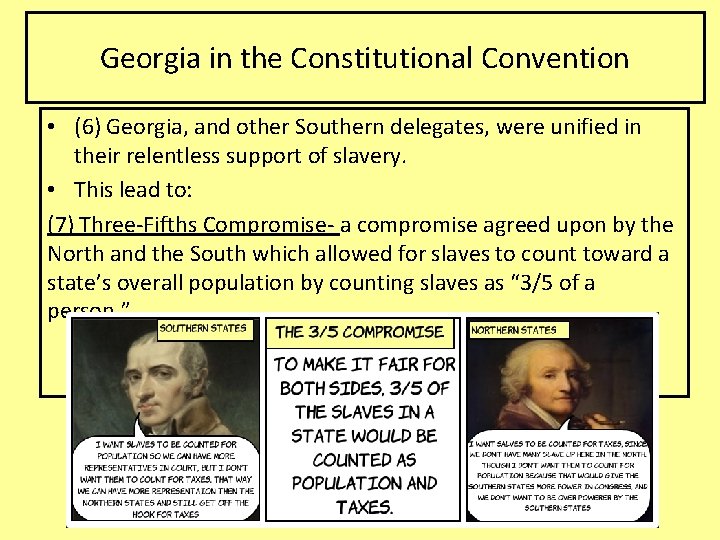
Georgia in the Constitutional Convention • (6) Georgia, and other Southern delegates, were unified in their relentless support of slavery. • This lead to: (7) Three-Fifths Compromise- a compromise agreed upon by the North and the South which allowed for slaves to count toward a state’s overall population by counting slaves as “ 3/5 of a person. ”
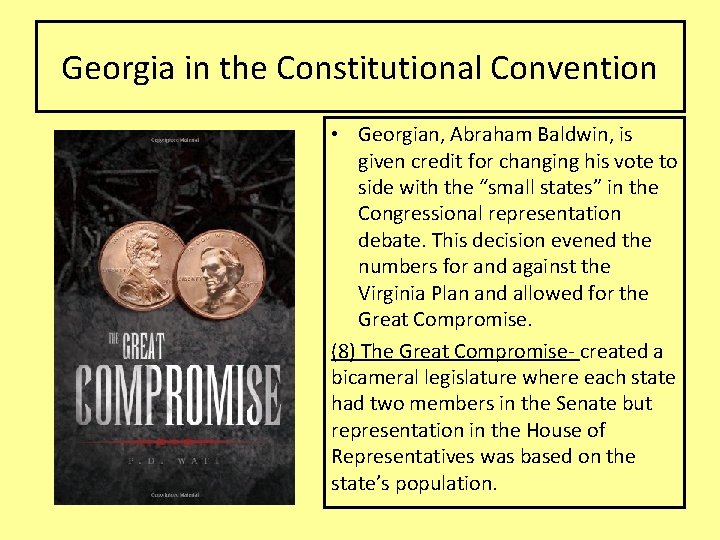
Georgia in the Constitutional Convention • Georgian, Abraham Baldwin, is given credit for changing his vote to side with the “small states” in the Congressional representation debate. This decision evened the numbers for and against the Virginia Plan and allowed for the Great Compromise. (8) The Great Compromise- created a bicameral legislature where each state had two members in the Senate but representation in the House of Representatives was based on the state’s population.
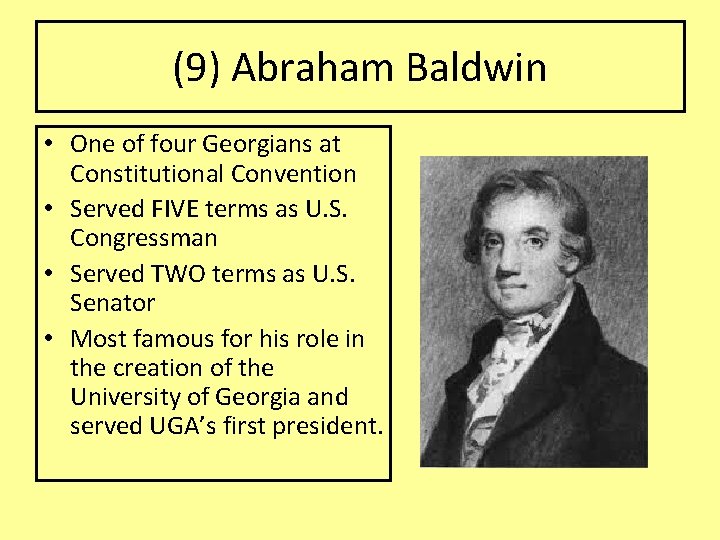
(9) Abraham Baldwin • One of four Georgians at Constitutional Convention • Served FIVE terms as U. S. Congressman • Served TWO terms as U. S. Senator • Most famous for his role in the creation of the University of Georgia and served UGA’s first president.
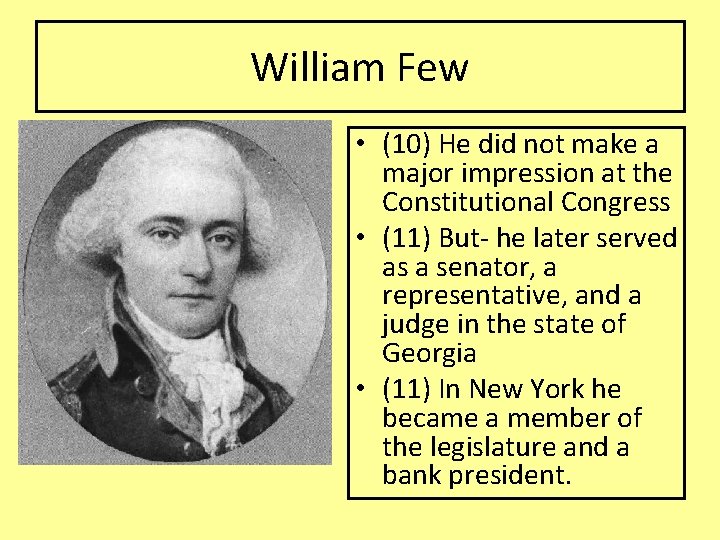
William Few • (10) He did not make a major impression at the Constitutional Congress • (11) But- he later served as a senator, a representative, and a judge in the state of Georgia • (11) In New York he became a member of the legislature and a bank president.
Georgia Stories • Video Link
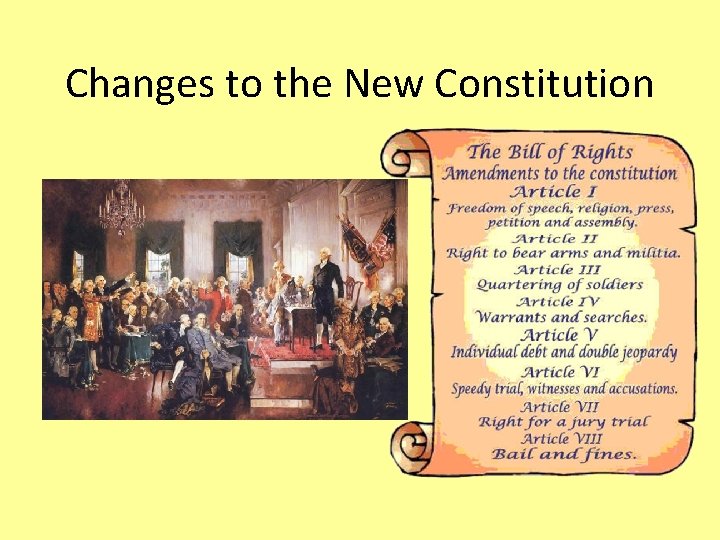
Changes to the New Constitution
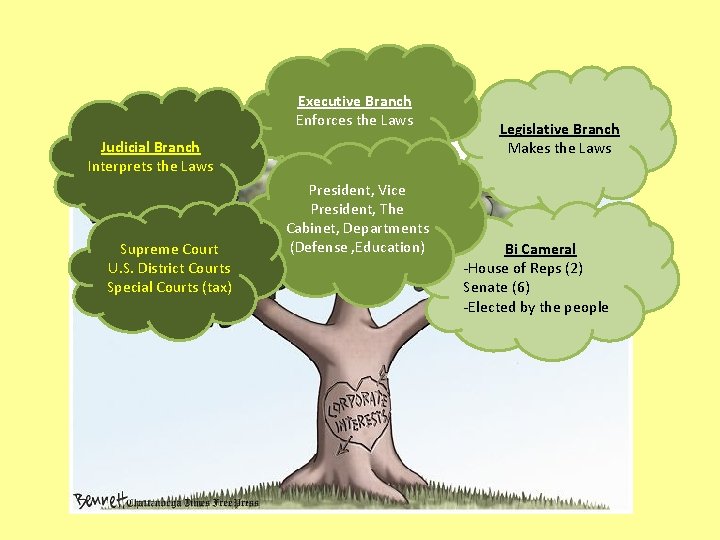
Reading pages 174 -174 1. With the new constitution, the government was formed by THREE branches instead of ONE: legislative, executive, and judicial. 2. The legislative branch was now BICAMERAL instead of UNICAMERAL. They created the SENATE and the HOUSE OF REPRESENTATIVES. 3. With changing times and circumstances, the delegates provided for a method of amending, or making changes or additions, to the U. S. Constitution. 4. The first ten amendments made to the Constitution are known as the Bill of Rights. Video – School House Rock
Executive Branch Enforces the Laws Judicial Branch Interprets the Laws Supreme Court U. S. District Courts Special Courts (tax) President, Vice President, The Cabinet, Departments (Defense , Education) Legislative Branch Makes the Laws Bi Cameral -House of Reps (2) Senate (6) -Elected by the people
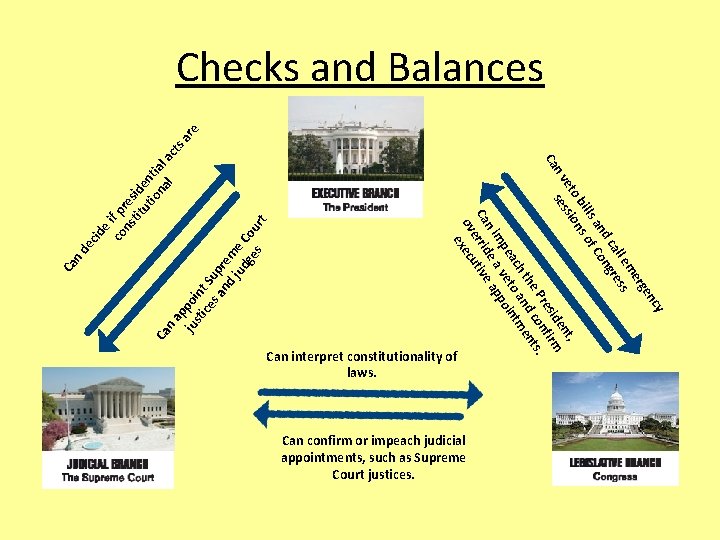
Checks and Balances • Checks and balances- the system that provides to each branch of government some power that controls or prevents some actions of the other two branches • Separation of Power- a division of responsibilities for government among the three branches (legislative, judicial, and executive) • Without checks and balances and separation of power, one person or portion of the government would have unlimited power. • This is the creation of an oligarchy, autocratic, or dictatorship.
Ca de c re sa id e co if pr ns es tit id ut en io tia na l l act na p ju poi sti nt ce Su sa p nd rem ju e dg Co es ur t y nc ge er em s all res d c ng an C o ills of s ob n t, et ssio en n v se sid rm Ca re nfi e P co ts. th and en ch tm ea eto oin mp a v app ni e Ca errid tive ov xecu e Ca n Checks and Balances Can interpret constitutionality of laws. Can confirm or impeach judicial appointments, such as Supreme Court justices.
QUICK QUIZ! ARTICLES VS. CONSTITUTION
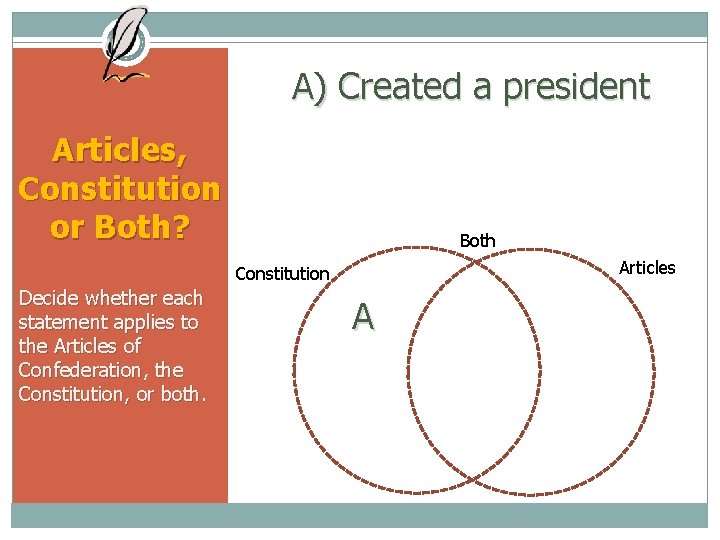
A) Created a president Articles, Constitution or Both? Both Articles Constitution Decide whether each statement applies to the Articles of Confederation, the Constitution, or both. A
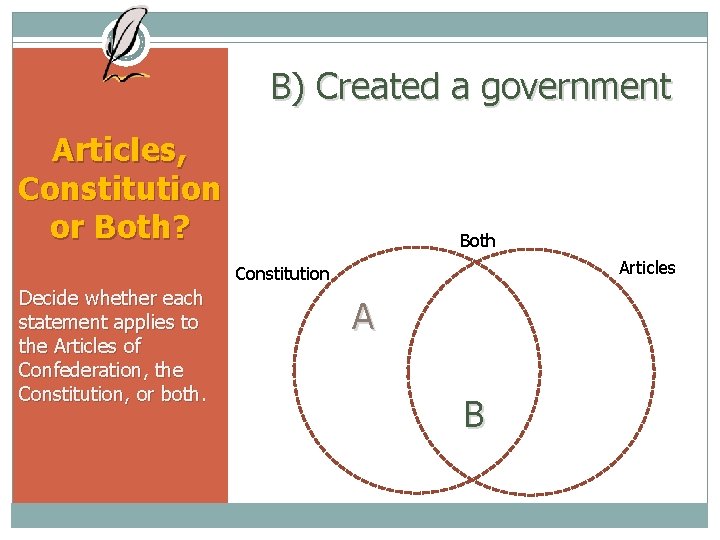
B) Created a government Articles, Constitution or Both? Both Articles Constitution Decide whether each statement applies to the Articles of Confederation, the Constitution, or both. A B
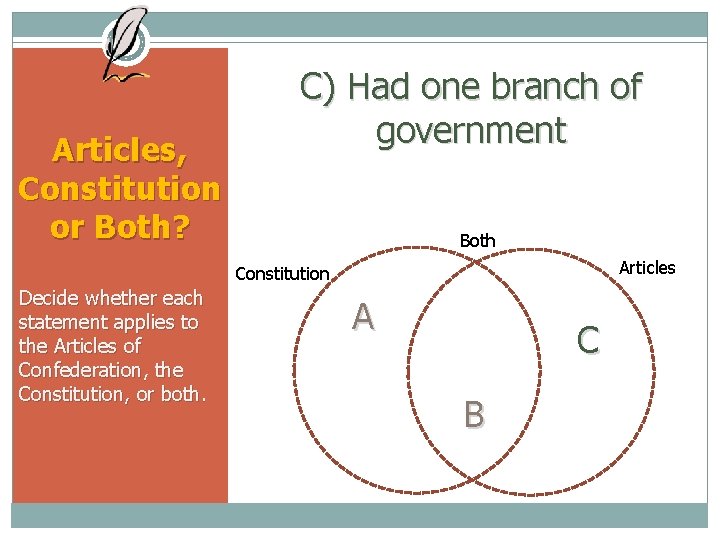
Articles, Constitution or Both? C) Had one branch of government Both Articles Constitution Decide whether each statement applies to the Articles of Confederation, the Constitution, or both. A C B
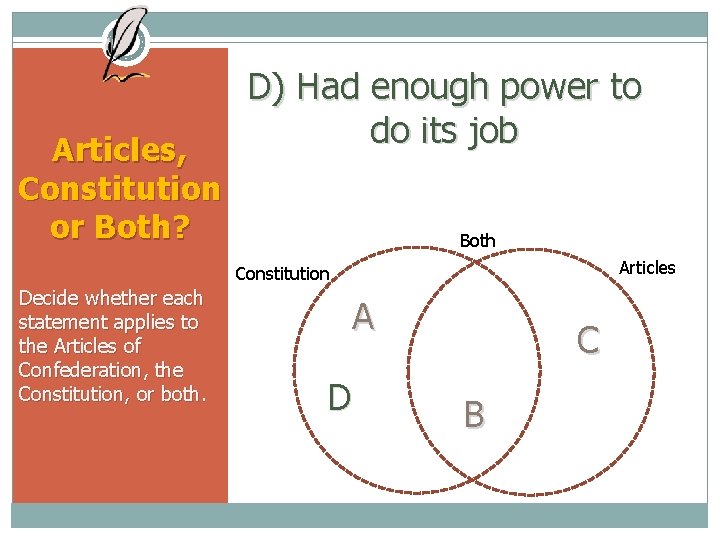
Articles, Constitution or Both? D) Had enough power to do its job Both Articles Constitution Decide whether each statement applies to the Articles of Confederation, the Constitution, or both. A D C B
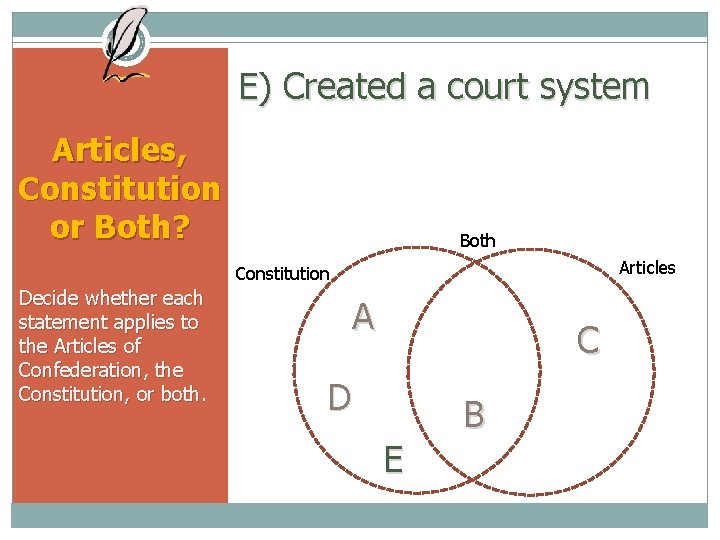
E) Created a court system Articles, Constitution or Both? Both Articles Constitution Decide whether each statement applies to the Articles of Confederation, the Constitution, or both. A C D B E
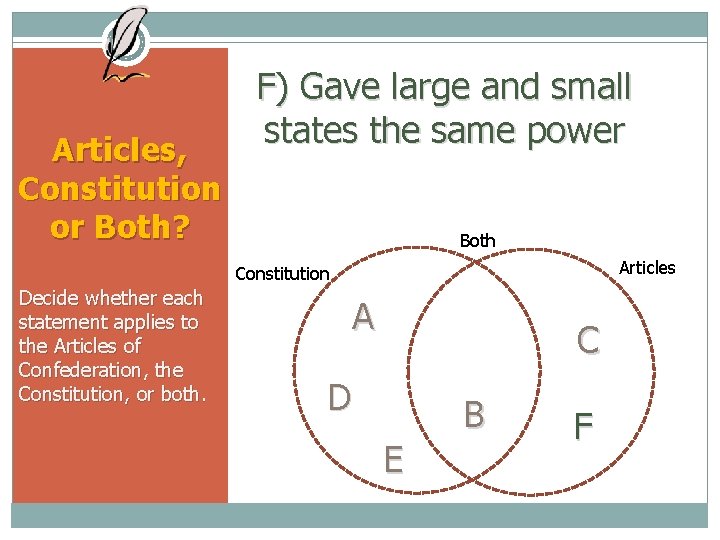
Articles, Constitution or Both? F) Gave large and small states the same power Both Articles Constitution Decide whether each statement applies to the Articles of Confederation, the Constitution, or both. A C D B E F
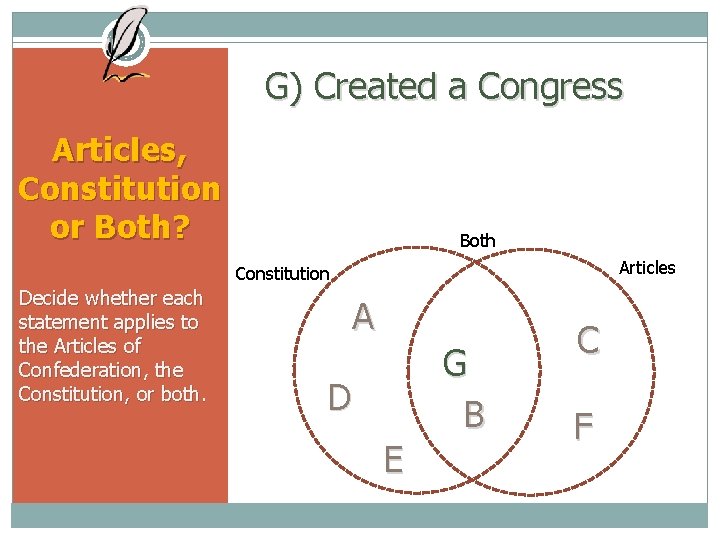
G) Created a Congress Articles, Constitution or Both? Both Articles Constitution Decide whether each statement applies to the Articles of Confederation, the Constitution, or both. A G B D E C F
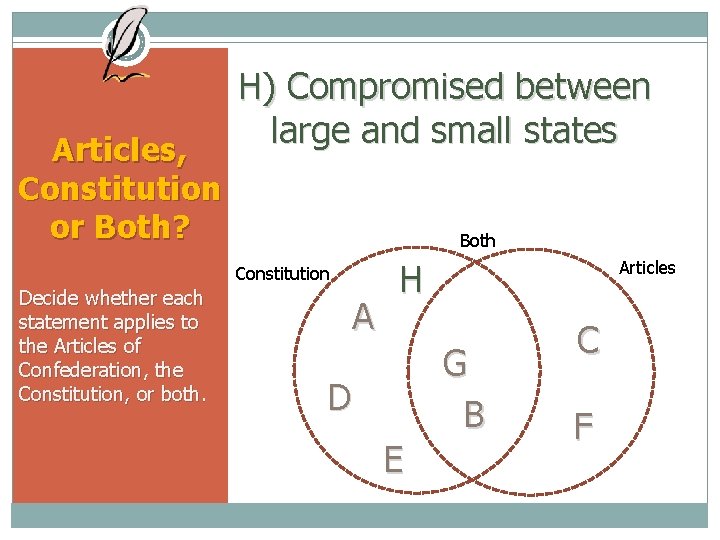
Articles, Constitution or Both? H) Compromised between large and small states Both Constitution Decide whether each statement applies to the Articles of Confederation, the Constitution, or both. A H Articles G B D E C F
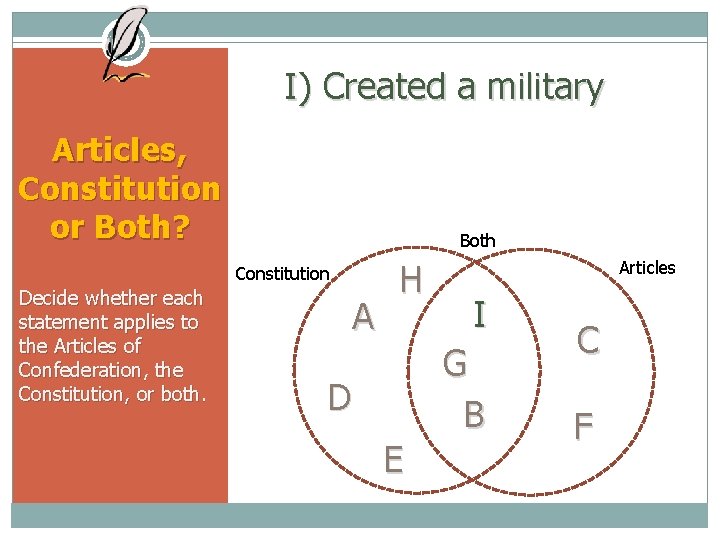
I) Created a military Articles, Constitution or Both? Both Constitution Decide whether each statement applies to the Articles of Confederation, the Constitution, or both. A H Articles I G B D E C F
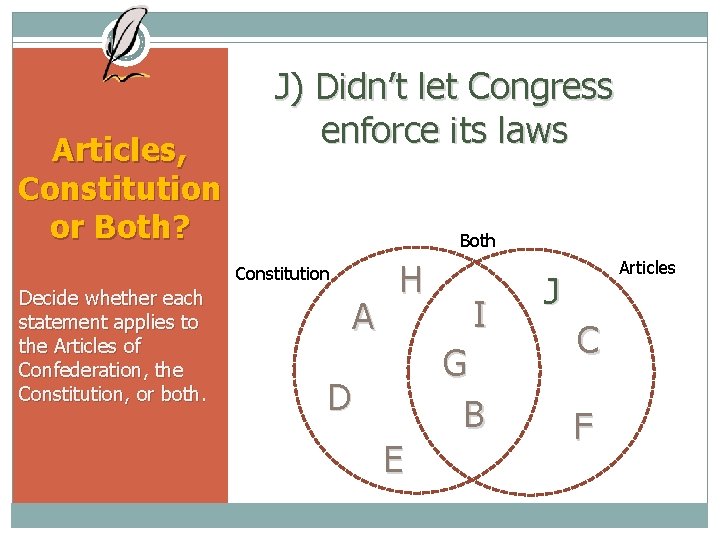
Articles, Constitution or Both? J) Didn’t let Congress enforce its laws Both Constitution Decide whether each statement applies to the Articles of Confederation, the Constitution, or both. A H I G B D E Articles J C F
Cause and Effect Activity • When you look at causes and effects, you can see the relationship between different things that take place. Use what you have learned to match the causes and effects for different stages of American Government. – When I say go, dump out your cause and effect strips. – Match three cause/effects statements onto the chart under the correct categories.
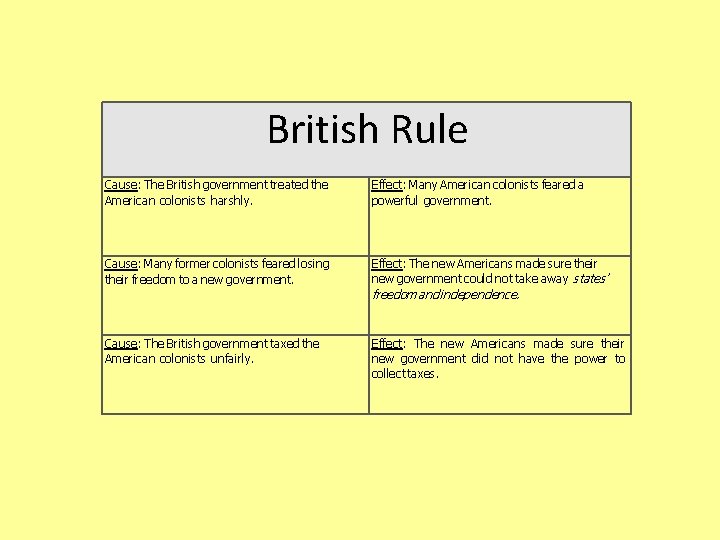
British Rule Cause: The British government treated the American colonists harshly. Effect: Many American colonists feared a powerful government. Cause: Many former colonists feared losing their freedom to a new government. Effect: The new Americans made sure their new government could not take away states’ Cause: The British government taxed the American colonists unfairly. Effect: The new Americans made sure their new government did not have the power to collect taxes. freedom and independence.
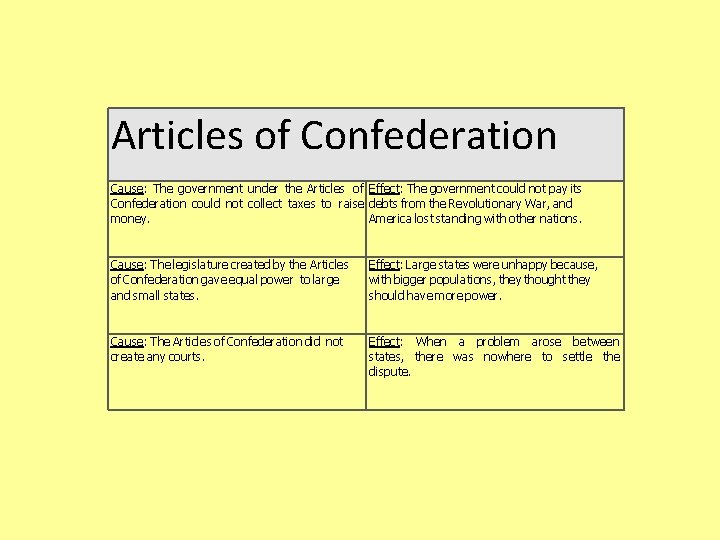
Articles of Confederation Cause: The government under the Articles of Effect: The government could not pay its Confederation could not collect taxes to raise debts from the Revolutionary War, and money. America lost standing with other nations. Cause: The legislature created by the Articles of Confederation gave equal power to large and small states. Effect: Large states were unhappy because, with bigger populations, they thought they should have more power. Cause: The Articles of Confederation did not create any courts. Effect: When a problem arose between states, there was nowhere to settle the dispute.
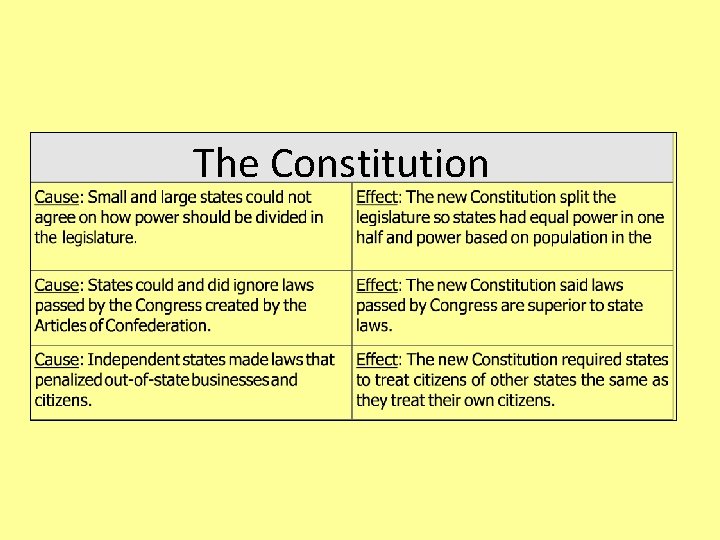
The Constitution
Georgia’s New State Constitution
Changes over time • Since the original state constitution of 1777, Georgia has had TEN other constitutions. • Each of these constitutions set the guidelines for those who governed the state and outlined the rights and responsibilities of Georgia’s citizens.
Structure of the Constitution • Legislators began writing our current constitution in 1977 and it was approved by Georgia citizens in 1983 • The constitution is broken up into 11 articles and is 89 pages long • It outlines the rights, rules, regulations, and procedures for both the state’s citizens and the state’s government.
What is a preamble and what is its purpose? • An introduction • States the ideas, or philosophy, behind a constitution • States the purpose of the government and the Constitution
Preamble • A short paragraph that gives reasons for the Constitution
Article I: Bill of Rights 1. Individual rights 2. Separation of powers/church & state 3. Property rights
Article II: Voting and Elections 1. Elections must be by secret ballot and law-abiding 2. Steps to take for a run-off election 3. Steps to take if a public official is found guilty of a serious crime
Article III: Legislative Branch • Made up of ten sections • Outlines the structure and function of the two houses of GA’s General Assembly • Explains how bills are passed into laws
Article IV: Constitutional Boards and Commissions • Provides for a: Public Service Commission, State Board of Pardons and Paroles, State Personnel Board, State Transportation Board, Veterans Service Board, and Board of Natural Resources
Article V: Executive Branch • Sets out the qualifications and terms of office for the governor and lieutenant governor • Explains duties and powers of governor • Lists other elected positions in GA’s executive branch
Article VI: Judicial Branch • Outlines GA’s unified court system • Gives purposes and limits of each court – Magistrate – Probate – Juvenile – State – Superior – Court of Appeals – Supreme
Article VII: Taxation and Finance • Lists reasons why GA may tax its citizens • Explains methods and limits of taxation
Article VIII: Education • Explains how GA’s public school system is paid for by taxes • Outlines the structure of the school system at state and local levels
Article IX: Counties and Municipal Corporations • Outlines roles and functions of county and city governments
Article X: Amendments to the Constitution • Explains how changes, or amendments, to the Constitution can be made
Article XI: Miscellaneous Provisions • Deal mostly with historical and legal continuity - that is, how GA’s different constitutions have been changed over the years
The End