
Georgia Alternate Assessment Basics of the GAA 2014
Georgia Alternate Assessment Basics of the GAA 2014 -2015 Troup County Schools
Overview of this Presentation This presentation provides information and tools that will assist new and experienced examiners in the preparation of portfolios. • GAA Blueprint and Portfolio Components • Terminology for the GAA • Descriptions and Examples of Types of Evidence • Alignment/Documentation • Completing the Forms • Organizing and Submitting the Portfolio 2
Overview of the GAA • The GAA is a portfolio‐based assessment comprised of student work provided as evidence that a student is making progress toward grade‐level academic standards, often at a prerequisite or entry level. • Evidence provided must show student work that is aligned to specific grade‐level content standards, adapted to meet the student’s cognitive, communication, physical, and/or sensory impairments. • The Georgia Alternate Assessment meets NCLB, ESEA, and IDEA mandates. 3
Overview of the GAA • The portfolio system is flexible to allow for the diversity of the students participating in the GAA. § Evidence for the portfolio is collected throughout the assessment window (September 2–March 27). § This type of assessment allows for the student’s best work to be submitted as evidence of what the student knows and can do as related to the content standards and elements/indicators being assessed for the portfolio. • Students will be assessed in the same content areas as their peers and on grade‐level content standards. 4
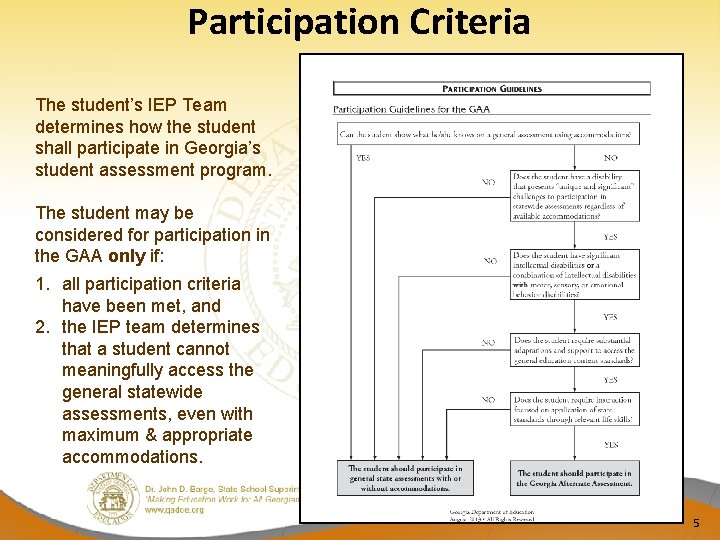
Participation Criteria The student’s IEP Team determines how the student shall participate in Georgia’s student assessment program. The student may be considered for participation in the GAA only if: 1. all participation criteria have been met, and 2. the IEP team determines that a student cannot meaningfully access the general statewide assessments, even with maximum & appropriate accommodations. 5
Continuation of Current Assessment • The GAA will continue via the portfolio‐based assessment. • Content Standards for grades K, 3‐ 8 in ELA, Math, Science, and Social Studies will remain consistent with those that were used for the GAA during the 2013‐ 2014 Administration. v NEW High School Mathematics Standards under the following two courses: Ø Coordinate Algebra & Analytic Geometry 6
State-Mandated Content Standards High School Mathematics • Coordinate Algebra § Algebra and Functions § Algebra Connections to Geometry § Algebra Connections to Statistics and Probability • Analytic Geometry § Expressions, Equations, and Functions § Statistics and Probability 7
State-Mandated Content Standards • Georgia began implementing the current state‐ mandated content standards in ELA (all grades) and Math (K, 3‐ 8) for the first time in 2012‐ 2013. • The GAA has reflected these current content standards since the fall of 2012. • The content standards selected for assessment on the GAA have been reviewed and approved by a committee of Georgia educators. 8
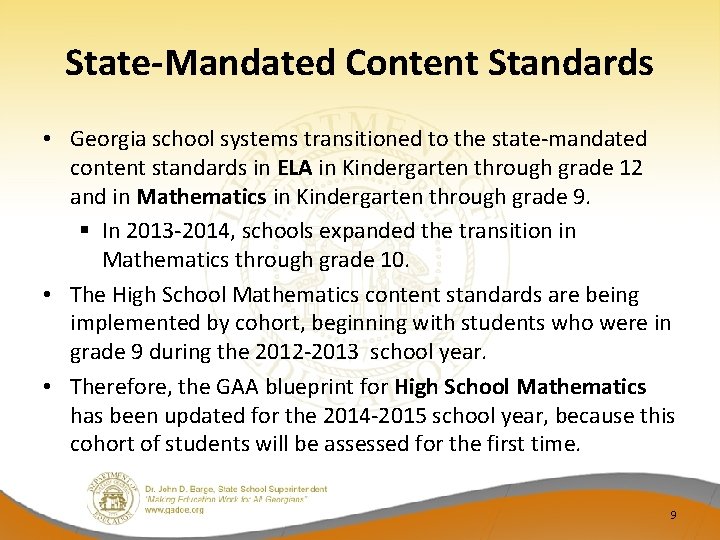
State-Mandated Content Standards • Georgia school systems transitioned to the state‐mandated content standards in ELA in Kindergarten through grade 12 and in Mathematics in Kindergarten through grade 9. § In 2013‐ 2014, schools expanded the transition in Mathematics through grade 10. • The High School Mathematics content standards are being implemented by cohort, beginning with students who were in grade 9 during the 2012‐ 2013 school year. • Therefore, the GAA blueprint for High School Mathematics has been updated for the 2014‐ 2015 school year, because this cohort of students will be assessed for the first time. 9

State-Mandated Content Standards • The content standards for Science and Social Studies will remain unchanged for the 2014‐ 2015 school year. 10
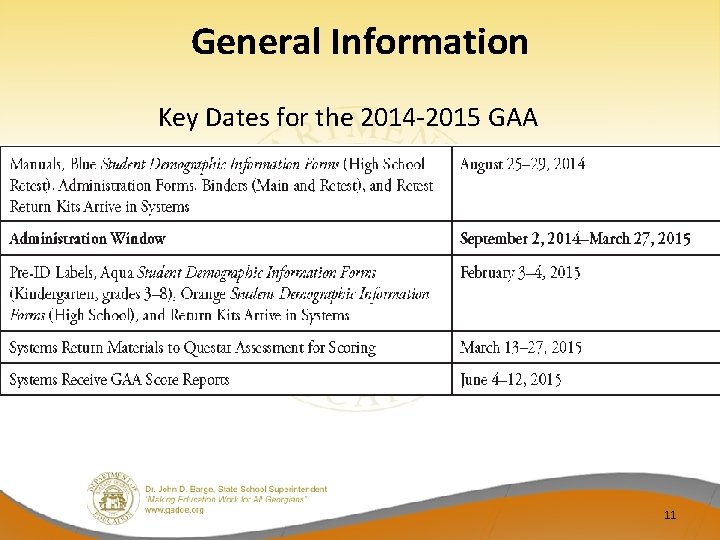
General Information Key Dates for the 2014‐ 2015 GAA 11
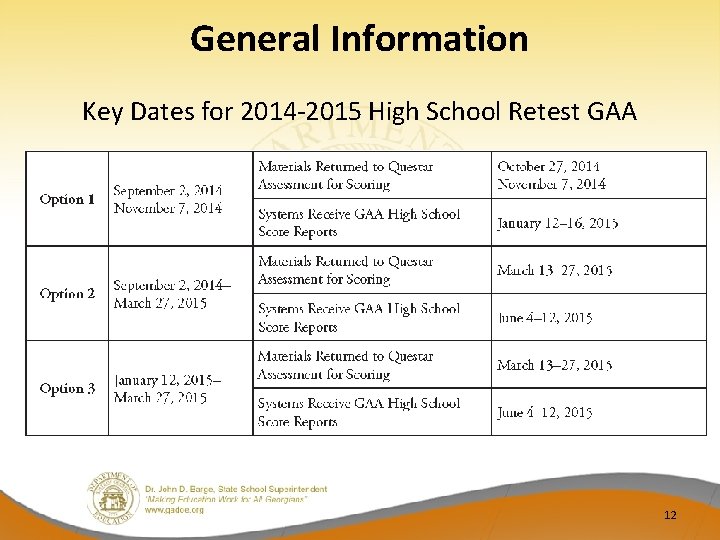
General Information Key Dates for 2014‐ 2015 High School Retest GAA 12

Lessons Learned from the 2013 -2014 Administration 13
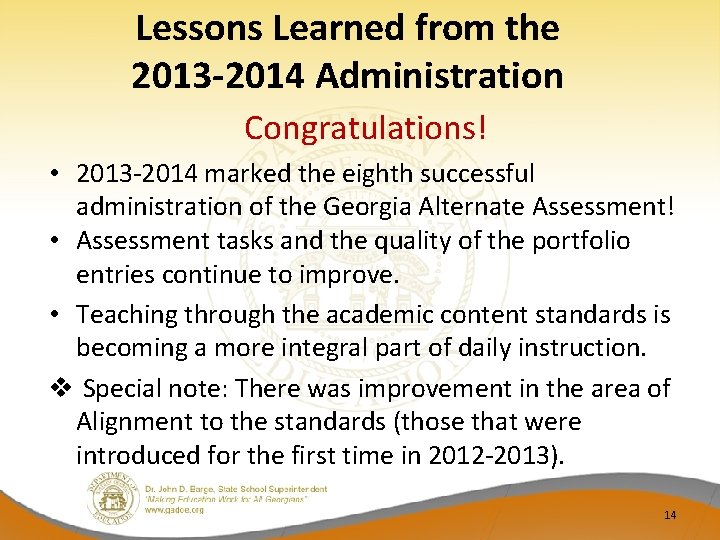
Lessons Learned from the 2013 -2014 Administration Congratulations! • 2013‐ 2014 marked the eighth successful administration of the Georgia Alternate Assessment! • Assessment tasks and the quality of the portfolio entries continue to improve. • Teaching through the academic content standards is becoming a more integral part of daily instruction. v Special note: There was improvement in the area of Alignment to the standards (those that were introduced for the first time in 2012‐ 2013). 14
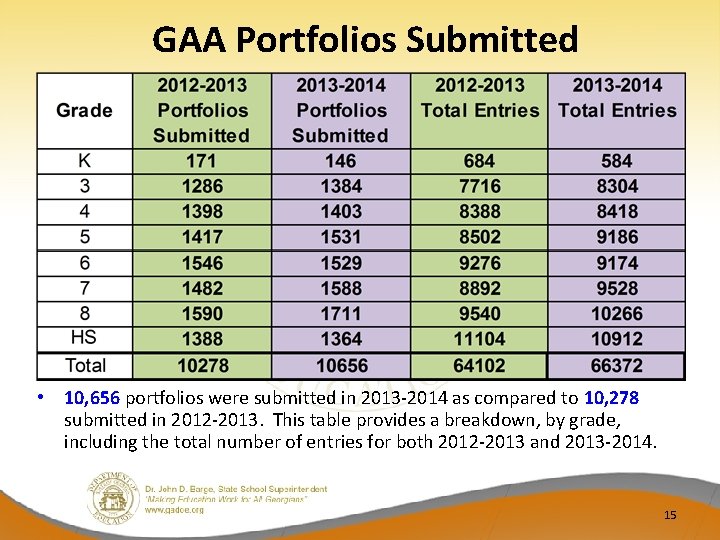
GAA Portfolios Submitted • 10, 656 portfolios were submitted in 2013‐ 2014 as compared to 10, 278 submitted in 2012‐ 2013. This table provides a breakdown, by grade, including the total number of entries for both 2012‐ 2013 and 2013‐ 2014. 15
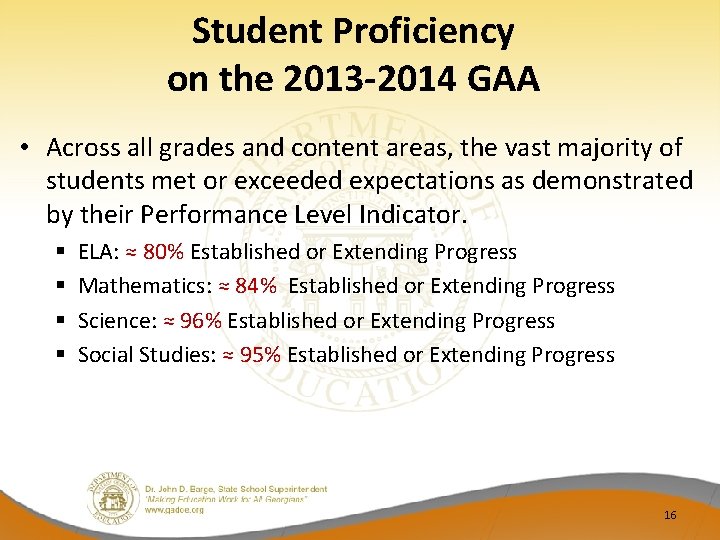
Student Proficiency on the 2013 -2014 GAA • Across all grades and content areas, the vast majority of students met or exceeded expectations as demonstrated by their Performance Level Indicator. § § ELA: ≈ 80% Established or Extending Progress Mathematics: ≈ 84% Established or Extending Progress Science: ≈ 96% Established or Extending Progress Social Studies: ≈ 95% Established or Extending Progress 16
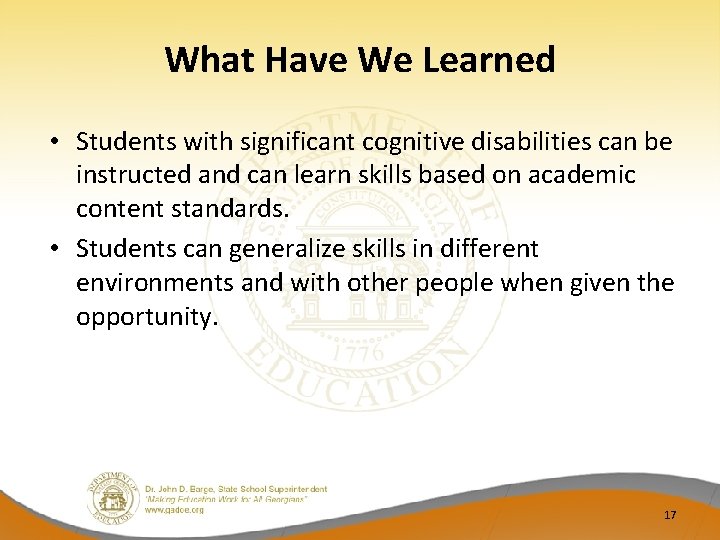
What Have We Learned • Students with significant cognitive disabilities can be instructed and can learn skills based on academic content standards. • Students can generalize skills in different environments and with other people when given the opportunity. 17
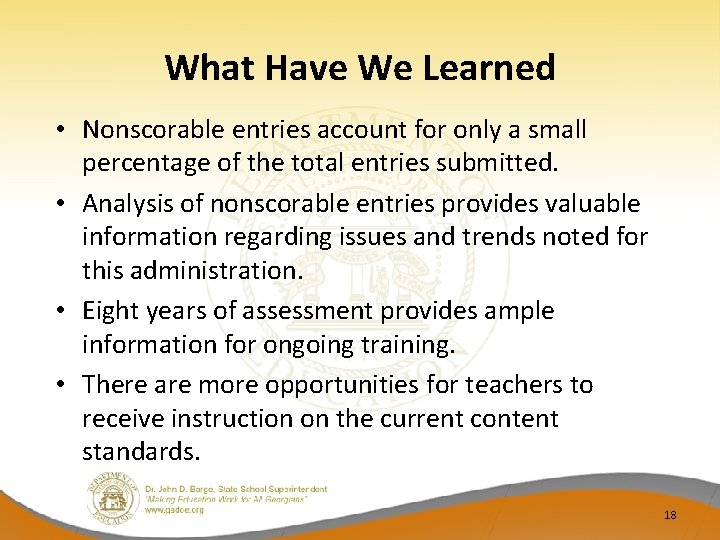
What Have We Learned • Nonscorable entries account for only a small percentage of the total entries submitted. • Analysis of nonscorable entries provides valuable information regarding issues and trends noted for this administration. • Eight years of assessment provides ample information for ongoing training. • There are more opportunities for teachers to receive instruction on the current content standards. 18
What Have We Learned • Assessment tasks that worked with previous GAA standards/elements cannot be reused with the current state‐mandated content standards without being modified to address the specific intent of the current standards. • There is continuing difficulty with including the co‐ requisite Characteristic of Science (Co. S) within the Science assessment tasks. 19
Updates for 2014 -2015 • Entry Sheet: there is one Entry Sheet for all students. Drop‐down boxes will guide you through the process. • The GAA Examiner’s Manual, 2014‐ 2015, is smaller. Ø The entry samples have been placed in the Student Samples Resource Guide available on the Ga. DOE website. Ø Please visit the state’s Web site to view important trainings and presentations, for access level examples and the IDEAS presentation and PPT (for the new HS courses). It may be found here under the section, “Handouts”: http: //www. gadoe. org/Curriculum‐Instruction‐and‐Assessment/Special‐ Education‐Services/Pages/IDEAS‐ 2014‐Handouts. aspx 20
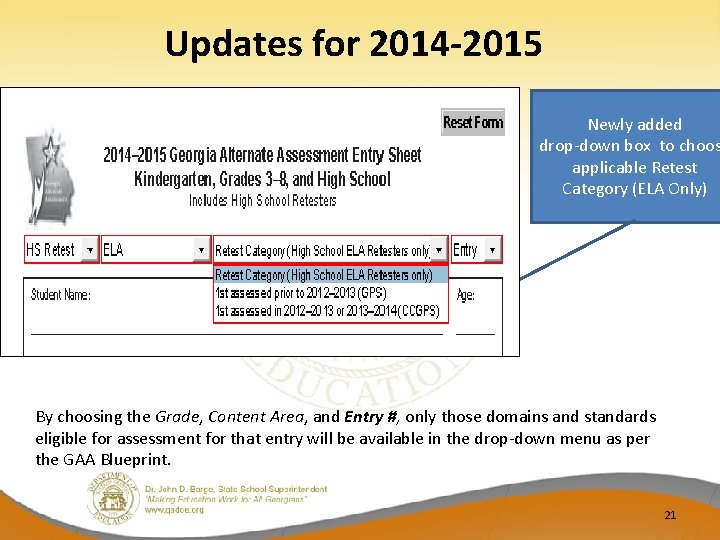
Updates for 2014 -2015 Newly added drop‐down box to choos applicable Retest Category (ELA Only) By choosing the Grade, Content Area, and Entry #, only those domains and standards eligible for assessment for that entry will be available in the drop‐down menu as per the GAA Blueprint. 21
Updates for 2014 -2015 Reminders: • One Entry Sheet for all GAA students: http: //www. gadoe. org/Curriculum‐Instruction‐and‐ Assessment/Pages/GAA‐Resources. aspx • Be sure to discard previous templates and use only the Entry Sheet for 2014 -2015! • It is highly recommended that you use the electronic Entry Sheet to avoid Entry Sheet errors. 22
GAA Blueprint and Portfolio Components 23
2014 -2015 GAA Blueprint • The Blueprint outlines the requirements of the 2014‐ 2015 GAA. • The Blueprint identifies the content standards that are required and eligible for assessment on the GAA. • The Blueprint, by grade, can be found in Appendix D of the GAA Examiner’s Manual, 2014 -2015. • The Blueprint for High School retesters can be found at: http: //www. gadoe. org/Curriculum‐Instruction‐and‐ Assessment/Pages/GAA‐Resources. aspx under the header: “Standards Documents and Blueprints 2014 – 2015” Note: Do not use Blueprints from previous years! 24
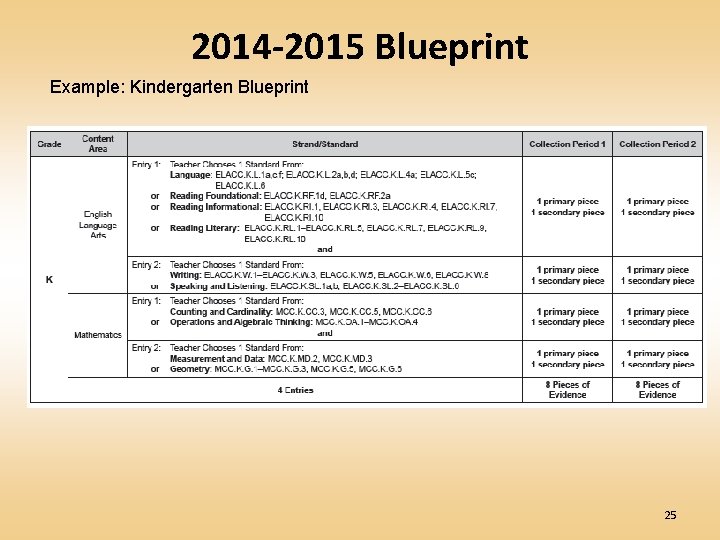
2014 -2015 Blueprint Example: Kindergarten Blueprint 25
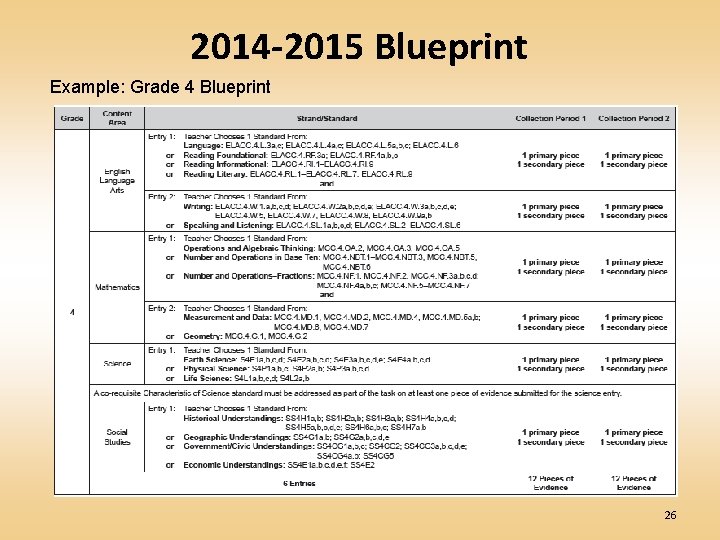
2014 -2015 Blueprint Example: Grade 4 Blueprint 26
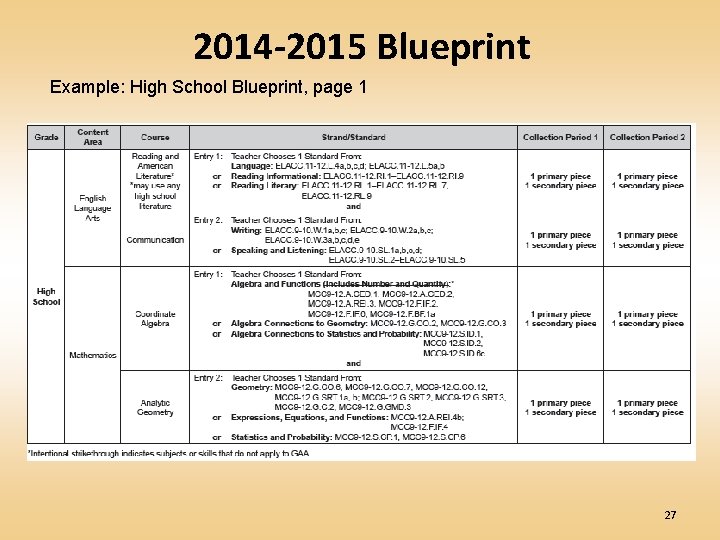
2014 -2015 Blueprint Example: High School Blueprint, page 1 27
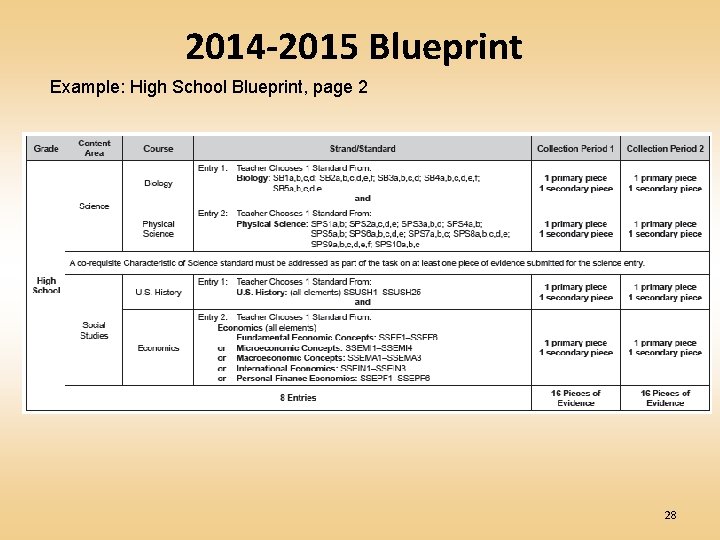
2014 -2015 Blueprint Example: High School Blueprint, page 2 28
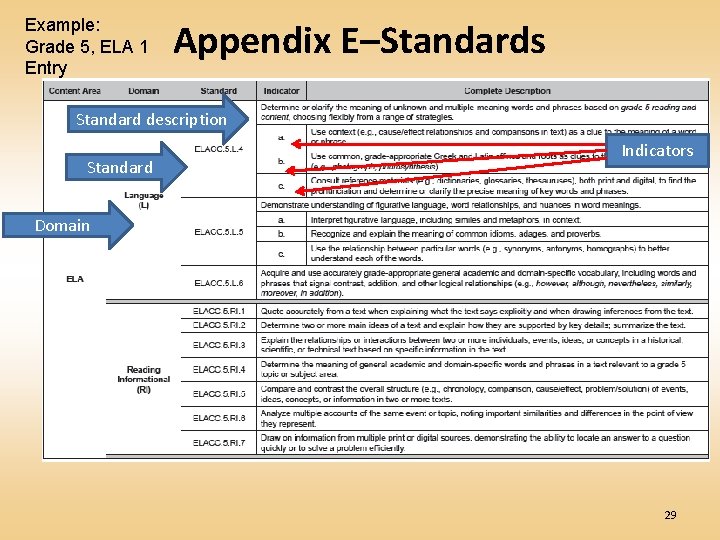
Example: Grade 5, ELA 1 Entry Appendix E–Standards Standard description Standard Indicators Domain 29
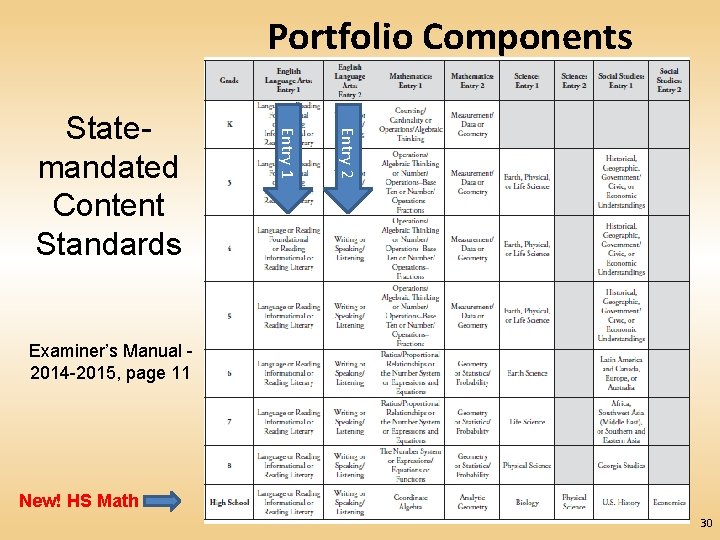
Portfolio Components Entry 2 Entry 1 Statemandated Content Standards Examiner’s Manual 2014 -2015, page 11 New! HS Math 30

Terminology for the GAA 31
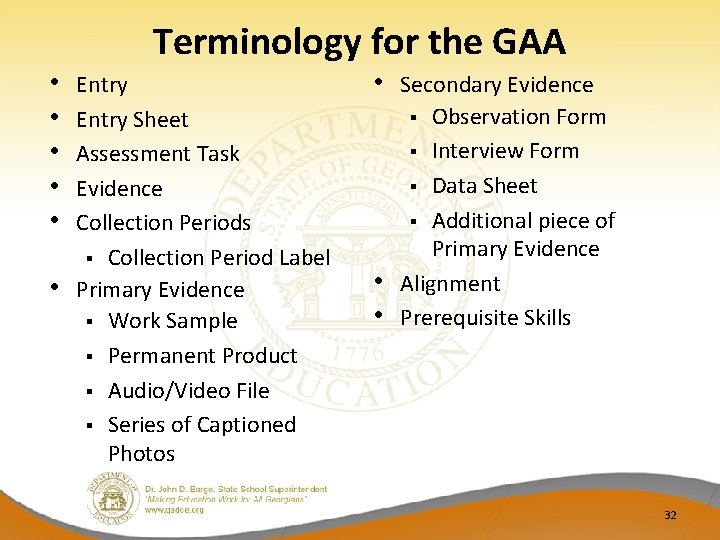
Terminology for the GAA • • • Entry Sheet Assessment Task Evidence Collection Periods § Collection Period Label Primary Evidence § Work Sample § Permanent Product § Audio/Video File § Series of Captioned Photos • • • Secondary Evidence § Observation Form § Interview Form § Data Sheet § Additional piece of Primary Evidence Alignment Prerequisite Skills 32
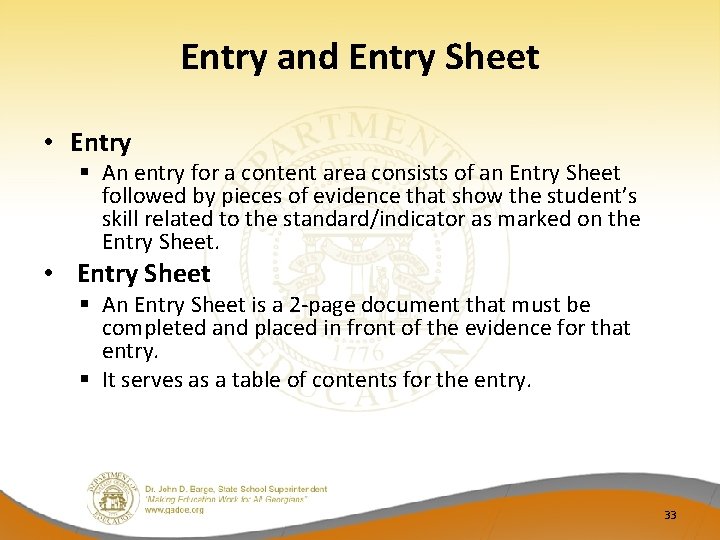
Entry and Entry Sheet • Entry § An entry for a content area consists of an Entry Sheet followed by pieces of evidence that show the student’s skill related to the standard/indicator as marked on the Entry Sheet. • Entry Sheet § An Entry Sheet is a 2‐page document that must be completed and placed in front of the evidence for that entry. § It serves as a table of contents for the entry. 33
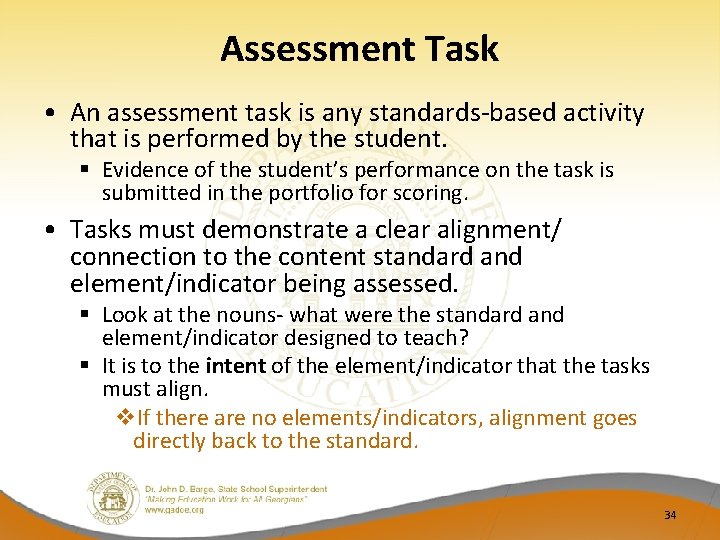
Assessment Task • An assessment task is any standards‐based activity that is performed by the student. § Evidence of the student’s performance on the task is submitted in the portfolio for scoring. • Tasks must demonstrate a clear alignment/ connection to the content standard and element/indicator being assessed. § Look at the nouns‐ what were the standard and element/indicator designed to teach? § It is to the intent of the element/indicator that the tasks must align. v. If there are no elements/indicators, alignment goes directly back to the standard. 34
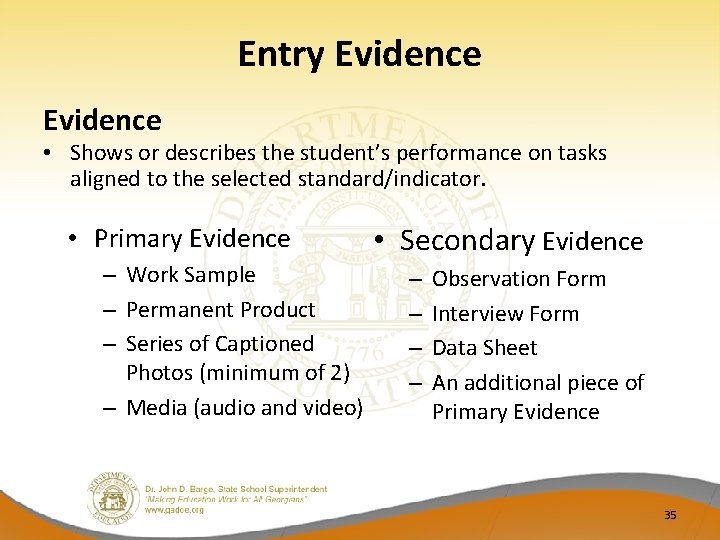
Entry Evidence • Shows or describes the student’s performance on tasks aligned to the selected standard/indicator. • Primary Evidence – Work Sample – Permanent Product – Series of Captioned Photos (minimum of 2) – Media (audio and video) • Secondary Evidence – – Observation Form Interview Form Data Sheet An additional piece of Primary Evidence 35
Collection Periods • For each entry, there are two collection periods. § Collection Period 1 shows the student’s initial skill. § Collection Period 2 shows the student’s progress. • For each collection period, there must be two pieces of evidence: Primary Evidence and Secondary Evidence. § Therefore, there are 4 pieces of evidence in each entry. 36
Collection Periods • Date on the Primary Evidence for Collection Period 2 must be a minimum of 14 calendar days after the date on the Primary Evidence for Collection Period 1. • Collection Period 1 evidence for an entry must be complete before Collection Period 2 evidence begins. • All 4 pieces of evidence must represent different, distinct, complete events. 37
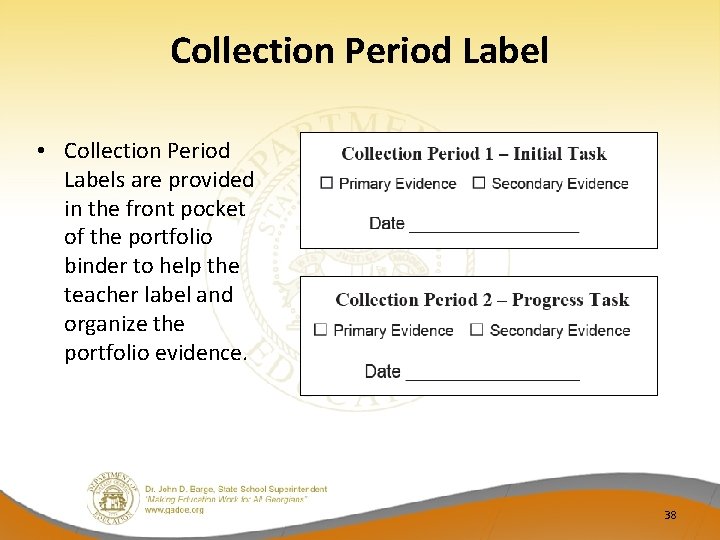
Collection Period Label • Collection Period Labels are provided in the front pocket of the portfolio binder to help the teacher label and organize the portfolio evidence. 38
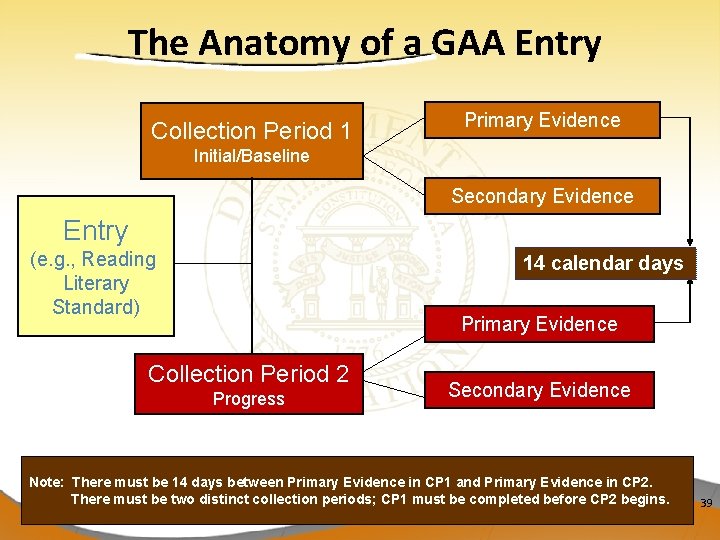
The Anatomy of a GAA Entry Collection Period 1 Primary Evidence Initial/Baseline Secondary Evidence Entry (e. g. , Reading Literary Standard) 14 calendar days Primary Evidence Collection Period 2 Progress Secondary Evidence Note: There must be 14 days between Primary Evidence in CP 1 and Primary Evidence in CP 2. There must be two distinct collection periods; CP 1 must be completed before CP 2 begins. 39
Primary and Secondary Types of Evidence Descriptions and Examples 40
Primary Evidence • Demonstrates knowledge/skills by showing the student’s engagement in tasks • “Primary” refers to the type of evidence; it does not mean that it has to be dated earlier than the Secondary Evidence in that collection period. • It is important that the type of evidence used is the appropriate choice to clearly demonstrate the student’s response. 41
Student Work Sample Primary Evidence • Work samples are items completed or created by the student. Examples: § Writing samples § Graphic organizers § Worksheets (whether commercial or teacher made) • Work samples must be annotated, either on the student work or on a separate annotation page to provide the necessary information for scoring. 42
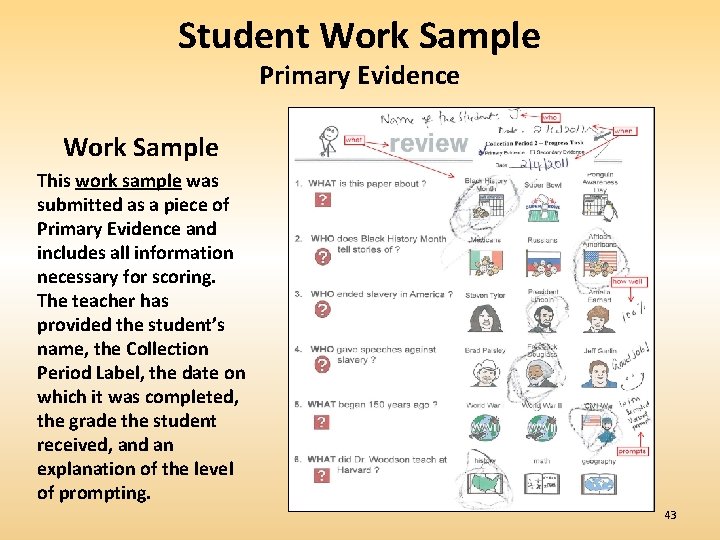
Student Work Sample Primary Evidence Work Sample This work sample was submitted as a piece of Primary Evidence and includes all information necessary for scoring. The teacher has provided the student’s name, the Collection Period Label, the date on which it was completed, the grade the student received, and an explanation of the level of prompting. 43
Permanent Product Primary Evidence • Permanent products are items created by the student (e. g. , murals, drawings, or models). • Many times, a permanent product may be too large or of a nature that prevents the teacher from sending in the actual work. § In these cases, the teacher should photograph (not photocopy) the student’s work, date it, and label it “permanent product. ” § A single photo is acceptable only for permanent products. • Permanent products should have annotations in order to be accurately scored. (GAA Examiner's Manual, 2014 -2015, pages 22 & 23) 44
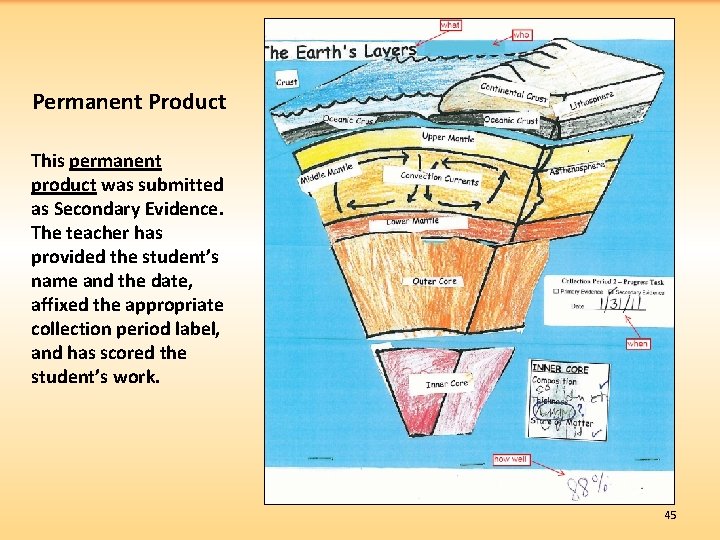
Permanent Product This permanent product was submitted as Secondary Evidence. The teacher has provided the student’s name and the date, affixed the appropriate collection period label, and has scored the student’s work. 45
Series of Captioned Photos Primary Evidence • A series of captioned photographs means at least two photographs must be submitted (three or more are recommended). § The photos should clearly depict the student in the process of the task as well as the completion of the task. § Photos should be captioned to relate to the individual student who is being assessed and should not describe a generic activity completed by the class/group. § The caption should include information regarding the activity in which the student is engaged, the student’s level of success, the setting and interactions, and the type and frequency of prompting, if any, that were provided to the student. 46
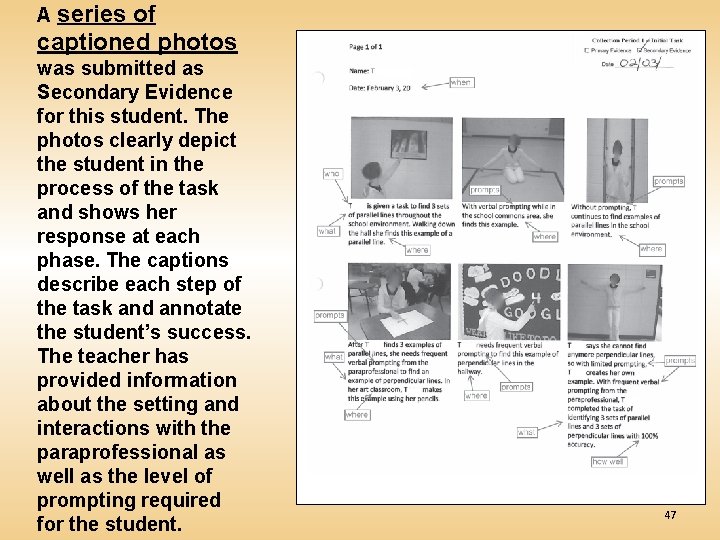
A series of captioned photos was submitted as Secondary Evidence for this student. The photos clearly depict the student in the process of the task and shows her response at each phase. The captions describe each step of the task and annotate the student’s success. The teacher has provided information about the setting and interactions with the paraprofessional as well as the level of prompting required for the student. 47
Media–Audio/Video Accompanied by a Script Primary Evidence • Audio, Video, CDs, Flash Drives, and DVDs can be effective ways to demonstrate students’ skills when tasks involve multiple steps, “verbal” responses, or interaction with others. § It is important to provide a script so that, in the event there are technical problems with viewing or listening to the media, the script can be used for scoring. § The media must be labeled with the student’s name in order to avoid confusion should the media become separated from the portfolio. If there are multiple students in the video, it must be made clear which student should be observed. 48
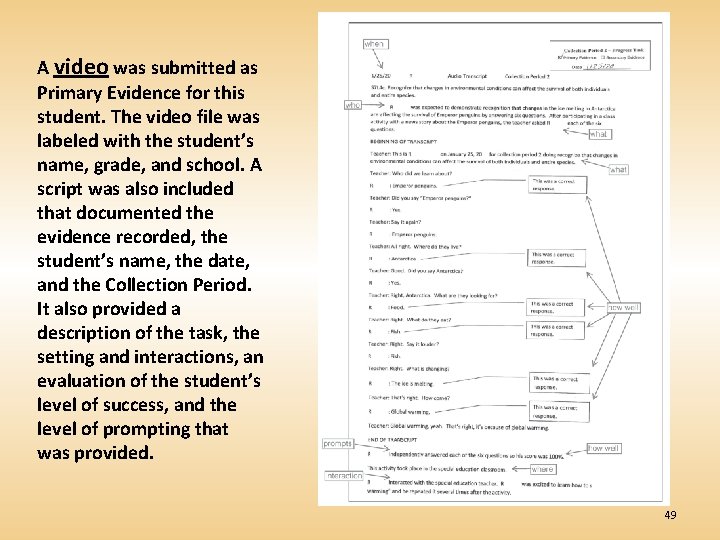
A video was submitted as Primary Evidence for this student. The video file was labeled with the student’s name, grade, and school. A script was also included that documented the evidence recorded, the student’s name, the date, and the Collection Period. It also provided a description of the task, the setting and interactions, an evaluation of the student’s level of success, and the level of prompting that was provided. 49
Secondary Evidence • Reports knowledge/skills by documenting, charting, or interpreting the student’s performance • Secondary Evidence refers to the type of evidence, not to the date or order in which evidence was collected. 50
Data Sheet Secondary Evidence • The data sheet should include a clear description of the task, analysis of the student performance, and a key. It should also include information on the setting, interactions with peers (both with and without disabilities) and community members, and the type and frequency of prompting, if any, that was provided. • A minimum of 3 distinct dates on which evidence was collected for each collection period is required for a data sheet. 51
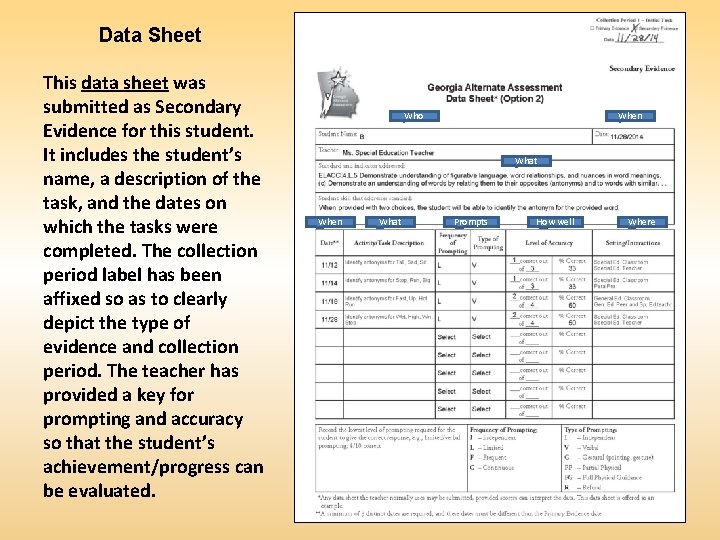
Data Sheet This data sheet was submitted as Secondary Evidence for this student. It includes the student’s name, a description of the task, and the dates on which the tasks were completed. The collection period label has been affixed so as to clearly depict the type of evidence and collection period. The teacher has provided a key for prompting and accuracy so that the student’s achievement/progress can be evaluated. Who When What Prompts How well Where 52
Interview Form Secondary Evidence • Typically, this method of documentation is used when the performance occurs in a community or home setting in which the teacher who is assessing the student is not present (e. g. , on a work site, at a restaurant, etc. ). • The parent, another educator, peer helper, employer, related service staff, or other individual who is in a position to describe the student’s performance is asked a structured set of questions to enable the teacher to document the student’s performance. • Include specific information regarding student performance, setting, and interactions with peers (both with and without disabilities) and community members. 53
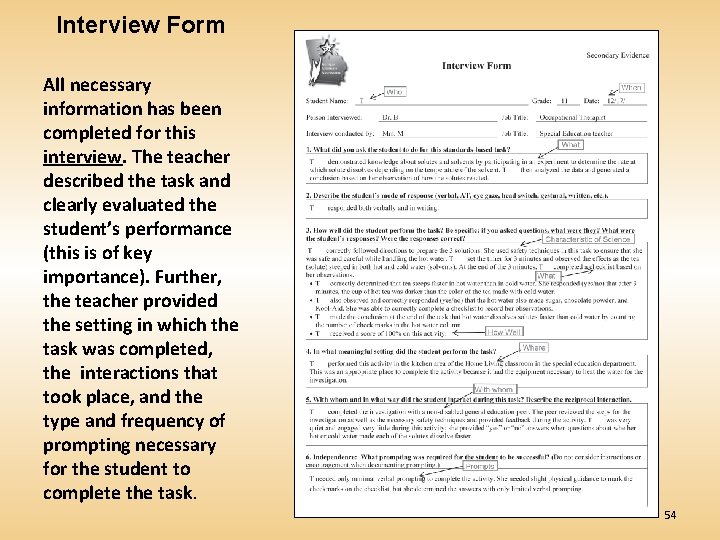
Interview Form All necessary information has been completed for this interview. The teacher described the task and clearly evaluated the student’s performance (this is of key importance). Further, the teacher provided the setting in which the task was completed, the interactions that took place, and the type and frequency of prompting necessary for the student to complete the task. 54
Observation Form Secondary Evidence • The teacher or para‐pro uses the observation form to record the student’s performance on a planned or naturally occurring activity. • Be sure to include specific information regarding student performance, setting, and interactions with peers (both with and without disabilities) and community members. • Do not include an observation of an event for which Primary Evidence has already been submitted. 55
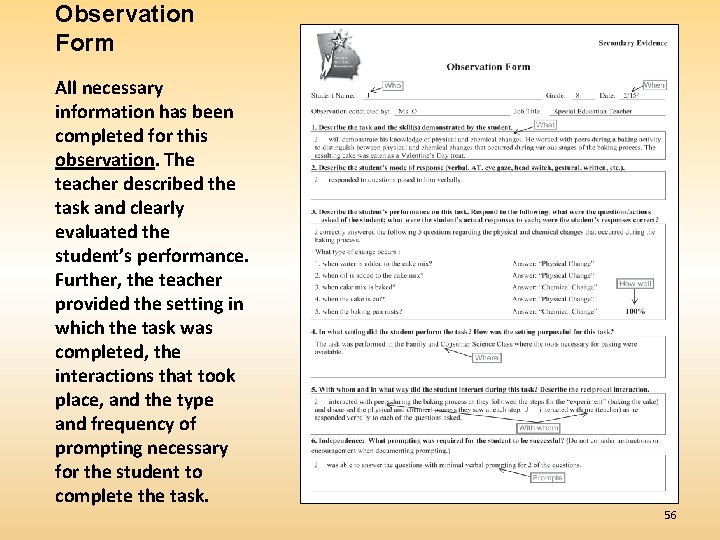
Observation Form All necessary information has been completed for this observation. The teacher described the task and clearly evaluated the student’s performance. Further, the teacher provided the setting in which the task was completed, the interactions that took place, and the type and frequency of prompting necessary for the student to complete the task. 56
Alignment Choosing the Standard for Assessment Alignment to the Intent of the Standard 57
Alignment • Alignment is the connection between the written, taught, and tested curriculum. § Alignment demonstrates the linkage of the activities (student work) to the intent of the grade-level standard and element/indicator on which the student is being assessed. § In order for an entry to be scorable, all four (4) tasks must align to the standard and element/indicator. § Assessment tasks should be designed and task descriptions written to specifically address the standards‐ based skill being evaluated. 58
Alignment–Prerequisite Skills • A prerequisite skill is one that is essential to the acquisition of the standard and element/indicator. § Tasks submitted for the assessment can focus on prerequisite skills that allow the student to be exposed to and assessed on the standard/element at a level that is meaningful and purposeful for the student. • Prerequisite skills must still focus on the intent of the grade level standard and element. § Can working on this skill eventually lead the student to the skill targeted by the standard/element/indicator? 59
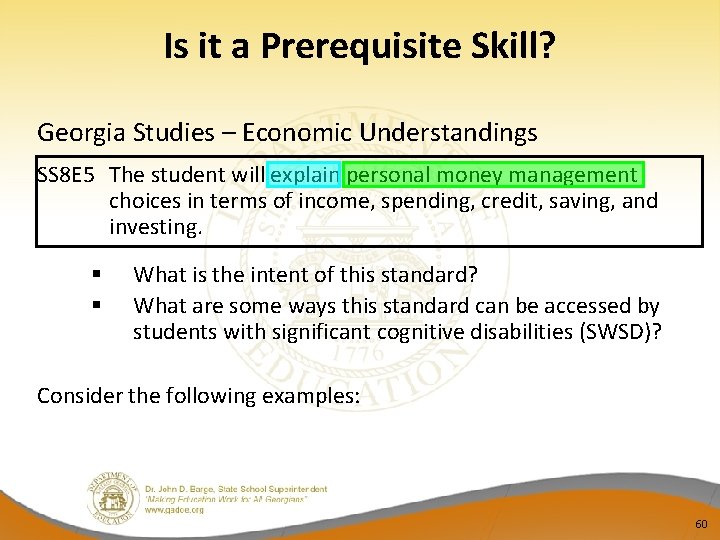
Is it a Prerequisite Skill? Georgia Studies – Economic Understandings SS 8 E 5 The student will explain personal money management choices in terms of income, spending, credit, saving, and investing. § § What is the intent of this standard? What are some ways this standard can be accessed by students with significant cognitive disabilities (SWSD)? Consider the following examples: 60
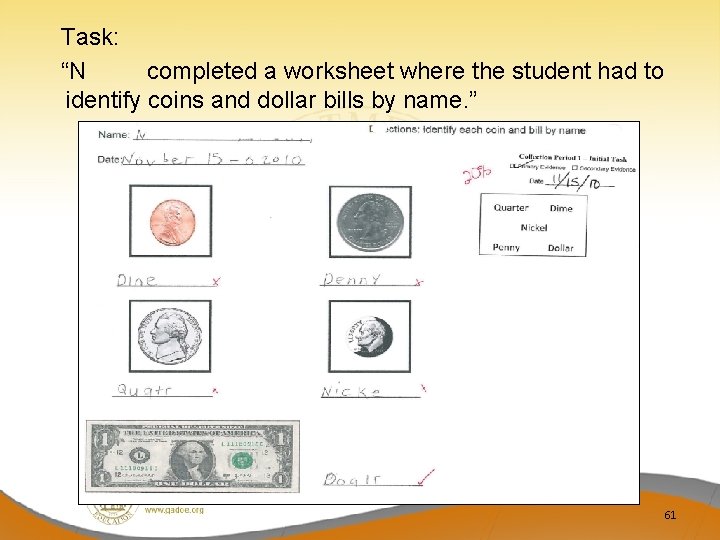
Task: “N completed a worksheet where the student had to identify coins and dollar bills by name. ” 61
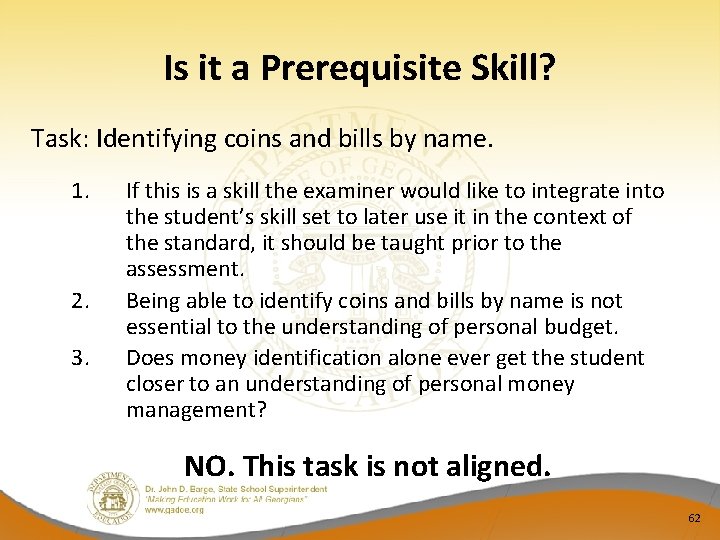
Is it a Prerequisite Skill? Task: Identifying coins and bills by name. 1. 2. 3. If this is a skill the examiner would like to integrate into the student’s skill set to later use it in the context of the standard, it should be taught prior to the assessment. Being able to identify coins and bills by name is not essential to the understanding of personal budget. Does money identification alone ever get the student closer to an understanding of personal money management? NO. This task is not aligned. 62
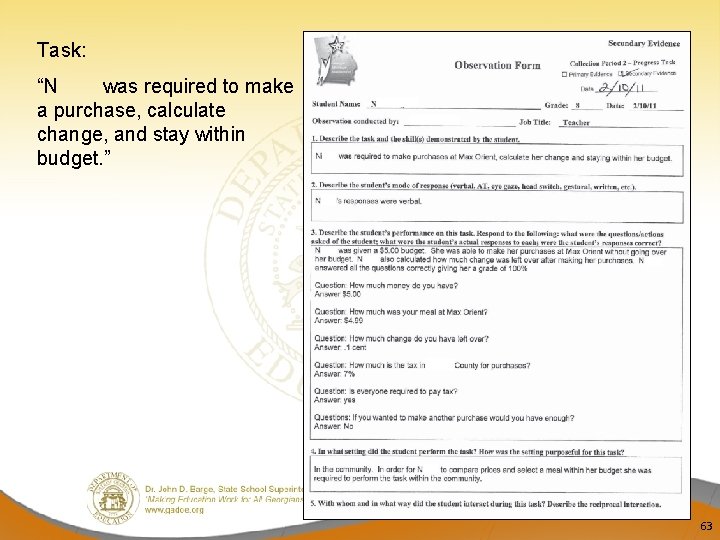
Task: “N was required to make a purchase, calculate change, and stay within budget. ” 63

Is it a Prerequisite Skill? Task: Making spending choices while staying within a budget. 1. 2. 3. This skill is being assessed within the context of the strand standard. Being able to recognize whether or not you have the funds to make a purchase is essential to the understanding of personal money management. Will practice in making saving and spending decisions in a variety of situations get the student closer to an understanding of personal money management? YES. This task is aligned. 64
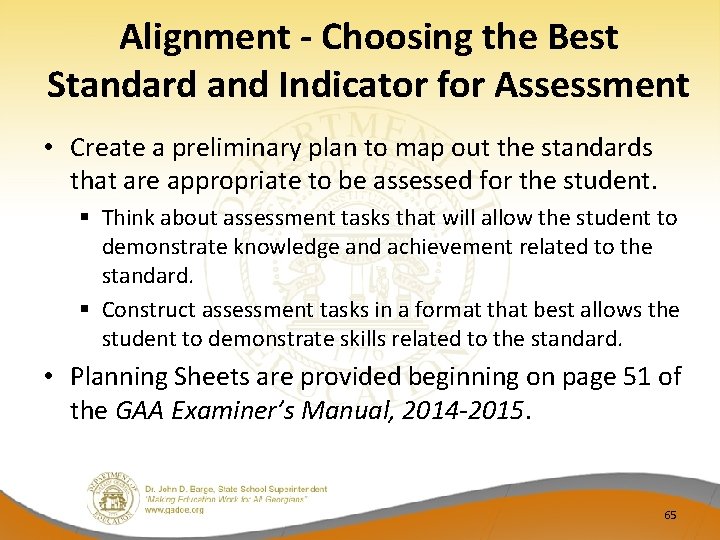
Alignment - Choosing the Best Standard and Indicator for Assessment • Create a preliminary plan to map out the standards that are appropriate to be assessed for the student. § Think about assessment tasks that will allow the student to demonstrate knowledge and achievement related to the standard. § Construct assessment tasks in a format that best allows the student to demonstrate skills related to the standard. • Planning Sheets are provided beginning on page 51 of the GAA Examiner’s Manual, 2014 -2015. 65
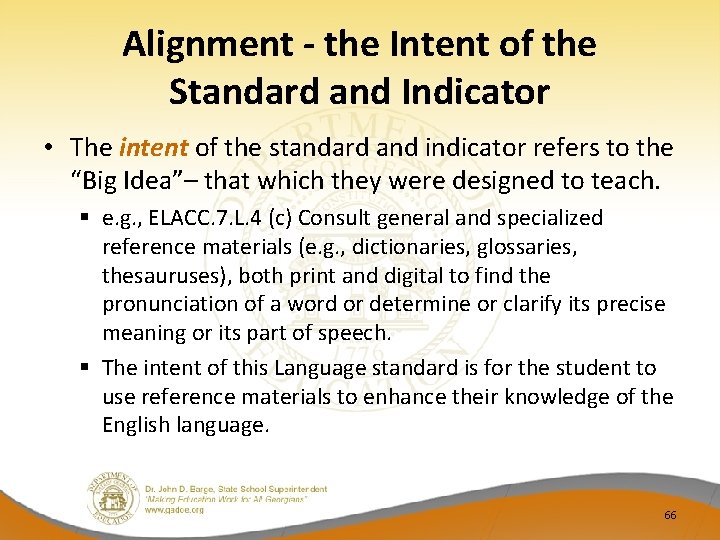
Alignment - the Intent of the Standard and Indicator • The intent of the standard and indicator refers to the “Big Idea”– that which they were designed to teach. § e. g. , ELACC. 7. L. 4 (c) Consult general and specialized reference materials (e. g. , dictionaries, glossaries, thesauruses), both print and digital to find the pronunciation of a word or determine or clarify its precise meaning or its part of speech. § The intent of this Language standard is for the student to use reference materials to enhance their knowledge of the English language. 66
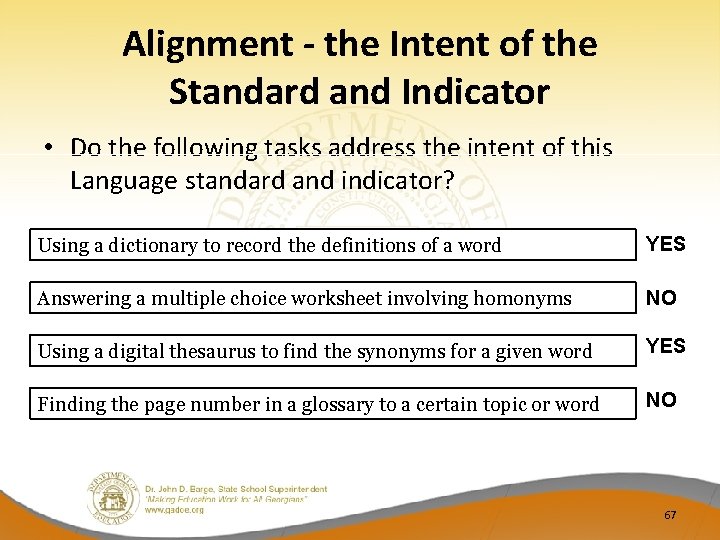
Alignment - the Intent of the Standard and Indicator • Do the following tasks address the intent of this Language standard and indicator? Using a dictionary to record the definitions of a word YES Answering a multiple choice worksheet involving homonyms NO Using a digital thesaurus to find the synonyms for a given word YES Finding the page number in a glossary to a certain topic or word NO 67
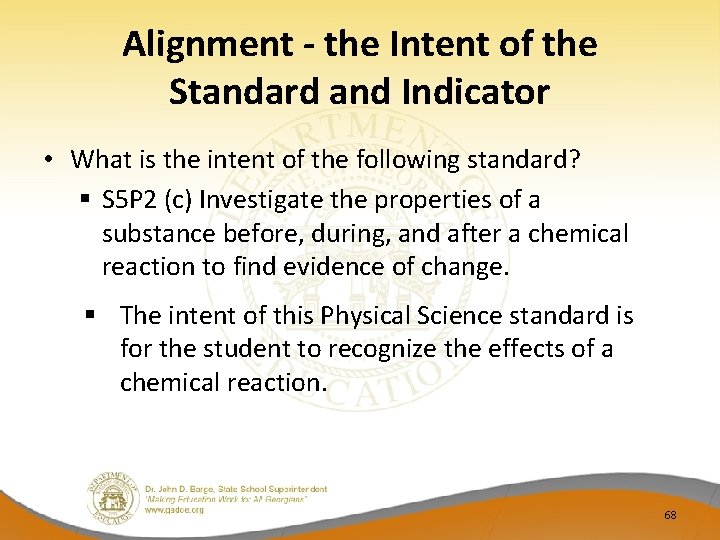
Alignment - the Intent of the Standard and Indicator • What is the intent of the following standard? § S 5 P 2 (c) Investigate the properties of a substance before, during, and after a chemical reaction to find evidence of change. § The intent of this Physical Science standard is for the student to recognize the effects of a chemical reaction. 68
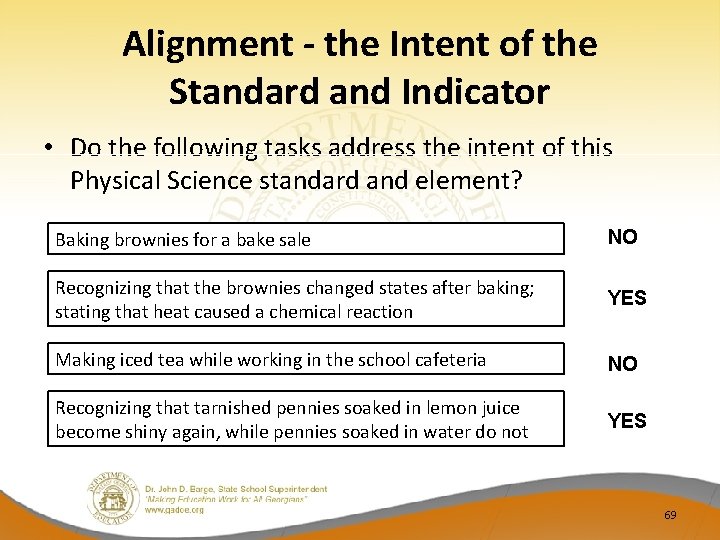
Alignment - the Intent of the Standard and Indicator • Do the following tasks address the intent of this Physical Science standard and element? Baking brownies for a bake sale NO Recognizing that the brownies changed states after baking; stating that heat caused a chemical reaction YES Making iced tea while working in the school cafeteria NO Recognizing that tarnished pennies soaked in lemon juice become shiny again, while pennies soaked in water do not YES 69
Effective Evidence Documentation 70
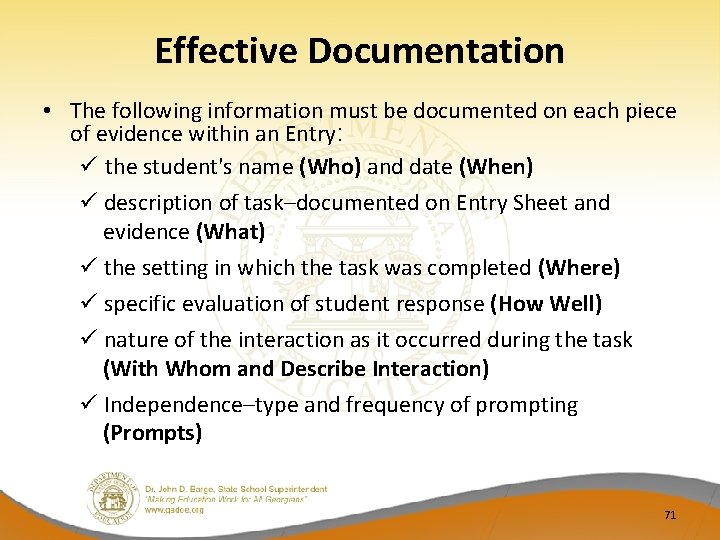
Effective Documentation • The following information must be documented on each piece of evidence within an Entry: ü the student's name (Who) and date (When) ü description of task–documented on Entry Sheet and evidence (What) ü the setting in which the task was completed (Where) ü specific evaluation of student response (How Well) ü nature of the interaction as it occurred during the task (With Whom and Describe Interaction) ü Independence–type and frequency of prompting (Prompts) 71
Completing the Entry Sheet and the Student Demographic Information Form (SDIF) 72
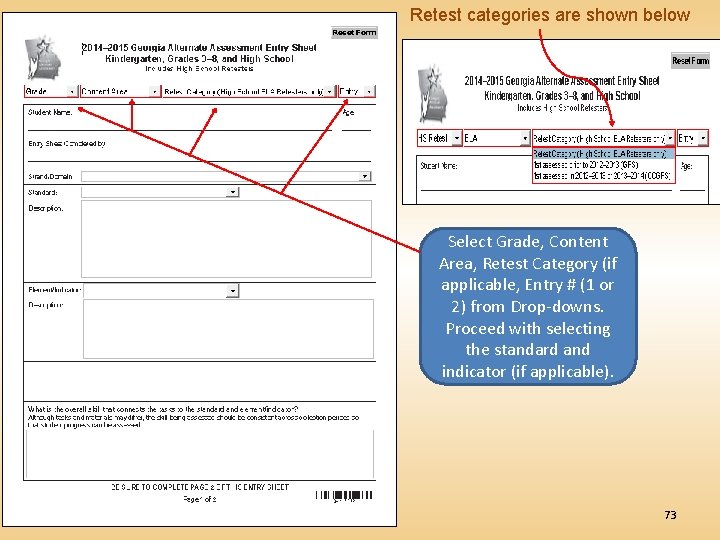
Retest categories are shown below Select Grade, Content Area, Retest Category (if applicable, Entry # (1 or 2) from Drop‐downs. Proceed with selecting the standard and indicator (if applicable). 73
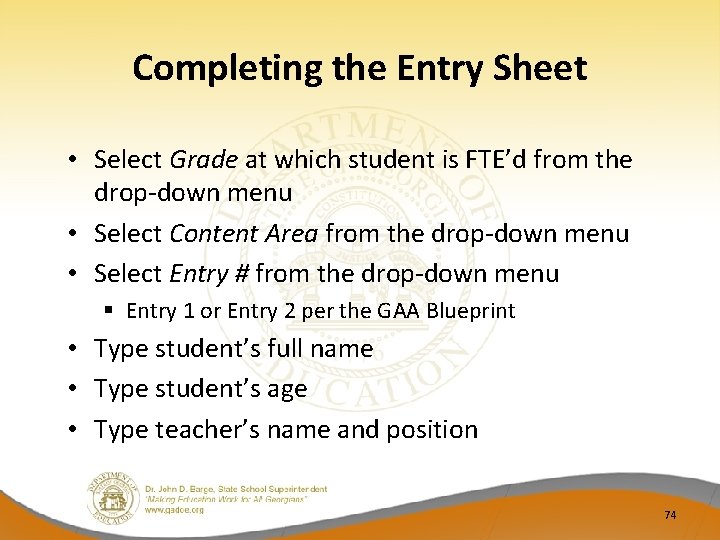
Completing the Entry Sheet • Select Grade at which student is FTE’d from the drop‐down menu • Select Content Area from the drop‐down menu • Select Entry # from the drop‐down menu § Entry 1 or Entry 2 per the GAA Blueprint • Type student’s full name • Type student’s age • Type teacher’s name and position 74
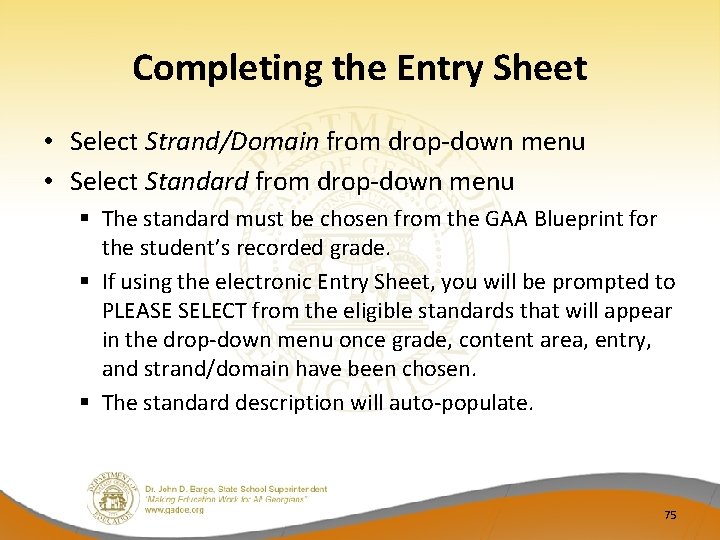
Completing the Entry Sheet • Select Strand/Domain from drop‐down menu • Select Standard from drop‐down menu § The standard must be chosen from the GAA Blueprint for the student’s recorded grade. § If using the electronic Entry Sheet, you will be prompted to PLEASE SELECT from the eligible standards that will appear in the drop‐down menu once grade, content area, entry, and strand/domain have been chosen. § The standard description will auto‐populate. 75
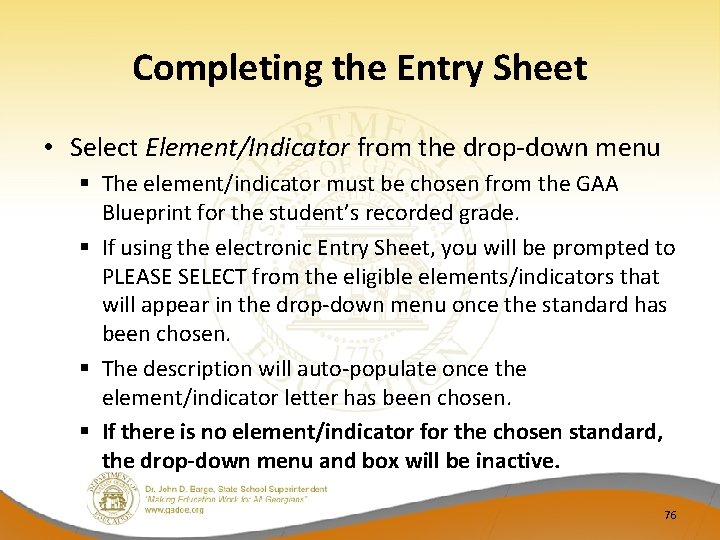
Completing the Entry Sheet • Select Element/Indicator from the drop‐down menu § The element/indicator must be chosen from the GAA Blueprint for the student’s recorded grade. § If using the electronic Entry Sheet, you will be prompted to PLEASE SELECT from the eligible elements/indicators that will appear in the drop‐down menu once the standard has been chosen. § The description will auto‐populate once the element/indicator letter has been chosen. § If there is no element/indicator for the chosen standard, the drop-down menu and box will be inactive. 76
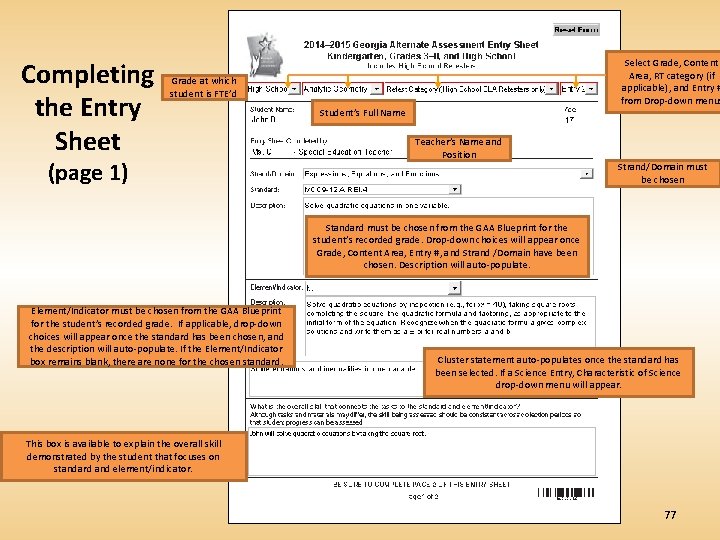
Completing the Entry Sheet Select Grade, Content Area, RT category (if applicable), and Entry # from Drop‐down menus Grade at which student is FTE’d (page 1) Student’s Full Name Teacher’s Name and Position Strand/Domain must be chosen Standard must be chosen from the GAA Blueprint for the student’s recorded grade. Drop‐down choices will appear once Grade, Content Area, Entry #, and Strand /Domain have been chosen. Description will auto‐populate. Element/Indicator must be chosen from the GAA Blueprint for the student’s recorded grade. If applicable, drop‐down choices will appear once the standard has been chosen, and the description will auto‐populate. If the Element/Indicator box remains blank, there are none for the chosen standard. Cluster statement auto‐populates once the standard has been selected. If a Science Entry, Characteristic of Science drop‐down menu will appear. This box is available to explain the overall skill demonstrated by the student that focuses on standard and element/indicator. 77
Completing the Entry Sheet Special Features • When assessing mathematics in grades Kindergarten, 3‐ 8 and HS a note will auto‐populate with information about the cluster from which the math standard is derived. • When assessing science, the words Characteristic of Science will appear along with a drop‐down menu of the co‐requisite science process that must be selected on the Entry Sheet and exhibited in at least one of the four pieces of evidence submitted for the science entry. 78
Completing the Entry Sheet • Continue to page 2 of the Entry Sheet and complete all required fields for Primary and Secondary Evidence for both collection periods. § Type the date in the “Date” box. § Select the type of evidence being submitted from the “Type of Evidence” drop‐down. § Type the task description into the “Description of Task” box. • The description of the assessment task should relate the task to the specific standard/indicator being assessed. • Do NOT include evaluation of the student’s work, documentation of the type and frequency of prompting, or information about settings or interactions. This documentation must be found within the evidence. 79
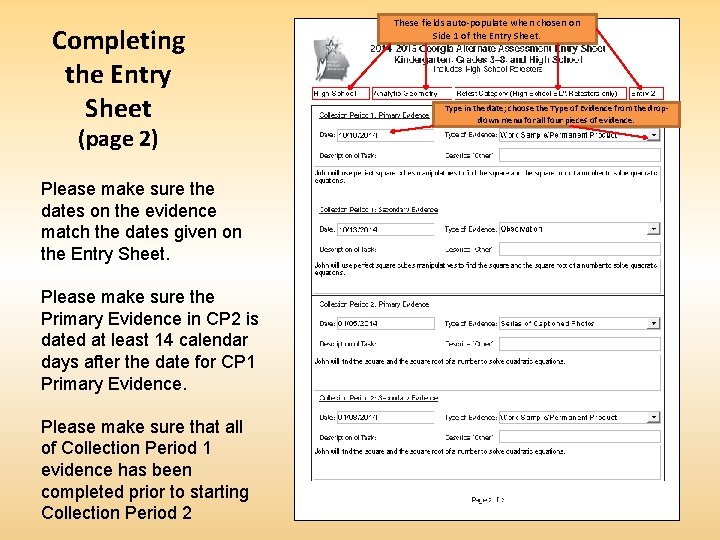
Completing the Entry Sheet (page 2) These fields auto‐populate when chosen on Side 1 of the Entry Sheet. Type in the date; choose the Type of Evidence from the drop‐ down menu for all four pieces of evidence. Please make sure the dates on the evidence match the dates given on the Entry Sheet. Please make sure the Primary Evidence in CP 2 is dated at least 14 calendar days after the date for CP 1 Primary Evidence. Please make sure that all of Collection Period 1 evidence has been completed prior to starting Collection Period 2 80
Student Demographic Information Form Three different SDIFs will be utilized for the 2014‐ 2015 administration of the GAA. • SDIF for grades Kindergarten and 3‐ 8 § Form is AQUA • SDIF for High School § Form is ORANGE • SDIF for High School Retest § Form is BLUE 81
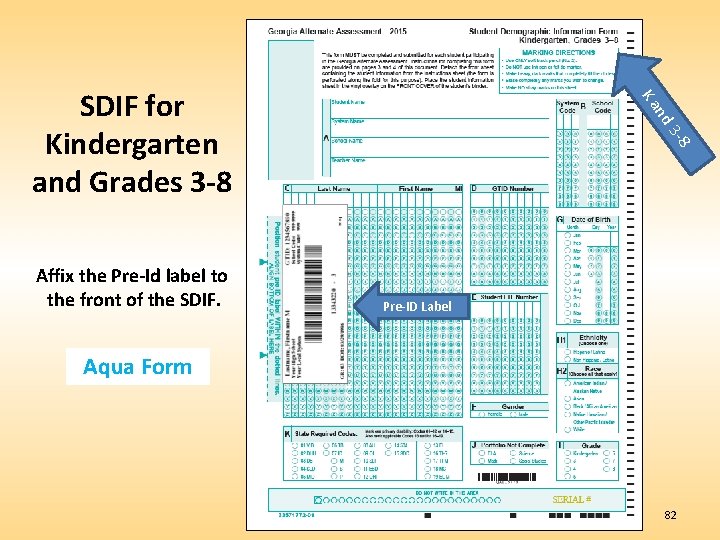
nd 3‐ 8 Affix the Pre-Id label to the front of the SDIF. Ka SDIF for Kindergarten and Grades 3 -8 Pre‐ID Label Aqua Form 82
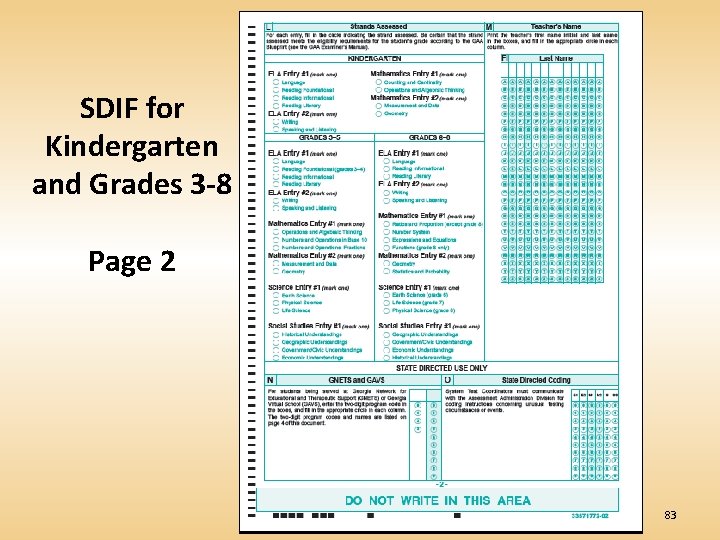
SDIF for Kindergarten and Grades 3 -8 Page 2 83
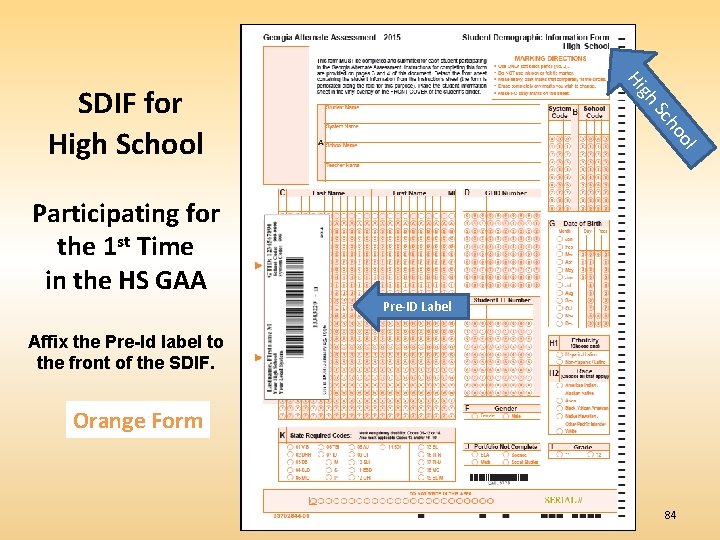
gh Hi ol ho Sc SDIF for High School Participating for the 1 st Time in the HS GAA Pre‐ID Label Affix the Pre-Id label to the front of the SDIF. Orange Form 84
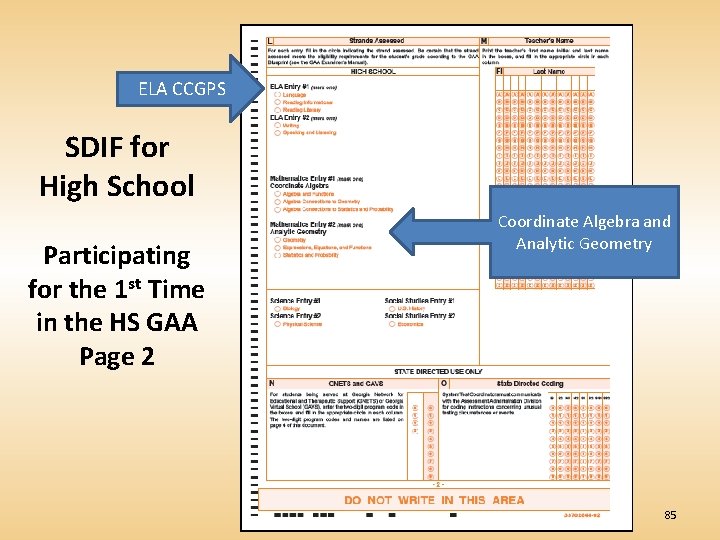
ELA CCGPS SDIF for High School Participating for the 1 st Time in the HS GAA Page 2 Coordinate Algebra and Analytic Geometry 85
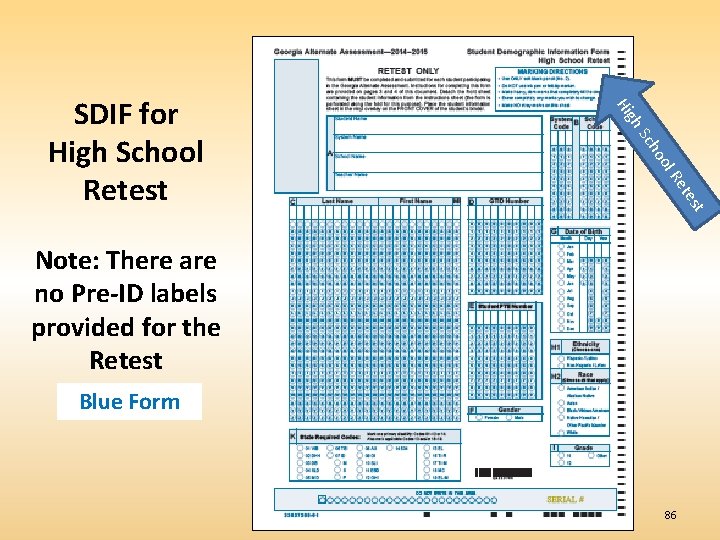
gh Hi ete l. R o ho Sc st SDIF for High School Retest Note: There are no Pre-ID labels provided for the Retest Blue Form 86
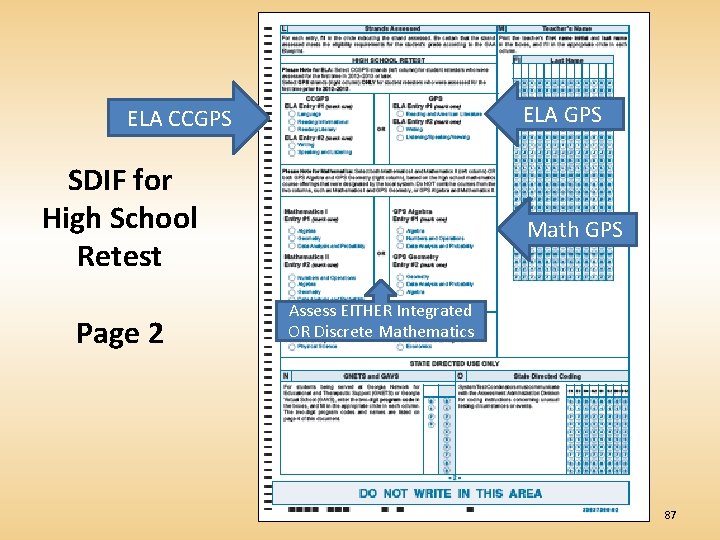
ELA GPS ELA CCGPS SDIF for High School Retest Page 2 Math GPS Assess EITHER Integrated OR Discrete Mathematics 87

Organizing and Submitting the Portfolio 88
Organize the Portfolio • Review the evidence to ensure that you have used only grade‐ appropriate materials and that you have provided opportunities for generalization of skills in different settings and with different people. • Replace any evidence you have collected that does not clearly illustrate the student’s initial skill or progress on the tasks. • Date your evidence and affix the appropriate collection period labels (optional) to all evidence being submitted – Primary and Secondary. § There must be at least 14 calendar days between the Primary Evidence for Collection Period 1 and the Primary Evidence for Collection Period 2. § There must be two distinct collection periods; CP 1 must be completed before CP 2 begins. 89
Organize the Portfolio • Affix the Pre‐ID Label to the Student Demographic Information Form (SDIF) in the correct location. § If a pre‐ID label is not available for a student or if the information is not correct, complete all of the student demographic information according to the instructions. • Complete the Validation Form. § Make sure that it is signed by the test administrator and the building administrator. § Place it behind Divider One (Student Information). • Complete the Release to Use Portfolio for Training. § Place it behind Divider One (Student Information). 90
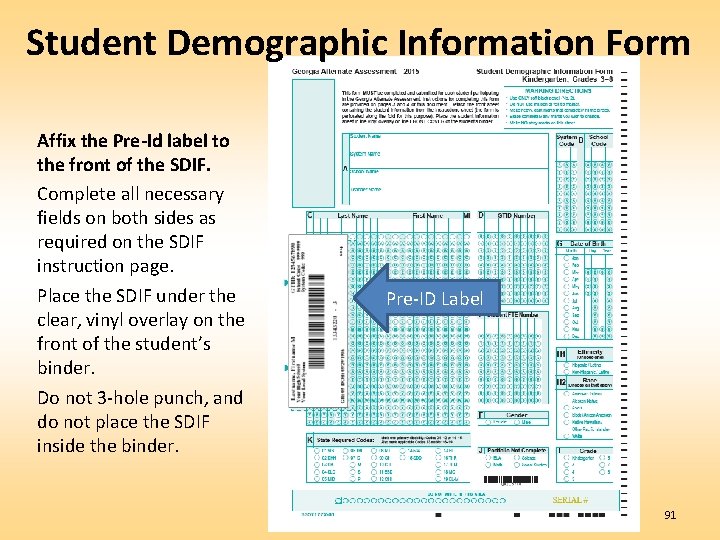
Student Demographic Information Form Affix the Pre-Id label to the front of the SDIF. Complete all necessary fields on both sides as required on the SDIF instruction page. Place the SDIF under the clear, vinyl overlay on the front of the student’s binder. Do not 3‐hole punch, and do not place the SDIF inside the binder. Pre‐ID Label 91
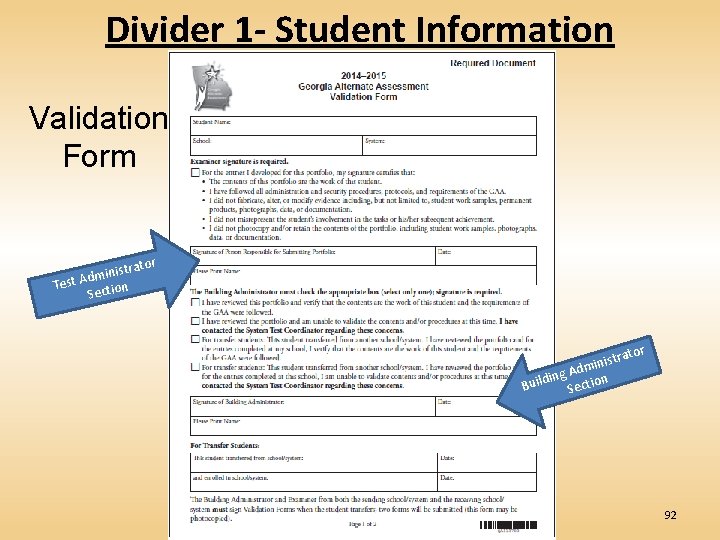
Divider 1 - Student Information Validation Form tor istra n i m d Test A ction Se ator r t s i n i Adm g n i Build Section 92
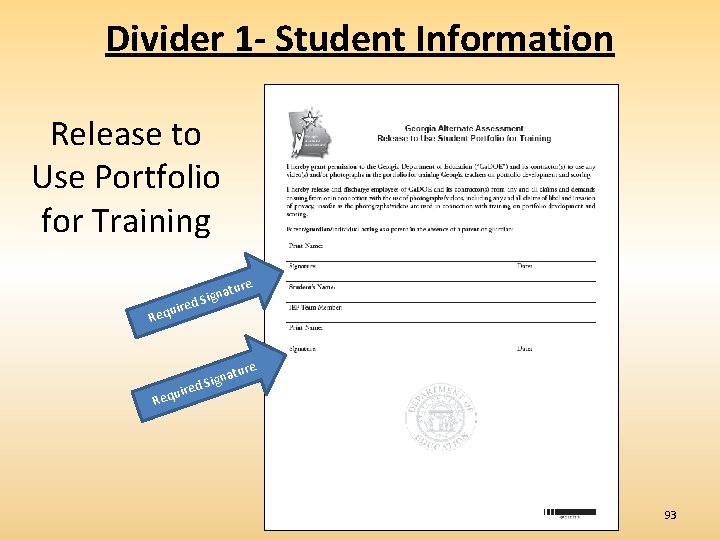
Divider 1 - Student Information Release to Use Portfolio for Training e atur n g i ed S ir u Req e r natu g i S ed uir Req 93
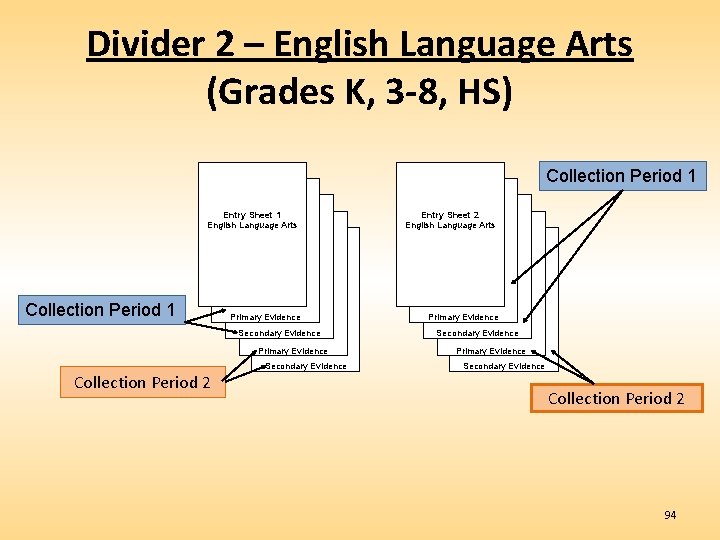
Divider 2 – English Language Arts (Grades K, 3 -8, HS) Collection Period 1 Entry Sheet 1 English Language Arts Collection Period 1 Primary Evidence Secondary Evidence Primary Evidence Collection Period 2 Secondary Evidence Entry Sheet 2 English Language Arts Primary Evidence Secondary Evidence Collection Period 2 94
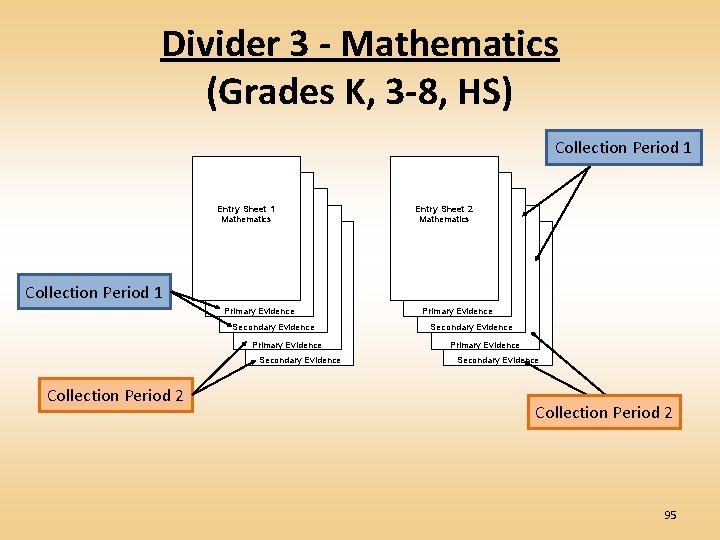
Divider 3 - Mathematics (Grades K, 3 -8, HS) Collection Period 1 Entry Sheet 1 Mathematics Entry Sheet 2 Mathematics Collection Period 1 Primary Evidence Secondary Evidence Collection Period 2 95
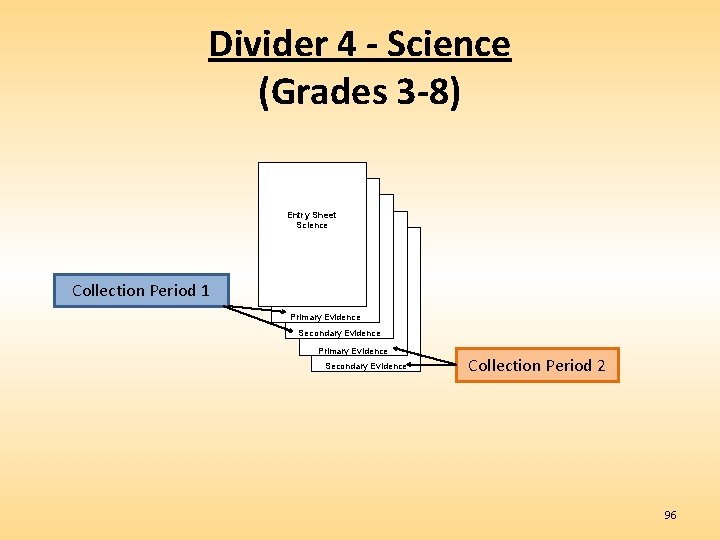
Divider 4 - Science (Grades 3 -8) Entry Sheet Science Collection Period 1 Primary Evidence Secondary Evidence Collection Period 2 96
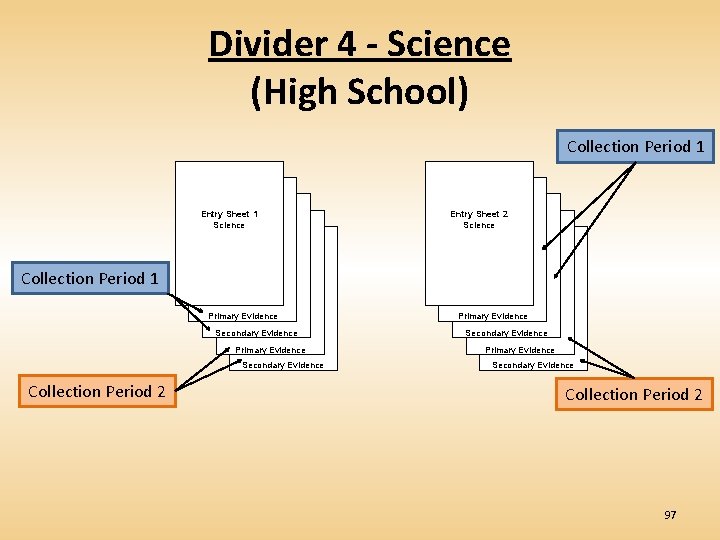
Divider 4 - Science (High School) Collection Period 1 Entry Sheet 1 Science Entry Sheet 2 Science Collection Period 1 Primary Evidence Secondary Evidence Collection Period 2 97
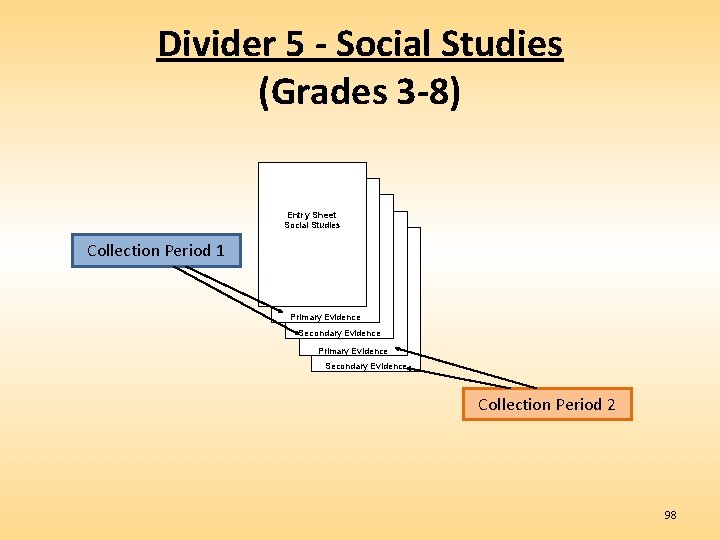
Divider 5 - Social Studies (Grades 3 -8) Entry Sheet Social Studies Collection Period 1 Primary Evidence Secondary Evidence Collection Period 2 98
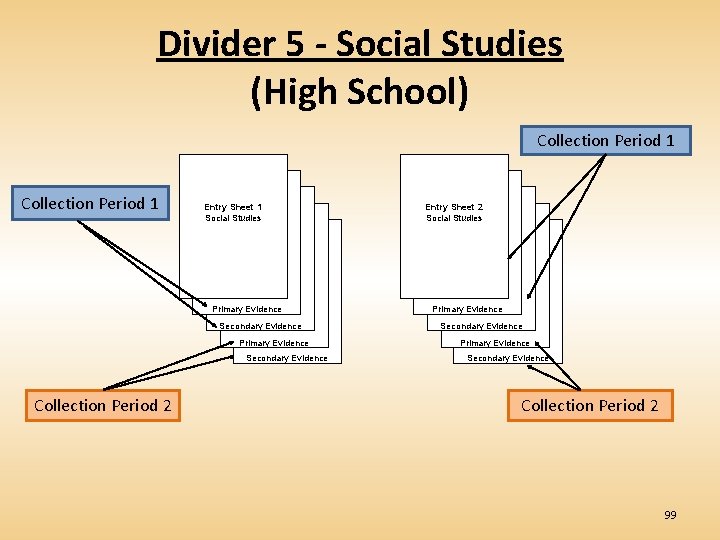
Divider 5 - Social Studies (High School) Collection Period 1 Entry Sheet 1 Social Studies Primary Evidence Secondary Evidence Collection Period 2 Entry Sheet 2 Social Studies Primary Evidence Secondary Evidence Collection Period 2 99
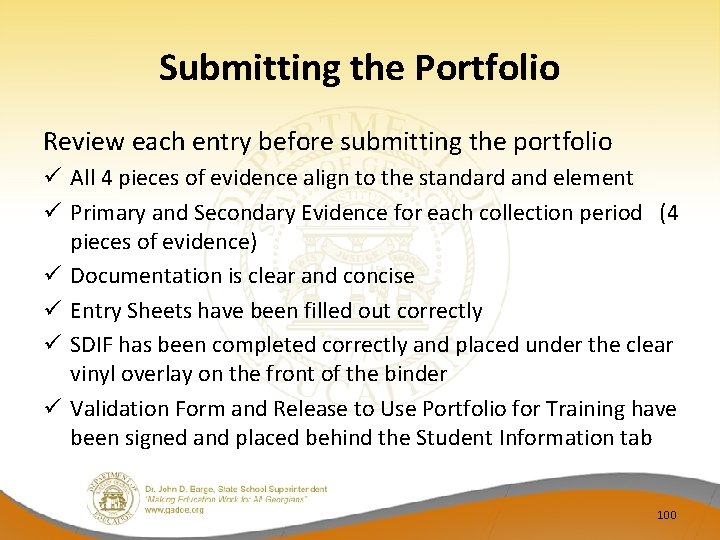
Submitting the Portfolio Review each entry before submitting the portfolio ü All 4 pieces of evidence align to the standard and element ü Primary and Secondary Evidence for each collection period (4 pieces of evidence) ü Documentation is clear and concise ü Entry Sheets have been filled out correctly ü SDIF has been completed correctly and placed under the clear vinyl overlay on the front of the binder ü Validation Form and Release to Use Portfolio for Training have been signed and placed behind the Student Information tab 100
Submitting the Portfolio • Check with your School Test Coordinator for information about portfolio review procedures and schedules within your school/system. • Follow the protocol determined by your system for the Portfolio Review Process. • Submit the binder to your School Test Coordinator by the date specified by your school system. 101

Test Security 102
Test Security • Maintaining security of all student materials is crucial to obtaining valid and reliable assessment results. • While the GAA materials themselves are not considered secure materials, student work and entries are secure once they have been chosen as assessment evidence and placed in the GAA portfolio binder. § Original student work or photos/videos of original student work (permanent products) must be submitted. § GAA evidence may not be photocopied and retained. § Photocopied permanent products may not be submitted as evidence. 103
Test Security • Once compiled into the portfolio, student work and materials being used for the purposes of the GAA must be kept in locked storage within the classroom– except during use. • Access to those materials must be restricted to authorized individuals only. 104
Test Security • The assessment binder should not be removed from the school building, except when sign‐out procedures are in effect for the purpose of peer reviews. • It is the direct responsibility of all individuals who administer the assessment to follow security procedures and protect the integrity of the assessment process. 105
Test Security • Any action which compromises assessment security or leads to the invalidation of an individual student’s or a group of students’ test scores will be viewed by the Georgia Department of Education (Ga. DOE) as inappropriate use or handling of tests and will be treated as such. • Any concern regarding test security must be reported to Ga. DOE immediately. • Assessment Administration Division staff members are available to help system personnel develop and implement appropriate assessment security procedures. 106

Portfolio Validation 107
2014 -2015 Validation Form • The Validation Form was designed to address certain issues that should not occur during the assembly of a student’s portfolio. ØFabricating or altering evidence of student work ØMaking and retaining photocopies of contents ØSubmitting photocopies of student work • Signatures of the Test Administrator and Building Administrator are required. 108
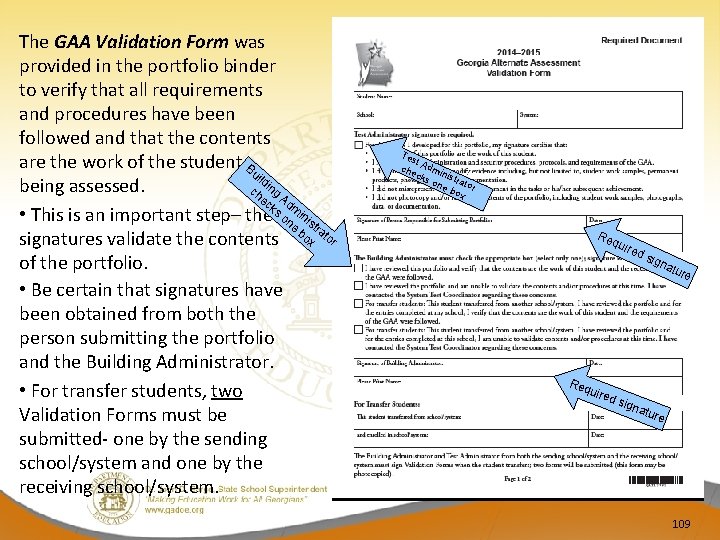
The GAA Validation Form was provided in the portfolio binder to verify that all requirements and procedures have been followed and that the contents are the work of the student Bu ild being assessed. ch ing ec Ad k m • This is an important step– thes one inistr a signatures validate the contents box tor of the portfolio. • Be certain that signatures have been obtained from both the person submitting the portfolio and the Building Administrator. • For transfer students, two Validation Forms must be submitted‐ one by the sending school/system and one by the receiving school/system. Tes t che Admi cks nist one rator box Re qui red Req sig nat ure uire d si gna ture 109
Portfolio Validation • The portfolio validation process requires signatures on the Validation Form which authenticates the student work included in the portfolio. • This form is a required document that must be completed and signed by both the Building Administrator and the person responsible for submitting the portfolio. § Refusal to sign the Validation Form is NOT an option • This is a secure document which will be checked upon receipt. • In the case of transfer students, two Validation Forms must be submitted (one from the original school and one from the new school). 110
Portfolio Validation • Violation of any of the aforementioned requirements for compiling student work for the GAA may result in the portfolio being invalidated and could result in additional actions or consequences. • Should the Building Administrator, Portfolio Reviewer, or STC discover any irregularities, the portfolio can be returned to the teacher for correction. • If it is too late in the process or not feasible to return the portfolio to the school/teacher, an Irregularities Form must be completed by the System Test Coordinator alerting the Ga. DOE to the problem. 111

Ethics Portfolio Invalidations 112
Ethics • The Georgia Alternate Assessment is a state and federally mandated assessment for students with significant cognitive disabilities who have met the participation guidelines and have been determined appropriate for the assessment by their IEP teams. • This assessment must adhere to all of the protocols and procedures required for the general assessments. • A breach of any of the validation or security policies constitutes both a procedural and ethical violation necessitating an investigation and possible consequences. 113
Portfolio Invalidation • Should an investigation of any of the aforementioned issues determine that a breach has occurred, one possible consequence is invalidation of the portfolio. • In such a case, the scores for the entry/entries in question are wiped out, and it is reported as an invalid assessment. 114
Issues Resulting in Invalidation • Irregularities and questions about evidence authenticity are sometimes discovered and -reported by schools and/or systems. self § brought to light during portfolio review process § noted by Building Administrators during validation process § reported, sometimes anonymously, by various school personnel • If these irregularities are discovered, addressed, and corrected prior to portfolio submission, it is unnecessary to report them to the state as long as they are dealt with at the school/system level. 115
Issues Resulting in Invalidation • Issues regarding evidence authenticity and possible fabrication can also be discovered during scoring. • Problems most frequently seen include: § Dates changed, erased, and rewritten or covered over with correction fluid or collection period labels § Observation and interview forms with identical information attributed to multiple students § Identical permanent products attributed to multiple students (not group work) • These issues will result in the portfolio being invalidated. 116
Issues Resulting in Invalidation • The vast majority of portfolios submitted for the 2013‐ 2014 GAA were compiled following prescribed policies and procedures, and the evidence submitted represented authentic student work. § Actually, the number of invalidated portfolios has decreased slightly over the last two administrations. • Careful attention to validation and evidence requirements during portfolio review will help to ensure that this trend continues. 117

Portfolio Review Process 118
GAA Portfolio Review • A great deal of time and effort goes into compiling the portfolio of student work that showcases the progress a student has made in knowledge and skills in the academic content standards and elements. • Portfolio reviewers provide an invaluable service as they work to support teachers before final submission of GAA portfolios by making sure that all requirements have been met. 119
Portfolio Review Prior to Submission • It is critical that the portfolio be reviewed both during collection and before submission to be certain that everything is complete, tasks align, and evidence requirements have been met. • To this end, it is imperative that portfolio reviewers participate in training and become very familiar with all requirements as outlined in the Examiner’s Manual and the webinar trainings. 120
Portfolio Review by the Teacher Portfolio review by the teacher should be an ongoing process throughout evidence collection. ü Have I selected the best standard and indicator for this student? • Does he/she seem engaged? • Is he/she making progress? üAre the tasks and materials appropriate? • Is he/she able to demonstrate what he/she knows? • Can he/she communicate with a reliable response? ü Should I replace this evidence and design a task that is more appropriate for the individual student? 121
Structuring a Portfolio Review Who should conduct the portfolio review? • Trained GAA Administrator • Designated GAA Trainer • Core Access Teacher • School Test Coordinator • SPED Coordinator • Building Administrator 122
Structuring a Portfolio Review When should the review be conducted? • 1 st Review: mid‐administration, after Collection Period 1 evidence has been compiled • Final Review: before submission, after all evidence has been compiled and organized in the portfolio binder 123
Portfolio Review Steps to complete a peer review of the portfolio: 1. Carefully review the Entry Sheet • • Student name Teacher name Required standard Eligible standard Strand/domain, standard, element/indicator match up Characteristic of Science Task Descriptions 124
Portfolio Review 2. Consider all aspects of the evidence requirements All four pieces of evidence align to standard and indicator Primary and Secondary Evidence included for each collection period • Original student work, not photocopies, must be submitted. § At least 14 calendar days from Primary to Primary § Types of evidence are the best choices to clearly demonstrate the student’s responses § Grade‐appropriate materials § § 125
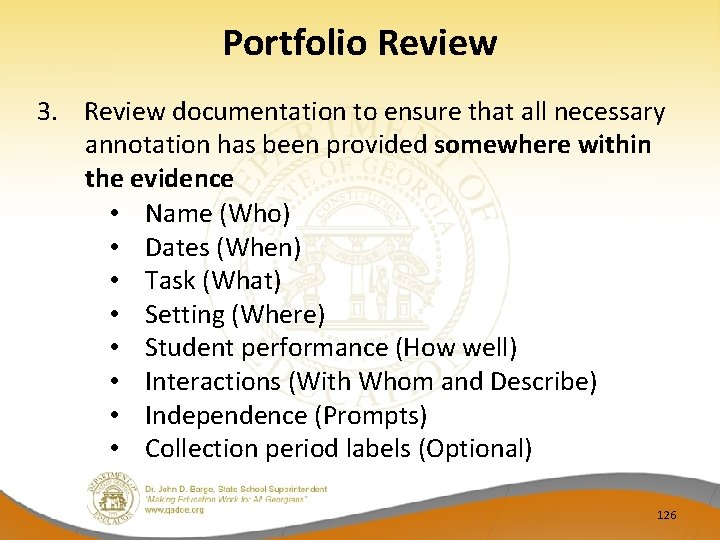
Portfolio Review 3. Review documentation to ensure that all necessary annotation has been provided somewhere within the evidence • Name (Who) • Dates (When) • Task (What) • Setting (Where) • Student performance (How well) • Interactions (With Whom and Describe) • Independence (Prompts) • Collection period labels (Optional) 126
Portfolio Review 4. Sign and date Checklist for Teachers and Portfolio Reviewers 5. Validation Form must be signed by Building Administrator and Person Responsible for Submitting the Portfolio (Test Administrator) 6. Recommend or verify that the Release to use Portfolio for Training has been signed and included in portfolio 127
Validation Check for Alignment • The vast majority of nonscorables on the GAA are assigned in the Not Aligned (NA) category. § In the 2013‐ 2014 administration, over 80% of all nonscorables were the result of alignment issues. § In a majority of these instances, only one or two of the four tasks did not align. • This indicates that teachers do have an understanding of the requirements of the standard and element. • It is critical that the portfolio reviewers evaluate each task individually to determine alignment of all four tasks to the standard and element. 128
Validation Check for Alignment Have opportunities for teaching and learning, aligned to the assessed content, been provided? • When looking at the assessment task in isolation, can you identify the content standard/academic domain? • Could a curriculum content expert link the task back to the specific state standard? • Have the distinct essential components of the standard (element/indicator) been addressed? § What are the specific characteristics that make up the standard? § Focus on the language/terminology as written. • Do all four assessment tasks align to the intent of the element as it applies to the specified content standard? 129
Reviewing Documentation When reviewing evidence documentation, the teacher and portfolio reviewer must ask him or herself the following questions: 1. What, specifically, was the student asked to do as it aligns to the standard and indicator? 2. What were the actual questions/actions asked of the student? 3. What were the student’s answers? How did he/she respond? 4. Were the answers/responses correct? Has evaluation of student performance by the teacher been clearly documented? 5. What was the type and frequency of prompting required for the student to successfully complete the task? 130
Reviewing Documentation • Review to ensure that all necessary documentation has been provided. • It is very important that documentation be clear and concise. • Contradictory or unnecessary annotations can lead to lower scores. • Accuracy or correctness of the student response should be documented separately from the type and frequency of prompting that led the student to the correct response. 131
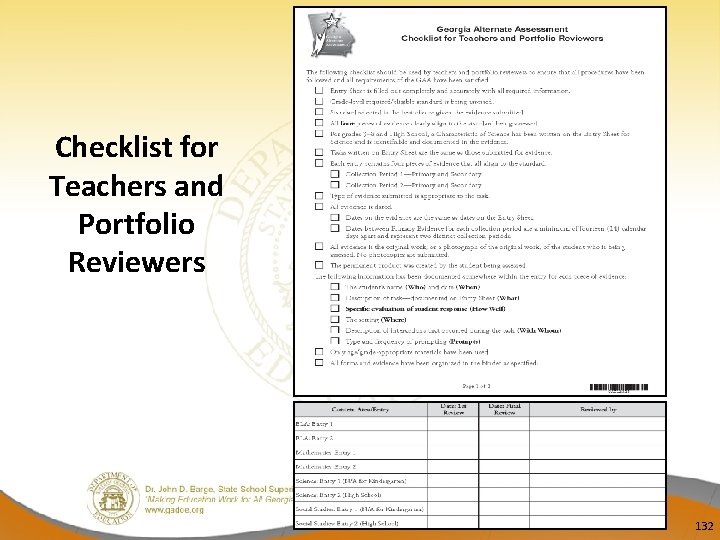
Checklist for Teachers and Portfolio Reviewers 132
The Checklist for Teachers and Portfolio Reviewers is provided in the portfolio binder to ensure that all procedures and requirements have been satisfied before the portfolio is submitted. • The checklist should be part of the portfolio validation and review process as the reviewer signs and dates the form after each content area entry is checked. • It is recommended that the portfolio be reviewed twice – once after the first collection period has been completed and again before the portfolio is submitted. • The GAA Evidence Checklist, specific to each type of evidence submitted, can be found on pages 54‐ 56 of the GAA Examiner’s Manual, 2014 -2015. 133
Avoiding Invalidations Reminder: • If irregularities are discovered, addressed, and corrected prior to portfolio submission, it would be unnecessary to report them to the state as long as they are dealt with at the school/system level. • Systems can and should attempt to rectify them. However, as with all irregularities, they should be reported to Deborah Houston. They may, or may not, require a Portal record. 134
Ensuring a Successful Administration • Principals are critical! § The GAA must be given the same consideration, resources, and support provided for all programs. • Teachers need support § Planning time needs to be scheduled; substitutes provided § Collaboration and training with content experts to facilitate understanding of content standards § Collaboration with other special educators to discuss/share/review aligned tasks § Professional development concerning curriculum access 135

Ensuring a Successful Administration • Training and support will continue to be provided on the state level in the form of: § GAA Fall Workshops via Blackboard presentations, § Webinars focusing on GAA administration as well as access to the curriculum, § the GAA Resource Board, and § portfolio review by peers and building examiners. 136

137
- Slides: 137