
Georgetown University School of Continuing Studies Certificate in
- Slides: 1
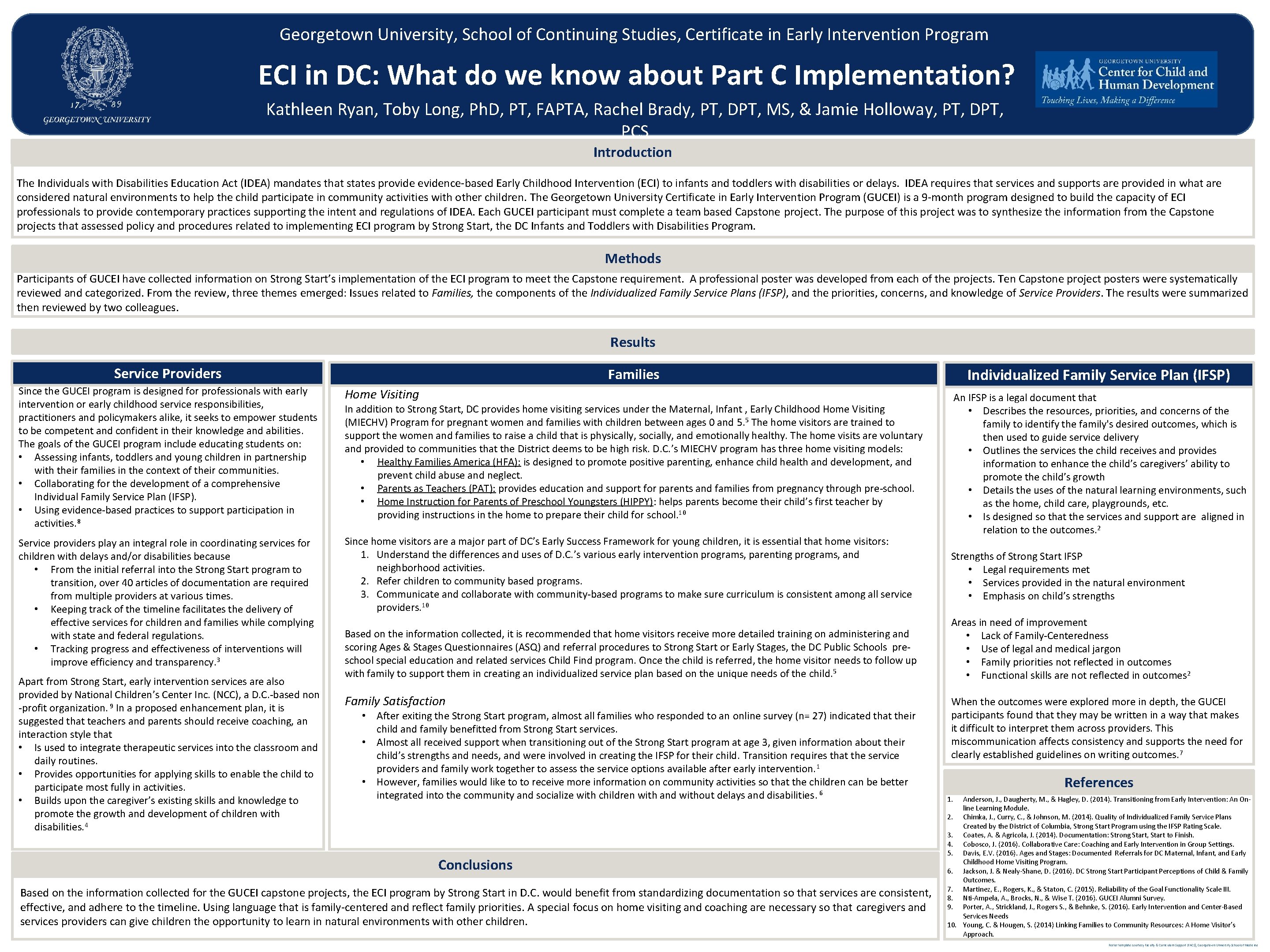
Georgetown University, School of Continuing Studies, Certificate in Early Intervention Program ECI in DC: What do we know about Part C Implementation? Kathleen Ryan, Toby Long, Ph. D, PT, FAPTA, Rachel Brady, PT, DPT, MS, & Jamie Holloway, PT, DPT, PCS Introduction The Individuals with Disabilities Education Act (IDEA) mandates that states provide evidence-based Early Childhood Intervention (ECI) to infants and toddlers with disabilities or delays. IDEA requires that services and supports are provided in what are considered natural environments to help the child participate in community activities with other children. The Georgetown University Certificate in Early Intervention Program (GUCEI) is a 9 -month program designed to build the capacity of ECI professionals to provide contemporary practices supporting the intent and regulations of IDEA. Each GUCEI participant must complete a team based Capstone project. The purpose of this project was to synthesize the information from the Capstone projects that assessed policy and procedures related to implementing ECI program by Strong Start, the DC Infants and Toddlers with Disabilities Program. Methods Participants of GUCEI have collected information on Strong Start’s implementation of the ECI program to meet the Capstone requirement. A professional poster was developed from each of the projects. Ten Capstone project posters were systematically reviewed and categorized. From the review, three themes emerged: Issues related to Families, the components of the Individualized Family Service Plans (IFSP), and the priorities, concerns, and knowledge of Service Providers. The results were summarized then reviewed by two colleagues. Results Service Providers Families Individualized Family Service Plan (IFSP) In addition to Strong Start, DC provides home visiting services under the Maternal, Infant , Early Childhood Home Visiting (MIECHV) Program for pregnant women and families with children between ages 0 and 5. 5 The home visitors are trained to support the women and families to raise a child that is physically, socially, and emotionally healthy. The home visits are voluntary and provided to communities that the District deems to be high risk. D. C. ’s MIECHV program has three home visiting models: • Healthy Families America (HFA): is designed to promote positive parenting, enhance child health and development, and prevent child abuse and neglect. • Parents as Teachers (PAT): provides education and support for parents and families from pregnancy through pre-school. • Home Instruction for Parents of Preschool Youngsters (HIPPY): helps parents become their child’s first teacher by providing instructions in the home to prepare their child for school. 10 An IFSP is a legal document that • Describes the resources, priorities, and concerns of the family to identify the family's desired outcomes, which is then used to guide service delivery • Outlines the services the child receives and provides information to enhance the child’s caregivers’ ability to promote the child’s growth • Details the uses of the natural learning environments, such as the home, child care, playgrounds, etc. • Is designed so that the services and support are aligned in relation to the outcomes. 2 Since the GUCEI program is designed for professionals with early intervention or early childhood service responsibilities, practitioners and policymakers alike, it seeks to empower students to be competent and confident in their knowledge and abilities. The goals of the GUCEI program include educating students on: • Assessing infants, toddlers and young children in partnership with their families in the context of their communities. • Collaborating for the development of a comprehensive Individual Family Service Plan (IFSP). • Using evidence-based practices to support participation in activities. 8 Home Visiting Service providers play an integral role in coordinating services for children with delays and/or disabilities because • From the initial referral into the Strong Start program to transition, over 40 articles of documentation are required from multiple providers at various times. • Keeping track of the timeline facilitates the delivery of effective services for children and families while complying with state and federal regulations. • Tracking progress and effectiveness of interventions will improve efficiency and transparency. 3 Since home visitors are a major part of DC’s Early Success Framework for young children, it is essential that home visitors: 1. Understand the differences and uses of D. C. ’s various early intervention programs, parenting programs, and neighborhood activities. 2. Refer children to community based programs. 3. Communicate and collaborate with community-based programs to make sure curriculum is consistent among all service providers. 10 Apart from Strong Start, early intervention services are also provided by National Children’s Center Inc. (NCC), a D. C. -based non -profit organization. 9 In a proposed enhancement plan, it is suggested that teachers and parents should receive coaching, an interaction style that • Is used to integrate therapeutic services into the classroom and daily routines. • Provides opportunities for applying skills to enable the child to participate most fully in activities. • Builds upon the caregiver’s existing skills and knowledge to promote the growth and development of children with disabilities. 4 Based on the information collected, it is recommended that home visitors receive more detailed training on administering and scoring Ages & Stages Questionnaires (ASQ) and referral procedures to Strong Start or Early Stages, the DC Public Schools preschool special education and related services Child Find program. Once the child is referred, the home visitor needs to follow up with family to support them in creating an individualized service plan based on the unique needs of the child. 5 Family Satisfaction • After exiting the Strong Start program, almost all families who responded to an online survey (n= 27) indicated that their child and family benefitted from Strong Start services. • Almost all received support when transitioning out of the Strong Start program at age 3, given information about their child’s strengths and needs, and were involved in creating the IFSP for their child. Transition requires that the service providers and family work together to assess the service options available after early intervention. 1 • However, families would like to to receive more information on community activities so that the children can be better integrated into the community and socialize with children with and without delays and disabilities. 6 Conclusions Based on the information collected for the GUCEI capstone projects, the ECI program by Strong Start in D. C. would benefit from standardizing documentation so that services are consistent, effective, and adhere to the timeline. Using language that is family-centered and reflect family priorities. A special focus on home visiting and coaching are necessary so that caregivers and services providers can give children the opportunity to learn in natural environments with other children. Strengths of Strong Start IFSP • Legal requirements met • Services provided in the natural environment • Emphasis on child’s strengths Areas in need of improvement • Lack of Family-Centeredness • Use of legal and medical jargon • Family priorities not reflected in outcomes • Functional skills are not reflected in outcomes 2 When the outcomes were explored more in depth, the GUCEI participants found that they may be written in a way that makes it difficult to interpret them across providers. This miscommunication affects consistency and supports the need for clearly established guidelines on writing outcomes. 7 References 1. Anderson, J. , Daugherty, M. , & Hagley, D. (2014). Transitioning from Early Intervention: An Online Learning Module. 2. Chimka, J. , Curry, C. , & Johnson, M. (2014). Quality of Individualized Family Service Plans Created by the District of Columbia, Strong Start Program using the IFSP Rating Scale. 3. Coates, A. & Agricola, J. (2014). Documentation: Strong Start, Start to Finish. 4. Cobosco, J. (2016). Collaborative Care: Coaching and Early Intervention in Group Settings. 5. Davis, E. V. (2016). Ages and Stages: Documented Referrals for DC Maternal, Infant, and Early Childhood Home Visiting Program. 6. Jackson, J. & Nealy-Shane, D. (2016). DC Strong Start Participant Perceptions of Child & Family Outcomes. 7. Martinez, E. , Rogers, K. , & Staton, C. (2015). Reliability of the Goal Functionality Scale III. 8. Nti-Ampela, A. , Brocks, N. , & Wise T. (2016). GUCEI Alumni Survey. 9. Porter, A. , Strickland, J. , Rogers S. , & Behnke, S. (2016). Early Intervention and Center-Based Services Needs 10. Young, C. & Hougen, S. (2014) Linking Families to Community Resources: A Home Visitor’s Approach. Poster template courtesy Faculty & Curriculum Support (FACS), Georgetown University School of Medicine