George Washingtons Terms Review o Articles of Confederation
- Slides: 21
George Washington’s Terms
Review o Articles of Confederation o Constitution o Bill of Rights
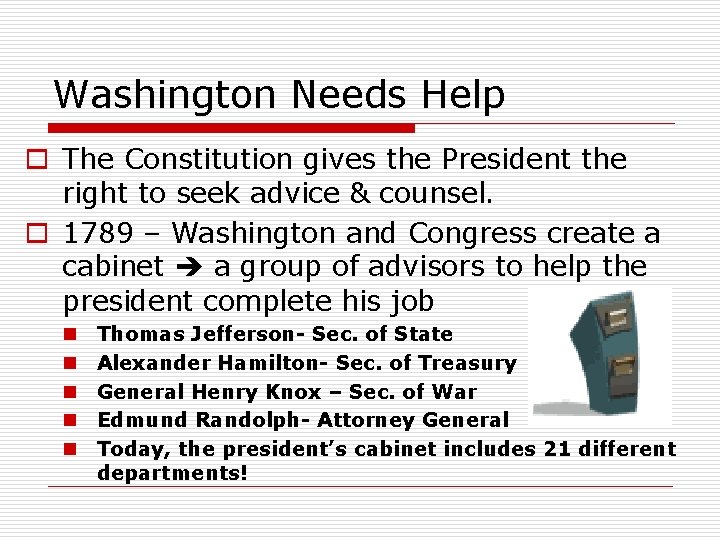
Washington Needs Help o The Constitution gives the President the right to seek advice & counsel. o 1789 – Washington and Congress create a cabinet a group of advisors to help the president complete his job n n n Thomas Jefferson- Sec. of State Alexander Hamilton- Sec. of Treasury General Henry Knox – Sec. of War Edmund Randolph- Attorney General Today, the president’s cabinet includes 21 different departments!
The Judicial Branch o Judiciary Act of 1789 – Congress established… n 13 district courts n 3 appellate courts n The Supreme Court o With the Senate’s consent, Washington chose the federal judges
Washington Inherits Problems o The US was broke! n Tariff of 1789 – importers had to pay a tax on their cargo when they landed it in the US o Shippers also had to pay tonnage – a tax based on how much their ships carried n Angered Southerners! o New taxes = higher prices for the goods they needed o Tonnage tax = they would be charged more to ship their crops to Europe
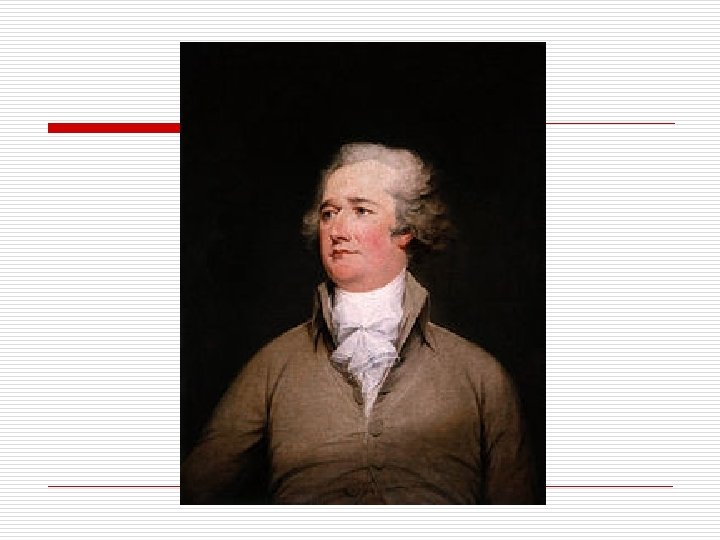
Hamilton’s Debt Plan o Alexander Hamilton – Sec. Of Treasury developed a plan to solve nation’s debt: 1. Supported Tariff of 1789 (tax imported goods) 2. Pay off all foreign debts (from Rev. War) 3. Pay off bonds to their full value (from Rev. War) 4. Combine all state debts from the war & pay off together
Opposition to Hamilton o Madison and Jefferson hated Hamilton’s plan. They felt it was unfair b/c… 1. Original purchasers of the bonds would not get their money back o Many had already sold them for very cheap to speculators n Speculators – people willing to take a risk in hopes of future financial gain 2. Most of the tax money to pay off the bonds would come from the South, but… o It was Northerners who owned most of the bonds
Mad-Jeff/Hamilton Compromise o July 1790 – Madison-Jefferson strike a deal with Hamilton n Mad-Jeff use their influence to convince Southerners in Congress to vote for Hamilton’s plan n In return the capital would be moved from New York to a southern area b/w Virginia and Maryland along the Potomac River o They b/l having the capital in the South would offset the strength of the Northern states in Congress
Creating a US Bank o Hamilton asks Congress to create a national bank to… n Manage debts n Issue bank notes (paper money) n Provide a national currency o Promote trade, encourage investment, stimulate economic growth
Opposition to the US Bank o Madison and Jefferson were opposed n Worried Northern merchants would own most of the bank’s stock n Argued that Congress could not establish a bank o Not listed in the enumerated powers in the Constitution o Congress passes the bank bill o 1791 – Washington signs it into law
Different Interpretations o Mad-Jeff said the Constitution did not give the federal govt. power to create a bank o Hamilton argued it did… n Article I, Section 8 – the federal govt. has the power “to make all laws which shall be necessary and proper” n The “necessary and proper” clause created implied powers – powers not specifically listed in the Constitution
Loose or Strict? o Loose interpretation of the Constitution n Can do whatever the Constitution does not specifically restrict govt. from doing o Strict interpretation of the Constitution n Can do only what the Constitution specifically states the govt. can do
Tax the Whiskey! o 1791 – Hamilton urges Congress to impose a tax on the manufacture of whiskey n Enraged Western farmers b/c whiskey was used as a way of trading (money) n Opposition to the tax lasted for a few years but b/c a rebellion in 1794
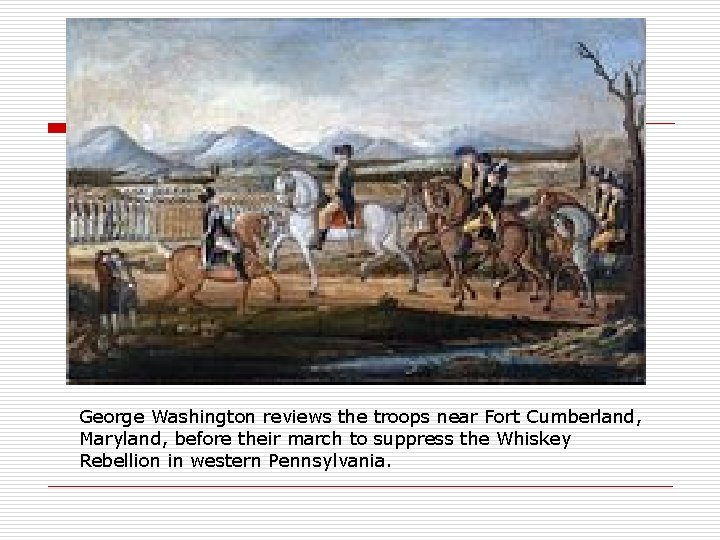
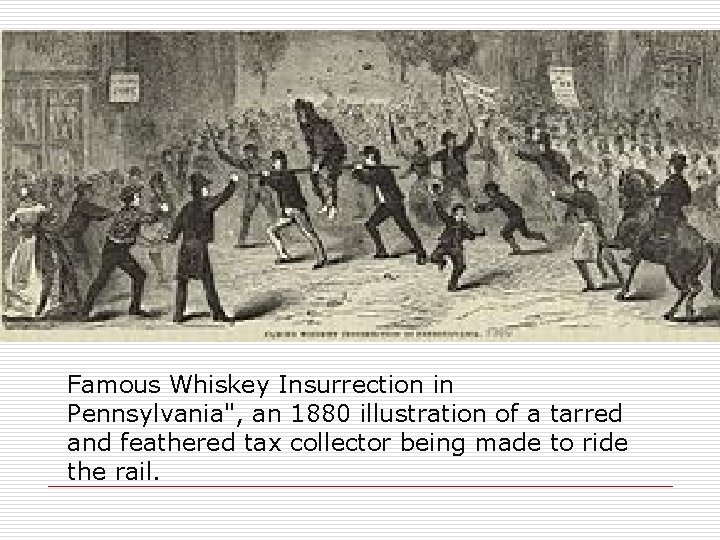
Whiskey Rebellion o 1794 – a rebellion erupted in Western Pennsylvania n n Farmers terrorized tax collectors Stopped court proceedings Robbed the mail Destroyed the whiskey-making stills of those who paid the tax
George Washington reviews the troops near Fort Cumberland, Maryland, before their march to suppress the Whiskey Rebellion in western Pennsylvania.
Washington Kills the Rebellion o August 1794 – Washington sends 15, 000 troops to crush the Whiskey Rebellion n The rebels dispersed without a fight o Shows the federal govt. willingness to use troops against its own citizens
Famous Whiskey Insurrection in Pennsylvania", an 1880 illustration of a tarred and feathered tax collector being made to ride the rail.
The Formation of Political Parties o Federalists- supporters of Hamilton’s plans and viewpoints o Democratic-Republicans- supporters of Madison and Jefferson’s viewpoints n At this time they referred to them as Republicans n In the 1800’s the party b/c known as the Democrats
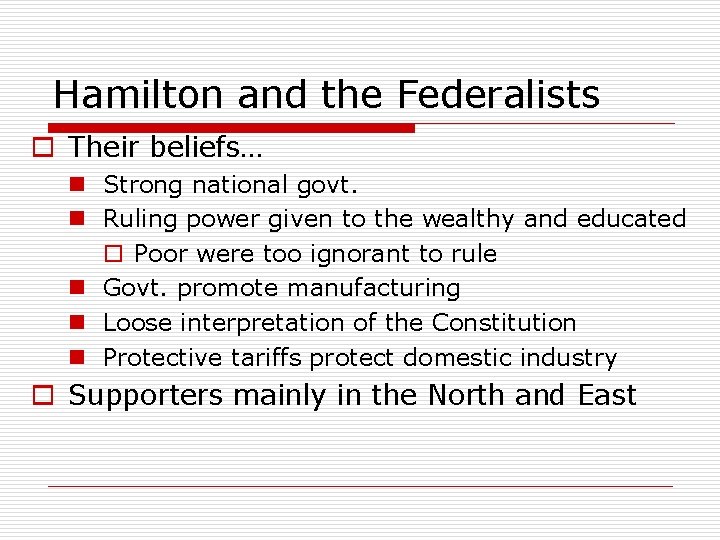
Hamilton and the Federalists o Their beliefs… n Strong national govt. n Ruling power given to the wealthy and educated o Poor were too ignorant to rule n Govt. promote manufacturing n Loose interpretation of the Constitution n Protective tariffs protect domestic industry o Supporters mainly in the North and East
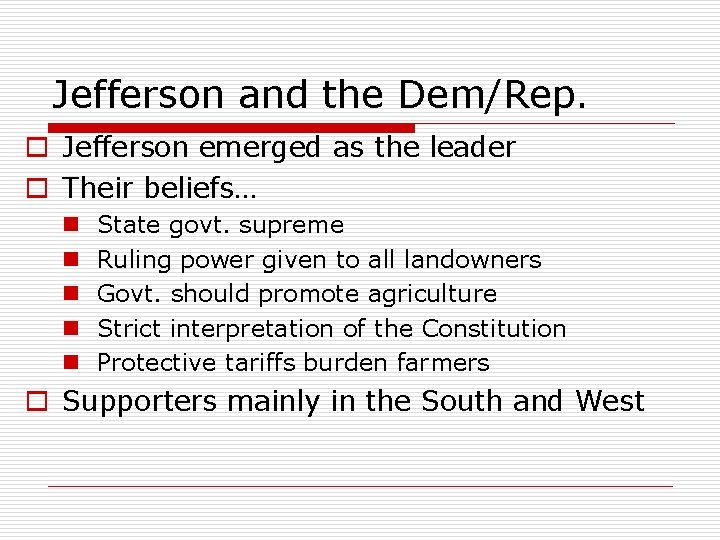
Jefferson and the Dem/Rep. o Jefferson emerged as the leader o Their beliefs… n n n State govt. supreme Ruling power given to all landowners Govt. should promote agriculture Strict interpretation of the Constitution Protective tariffs burden farmers o Supporters mainly in the South and West