
GEORGE MASON UNIVERSITY GRADUATE SCHOOL OF EDUCATION ADVANCED




- Slides: 25
GEORGE MASON UNIVERSITY GRADUATE SCHOOL OF EDUCATION ADVANCED STUDIES IN TEACHING AND LEARNING ACADEMIC PROGRAM COORDINATOR, ASTL: DR. REBECCA K. FOX OUTREACH COORDINATOR, ASTL: TERRENCE J. JENKINS DEGREE; M. ED. , CURRICULUM AND INSTRUCTION HOMEPAGE: HTTP: //GSE. GMU. EDU/PROGRAMS/ASTL/
AGENDA q. Program Overview: q. Mission, Core Values, Program Outcomes & Professional Dispositions q. Program Structure q. Course Sequence & Admission Information q. Final Reminders
GEORGE MASON UNIVERSITY College of Education and Human Development Graduate School of Education Division of Advanced Professional Teacher Development and International Education Advanced Studies in Teaching and Learning
ASTL MISSION To develop the content, pedagogical content knowledge, leadership skills, and research capacity of practicing teachers who want to take an inquiry stance on their educational practice and lead from the classroom as they contribute to on-going school improvement and educational change.
The ASTL Curriculum is Grounded in the Five Core Propositions of the National Board for Professional Teaching Standards
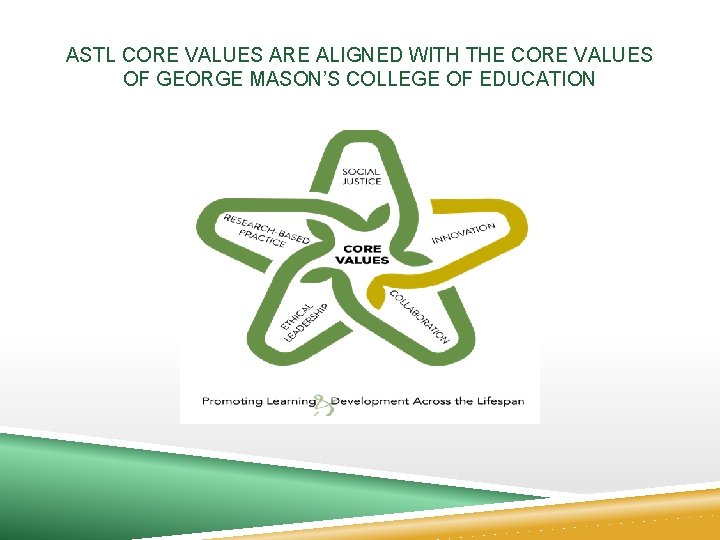
ASTL CORE VALUES ARE ALIGNED WITH THE CORE VALUES OF GEORGE MASON’S COLLEGE OF EDUCATION
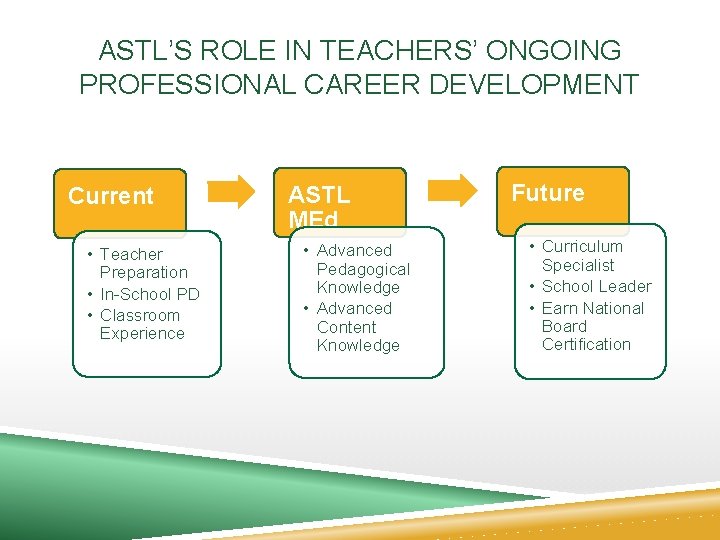
ASTL’S ROLE IN TEACHERS’ ONGOING PROFESSIONAL CAREER DEVELOPMENT Current • Teacher Preparation • In-School PD • Classroom Experience ASTL MEd • Advanced Pedagogical Knowledge • Advanced Content Knowledge Future • Curriculum Specialist • School Leader • Earn National Board Certification
ASTL Program Learning Outcomes: What Teachers Should Know and Be Able to Do q Teachers are committed to students and their learning. q Teachers know the subjects they teach and how to teach those subjects to students. q Teachers are responsible for managing and monitoring student learning. q Teachers think systematically about their practice and learn from experience. q Teachers are members of learning communities. The Five Core Propositions of the National Board for Professional Teaching Standards
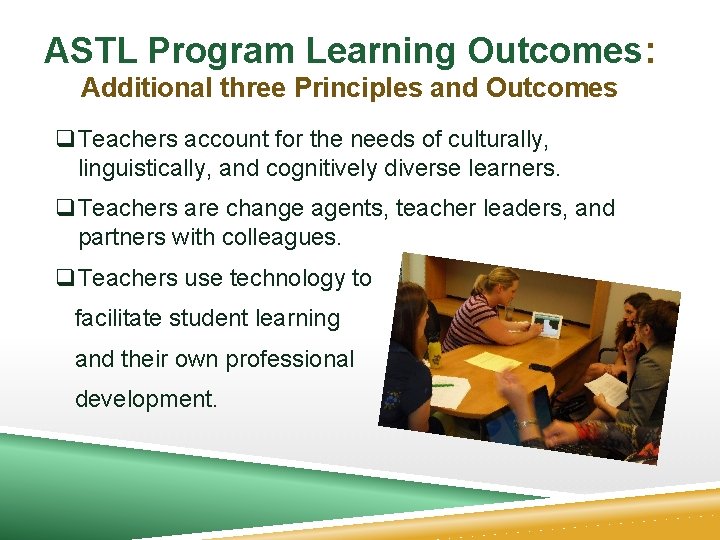
ASTL Program Learning Outcomes: Additional three Principles and Outcomes q. Teachers account for the needs of culturally, linguistically, and cognitively diverse learners. q. Teachers are change agents, teacher leaders, and partners with colleagues. q. Teachers use technology to facilitate student learning and their own professional development.
FEATURES OF ASTL: q Face-to-face and Distance Learning formats available for Core course and some Concentrations q Tuition Discount for Virginia Educators with 15% discount for PK- 12 credit course (for information and to apply for discount go to cehd. gmu. edu/teachva) q Tuition Discount for out-of-state students with 45% discount on out-studentaccounts. gmu. edu/tuition-fees
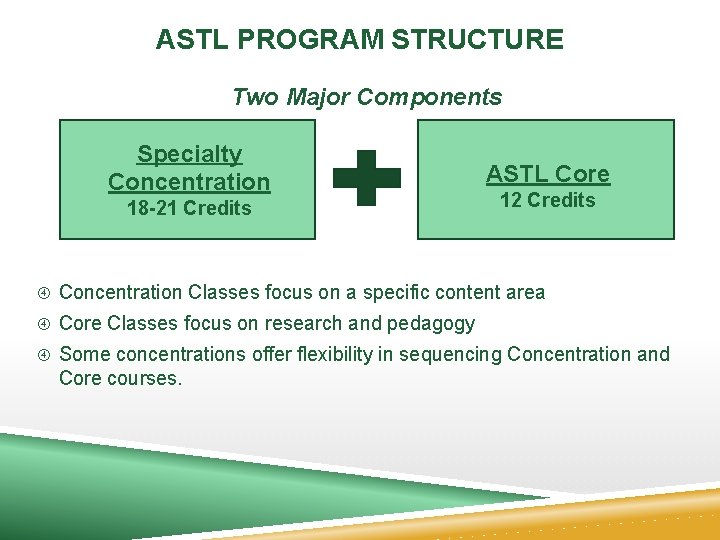
ASTL PROGRAM STRUCTURE Two Major Components Specialty Concentration 18 -21 Credits ASTL Core 12 Credits Concentration Classes focus on a specific content area Core Classes focus on research and pedagogy Some concentrations offer flexibility in sequencing Concentration and Core courses.
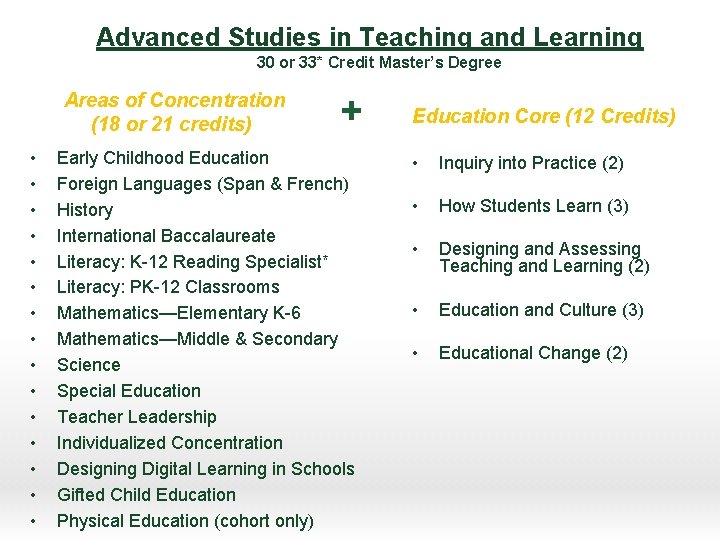
Advanced Studies in Teaching and Learning 30 or 33* Credit Master’s Degree Areas of Concentration (18 or 21 credits) • • • • + Early Childhood Education Foreign Languages (Span & French) History International Baccalaureate Literacy: K-12 Reading Specialist* Literacy: PK-12 Classrooms Mathematics—Elementary K-6 Mathematics—Middle & Secondary Science Special Education Teacher Leadership Individualized Concentration Designing Digital Learning in Schools Gifted Child Education Physical Education (cohort only) Education Core (12 Credits) • Inquiry into Practice (2) • How Students Learn (3) • Designing and Assessing Teaching and Learning (2) • Education and Culture (3) • Educational Change (2)
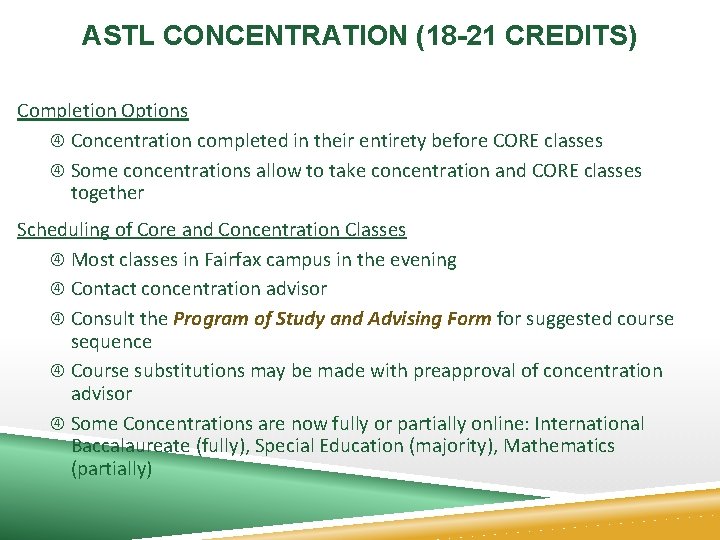
ASTL CONCENTRATION (18 -21 CREDITS) Completion Options Concentration completed in their entirety before CORE classes Some concentrations allow to take concentration and CORE classes together Scheduling of Core and Concentration Classes Most classes in Fairfax campus in the evening Contact concentration advisor Consult the Program of Study and Advising Form for suggested course sequence Course substitutions may be made with preapproval of concentration advisor Some Concentrations are now fully or partially online: International Baccalaureate (fully), Special Education (majority), Mathematics (partially)
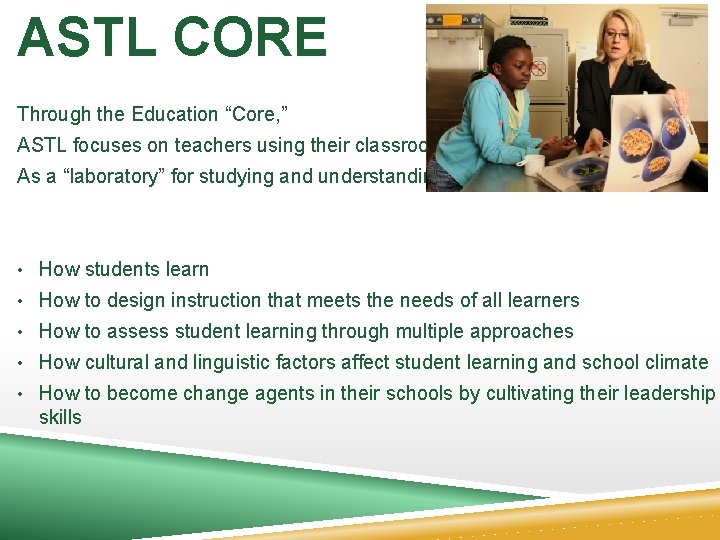
ASTL CORE Through the Education “Core, ” ASTL focuses on teachers using their classrooms As a “laboratory” for studying and understanding: • How students learn • How to design instruction that meets the needs of all learners • How to assess student learning through multiple approaches • How cultural and linguistic factors affect student learning and school climate • How to become change agents in their schools by cultivating their leadership skills
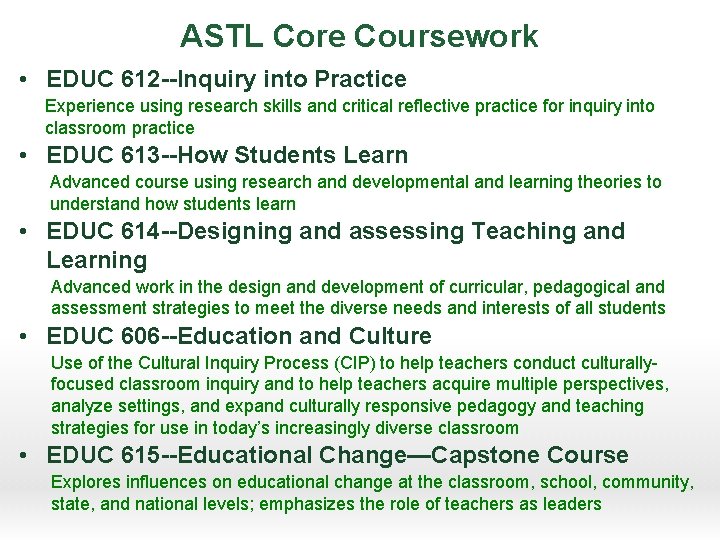
ASTL Core Coursework • EDUC 612 --Inquiry into Practice Experience using research skills and critical reflective practice for inquiry into classroom practice • EDUC 613 --How Students Learn Advanced course using research and developmental and learning theories to understand how students learn • EDUC 614 --Designing and assessing Teaching and Learning Advanced work in the design and development of curricular, pedagogical and assessment strategies to meet the diverse needs and interests of all students • EDUC 606 --Education and Culture Use of the Cultural Inquiry Process (CIP) to help teachers conduct culturallyfocused classroom inquiry and to help teachers acquire multiple perspectives, analyze settings, and expand culturally responsive pedagogy and teaching strategies for use in today’s increasingly diverse classroom • EDUC 615 --Educational Change—Capstone Course Explores influences on educational change at the classroom, school, community, state, and national levels; emphasizes the role of teachers as leaders
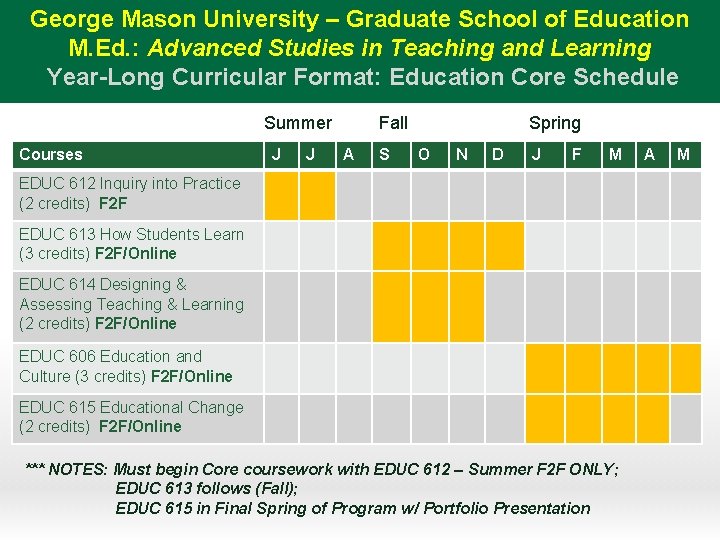
George Mason University – Graduate School of Education M. Ed. : Advanced Studies in Teaching and Learning Year-Long Curricular Format: Education Core Schedule Summer Courses J J Fall A S Spring O N D J F M EDUC 612 Inquiry into Practice (2 credits) F 2 F EDUC 613 How Students Learn (3 credits) F 2 F/Online EDUC 614 Designing & Assessing Teaching & Learning (2 credits) F 2 F/Online EDUC 606 Education and Culture (3 credits) F 2 F/Online EDUC 615 Educational Change (2 credits) F 2 F/Online *** NOTES: Must begin Core coursework with EDUC 612 – Summer F 2 F ONLY; EDUC 613 follows (Fall); EDUC 615 in Final Spring of Program w/ Portfolio Presentation A M
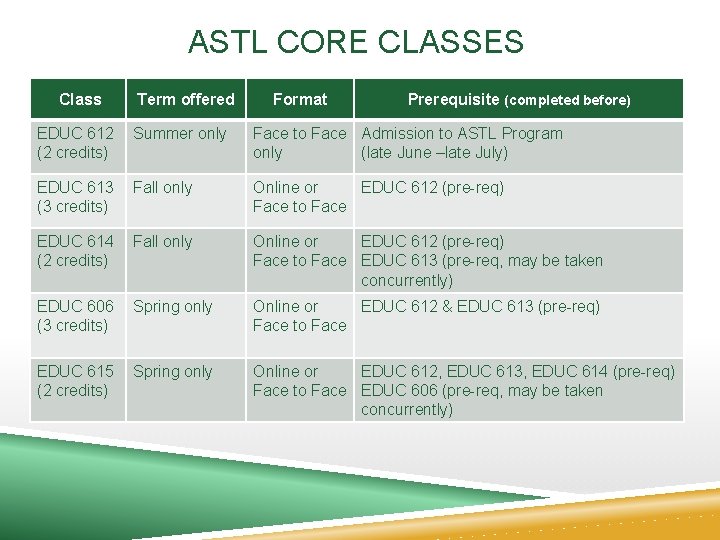
ASTL CORE CLASSES Class Term offered Format Prerequisite (completed before) EDUC 612 (2 credits) Summer only Face to Face Admission to ASTL Program only (late June –late July) EDUC 613 (3 credits) Fall only Online or EDUC 612 (pre-req) Face to Face EDUC 614 (2 credits) Fall only Online or EDUC 612 (pre-req) Face to Face EDUC 613 (pre-req, may be taken concurrently) EDUC 606 (3 credits) Spring only Online or EDUC 612 & EDUC 613 (pre-req) Face to Face EDUC 615 (2 credits) Spring only Online or EDUC 612, EDUC 613, EDUC 614 (pre-req) Face to Face EDUC 606 (pre-req, may be taken concurrently)
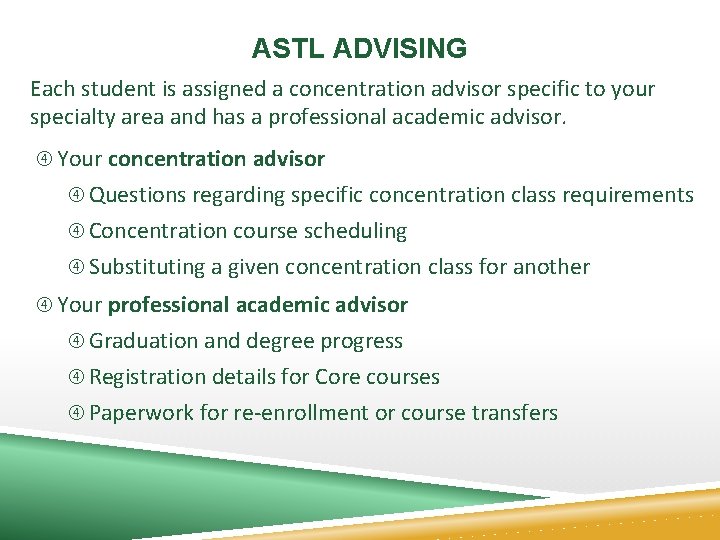
ASTL ADVISING Each student is assigned a concentration advisor specific to your specialty area and has a professional academic advisor. Your concentration advisor Questions regarding specific concentration class requirements Concentration course scheduling Substituting a given concentration class for another Your professional academic advisor Graduation and degree progress Registration details for Core courses Paperwork for re-enrollment or course transfers
PROGRAM PLANNING Submit to Dr. Fox rfox@gmu. edu Advisor and Marie Champagne mchampa 4@gmu. edu
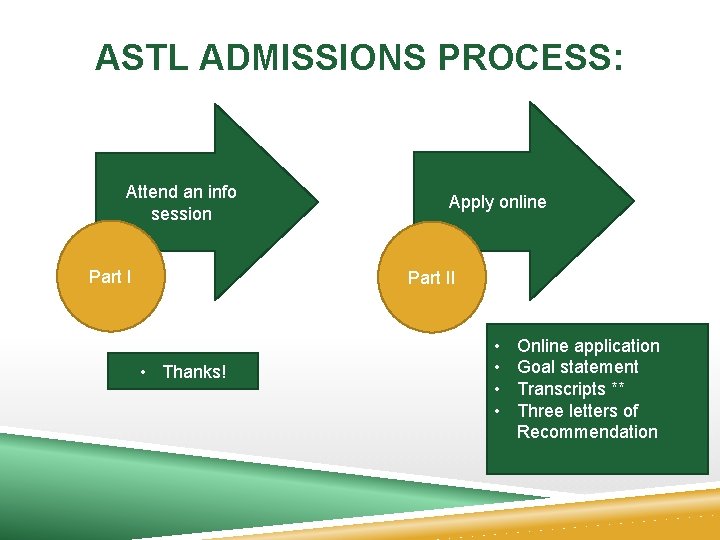
ASTL ADMISSIONS PROCESS: Attend an info session Part I Apply online Part II • Thanks! • • Online application Goal statement Transcripts ** Three letters of Recommendation
ADMISSIONS PROCESS Completed graduate application--available on line at: http: //gse. gmu. edu/programs/astl/admissions Includes an Expanded Goals Statement on the application then scroll down to Department Form and download to complete Official transcripts from all post-secondary institutions A minimum undergraduate GPA of 3. 0 in the last 60 hours Three letters of recommendation describing the applicant’s potential for success in the program, one of which must be from a direct supervisor $75 application fee online ** There additional requirements for international students
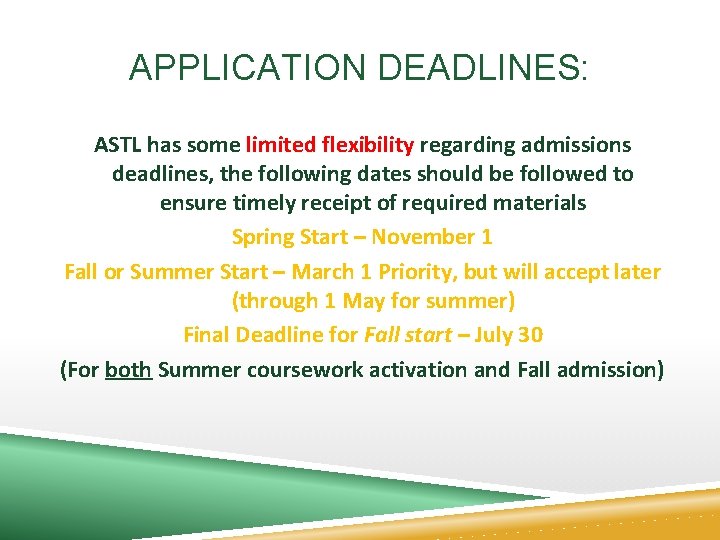
APPLICATION DEADLINES: ASTL has some limited flexibility regarding admissions deadlines, the following dates should be followed to ensure timely receipt of required materials Spring Start – November 1 Fall or Summer Start – March 1 Priority, but will accept later (through 1 May for summer) Final Deadline for Fall start – July 30 (For both Summer coursework activation and Fall admission)
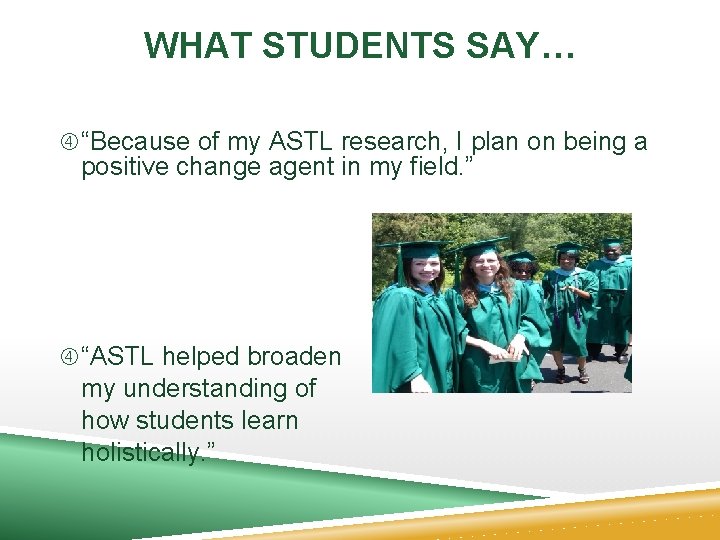
WHAT STUDENTS SAY… “Because of my ASTL research, I plan on being a positive change agent in my field. ” “ASTL helped broaden my understanding of how students learn holistically. ”
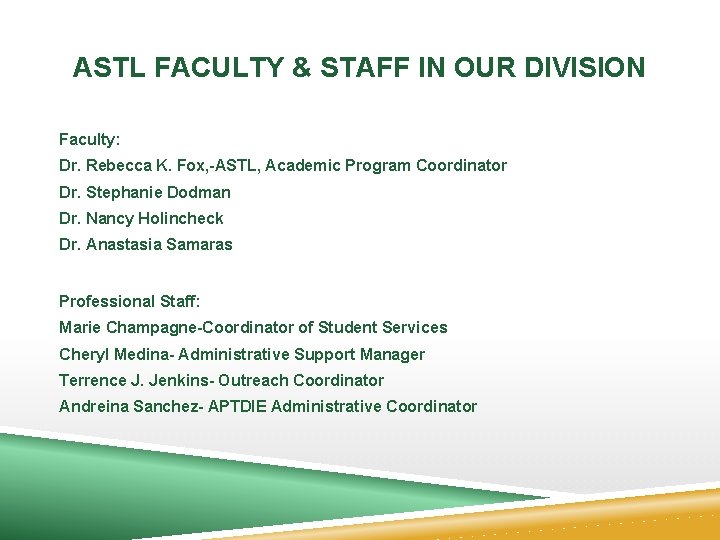
ASTL FACULTY & STAFF IN OUR DIVISION Faculty: Dr. Rebecca K. Fox, -ASTL, Academic Program Coordinator Dr. Stephanie Dodman Dr. Nancy Holincheck Dr. Anastasia Samaras Professional Staff: Marie Champagne-Coordinator of Student Services Cheryl Medina- Administrative Support Manager Terrence J. Jenkins- Outreach Coordinator Andreina Sanchez- APTDIE Administrative Coordinator
ASTL CONTACT INFORMATION General Information 703 -993 -3640 astl@gmu. edu Dr. Rebecca K. Fox Academic Program Coordinator, Terrence J. Jenkins Marie Champagne 703 -993 -4123 ASTL rfox@gmu. edu ASTL Program Outreach ASTL Student Advising astl@gmu. edu http: //gse. gmu. edu/programs/astl