
George Mason School of Law Contracts II Interpretation















































- Slides: 112
George Mason School of Law Contracts II Interpretation Not to be shared © F. H. Buckley fbuckley@gmu. edu 1
Terms and Interpretation o Terms: May we look outside a writing to supplement it with additional terms? o Interpretation: Within a writing, may we look beyond it to interpret the meaning of its words (e. g. , to oral evidence) 2
Terms and Interpretation o Terms o Interpretation o Which was Masterson at 550? o “an option to purchase” 3
Sometimes there’s no common meaning…and no contract o Raffles v. Wickelhaus at 572 The Peerless 4
Sometimes there’s no common meaning…and no contract o “ 125 bales of Surat cotton, ex Peerless from Bombay”: Raffles v. Wickelhaus The Peerless 5
Sometimes there’s no common meaning…and no contract o What’s a court to do, in that case? 6
Sometimes there’s no common meaning…and no contract o Misunderstandings n Restatement § 20 “There is no manifestation of mutual assent if the parties attach materially different meanings to their manifestations” n A “mutual mistake” 7
Interpretive Theories o Literary Interpretation n Subjective n Objective 8
Literary Interpretation o Subjective: Authorial Intention n There is a meaning, and it is the author’s meaning n To be derived by seeking evidence about his motivation from a knowledge of his background and influences 9
Literary Interpretation o Objective n Privileges the reader: There is a meaning but the author’s intention is irrelevant. n Only the words of the text matter. 10
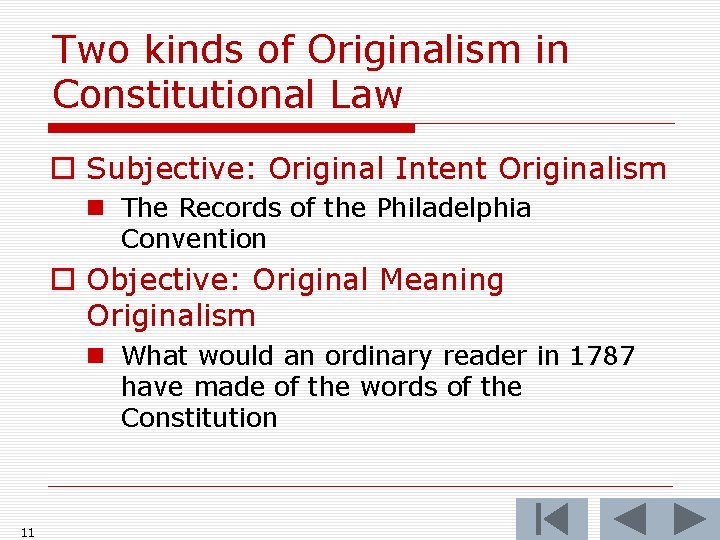
Two kinds of Originalism in Constitutional Law o Subjective: Original Intent Originalism n The Records of the Philadelphia Convention o Objective: Original Meaning Originalism n What would an ordinary reader in 1787 have made of the words of the Constitution 11
At Contract Law o Subjective: Contextualism n Find out what the parties might have meant by looking at all background evidence o Objective: Textualism n Don’t look outside the words of the contract: “Plain Meaning” 12
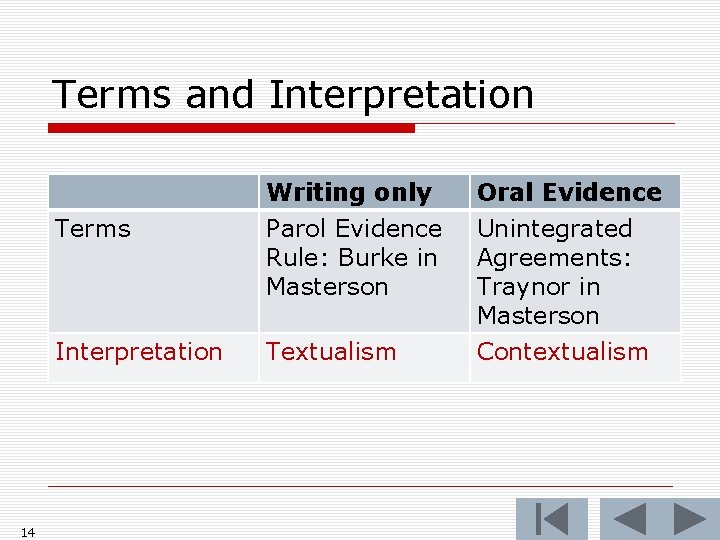
Terms and Interpretation Terms 13 Writing only Oral Evidence Parol Evidence Rule: Burke in Masterson Unintegrated Agreements: Traynor in Masterson
Terms and Interpretation 14 Writing only Oral Evidence Terms Parol Evidence Rule: Burke in Masterson Unintegrated Agreements: Traynor in Masterson Interpretation Textualism Contextualism
Textualism in New York o WWW v. Giancontieri at 569 n What did clause 31 provide? 15
Textualism in New York o WWW v. Giancontieri at 569 n What was the reason for clause 31? o Why might the buyer want to exercise the cancellation right? 16
Textualism in New York o WWW v. Giancontieri at 569 n What was the reason for clause 31? o Why might the seller want to exercise the cancellation right? 17
Textualism in New York o WWW v. Giancontieri at 569 n What was the reason for clause 31? o Why might the seller want to exercise the cancellation right? o Does that matter? 18
The Limits of Textualism: In re Soper 573 19
In re Soper 573: “to my wife” o On objective or plain meaning standards, who is the wife? 20
In re Soper: “to my wife” o On objective or plain meaning standards, who is the wife? o On subjective or contextualist standards, who is the wife? 21
In re Soper: “to my wife” o On objective or plain meaning standards, who is the wife? o On subjective or contextualist standards, who is the wife? n To hold otherwise would give the word “a fixed symbol” 22
In re Soper o What if the insurance company had not paid Gertrude? 23
In re Soper o How might Soper have cured the problem? 24
In re Soper o How might Soper have cured the problem? n “to my wife, Gertrude Whitby Young” o So why didn’t he? 25
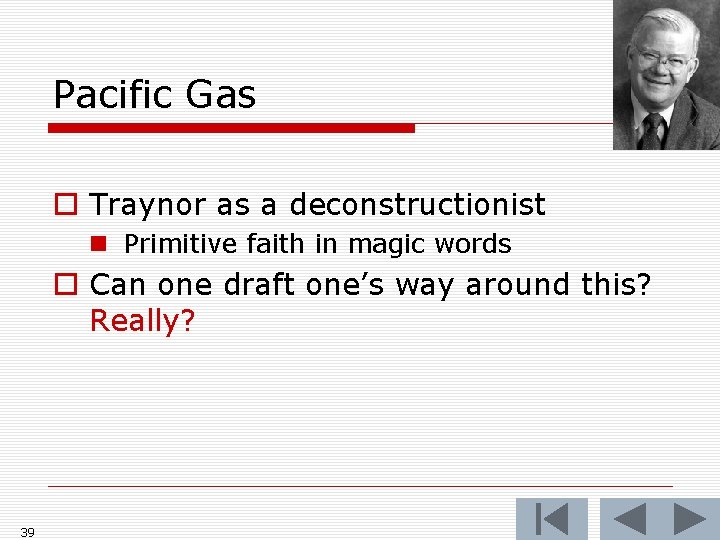
Pacific Gas 574 Roger Traynor 26
Pacific Gas 574 o Why did Pacific Gas sue in Contract? 27
Pacific Gas 574 o What did the indemnity clause state? 28
Pacific Gas o What did the indemnity clause state? n What does “A indemnifies B mean”? 29
Pacific Gas o What did the indemnity clause state? n What does “A indemnifies B mean”? o A compensates B for claims asserted by C against B and caused by A? 30
Pacific Gas o What did the indemnity clause state? n What does “A indemnifies B mean”? o A compensates B for claims asserted by C against B o Qu. A compensates B for losses incurred by B and caused by A? 31
Pacific Gas o What did the indemnity clause state? n What does “A indemnifies B mean”? o A compensates B for claims asserted by C against B o Qu. A compensates B for losses caused by A o Just how would you expect damage to arise “in any way connected with the performance of this contract”? 32
Pacific Gas o What did the indemnity clause state? n What does “A indemnifies B mean”? o A compensates B for claims asserted by C against B o Qu. A compensates B for losses caused by A. o What did the trial court hold? n A “plain language” standard 33
Pacific Gas o What did the indemnity clause state? n What does “A indemnifies B mean”? o A compensates B for claims asserted by C against B o Qu. A compensates B for losses caused by A. o And Traynor? n You can see this coming, can’t you? 34
Pacific Gas o Traynor rejects textualism n Primitive faith in magic words 35
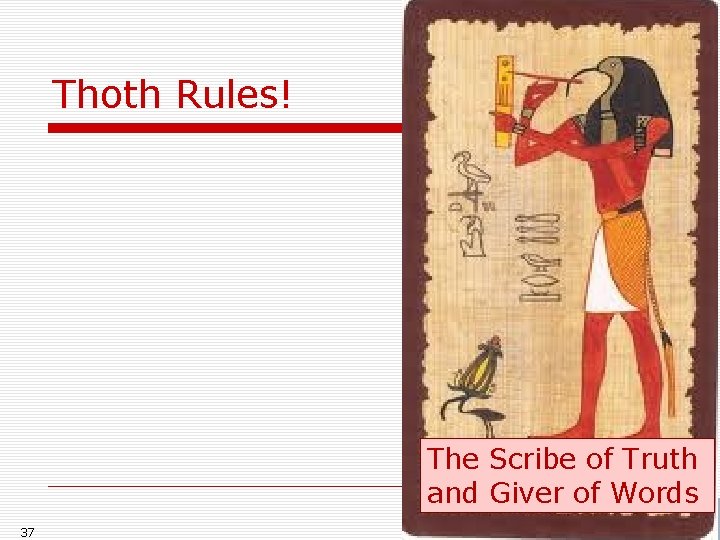
Pacific Gas: Footnote 2 o "The elaborate system of taboo and verbal prohibitions in primitive groups; the ancient Egyptian myth of Khern, the apotheosis of the words, and of Thoth, the Scribe of Truth, the Giver of Words and Script, the Master of Incantations; the avoidance of the name of God in Brahmanism, Judaism and Islam; totemistic and protective names in mediaeval Turkish and Finno-Ugrian languages; the misplaced verbal scruples of the 'Precieuses'; the Swedish peasant custom of curing sick cattle smitten by witchcraft, by making them swallow a page torn out of the psalter and put in dough. . ' from Ullman, The Principles of Semantics (1963 ed. ) 43. (See also Ogden and Richards, The Meaning of Meaning (rev. ed. 1956) pp. 24 - 47. ) 36
Thoth Rules! The Scribe of Truth and Giver of Words 37
Pacific Gas o Traynor rejects textualism n Primitive faith in magic words o Can one draft one’s way around this? 38
Pacific Gas o Traynor as a deconstructionist n Primitive faith in magic words o Can one draft one’s way around this? Really? 39
Pacific Gas o What do you think Traynor would have done had the trial judge ruled that the plain meaning of the contract was just the opposite? that the indemnity clause didn’t apply? 40
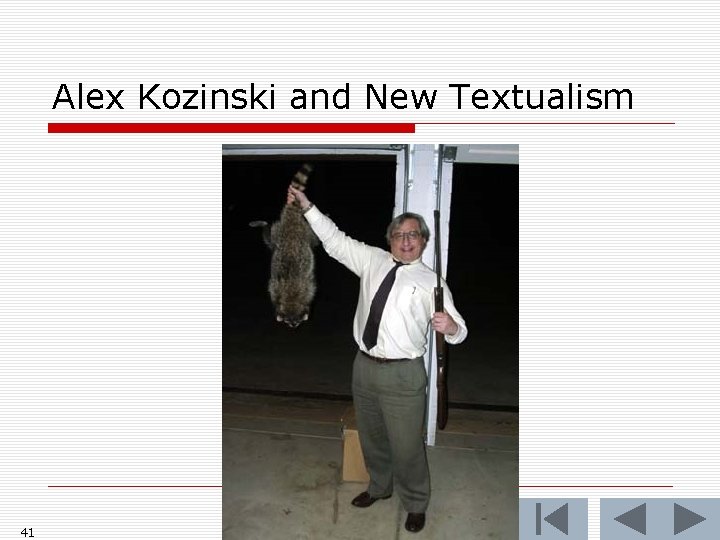
Alex Kozinski and New Textualism 41
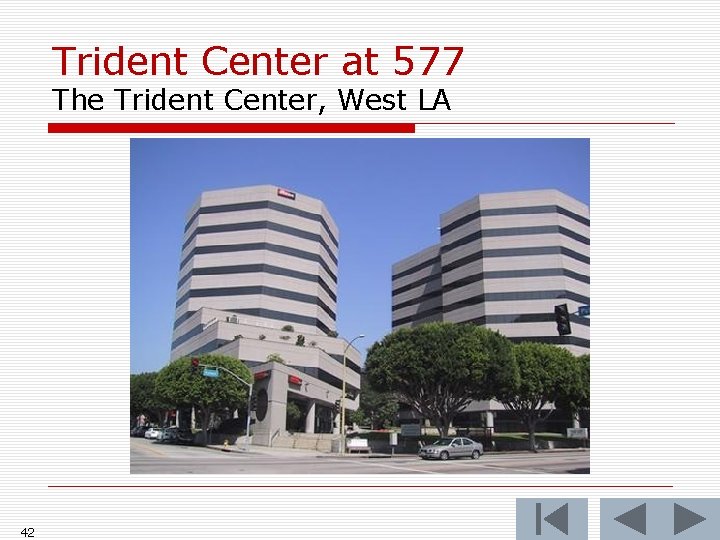
Trident Center at 577 The Trident Center, West LA 42
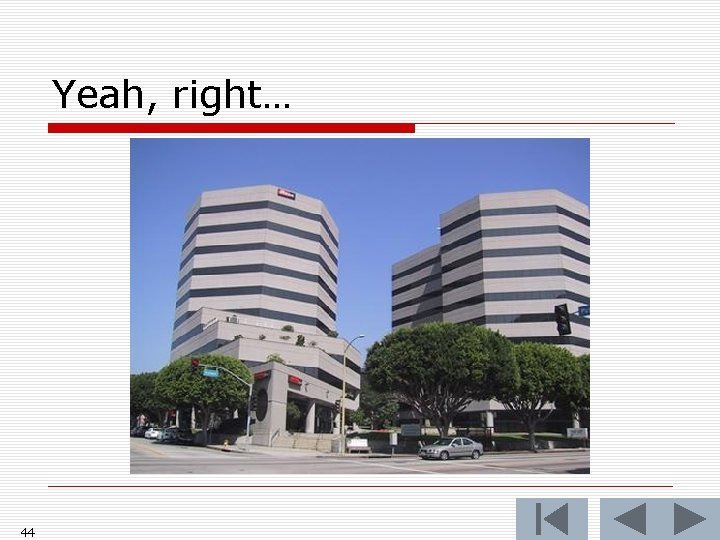
Kozinski and New Textualism The Trident Center o Completed in 1983, Trident Center consists of two, steel-framed, 10 -story office towers containing approximately 383, 000 square feet and connected by a five-level parking structure. Trident Center is situated on approximately 3. 6 acres of beautifully landscaped common areas rich with tenant amenities. 43
Yeah, right… 44
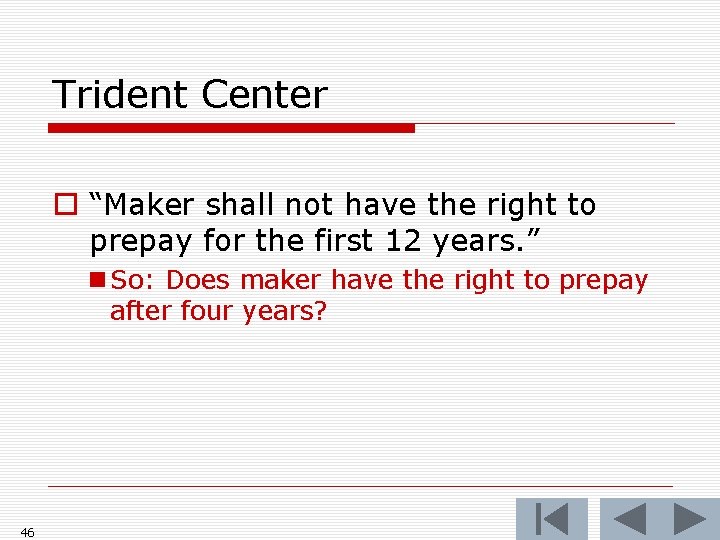
Trident Center o “Maker shall not have the right to prepay for the first 12 years. ” 45
Trident Center o “Maker shall not have the right to prepay for the first 12 years. ” n So: Does maker have the right to prepay after four years? 46
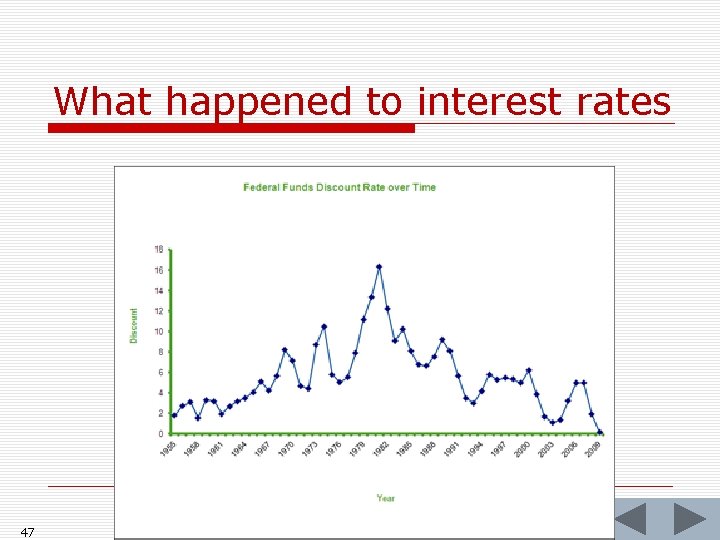
What happened to interest rates 47
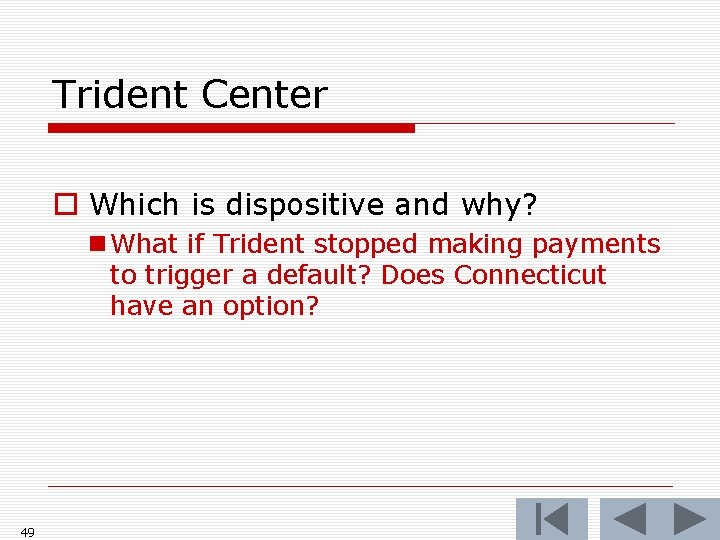
Trident Center o In the event of prepayment resulting from a default the prepayment fee will be 10 percent. n But whose option? 48
Trident Center o Which is dispositive and why? n What if Trident stopped making payments to trigger a default? Does Connecticut have an option? 49
Trident Center o Was this between sophisticated parties? 50
Trident Center o Mitchell Silberberg & Knupp web site: CORE SERVICES: Commercial Properties Represent purchasers and sellers of commercial property as well as owners, developers, investors and contractors in planning, zoning, entitling, financing, development, construction of commercial, industrial, retail, residential and hotel projects. 51
Trident Center o Manat Phelps Law Firm: n Manatt's attorneys have a broad background in all areas of real estate, land use and hospitality. Our professionals are among the premier real estate and development advisors in the nation 52
Trident Center o Was this between sophisticated parties n Were they really much less so in Pacific Gas? Hunt Foods? 53
Going outside the writing Writing only Terms Interpretation 54 Oral Evidence
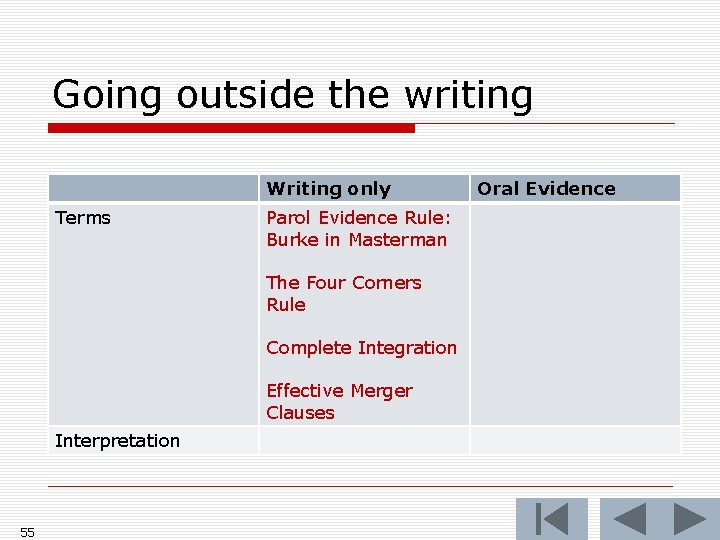
Going outside the writing Writing only Terms Parol Evidence Rule: Burke in Masterman The Four Corners Rule Complete Integration Effective Merger Clauses Interpretation 55 Oral Evidence
What has been promised? Terms Writing only Oral Evidence Parol Evidence Rule: Burke in Masterman Unintegrated Agreements Partial Integration Traynor on the need to refer to oral evidence to prove intergration The fraud exception Interpretation 56
What has been promised? 57 Writing only Oral Evidence Terms Parol Evidence Rule: Burke in Masterman Unintegrated Agreements Interpretation Textualism: WWW v. Giancontieri
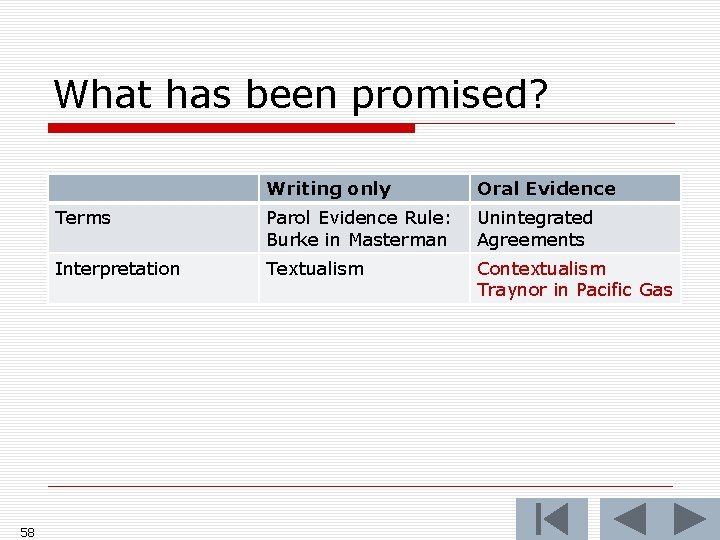
What has been promised? 58 Writing only Oral Evidence Terms Parol Evidence Rule: Burke in Masterman Unintegrated Agreements Interpretation Textualism Contextualism Traynor in Pacific Gas
When does it make least sense to admit oral evidence? 59
When does it make least sense to admit oral evidence? o Idiosyncratic bargains and the court’s information problem 60
When does it make least sense to admit oral evidence? o Idiosyncratic bargains o The alleged oral terms would be harsh and unusual (e. g. cancellation rights in Snyder at 565) 61
When does it make least sense to admit oral evidence? o Idiosyncratic bargains o Harsh terms o Sophisticated parties (e. g. Pacific Gas) 62
When does it make least sense to admit oral evidence? o o 63 Idiosyncratic bargains Harsh terms Sophisticated parties Non-standard terms
When does it make least sense to admit oral evidence? o o o 64 Idiosyncratic bargains Harsh terms Sophisticated parties Non-standard terms Merger clauses
When does it make Most sense to admit oral evidence? 65
When does it make most sense to admit oral evidence? o The transaction costs of inclusion? n When these are high, courts might be more likely to admit parol evidence 66
When does it make most sense to admit oral evidence? o The transaction costs of inclusion? o Unsophisticated parties 67
Now: Canons of interpretation o Express Terms o Course of performance o Course of dealing o Trade Usage 68
Express Terms o Restatement § 203(d) n Give greater weight to specifically negotiated over standard terms 69
Express Terms o Restatement § 203(c) n Prefer specific terms over general terms o Inclusio unius est exclusio alterius 70
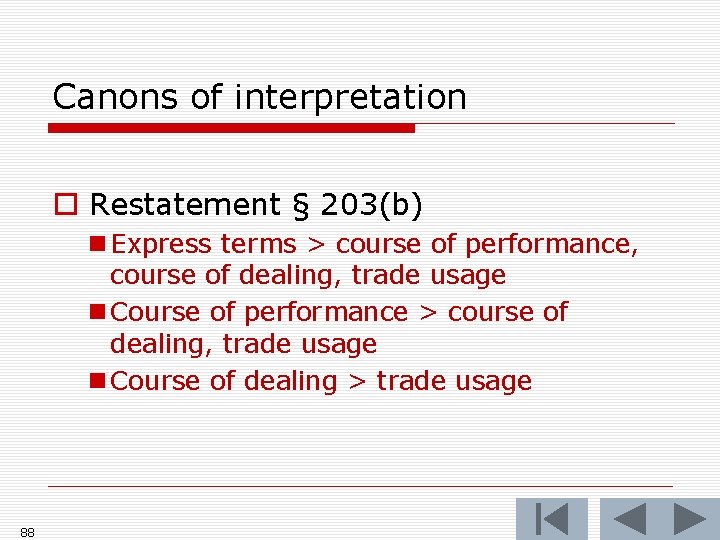
Canons of interpretation o Restatement § 203(b) n Express terms > course of performance, course of dealing, trade usage n Course of performance > course of dealing, trade usage n Course of dealing > trade usage 71
Canons of interpretation o Restatement § 203(b) n Express terms > course of performance, course of dealing, trade usage n Course of performance > course of dealing, trade usage n Course of dealing > trade usage o Snyder p. 565: what was the course of dealing? 72
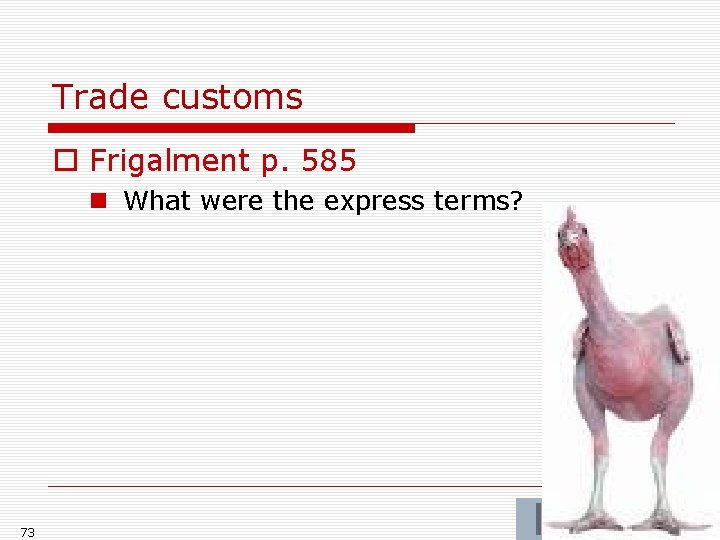
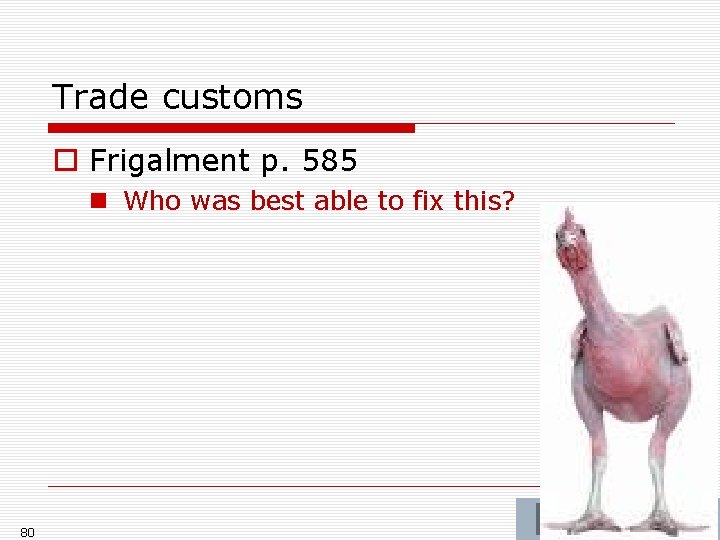
Trade customs o Frigalment p. 585 n What were the express terms? 73
Trade customs o Frigalment p. 585 n What were the express terms? n “fresh frozen chicken, Grade A” o Which might have meant? 74
Trade customs o Frigalment p. 585 n What were the express terms? n “fresh frozen chicken, Grade A” o Which might have meant? o “fowl” or stewing chicken, or o “Broiler chicken” 75
Trade customs o Frigalment p. 585 n What was the trade usage? 76
Trade customs o Frigalment p. 585 n What was the trade usage? o Higher grade broiler chicken 77
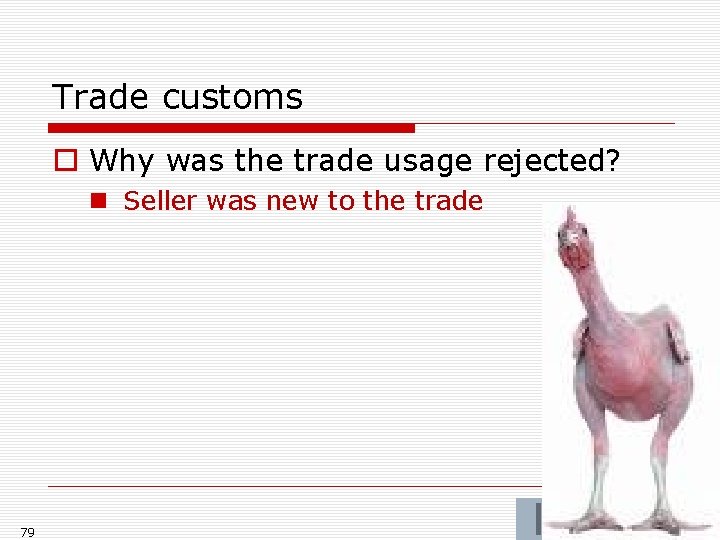
Trade customs o Why was the trade usage rejected? 78
Trade customs o Why was the trade usage rejected? n Seller was new to the trade 79
Trade customs o Frigalment p. 585 n Who was best able to fix this? 80
Sunshine Biscuits at 606 o Why a different result? 81
Sunshine Biscuits at 606 o Why a trade custom about estimates of crops? 82
Sunshine Biscuits at 606 o What happened to the potato crop? o And why do you think the seller wanted out? 83
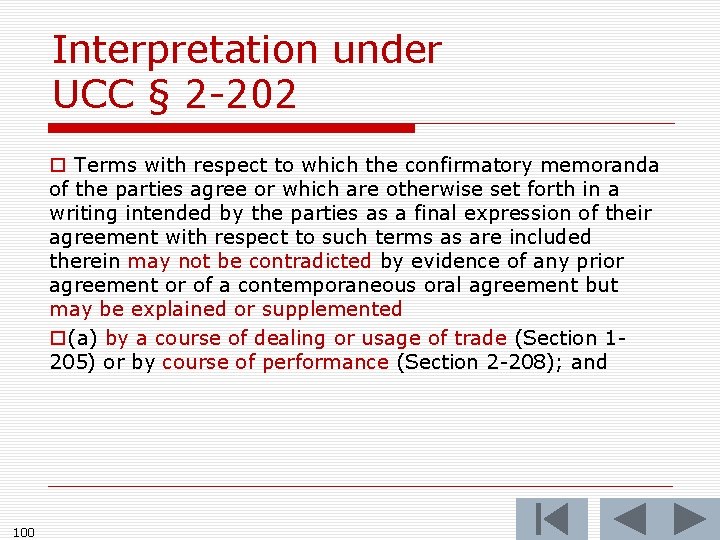
Interpretation under UCC § 2 -202 o Terms with respect to which the confirmatory memoranda of the parties agree or which are otherwise set forth in a writing intended by the parties as a final expression of their agreement with respect to such terms as are included therein may not be contradicted by evidence of any prior agreement or of a contemporaneous oral agreement but may be explained or supplemented o(a) by a course of dealing or usage of trade (Section 1205) or by course of performance (Section 2 -208); and 84
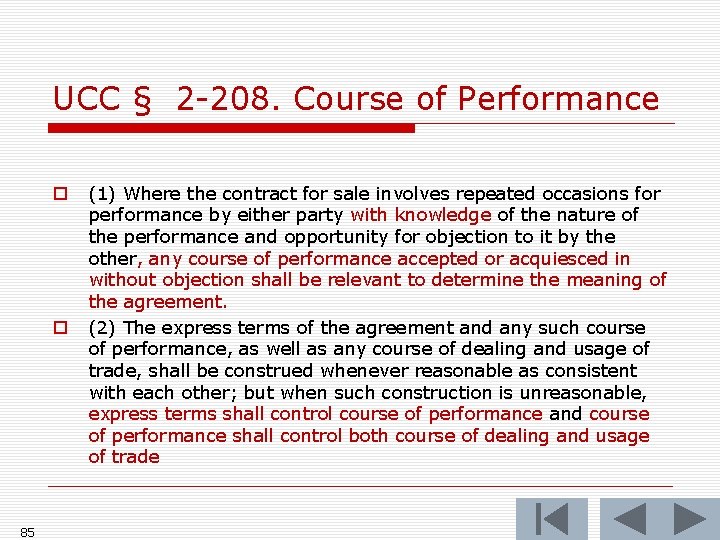
UCC § 2 -208. Course of Performance o o 85 (1) Where the contract for sale involves repeated occasions for performance by either party with knowledge of the nature of the performance and opportunity for objection to it by the other, any course of performance accepted or acquiesced in without objection shall be relevant to determine the meaning of the agreement. (2) The express terms of the agreement and any such course of performance, as well as any course of dealing and usage of trade, shall be construed whenever reasonable as consistent with each other; but when such construction is unreasonable, express terms shall control course of performance and course of performance shall control both course of dealing and usage of trade
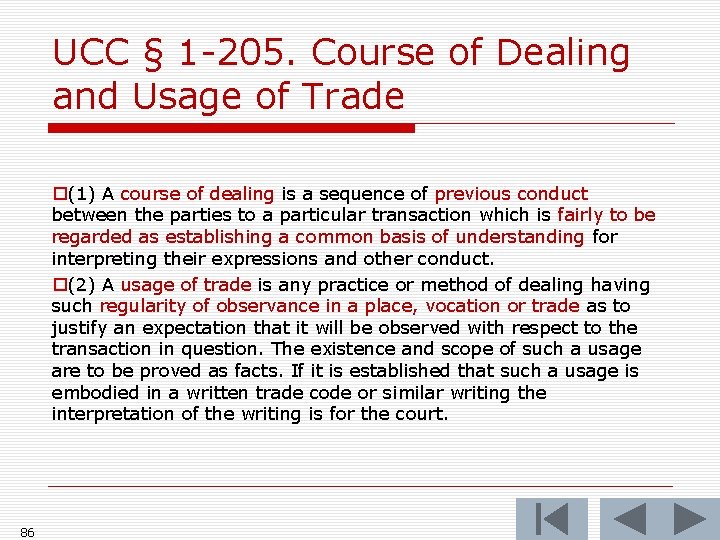
UCC § 1 -205. Course of Dealing and Usage of Trade o(1) A course of dealing is a sequence of previous conduct between the parties to a particular transaction which is fairly to be regarded as establishing a common basis of understanding for interpreting their expressions and other conduct. o(2) A usage of trade is any practice or method of dealing having such regularity of observance in a place, vocation or trade as to justify an expectation that it will be observed with respect to the transaction in question. The existence and scope of such a usage are to be proved as facts. If it is established that such a usage is embodied in a written trade code or similar writing the interpretation of the writing is for the court. 86
Canons of interpretation o UCC 2 -208(2) n Express terms > course of performance, course of dealing, trade usage n Course of performance > course of dealing, trade usage n Course of dealing > trade usage 87
Canons of interpretation o Restatement § 203(b) n Express terms > course of performance, course of dealing, trade usage n Course of performance > course of dealing, trade usage n Course of dealing > trade usage 88
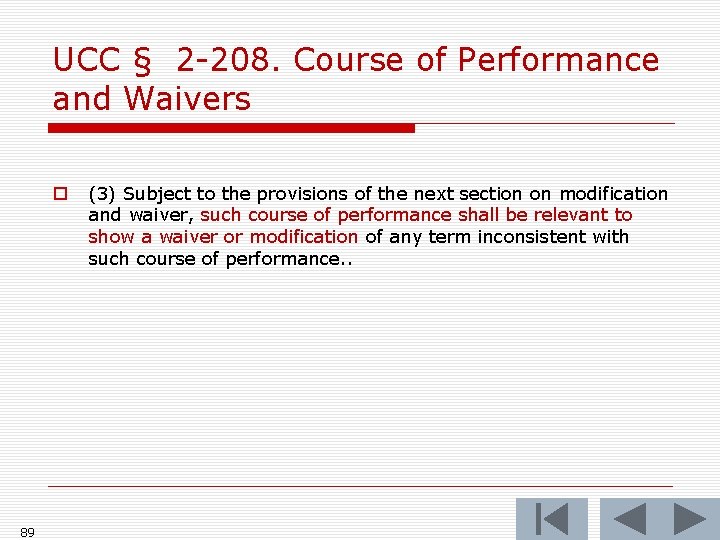
UCC § 2 -208. Course of Performance and Waivers o 89 (3) Subject to the provisions of the next section on modification and waiver, such course of performance shall be relevant to show a waiver or modification of any term inconsistent with such course of performance. .
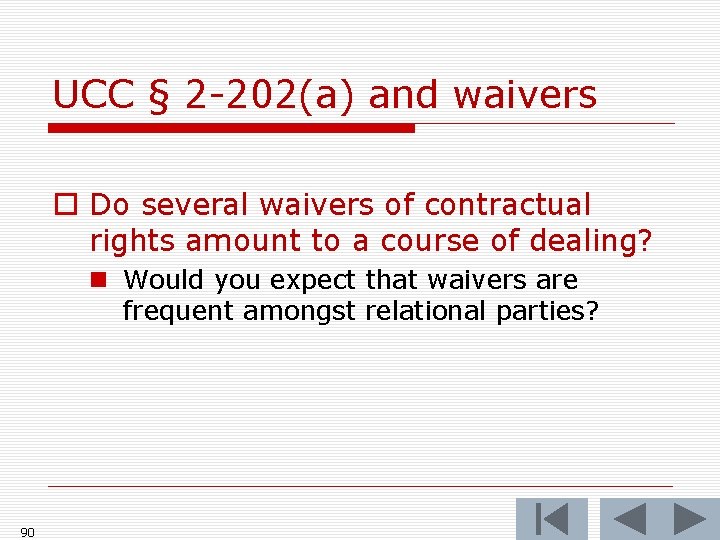
UCC § 2 -202(a) and waivers o Do several waivers of contractual rights amount to a course of dealing? n Would you expect that waivers are frequent amongst relational parties? 90
Columbia Nitrogen 595 91
Columbia Nitrogen 595 Columbia 92 Royster
Columbia Nitrogen 595 Buyer agrees to purchase and seller agrees to furnish quantities … on the following terms… Products Supplied Under Contract Minimum Tonnage per year… 93
Columbia Nitrogen 595 Columbia Royster Minimum 31, 000 tons yr/3 yrs 94
Columbia Nitrogen o Who took the risk of price fluctuations? 95
Columbia Nitrogen o Who took the risk of price fluctuations? n What did the default clause specify? 96
Columbia Nitrogen o Who took the risk of price fluctuations? n How was the merger clause drafted? 97
Columbia Nitrogen o Who took the risk of price fluctuations? n What was the course of dealing where Royster was the buyer? n Trade Usage? 98
Columbia Nitrogen o Who took the risk of price fluctuations? n What was the course of dealing where Royster was the buyer? n Trade Usage? n Was the express language inconsistent with this? 99
Interpretation under UCC § 2 -202 o Terms with respect to which the confirmatory memoranda of the parties agree or which are otherwise set forth in a writing intended by the parties as a final expression of their agreement with respect to such terms as are included therein may not be contradicted by evidence of any prior agreement or of a contemporaneous oral agreement but may be explained or supplemented o(a) by a course of dealing or usage of trade (Section 1205) or by course of performance (Section 2 -208); and 100
UCC § 2 -208. Course of Performance and Waivers o 101 (3) Subject to the provisions of the next section on modification and waiver, such course of performance shall be relevant to show a waiver or modification of any term inconsistent with such course of performance. .
Columbia Nitrogen o Who took the risk of price fluctuations? n What was the course of dealing where Royster was the buyer? n Trade Usage? n As between the parties, who was in the best position to predict price fluctuations? 102
Columbia Nitrogen o Who took the risk of price fluctuations? n What was the course of dealing where Royster was the buyer? n Trade Usage? n Do you agree with Vic Goldberg at 604? 103
Southern Concrete 600 104 Power Plant, Carrolton GA
Southern Concrete 600 Southern Concrete 105 concrete Mableton
Southern Concrete 600 o How to distinguish from Columbia Nitrogen? 106
Southern Concrete o How to distinguish from Columbia Nitrogen? n The equities…? No prior dealing here. n Contract default clause? n Escalation clause? 107
Southern Concrete o How to distinguish from Columbia Nitrogen? n The risk was not a change of price but a change in the quantity buyer would need 108
Southern Concrete o How to distinguish from Columbia Nitrogen? n The risk was not a change of price but a change in the quantity buyer would need o Who is in the best position to determine that? 109
Southern Concrete o Evenfield on contractual enforcement n Why might a course of dealing not tell us much n When is a waiver just a one-shot waiver? 110
Southern Concrete o Evenfield on contractual enforcement n Suppose waivers can be held against one. Does that mean we’d see fewer waivers? 111
Southern Concrete o Evenfield on contractual enforcement n Why not put the parties to the election of negativing customs and usages? o Cf. merger clause at 605 112