
GEOREPLICATION a journey from the simple to the
![SPANNER [OSDI’ 12]](https://slidetodoc.com/presentation_image_h2/7e8b4e436beb5077c66967d9281a7c09/image-10.jpg "SPANNER [OSDI’ 12]")
![Spanner [OSDI’ 12] • Google’s solution for geo-replication • Commit protocol (2 PC/Paxos) •](https://slidetodoc.com/presentation_image_h2/7e8b4e436beb5077c66967d9281a7c09/image-11.jpg "Spanner [OSDI’ 12] • Google’s solution for geo-replication • Commit protocol (2 PC/Paxos) •")
![WIDE-AREA LATENCY AWARENESS [VLDB’ 13]](https://slidetodoc.com/presentation_image_h2/7e8b4e436beb5077c66967d9281a7c09/image-14.jpg "WIDE-AREA LATENCY AWARENESS [VLDB’ 13]")
![Replicated Commit [VLDB’ 13] Read requests Voting messages Locking messages A B A C](https://slidetodoc.com/presentation_image_h2/7e8b4e436beb5077c66967d9281a7c09/image-16.jpg "Replicated Commit [VLDB’ 13] Read requests Voting messages Locking messages A B A C")
![“Can we break the RTT barrier? ” [CIDR’ 2013]](https://slidetodoc.com/presentation_image_h2/7e8b4e436beb5077c66967d9281a7c09/image-19.jpg "“Can we break the RTT barrier? ” [CIDR’ 2013]")
![“IS THERE A LOWER-BOUND ” ON TRANSACTION LATENCY? [SIGMOD’ 15]](https://slidetodoc.com/presentation_image_h2/7e8b4e436beb5077c66967d9281a7c09/image-23.jpg "“IS THERE A LOWER-BOUND ” ON TRANSACTION LATENCY? [SIGMOD’ 15]")
![ACHIEVING THE LOWER-BOUND [SIGMOD’ 15]](https://slidetodoc.com/presentation_image_h2/7e8b4e436beb5077c66967d9281a7c09/image-27.jpg "ACHIEVING THE LOWER-BOUND [SIGMOD’ 15]")
- Slides: 30
GEO-REPLICATION a journey from the simple to the optimal Faisal Nawab In collaboration with: Divy Agrawal, Amr El Abbadi, Vaibhav Arora, Hatem Mahmoud, Alex Pucher (UC Santa Barbara) Aaron Elmore (U. of Chicago) Stacy Patterson (Rensselaer Polytechnic Institute) Ken Salem (U. of Waterloo)
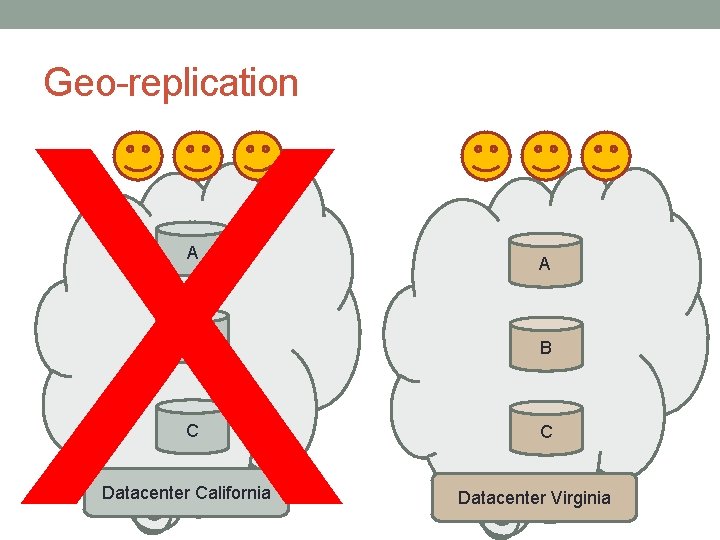
X Geo-replication A A B B C C Datacenter California Datacenter Virginia
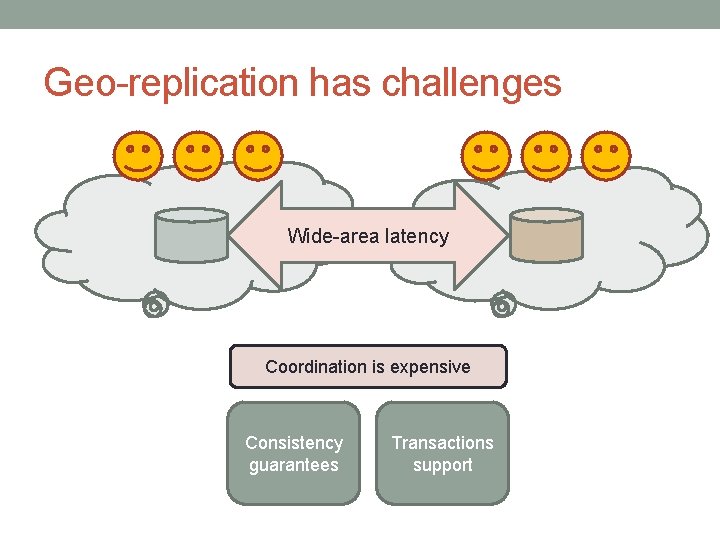
Geo-replication has challenges Wide-area latency Coordination is expensive Consistency guarantees Transactions support
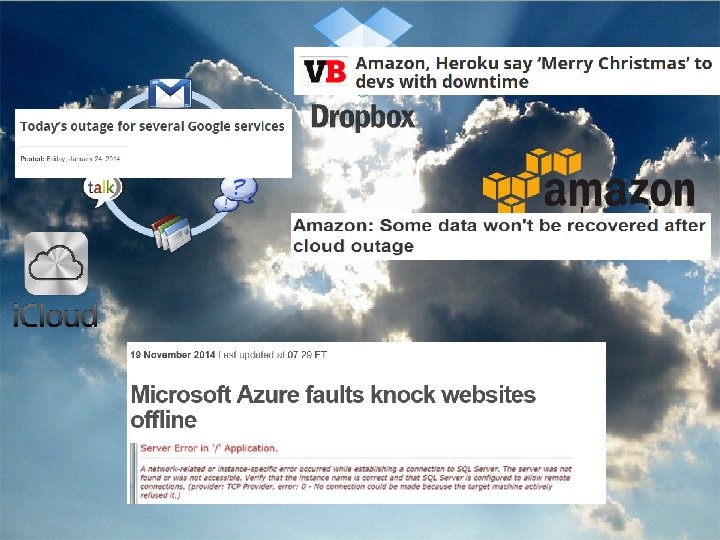
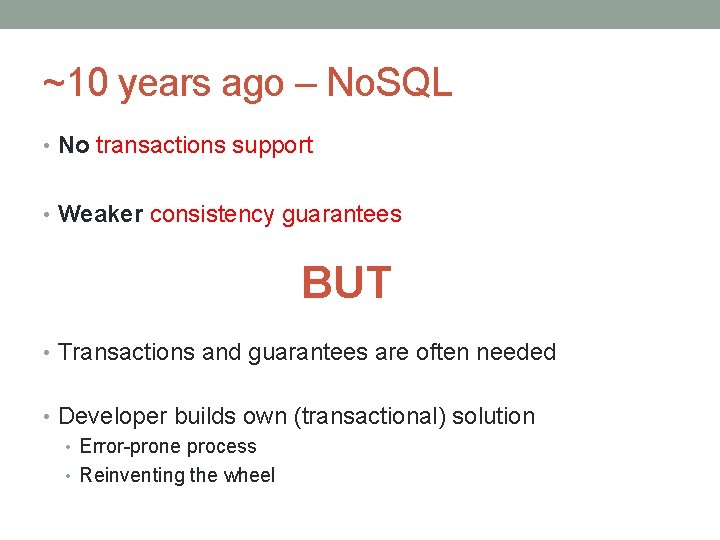
~10 years ago – No. SQL • No transactions support • Weaker consistency guarantees BUT • Transactions and guarantees are often needed • Developer builds own (transactional) solution • Error-prone process • Reinventing the wheel
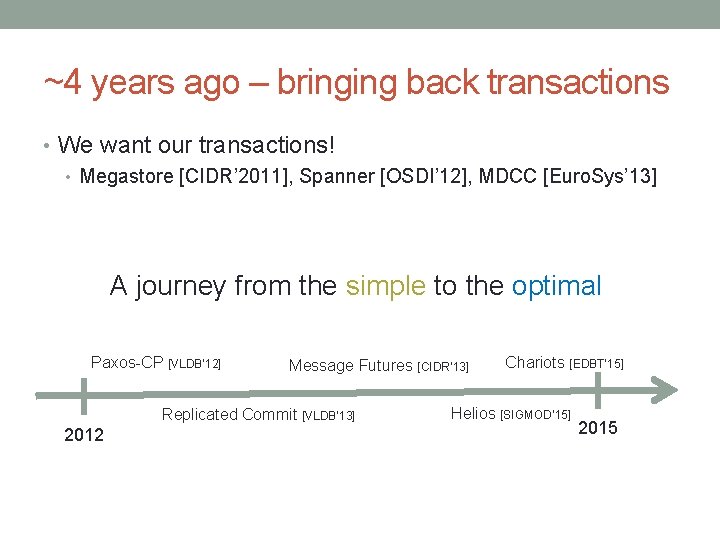
~4 years ago – bringing back transactions • We want our transactions! • Megastore [CIDR’ 2011], Spanner [OSDI’ 12], MDCC [Euro. Sys’ 13] A journey from the simple to the optimal Paxos-CP [VLDB’ 12] Message Futures [CIDR’ 13] Replicated Commit [VLDB’ 13] 2012 Chariots [EDBT’ 15] Helios [SIGMOD’ 15] 2015
TRANSACTIONS
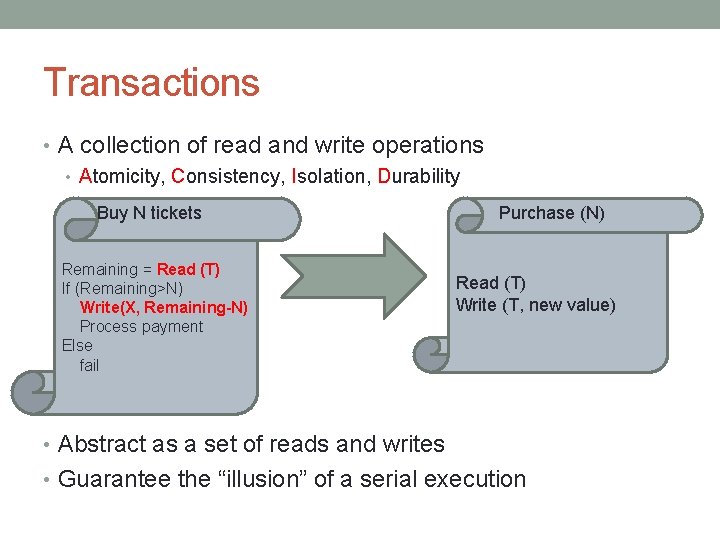
Transactions • A collection of read and write operations • Atomicity, Consistency, Isolation, Durability Buy N tickets Remaining = Read (T) If (Remaining>N) Write(X, Remaining-N) Process payment Else fail Purchase (N) Read (T) Write (T, new value) • Abstract as a set of reads and writes • Guarantee the “illusion” of a serial execution
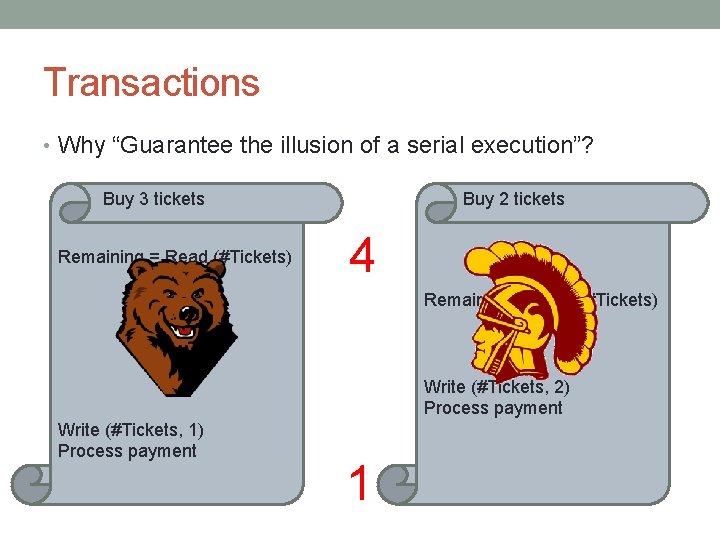
Transactions • Why “Guarantee the illusion of a serial execution”? Buy 3 tickets Remaining = Read (#Tickets) Buy 2 tickets 4 Remaining = Read (#Tickets) Write (#Tickets, 2) Process payment Write (#Tickets, 1) Process payment 1
SPANNER [OSDI’ 12]
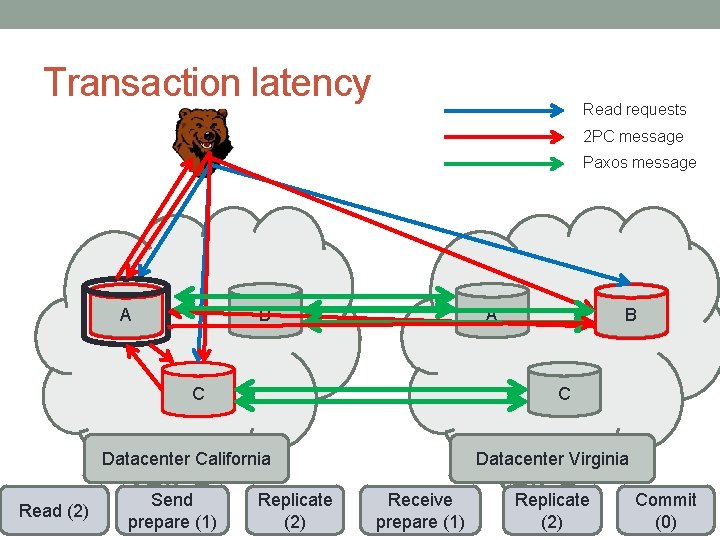
Spanner [OSDI’ 12] • Google’s solution for geo-replication • Commit protocol (2 PC/Paxos) • Each partition has a leader • Two-Phase Commit (2 PC) across partition leaders • Paxos to replicate each step of 2 PC A B C
Transaction latency Read requests 2 PC message Paxos message A B A C C Datacenter California Read (2) Send prepare (1) B Replicate (2) Datacenter Virginia Receive prepare (1) Replicate (2) Commit (0)
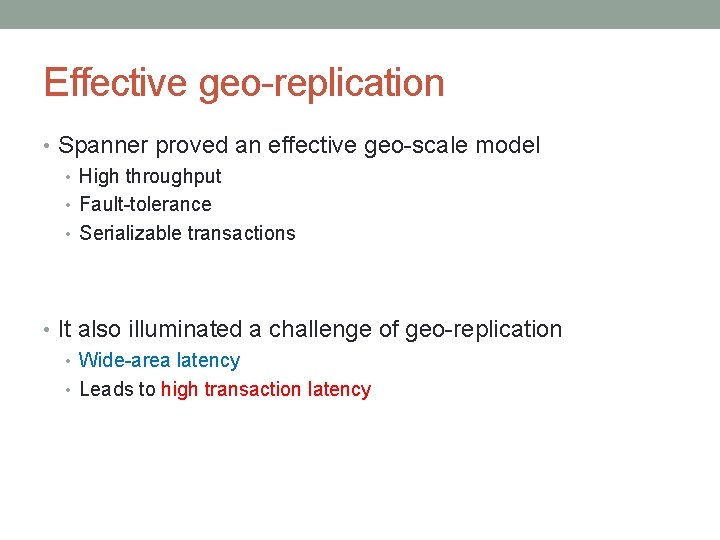
Effective geo-replication • Spanner proved an effective geo-scale model • High throughput • Fault-tolerance • Serializable transactions • It also illuminated a challenge of geo-replication • Wide-area latency • Leads to high transaction latency
WIDE-AREA LATENCY AWARENESS [VLDB’ 13]
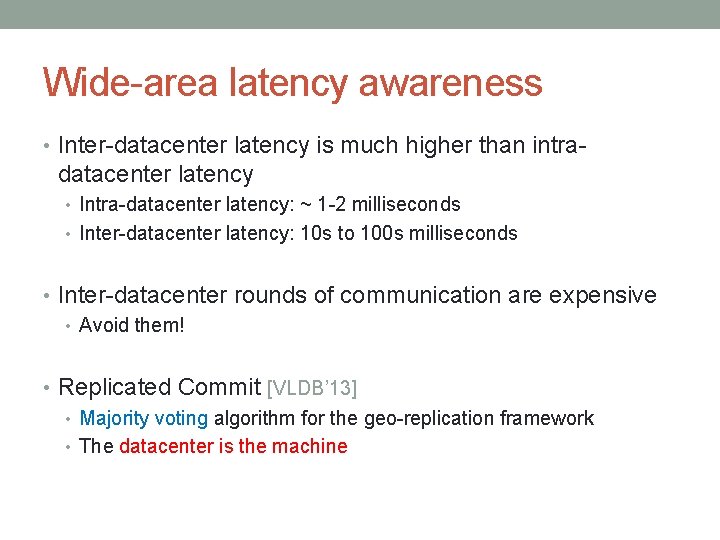
Wide-area latency awareness • Inter-datacenter latency is much higher than intra- datacenter latency • Intra-datacenter latency: ~ 1 -2 milliseconds • Inter-datacenter latency: 10 s to 100 s milliseconds • Inter-datacenter rounds of communication are expensive • Avoid them! • Replicated Commit [VLDB’ 13] • Majority voting algorithm for the geo-replication framework • The datacenter is the machine
Replicated Commit [VLDB’ 13] Read requests Voting messages Locking messages A B A C C Datacenter California Read (2) Voting request (1) B Locks (0) Datacenter Virginia Voting (1) Commit (0)
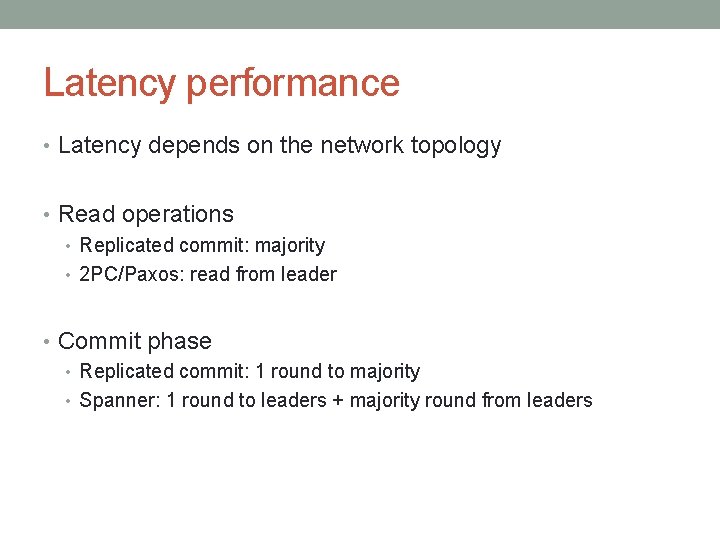
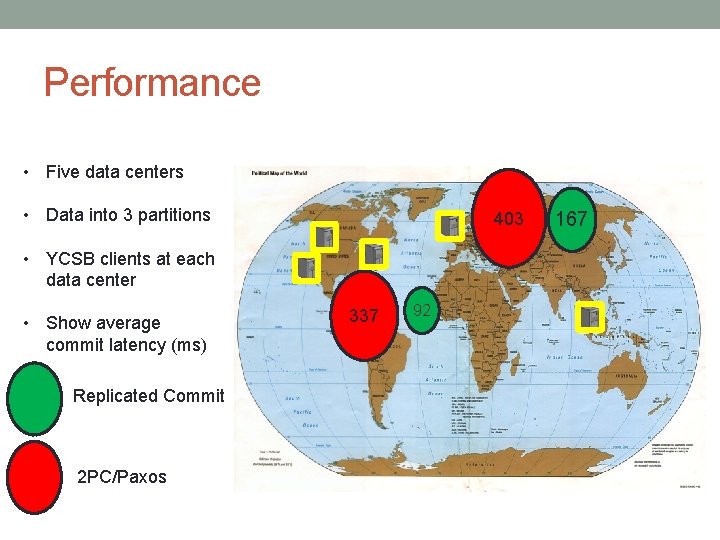
Latency performance • Latency depends on the network topology • Read operations • Replicated commit: majority • 2 PC/Paxos: read from leader • Commit phase • Replicated commit: 1 round to majority • Spanner: 1 round to leaders + majority round from leaders
Performance • Five data centers • Data into 3 partitions 403 • YCSB clients at each data center • Show average commit latency (ms) Replicated Commit 2 PC/Paxos 337 92 167
“Can we break the RTT barrier? ” [CIDR’ 2013]
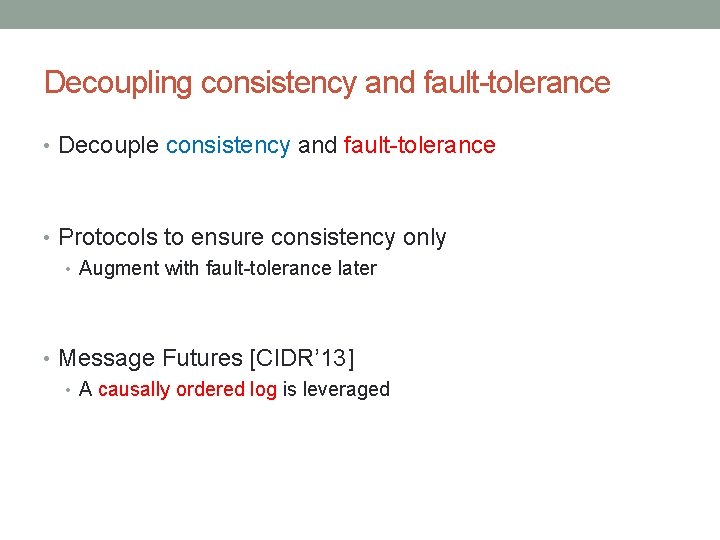
Decoupling consistency and fault-tolerance • Decouple consistency and fault-tolerance • Protocols to ensure consistency only • Augment with fault-tolerance later • Message Futures [CIDR’ 13] • A causally ordered log is leveraged
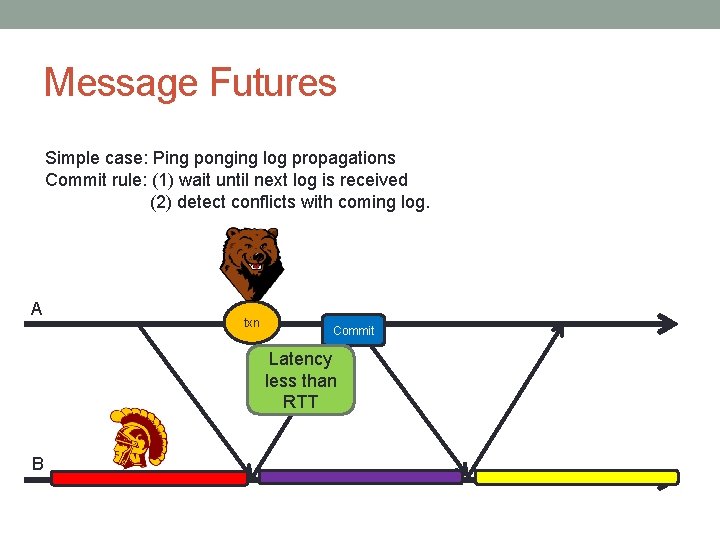
Message Futures Simple case: Ping ponging log propagations Commit rule: (1) wait until next log is received (2) detect conflicts with coming log. A txn Commit Latency less than RTT B
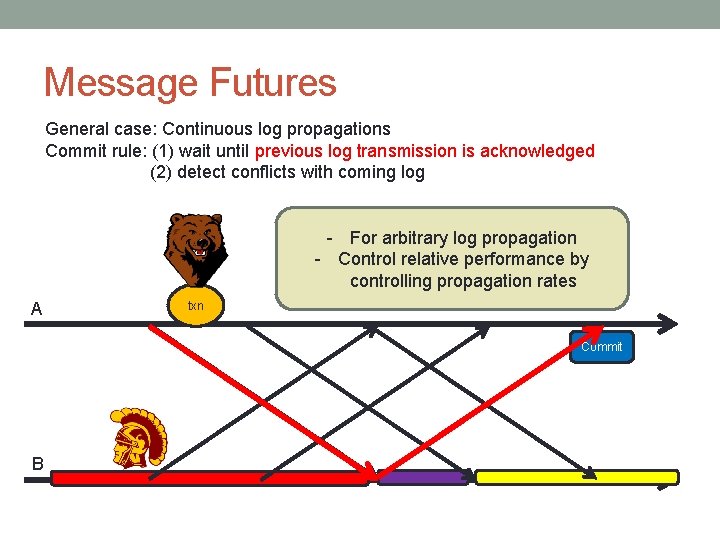
Message Futures General case: Continuous log propagations Commit rule: (1) wait until previous log transmission is acknowledged (2) detect conflicts with coming log - For arbitrary log propagation - Control relative performance by controlling propagation rates A txn Commit B
“IS THERE A LOWER-BOUND ” ON TRANSACTION LATENCY? [SIGMOD’ 15]
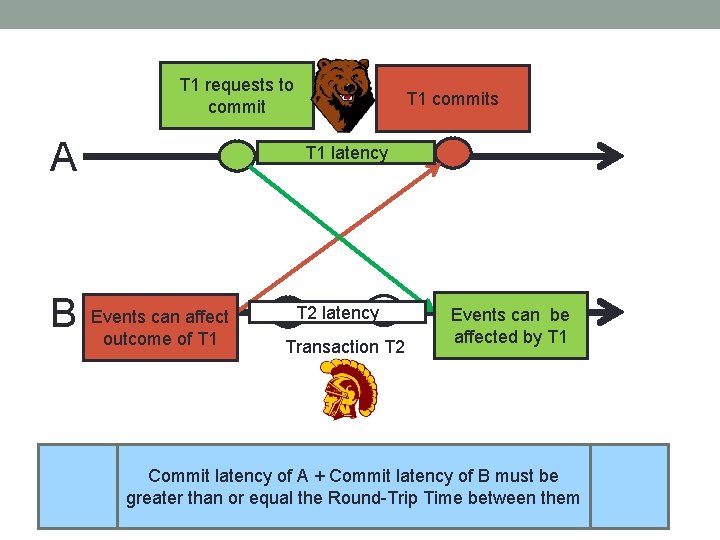
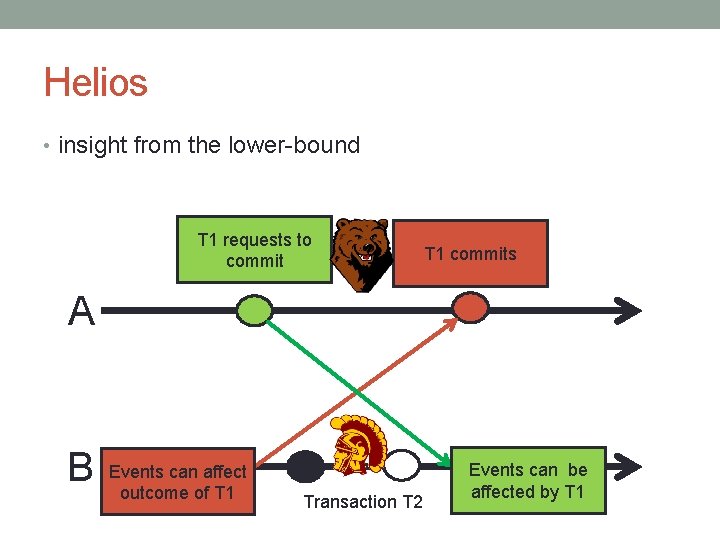
T 1 requests to commit A B T 1 commits T 1 latency Events can affect outcome of T 1 T 2 latency Transaction T 2 Events can be affected by T 1 Commit latency of A + Commit latency of B must be greater than or equal the Round-Trip Time between them
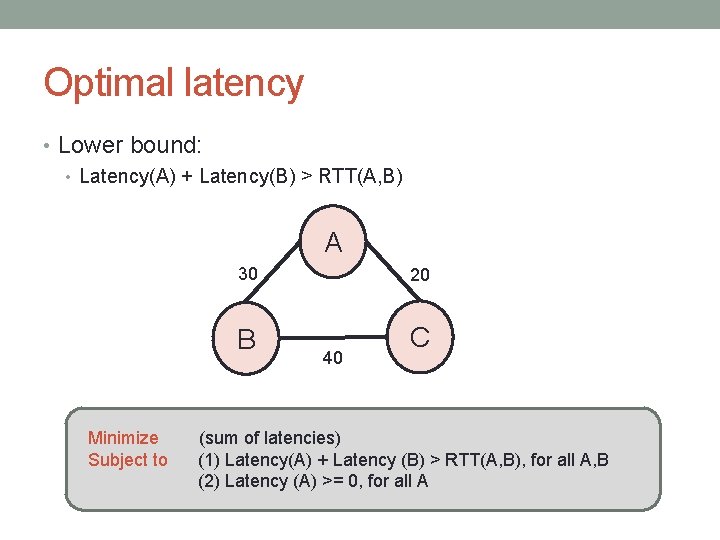
Optimal latency • Lower bound: • Latency(A) + Latency(B) > RTT(A, B) A Minimize Subject to 30 20 B C 40 (sum of latencies) (1) Latency(A) + Latency (B) > RTT(A, B), for all A, B (2) Latency (A) >= 0, for all A
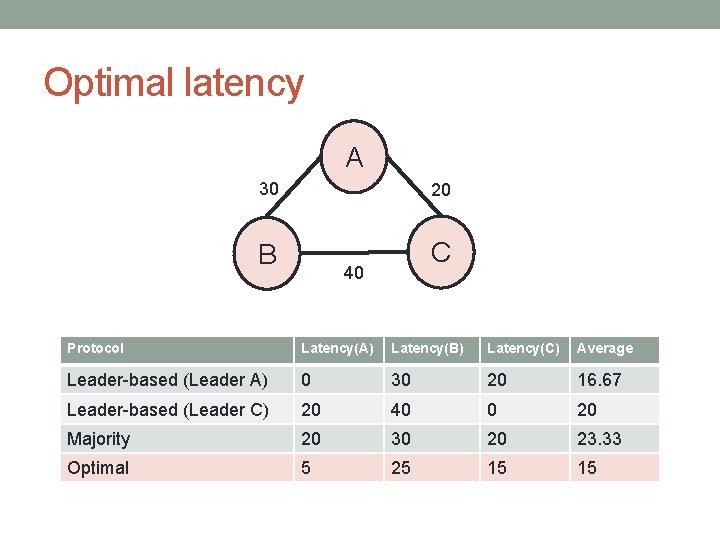
Optimal latency A 30 20 B C 40 Protocol Latency(A) Latency(B) Latency(C) Average Leader-based (Leader A) 0 30 20 16. 67 Leader-based (Leader C) 20 40 0 20 Majority 20 30 20 23. 33 Optimal 5 25 15 15
ACHIEVING THE LOWER-BOUND [SIGMOD’ 15]
Helios • insight from the lower-bound T 1 requests to commit T 1 commits A B Events can affect outcome of T 1 Transaction T 2 Events can be affected by T 1
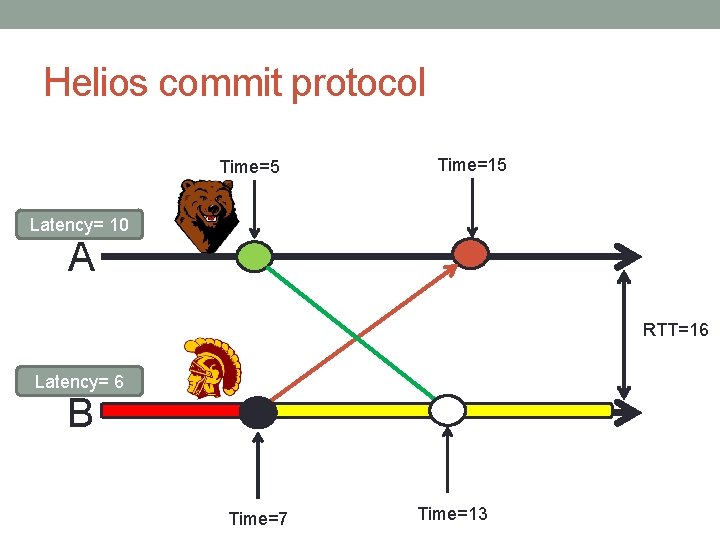
Helios commit protocol Time=5 Time=15 Latency= 10 A RTT=16 Latency= 6 B Time=7 Time=13
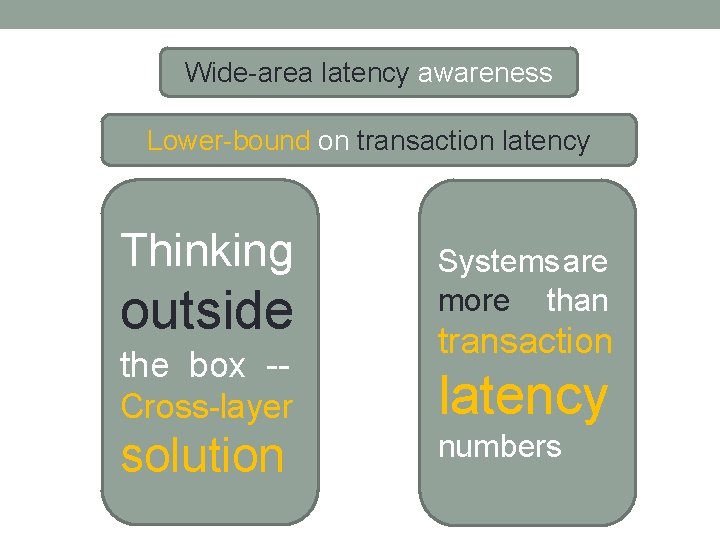
Wide-area latency awareness Lower-bound on transaction latency Thinking outside the box -- Systems are more than transaction Cross-layer latency solution numbers