
Geopolitical Theory 2016 What is Geopolitics Geopolitics The
- Slides: 20
Geopolitical Theory 2016
What is Geopolitics? ► Geopolitics § The study of power relationships past, present, and future § The study of the relationship among politics and geography, demography, and economics, especially with respect to the foreign policy of a nation. § A branch of political geography that considers the strategic value of land sea area in the context of national economic and military power and ambitions
What is Geopolitics? ► Geopolitics § The state’s power to control space or territory and shape the foreign policy of individual states and international political relations § Geopolitics is concerned with how geographical factors, including territory, population, strategic location, and natural resource endowments, as modified by economics and technology, affect the relations between states and the struggle for world domination. § Geopolitics is defined as a branch of geography that promises to explain the relationships between geographical realities and international affairs.
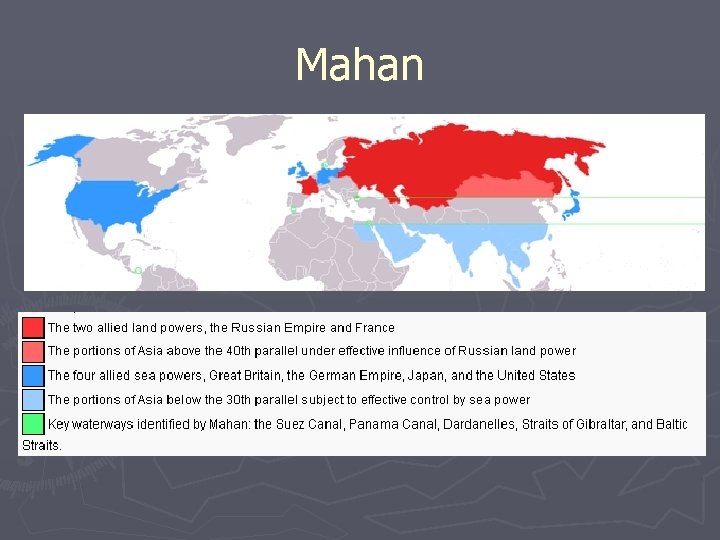
Alfred Thayer Mahan: 1890 ► sea power necessary to facilitate trade and peaceful commerce ► the country that possessed power would be one that could control the seas ► development of a strong navy was an essential ingredient to a powerful state as was the country's location ► most power would be held by a country with accessible relative location and connected with a long coastline and good harbors ► power held north of the Suez and Panama Canals.
Mahan
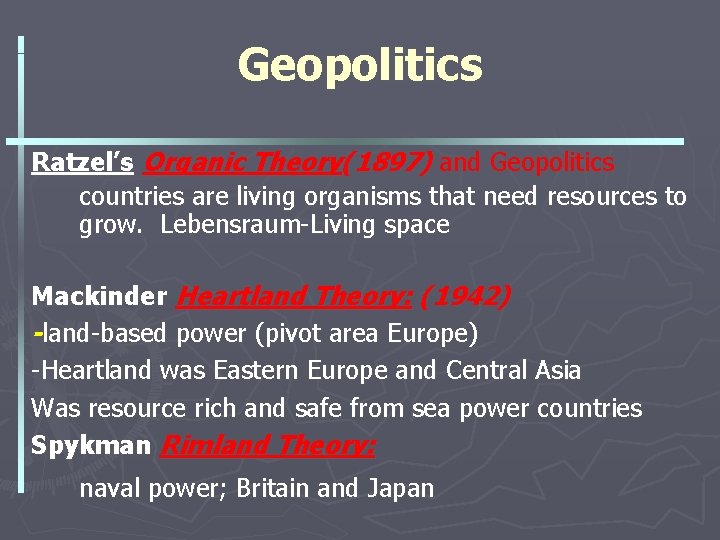
Geopolitics Ratzel’s Organic Theory(1897) and Geopolitics countries are living organisms that need resources to grow. Lebensraum-Living space Mackinder Heartland Theory: (1942) -land-based power (pivot area Europe) -Heartland was Eastern Europe and Central Asia Was resource rich and safe from sea power countries Spykman Rimland Theory: naval power; Britain and Japan
Ratzel: 1897 ► "organic theory“ ► the state is an organism attached to the earth that competes with other states to thrive ► state requires lebensraum - living space ► must devour other territories to achieve this goal
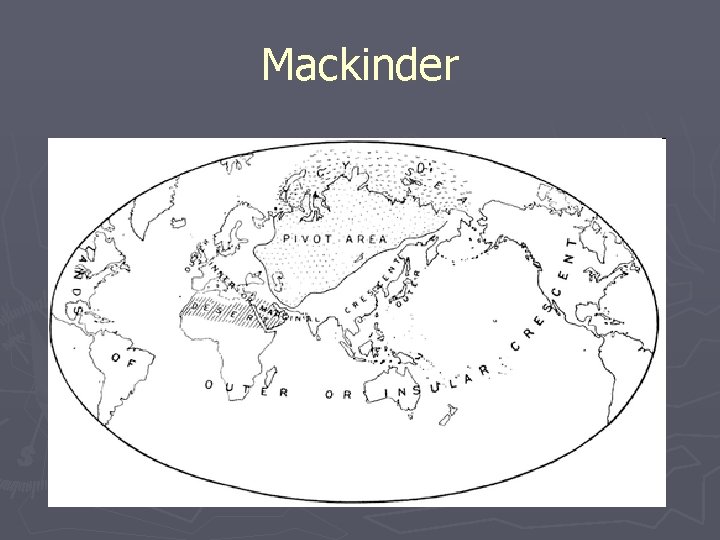
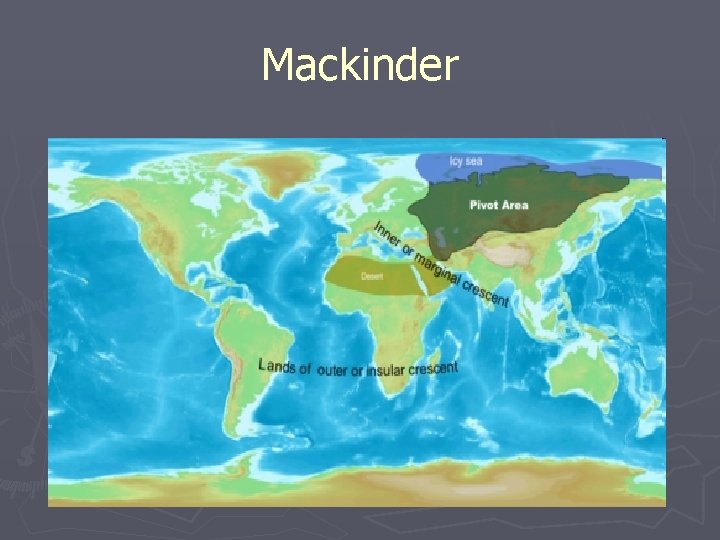
Sir Halford Mackinder: 1904 ► ► ► ► unequal spatial distribution of strategic opportunities in the world advent of railroads released countries from dependence on Navy to move Army focus of warfare would be shifted from the sea to the hinterland "pivot area“ § northern and interior parts of the Eurasian continent where the rivers flow to the Arctic or to salt seas and lakes railroads would make this area easy to defend and hard to conquer Heartland Theory: "He who controls the Heartland controls the World Island (Eurasia and Africa); He who controls the World Island, controls the world. " believed Germany would be a threat to controlling the resources of Eastern Europe and the Heartland.
Mackinder
Mackinder
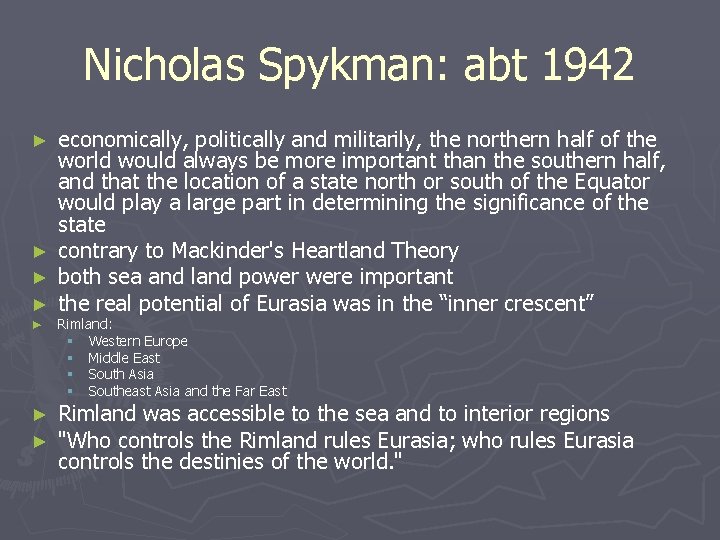
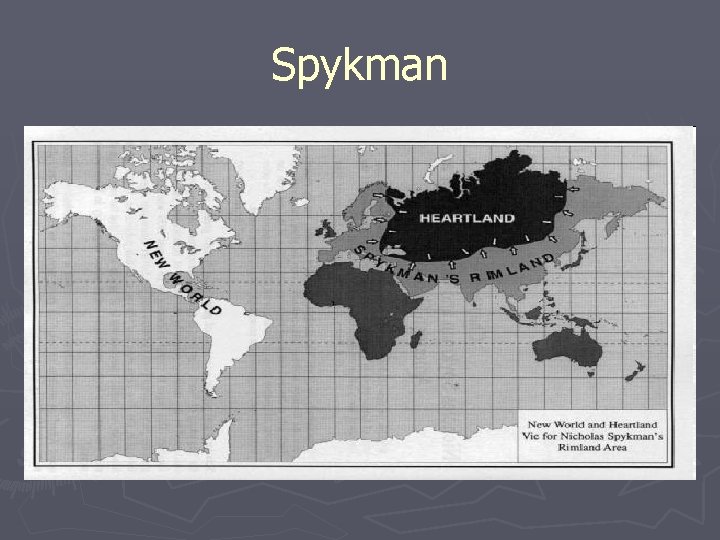
Nicholas Spykman: abt 1942 economically, politically and militarily, the northern half of the world would always be more important than the southern half, and that the location of a state north or south of the Equator would play a large part in determining the significance of the state ► contrary to Mackinder's Heartland Theory ► both sea and land power were important ► the real potential of Eurasia was in the “inner crescent” ► ► Rimland: § Western Europe § Middle East § South Asia § Southeast Asia and the Far East Rimland was accessible to the sea and to interior regions "Who controls the Rimland rules Eurasia; who rules Eurasia controls the destinies of the world. "
Spykman
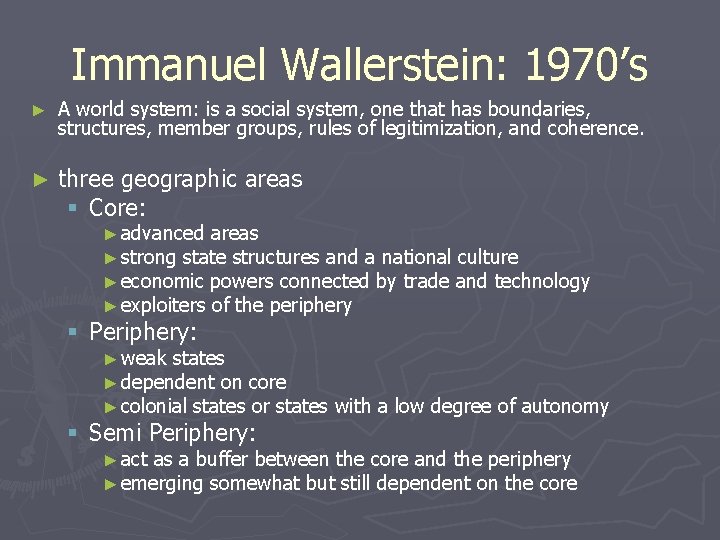
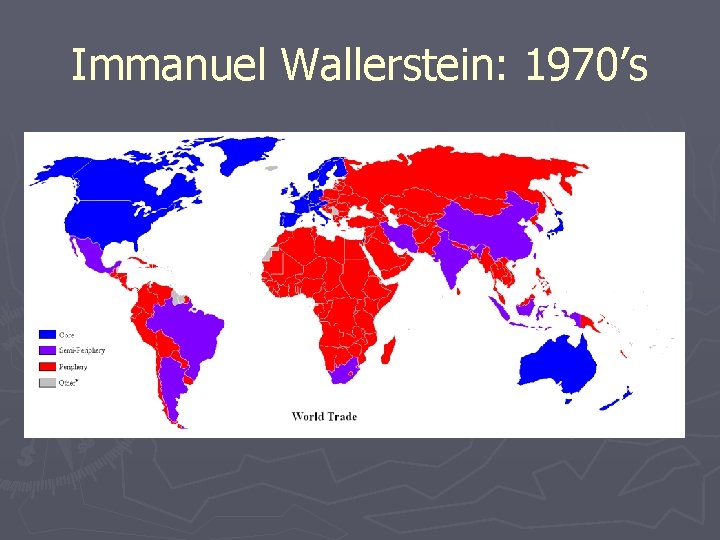
Immanuel Wallerstein: 1970’s ► A world system: is a social system, one that has boundaries, structures, member groups, rules of legitimization, and coherence. ► three geographic areas § Core: ► advanced areas ► strong state structures and a national culture ► economic powers connected by trade and technology ► exploiters of the periphery § Periphery: ► weak states ► dependent on core ► colonial states or states with a low degree of autonomy § Semi Periphery: ► act as a buffer between the core and the periphery ► emerging somewhat but still dependent on the core
Immanuel Wallerstein: 1970’s
Cold War Geopolitics ► After WWII (after 1945) ► Hostility bw/ US and Soviet Union ► Race for nuclear weapons ► Created a bipolar world in terms of conflict ► Capitalist Bloc(US and Western Europe) vs ► Communist Bloc (Soviet Union and allies)China, NK, Mongolia etc
Marxism-Karl Marx wrote the Communist Manifesto Living in a capitalist society, however, the individual is not truly free. Advocates the rise of the proletariat(working class versus bourgeoise(capitalists). Class free society. State controlled economy. Shatterbelt-Cohen He modified Mackinder’s theory. Heartland was the pivot area, inner crescent was the rimland. He pointed out that several inner crescent areas were shatterbelts or areas of political weakness.
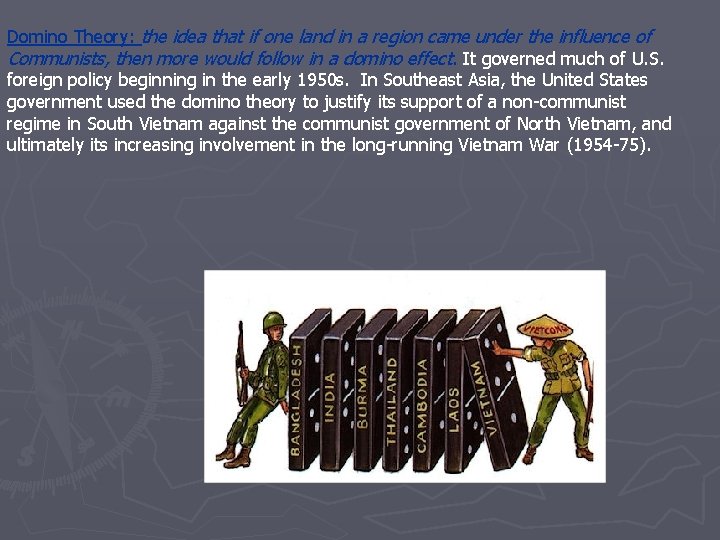
Domino Theory: the idea that if one land in a region came under the influence of Communists, then more would follow in a domino effect. It governed much of U. S. foreign policy beginning in the early 1950 s. In Southeast Asia, the United States government used the domino theory to justify its support of a non-communist regime in South Vietnam against the communist government of North Vietnam, and ultimately its increasing involvement in the long-running Vietnam War (1954 -75).
Containment: by George Kennan A resulting policy out of the Truman Doctrine that promoted containment of communism, the domino theory was used by successive United States administrations during the Cold War to justify American intervention around the world. Vietnam to contain Communism in Asia
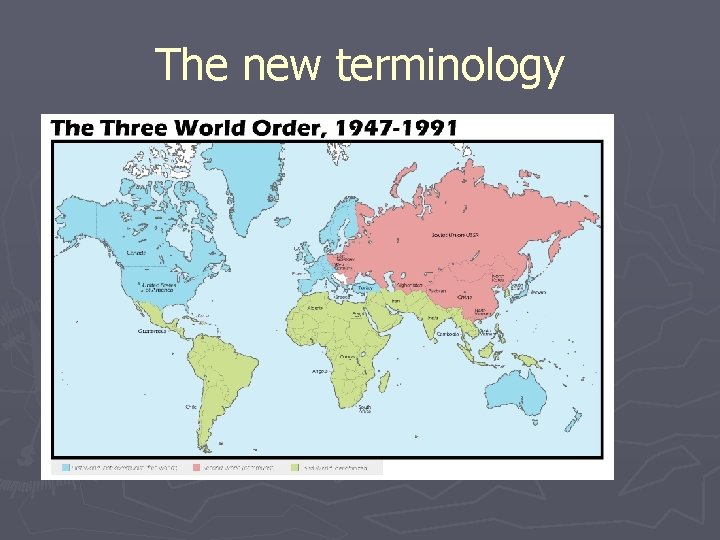
The new terminology