
Geophysical Conditions of the Earth Seismicity Gravity Heat
- Slides: 11
Geophysical Conditions of the Earth : Seismicity, Gravity, Heat Flow, Geomagnetism Applications of Geophysics in understanding Geodynamics
Earthquakes and Plate Tectonics • Earthquakes are caused by plate interactions along tectonic plate boundaries • Plate boundaries are identified and defined by earthquakes • Earthquakes occur at each of the three types of plate boundaries: divergent, transform, and convergent – At divergent boundaries, tensional forces produce shallow-focus quakes on normal faults – At transform boundaries, shear forces produce shallow-focus quakes along strike-slip faults – At convergent boundaries, compressional forces produce shallow- to deep-focus quakes along reverse faults
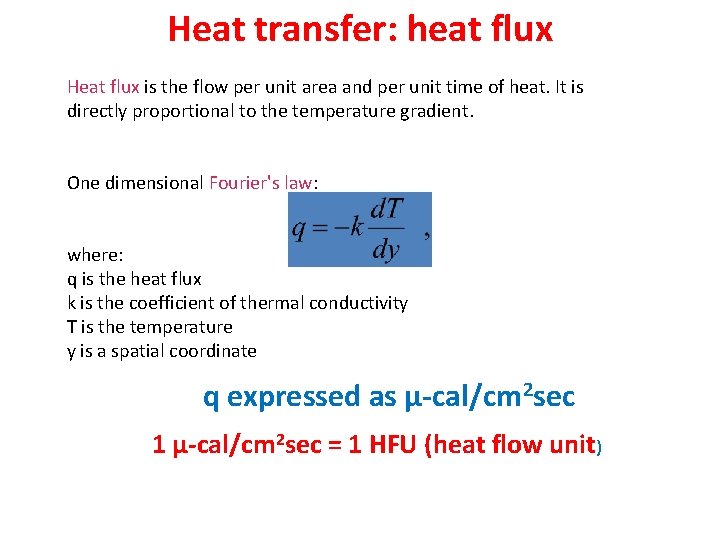
Heat transfer: heat flux Heat flux is the flow per unit area and per unit time of heat. It is directly proportional to the temperature gradient. One dimensional Fourier's law: where: q is the heat flux k is the coefficient of thermal conductivity T is the temperature y is a spatial coordinate q expressed as µ-cal/cm 2 sec 1 µ-cal/cm 2 sec = 1 HFU (heat flow unit)
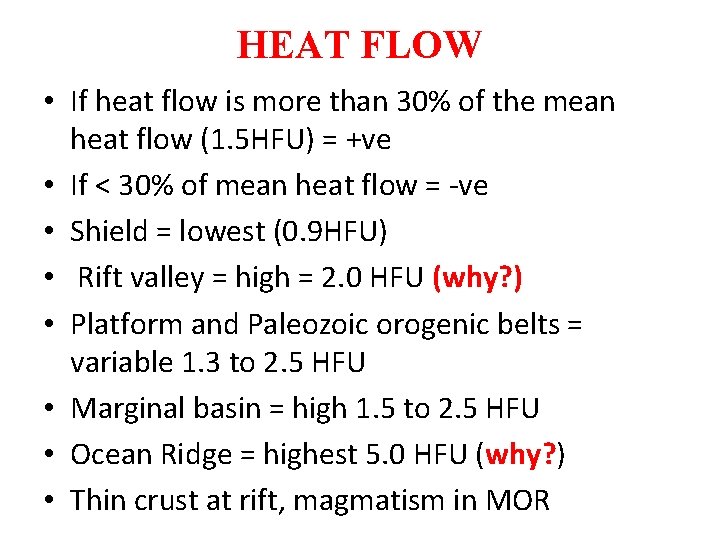
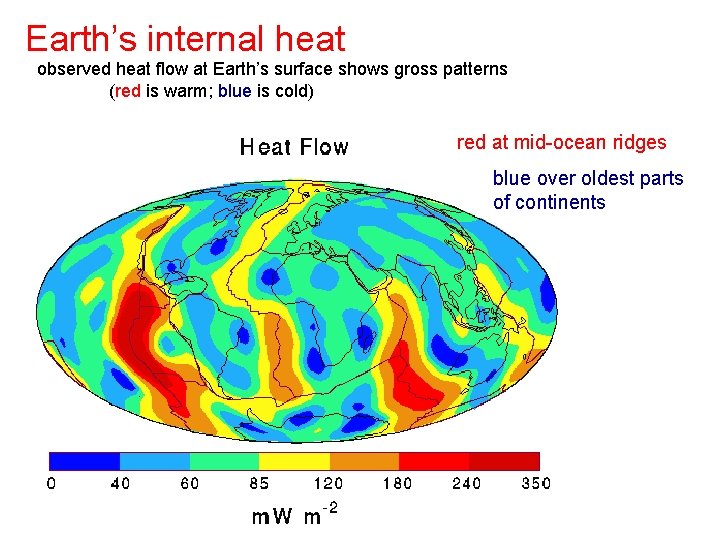
HEAT FLOW • • Heat flow in continents = 1. 2 HFU, Ocean = 1. 4 HFU Mean = 1. 5 HFU This implies near equality of heat flow ----which indicates source of heat is not the crust but the upper mantle ---- otherwise the continental crust containing radioactive minerals should have shown a larger heat flow
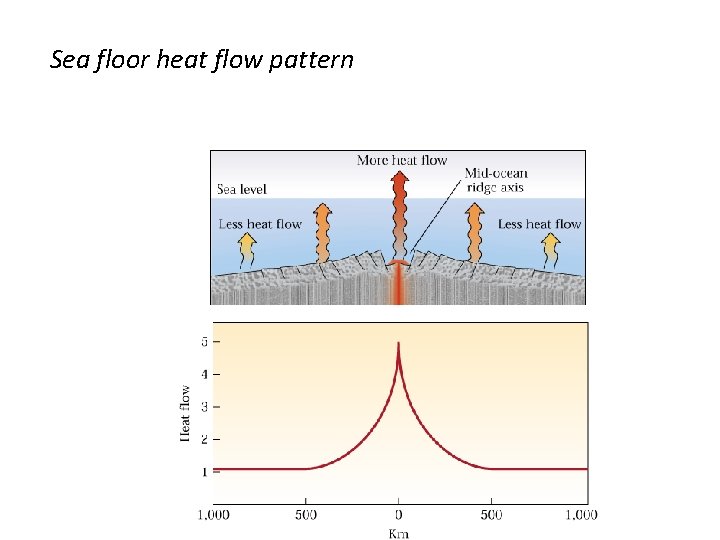
HEAT FLOW • If heat flow is more than 30% of the mean heat flow (1. 5 HFU) = +ve • If < 30% of mean heat flow = -ve • Shield = lowest (0. 9 HFU) • Rift valley = high = 2. 0 HFU (why? ) • Platform and Paleozoic orogenic belts = variable 1. 3 to 2. 5 HFU • Marginal basin = high 1. 5 to 2. 5 HFU • Ocean Ridge = highest 5. 0 HFU (why? ) • Thin crust at rift, magmatism in MOR
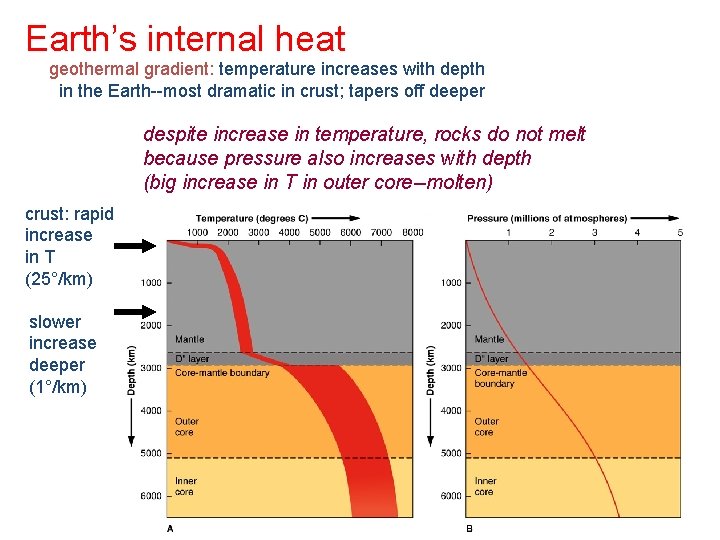
Earth’s internal heat geothermal gradient: temperature increases with depth in the Earth--most dramatic in crust; tapers off deeper despite increase in temperature, rocks do not melt because pressure also increases with depth (big increase in T in outer core--molten) crust: rapid increase in T (25°/km) slower increase deeper (1°/km)
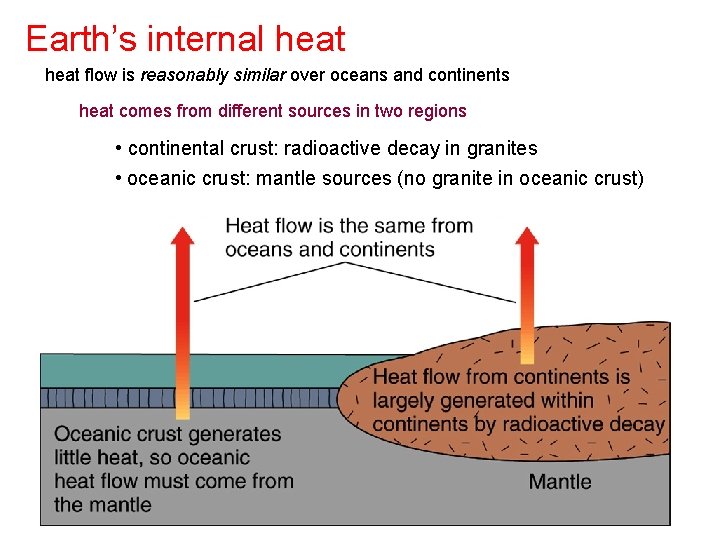
Earth’s internal heat flow is reasonably similar over oceans and continents heat comes from different sources in two regions • continental crust: radioactive decay in granites • oceanic crust: mantle sources (no granite in oceanic crust)
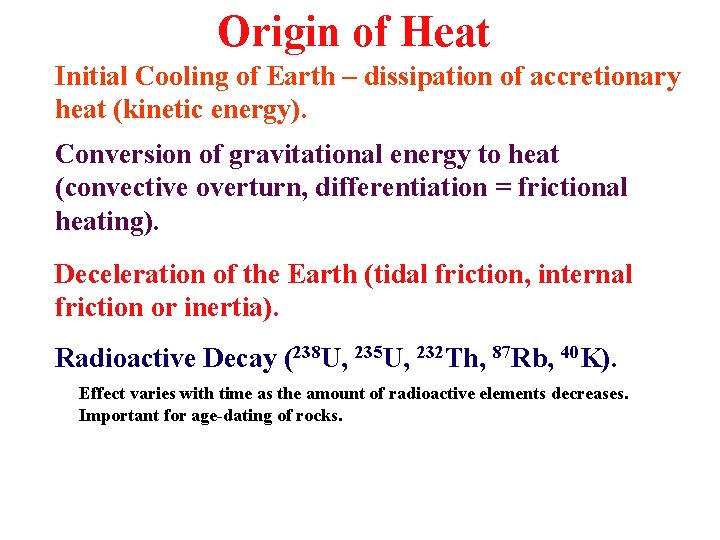
Origin of Heat Initial Cooling of Earth – dissipation of accretionary heat (kinetic energy). Conversion of gravitational energy to heat (convective overturn, differentiation = frictional heating). Deceleration of the Earth (tidal friction, internal friction or inertia). Radioactive Decay (238 U, 235 U, 232 Th, 87 Rb, 40 K). Effect varies with time as the amount of radioactive elements decreases. Important for age-dating of rocks.
Earth’s internal heat observed heat flow at Earth’s surface shows gross patterns (red is warm; blue is cold) red at mid-ocean ridges blue over oldest parts of continents
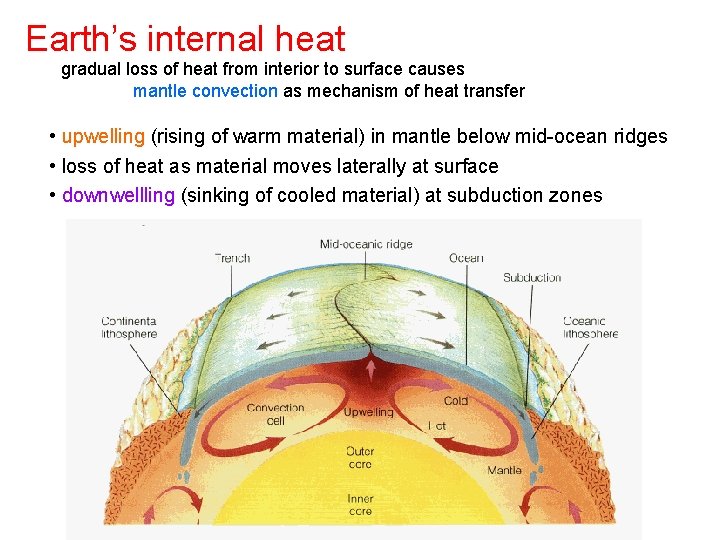
Earth’s internal heat gradual loss of heat from interior to surface causes mantle convection as mechanism of heat transfer • upwelling (rising of warm material) in mantle below mid-ocean ridges • loss of heat as material moves laterally at surface • downwellling (sinking of cooled material) at subduction zones
Sea floor heat flow pattern