
Geometry Vocabulary 1 http www mathopenref comcong ruentlines
Geometry Vocabulary 1 http: //www. mathopenref. com/cong ruentlines. html

http: //www. themathlab. com/dictionary/awords. htm http: //www. themathlab. com/diction ary/pwords. htm

parallel lines • The lines that never intersect are parallel lines. NOTE: two common symbols used to indicate parallel lines are the extra arrowheads placed on the lines as you see in the example above and also the || symbol.
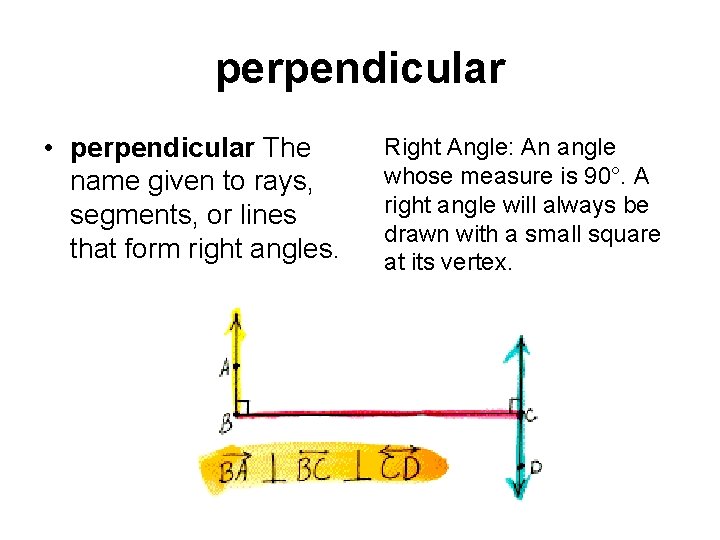
perpendicular • perpendicular The name given to rays, segments, or lines that form right angles. Right Angle: An angle whose measure is 90°. A right angle will always be drawn with a small square at its vertex.

Length Line segment • Length The distance between two points • Line segment The points A and B along with the points on segment between A and B. Also called segments.
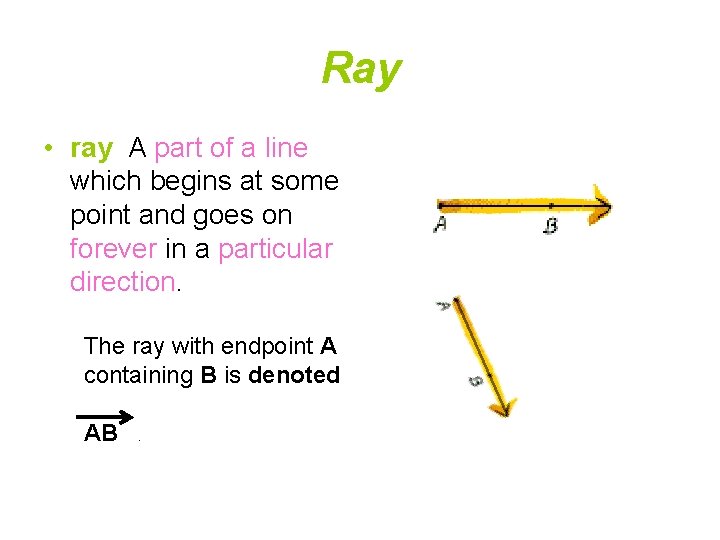
Ray • ray A part of a line which begins at some point and goes on forever in a particular direction. The ray with endpoint A containing B is denoted AB .
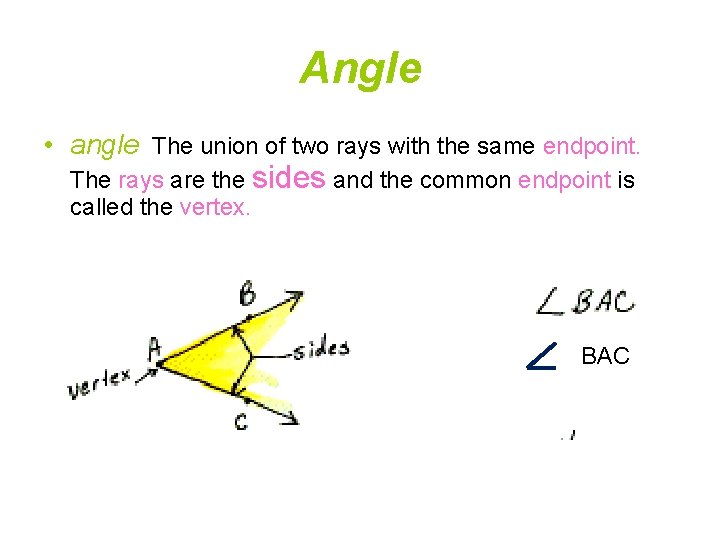
Angle • angle The union of two rays with the same endpoint. The rays are the sides and the common endpoint is called the vertex. BAC
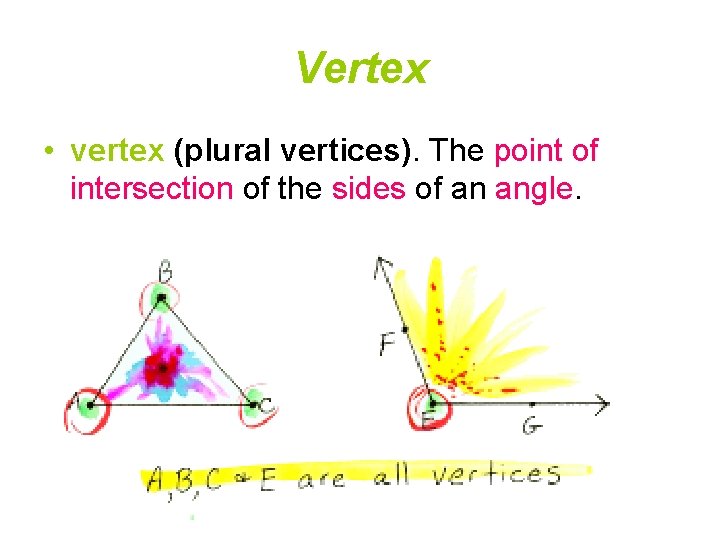
Vertex • vertex (plural vertices). The point of intersection of the sides of an angle.
Congruent • Congruent Segments Line segments that have the same length. • Congruent Angles that have the same measure. • Congruent Polygons have the same shape and the same size http: //www. mathopenref. com/congruentlines. html
Point, Line, Plane • point An undefined geometric term: a point represents a location and has no size. • line An undefined geometric term. It is represented by a straight line with two arrowheads indicating line extends forever. AB BA • plane An undefined geometric term. In Euclidean Geometry, a plane is a flat surface that extends infinitely in all directions.
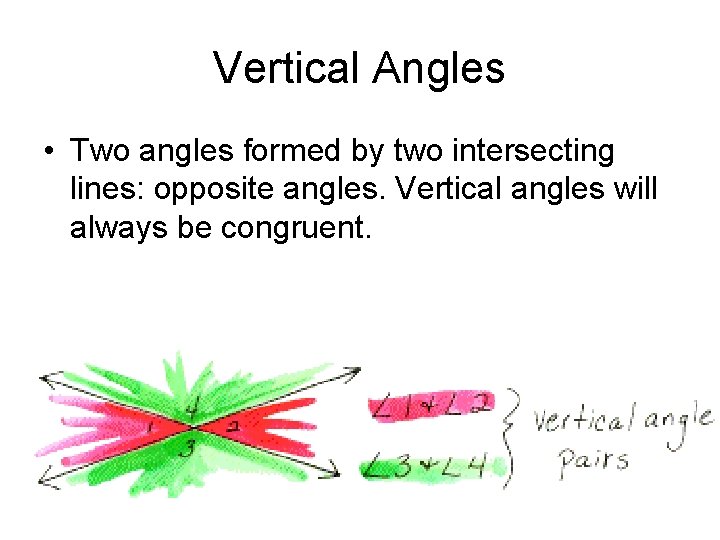
Vertical Angles • Two angles formed by two intersecting lines: opposite angles. Vertical angles will always be congruent.
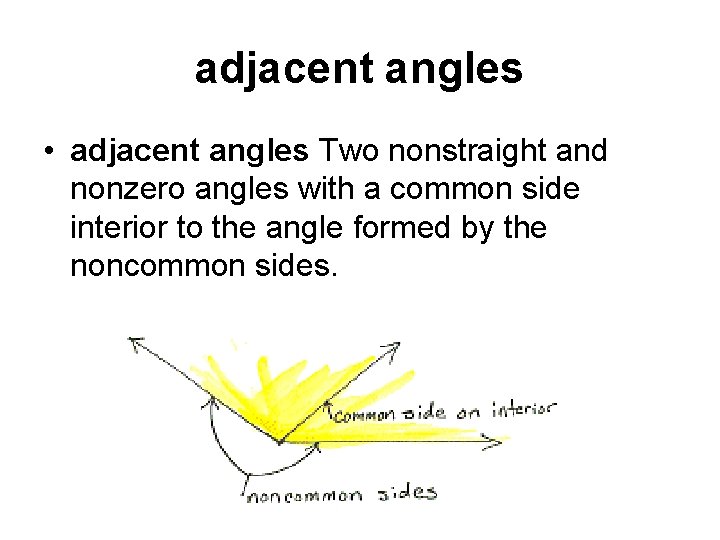
adjacent angles • adjacent angles Two nonstraight and nonzero angles with a common side interior to the angle formed by the noncommon sides.
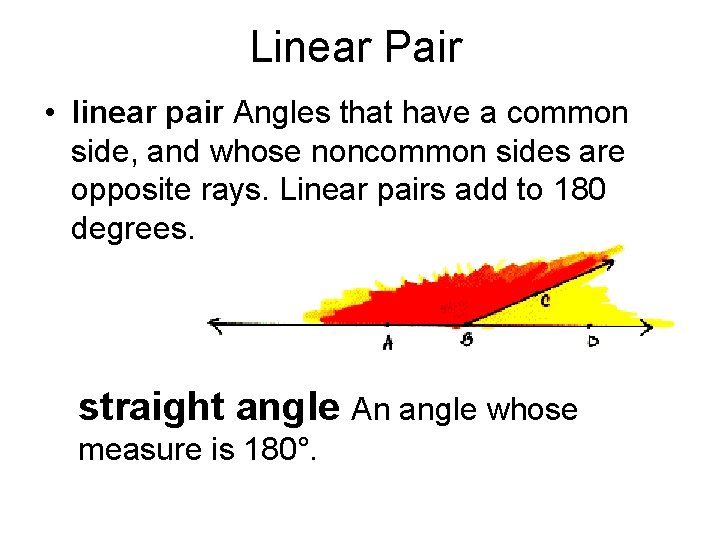
Linear Pair • linear pair Angles that have a common side, and whose noncommon sides are opposite rays. Linear pairs add to 180 degrees. straight angle An angle whose measure is 180°.
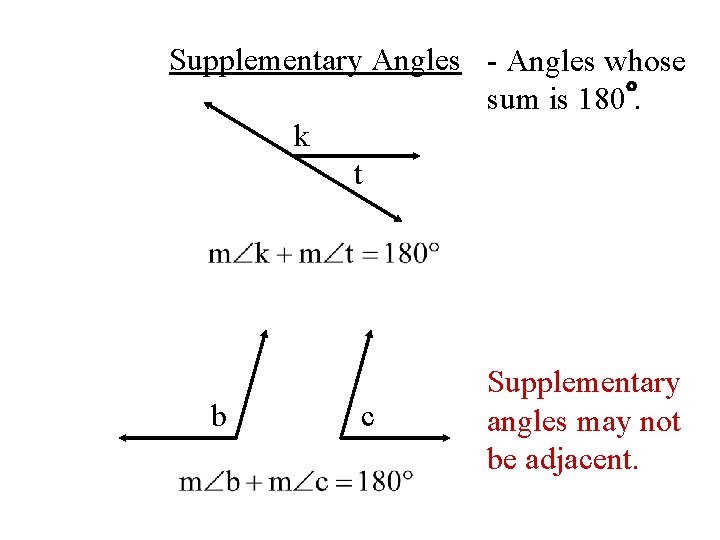
Supplementary Angles - Angles whose sum is 180. k t b c Supplementary angles may not be adjacent.
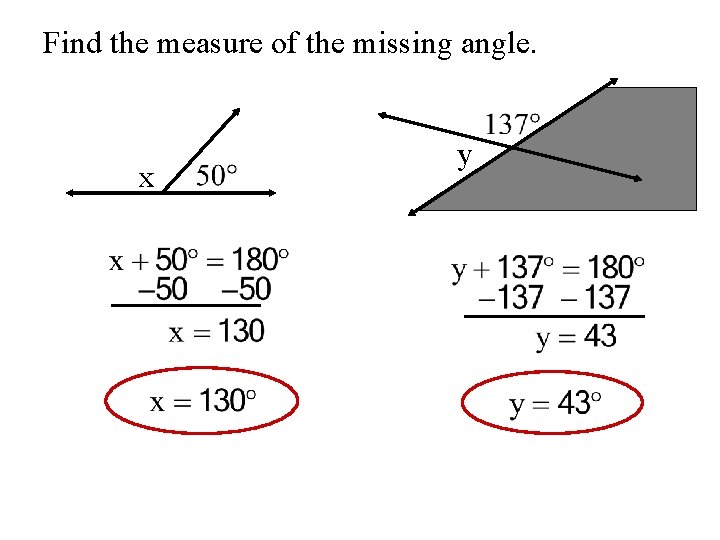
Find the measure of the missing angle. x y
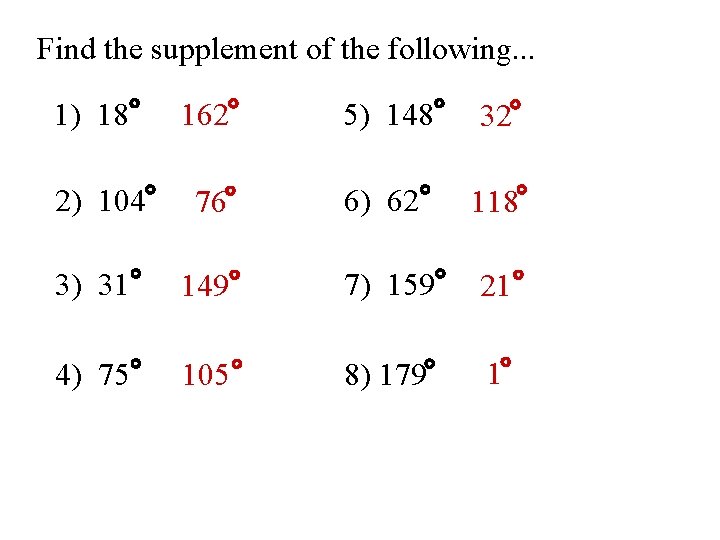
Find the supplement of the following. . . 1) 18 162 5) 148 32 2) 104 76 6) 62 118 3) 31 149 7) 159 21 4) 75 105 8) 179 1
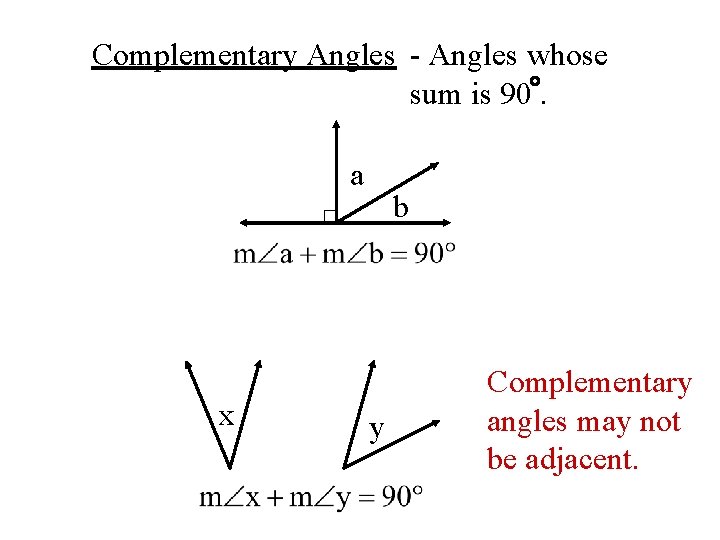
Complementary Angles - Angles whose sum is 90. a x b y Complementary angles may not be adjacent.
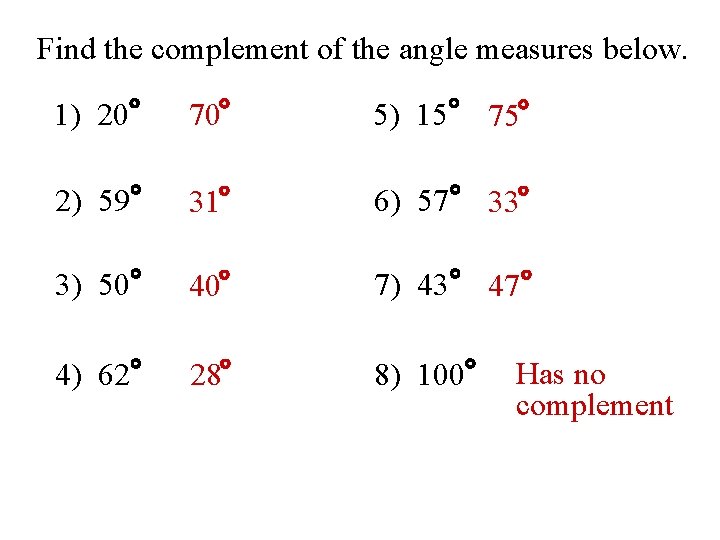
Find the complement of the angle measures below. 1) 20 70 5) 15 75 2) 59 31 6) 57 33 3) 50 40 7) 43 47 4) 62 28 8) 100 Has no complement
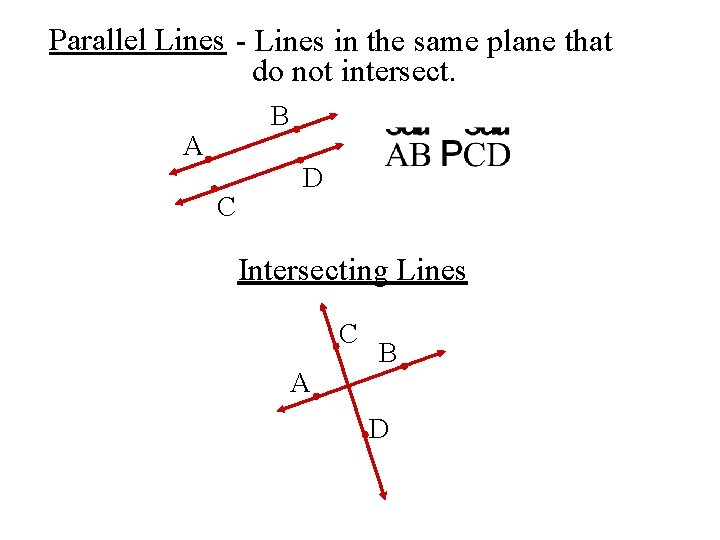
Parallel Lines - Lines in the same plane that do not intersect. B A C D Intersecting Lines C A B D
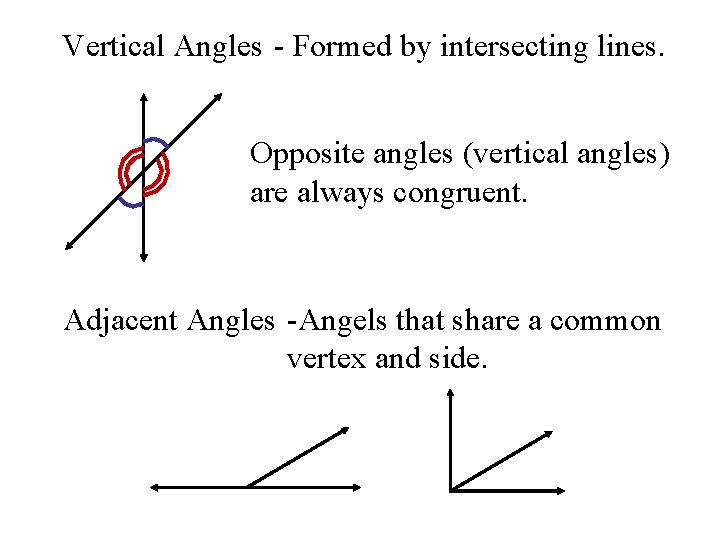
Vertical Angles - Formed by intersecting lines. Opposite angles (vertical angles) are always congruent. Adjacent Angles -Angels that share a common vertex and side.
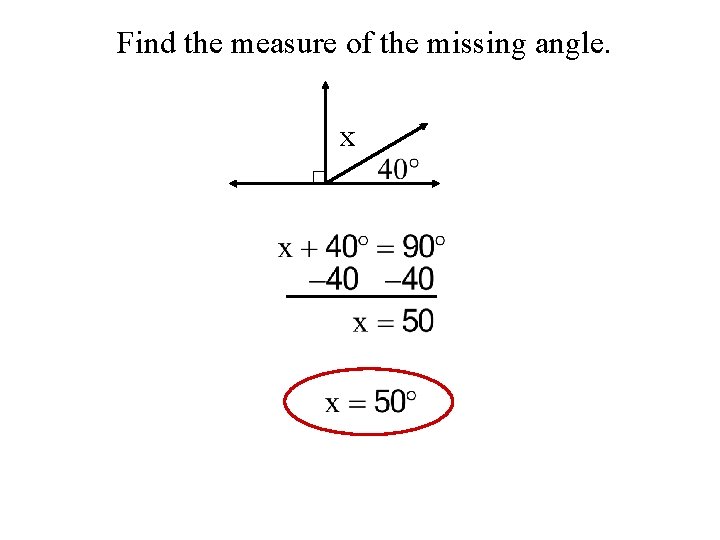
Find the measure of the missing angle. x
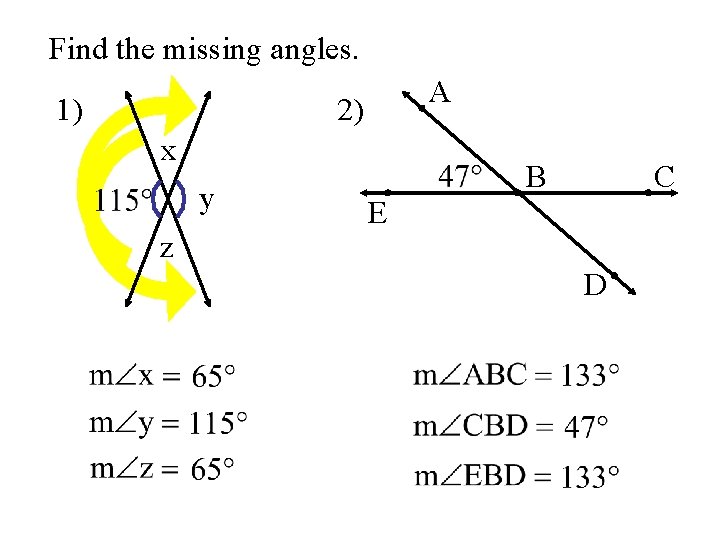
Find the missing angles. 1) A 2) x y z B C E D
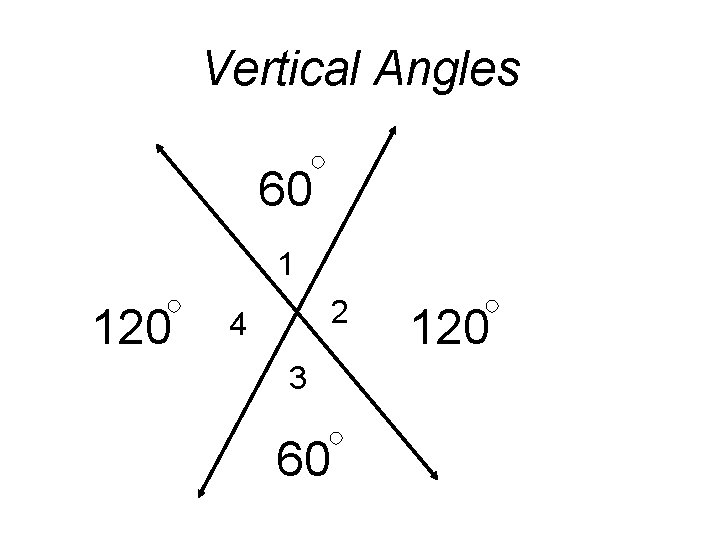
Vertical Angles 60 1 120 2 4 3 60 120
Characteristics of Vertical Angles • Vertical Angles are Congruent Angles. • Vertical Angles are Non-adjacent Angles. • Adjacent Angles are Supplementary.
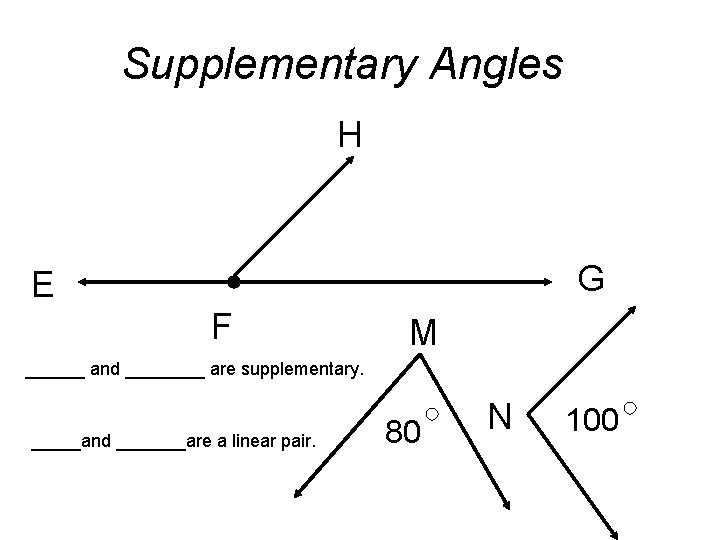
Supplementary Angles H G E F M ______ and ____ are supplementary. _____and _______are a linear pair. 80 N 100
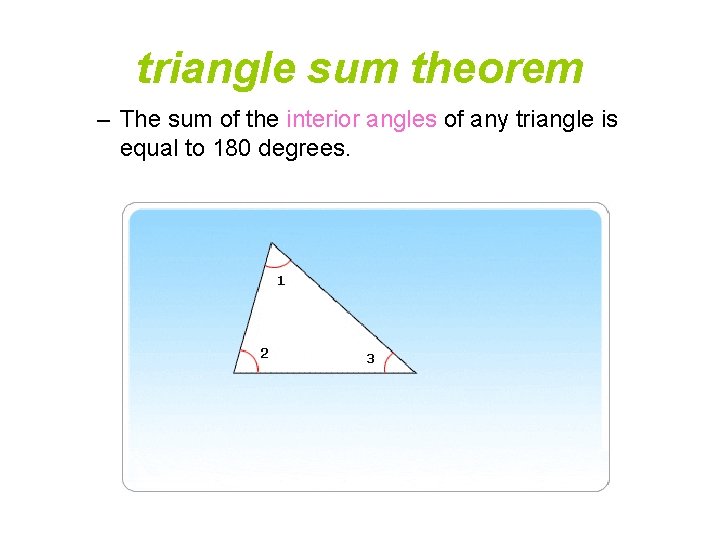
triangle sum theorem – The sum of the interior angles of any triangle is equal to 180 degrees.
- Slides: 26