
Geometry Unit 13 part 2 Statistics Summarize represent


- Slides: 13
Geometry Unit 13 part 2 Statistics Summarize, represent, and interpret data on two categorical and quantitative variables.
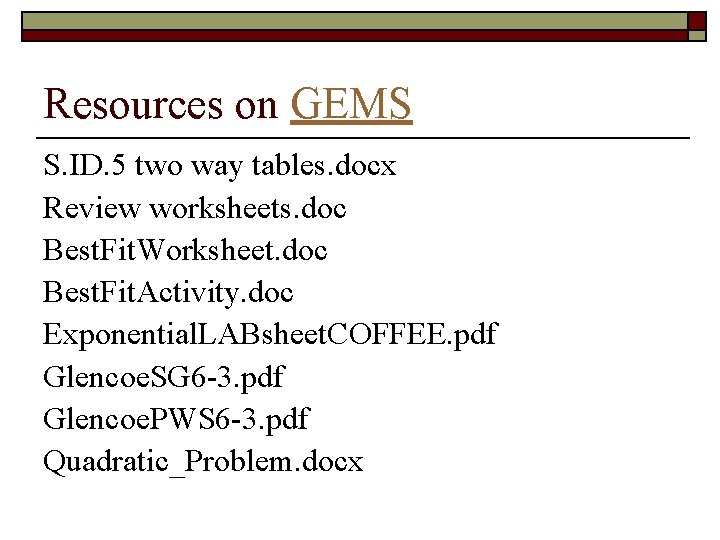
Resources on GEMS S. ID. 5 two way tables. docx Review worksheets. doc Best. Fit. Worksheet. doc Best. Fit. Activity. doc Exponential. LABsheet. COFFEE. pdf Glencoe. SG 6 -3. pdf Glencoe. PWS 6 -3. pdf Quadratic_Problem. docx
Great TI calculator websites o o http: //calculator. maconstate. edu/calc_topics. ht ml http: //mathbits. com/mathbits/tisection/openpa ge. htm
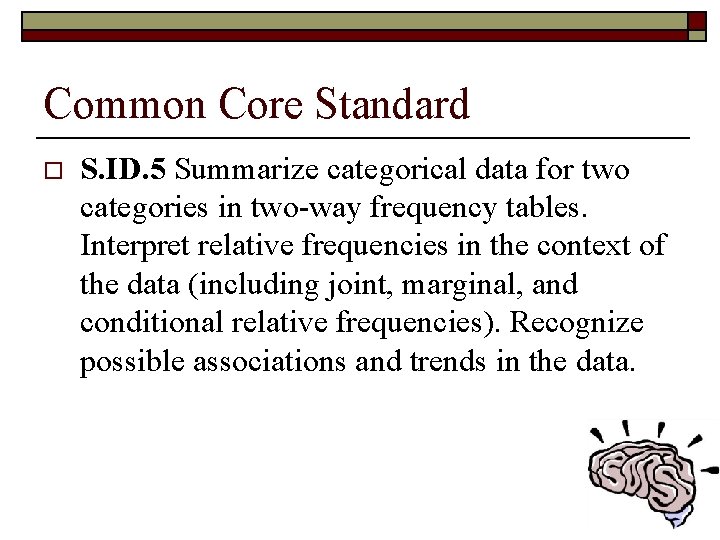
Common Core Standard o S. ID. 5 Summarize categorical data for two categories in two-way frequency tables. Interpret relative frequencies in the context of the data (including joint, marginal, and conditional relative frequencies). Recognize possible associations and trends in the data.
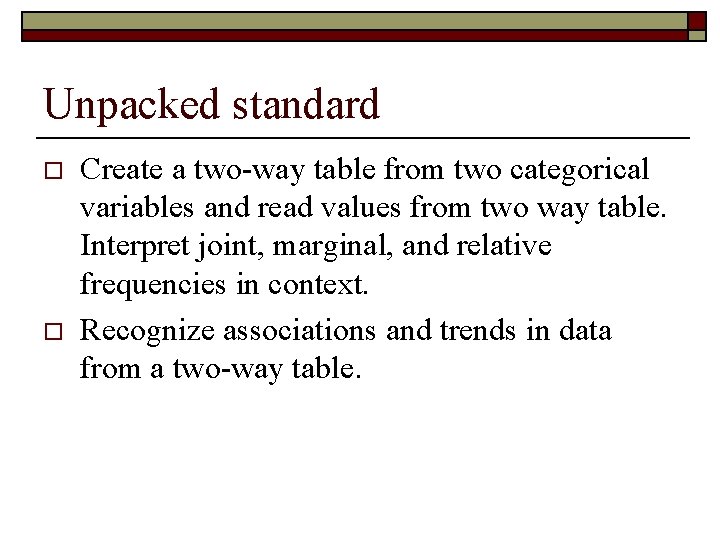
Unpacked standard o o Create a two-way table from two categorical variables and read values from two way table. Interpret joint, marginal, and relative frequencies in context. Recognize associations and trends in data from a two-way table.
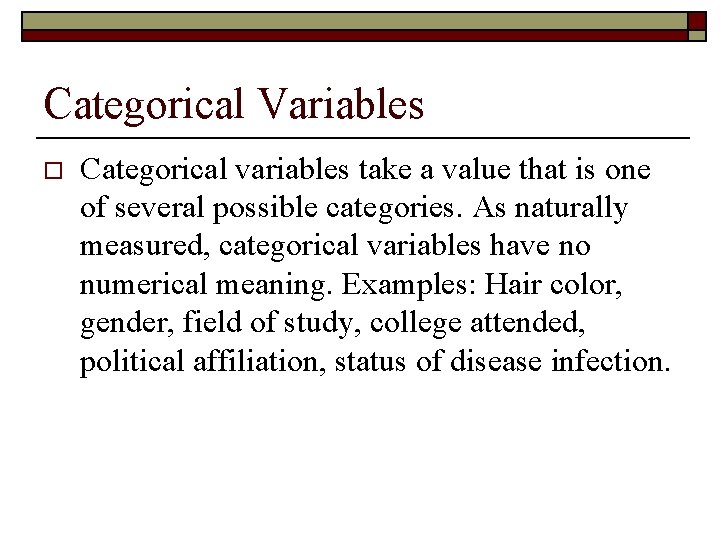
Categorical Variables o Categorical variables take a value that is one of several possible categories. As naturally measured, categorical variables have no numerical meaning. Examples: Hair color, gender, field of study, college attended, political affiliation, status of disease infection.
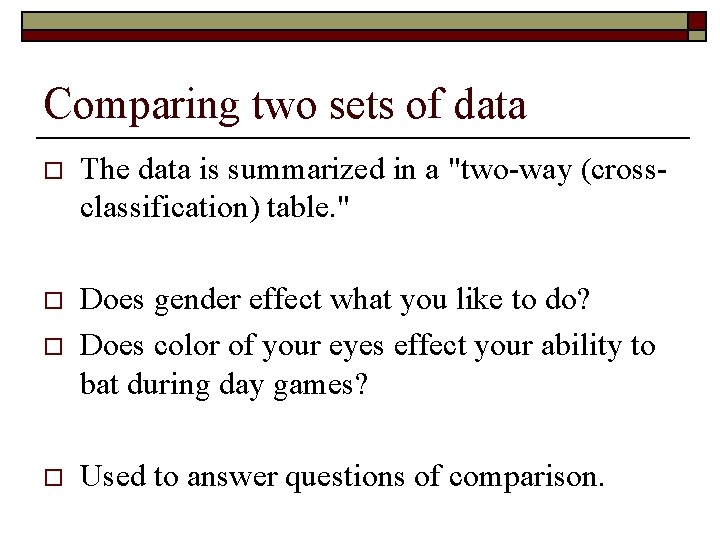
Comparing two sets of data o The data is summarized in a "two-way (crossclassification) table. " o o Does gender effect what you like to do? Does color of your eyes effect your ability to bat during day games? o Used to answer questions of comparison.
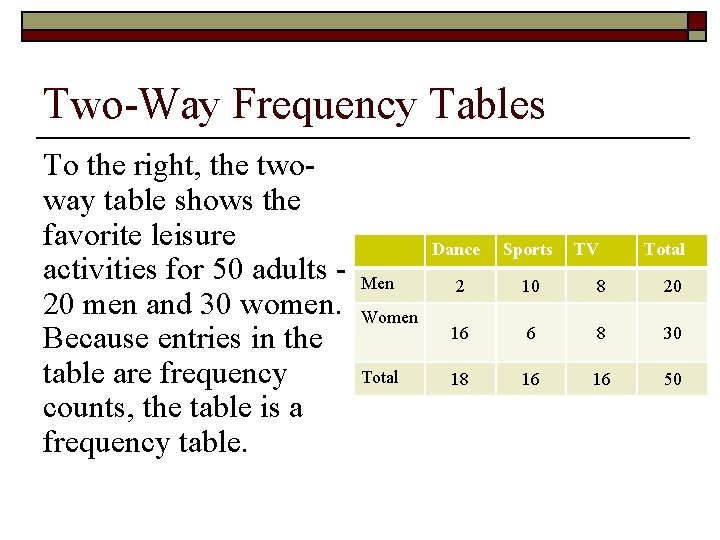
Two-Way Frequency Tables To the right, the twoway table shows the favorite leisure activities for 50 adults 20 men and 30 women. Because entries in the table are frequency counts, the table is a frequency table. Men Women Total Dance Sports TV Total 2 10 8 20 16 6 8 30 18 16 16 50
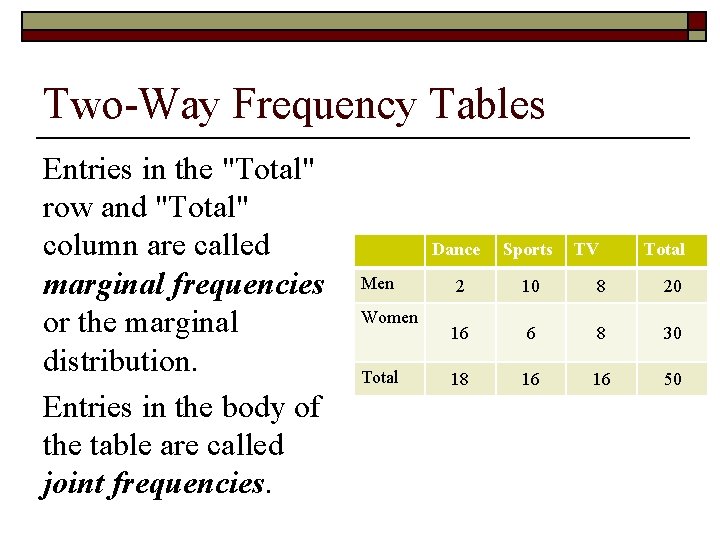
Two-Way Frequency Tables Entries in the "Total" row and "Total" column are called marginal frequencies or the marginal distribution. Entries in the body of the table are called joint frequencies. Men Women Total Dance Sports TV Total 2 10 8 20 16 6 8 30 18 16 16 50
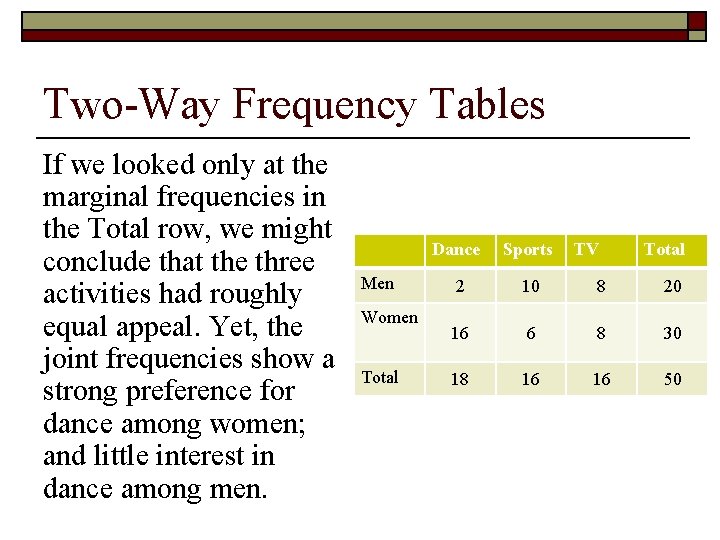
Two-Way Frequency Tables If we looked only at the marginal frequencies in the Total row, we might conclude that the three activities had roughly equal appeal. Yet, the joint frequencies show a strong preference for dance among women; and little interest in dance among men. Men Women Total Dance Sports TV Total 2 10 8 20 16 6 8 30 18 16 16 50
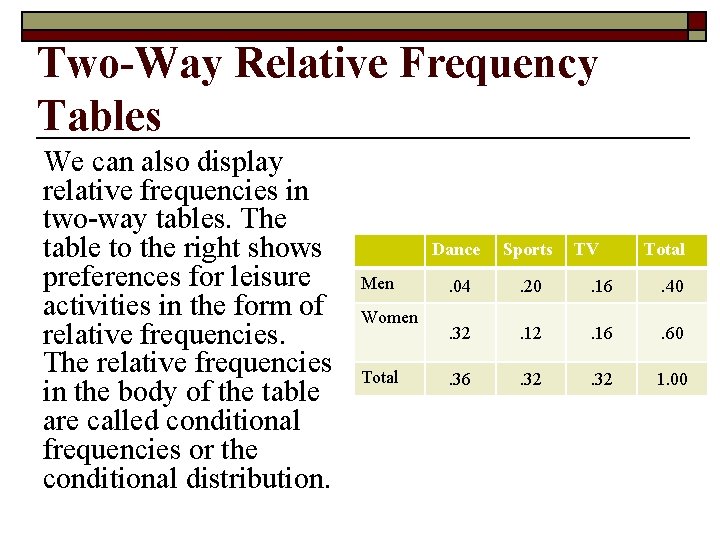
Two-Way Relative Frequency Tables We can also display relative frequencies in two-way tables. The table to the right shows preferences for leisure activities in the form of relative frequencies. The relative frequencies in the body of the table are called conditional frequencies or the conditional distribution. Men Women Total Dance Sports TV Total . 04 . 20 . 16 . 40 . 32 . 16 . 60 . 36 . 32 1. 00
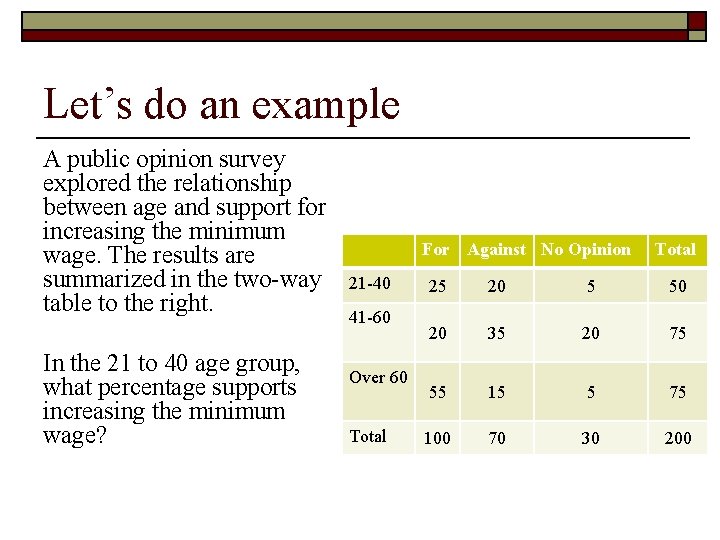
Let’s do an example A public opinion survey explored the relationship between age and support for increasing the minimum wage. The results are summarized in the two-way table to the right. In the 21 to 40 age group, what percentage supports increasing the minimum wage? o 50% For Against No Opinion 21 -40 41 -60 Over 60 Total 25 20 5 50 20 35 20 75 55 15 5 75 100 70 30 200
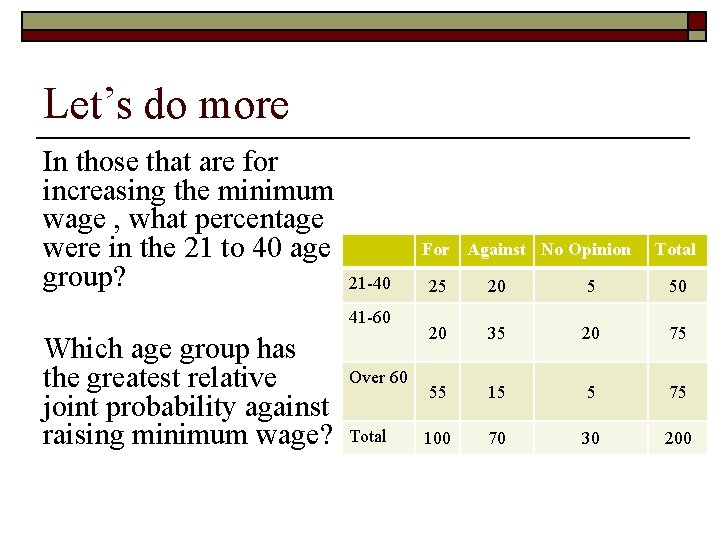
Let’s do more In those that are for increasing the minimum wage , what percentage were in the 21 to 40 age group? o 25% Which age group has the greatest relative joint probability against raising minimum wage? 41 -60 age group For Against No Opinion 21 -40 41 -60 Over 60 Total 25 20 5 50 20 35 20 75 55 15 5 75 100 70 30 200