
Geometry Unit 1 Transformations Chapter 14 In Textbook
Geometry: Unit 1: Transformations Chapter 14 (In Textbook)
Transformations � Objective: Students will be able to do the following, regarding geometric transformations. ◦ Write Transformations Symbolically and justify their choice. ◦ Explain the movement of points for a given transformation. ◦ Draw an image under each transformation.
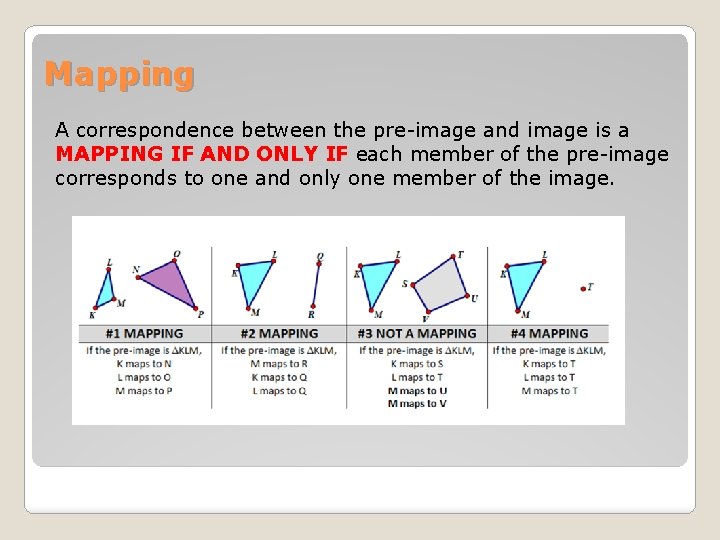
Mapping A correspondence between the pre-image and image is a MAPPING IF AND ONLY IF each member of the pre-image corresponds to one and only one member of the image.
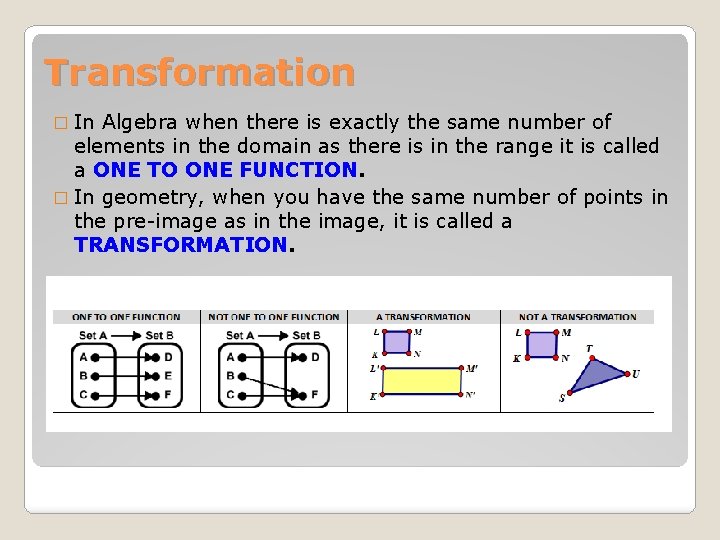
Transformation � In Algebra when there is exactly the same number of elements in the domain as there is in the range it is called a ONE TO ONE FUNCTION. � In geometry, when you have the same number of points in the pre-image as in the image, it is called a TRANSFORMATION.
Transformations: Image and Pre. Image A transformation is a one-to-one correspondence between the points of the pre-image and the points of the image. A transformation guarantees that if our pre-image has three points, then our image will also have three points. Pre-Image: The figure prior to transformation (P) Image: The figure after the transformation (P’)
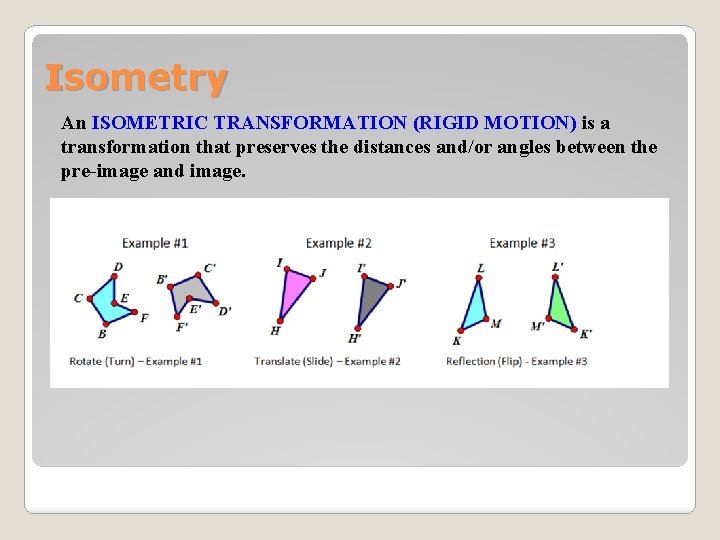
Isometry An ISOMETRIC TRANSFORMATION (RIGID MOTION) is a transformation that preserves the distances and/or angles between the pre-image and image.
Isometry � An Isometric Transformation has the following properties are preserved: ◦ Distance (All lengths stay the same) ◦ Angle measure (All angles stay the same) ◦ Parallelism (All lines that are parallel stay parallel) ◦ Collinearity (All points on a line remain on a line) � In short, the transformed figure (Image) is the same shape and size as the original figure (Pre-Image).
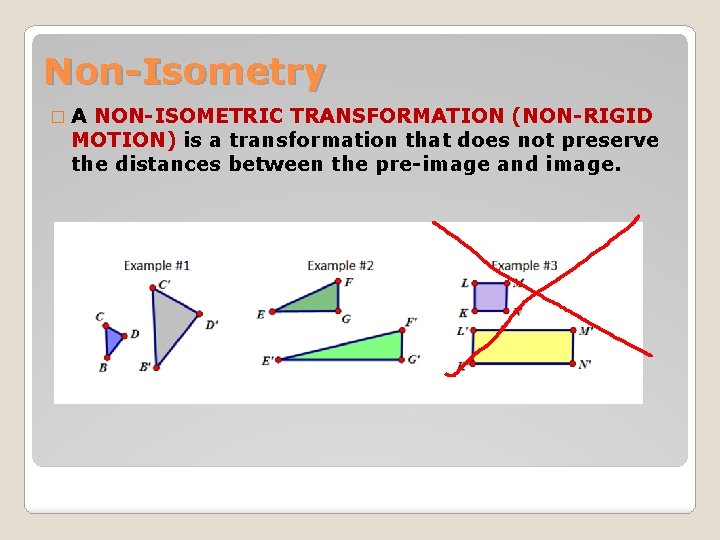
Non-Isometry �A NON-ISOMETRIC TRANSFORMATION (NON-RIGID MOTION) is a transformation that does not preserve the distances between the pre-image and image.
Non-Isometry �A Non-Isometric Transformation has the following properties preserved: ◦ Angle measure (All angles stay the same) ◦ Parallelism (All lines that are parallel stay parallel) ◦ Collinearity (All points on a line remain on a line) � In short, the transformed figure (Image) has the same shape as the original figure (Pre-Image), but not the same size.
Transformations �The following Transformations are Isometries: ◦ Reflections ◦ Rotations ◦ Translations �The following Transformations are Non. Isometries: ◦ Dilations
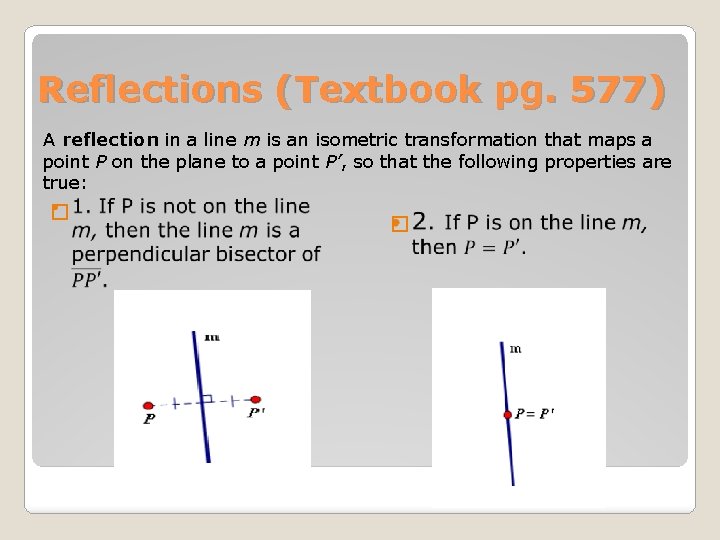
Reflections (Textbook pg. 577) A reflection in a line m is an isometric transformation that maps a point P on the plane to a point P’, so that the following properties are true: � �
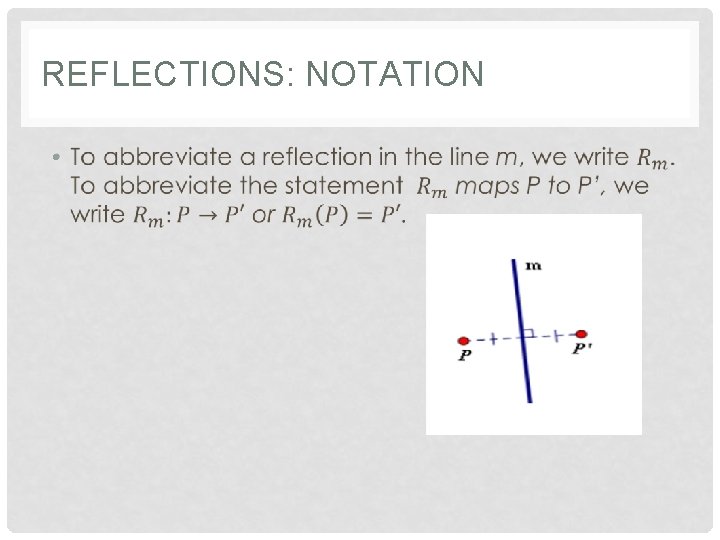
REFLECTIONS: NOTATION •
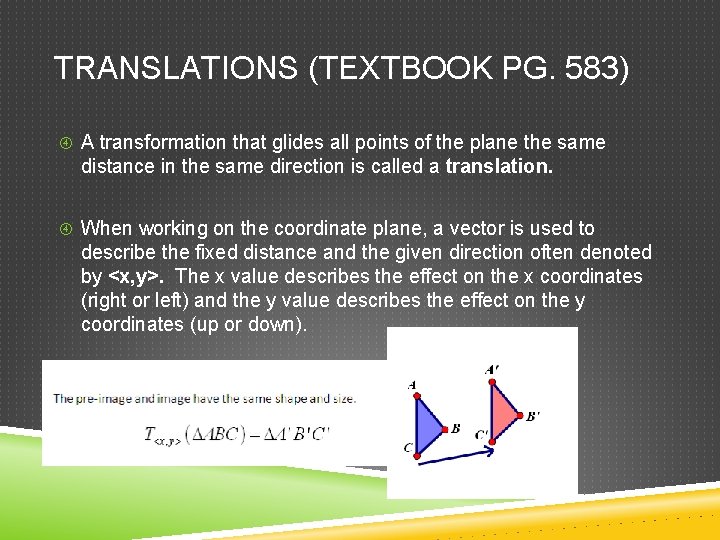
TRANSLATIONS (TEXTBOOK PG. 583) A transformation that glides all points of the plane the same distance in the same direction is called a translation. When working on the coordinate plane, a vector is used to describe the fixed distance and the given direction often denoted by <x, y>. The x value describes the effect on the x coordinates (right or left) and the y value describes the effect on the y coordinates (up or down).
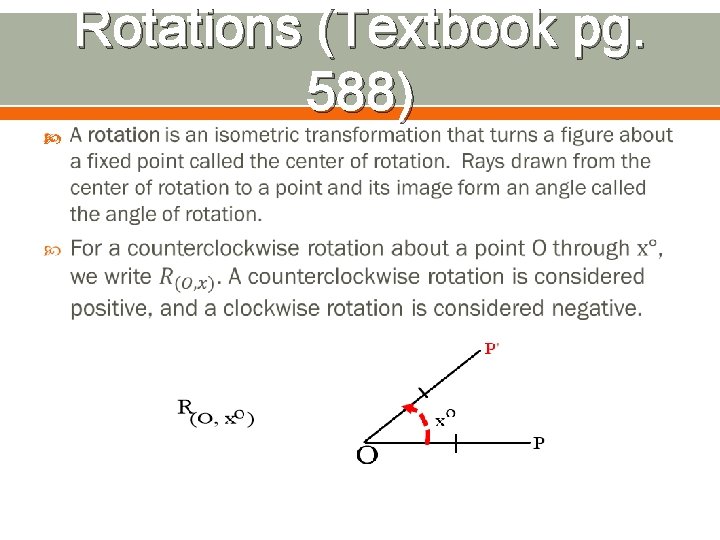
Rotations (Textbook pg. 588)
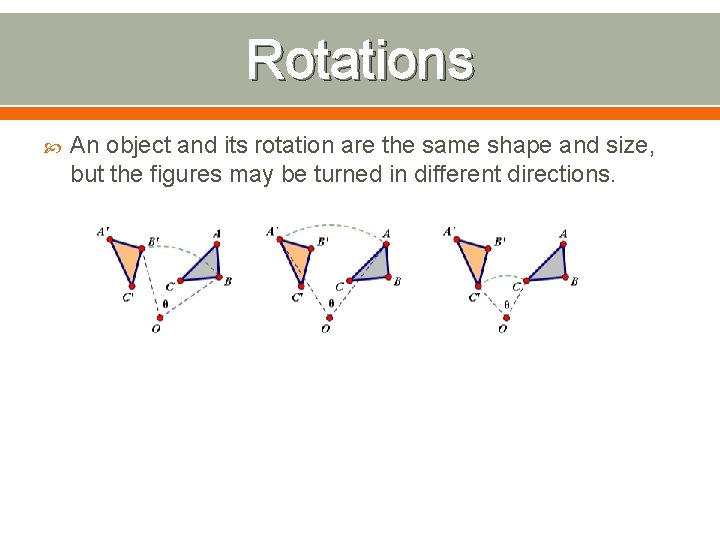
Rotations An object and its rotation are the same shape and size, but the figures may be turned in different directions.

Final Words �For the next few days, there will be a sub. �Follow �Be the subs rules. on your best behavior. �Bring your textbooks the rest of this week.
- Slides: 16