
Geometry Quadrangle Shape which has 4 sides and
- Slides: 11
Geometry
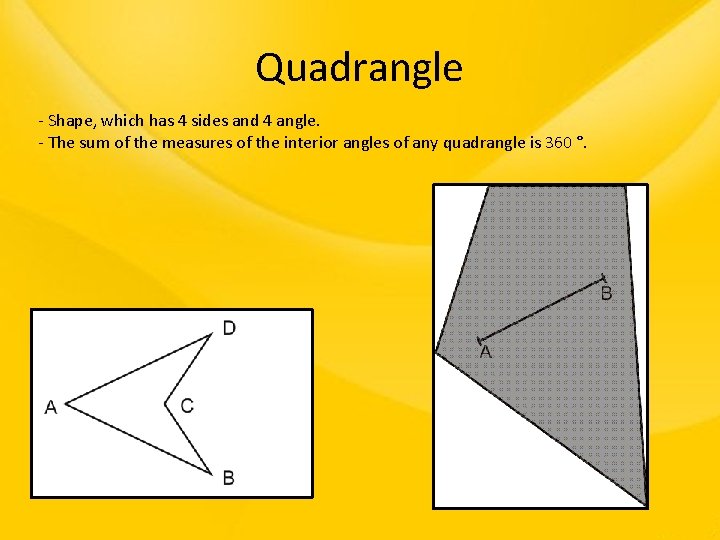
Quadrangle - Shape, which has 4 sides and 4 angle. - The sum of the measures of the interior angles of any quadrangle is 360 °.
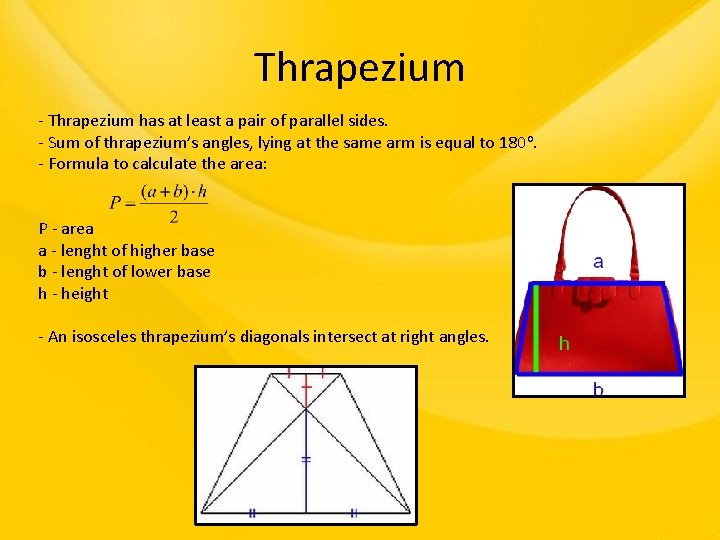
Thrapezium - Thrapezium has at least a pair of parallel sides. - Sum of thrapezium’s angles, lying at the same arm is equal to 180 o. - Formula to calculate the area: P - area a - lenght of higher base b - lenght of lower base h - height - An isosceles thrapezium’s diagonals intersect at right angles.
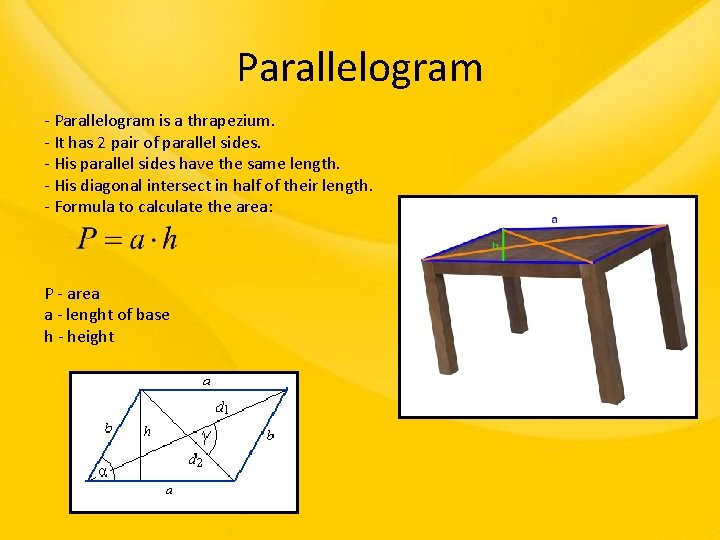
Parallelogram - Parallelogram is a thrapezium. - It has 2 pair of parallel sides. - His parallel sides have the same length. - His diagonal intersect in half of their length. - Formula to calculate the area: P - area a - lenght of base h - height
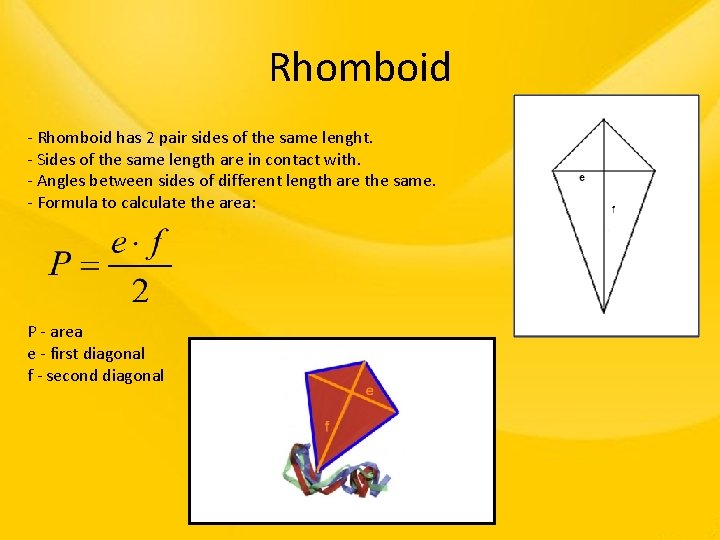
Rhomboid - Rhomboid has 2 pair sides of the same lenght. - Sides of the same length are in contact with. - Angles between sides of different length are the same. - Formula to calculate the area: P - area e - first diagonal f - second diagonal
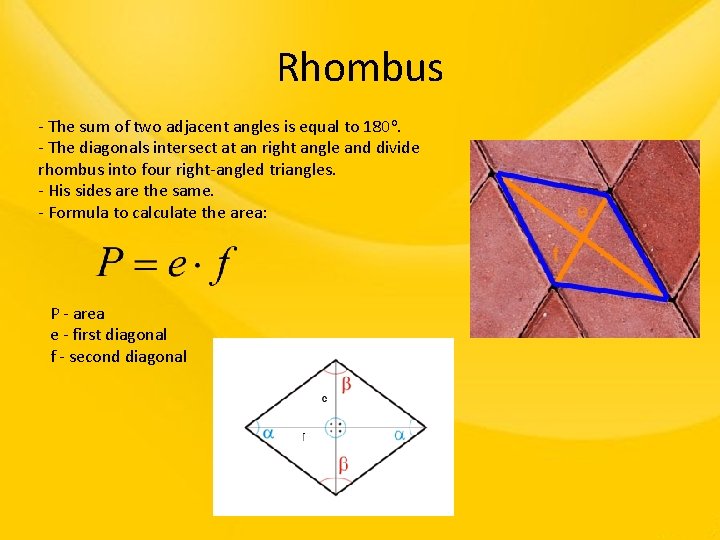
Rhombus - The sum of two adjacent angles is equal to 180 o. - The diagonals intersect at an right angle and divide rhombus into four right-angled triangles. - His sides are the same. - Formula to calculate the area: P - area e - first diagonal f - second diagonal
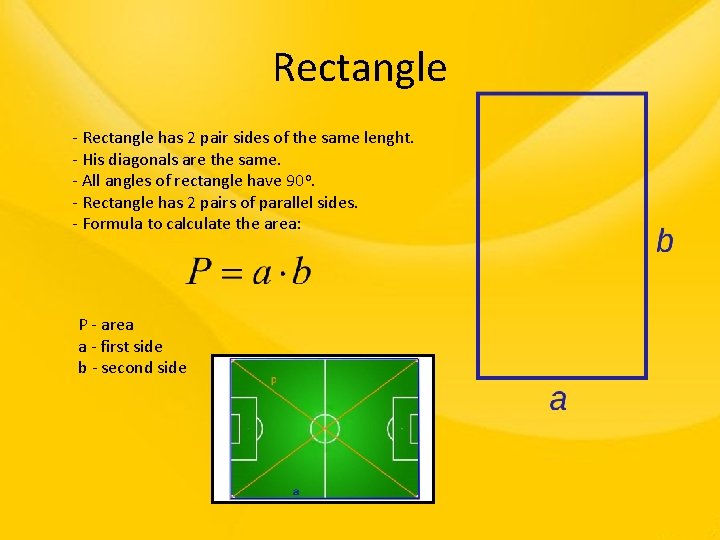
Rectangle - Rectangle has 2 pair sides of the same lenght. - His diagonals are the same. - All angles of rectangle have 90 o. - Rectangle has 2 pairs of parallel sides. - Formula to calculate the area: P - area a - first side b - second side
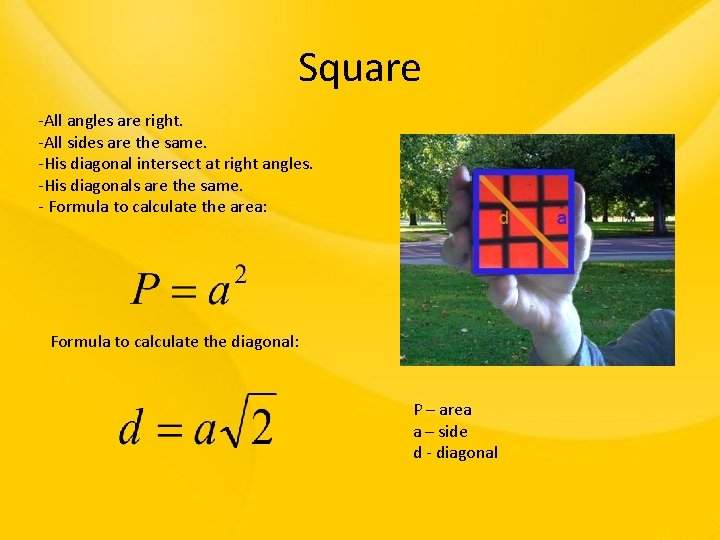
Square -All angles are right. -All sides are the same. -His diagonal intersect at right angles. -His diagonals are the same. - Formula to calculate the area: Formula to calculate the diagonal: P – area a – side d - diagonal
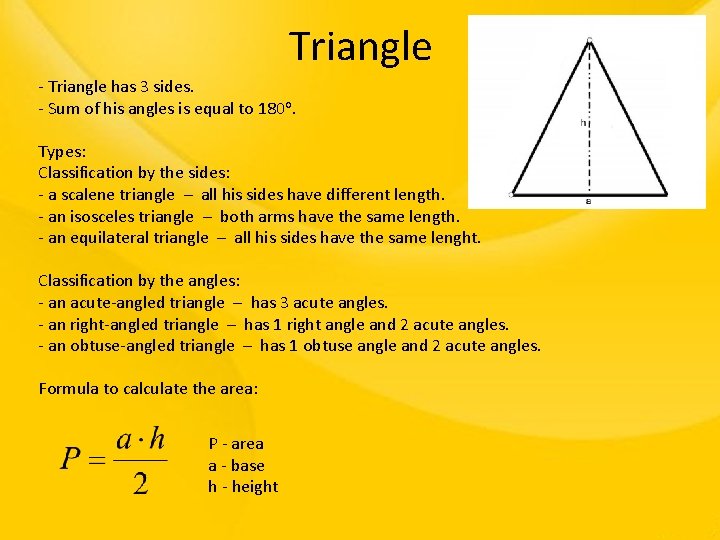
Triangle - Triangle has 3 sides. - Sum of his angles is equal to 180 o. Types: Classification by the sides: - a scalene triangle – all his sides have different length. - an isosceles triangle – both arms have the same length. - an equilateral triangle – all his sides have the same lenght. Classification by the angles: - an acute-angled triangle – has 3 acute angles. - an right-angled triangle – has 1 right angle and 2 acute angles. - an obtuse-angled triangle – has 1 obtuse angle and 2 acute angles. Formula to calculate the area: P - area a - base h - height
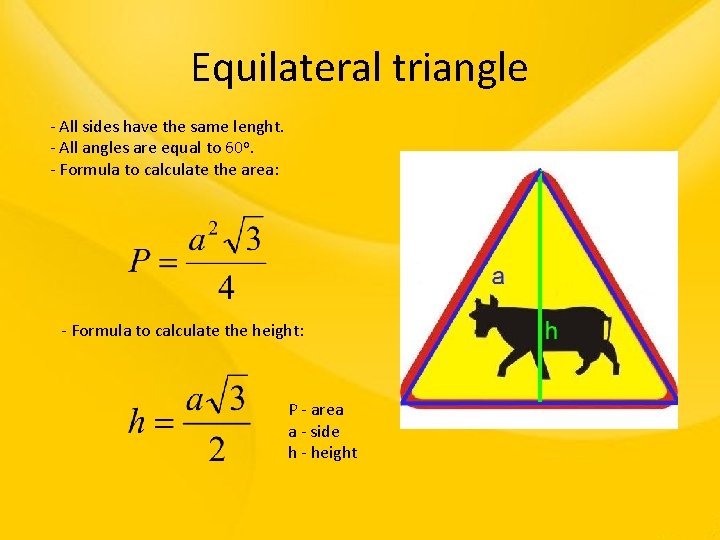
Equilateral triangle - All sides have the same lenght. - All angles are equal to 60 o. - Formula to calculate the area: - Formula to calculate the height: P - area a - side h - height