
Geometry of Power Flows on Trees with Applications
- Slides: 29
Geometry of Power Flows on Trees with Applications to the Voltage Regulation Problem David Tse Dept. of EECS U. C. Berkeley Santa Fe May 23, 2012 Joint work with Baosen Zhang (UCB) , Albert Lam (UCB), Javad Lavaei (Stanford), Alejandro Dominguez-Garcia (UIUC).
Optimization problems in power networks • Increasing complexity: – Optimal Power Flow (OPF) – Unit Commitment – Security Constraint Unit Commitment • All are done at the level of transmission networks • Smart grid: Optimization in distribution networks
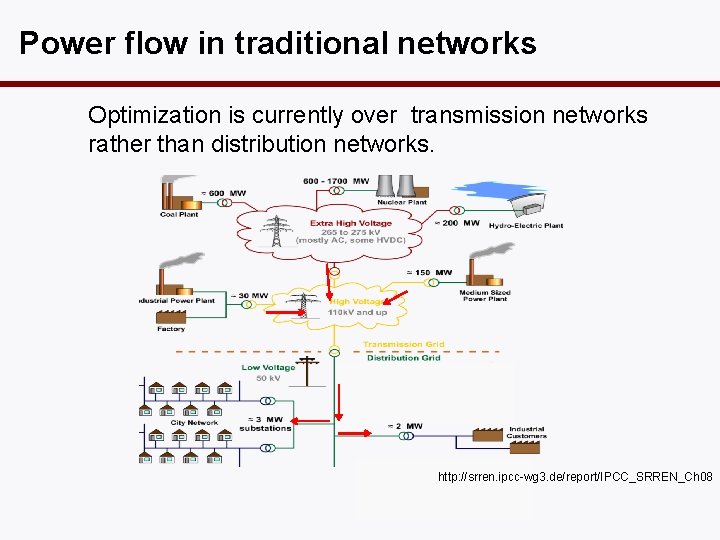
Power flow in traditional networks Optimization is currently over transmission networks rather than distribution networks. http: //srren. ipcc-wg 3. de/report/IPCC_SRREN_Ch 08
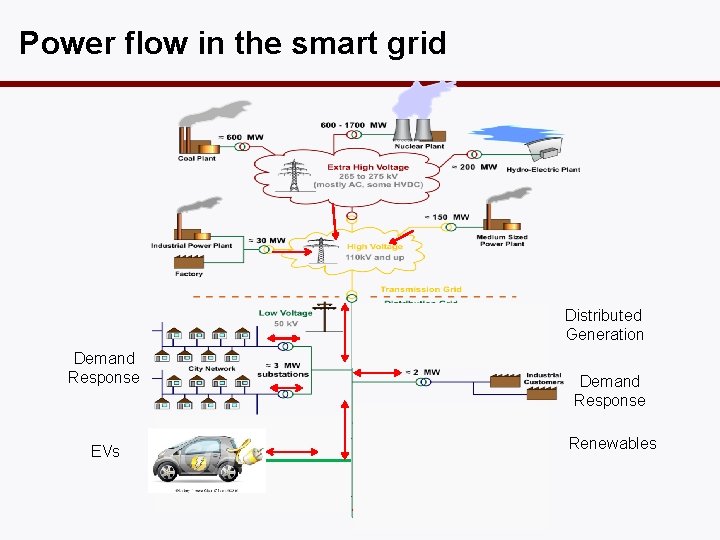
Power flow in the smart grid Distributed Generation Demand Response EVs Demand Response Renewables
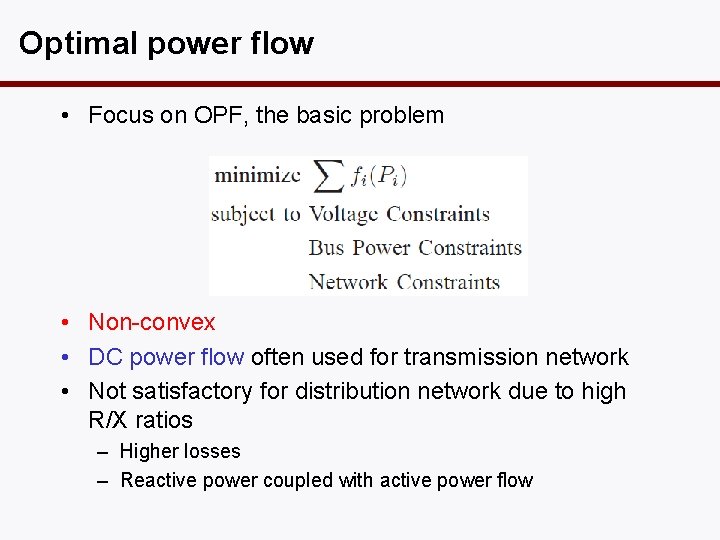
Optimal power flow • Focus on OPF, the basic problem • Non-convex • DC power flow often used for transmission network • Not satisfactory for distribution network due to high R/X ratios – Higher losses – Reactive power coupled with active power flow
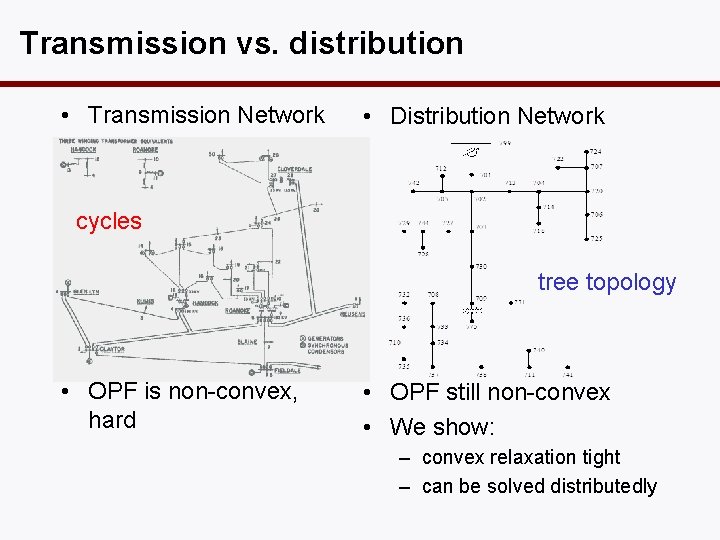
Transmission vs. distribution • Transmission Network • Distribution Network cycles tree topology • OPF is non-convex, hard • OPF still non-convex • We show: – convex relaxation tight – can be solved distributedly
Outline of talk • Results on optimal power flow on trees. • A geometric understanding. • Application to the voltage regulation problem in distribution networks with renewables. • An optimal distributed algorithm for solving this problem.
Previous results for general networks • Jabr 2006: SOCP relaxation for OPF • Bai et. al 2008: rank relaxation SDP formulation of OPF: Formulate in terms of VVH and replace by positive definite A. • Lavaei & Low 2010: – key observation: rank relaxation for OPF is tight in many IEEE networks – key theoretical result: rank relaxation is tight for purely resistive networks • What about for networks with general transmission lines?
OPF on trees: take 1 Theorem 1 (Zhang & T. , 2011): Convex rank relaxation for OPF is tight if: 1) the network is a tree 2) no two connected buses have tight bus power lower bounds. No assumption on transmission line characteristics. (See also: Sojoudi & Lavaei 11, Bose & Low 11)
Proof approach • Focus on the underlying injection region and investigate its convexity. • Used a matrix-fitting lemma from algebraic graph theory. Drawbacks: • Role of tree topology unclear. • Restriction on bus power lower bounds unsatisfactory.
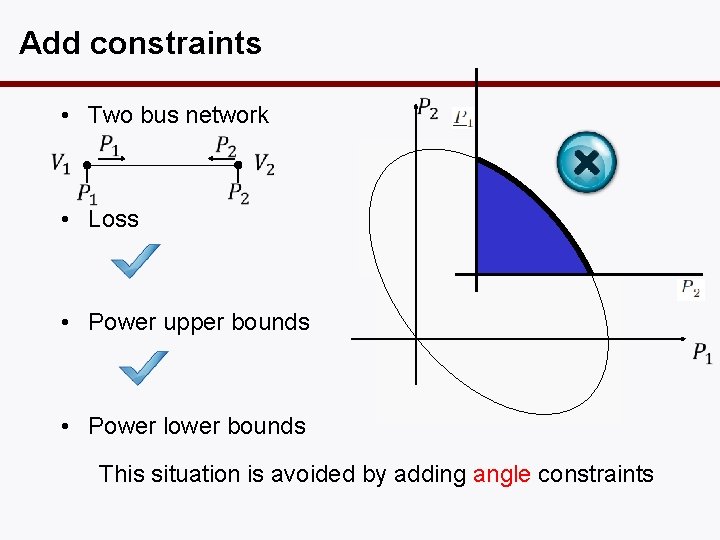
OPF on trees: take 2 Theorem 2 (Lavaei, T. & Zhang 12): Convex relaxation for OPF is tight if 1) the network is a tree 2) angle differences along lines are “reasonable” More importantly: Proof is entirely geometric and from first principles.
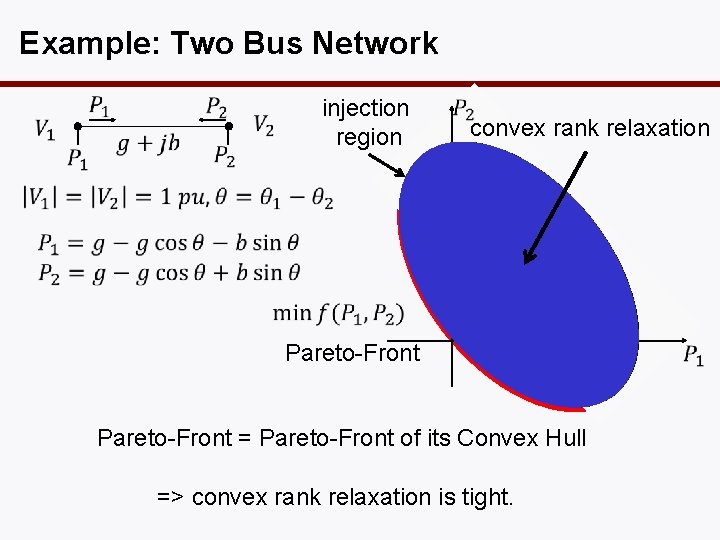
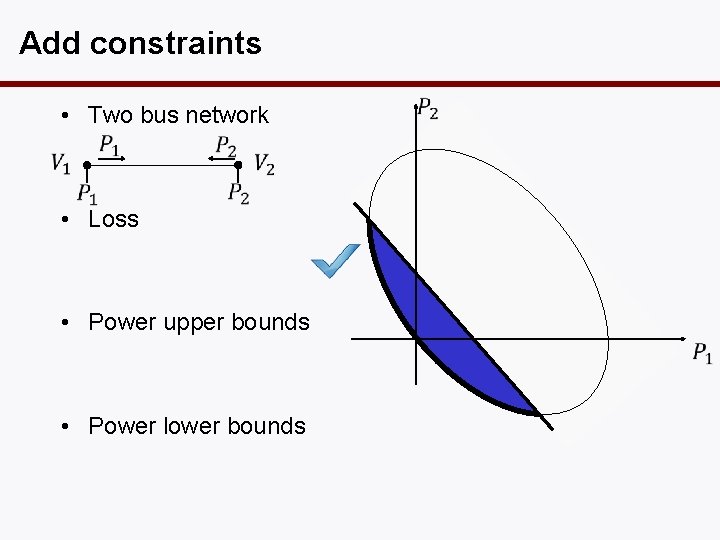
Example: Two Bus Network injection region convex rank relaxation Pareto-Front = Pareto-Front of its Convex Hull => convex rank relaxation is tight.
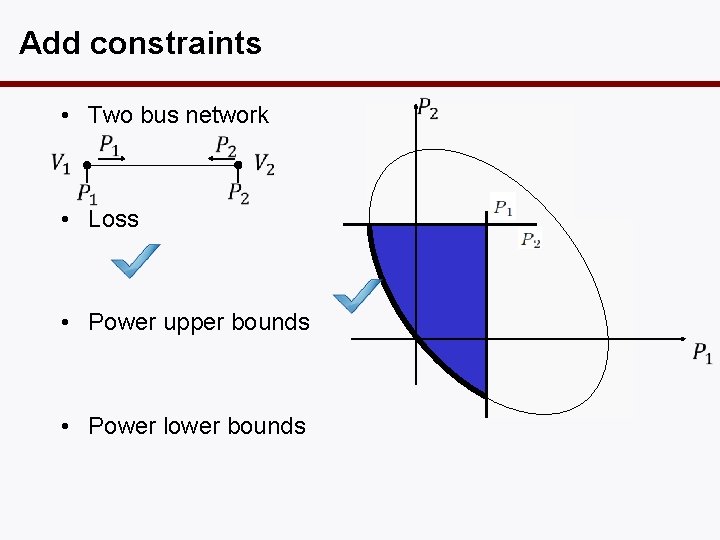
Add constraints • Two bus network • Loss • Power upper bounds • Power lower bounds
Add constraints • Two bus network • Loss • Power upper bounds • Power lower bounds
Add constraints • Two bus network • Loss • Power upper bounds • Power lower bounds This situation is avoided by adding angle constraints
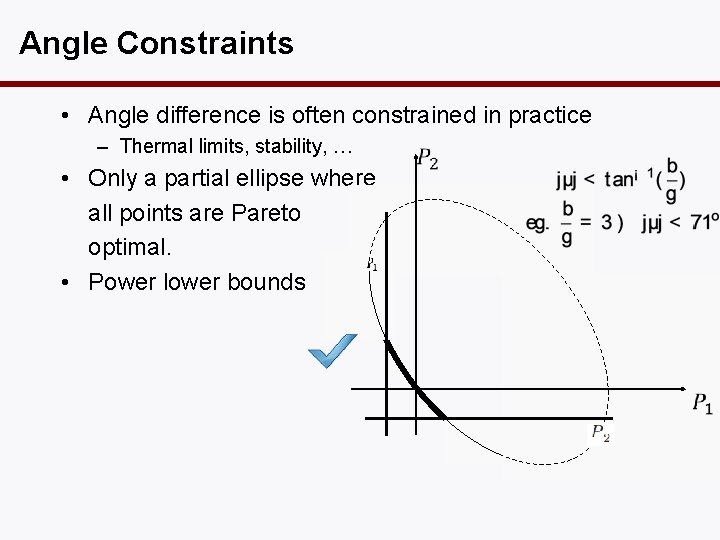
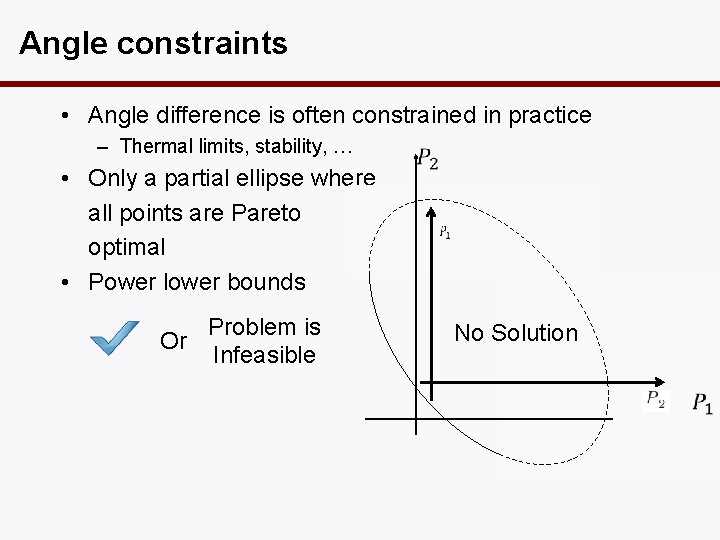
Angle Constraints • Angle difference is often constrained in practice – Thermal limits, stability, … • Only a partial ellipse where all points are Pareto optimal. • Power lower bounds
Angle constraints • Angle difference is often constrained in practice – Thermal limits, stability, … • Only a partial ellipse where all points are Pareto optimal • Power lower bounds Problem is Or Infeasible No Solution
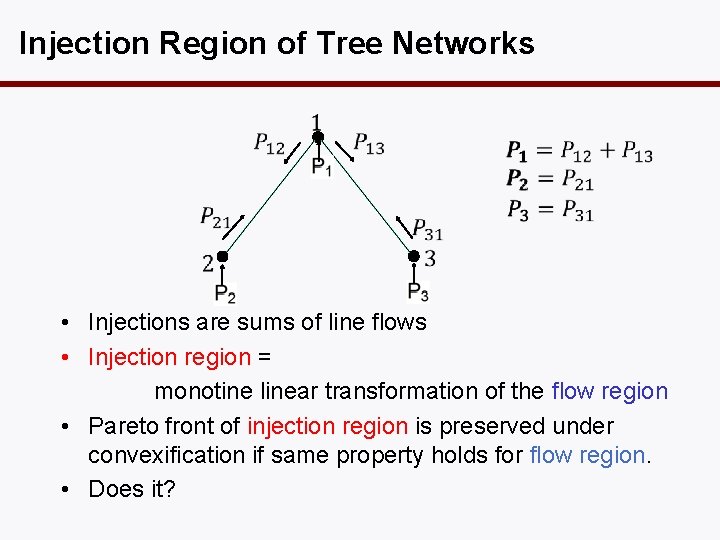
Injection Region of Tree Networks • Injections are sums of line flows • Injection region = monotine linear transformation of the flow region • Pareto front of injection region is preserved under convexification if same property holds for flow region. • Does it?
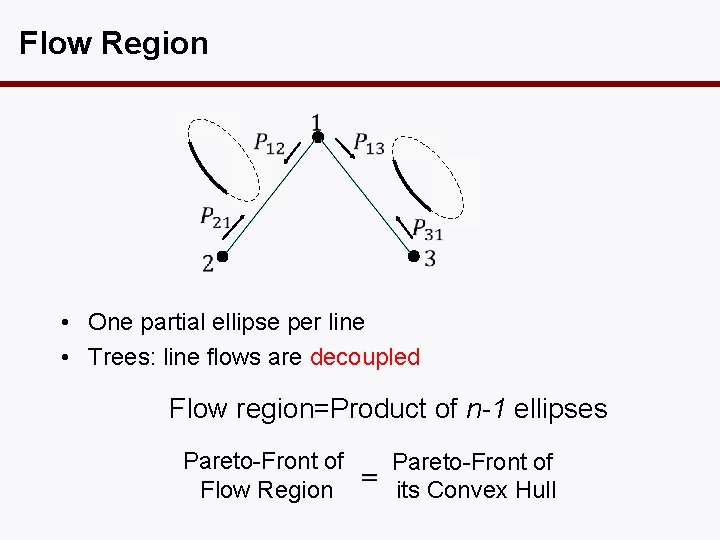
Flow Region • One partial ellipse per line • Trees: line flows are decoupled Flow region=Product of n-1 ellipses Pareto-Front of Flow Region Pareto-Front of its Convex Hull
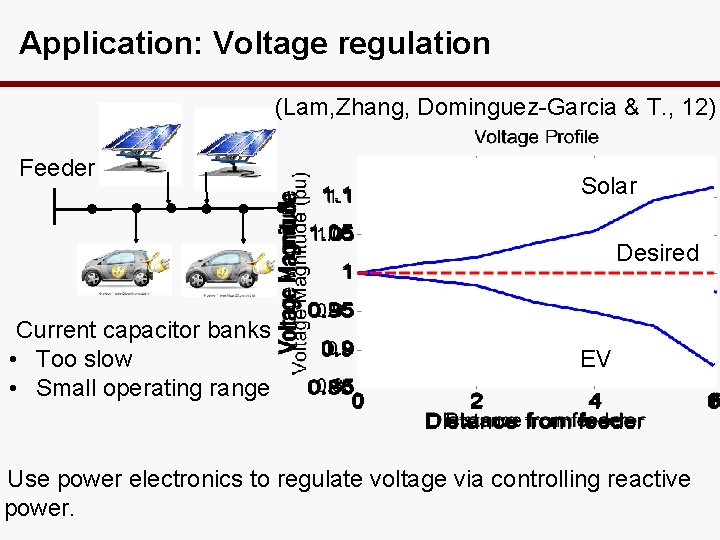
Application: Voltage regulation (Lam, Zhang, Dominguez-Garcia & T. , 12) Feeder Solar Desired Current capacitor banks • Too slow • Small operating range EV Use power electronics to regulate voltage via controlling reactive power.
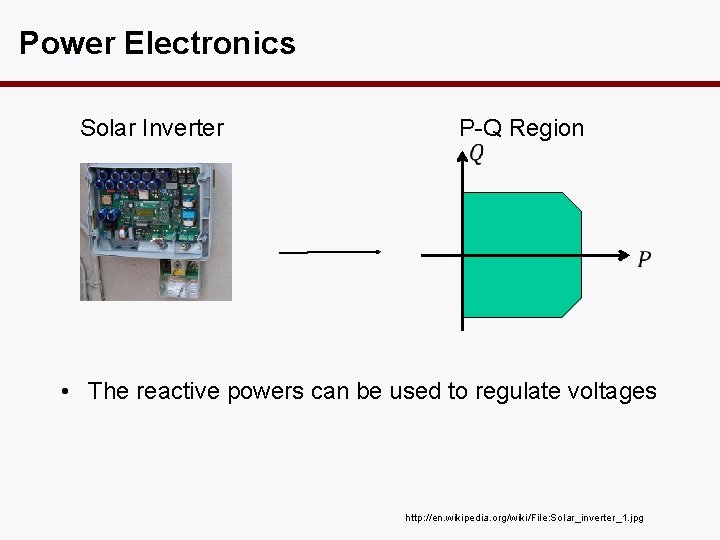
Power Electronics Solar Inverter P-Q Region • The reactive powers can be used to regulate voltages http: //en. wikipedia. org/wiki/File: Solar_inverter_1. jpg
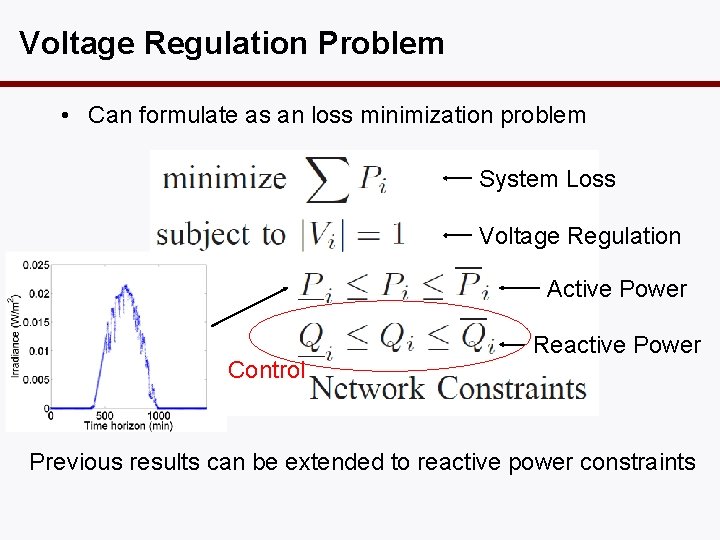
Voltage Regulation Problem • Can formulate as an loss minimization problem System Loss Voltage Regulation Active Power Control Reactive Power Previous results can be extended to reactive power constraints
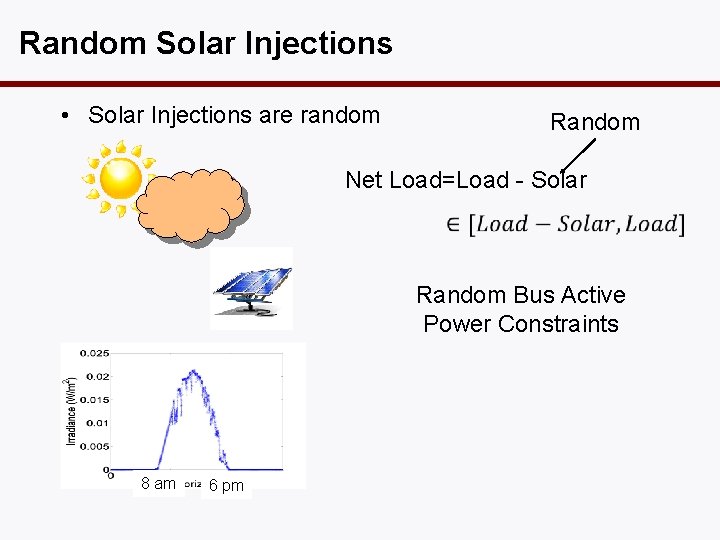
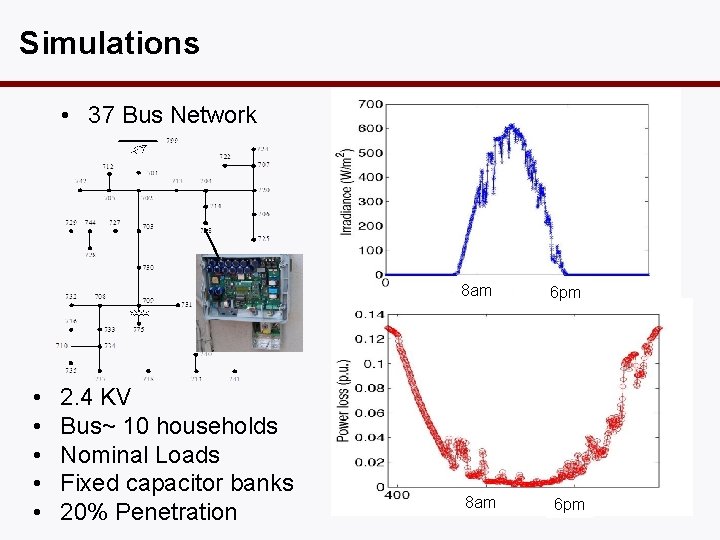
Random Solar Injections • Solar Injections are random Random Net Load=Load - Solar Random Bus Active Power Constraints 8 am 6 pm
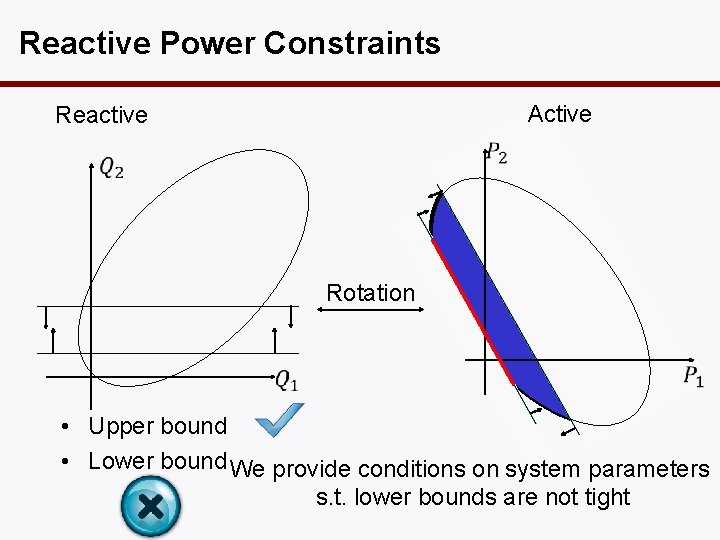
Reactive Power Constraints Active Reactive Rotation • Upper bound • Lower bound We provide conditions on system parameters s. t. lower bounds are not tight
Distributed Algorithm • Convex relaxation gives an SDP, does not scale • No infrastructure to transfer all data to a central node • We exploit the tree structure to derive a distributed algorithm • Local communication along physical topology.
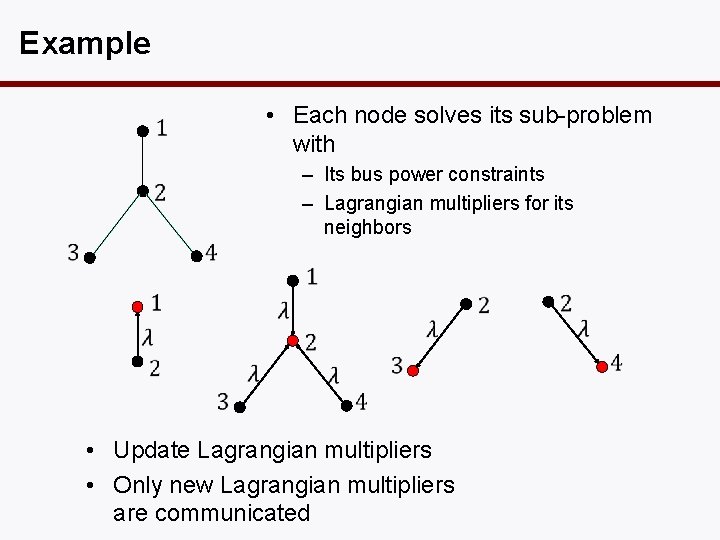
Example • Each node solves its sub-problem with – Its bus power constraints – Lagrangian multipliers for its neighbors • Update Lagrangian multipliers • Only new Lagrangian multipliers are communicated
Simulations • 37 Bus Network • • • 2. 4 KV Bus~ 10 households Nominal Loads Fixed capacitor banks 20% Penetration 8 am 6 pm
Summary • Geometrical view of power flow • Optimization problems on tree networks can be convexified • Applied to design an optimal distributed algorithm for voltage regulation.
References http: //arxiv. org/abs/1107. 1467 (Theorem 1) http: //arxiv. org/abs/1204. 4419 (Theorem 2) http: //arxiv. org/abs/1204. 5226 (the voltage regulation problem)