
Geometry of a single camera Odilon Redon Cyclops

- Slides: 41
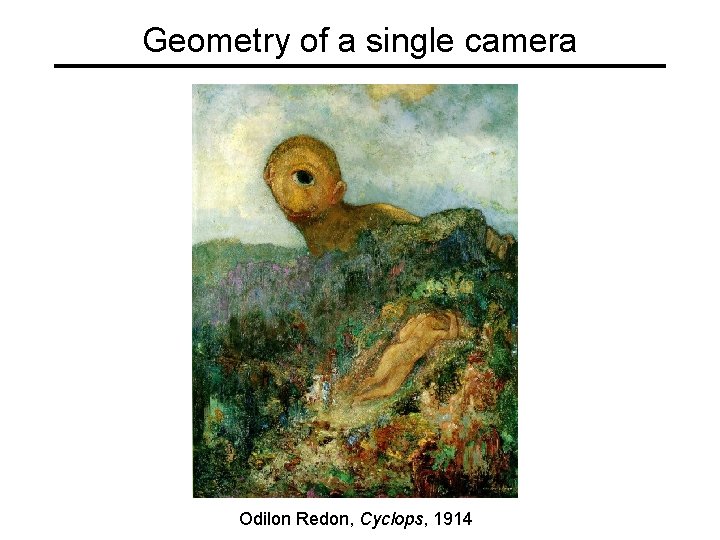
Geometry of a single camera Odilon Redon, Cyclops, 1914
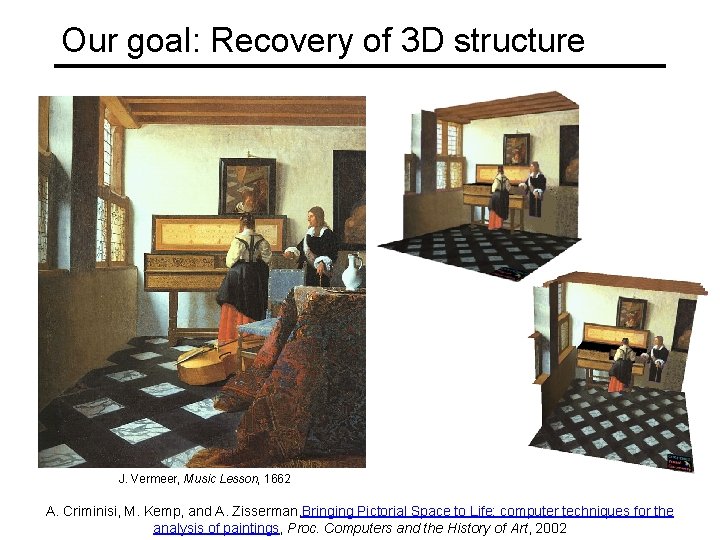
Our goal: Recovery of 3 D structure J. Vermeer, Music Lesson, 1662 A. Criminisi, M. Kemp, and A. Zisserman, Bringing Pictorial Space to Life: computer techniques for the analysis of paintings, Proc. Computers and the History of Art, 2002
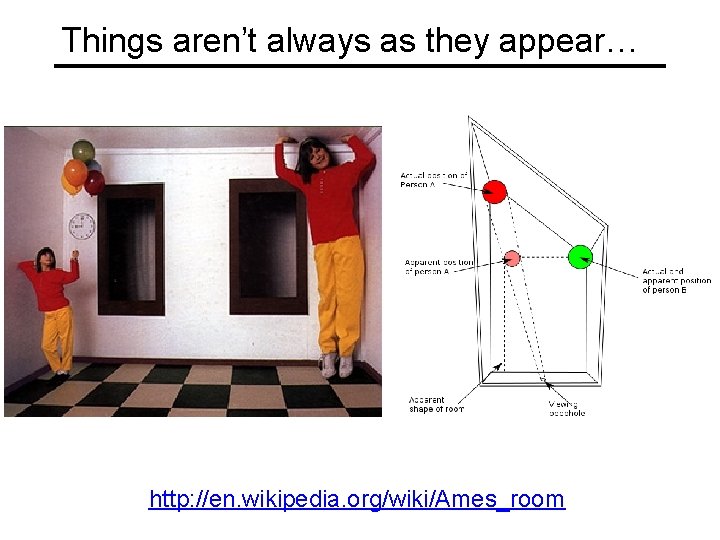
Things aren’t always as they appear… http: //en. wikipedia. org/wiki/Ames_room
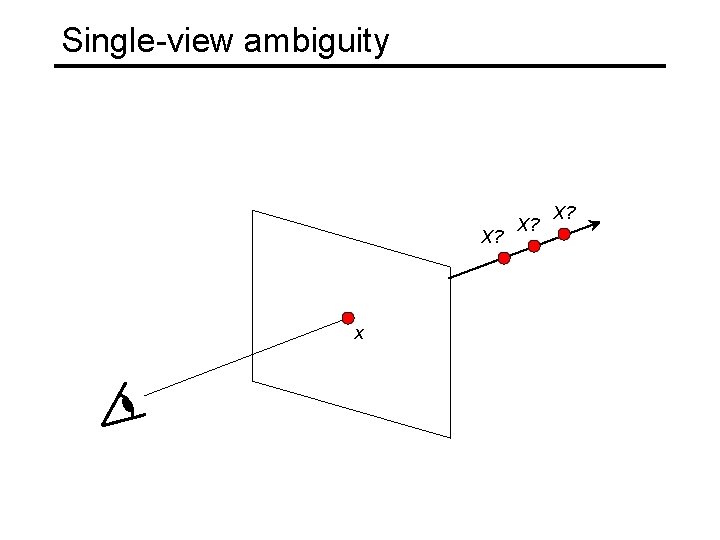
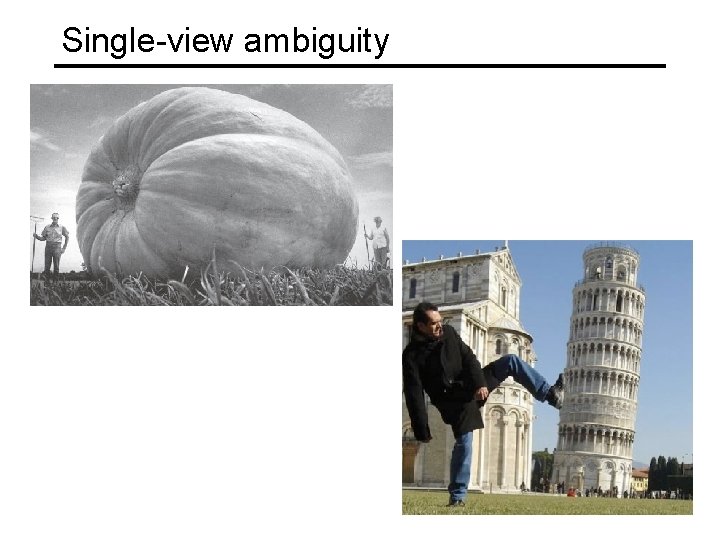
Single-view ambiguity X? x X?
Single-view ambiguity
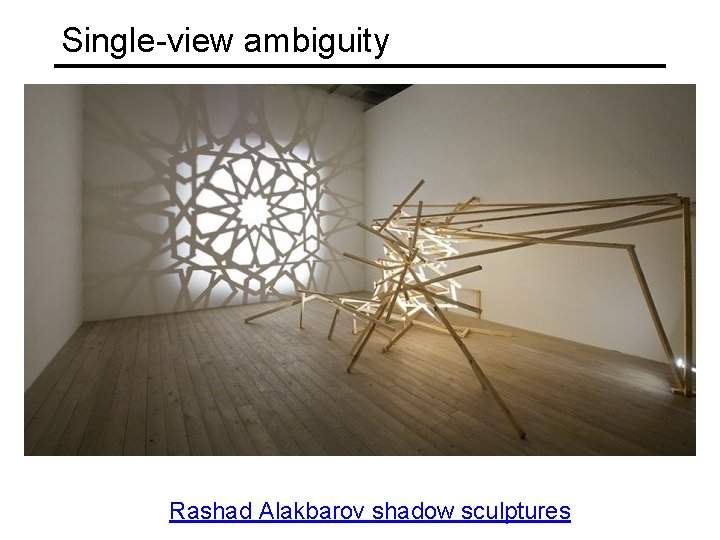
Single-view ambiguity Rashad Alakbarov shadow sculptures
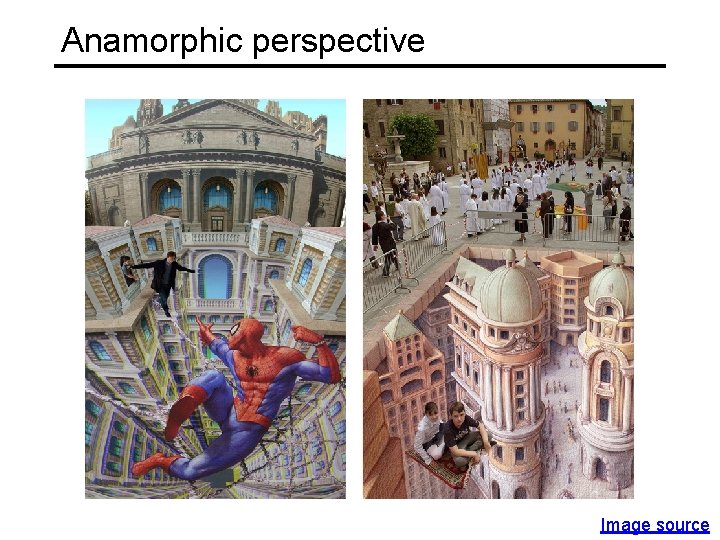
Anamorphic perspective Image source
Anamorphic perspective H. Holbein The Younger, The Ambassadors, 1533 https: //en. wikipedia. org/wiki/Anamorphosis
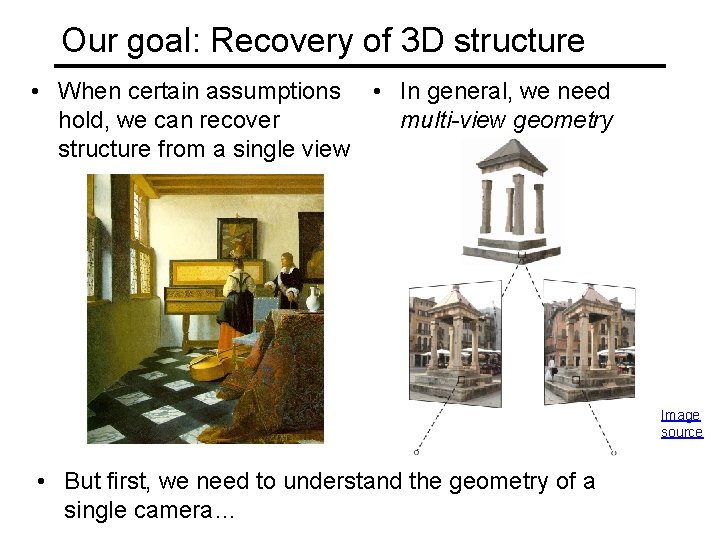
Our goal: Recovery of 3 D structure • When certain assumptions • In general, we need multi-view geometry hold, we can recover structure from a single view Image source • But first, we need to understand the geometry of a single camera…
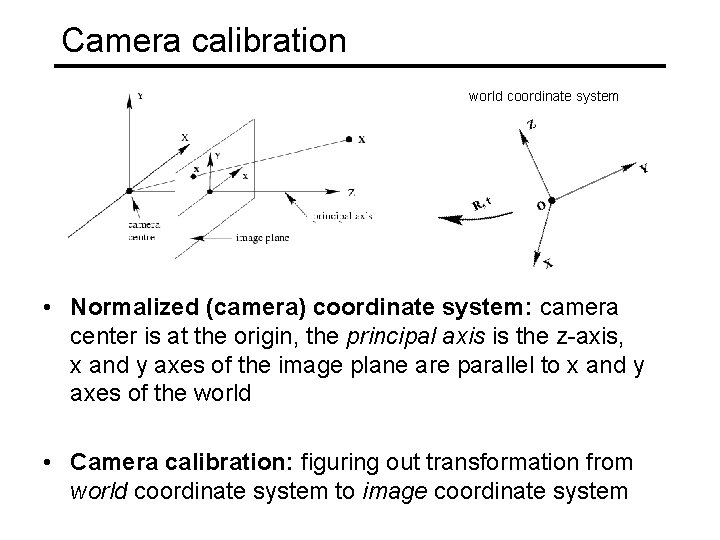
Camera calibration world coordinate system • Normalized (camera) coordinate system: camera center is at the origin, the principal axis is the z-axis, x and y axes of the image plane are parallel to x and y axes of the world • Camera calibration: figuring out transformation from world coordinate system to image coordinate system
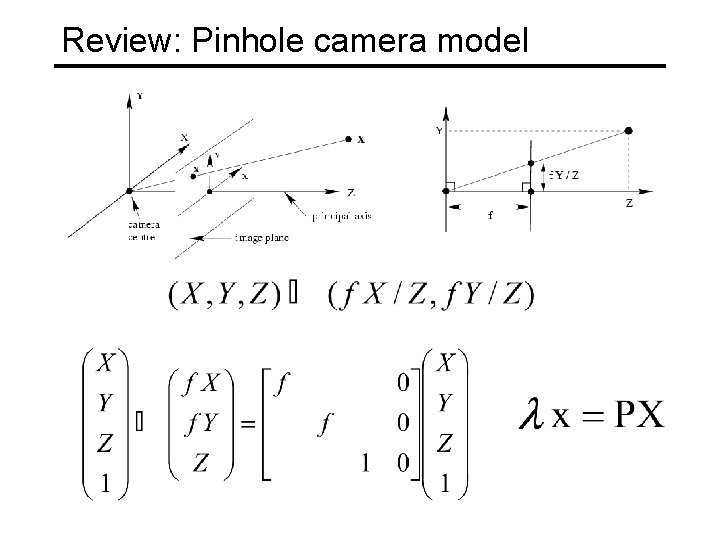
Review: Pinhole camera model
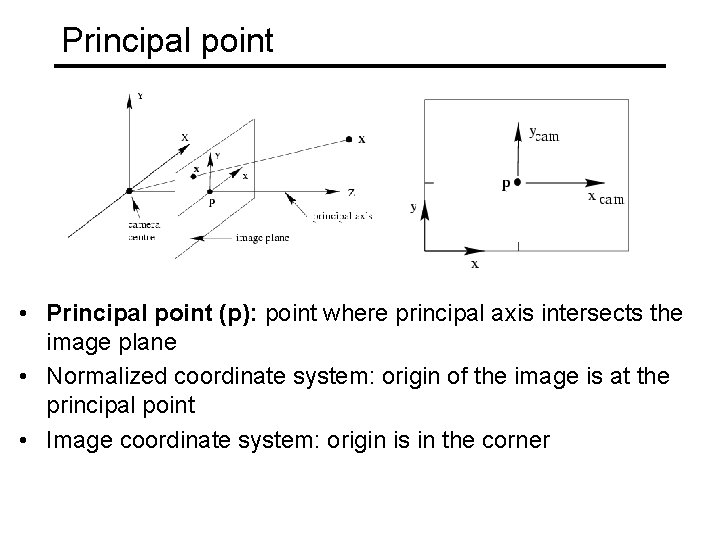
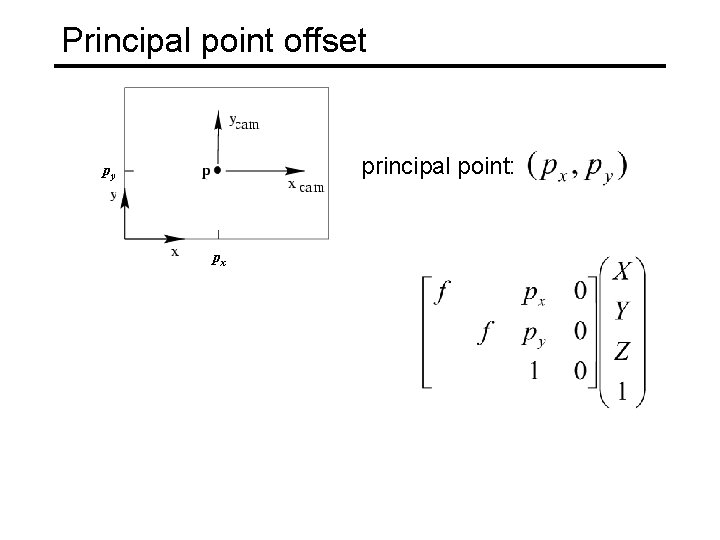
Principal point • Principal point (p): point where principal axis intersects the image plane • Normalized coordinate system: origin of the image is at the principal point • Image coordinate system: origin is in the corner
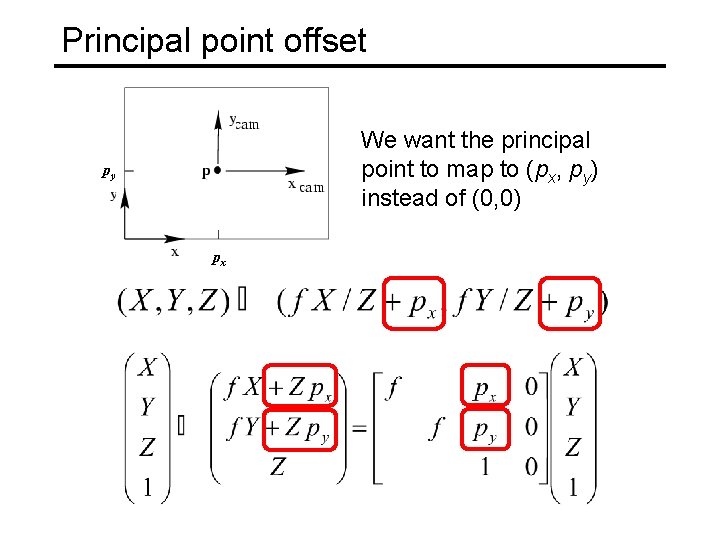
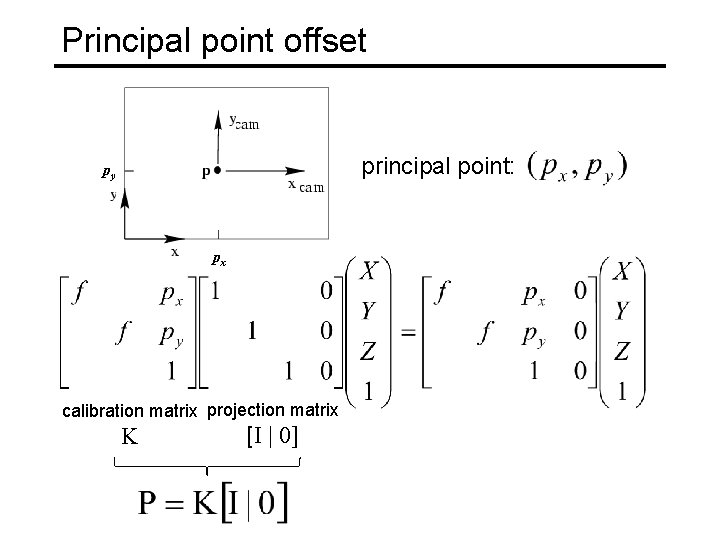
Principal point offset We want the principal point to map to (px, py) instead of (0, 0) py px
Principal point offset principal point: py px
Principal point offset principal point: py px calibration matrix projection matrix K [I | 0]
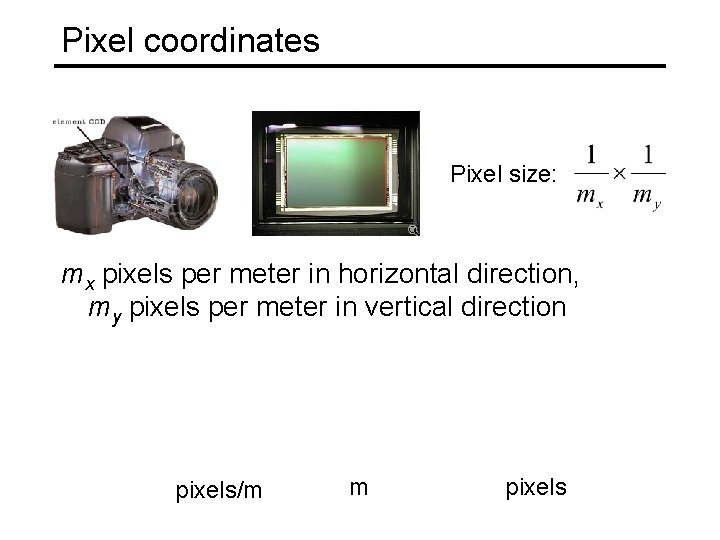
Pixel coordinates Pixel size: mx pixels per meter in horizontal direction, my pixels per meter in vertical direction pixels/m m pixels
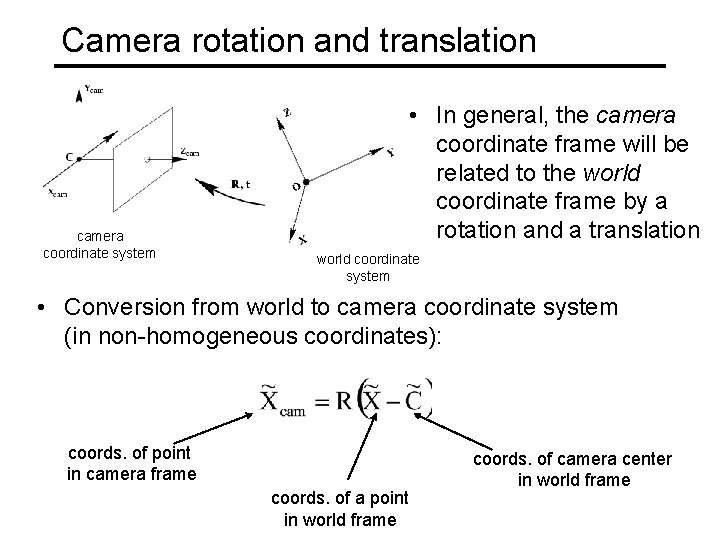
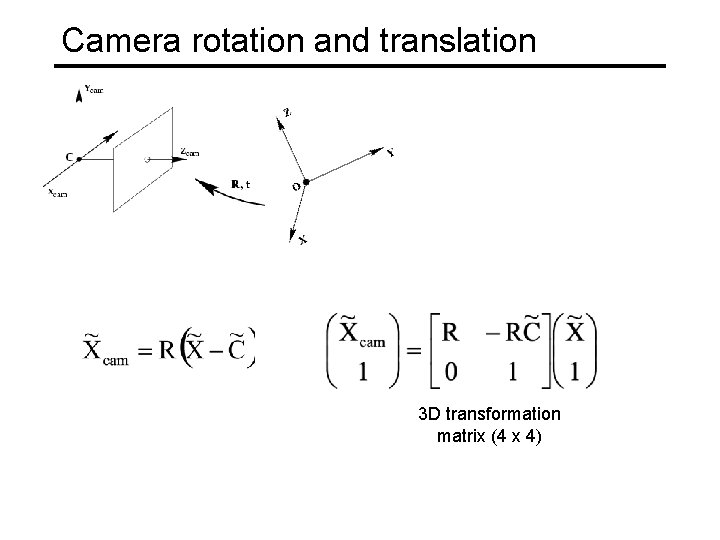
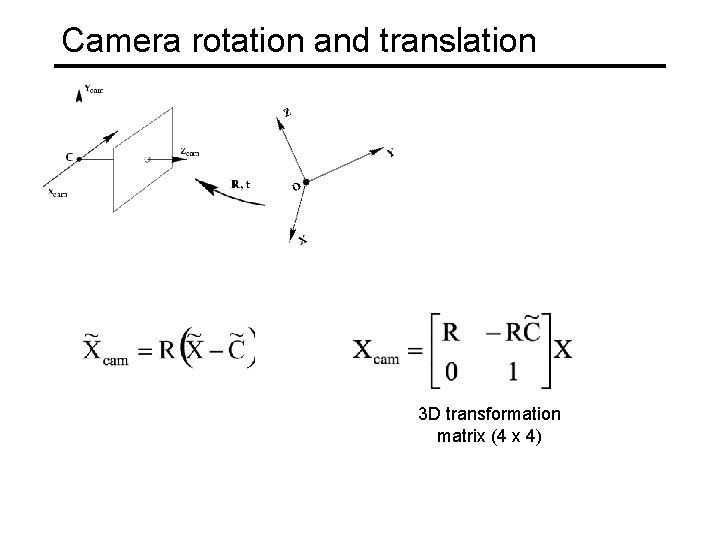
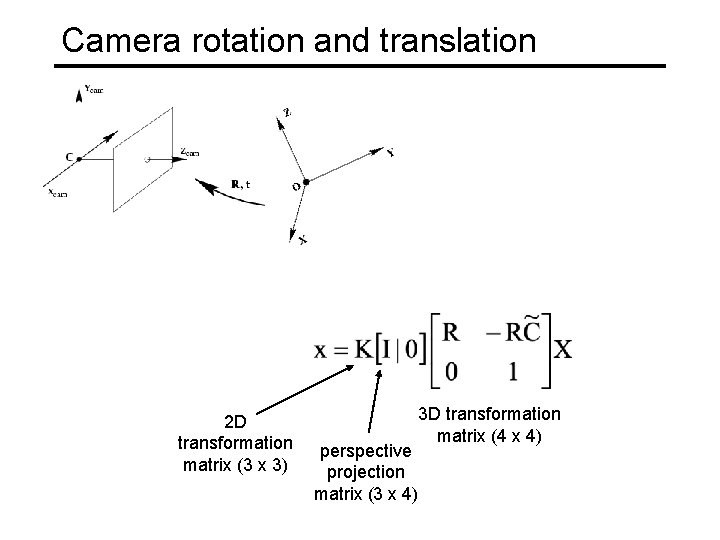
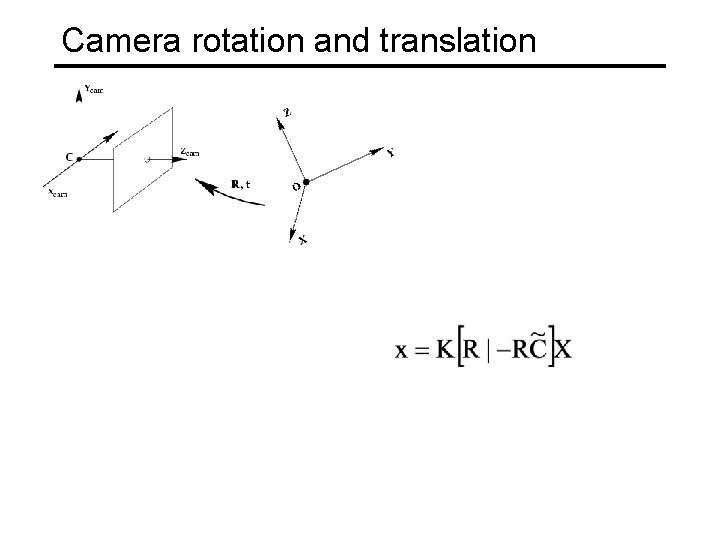
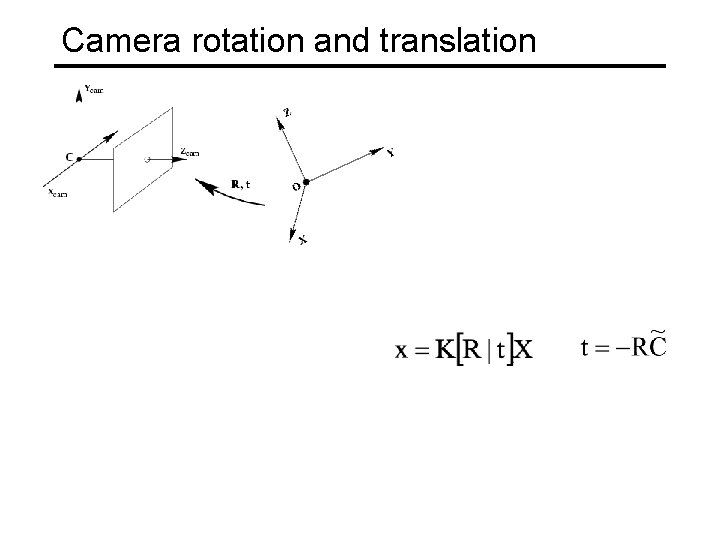
Camera rotation and translation camera coordinate system • In general, the camera coordinate frame will be related to the world coordinate frame by a rotation and a translation world coordinate system • Conversion from world to camera coordinate system (in non-homogeneous coordinates): coords. of point in camera frame coords. of a point in world frame coords. of camera center in world frame
Camera rotation and translation 3 D transformation matrix (4 x 4)
Camera rotation and translation 3 D transformation matrix (4 x 4)
Camera rotation and translation 2 D transformation matrix (3 x 3) 3 D transformation matrix (4 x 4) perspective projection matrix (3 x 4)
Camera rotation and translation
Camera rotation and translation
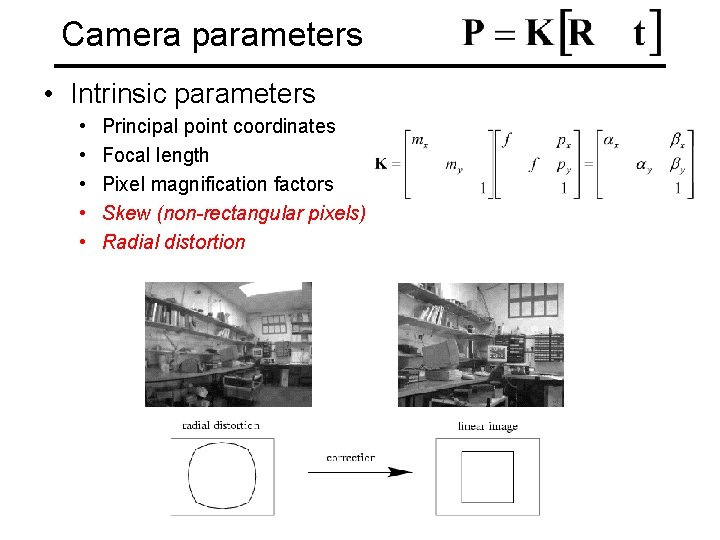
Camera parameters • Intrinsic parameters • • • Principal point coordinates Focal length Pixel magnification factors Skew (non-rectangular pixels) Radial distortion
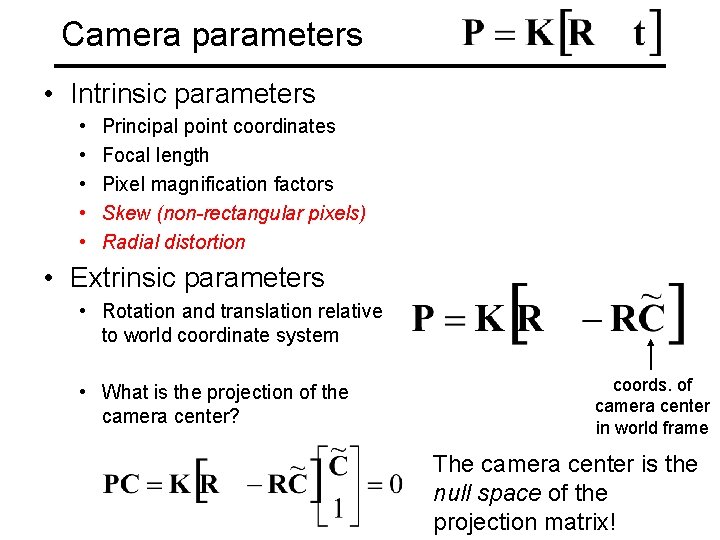
Camera parameters • Intrinsic parameters • • • Principal point coordinates Focal length Pixel magnification factors Skew (non-rectangular pixels) Radial distortion • Extrinsic parameters • Rotation and translation relative to world coordinate system • What is the projection of the camera center? coords. of camera center in world frame The camera center is the null space of the projection matrix!
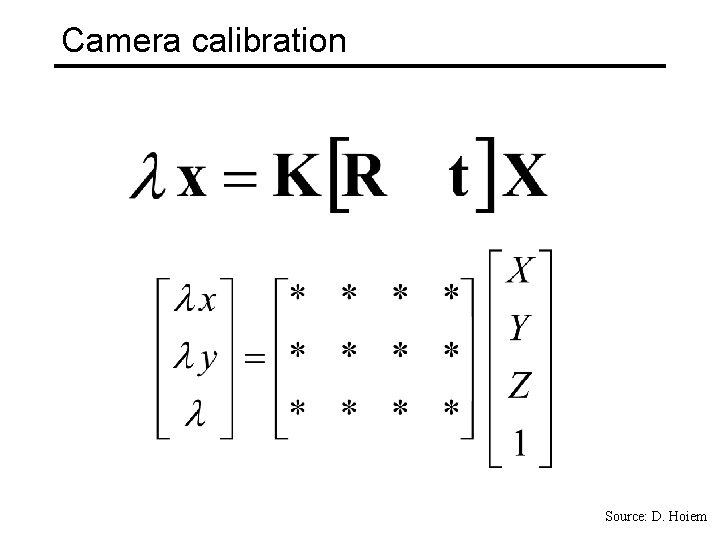
Camera calibration Source: D. Hoiem
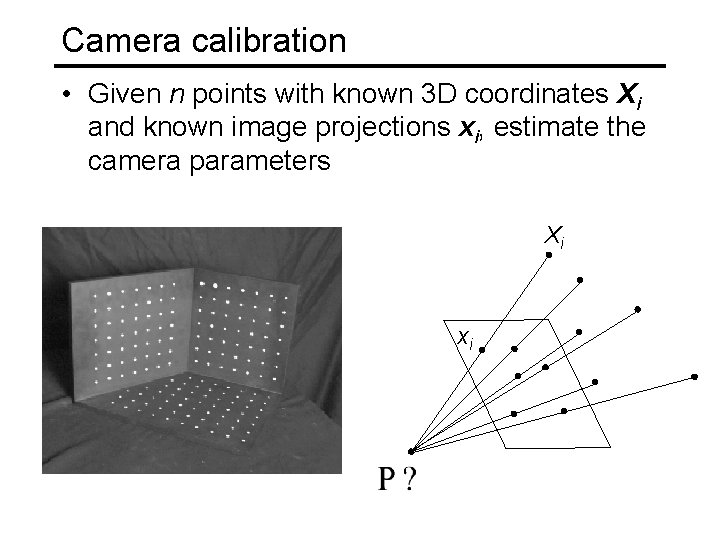
Camera calibration • Given n points with known 3 D coordinates Xi and known image projections xi, estimate the camera parameters Xi xi
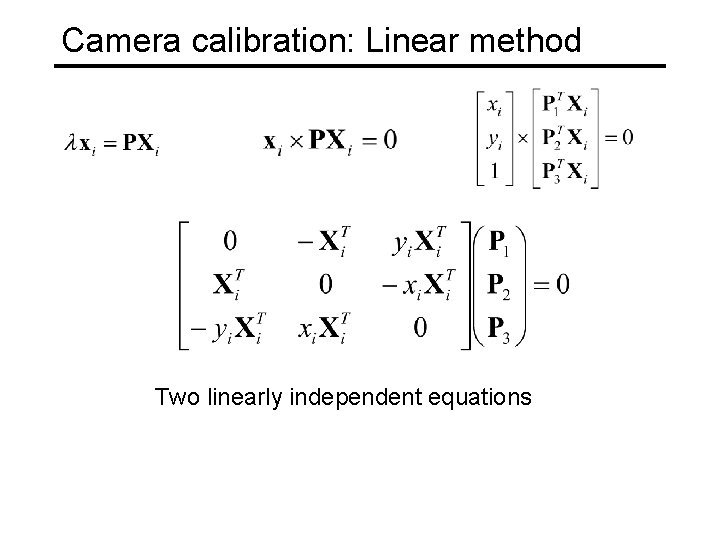
Camera calibration: Linear method Two linearly independent equations
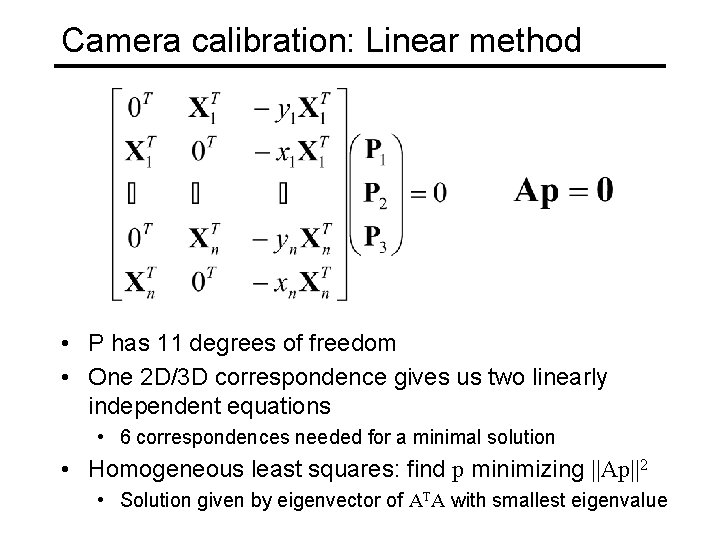
Camera calibration: Linear method • P has 11 degrees of freedom • One 2 D/3 D correspondence gives us two linearly independent equations • 6 correspondences needed for a minimal solution • Homogeneous least squares: find p minimizing ||Ap||2 • Solution given by eigenvector of ATA with smallest eigenvalue
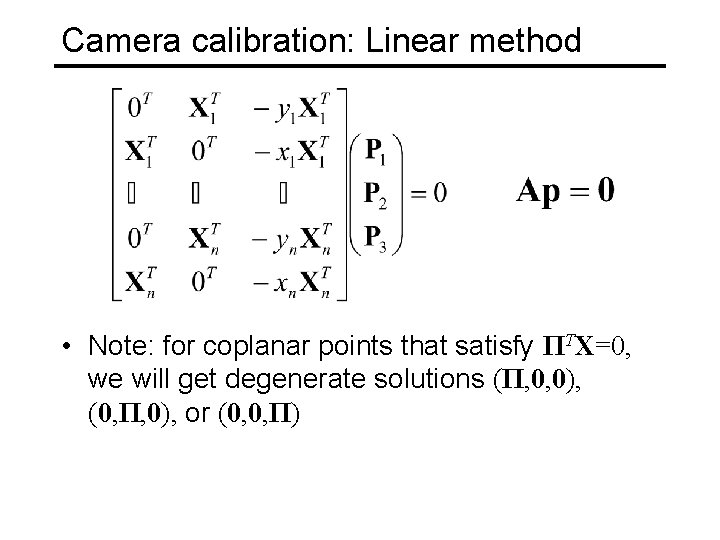
Camera calibration: Linear method • Note: for coplanar points that satisfy ΠTX=0, we will get degenerate solutions (Π, 0, 0), (0, Π, 0), or (0, 0, Π)
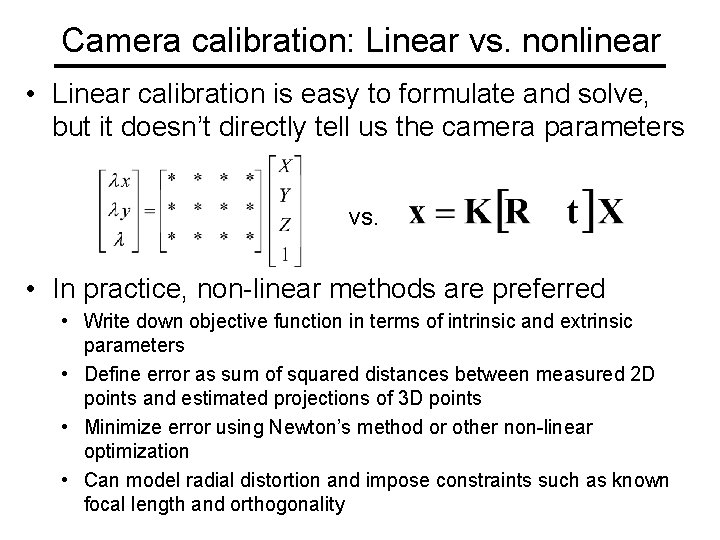
Camera calibration: Linear vs. nonlinear • Linear calibration is easy to formulate and solve, but it doesn’t directly tell us the camera parameters vs. • In practice, non-linear methods are preferred • Write down objective function in terms of intrinsic and extrinsic parameters • Define error as sum of squared distances between measured 2 D points and estimated projections of 3 D points • Minimize error using Newton’s method or other non-linear optimization • Can model radial distortion and impose constraints such as known focal length and orthogonality
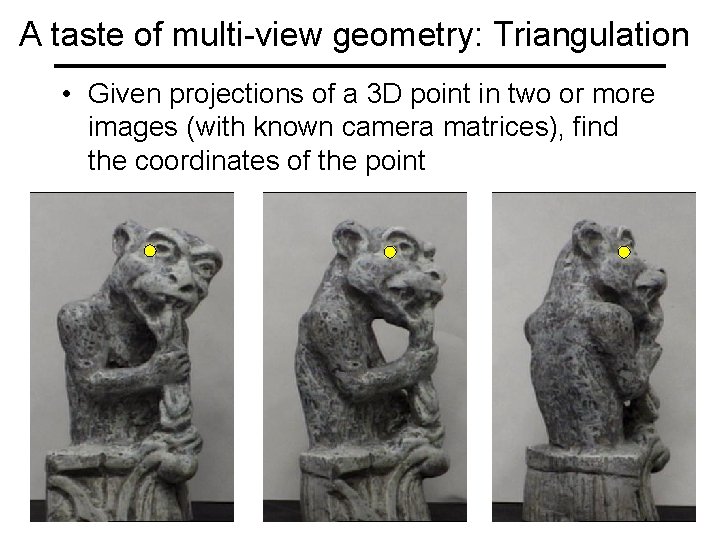
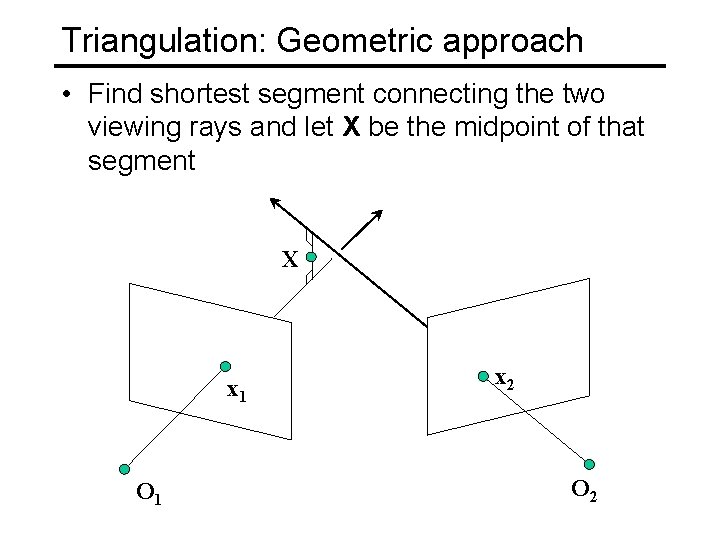
A taste of multi-view geometry: Triangulation • Given projections of a 3 D point in two or more images (with known camera matrices), find the coordinates of the point
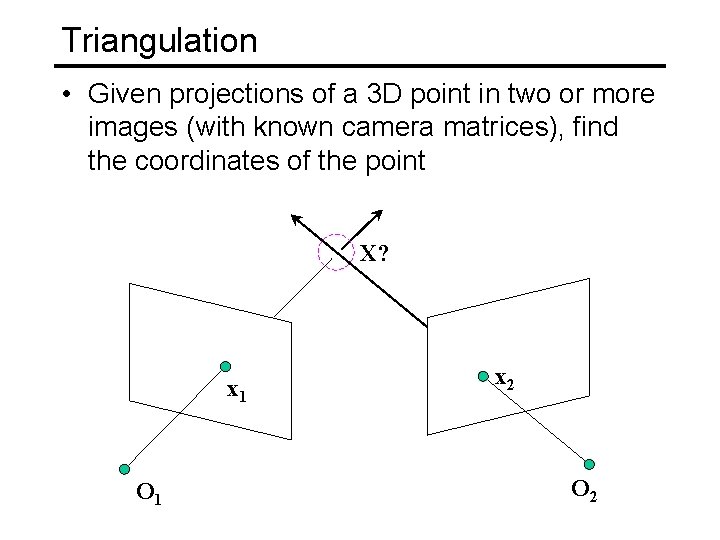
Triangulation • Given projections of a 3 D point in two or more images (with known camera matrices), find the coordinates of the point X? x 1 O 1 x 2 O 2
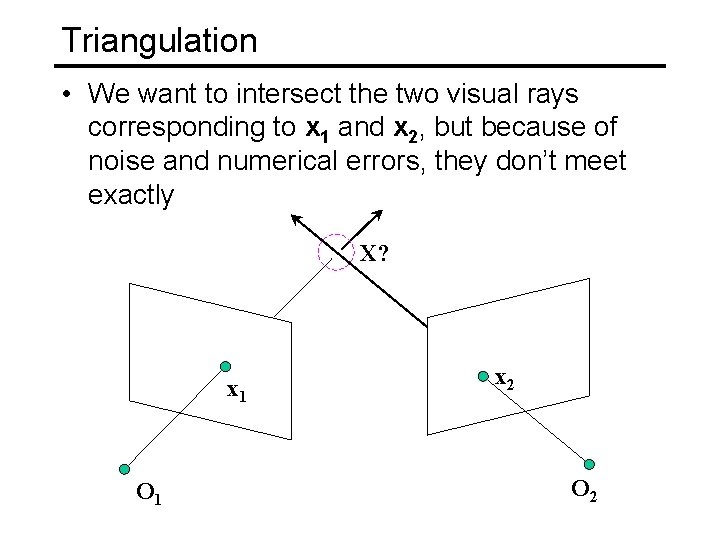
Triangulation • We want to intersect the two visual rays corresponding to x 1 and x 2, but because of noise and numerical errors, they don’t meet exactly X? x 1 O 1 x 2 O 2
Triangulation: Geometric approach • Find shortest segment connecting the two viewing rays and let X be the midpoint of that segment X x 1 O 1 x 2 O 2
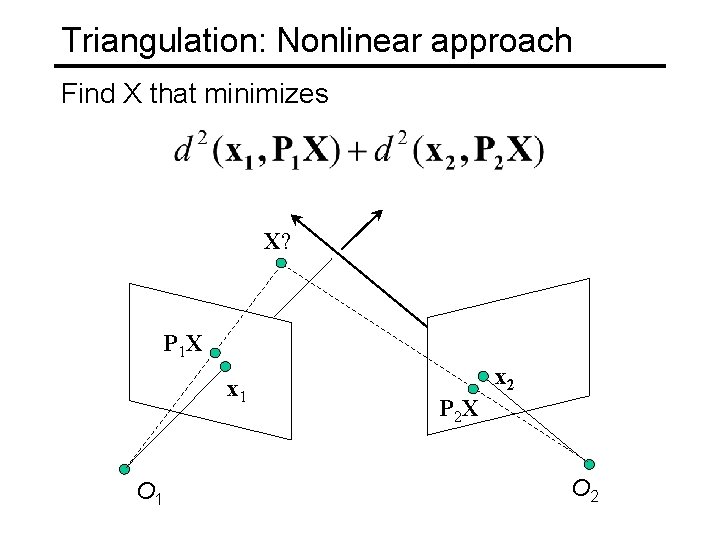
Triangulation: Nonlinear approach Find X that minimizes X? P 1 X x 1 O 1 x 2 P 2 X O 2
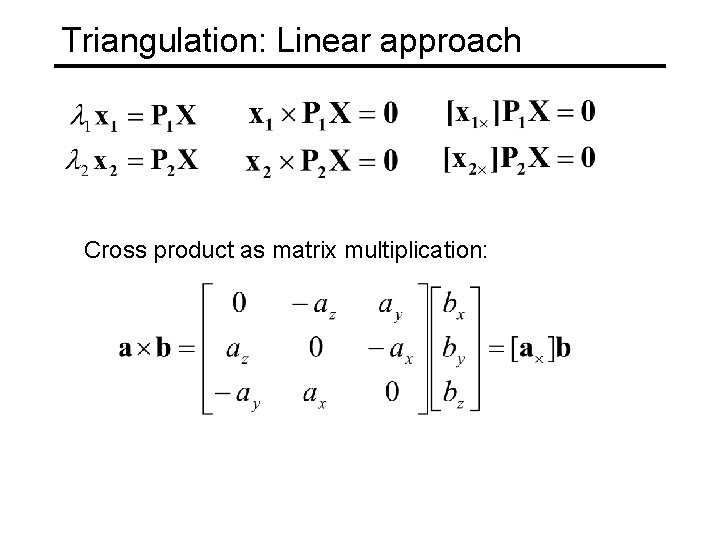
Triangulation: Linear approach Cross product as matrix multiplication:
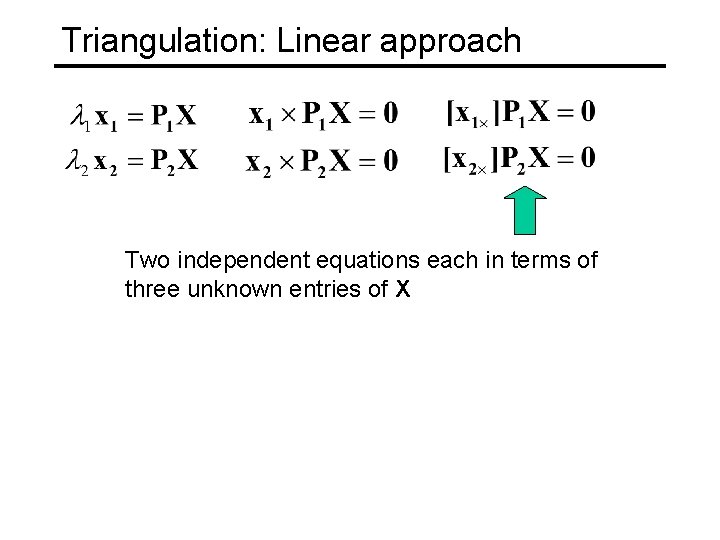
Triangulation: Linear approach Two independent equations each in terms of three unknown entries of X
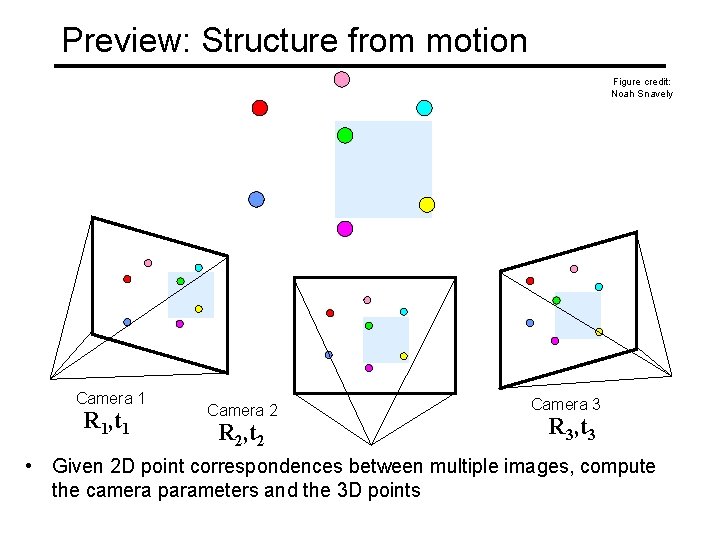
Preview: Structure from motion Figure credit: Noah Snavely Camera 1 R 1, t 1 Camera 2 R 2, t 2 Camera 3 R 3, t 3 • Given 2 D point correspondences between multiple images, compute the camera parameters and the 3 D points
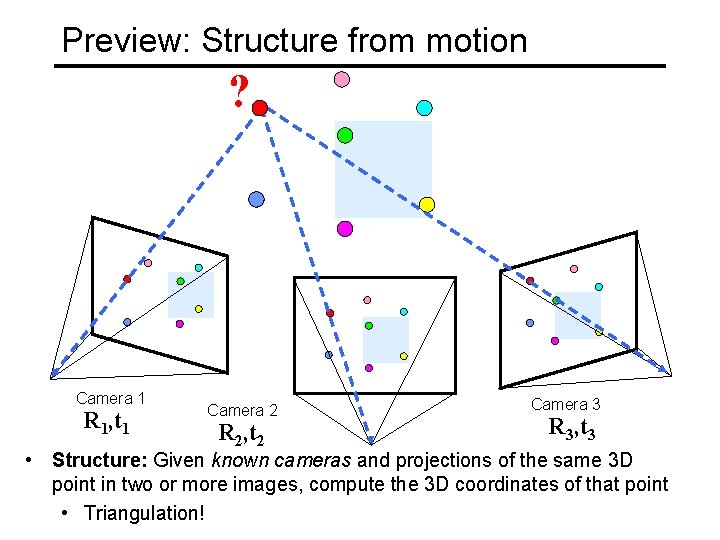
Preview: Structure from motion ? Camera 1 R 1, t 1 Camera 2 R 2, t 2 Camera 3 R 3, t 3 • Structure: Given known cameras and projections of the same 3 D point in two or more images, compute the 3 D coordinates of that point • Triangulation!
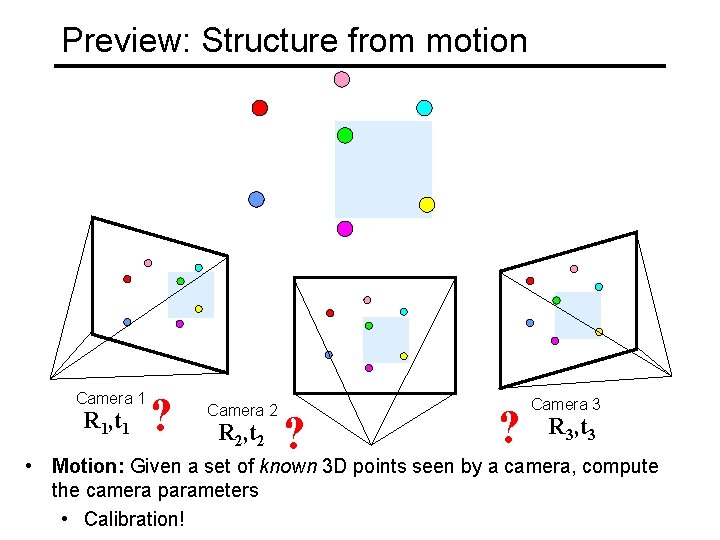
Preview: Structure from motion Camera 1 R 1, t 1 ? Camera 2 R 2, t 2 ? ? Camera 3 R 3, t 3 • Motion: Given a set of known 3 D points seen by a camera, compute the camera parameters • Calibration!
Useful reference