
Geometry Lesson 1 Construct an Equilateral Triangle Essential
- Slides: 15
Geometry- Lesson 1 Construct an Equilateral Triangle
Essential Question • Students will learn how to construct an equilateral triangle and communicate mathematic ideas effectively and efficiently.
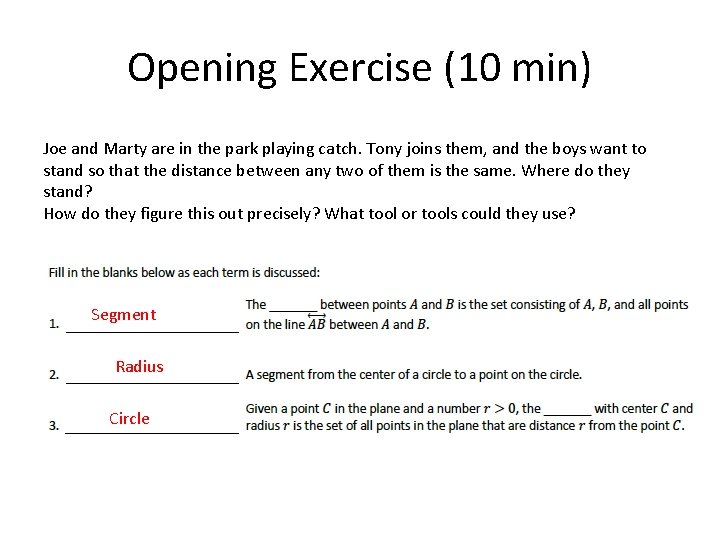
Opening Exercise (10 min) Joe and Marty are in the park playing catch. Tony joins them, and the boys want to stand so that the distance between any two of them is the same. Where do they stand? How do they figure this out precisely? What tool or tools could they use? Segment Radius Circle
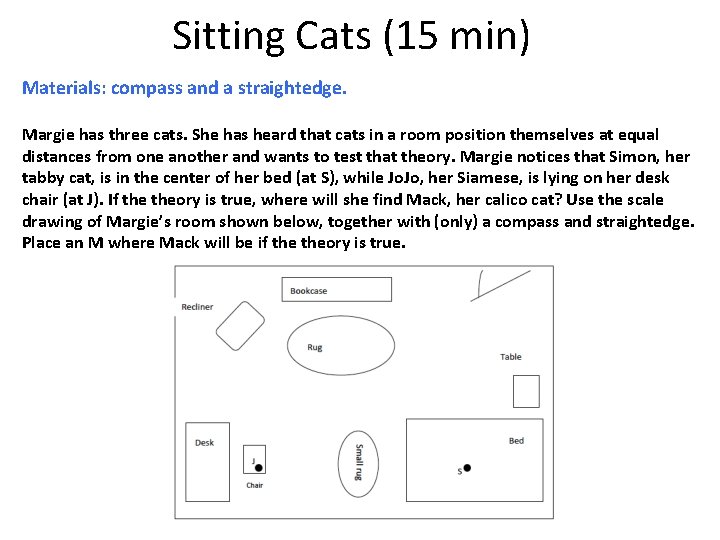
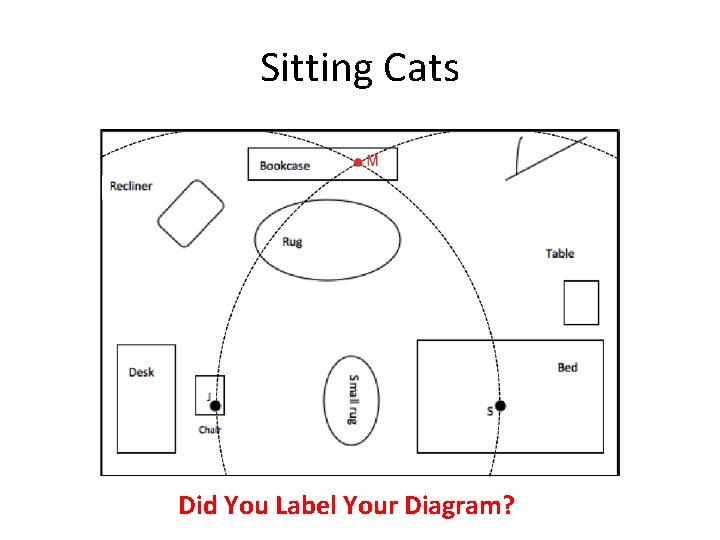
Sitting Cats (15 min) Materials: compass and a straightedge. Margie has three cats. She has heard that cats in a room position themselves at equal distances from one another and wants to test that theory. Margie notices that Simon, her tabby cat, is in the center of her bed (at S), while Jo. Jo, her Siamese, is lying on her desk chair (at J). If theory is true, where will she find Mack, her calico cat? Use the scale drawing of Margie’s room shown below, together with (only) a compass and straightedge. Place an M where Mack will be if theory is true.
Sitting Cats • Use your compass and ruler to find the position of the third cat • Try working alone for at least 5 minutes
Sitting Cats Did You Label Your Diagram?
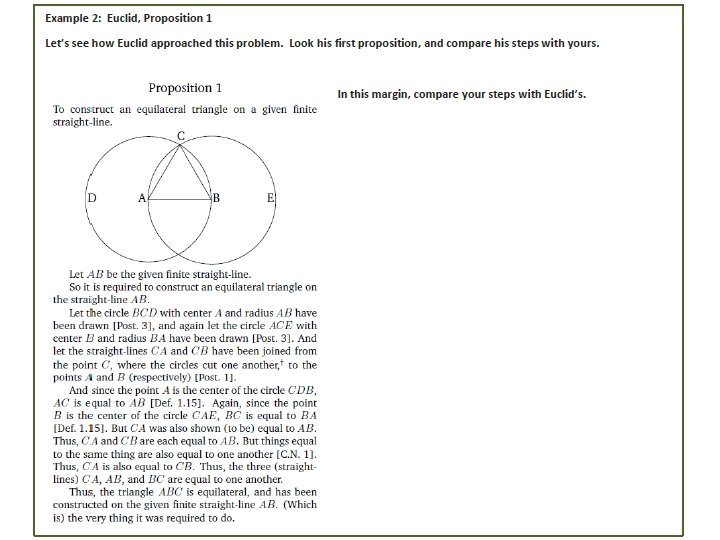
Euclid’s Solution of How to Construct an Equilateral Triangle (12 min) • Goal: For students to form a rough set of steps that outlines the construction of the equilateral triangle. Annotate the Following Text (Proposition 1) as we read through it together…
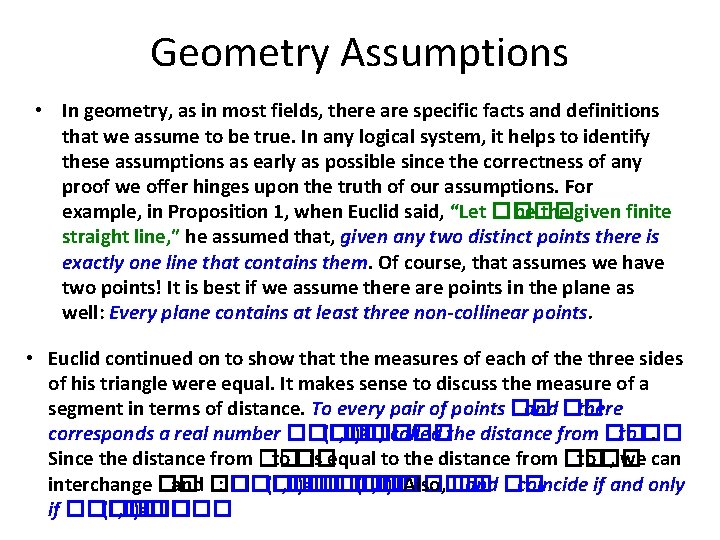
Geometry Assumptions • In geometry, as in most fields, there are specific facts and definitions that we assume to be true. In any logical system, it helps to identify these assumptions as early as possible since the correctness of any proof we offer hinges upon the truth of our assumptions. For example, in Proposition 1, when Euclid said, “Let ���� be the given finite straight line, ” he assumed that, given any two distinct points there is exactly one line that contains them. Of course, that assumes we have two points! It is best if we assume there are points in the plane as well: Every plane contains at least three non-collinear points. • Euclid continued on to show that the measures of each of the three sides of his triangle were equal. It makes sense to discuss the measure of a segment in terms of distance. To every pair of points �� and �� there corresponds a real number ���� (�� , �� )≥�� , called the distance from �� to ��. Since the distance from �� to �� is equal to the distance from �� to �� , we can interchange �� and �� : ���� (�� , �� )= ���� (�� , �� ). Also, �� and �� coincide if and only if ���� (�� , �� )=��.
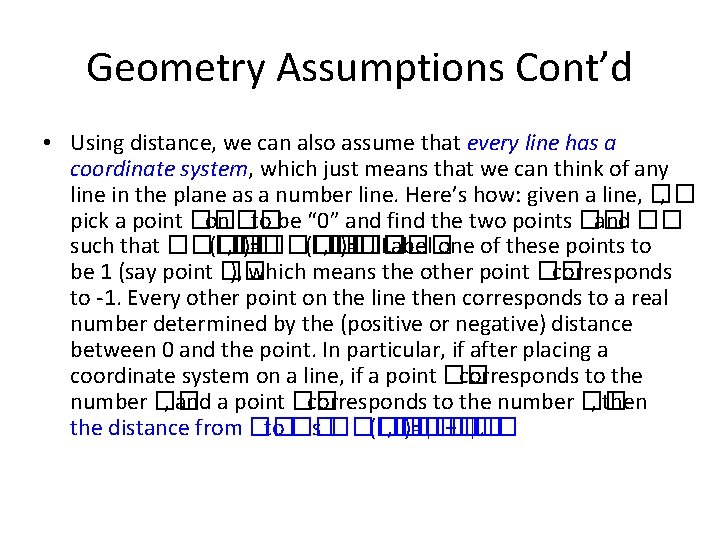
Geometry Assumptions Cont’d • Using distance, we can also assume that every line has a coordinate system, which just means that we can think of any line in the plane as a number line. Here’s how: given a line, �� , pick a point �� on �� to be “ 0” and find the two points �� and �� such that �������� (�� , �� )=��. Label one of these points to be 1 (say point �� ), which means the other point �� corresponds to -1. Every other point on the line then corresponds to a real number determined by the (positive or negative) distance between 0 and the point. In particular, if after placing a coordinate system on a line, if a point �� corresponds to the number �� , and a point �� corresponds to the number �� , then the distance from �� to �� is ���� (�� , �� )=|�� −�� |.
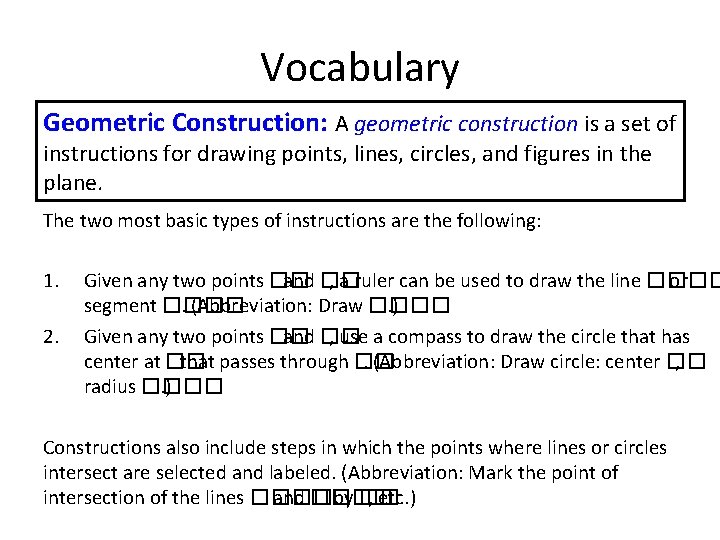
Vocabulary Geometric Construction: A geometric construction is a set of instructions for drawing points, lines, circles, and figures in the plane. The two most basic types of instructions are the following: 1. 2. Given any two points �� and �� , a ruler can be used to draw the line ���� or segment ����. (Abbreviation: Draw ����. ) Given any two points �� and �� , use a compass to draw the circle that has center at �� that passes through ��. (Abbreviation: Draw circle: center �� , radius ����. ) Constructions also include steps in which the points where lines or circles intersect are selected and labeled. (Abbreviation: Mark the point of intersection of the lines ���� and ���� by �� , etc. )
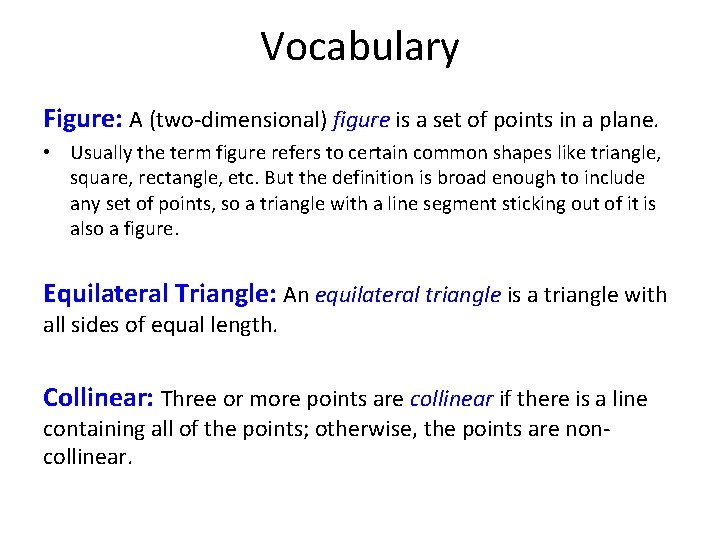
Vocabulary Figure: A (two-dimensional) figure is a set of points in a plane. • Usually the term figure refers to certain common shapes like triangle, square, rectangle, etc. But the definition is broad enough to include any set of points, so a triangle with a line segment sticking out of it is also a figure. Equilateral Triangle: An equilateral triangle is a triangle with all sides of equal length. Collinear: Three or more points are collinear if there is a line containing all of the points; otherwise, the points are noncollinear.
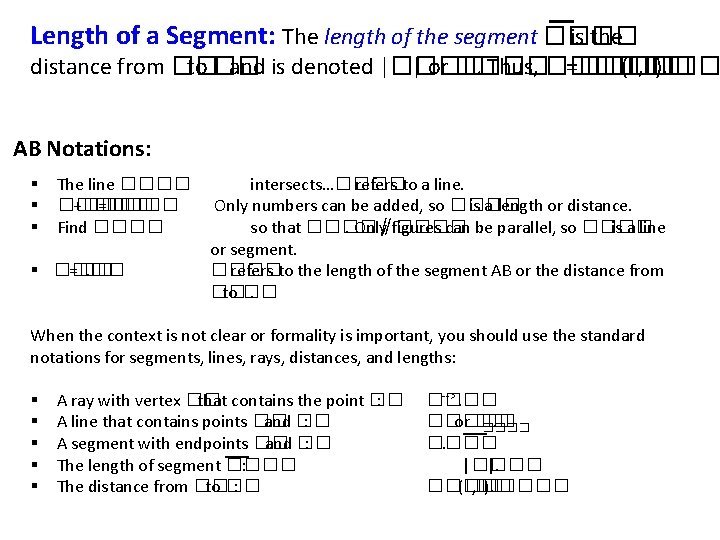
Length of a Segment: The length of the segment ���� is the distance from �� to �� and is denoted |���� | or ����. Thus, ���� =������ (�� , �� ). AB Notations: The line ���� +���� =���� Find ���� =��. intersects…���� refers to a line. Only numbers can be added, so ���� is a length or distance. so that ����∥����. Only figures can be parallel, so ���� is a line or segment. ���� refers to the length of the segment AB or the distance from �� to ��. When the context is not clear or formality is important, you should use the standard notations for segments, lines, rays, distances, and lengths: A ray with vertex �� that contains the point �� : A line that contains points �� and �� : A segment with endpoints �� and �� : The length of segment ���� : The distance from �� to �� : -->. ����� or ��. ����. |���� |. ���� (�� , �� ).
Homework • Problem Set Goal: To write a coherent set of steps on how to make an equilateral triangle
Exit Ticket • We saw two different scenarios where we used the construction of an equilateral triangle to help determine a needed location (i. e. , the friends playing catch in the park and the sitting cats). Can you think of another scenario where the construction of an equilateral triangle might be useful? Articulate how you would find the needed location using an equilateral triangle.