
GEOMETRY LEARNING TARGET Scope Sequence Kindergarten 1 st


- Slides: 14
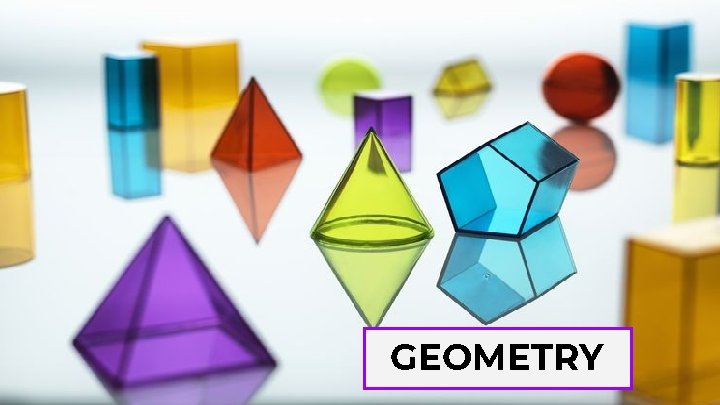
GEOMETRY
LEARNING TARGET Scope & Sequence: Kindergarten, 1 st, & 2 nd Colorado Standards 2020 Key Vocabulary Key Pedological Components Example Lesson/Activity Assessment Options Connections
2020 COLORADO ACADEMIC STANDARDS - STANDARD 4: GEOMETRY Kindergarten: 1. Identify and describe shapes (squares, circles, triangles, rectangles, hexagons, cubes, cones, cylinders, and spheres). 2. Analyze, compare, create, and compose shapes. 1 st & 2 nd Grade: 1. Reason with shapes and their attributes.
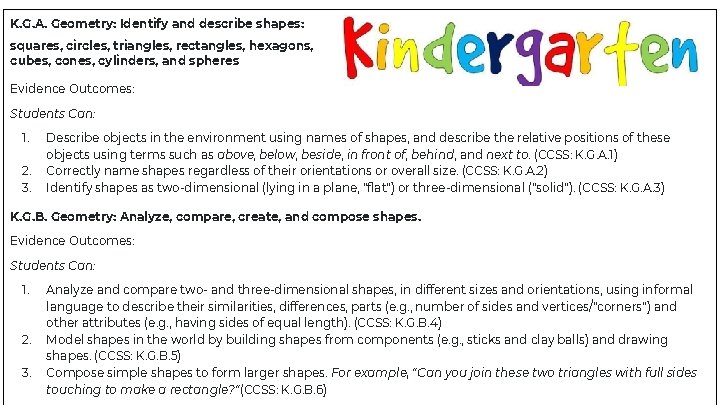
K. G. A. Geometry: Identify and describe shapes: squares, circles, triangles, rectangles, hexagons, cubes, cones, cylinders, and spheres Evidence Outcomes: Students Can: 1. 2. 3. Describe objects in the environment using names of shapes, and describe the relative positions of these objects using terms such as above, below, beside, in front of, behind, and next to. (CCSS: K. G. A. 1) Correctly name shapes regardless of their orientations or overall size. (CCSS: K. G. A. 2) Identify shapes as two-dimensional (lying in a plane, "flat") or three-dimensional ("solid"). (CCSS: K. G. A. 3) K. G. B. Geometry: Analyze, compare, create, and compose shapes. Evidence Outcomes: Students Can: 1. 2. 3. Analyze and compare two- and three-dimensional shapes, in different sizes and orientations, using informal language to describe their similarities, differences, parts (e. g. , number of sides and vertices/"corners") and other attributes (e. g. , having sides of equal length). (CCSS: K. G. B. 4) Model shapes in the world by building shapes from components (e. g. , sticks and clay balls) and drawing shapes. (CCSS: K. G. B. 5) Compose simple shapes to form larger shapes. For example, "Can you join these two triangles with full sides touching to make a rectangle? "(CCSS: K. G. B. 6)
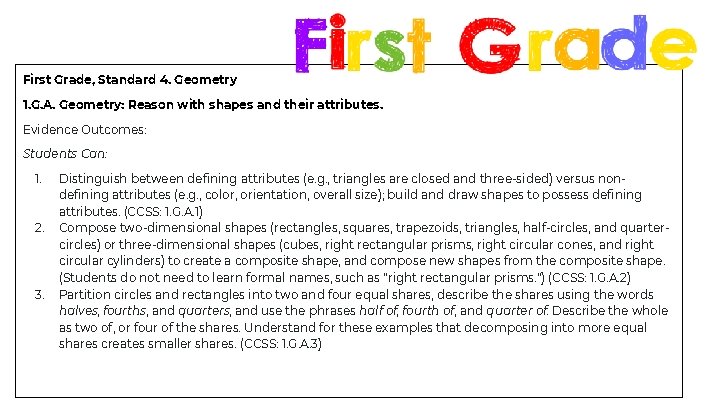
First Grade, Standard 4. Geometry 1. G. A. Geometry: Reason with shapes and their attributes. Evidence Outcomes: Students Can: 1. 2. 3. Distinguish between defining attributes (e. g. , triangles are closed and three-sided) versus nondefining attributes (e. g. , color, orientation, overall size); build and draw shapes to possess defining attributes. (CCSS: 1. G. A. 1) Compose two-dimensional shapes (rectangles, squares, trapezoids, triangles, half-circles, and quartercircles) or three-dimensional shapes (cubes, right rectangular prisms, right circular cones, and right circular cylinders) to create a composite shape, and compose new shapes from the composite shape. (Students do not need to learn formal names, such as "right rectangular prisms. ") (CCSS: 1. G. A. 2) Partition circles and rectangles into two and four equal shares, describe the shares using the words halves, fourths, and quarters, and use the phrases half of, fourth of, and quarter of. Describe the whole as two of, or four of the shares. Understand for these examples that decomposing into more equal shares creates smaller shares. (CCSS: 1. G. A. 3)
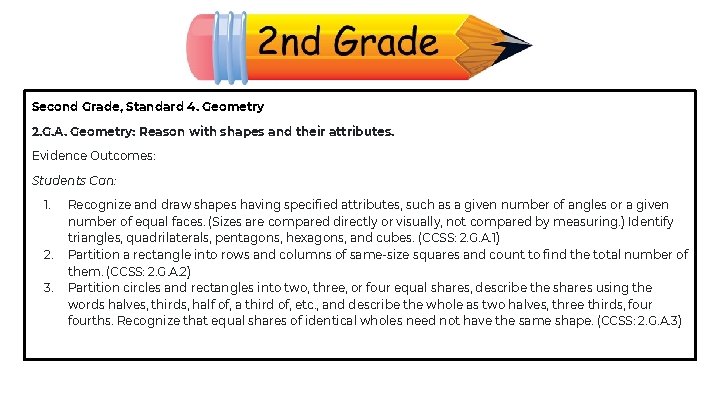
Second Grade, Standard 4. Geometry 2. G. A. Geometry: Reason with shapes and their attributes. Evidence Outcomes: Students Can: 1. 2. 3. Recognize and draw shapes having specified attributes, such as a given number of angles or a given number of equal faces. (Sizes are compared directly or visually, not compared by measuring. ) Identify triangles, quadrilaterals, pentagons, hexagons, and cubes. (CCSS: 2. G. A. 1) Partition a rectangle into rows and columns of same-size squares and count to find the total number of them. (CCSS: 2. G. A. 2) Partition circles and rectangles into two, three, or four equal shares, describe the shares using the words halves, thirds, half of, a third of, etc. , and describe the whole as two halves, three thirds, fourths. Recognize that equal shares of identical wholes need not have the same shape. (CCSS: 2. G. A. 3)
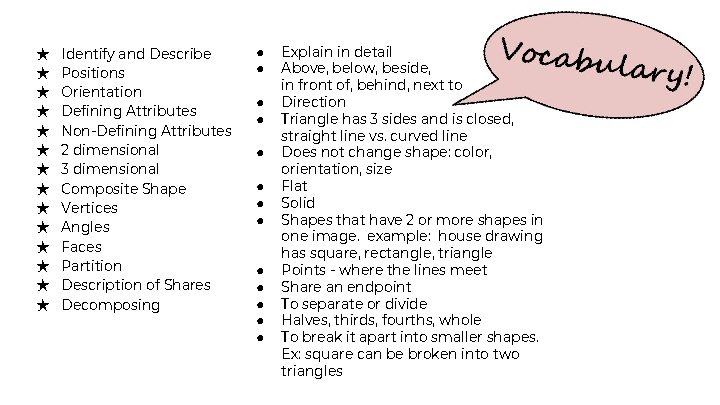
★ ★ ★ ★ Identify and Describe Positions Orientation Defining Attributes Non-Defining Attributes 2 dimensional 3 dimensional Composite Shape Vertices Angles Faces Partition Description of Shares Decomposing ● ● ● ● Explain in detail Above, below, beside, in front of, behind, next to Direction Triangle has 3 sides and is closed, straight line vs. curved line Does not change shape: color, orientation, size Flat Solid Shapes that have 2 or more shapes in one image. example: house drawing has square, rectangle, triangle Points - where the lines meet Share an endpoint To separate or divide Halves, thirds, fourths, whole To break it apart into smaller shapes. Ex: square can be broken into two triangles
KEY PEDOLOGICAL COMPONENTS ➔ Independent Thinking, Whole Class Discussion, Small Groups ➔ Manipulatives/Instruction: clay, shape blocks, geoboard, pictures, worksheets, shape walk, shape sort ➔ Technology: apps & games ➔ envision Math Curriculum - problem based learning and visual learning; interactive, pause and discuss ◆ https: //www. youtube. com/watch? time_continue=154&v=h. Szp-4 Krx. VI
I CAN: identify various shapes, I can identify characteristics of various shapes, I can draw examples of various shapes, and I can draw shapes to relate them to real world objects.
Exit slip Conversation Worksheets Math Books Checklist Show what you know SEESAW (video) ❏ Formal Assessment ❏ ❏ ❏ PRE MID POST Look at previous standards as benchmark.
CONNECTIONS ● ● ● ● ● Morning welcome/meeting Transitions Hallway walks Playground Connecting to stories (read alouds) Show and tell shape day Play I-Spy and other games Turn and talk Shape food party at the end of achieving classroom goals Other ideas? ? ? ?