
Geometry in the American school curriculum Brief timeline
Geometry in the American school curriculum

Brief timeline 1804, Flint published a book on surveying that included 12 pages devoted to geometry 1834, Davies publishes a revision of Brewster’s translation of Legendre’s Elements – becomes most widely used geometry text in America until 1870 1850’s-> Geometry made part of college entrance requirements (Yale 1865), hence entering secondary curriculum as “formal, demonstrative” subject. “Informal” geometry advocated for lower grades but makes minimal appearance. 1858, Greenleaf’s geometry text introduces “originals” 1894, NEA’s Committee of Ten convened (wanted geometry to replace so much arithmetic in lower grades) 1895, Committee of Fifteen convened (wanted algebra to replace arithmetic)

1899, Committee on College Entrance Requirementsencourages geometry to be included in grades 7, 8 1910 -> Junior high movement, informal geometry gains a foothold in the curriculum of grades 7 -9 1911, National Comm. Of 15 on Geometry syllabus: “algebra in the 9 th, plane geometry in the 10 th, …. ” , leave out some material 1912 -1917, International Commission formed to survey the status of teaching mathematics- first attempt at national assessment 1921, First published Mathematics Teacher The “ 1923 Report” by the MAA- include informal geometry in the lower grades

1932, NCTM’s Committee of Geometry reports that informal geometry seen as jr high subject 1924, Glass confirms in his detailed study that geometry is definitely being taught in grades 7 -9 1940 -> World War II reveals the shortcomings of the mathematical prep of our soldiers 1950’s-> School Mathematics Study group and U of I Committee on school mathematics formed 1963, Cambridge report- integrate geometry throughout curriculum starting in grade K 1970’s->Geometry throughout the entire curriculum, arguments have shifted to the method of its presentation in high school

Approaches to teaching geometry • • • Conventional- most prevalant Coordinates Transfomational Affine Vector
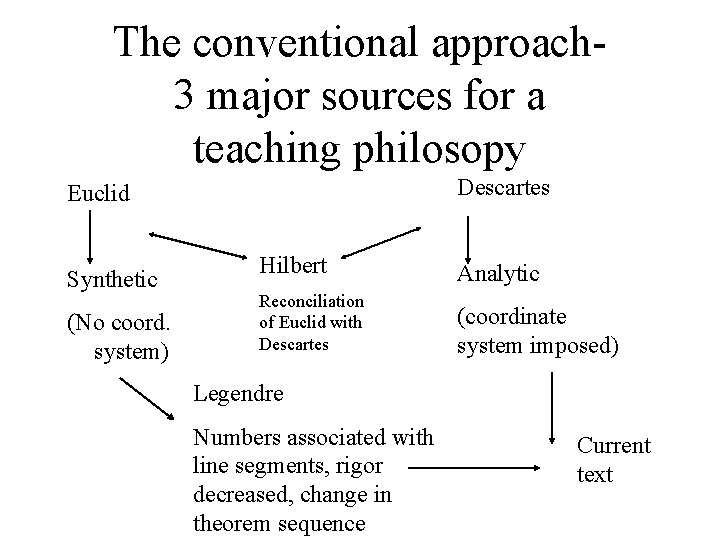
The conventional approach 3 major sources for a teaching philosopy Descartes Euclid Synthetic (No coord. system) Hilbert Analytic Reconciliation of Euclid with Descartes (coordinate system imposed) Legendre Numbers associated with line segments, rigor decreased, change in theorem sequence Current text
The current conventional (U. S. ) text-its two concerns 1. Content A list of axioms must be chosen, usually a subset of Euclid’s Elements that have been patterned after Moise texts produced by the SMSG 2. Organization of content • A single deductive system • Most results derived from several lists of undefined terms and postulates
- Slides: 7