
GEOMETRY CHAPTER 2 JOURNAL VALERIA IBARGUEN 9 1
GEOMETRY CHAPTER 2 JOURNAL VALERIA IBARGUEN 9 -1
CONDITIONAL STATEMENT a) b) c) This is a type of statement that can be written in a form of “if p, then q” P=Hypothesis Q=conclusion EXAMPLES: If m<A=195°, then <A is obtuse If an insect is a butterfly, then it has four wings If an angle is obtuse, then it has a measure of 100°
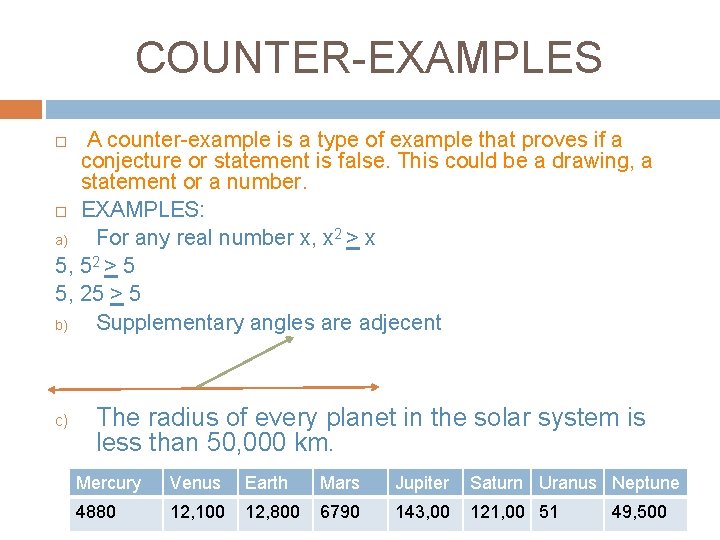
COUNTER-EXAMPLES A counter-example is a type of example that proves if a conjecture or statement is false. This could be a drawing, a statement or a number. EXAMPLES: a) For any real number x, x 2 > x 5, 52 > 5 5, 25 > 5 b) Supplementary angles are adjecent c) The radius of every planet in the solar system is less than 50, 000 km. Mercury Venus Earth Mars Jupiter Saturn Uranus Neptune 4880 12, 100 12, 800 6790 143, 00 121, 00 51 49, 500
DEFINITION a) b) c) This is a statement that tells or discribes a mathematical object and can be written as a true biconditional statement. A definition includes “if and only if” EXAMPLES: A figure is a triangle if and only if it is a three -sided polygon. A ray, segment or line is a segment bisector if and only if it divides a segment into two congruent segments. A traingle is straight if and only if it measures 180°.
BI-CONDITIONAL STATEMENTS a) b) c) This is a statment that is written in the form “p if and only if q”. They are important. This is used when a conditional statement and its converse are combined together. EXAMPLES: Converse: If x=3, then 2 x+5=11 Biconditional: 2 x+5=11 if and only if x=3 Converse: If a point divides a segment into two congruent segments, then the point is a midpoint. Biconditional: A point is a midpoint if and only if it divides the segments into two congruent segments. Converse: If the dates is July 40 th, then it
DEDUCTIVE REASONING a) b) c) This is the type of process in which we use logic to draw conclusions of something. EXAMPLES: If a team wins 10 games, they play in the finals. If a team plays in the finals they travel to Boston. The Reavens won 10 games. CONCLUSION: The Reavens will travel to Boston. If two angles form a linear pair, then they are adjecent. If two angles are adjecent, then they share a side. <1 and <2 form a linear pair. CONCLUSION: <1 and<2 share a side. If a polygon is a triangle, then it has three sides. If a polygon has three sides then it is not a quadrilateral. Polygon is a P triangle. CONCLUSION: A polygon is not a quadrilateral because ithas three sides.
LAWS OF LOGIC - - Law of detachment: If p-q is true we should assume if P is true then Q must also be true Law of Syllogism: If P-Q is true and Q then R is true then if P is true are must be true P and R is true.
LAW OF DETACHMENT Given: If two segments are congruent then they have the same length. AB≅XY Conjecture: AB=XY hypothesis: two segments are congruent conclusion: they have the same lenght The given AB≅XY statements does match the hypothesis so the conjecture IS true. Given: If you are 3 times tardy, you must go to detention. John is in detention. Conjecture: John was tardy at least 3 times. hypothesis: you are tardy 3 times conclusion: you must go to detention. The statement given to us matches the conclusion of a true conditiona, but the hypothesis is not true since John can be in detention for another reason so the conjecture is NOT valid.
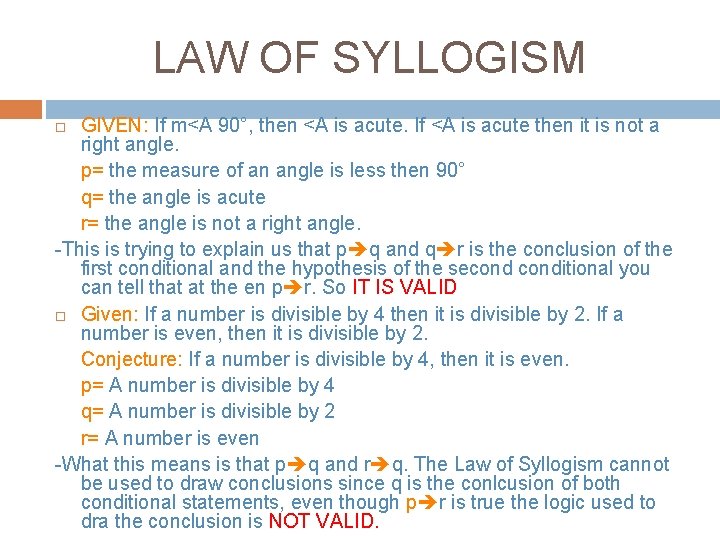
LAW OF SYLLOGISM GIVEN: If m<A 90°, then <A is acute. If <A is acute then it is not a right angle. p= the measure of an angle is less then 90° q= the angle is acute r= the angle is not a right angle. -This is trying to explain us that p q and q r is the conclusion of the first conditional and the hypothesis of the seconditional you can tell that at the en p r. So IT IS VALID Given: If a number is divisible by 4 then it is divisible by 2. If a number is even, then it is divisible by 2. Conjecture: If a number is divisible by 4, then it is even. p= A number is divisible by 4 q= A number is divisible by 2 r= A number is even -What this means is that p q and r q. The Law of Syllogism cannot be used to draw conclusions since q is the conlcusion of both conditional statements, even though p r is true the logic used to dra the conclusion is NOT VALID.
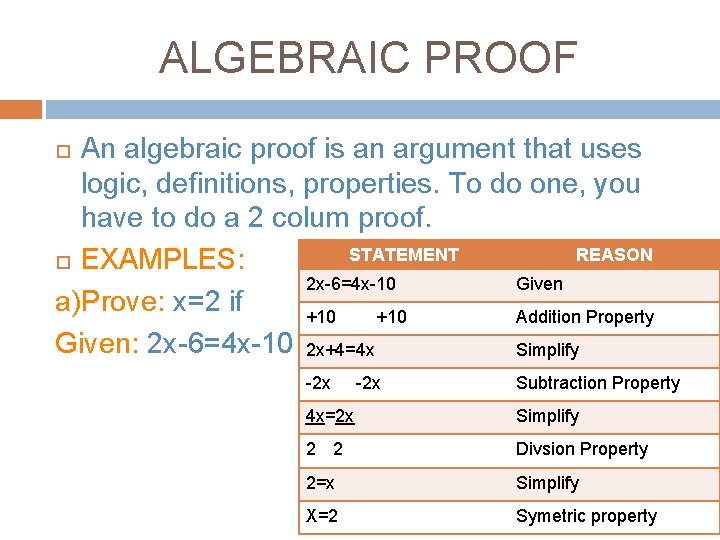
ALGEBRAIC PROOF An algebraic proof is an argument that uses logic, definitions, properties. To do one, you have to do a 2 colum proof. STATEMENT REASON EXAMPLES: 2 x-6=4 x-10 Given a)Prove: x=2 if +10 Addition Property Given: 2 x-6=4 x-10 2 x+4=4 x Simplify -2 x Subtraction Property 4 x=2 x Simplify 2 2 Divsion Property 2=x Simplify X=2 Symetric property
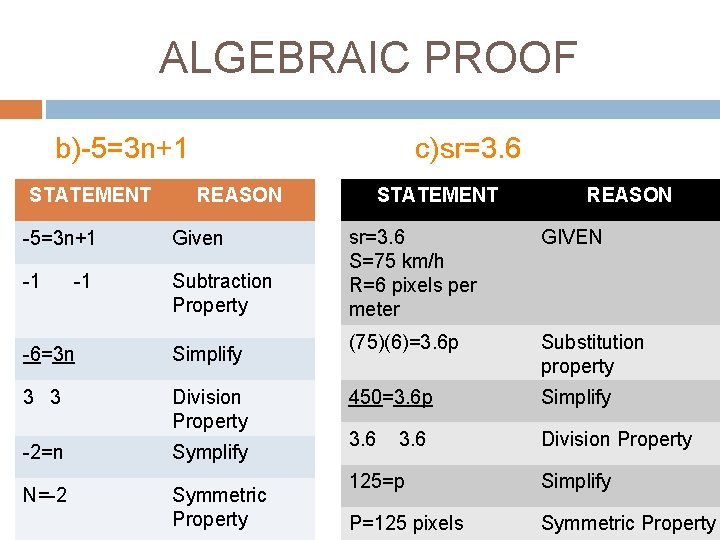
ALGEBRAIC PROOF b)-5=3 n+1 STATEMENT c)sr=3. 6 REASON -5=3 n+1 Given -1 Subtraction Property -1 -6=3 n Simplify 3 3 Division Property -2=n Symplify N=-2 Symmetric Property STATEMENT REASON sr=3. 6 S=75 km/h R=6 pixels per meter GIVEN (75)(6)=3. 6 p Substitution property 450=3. 6 p Simplify 3. 6 Division Property 3. 6 125=p Simplify P=125 pixels Symmetric Property
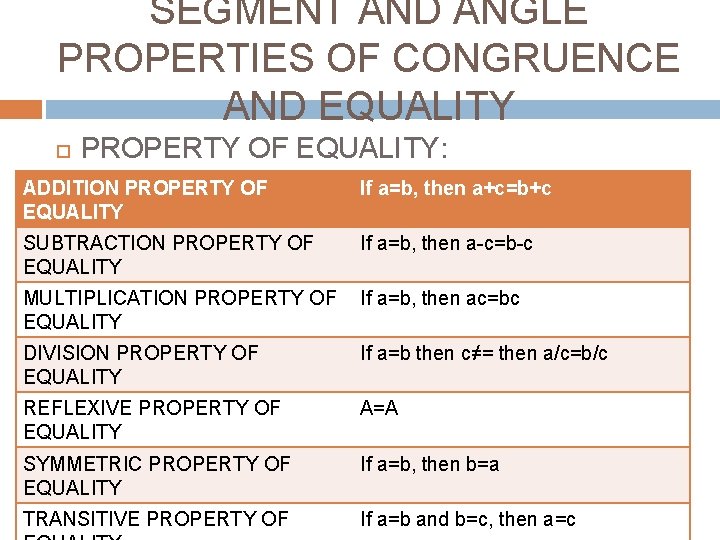
SEGMENT AND ANGLE PROPERTIES OF CONGRUENCE AND EQUALITY PROPERTY OF EQUALITY: ADDITION PROPERTY OF EQUALITY If a=b, then a+c=b+c SUBTRACTION PROPERTY OF EQUALITY If a=b, then a-c=b-c MULTIPLICATION PROPERTY OF EQUALITY If a=b, then ac=bc DIVISION PROPERTY OF EQUALITY If a=b then c≠= then a/c=b/c REFLEXIVE PROPERTY OF EQUALITY A=A SYMMETRIC PROPERTY OF EQUALITY If a=b, then b=a TRANSITIVE PROPERTY OF If a=b and b=c, then a=c
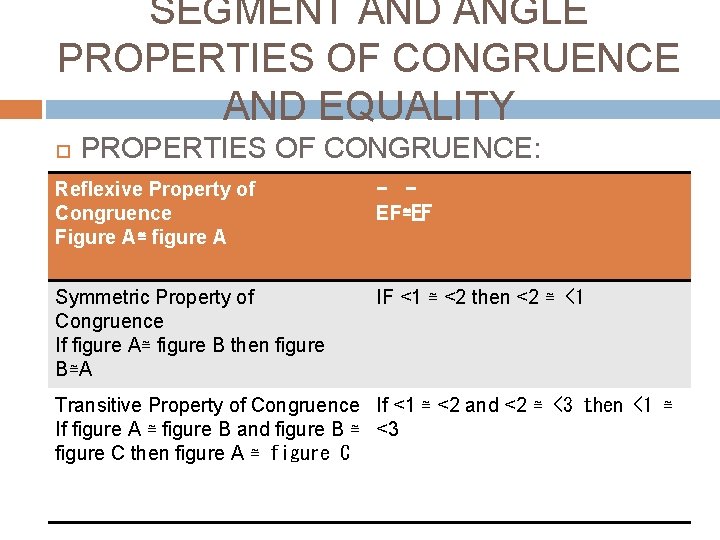
SEGMENT AND ANGLE PROPERTIES OF CONGRUENCE AND EQUALITY PROPERTIES OF CONGRUENCE: Reflexive Property of Congruence Figure A≅ figure A − − EF≅EF Symmetric Property of Congruence If figure A≅ figure B then figure B≅A IF <1 ≅ <2 then <2 ≅ <1 Transitive Property of Congruence If <1 ≅ <2 and <2 ≅ <3 then <1 ≅ If figure A ≅ figure B and figure B ≅ <3 figure C then figure A ≅ figure C
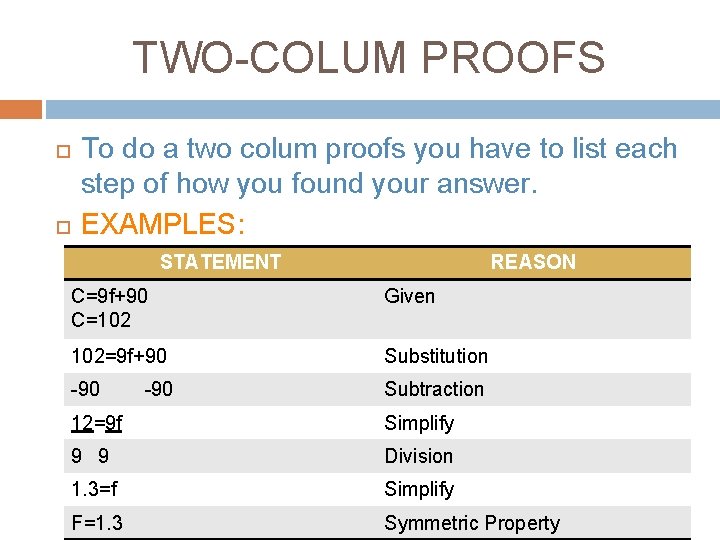
TWO-COLUM PROOFS To do a two colum proofs you have to list each step of how you found your answer. EXAMPLES: STATEMENT REASON C=9 f+90 C=102 Given 102=9 f+90 Substitution -90 Subtraction -90 12=9 f Simplify 9 9 Division 1. 3=f Simplify F=1. 3 Symmetric Property
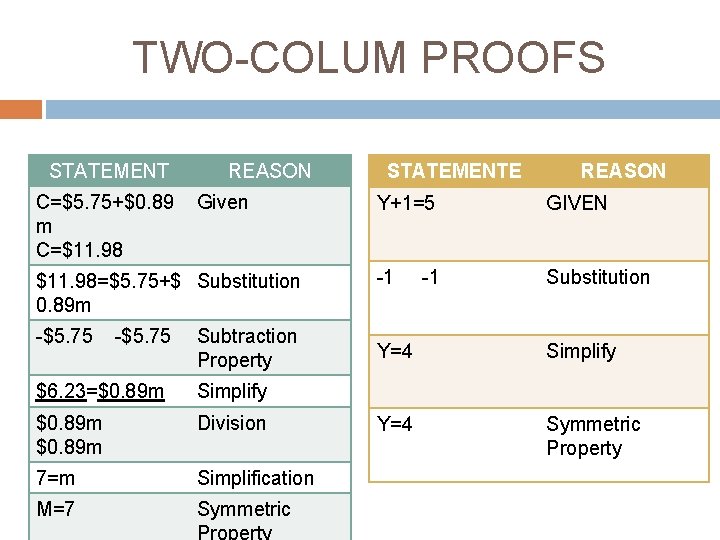
TWO-COLUM PROOFS STATEMENT C=$5. 75+$0. 89 m C=$11. 98 REASON Given $11. 98=$5. 75+$ Substitution 0. 89 m -$5. 75 Subtraction Property $6. 23=$0. 89 m Simplify $0. 89 m Division 7=m Simplification M=7 Symmetric STATEMENTE REASON Y+1=5 GIVEN -1 Substitution -1 Y=4 Simplify Y=4 Symmetric Property
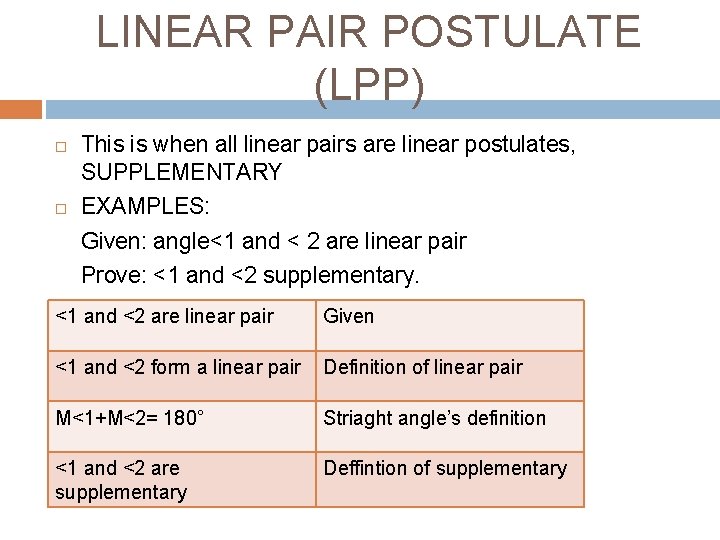
LINEAR PAIR POSTULATE (LPP) This is when all linear pairs are linear postulates, SUPPLEMENTARY EXAMPLES: Given: angle<1 and < 2 are linear pair Prove: <1 and <2 supplementary. <1 and <2 are linear pair Given <1 and <2 form a linear pair Definition of linear pair M<1+M<2= 180° Striaght angle’s definition <1 and <2 are supplementary Deffintion of supplementary
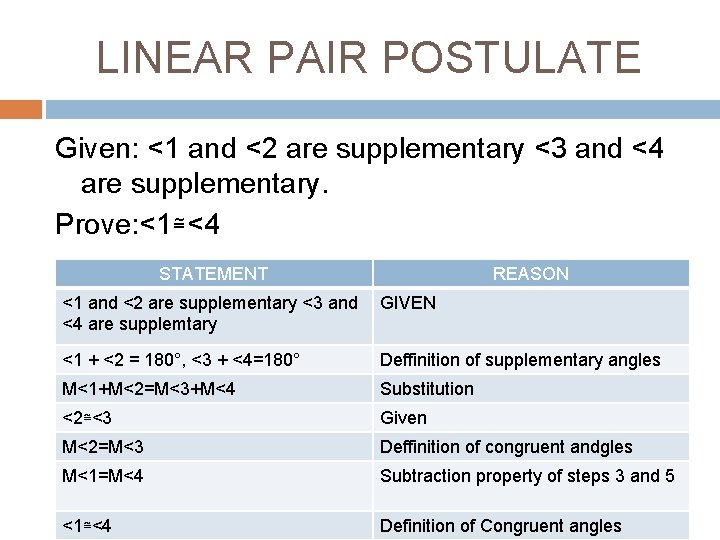
LINEAR PAIR POSTULATE Given: <1 and <2 are supplementary <3 and <4 are supplementary. Prove: <1≅<4 STATEMENT REASON <1 and <2 are supplementary <3 and <4 are supplemtary GIVEN <1 + <2 = 180°, <3 + <4=180° Deffinition of supplementary angles M<1+M<2=M<3+M<4 Substitution <2≅<3 Given M<2=M<3 Deffinition of congruent andgles M<1=M<4 Subtraction property of steps 3 and 5 <1≅<4 Definition of Congruent angles
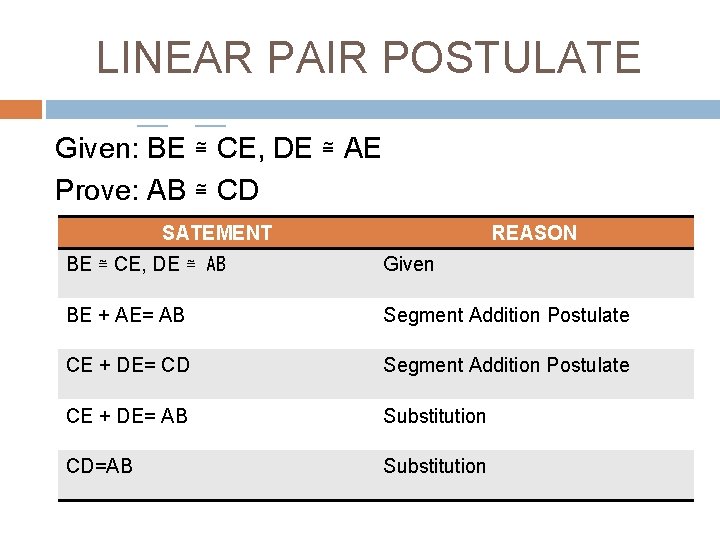
LINEAR PAIR POSTULATE Given: BE ≅ CE, DE ≅ AE Prove: AB ≅ CD SATEMENT REASON BE ≅ CE, DE ≅ AB Given BE + AE= AB Segment Addition Postulate CE + DE= CD Segment Addition Postulate CE + DE= AB Substitution CD=AB Substitution
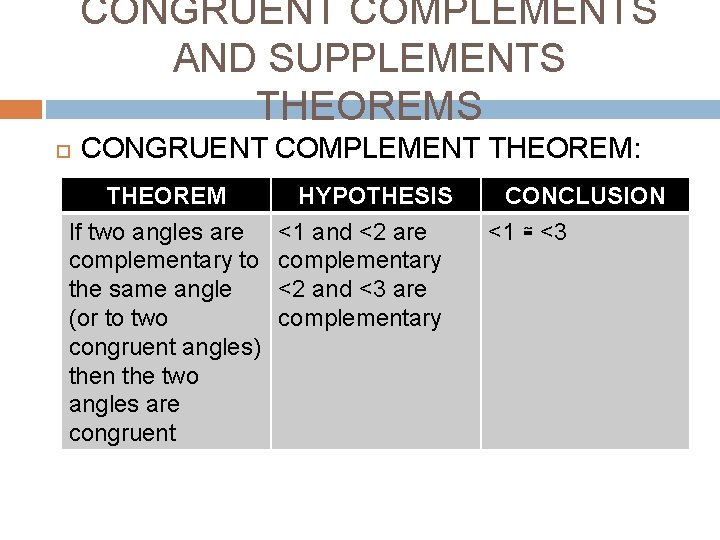
CONGRUENT COMPLEMENTS AND SUPPLEMENTS THEOREMS CONGRUENT COMPLEMENT THEOREM: THEOREM If two angles are complementary to the same angle (or to two congruent angles) then the two angles are congruent HYPOTHESIS <1 and <2 are complementary <2 and <3 are complementary CONCLUSION <1 ≅ <3
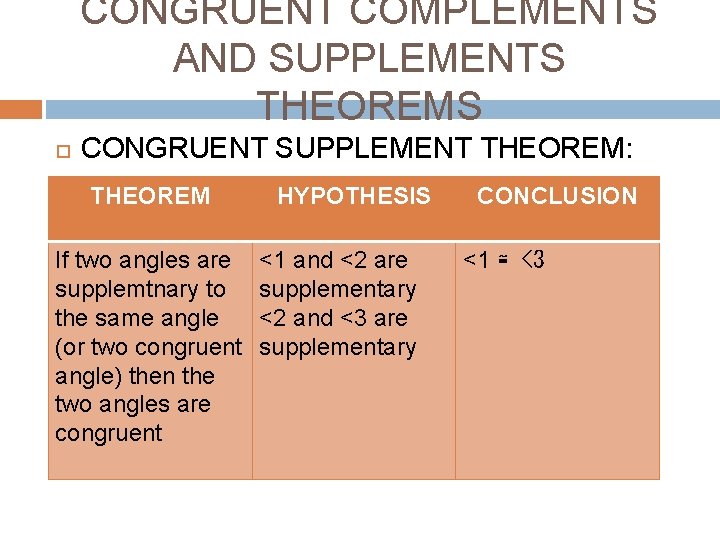
CONGRUENT COMPLEMENTS AND SUPPLEMENTS THEOREMS CONGRUENT SUPPLEMENT THEOREM: THEOREM If two angles are supplemtnary to the same angle (or two congruent angle) then the two angles are congruent HYPOTHESIS <1 and <2 are supplementary <2 and <3 are supplementary CONCLUSION <1 ≅ <3
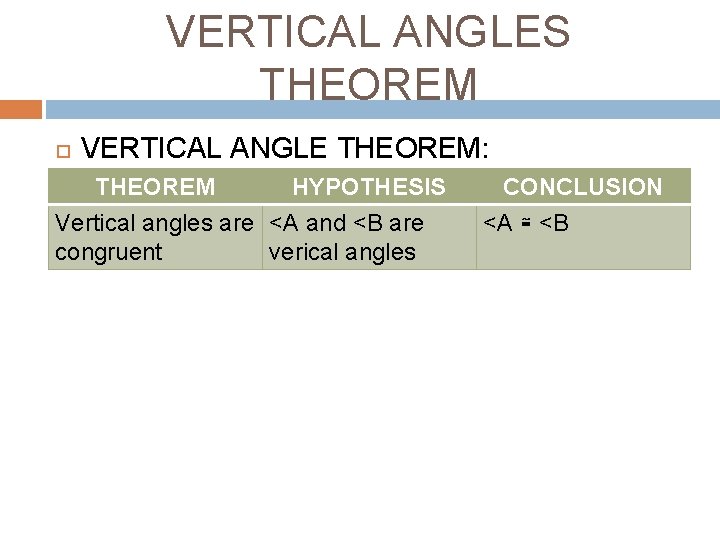
VERTICAL ANGLES THEOREM VERTICAL ANGLE THEOREM: THEOREM HYPOTHESIS Vertical angles are <A and <B are congruent verical angles CONCLUSION <A ≅ <B
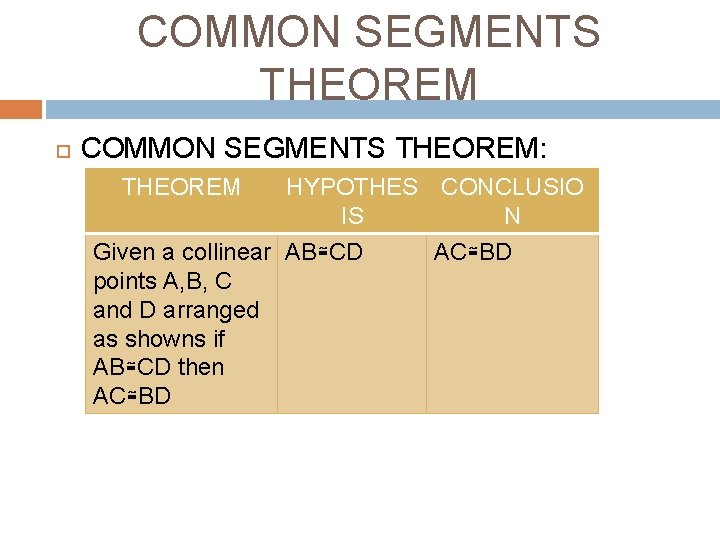
COMMON SEGMENTS THEOREM COMMON SEGMENTS THEOREM: THEOREM HYPOTHES CONCLUSIO IS N Given a collinear AB≅CD points A, B, C and D arranged as showns if AB≅CD then AC≅BD
- Slides: 22