
Geometry Chapter 13 Review The distance d between
Geometry Chapter 13 Review
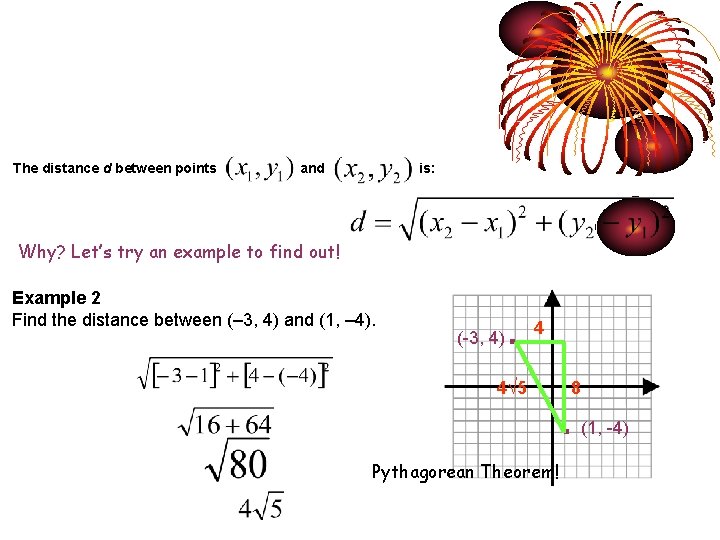
The distance d between points and is: Why? Let’s try an example to find out! Example 2 Find the distance between (– 3, 4) and (1, – 4). (-3, 4) . 4 4√ 5 Pythagorean Theorem! 8 . (1, -4)
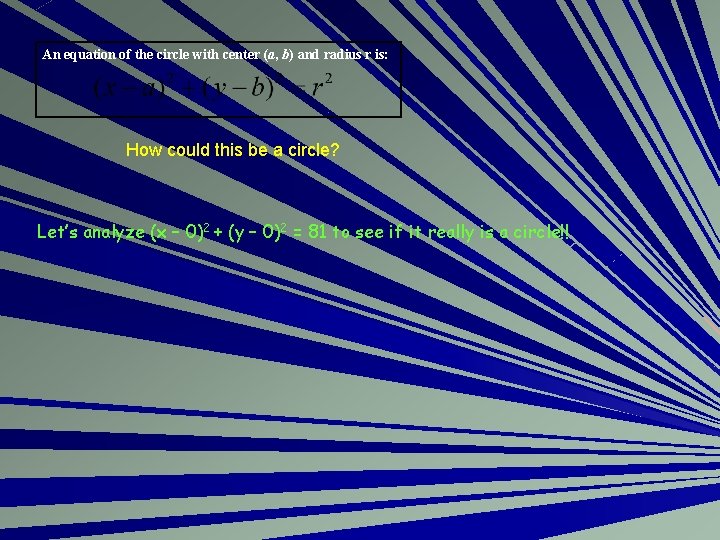
An equation of the circle with center (a, b) and radius r is: How could this be a circle? Let’s analyze (x – 0)2 + (y – 0)2 = 81 to see if it really is a circle!!
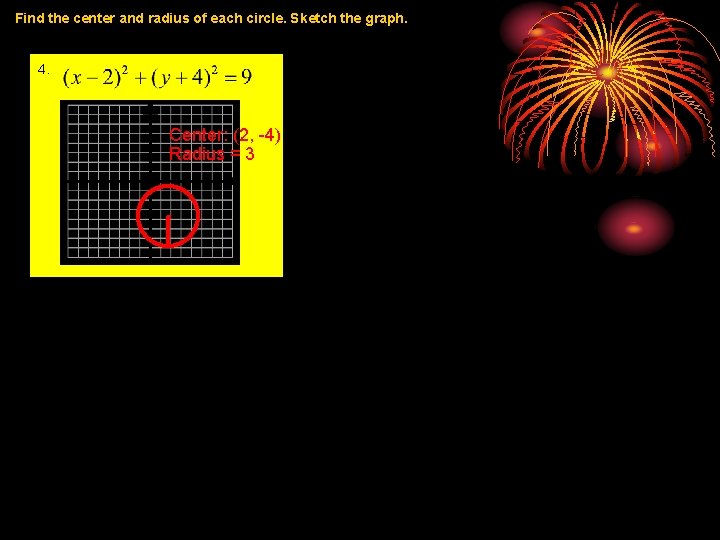
Find the center and radius of each circle. Sketch the graph. 5. 4. Center: (2, -4) Radius = 3 .
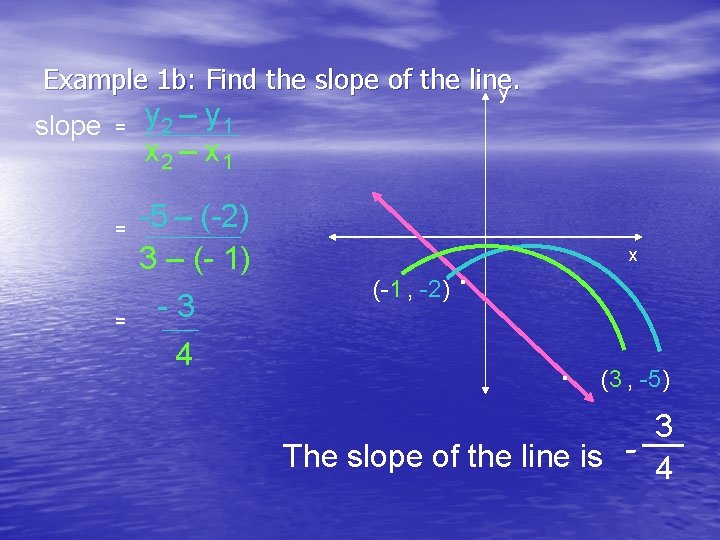
Example 1 b: Find the slope of the line. y slope = = = y 2 – y 1 x 2 – x 1 -5 – (-2) 3 – (- 1) -3 4 (-1 , -2) . x . (3 , -5) 3 __ The slope of the line is - 4

Positive Slope Greater than 1 Positive Slope Less than 1 Uphill Steep Flatter Negative Slope Greater than 1 Negative Slope Less than 1 Downhill Steep Flatter Slope = 0 Undefined Slope Running up the hill is undefined!
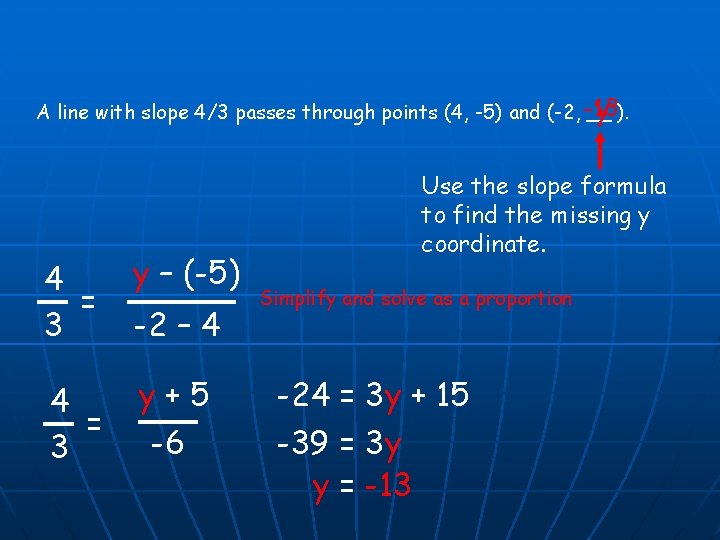
y A line with slope 4/3 passes through points (4, -5) and (-2, -13 __ ). 4 = 3 y – (-5) 4 = 3 y+5 -6 -2 – 4 Use the slope formula to find the missing y coordinate. Simplify and solve as a proportion -24 = 3 y + 15 -39 = 3 y y = -13
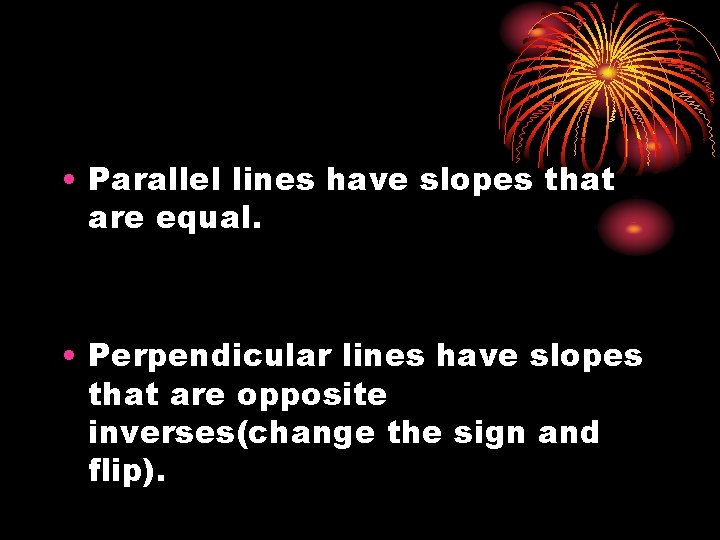
• Parallel lines have slopes that are equal. • Perpendicular lines have slopes that are opposite inverses(change the sign and flip).
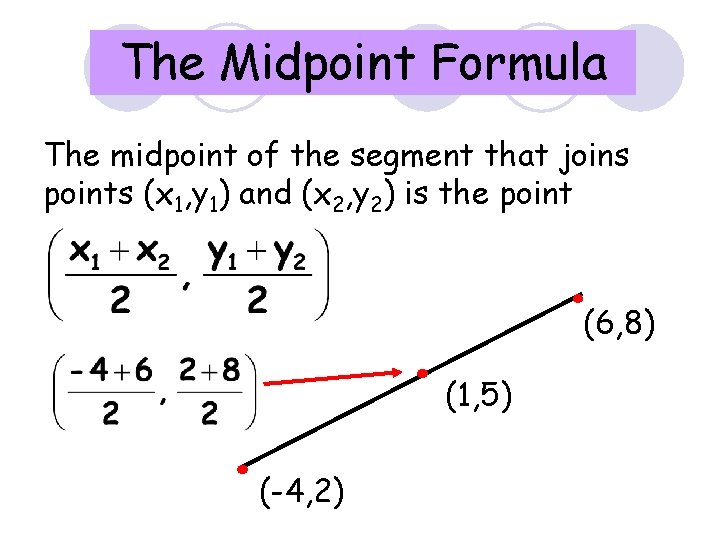
The Midpoint Formula The midpoint of the segment that joins points (x 1, y 1) and (x 2, y 2) is the point • (1, 5) • (-4, 2) • (6, 8)
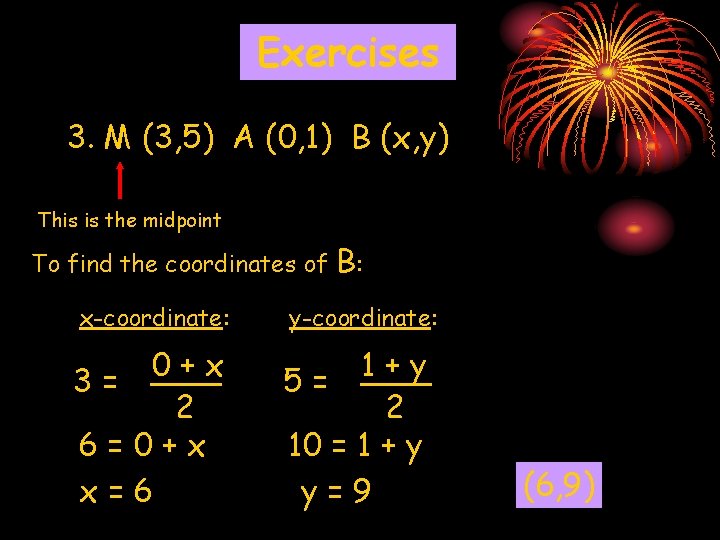
Exercises 3. M (3, 5) A (0, 1) B (x, y) This is the midpoint To find the coordinates of B: x-coordinate: y-coordinate: 0+x 3= 2 6=0+x x=6 1+y 5= 2 10 = 1 + y y=9 (6, 9)
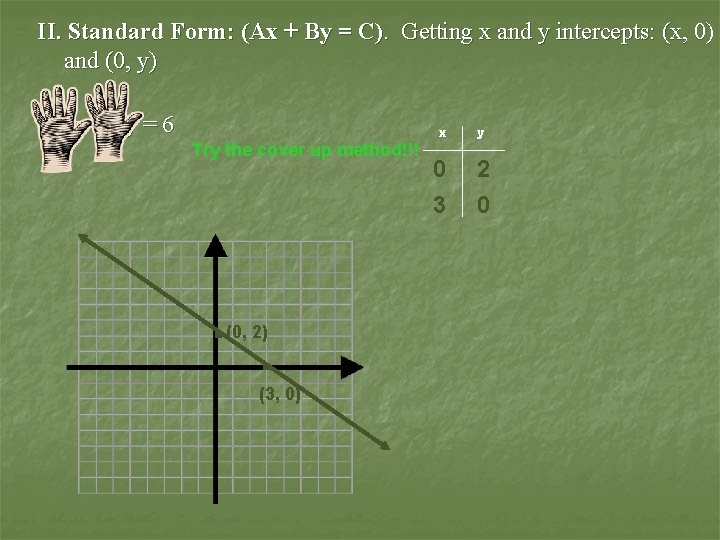
II. Standard Form: (Ax + By = C). Getting x and y intercepts: (x, 0) and (0, y) 1) 2 x + 3 y = 6 Try the cover up method!!! . . (0, 2) (3, 0) x y 0 3 2 0
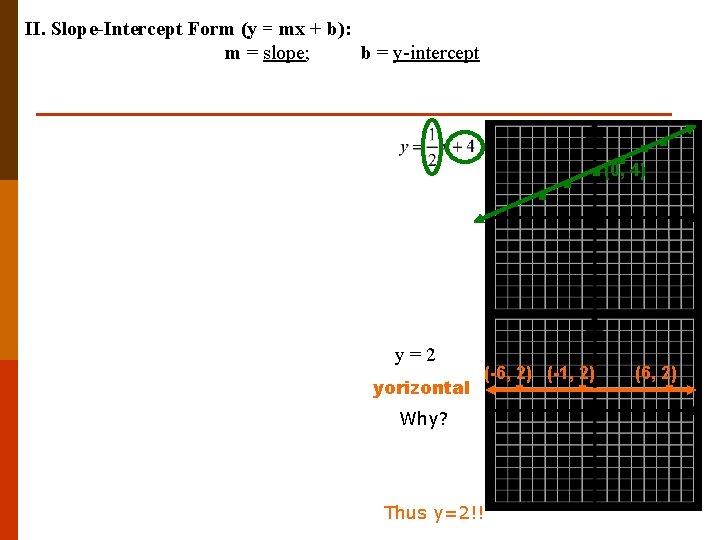
II. Slope-Intercept Form (y = mx + b): m = slope; b = y-intercept . . y=2 yorizontal . . . (-6, 2) (-1, 2) Why? Thus y=2!! (0, 4) . (6, 2)
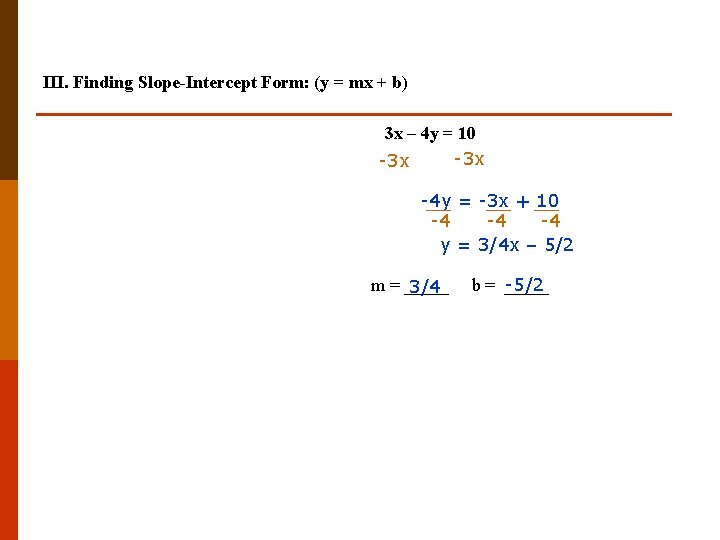
III. Finding Slope-Intercept Form: (y = mx + b) 3 x – 4 y = 10 -3 x -4 y = -3 x + 10 -4 -4 -4 y = 3/4 x – 5/2 m = _____ 3/4 b = _____ -5/2
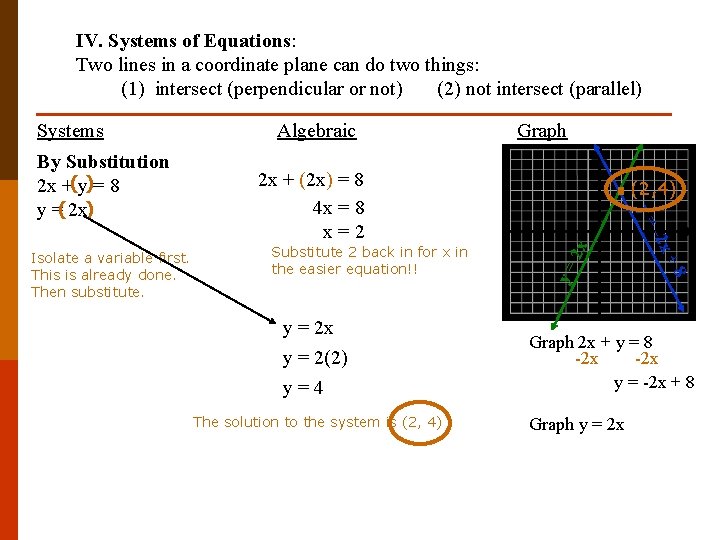
IV. Systems of Equations: Two lines in a coordinate plane can do two things: (1) intersect (perpendicular or not) (2) not intersect (parallel) 2 x + (2 x) = 8 4 x = 8 x=2 y = 2 x y = 2(2) y=4 The solution to the system is (2, 4) 2 x +8 Substitute 2 back in for x in the easier equation!! . -2 x Isolate a variable first. This is already done. Then substitute. Graph y= By Substitution 2 x +(y)= 8 y =( 2 x) Algebraic y= Systems Graph 2 x + y = 8 -2 x y = -2 x + 8 Graph y = 2 x
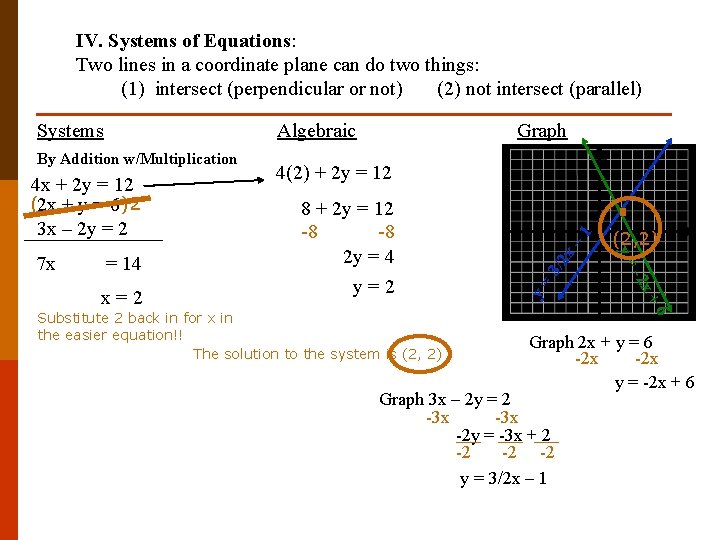
IV. Systems of Equations: Two lines in a coordinate plane can do two things: (1) intersect (perpendicular or not) (2) not intersect (parallel) Algebraic y=2 Substitute 2 back in for x in the easier equation!! The solution to the system is (2, 2) 1 (2, 2) +6 x=2 . -2 x = 14 8 + 2 y = 12 -8 -8 2 y = 4 y= 7 x 4(2) + 2 y = 12 x– 4 x + 2 y = 12 (2 x + y = 6 )2 3 x – 2 y = 2 3/2 By Addition w/Multiplication Graph y= Systems Graph 2 x + y = 6 -2 x y = -2 x + 6 Graph 3 x – 2 y = 2 -3 x -2 y = -3 x + 2 -2 -2 -2 y = 3/2 x – 1
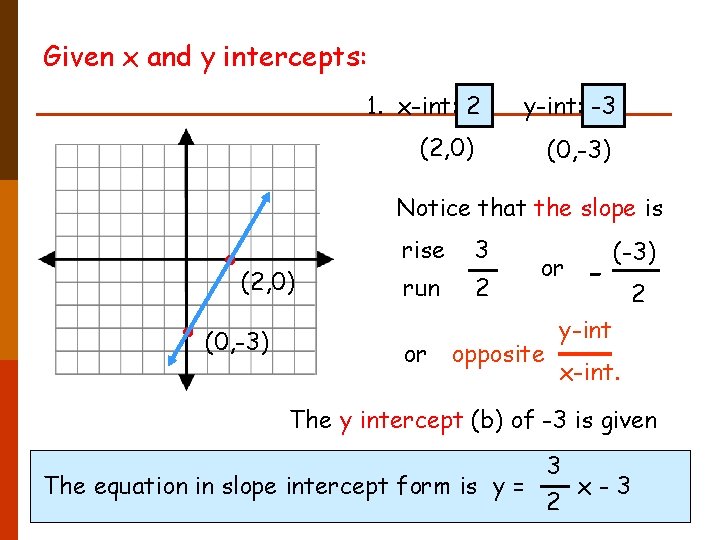
Given x and y intercepts: 1. x-int: 2 y-int: -3 (2, 0) (0, -3) Notice that the slope is ● (2, 0) ● (0, -3) rise 3 run 2 or or opposite - (-3) 2 y-int x-int. The y intercept (b) of -3 is given 3 The equation in slope intercept form is y = x-3 2
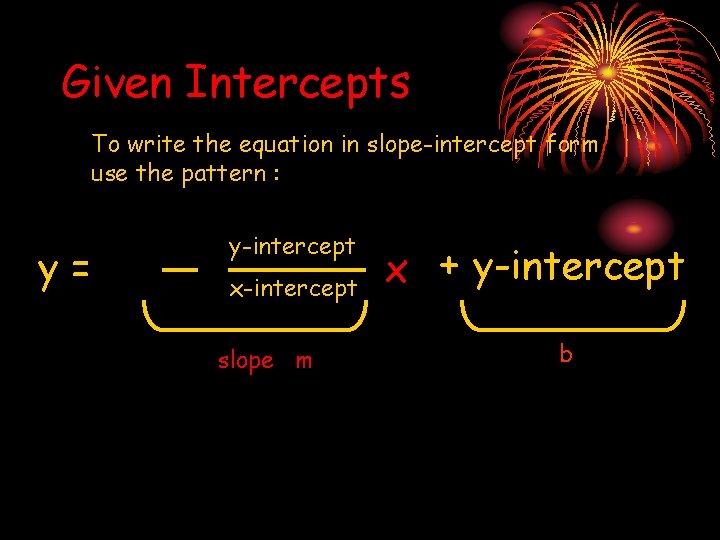
Given Intercepts To write the equation in slope-intercept form use the pattern : y= y-intercept x-intercept slope m x + y-intercept b
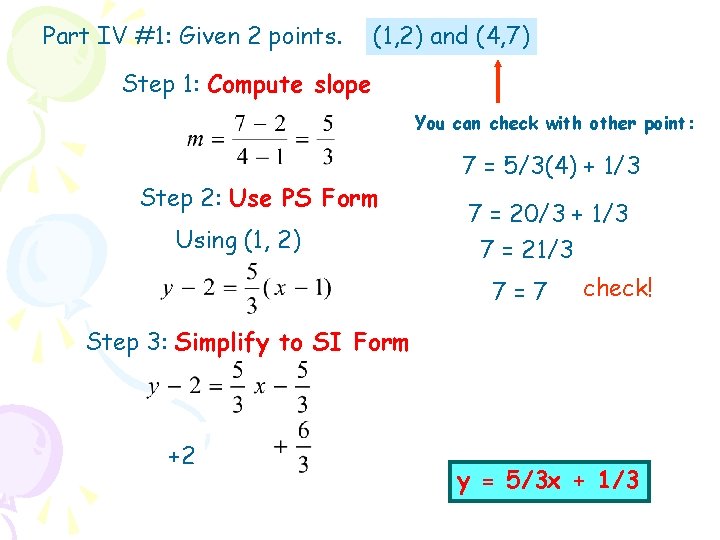
Part IV #1: Given 2 points. (1, 2) and (4, 7) Step 1: Compute slope You can check with other point: Step 2: Use PS Form Using (1, 2) 7 = 5/3(4) + 1/3 7 = 20/3 + 1/3 7 = 21/3 7=7 check! Step 3: Simplify to SI Form +2 y = 5/3 x + 1/3
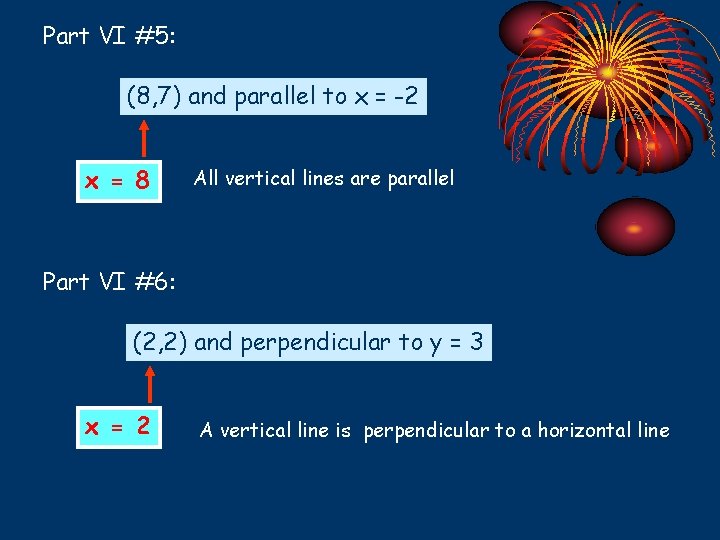
Part VI #5: (8, 7) and parallel to x = -2 x = 8 All vertical lines are parallel Part VI #6: (2, 2) and perpendicular to y = 3 x = 2 A vertical line is perpendicular to a horizontal line
• Chapter 13 WS • How can you get 100% on your final? Congrats two are locale speling be champien! http: //abclocal. go. com/kgo/story? section=education&id=5360989
- Slides: 20