
Geometry 6 3 Indirect Proof Indirect Proofs Up
- Slides: 14
Geometry 6. 3 Indirect Proof
Indirect Proofs Up to this point, we have been proving a statement true by direct proofs. n Sometimes direct proofs are difficult and we can instead prove a statement indirectly, which is very common in everyday logical thinking. n
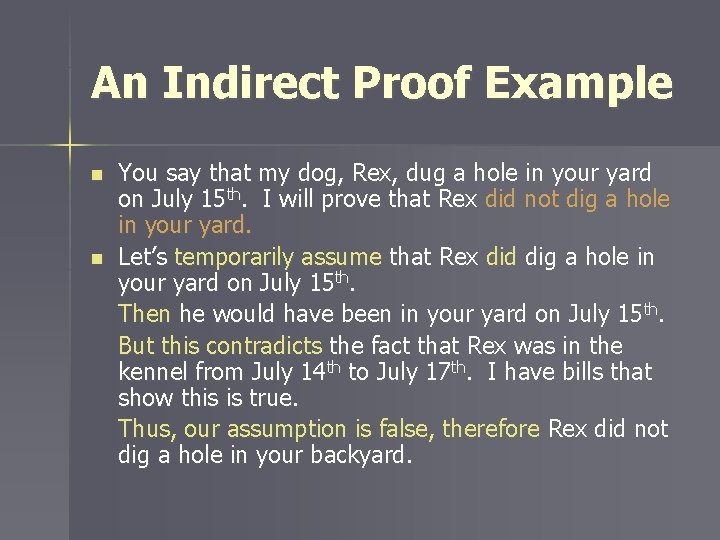
An Indirect Proof Example n n You say that my dog, Rex, dug a hole in your yard on July 15 th. I will prove that Rex did not dig a hole in your yard. Let’s temporarily assume that Rex did dig a hole in your yard on July 15 th. Then he would have been in your yard on July 15 th. But this contradicts the fact that Rex was in the kennel from July 14 th to July 17 th. I have bills that show this is true. Thus, our assumption is false, therefore Rex did not dig a hole in your backyard.
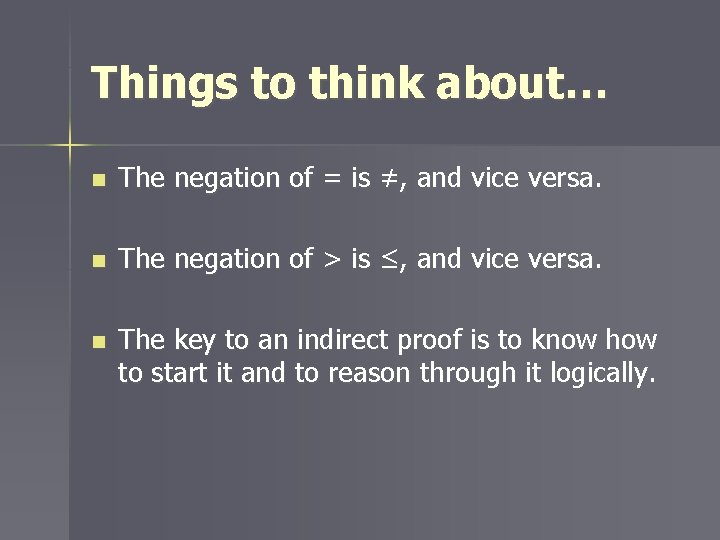
Things to think about… n The negation of = is ≠, and vice versa. n The negation of > is ≤, and vice versa. n The key to an indirect proof is to know how to start it and to reason through it logically.
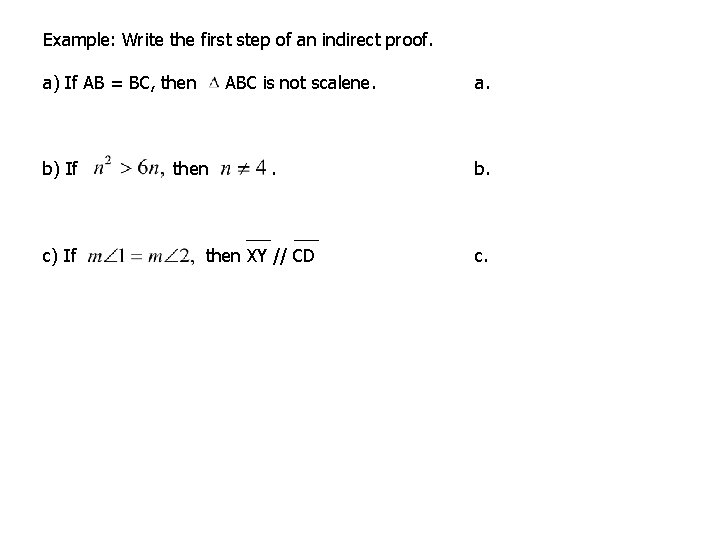
Example: Write the first step of an indirect proof. a) If AB = BC, then b) If c) If ABC is not scalene. then XY // CD a. b. c.
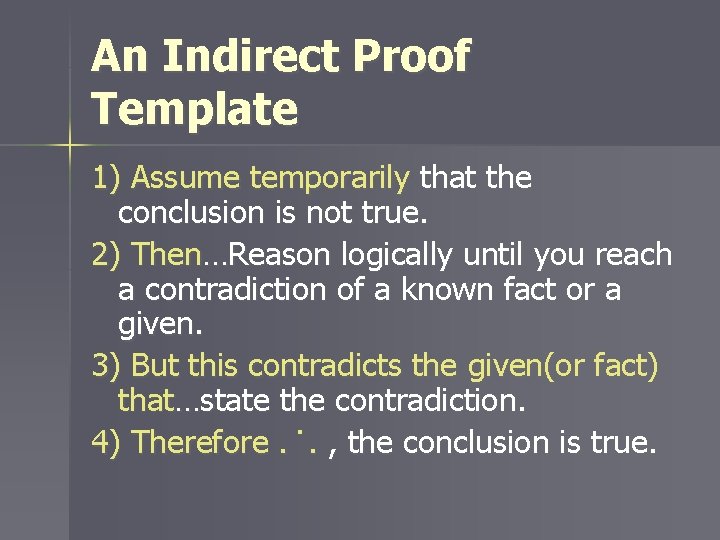
An Indirect Proof Template 1) Assume temporarily that the conclusion is not true. 2) Then…Reason logically until you reach a contradiction of a known fact or a given. 3) But this contradicts the given(or fact) that…state the contradiction. . 4) Therefore. . , the conclusion is true.
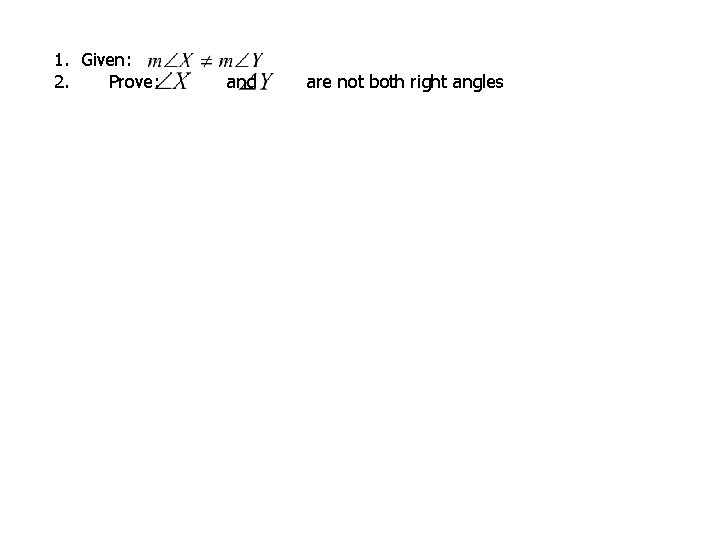
1. Given: 2. Prove: and are not both right angles
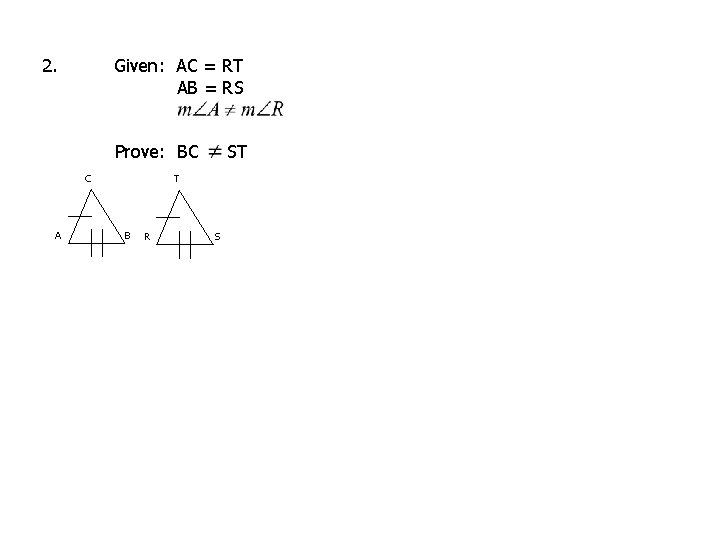
2. Given: AC = RT AB = RS Prove: BC T C A ST B R S
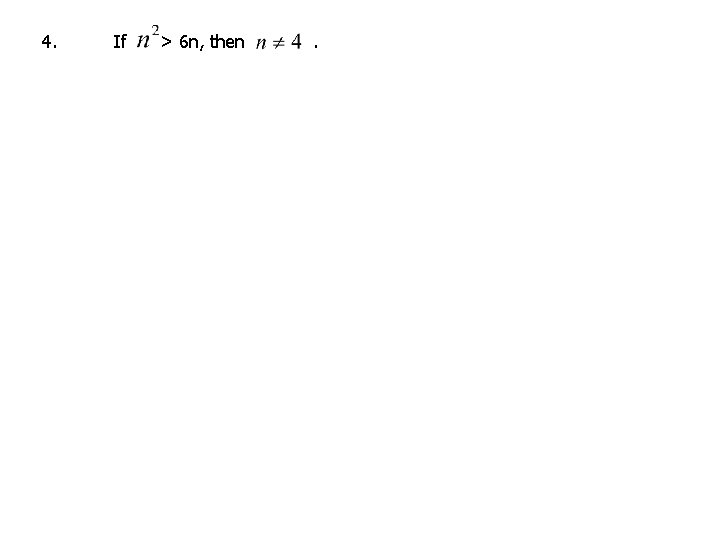
4. If > 6 n, then .
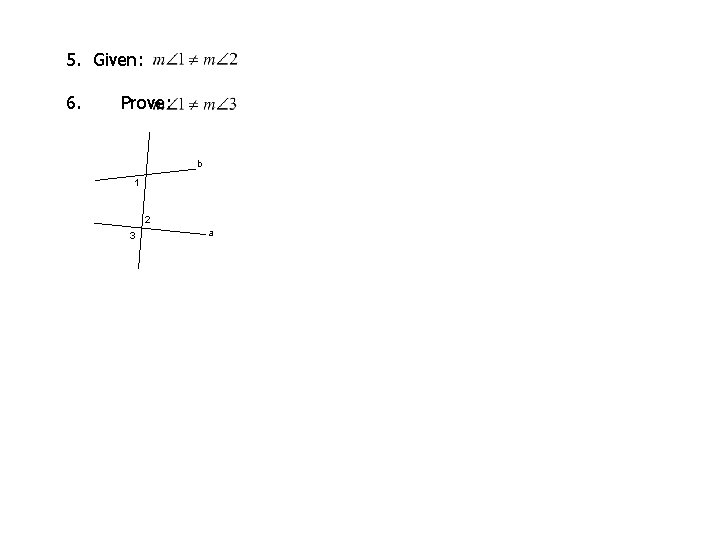
5. Given: 6. Prove: b 1 2 3 a
HW n P. 215 -216 CE 1 -10, WE 1 -10, 14
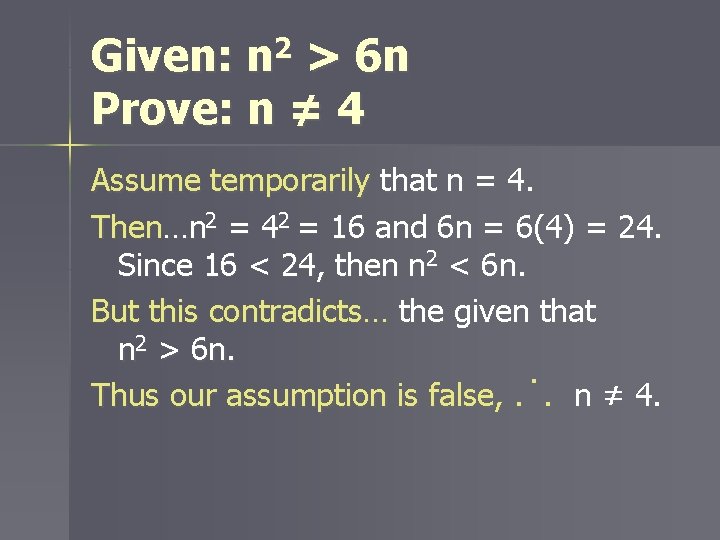
Given: n 2 > 6 n Prove: n ≠ 4 Assume temporarily that n = 4. Then…n 2 = 42 = 16 and 6 n = 6(4) = 24. Since 16 < 24, then n 2 < 6 n. But this contradicts… the given that n 2 > 6 n. . Thus our assumption is false, . . n ≠ 4.
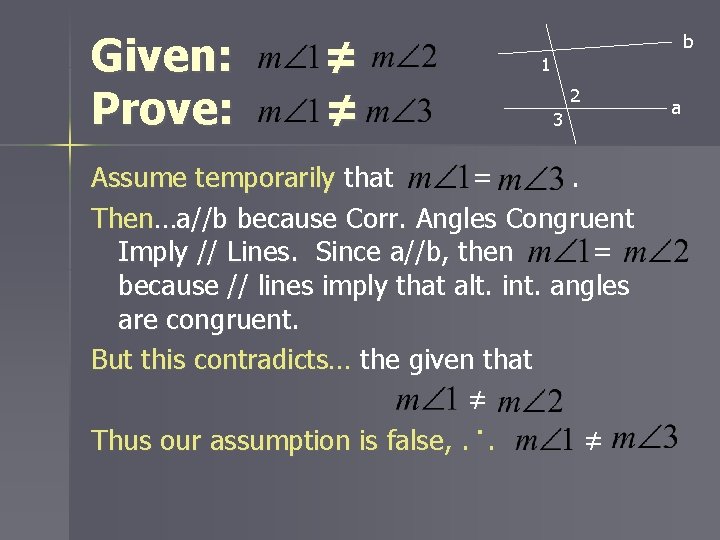
Given: Prove: ≠ ≠ b 1 2 3 Assume temporarily that =. Then…a//b because Corr. Angles Congruent Imply // Lines. Since a//b, then = because // lines imply that alt. int. angles are congruent. But this contradicts… the given that ≠. Thus our assumption is false, . . ≠ a
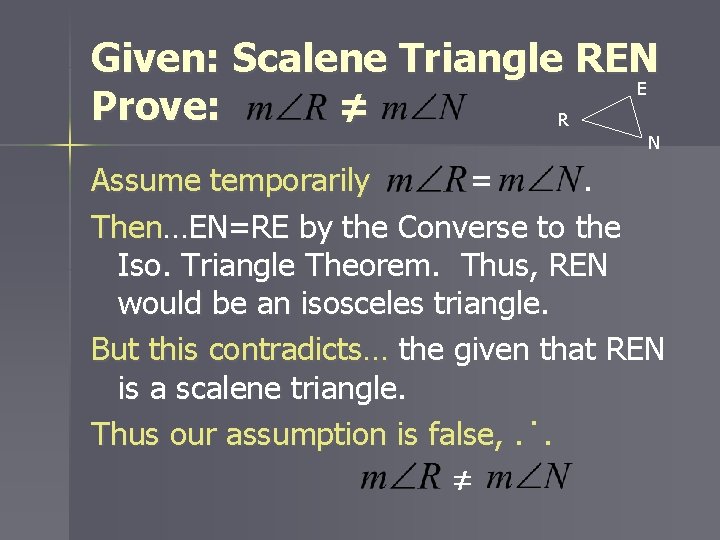
Given: Scalene Triangle REN E Prove: ≠ R N Assume temporarily =. Then…EN=RE by the Converse to the Iso. Triangle Theorem. Thus, REN would be an isosceles triangle. But this contradicts… the given that REN is a scalene triangle. . Thus our assumption is false, . . ≠