
Geometric Transformations Translation slide Reflection flip mirror Rotation
- Slides: 33
Geometric Transformations: Translation: slide Reflection: flip (mirror) Rotation: turn Dialation: enlarge or reduce
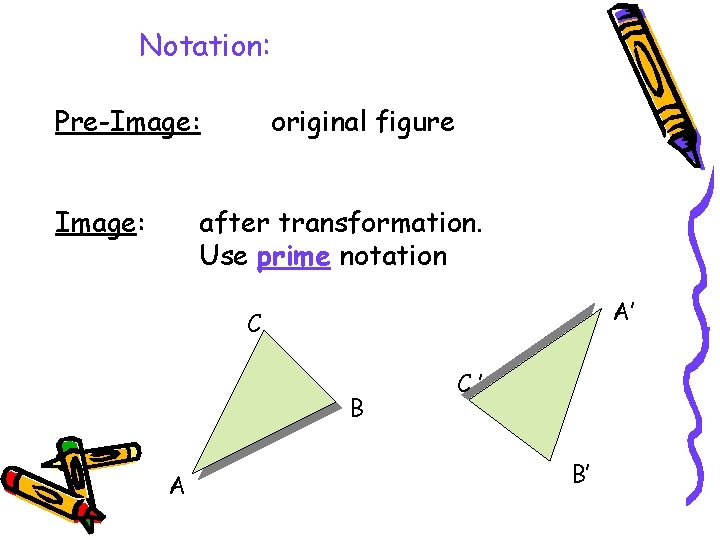
Notation: Pre-Image: original figure after transformation. Use prime notation A’ C B A C’ B’
Isometry AKA: congruence transformation a transformation in which an original figure and its image are congruent.
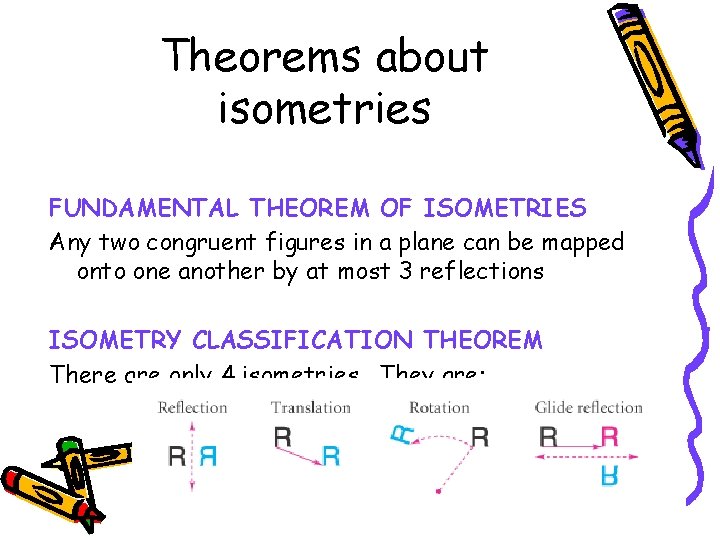
Theorems about isometries FUNDAMENTAL THEOREM OF ISOMETRIES Any two congruent figures in a plane can be mapped onto one another by at most 3 reflections ISOMETRY CLASSIFICATION THEOREM There are only 4 isometries. They are:
TRANSLATION: moves all points in a plane a given direction a fixed distance
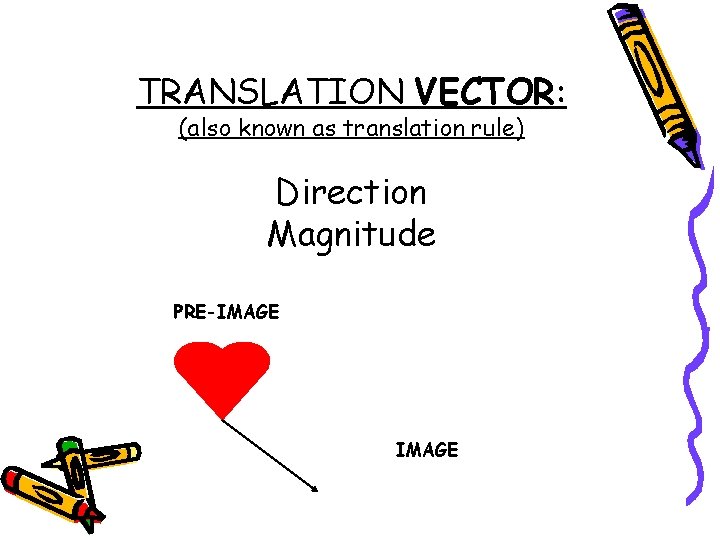
TRANSLATION VECTOR: (also known as translation rule) Direction Magnitude PRE-IMAGE
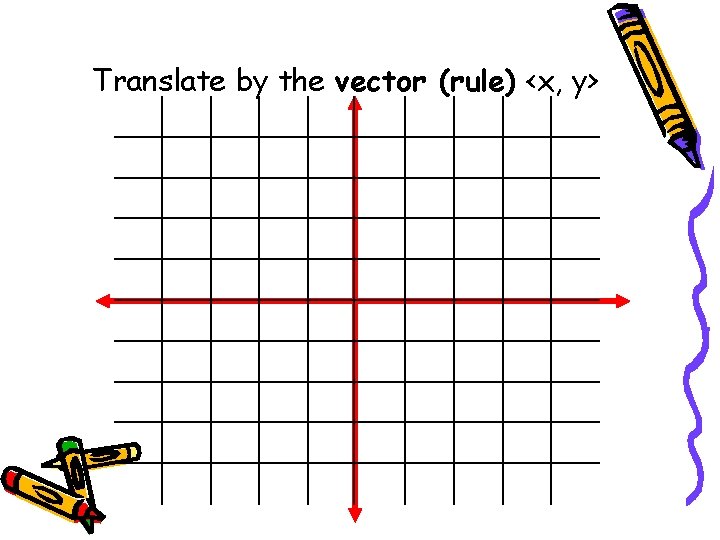
Translate by the vector (rule) <x, y>
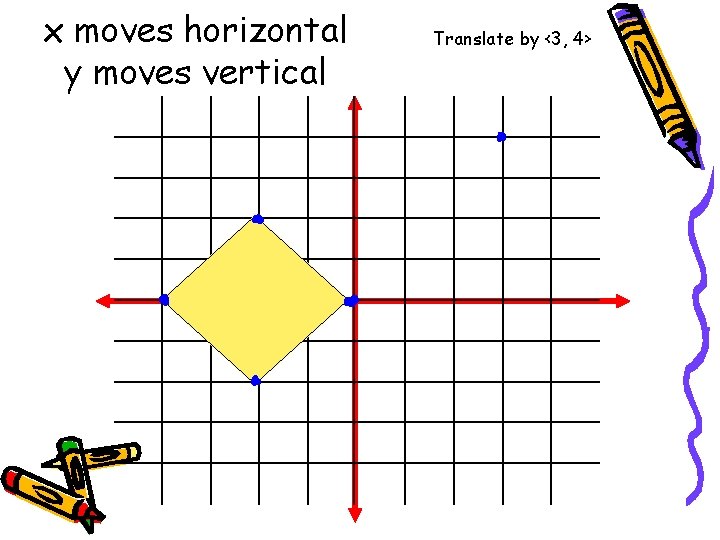
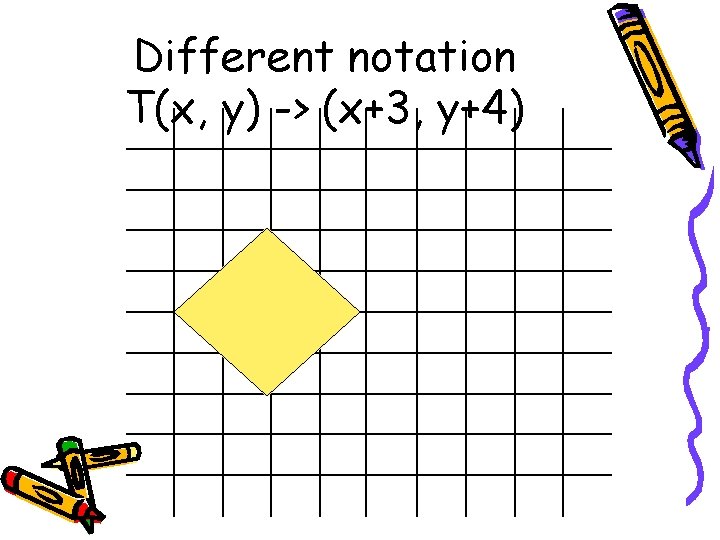
x moves horizontal y moves vertical Translate by <3, 4>
Different notation T(x, y) -> (x+3, y+4)
Translations PRESERVE: Size Shape Orientation
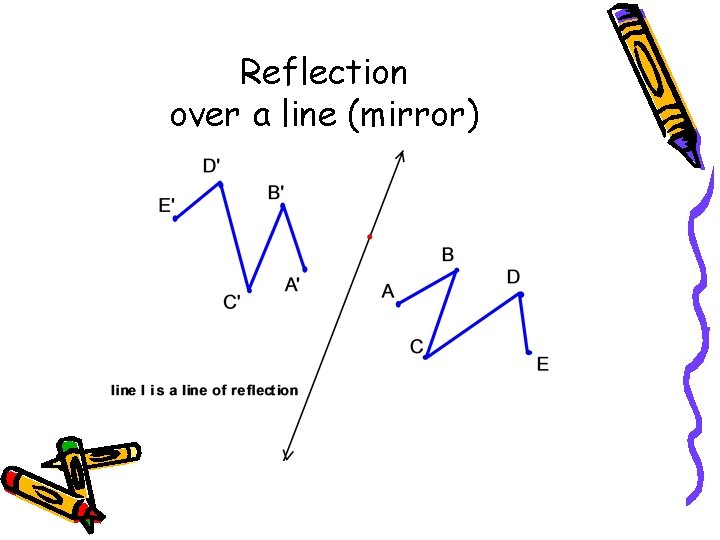
Reflection over a line (mirror)
Properties of reflections PRESERVE • Size (area, length, perimeter…) • Shape CHANGE orientation (flipped)
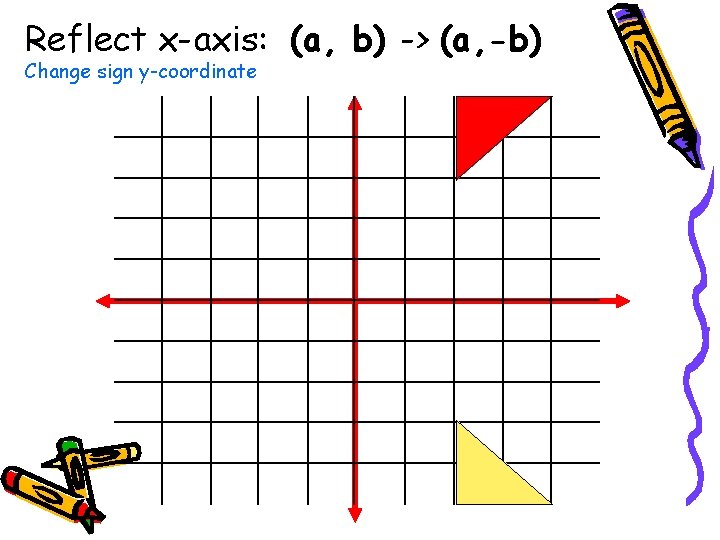
Reflect x-axis: (a, b) -> (a, -b) Change sign y-coordinate
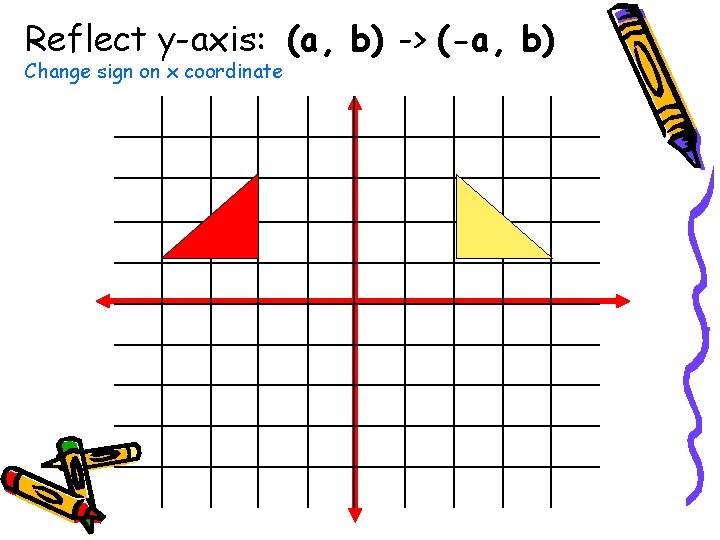
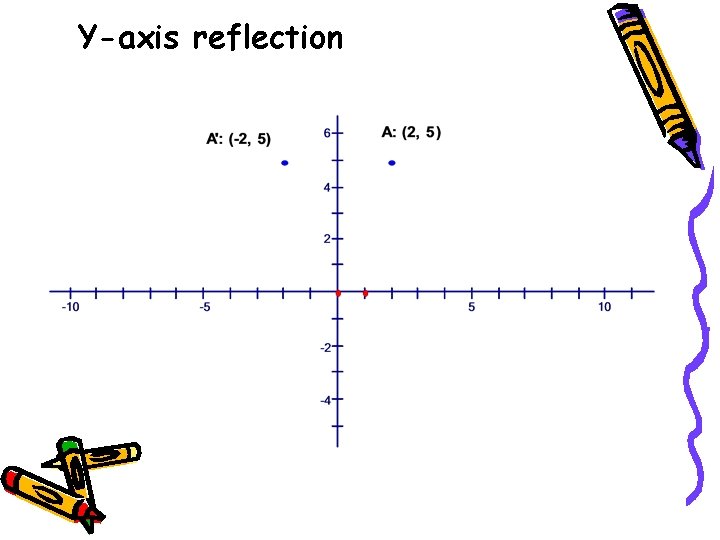
Reflect y-axis: (a, b) -> (-a, b) Change sign on x coordinate
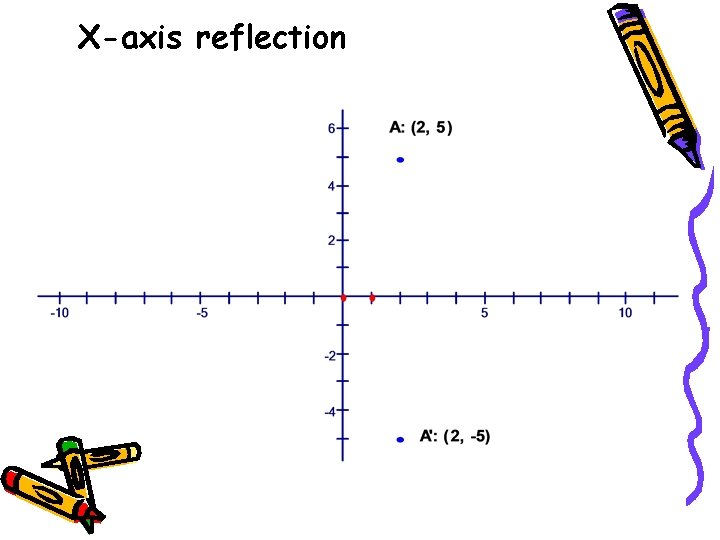
X-axis reflection
Y-axis reflection
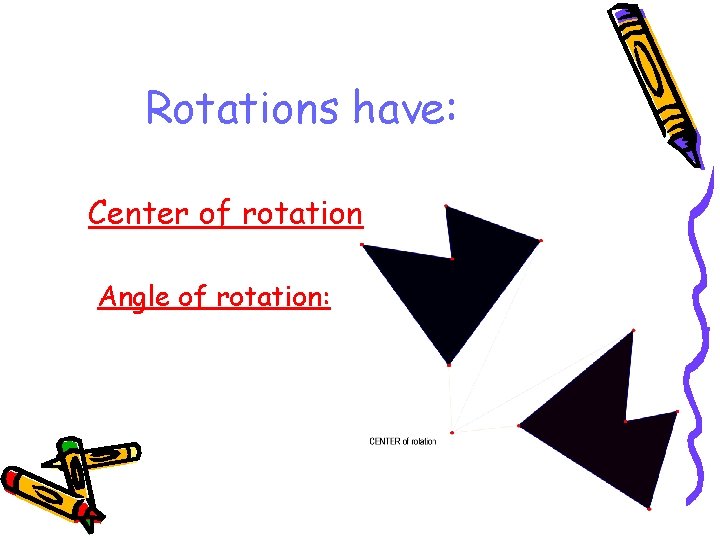
Rotations have: Center of rotation Angle of rotation:
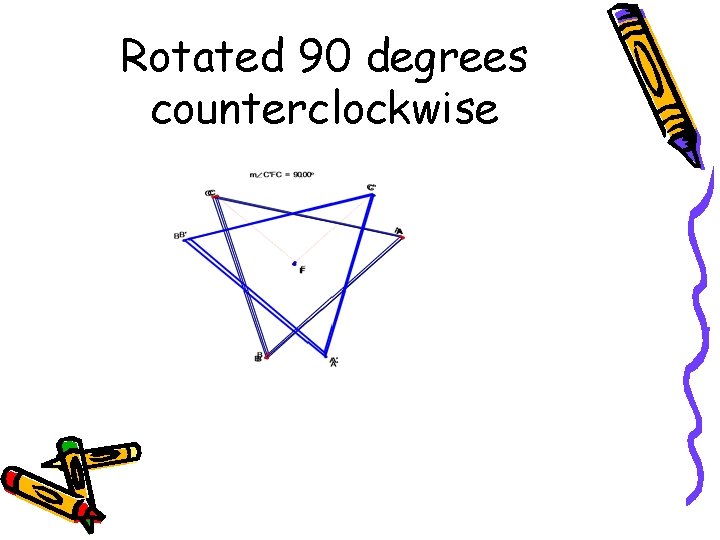
Rotated 90 degrees counterclockwise
ROTATIONS PRESERVE SIZE – – Length of sides Measure of angles Area Perimeter SHAPE ORIENTATION
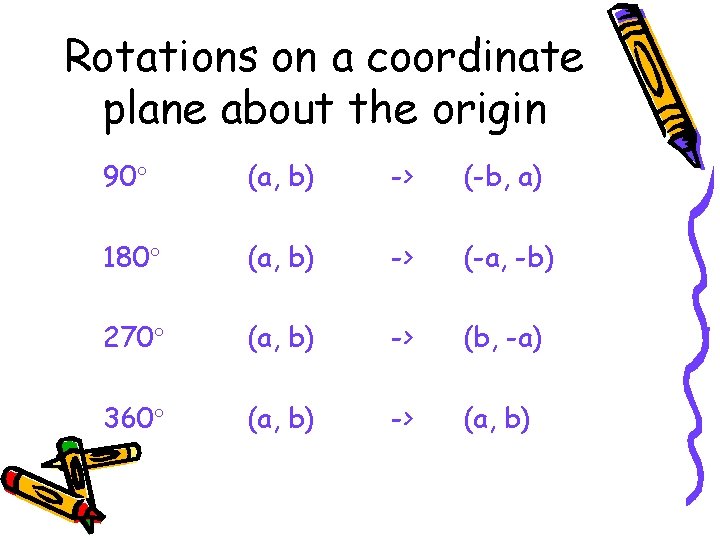
Rotations on a coordinate plane about the origin 90 (a, b) -> (-b, a) 180 (a, b) -> (-a, -b) 270 (a, b) -> (b, -a) 360 (a, b) -> (a, b)
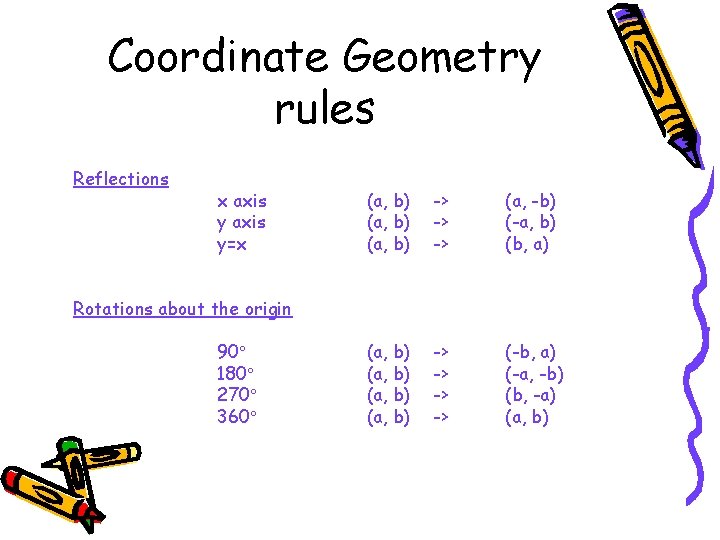
Coordinate Geometry rules Reflections x axis y=x (a, b) -> -> -> (a, -b) (-a, b) (b, a) (a, b) -> -> (-b, a) (-a, -b) (b, -a) (a, b) Rotations about the origin 90 180 270 360
GLIDE REFLECTIONS You can combine different Geometric Transformations…
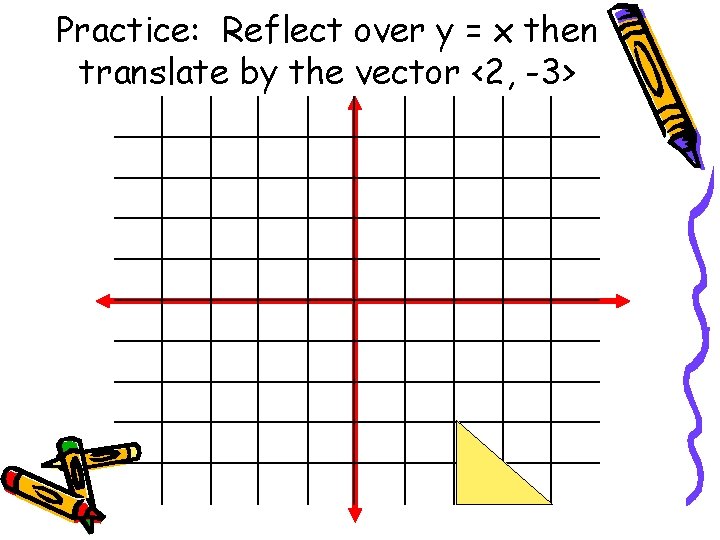
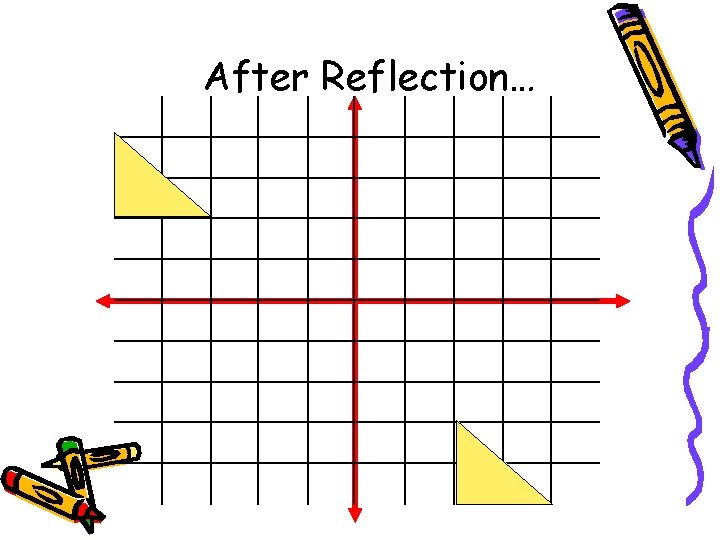
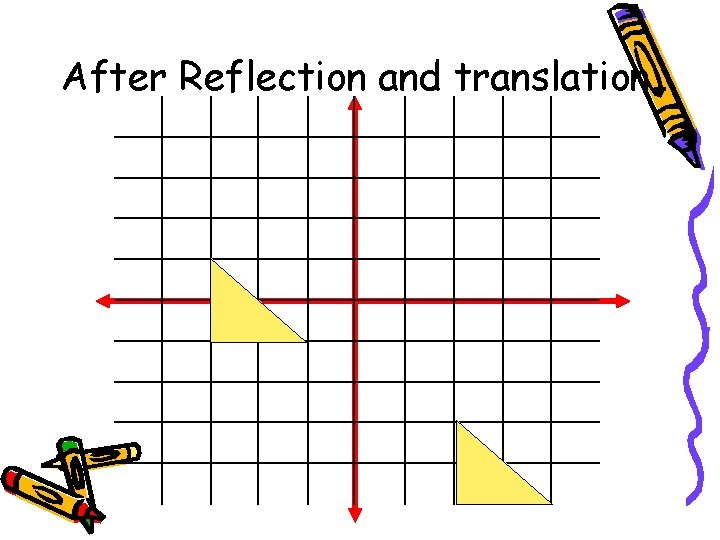
Practice: Reflect over y = x then translate by the vector <2, -3>
After Reflection…
After Reflection and translation…
Symmetry Line Symmetry If a figure can be reflected onto itself over a line. Rotational Symmetry If a figure can be rotated about some point onto itself through a rotation between 0 and 360 degrees
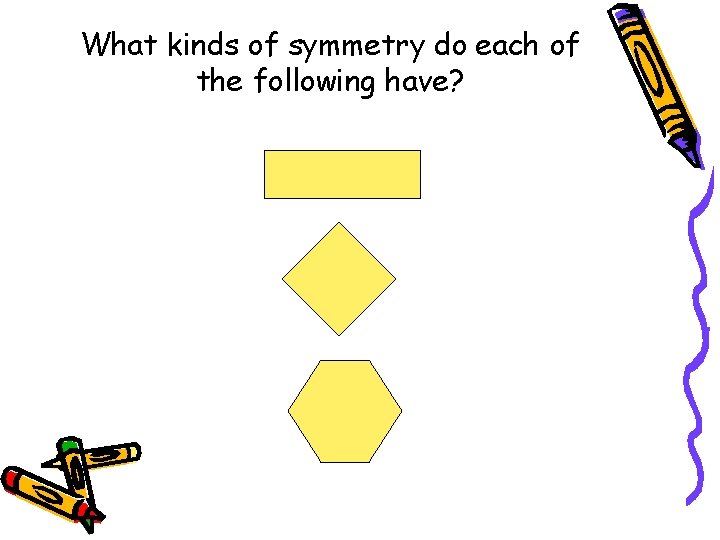
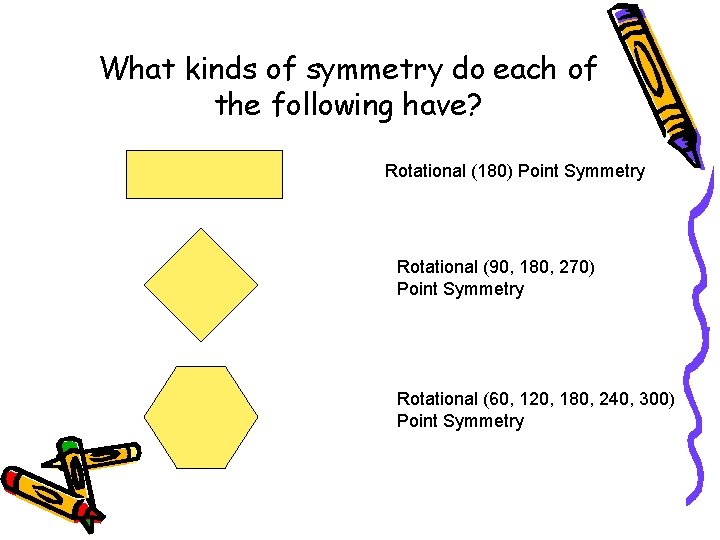
What kinds of symmetry do each of the following have?
What kinds of symmetry do each of the following have? Rotational (180) Point Symmetry Rotational (90, 180, 270) Point Symmetry Rotational (60, 120, 180, 240, 300) Point Symmetry
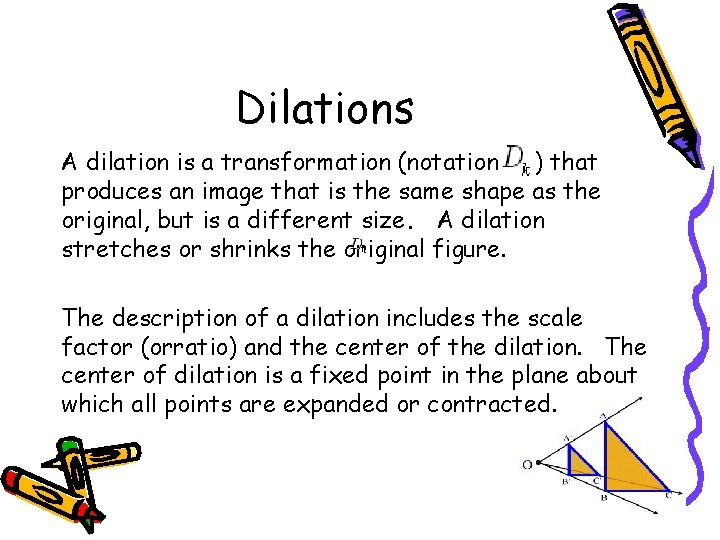
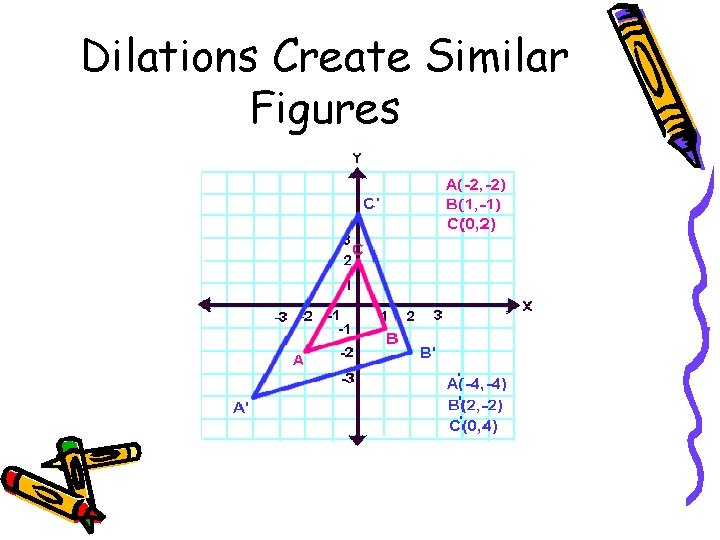
Dilations A dilation is a transformation (notation ) that produces an image that is the same shape as the original, but is a different size. A dilation stretches or shrinks the original figure. The description of a dilation includes the scale factor (orratio) and the center of the dilation. The center of dilation is a fixed point in the plane about which all points are expanded or contracted.
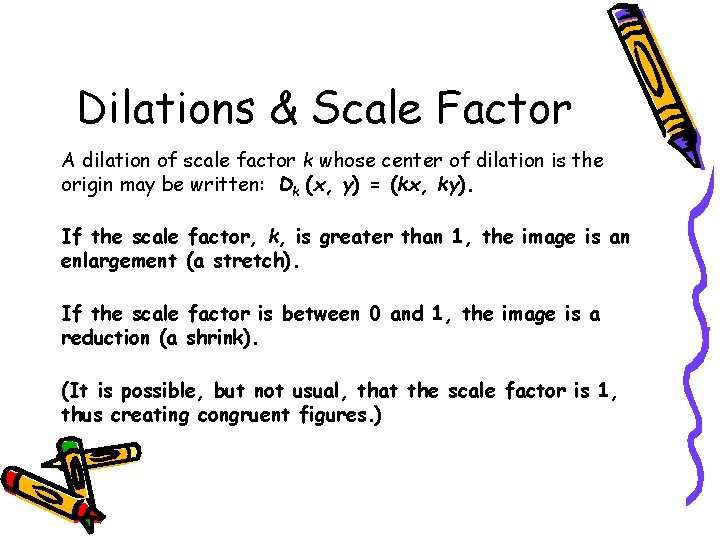
Dilations & Scale Factor A dilation of scale factor k whose center of dilation is the origin may be written: Dk (x, y) = (kx, ky). If the scale factor, k, is greater than 1, the image is an enlargement (a stretch). If the scale factor is between 0 and 1, the image is a reduction (a shrink). (It is possible, but not usual, that the scale factor is 1, thus creating congruent figures. )
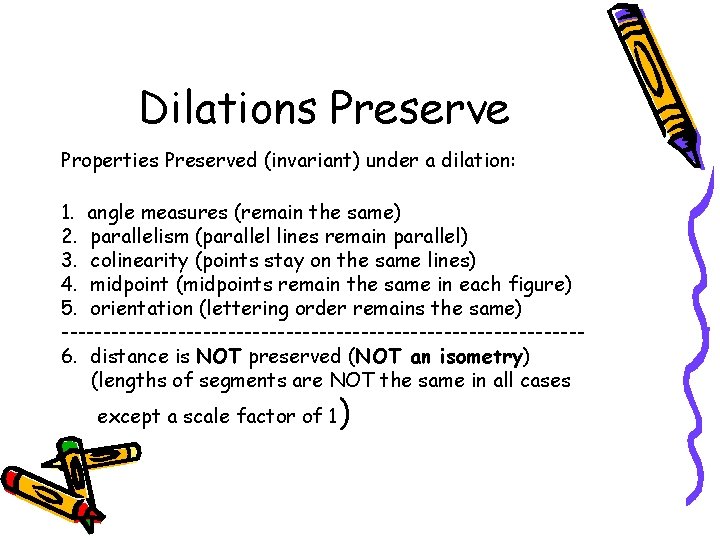
Dilations Preserve Properties Preserved (invariant) under a dilation: 1. angle measures (remain the same) 2. parallelism (parallel lines remain parallel) 3. colinearity (points stay on the same lines) 4. midpoint (midpoints remain the same in each figure) 5. orientation (lettering order remains the same) -------------------------------6. distance is NOT preserved (NOT an isometry) (lengths of segments are NOT the same in all cases except a scale factor of 1 )
Dilations Create Similar Figures