
Geometric Transformations Jehee Lee Seoul National University Transformations
- Slides: 51
Geometric Transformations Jehee Lee Seoul National University
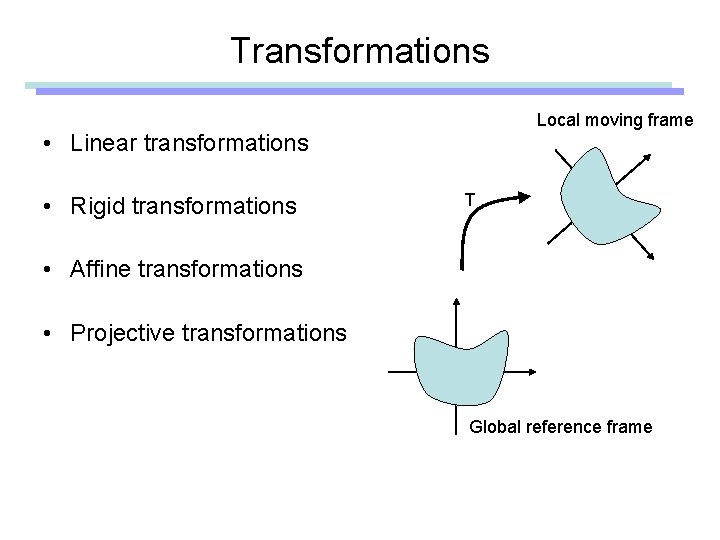
Transformations Local moving frame • Linear transformations • Rigid transformations T • Affine transformations • Projective transformations Global reference frame
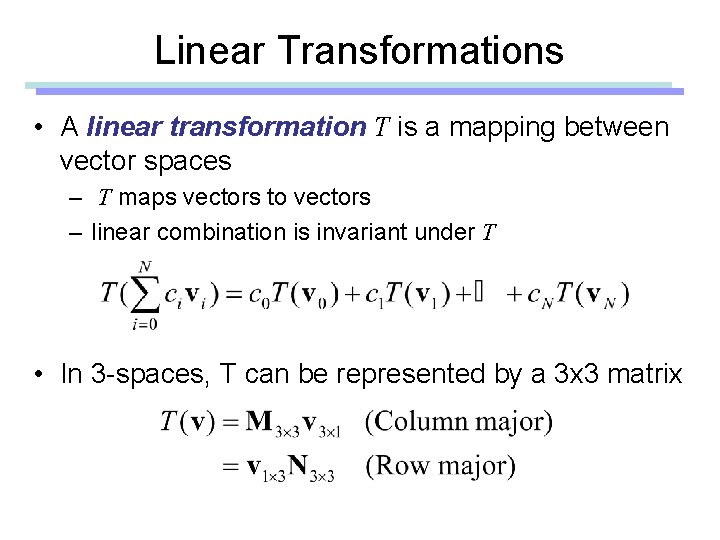
Linear Transformations • A linear transformation T is a mapping between vector spaces – T maps vectors to vectors – linear combination is invariant under T • In 3 -spaces, T can be represented by a 3 x 3 matrix
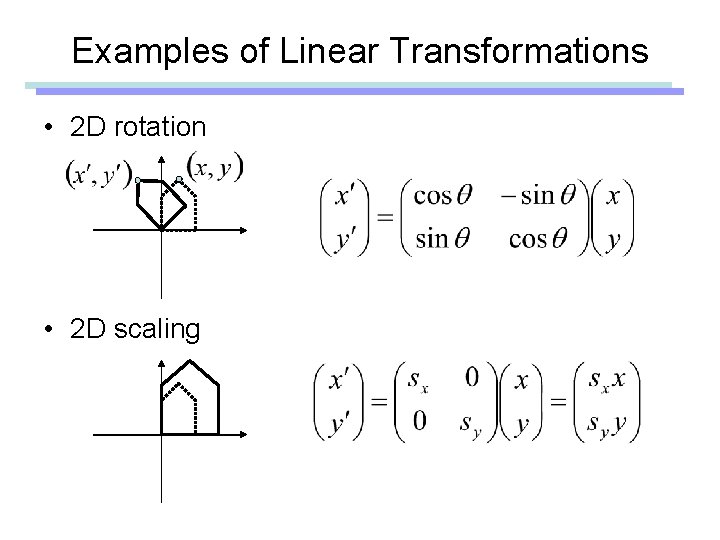
Examples of Linear Transformations • 2 D rotation • 2 D scaling
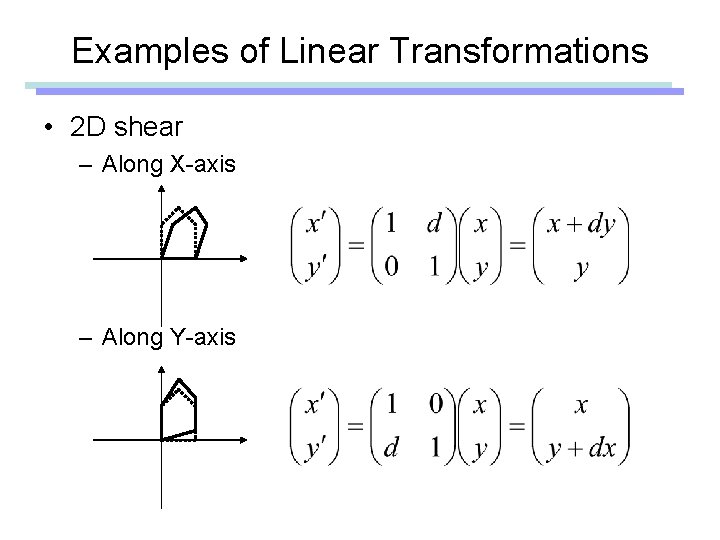
Examples of Linear Transformations • 2 D shear – Along X-axis – Along Y-axis
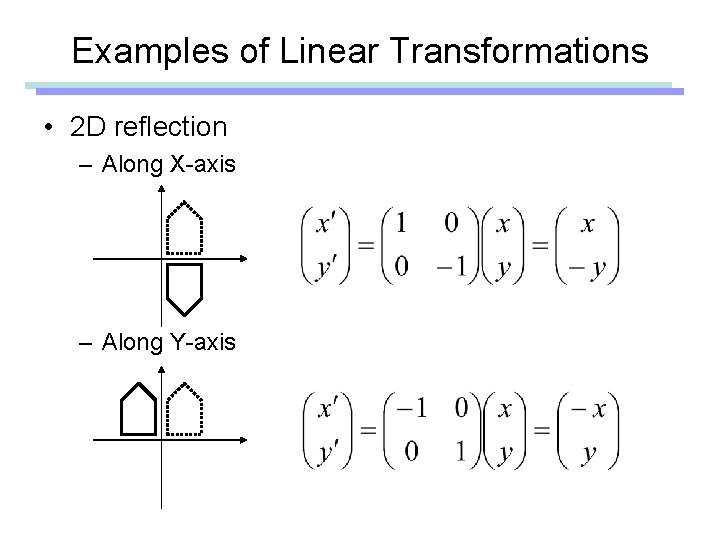
Examples of Linear Transformations • 2 D reflection – Along X-axis – Along Y-axis
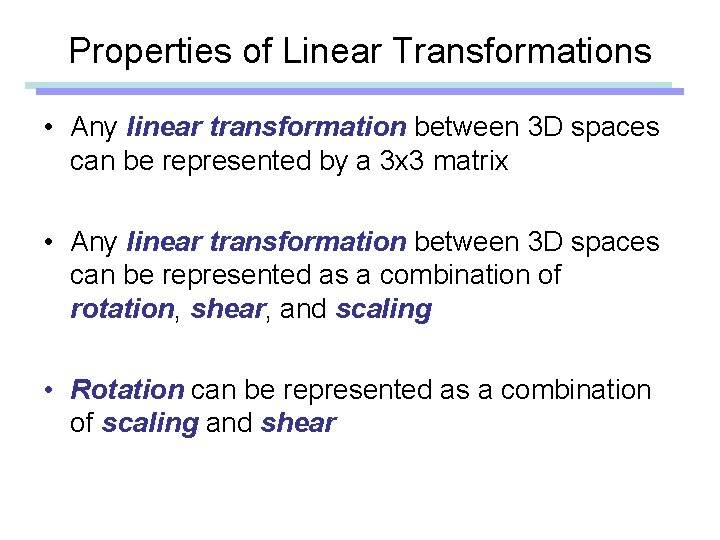
Properties of Linear Transformations • Any linear transformation between 3 D spaces can be represented by a 3 x 3 matrix • Any linear transformation between 3 D spaces can be represented as a combination of rotation, shear, and scaling • Rotation can be represented as a combination of scaling and shear
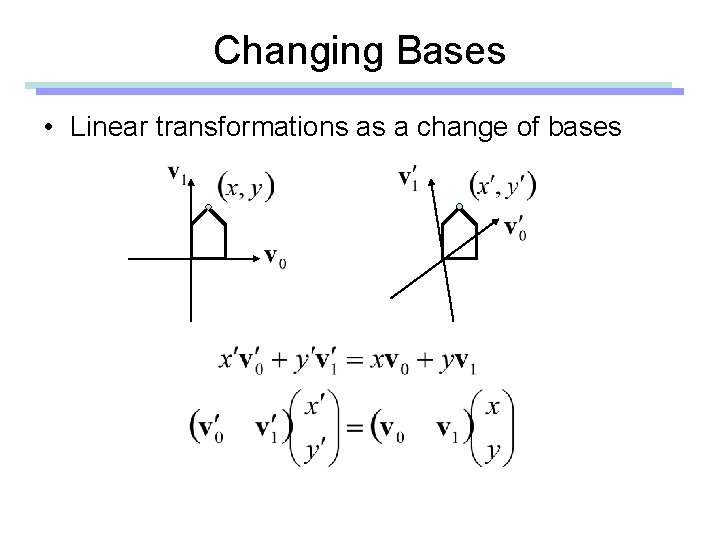
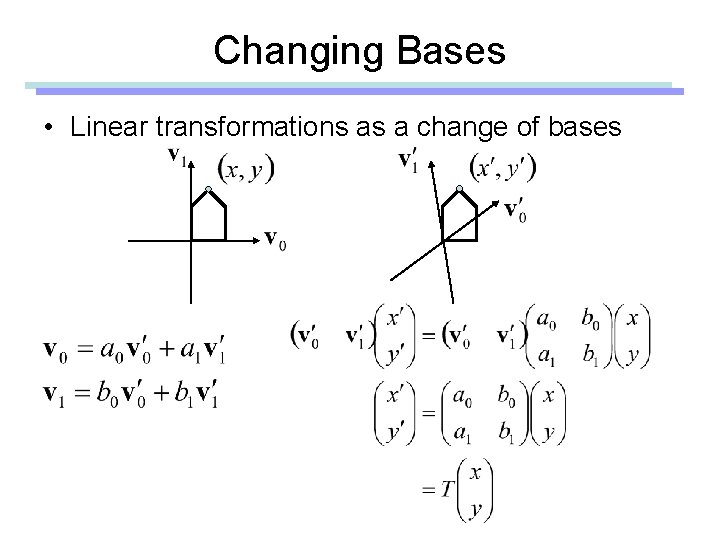
Changing Bases • Linear transformations as a change of bases
Changing Bases • Linear transformations as a change of bases
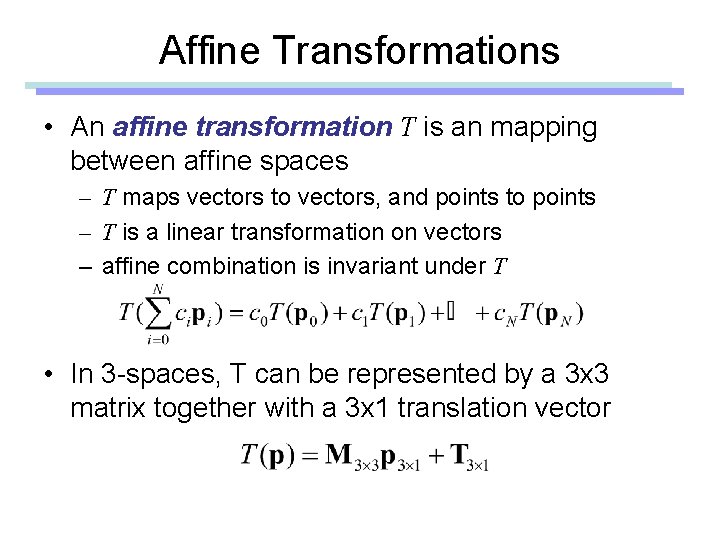
Affine Transformations • An affine transformation T is an mapping between affine spaces – T maps vectors to vectors, and points to points – T is a linear transformation on vectors – affine combination is invariant under T • In 3 -spaces, T can be represented by a 3 x 3 matrix together with a 3 x 1 translation vector
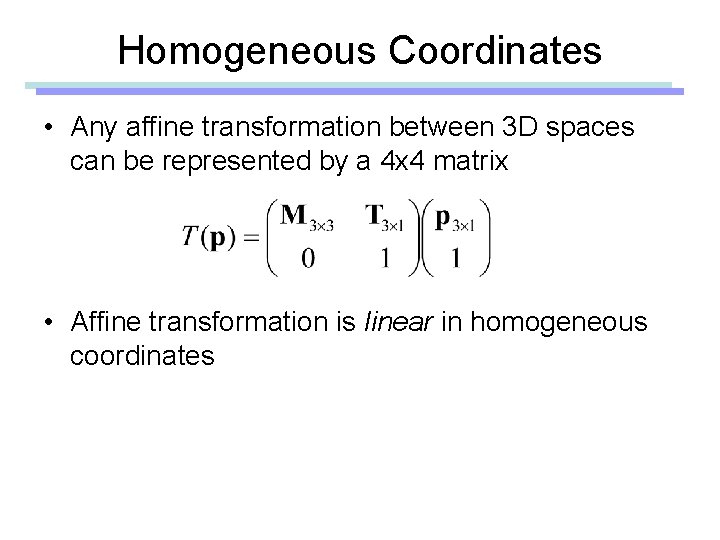
Homogeneous Coordinates • Any affine transformation between 3 D spaces can be represented by a 4 x 4 matrix • Affine transformation is linear in homogeneous coordinates
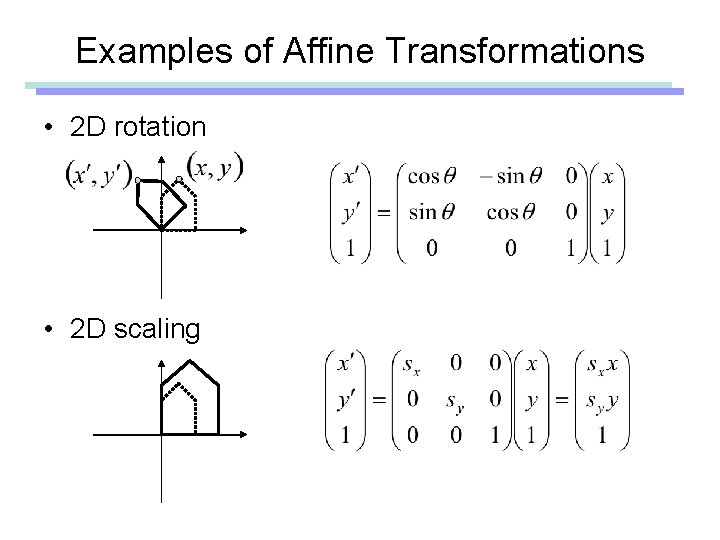
Examples of Affine Transformations • 2 D rotation • 2 D scaling
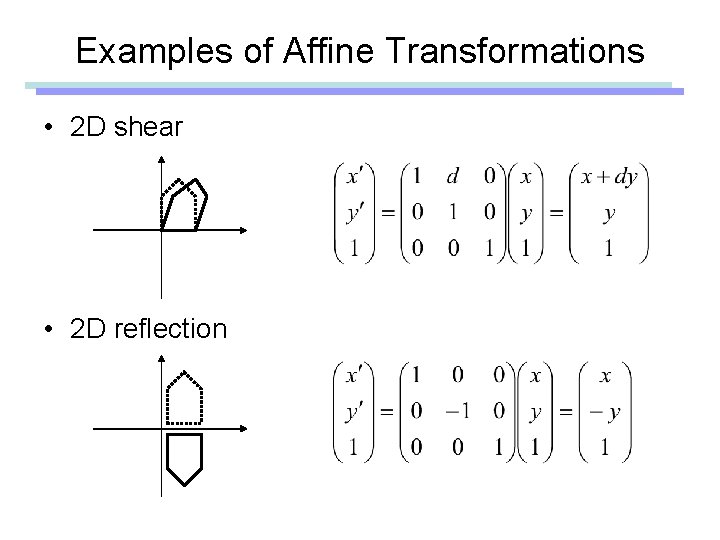
Examples of Affine Transformations • 2 D shear • 2 D reflection
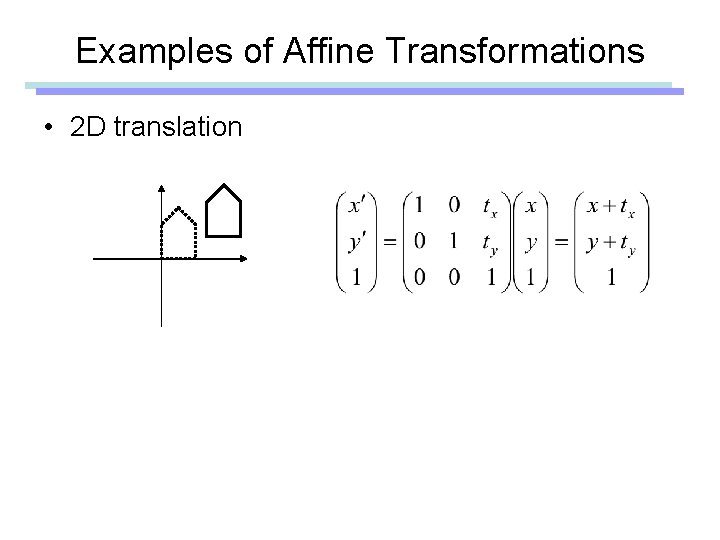
Examples of Affine Transformations • 2 D translation
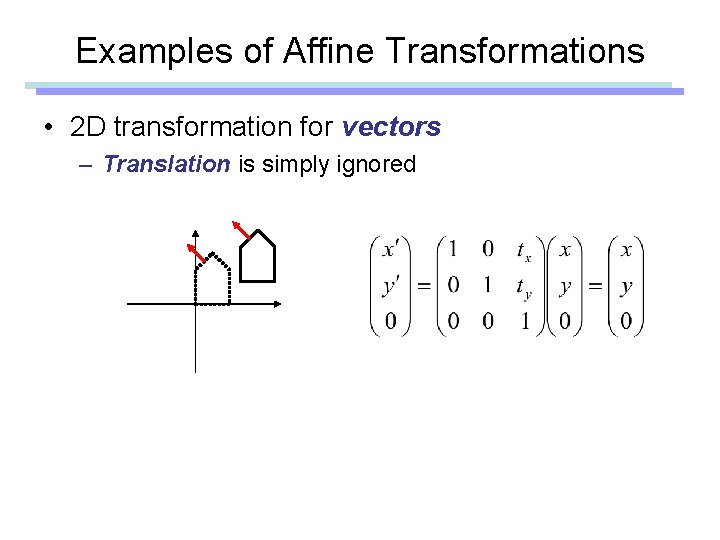
Examples of Affine Transformations • 2 D transformation for vectors – Translation is simply ignored
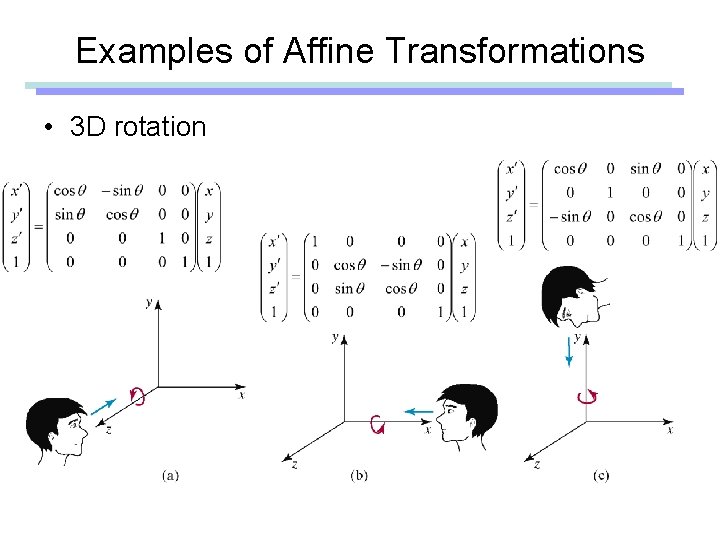
Examples of Affine Transformations • 3 D rotation
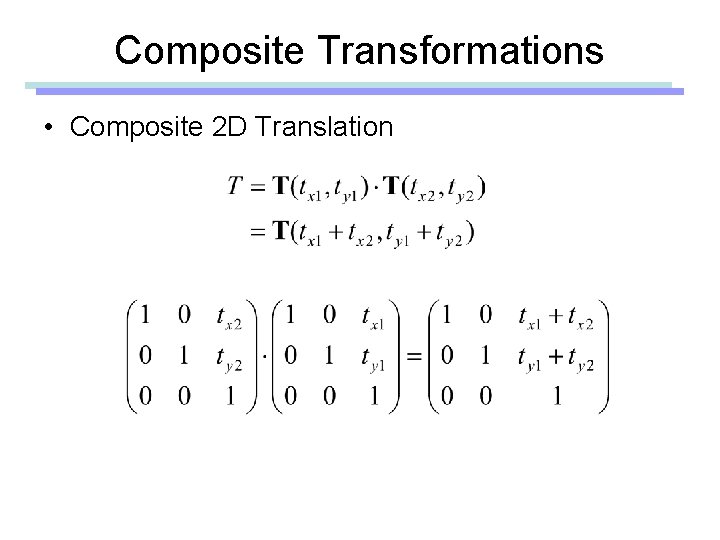
Composite Transformations • Composite 2 D Translation
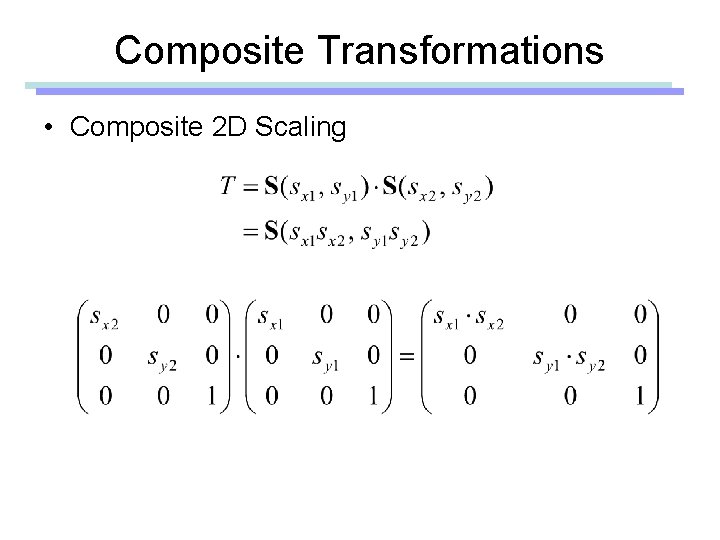
Composite Transformations • Composite 2 D Scaling
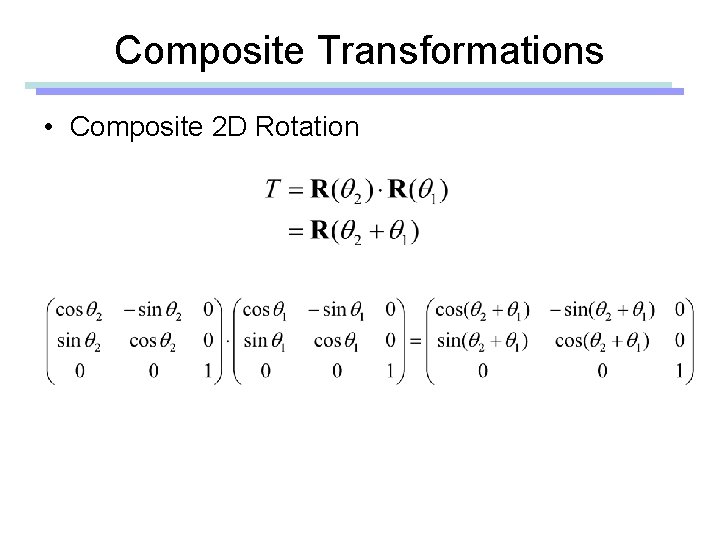
Composite Transformations • Composite 2 D Rotation
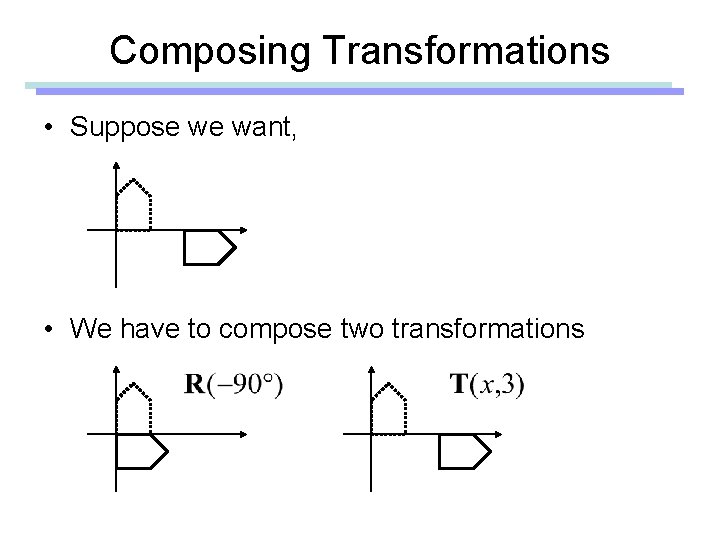
Composing Transformations • Suppose we want, • We have to compose two transformations
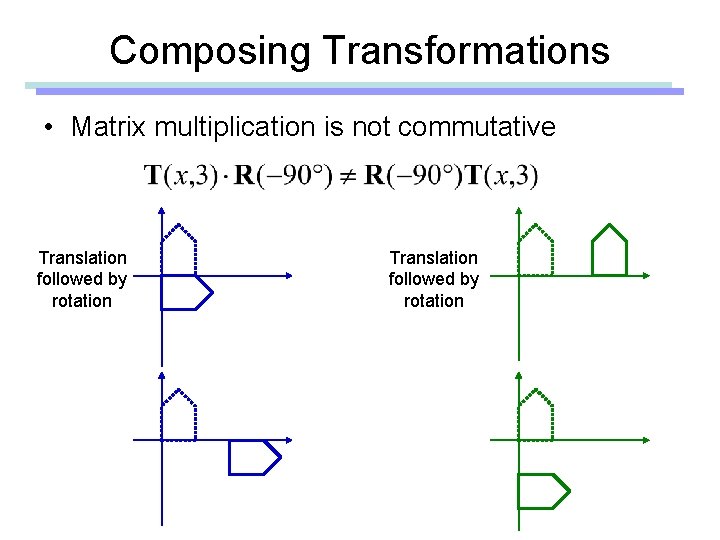
Composing Transformations • Matrix multiplication is not commutative Translation followed by rotation
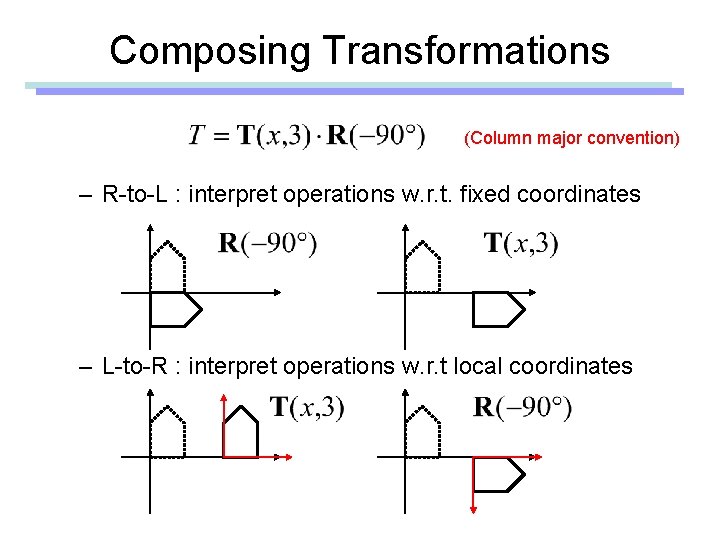
Composing Transformations (Column major convention) – R-to-L : interpret operations w. r. t. fixed coordinates – L-to-R : interpret operations w. r. t local coordinates
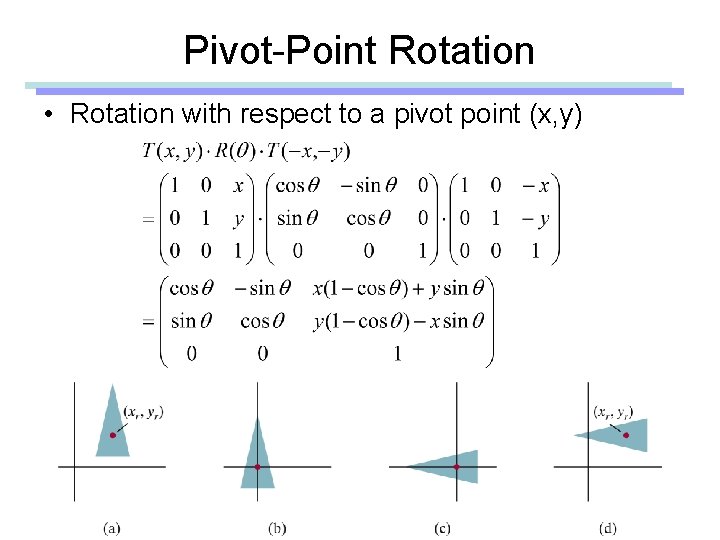
Pivot-Point Rotation • Rotation with respect to a pivot point (x, y)
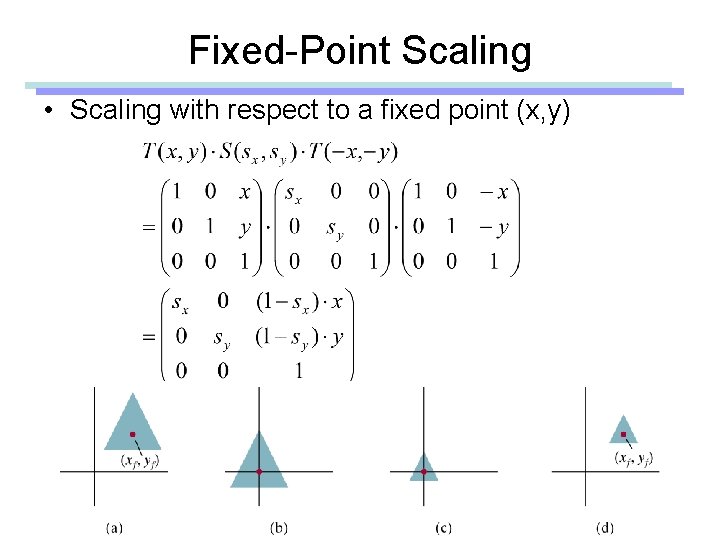
Fixed-Point Scaling • Scaling with respect to a fixed point (x, y)
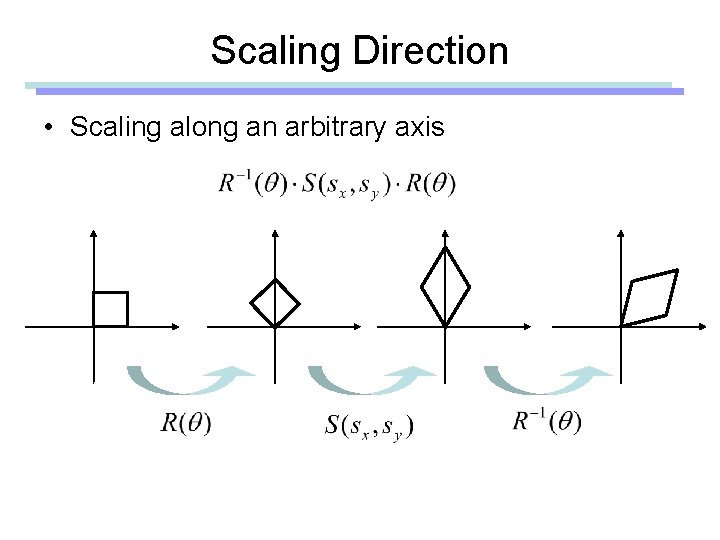
Scaling Direction • Scaling along an arbitrary axis
Properties of Affine Transformations • Any affine transformation between 3 D spaces can be represented as a combination of a linear transformation followed by translation • An affine transf. maps lines to lines • An affine transf. maps parallel lines to parallel lines • An affine transf. preserves ratios of distance along a line • An affine transf. does not preserve absolute distances and angles
Review of Affine Frames • A frame is defined as a set of vectors {vi | i=1, …, N} and a point o – Set of vectors {vi} are bases of the associate vector space – o is an origin of the frame – N is the dimension of the affine space – Any point p can be written as – Any vector v can be written as
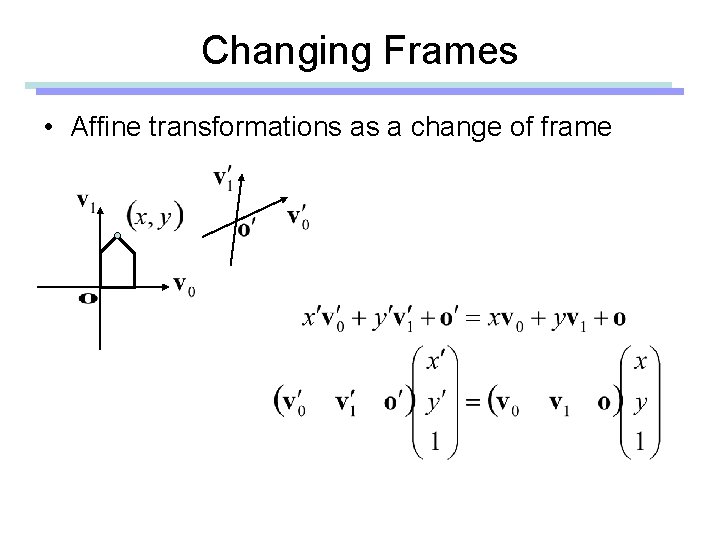
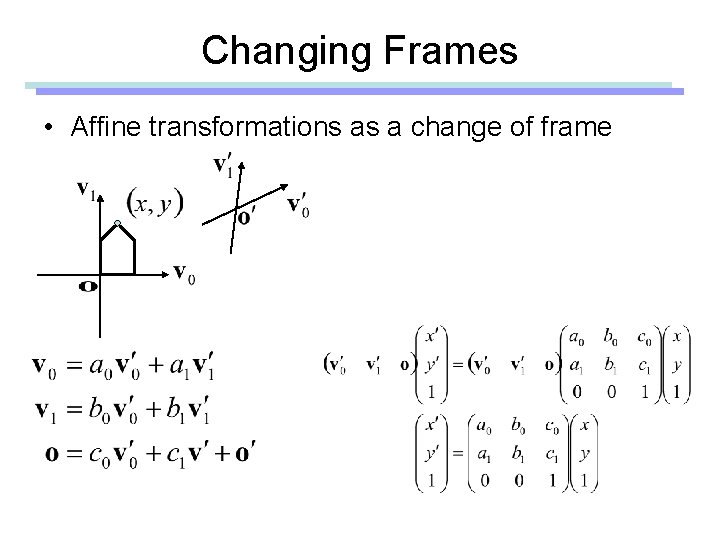
Changing Frames • Affine transformations as a change of frame
Changing Frames • Affine transformations as a change of frame
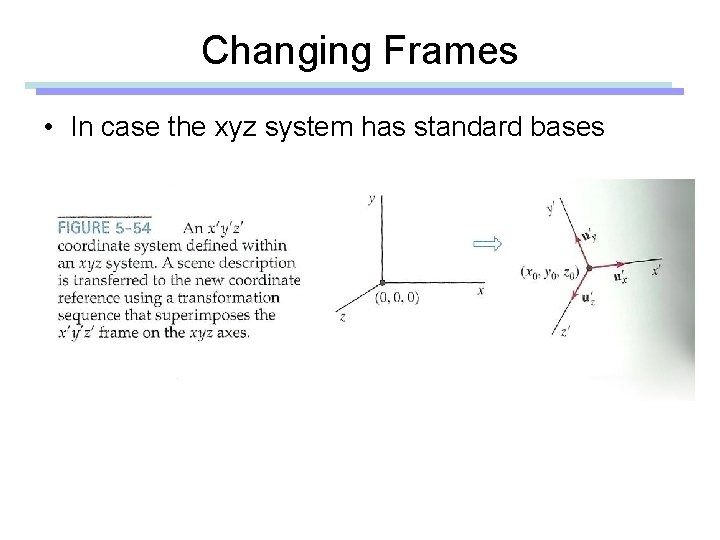
Changing Frames • In case the xyz system has standard bases
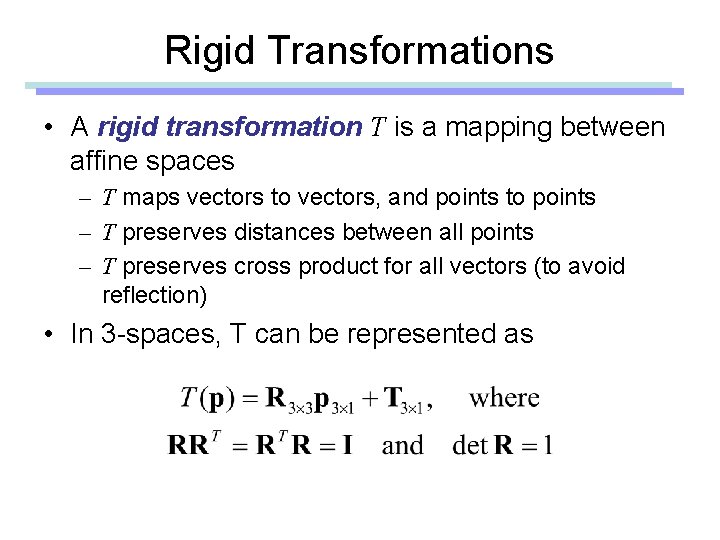
Rigid Transformations • A rigid transformation T is a mapping between affine spaces – T maps vectors to vectors, and points to points – T preserves distances between all points – T preserves cross product for all vectors (to avoid reflection) • In 3 -spaces, T can be represented as
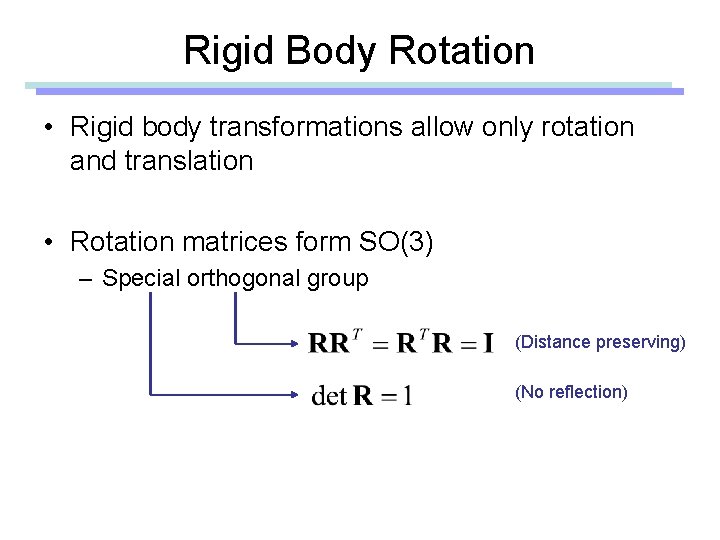
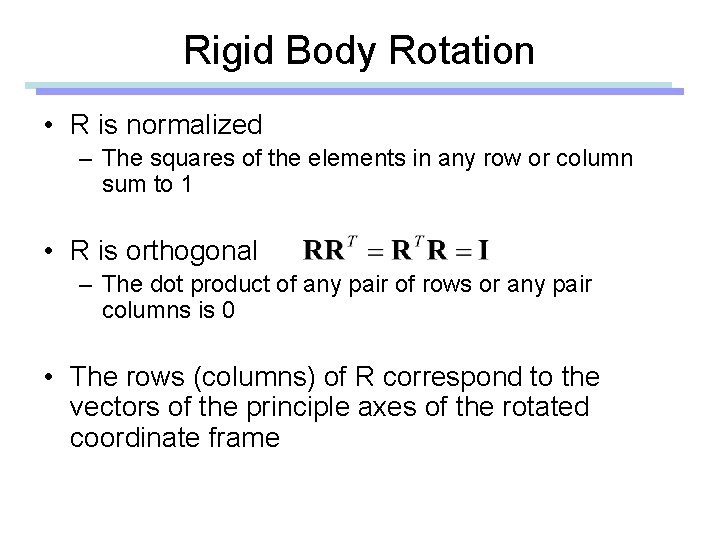
Rigid Body Rotation • Rigid body transformations allow only rotation and translation • Rotation matrices form SO(3) – Special orthogonal group (Distance preserving) (No reflection)
Rigid Body Rotation • R is normalized – The squares of the elements in any row or column sum to 1 • R is orthogonal – The dot product of any pair of rows or any pair columns is 0 • The rows (columns) of R correspond to the vectors of the principle axes of the rotated coordinate frame
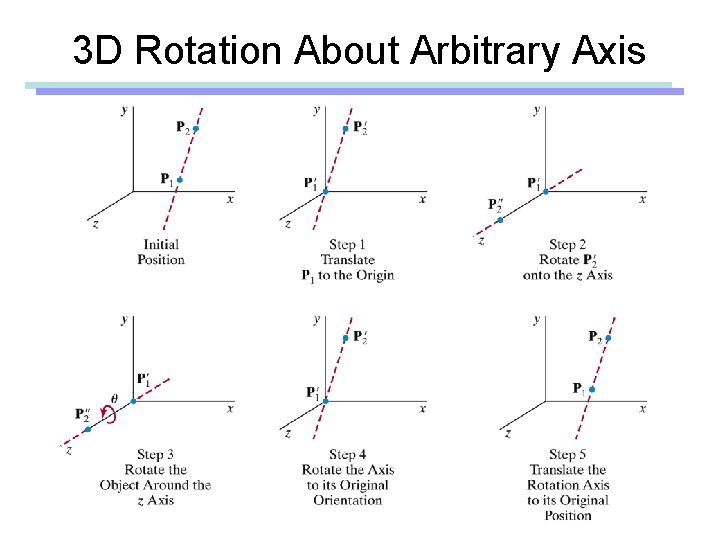
3 D Rotation About Arbitrary Axis
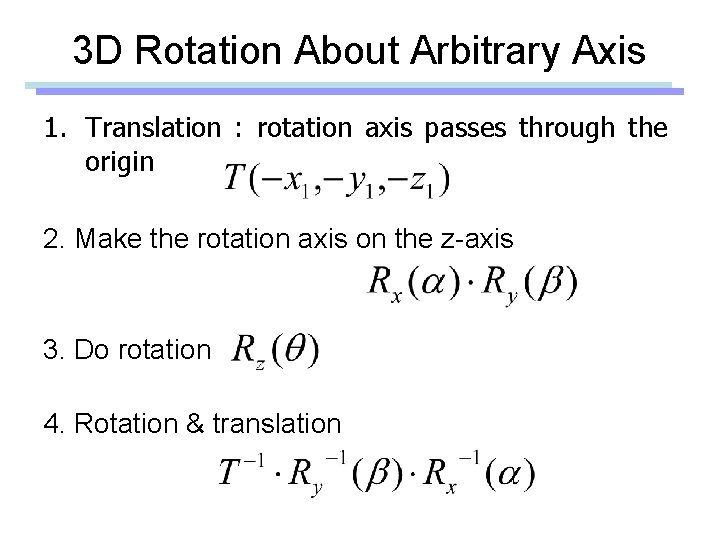
3 D Rotation About Arbitrary Axis 1. Translation : rotation axis passes through the origin 2. Make the rotation axis on the z-axis 3. Do rotation 4. Rotation & translation
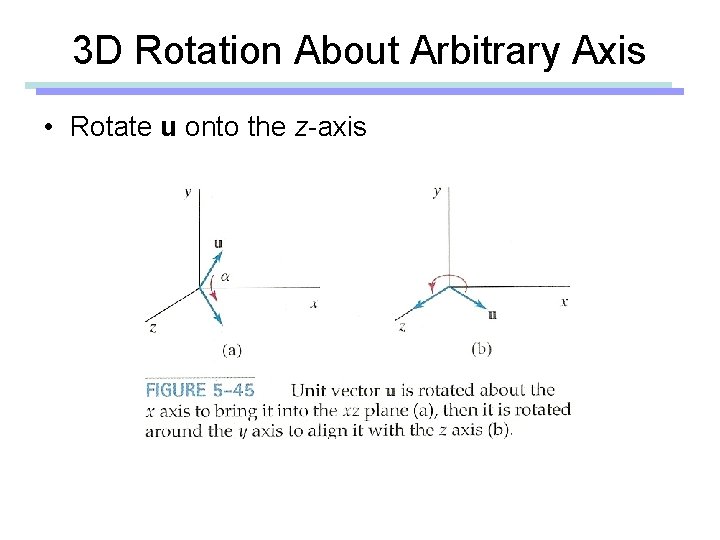
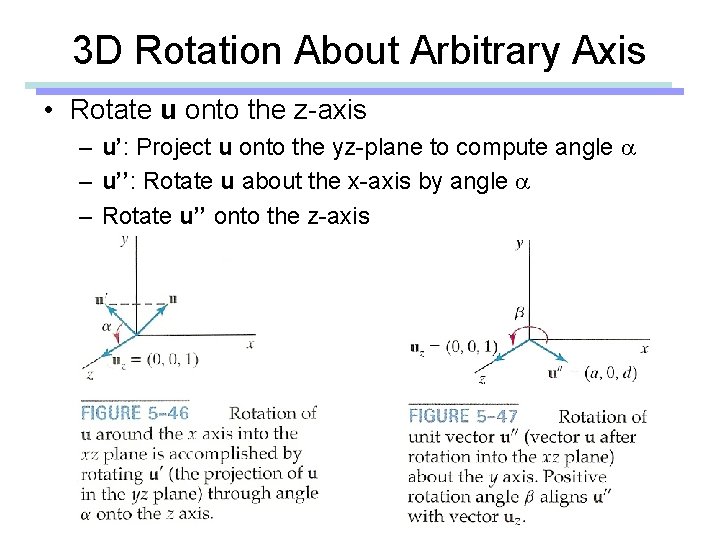
3 D Rotation About Arbitrary Axis • Rotate u onto the z-axis
3 D Rotation About Arbitrary Axis • Rotate u onto the z-axis – u’: Project u onto the yz-plane to compute angle a – u’’: Rotate u about the x-axis by angle a – Rotate u’’ onto the z-axis
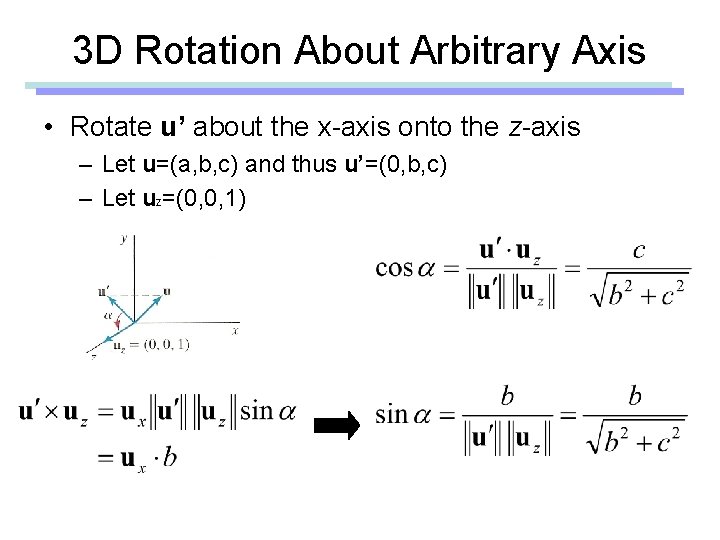
3 D Rotation About Arbitrary Axis • Rotate u’ about the x-axis onto the z-axis – Let u=(a, b, c) and thus u’=(0, b, c) – Let uz=(0, 0, 1)
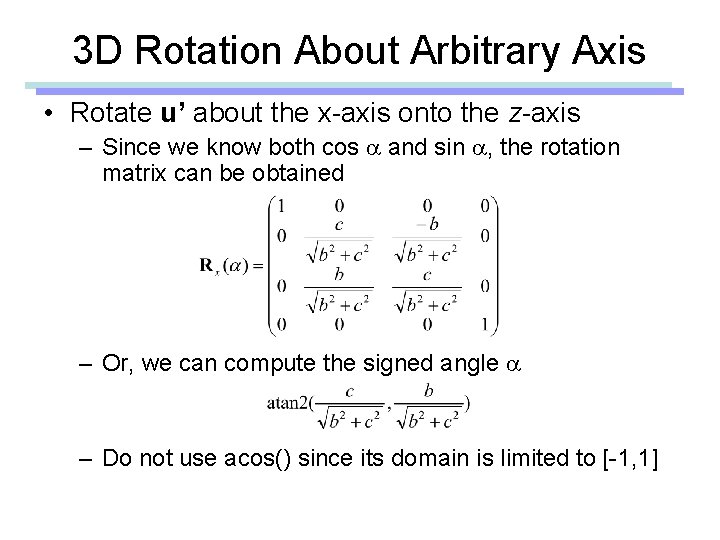
3 D Rotation About Arbitrary Axis • Rotate u’ about the x-axis onto the z-axis – Since we know both cos a and sin a, the rotation matrix can be obtained – Or, we can compute the signed angle a – Do not use acos() since its domain is limited to [-1, 1]
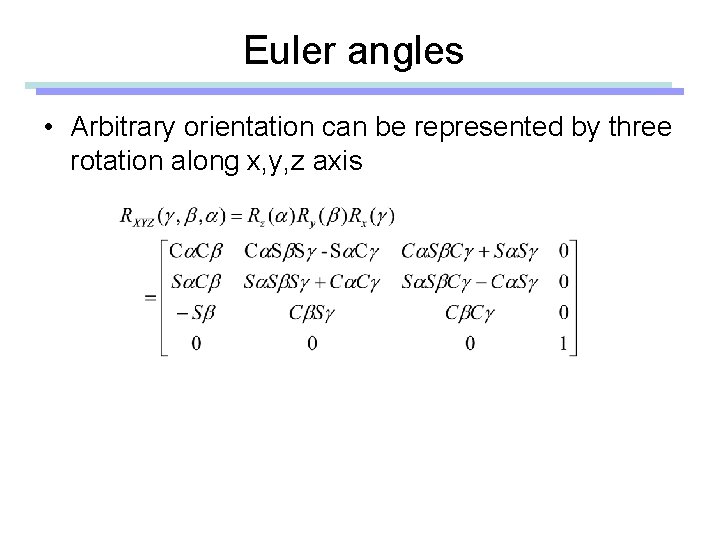
Euler angles • Arbitrary orientation can be represented by three rotation along x, y, z axis
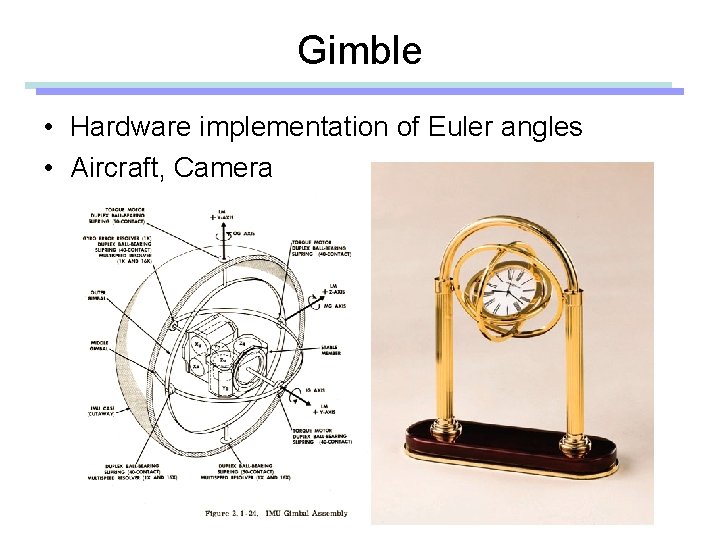
Gimble • Hardware implementation of Euler angles • Aircraft, Camera
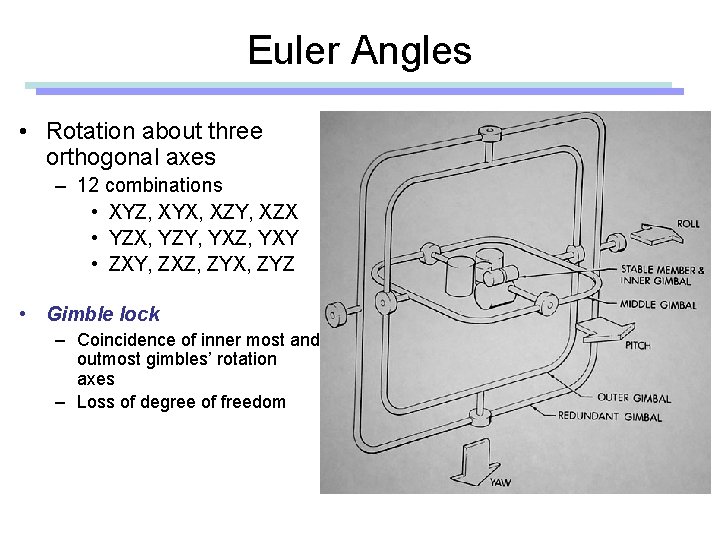
Euler Angles • Rotation about three orthogonal axes – 12 combinations • XYZ, XYX, XZY, XZX • YZX, YZY, YXZ, YXY • ZXY, ZXZ, ZYX, ZYZ • Gimble lock – Coincidence of inner most and outmost gimbles’ rotation axes – Loss of degree of freedom
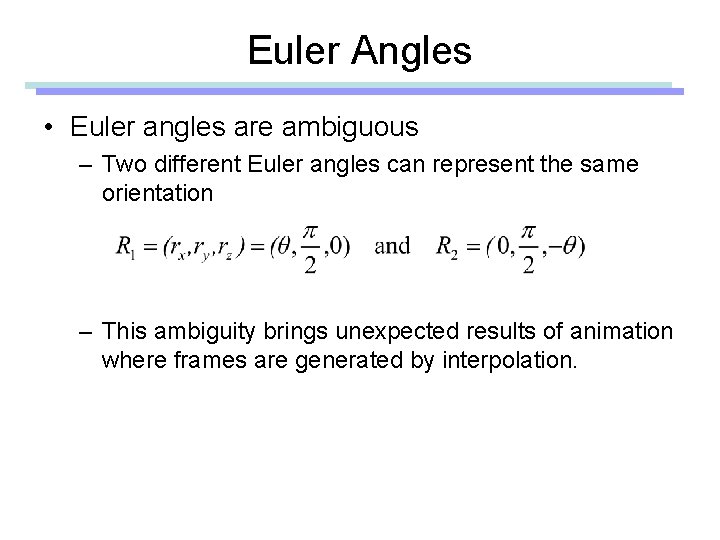
Euler Angles • Euler angles are ambiguous – Two different Euler angles can represent the same orientation – This ambiguity brings unexpected results of animation where frames are generated by interpolation.
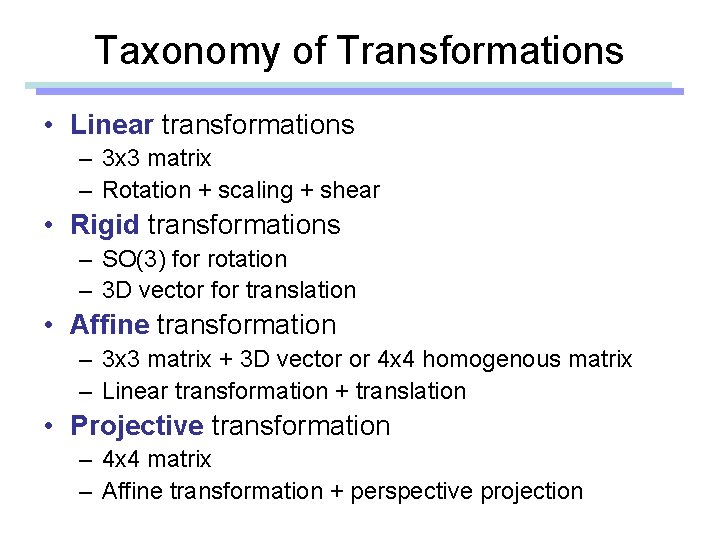
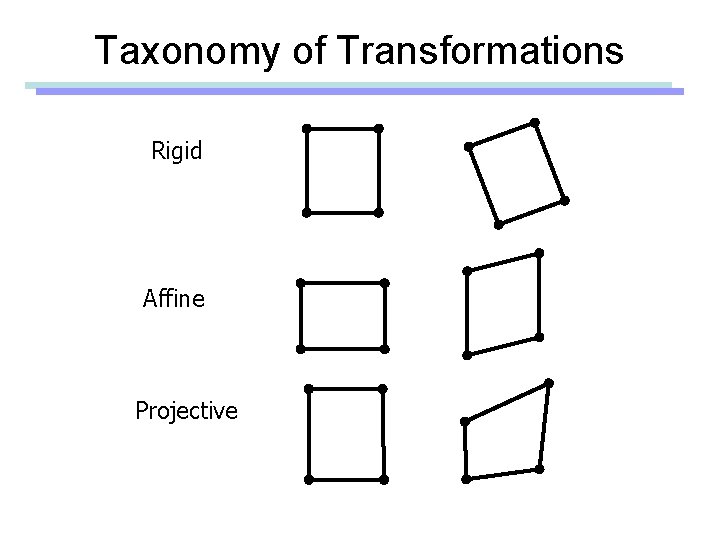
Taxonomy of Transformations • Linear transformations – 3 x 3 matrix – Rotation + scaling + shear • Rigid transformations – SO(3) for rotation – 3 D vector for translation • Affine transformation – 3 x 3 matrix + 3 D vector or 4 x 4 homogenous matrix – Linear transformation + translation • Projective transformation – 4 x 4 matrix – Affine transformation + perspective projection
Taxonomy of Transformations Rigid Affine Projective
Composition of Transforms • What is the composition of linear/affine/rigid transformations ? • What is the linear (or affine) combination of linear (or affine) transformations ? • What is the linear (or affine) combination of rigid transformations ?
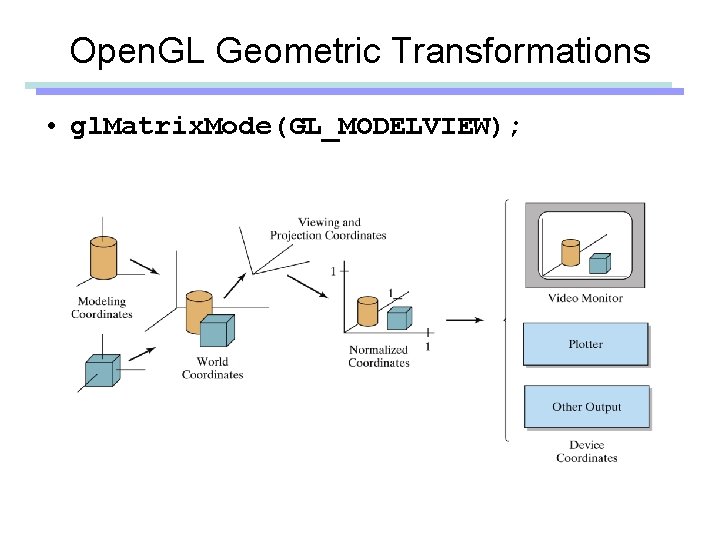
Open. GL Geometric Transformations • gl. Matrix. Mode(GL_MODELVIEW);
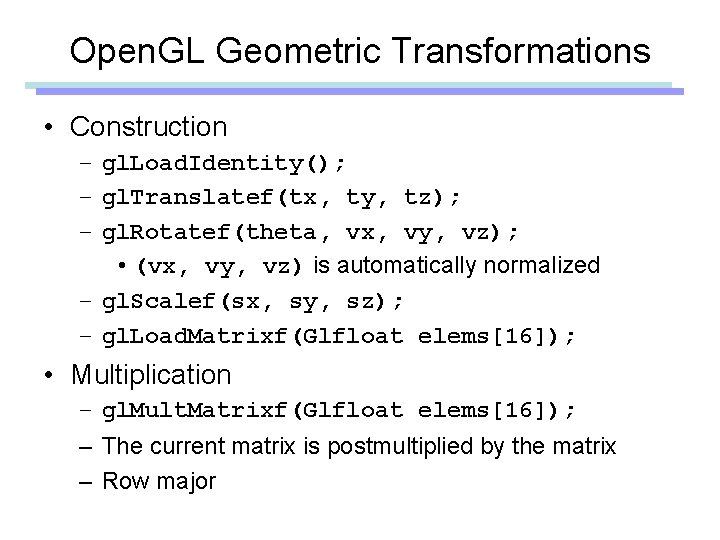
Open. GL Geometric Transformations • Construction – gl. Load. Identity(); – gl. Translatef(tx, ty, tz); – gl. Rotatef(theta, vx, vy, vz); • (vx, vy, vz) is automatically normalized – gl. Scalef(sx, sy, sz); – gl. Load. Matrixf(Glfloat elems[16]); • Multiplication – gl. Mult. Matrixf(Glfloat elems[16]); – The current matrix is postmultiplied by the matrix – Row major
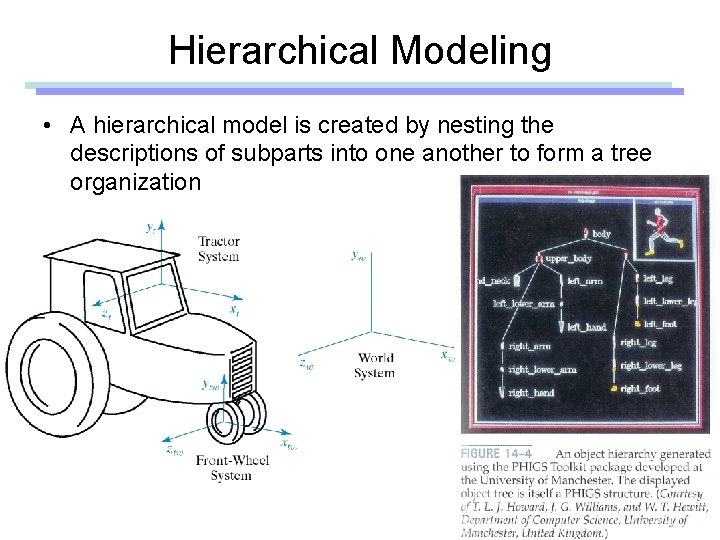
Hierarchical Modeling • A hierarchical model is created by nesting the descriptions of subparts into one another to form a tree organization
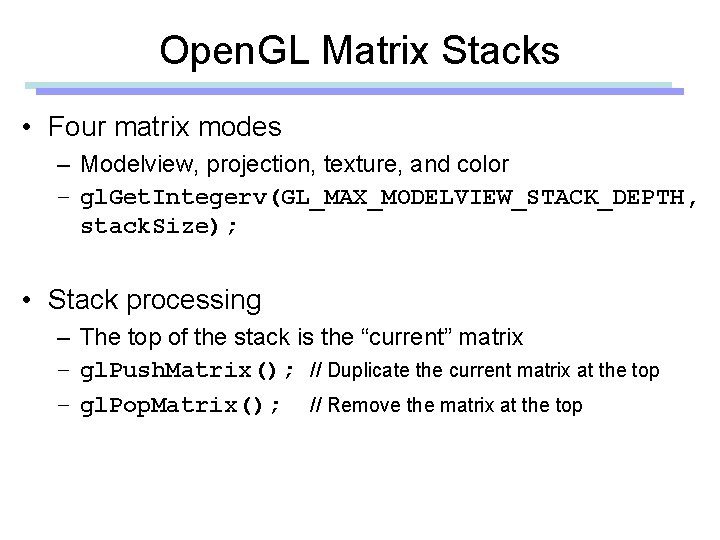
Open. GL Matrix Stacks • Four matrix modes – Modelview, projection, texture, and color – gl. Get. Integerv(GL_MAX_MODELVIEW_STACK_DEPTH, stack. Size); • Stack processing – The top of the stack is the “current” matrix – gl. Push. Matrix(); // Duplicate the current matrix at the top – gl. Pop. Matrix(); // Remove the matrix at the top
Programming Assignment #1 • Create a hierarchical model using matrix stacks • The model should consists of three-dimensional primitives such as polygons, boxes, cylinders, spheres and quadrics. • The model should have a hierarchy of at least three levels • Animate the model to show the hierarchical structure – Eg) a car driving with rotating wheels – Eg) a runner with arms and legs swing • Make it aesthetically pleasing or technically illustrative