
Geometric sequences 1 of 15 Boardworks 2012 Geometric
Geometric sequences 1 of 15 © Boardworks 2012
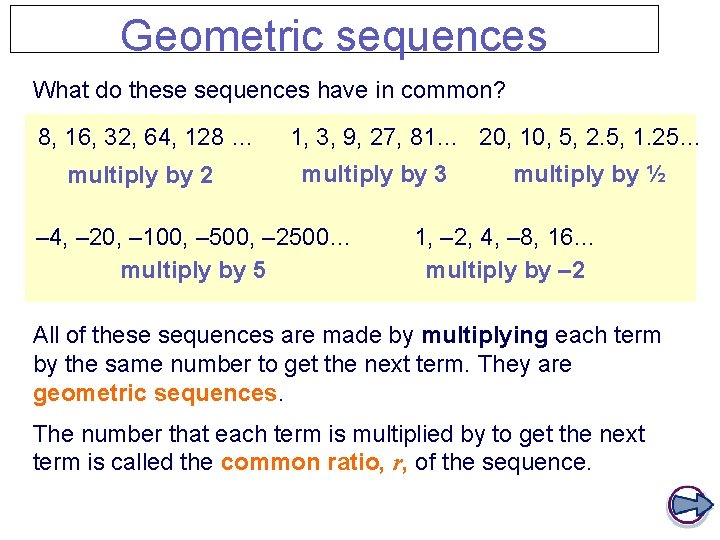
Geometric sequences What do these sequences have in common? 8, 16, 32, 64, 128 … multiply by 2 1, 3, 9, 27, 81… 20, 10, 5, 2. 5, 1. 25… multiply by 3 – 4, – 20, – 100, – 500, – 2500… multiply by 5 multiply by ½ 1, – 2, 4, – 8, 16… multiply by – 2 All of these sequences are made by multiplying each term by the same number to get the next term. They are geometric sequences. The number that each term is multiplied by to get the next term is called the common ratio, r, of the sequence.
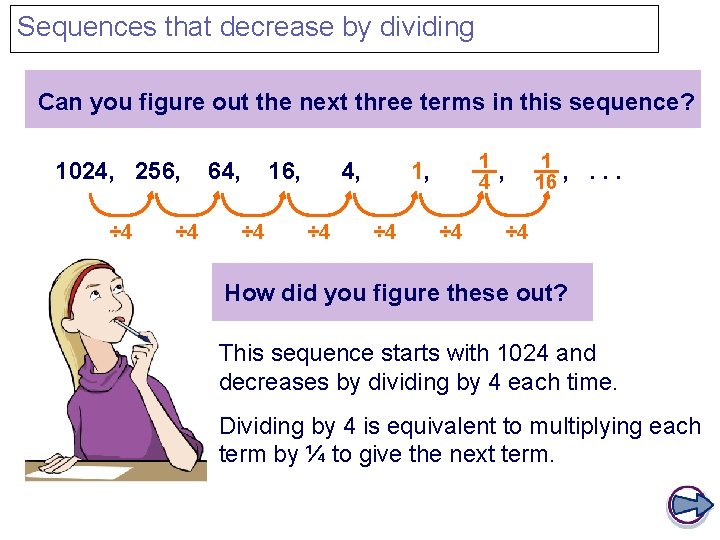
Sequences that decrease by dividing Can you figure out the next three terms in this sequence? 1024, 256, ÷ 4 64, 16, ÷ 4 4, ÷ 4 1, ÷ 4 , 1 , 16 . . . ÷ 4 How did you figure these out? This sequence starts with 1024 and decreases by dividing by 4 each time. Dividing by 4 is equivalent to multiplying each term by ¼ to give the next term.
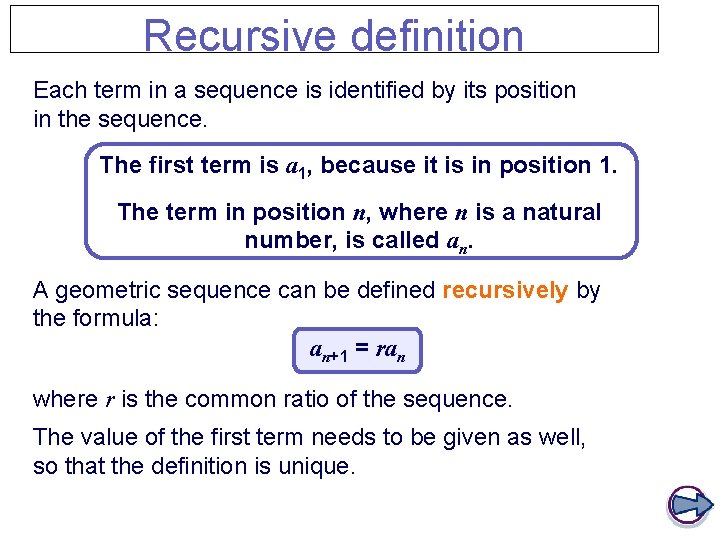
Recursive definition Each term in a sequence is identified by its position in the sequence. The first term is a 1, because it is in position 1. The term in position n, where n is a natural number, is called an. A geometric sequence can be defined recursively by the formula: an+1 = ran where r is the common ratio of the sequence. The value of the first term needs to be given as well, so that the definition is unique.
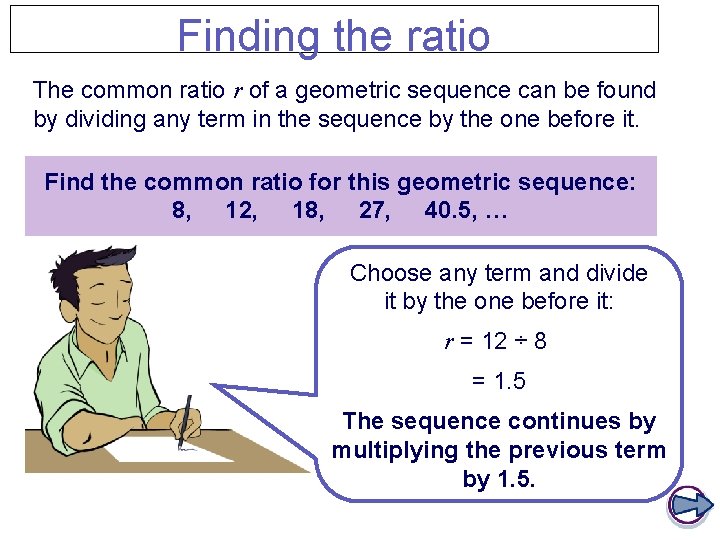
Finding the ratio The common ratio r of a geometric sequence can be found by dividing any term in the sequence by the one before it. Find the common ratio for this geometric sequence: 8, 12, 18, 27, 40. 5, … Choose any term and divide it by the one before it: r = 12 ÷ 8 = 1. 5 The sequence continues by multiplying the previous term by 1. 5.

The general term How do you find the general term of a geometric sequence? Find the nth term of the sequence, 3, 6, 12, 24, 48, … 3, 6, 12, 24, 48… × 2 × 2 This is a geometric sequence with 2 as the common ratio. We could write this sequence as: 3, 3 × 2 × 2, … 3 × 2 × … × 2 or 3, 3 × 2, 3 × 2 3, … n – 1 times 3 × 2(n– 1) The general term of this sequence is 3 × 2(n – 1).

Explicit formula If we call the first term of a geometric sequence a 1 and the common ratio r, then we can write a general geometric sequence as: 1 st 2 nd 3 rd 4 th a 1, a 1 × r 2, ×r ×r a 1 × r 3, ×r 5 th a 1 × r 4, … ×r The explicit formula for the geometric sequence with first term a 1 and common ratio r is given by an = a 1 rn – 1

Graphing a geometric sequence The population in Boomtown over 5 years is given in the table. n 1 2 3 4 5 year 2006 2007 2008 2009 2010 population 2, 000 3, 000 4, 500 6, 750 10, 125 This can be modeled by a geometric sequence with explicit formula an = 2000 × 1. 5 n– 1. We can plot the data as points on a graph with n along the x-axis and an along the y-axis. The points lie along an exponential function.
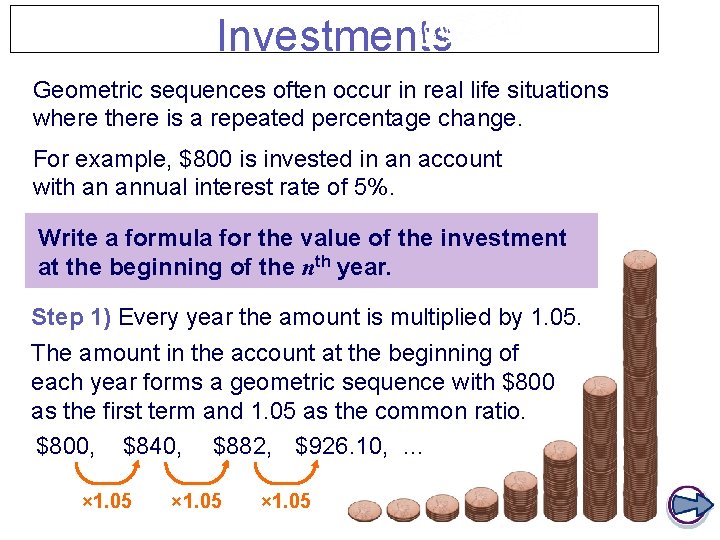
Investments Geometric sequences often occur in real life situations where there is a repeated percentage change. For example, $800 is invested in an account with an annual interest rate of 5%. Write a formula for the value of the investment at the beginning of the nth year. Step 1) Every year the amount is multiplied by 1. 05. The amount in the account at the beginning of each year forms a geometric sequence with $800 as the first term and 1. 05 as the common ratio. $800, $840, $882, $926. 10, … × 1. 05

Investments When $800 is invested in an account with an annual interest rate of 5%, the amount in the account at the beginning of each year forms a geometric sequence with $800 as the first term and 1. 05 as the common ratio. Step 2) We can write the sequence as: a 1 = $800 × 1. 050 a 2 = $800 × 1. 051 a 3 = $800 × 1. 052 a 4 = $800 × 1. 053 an = $800 × 1. 05 n– 1
- Slides: 10